
How Self-Service Solutions Improve Employee Engagement

Employee self-service (ESS) solutions have become essential for modern workforce management, with 78% of companies already implementing these systems. Organizations using ESS platforms report a 25% boost in employee engagement alongside significant reductions in HR administrative workload. This comprehensive guide explores how self-service technology transforms employee experiences through empowerment, automation, and personalized support—while delivering measurable business outcomes.
What Is Employee Self-Service (ESS)?
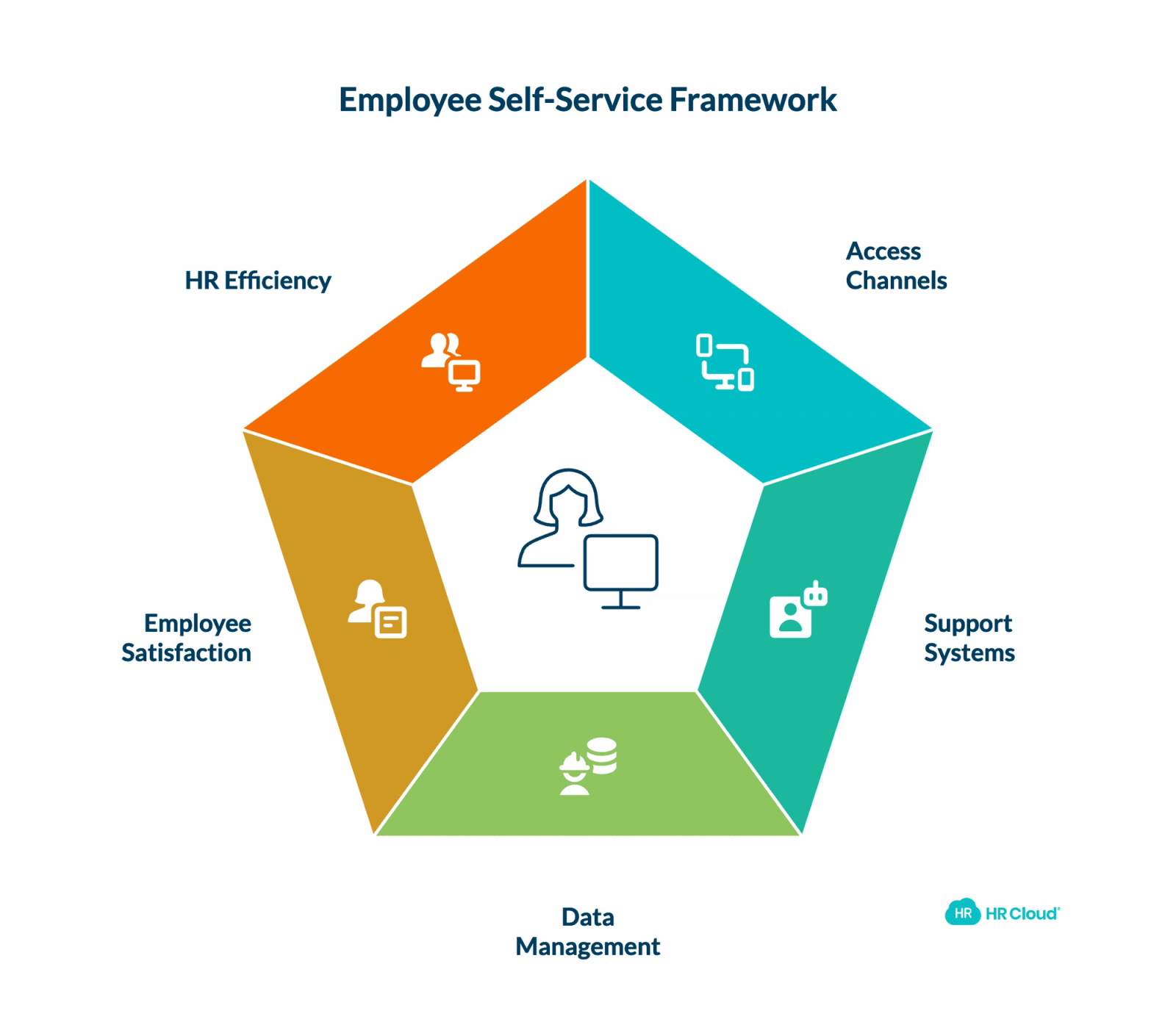
Employee self-service gives employees direct access to manage their job-related information without constantly reaching out to HR. Instead of submitting paper forms or waiting for email responses, employees can independently handle routine tasks through intuitive digital platforms.
Modern ESS solutions provide access through multiple channels:
- Corporate intranets and employee engagement platforms that centralize company information
- Knowledge bases with searchable HR policies and procedures
- Virtual help desks offering 24/7 support
- Mobile apps designed for frontline and distributed workers
- ESS portals integrated with HRIS systems for seamless data management
- AI-powered chatbots that answer common HR questions instantly
- Self-service kiosks for deskless employees
According to SHRM research, companies with robust ESS platforms reduce HR call volume by up to 75% while employees experience a 50% increase in satisfaction accessing their information independently.
HR Cloud's employee self-service solution combines these capabilities into a unified platform, enabling employees to access everything from payroll information to performance reviews in one secure location.
Top 3 Ways Employee Self-Service Impacts Workplace Engagement
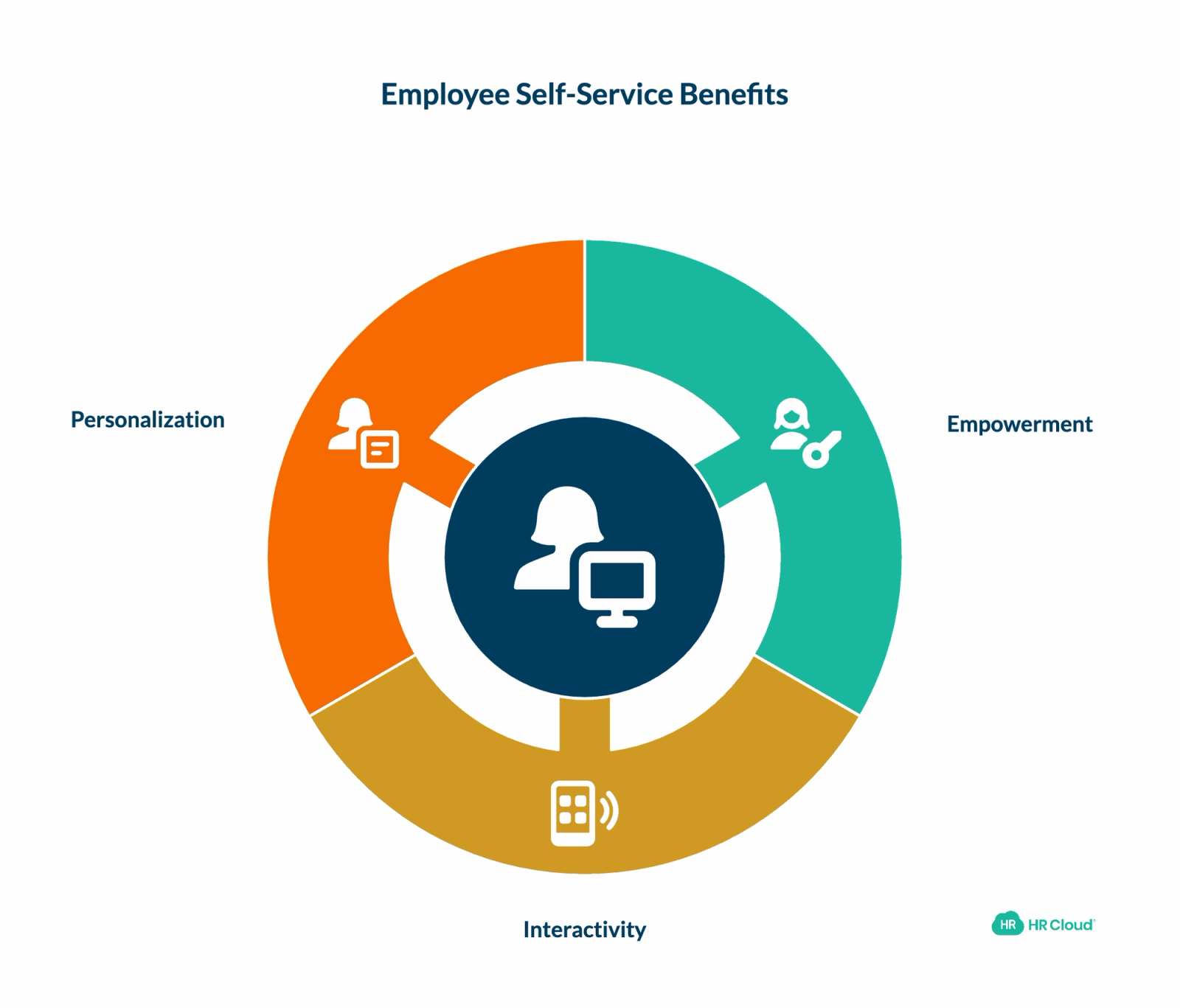
Organizations implementing ESS see dramatic improvements in employee engagement. Research from Gallup indicates that 70% of team engagement depends on enabling employees to work efficiently—and self-service technology directly addresses this need.
1. Empowerment Through Autonomy
ESS hands employees the keys to HR and IT resources that were traditionally gatekept. Rather than waiting hours or days for HR specialists to update contact information, process time-off requests, or retrieve pay stubs, employees can complete these tasks in minutes.
This autonomy creates a fundamental shift in workplace dynamics. When employees control their own information, they feel trusted and valued—two critical drivers of engagement. Forbes research shows that 89% of employees working for companies with robust self-service tools report higher job satisfaction.
HR Cloud's Onboard platform exemplifies this empowerment by enabling new hires to complete paperwork, e-signatures, and tax forms independently before their first day, reducing new hire questions by 60%.
2. Interactivity That Drives Engagement
Modern ESS platforms transform traditionally tedious HR tasks into engaging digital experiences. Employees can tap, click, or swipe through intuitive interfaces—similar to the consumer apps they use daily.
This interactivity extends beyond basic functionality. Gamification elements embedded in ESS platforms—such as achievement badges, recognition points, and progress tracking—make routine tasks more compelling. According to Zippia research, gamified activities enhance employee engagement by 48% and improve productivity in nine out of ten workers.
Workmates, HR Cloud's employee engagement platform, integrates social features like company announcements, peer recognition, and customizable channels directly into the ESS experience, creating a more connected workforce.
3. Personalization That Meets Individual Needs
Unlike one-size-fits-all HR processes, ESS platforms deliver personalized experiences tailored to each employee's role, location, and preferences. The system recognizes who you are, what you need, and presents relevant information accordingly.
For a remote sales representative, the ESS portal might prioritize expense reporting and travel approvals. For a manufacturing floor supervisor, it displays shift schedules and safety training updates. For new hires, it guides them through onboarding checklists step-by-step.
This personalization creates the experience of having a dedicated HR assistant—one that knows your specific needs and provides instant support. According to TechTarget research, ESS platforms with AI-powered personalization see 40% higher adoption rates than generic systems.
Most platforms offer customizable dashboards, multilingual support, and role-based permissions, ensuring each employee sees only what's relevant to them. HR Cloud's People HRIS enables this level of personalization while maintaining data security and compliance.
How to Drive Employee Engagement with Self-Service
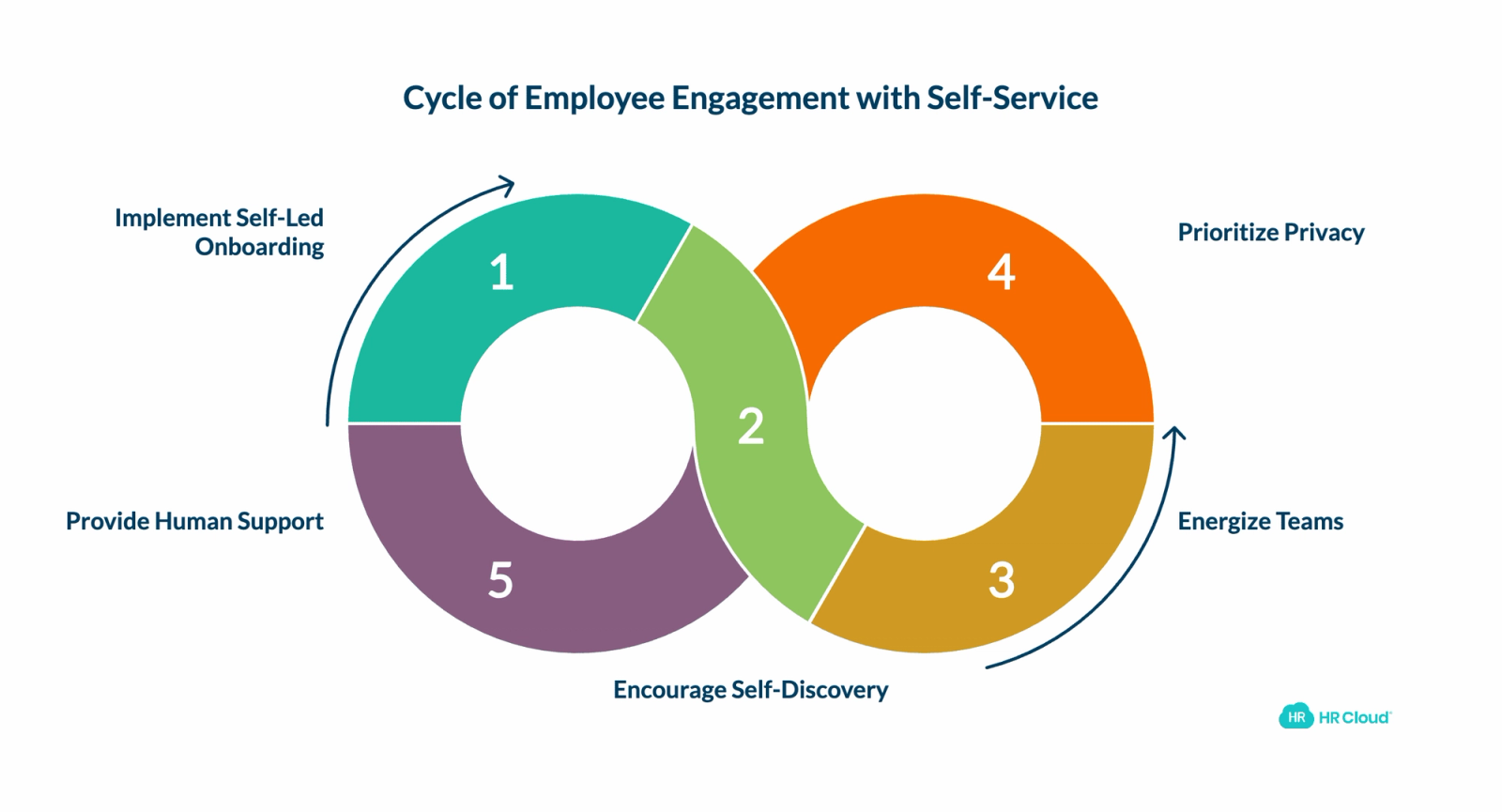
1. Implement Self-Led Onboarding
Right from the "You're hired!" moment, you can enhance employee onboarding and boost engagement through self-service solutions that give new hires control over their start.
Self-service onboarding platforms enable new employees to complete essential tasks independently: digital form completion, I-9 verification, benefits enrollment, and company policy acknowledgments—all before their first day.
Real Results: Behavioral Progression, an HR consulting firm, reduced new hire questions by 60% and increased employee engagement by 20% using HR Cloud's automated onboarding forms, tasks, and notifications.
Your digital onboarding checklist can include:
- Complete Form I-9 with E-Verify integration and automatic reminders
- E-sign documents including NDAs, employment agreements, and company policies
- Explore company culture through videos, mission statements, and values
- Virtual office tours with interactive org charts and employee directories
- Schedule introduction meetings with team members and managers
- Access training materials and role-specific resources
- Set up payroll and benefits with guided workflows
According to SHRM's 2025 State of the Workplace report, organizations with automated onboarding reduce time-to-productivity by 60% while significantly improving new hire engagement.
Browse our collection of onboarding checklists and templates to find the perfect starting point for your organization.
2. Encourage Self-Discovery for Career Development
ESS tools function as personalized career navigators, guiding employees through professional growth opportunities at their own pace. Rather than waiting for annual reviews or manager-initiated conversations, employees can proactively explore learning and development pathways that align with their goals.
Modern self-service platforms provide:
- Skill assessments that identify growth opportunities
- Training catalogs with on-demand courses and certifications
- Career pathing tools showing potential advancement routes
- Performance dashboards tracking progress toward goals
- Mentorship connection features linking employees with internal experts
Research shows that 58% of employees prefer learning at their own speed rather than mandatory scheduled sessions. ESS platforms accommodate this preference while ensuring consistency in skill development.
Consider a healthcare organization implementing a self-service learning hub. Staff members can access electronic health records training, patient care best practices, and compliance certifications 24/7. They complete modules during night shifts, between appointments, or whenever their schedule allows—dramatically improving completion rates compared to traditional classroom training.
HR Cloud's Performance Management system integrates development planning directly into the ESS experience, enabling employees to set goals, track progress, and request training without waiting for formal review cycles.
3. Energize Teams with Recognition and Rewards
Self-service platforms excel at making employee recognition immediate, meaningful, and fun. Rather than waiting for quarterly awards or annual banquets, ESS-enabled recognition happens in real-time when achievements occur.
Modern recognition features include:
- Peer-to-peer kudos sent instantly from any device
- Points-based rewards systems employees can redeem for personalized gifts
- Achievement badges for completing training, hitting milestones, or demonstrating values
- Leaderboards that showcase top contributors
- Automated celebrations for birthdays, work anniversaries, and promotions
- Social recognition feeds that amplify appreciation company-wide
Grant Aldrich, founder of Online Degree, recommends developing digital badge systems specifically for self-led learning: "Nothing's more motivational than immediate reward in employee development. Automatic badges distributed through your ESS system recognize educational achievements and transform learning into rewarding experiences."
Example in Action: Software AG employees earn virtual badges for professional development, including "IoT and Analytics Solution Professional" credentials and program completion recognition. These achievements appear in employee profiles, performance reviews, and internal directories.
However, recognition shouldn't be limited to learning achievements. HR Cloud's Workmates platform enables employees to accumulate points for various contributions—from peer assistance to innovation ideas—and redeem rewards across categories including electronics, dining experiences, travel, and charitable donations.
According to Gallup research, employees who receive regular recognition are 4.2x more likely to be engaged and productive.
4. Prioritize Privacy and Data Safety
For In-Person Teams
Physical ESS kiosks in workplaces require thoughtful placement to protect employee privacy. Without proper safeguards, these stations can become sources of embarrassment or gossip when colleagues observe sensitive transactions.
Solutions include:
- Private cubicles or booth-style areas that prevent shoulder-surfing
- Automatic screen timeouts (15-30 seconds) when inactive
- Privacy screens that limit viewing angles
- Strategic placement away from high-traffic areas
- Scheduled maintenance ensuring kiosks remain functional
For Remote and Hybrid Teams
Digital ESS platforms require robust security measures to protect sensitive employee information from cyber threats. According to SHRM's 2024 Workplace Security report, 67% of organizations experienced at least one security incident related to employee data in the past year.
Essential security requirements:
- End-to-end encryption for all data transmission and storage
- Multi-factor authentication beyond simple passwords
- Role-based access controls limiting who sees what
- Regular security audits identifying vulnerabilities
- Compliance certifications (GDPR, HIPAA, SOC 2, CCPA)
- Automatic session timeouts protecting unattended devices
- Data breach response planning with clear protocols
- Employee security training on phishing and social engineering
Example: Taco Bell's ESS system employs dedicated Security Approvers who manage access controls at organizational and departmental levels, ensuring employees access only information relevant to their roles.
HR Cloud maintains SOC 2 Type II certification and implements industry-leading security practices including penetration testing, encrypted data storage, and continuous monitoring.
5. Be Ready to Step In When Employees Need Human Support
While ESS platforms handle routine tasks brilliantly, they can't replace human judgment, empathy, and complex problem-solving. Think of ESS as a "self-driving car" for HR tasks—most of the time, it runs smoothly. But when road conditions get rough, employees need HR professionals to take the wheel.
When HR Must Intervene:
- Sensitive personal situations (medical leave, disability accommodations, family emergencies)
- Conflict resolution between employees or with managers
- Complex benefits questions beyond standard enrollment
- Performance improvement plans requiring nuanced conversations
- Workplace investigations into complaints or concerns
- Career transitions including promotions, transfers, or separations
According to SHRM's 2025 State of the Workplace report, 73% of employees value access to human HR support for sensitive issues, even when self-service options exist for routine tasks.
Relying solely on technology for all HR functions is a critical mistake. When workplace challenges arise—a personal injury requiring workers' compensation, harassment complaints needing investigation, or mental health crises demanding immediate attention—employees need empathetic human support.
The most effective approach combines ESS efficiency with strategic HR intervention. Employees handle routine transactions independently while HR professionals focus on high-value activities: talent development, organizational culture, strategic planning, and complex employee relations.
Best Practice: Design your ESS platform with clear escalation paths. Include "Contact HR" buttons prominently for issues requiring human judgment. Train your team to recognize patterns suggesting employees need more than self-service solutions.
ESS Implementation Best Practices
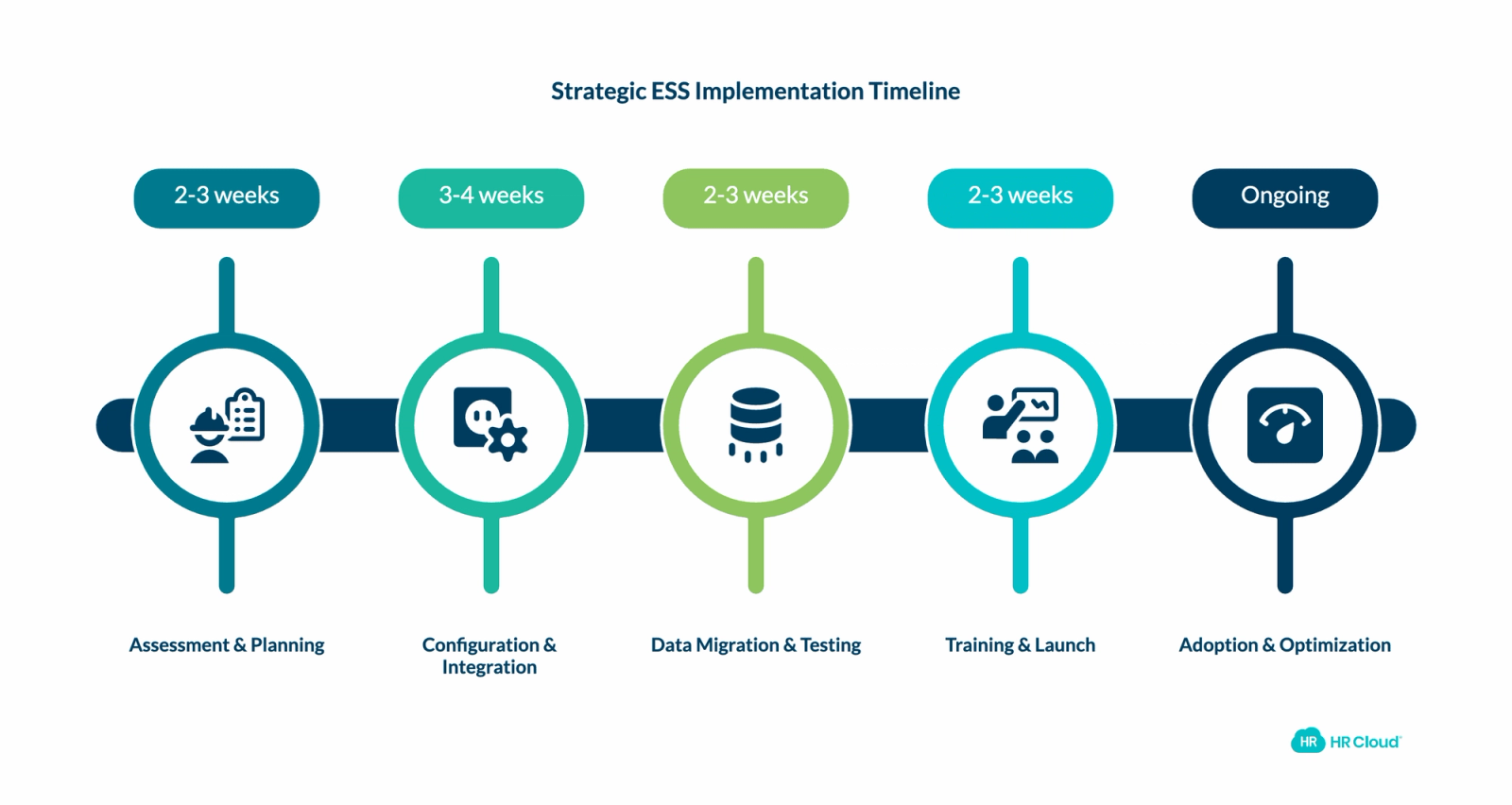
Successful employee self-service implementation requires strategic planning and change management. Organizations that follow structured deployment frameworks achieve 90%+ adoption rates within 90 days, compared to 50-60% for ad-hoc implementations.
Phase 1: Assessment & Planning (2-3 weeks)
- Audit current HR processes to identify automation opportunities
- Survey employees to understand pain points and preferences
- Define success metrics and ROI targets
- Select stakeholders for implementation team
- Review integration requirements with existing systems
Phase 2: Configuration & Integration (3-4 weeks)
- Configure platform settings aligned to company policies
- Set up integrations with payroll systems (ADP, Workday, UKG)
- Establish security protocols and access controls
- Customize workflows for different employee groups
- Create knowledge base content and help documentation
Phase 3: Data Migration & Testing (2-3 weeks)
- Migrate employee data with validation checkpoints
- Test integrations thoroughly across all modules
- Conduct user acceptance testing with pilot group
- Refine based on feedback from early adopters
- Ensure mobile functionality across devices
Phase 4: Training & Launch (2-3 weeks)
- Develop role-specific training materials
- Conduct manager training sessions first
- Launch employee training via multiple channels
- Provide hands-on support during first week
- Create quick-reference guides and video tutorials
Phase 5: Adoption & Optimization (Ongoing)
- Monitor usage analytics daily during first month
- Gather employee feedback through surveys
- Address technical issues within 24 hours
- Celebrate early wins and user success stories
- Iterate features based on user behavior data
According to SHRM research, organizations investing adequate time in planning and training phases see 3x higher long-term adoption compared to rushed implementations.
Measuring ESS Impact on Employee Engagement
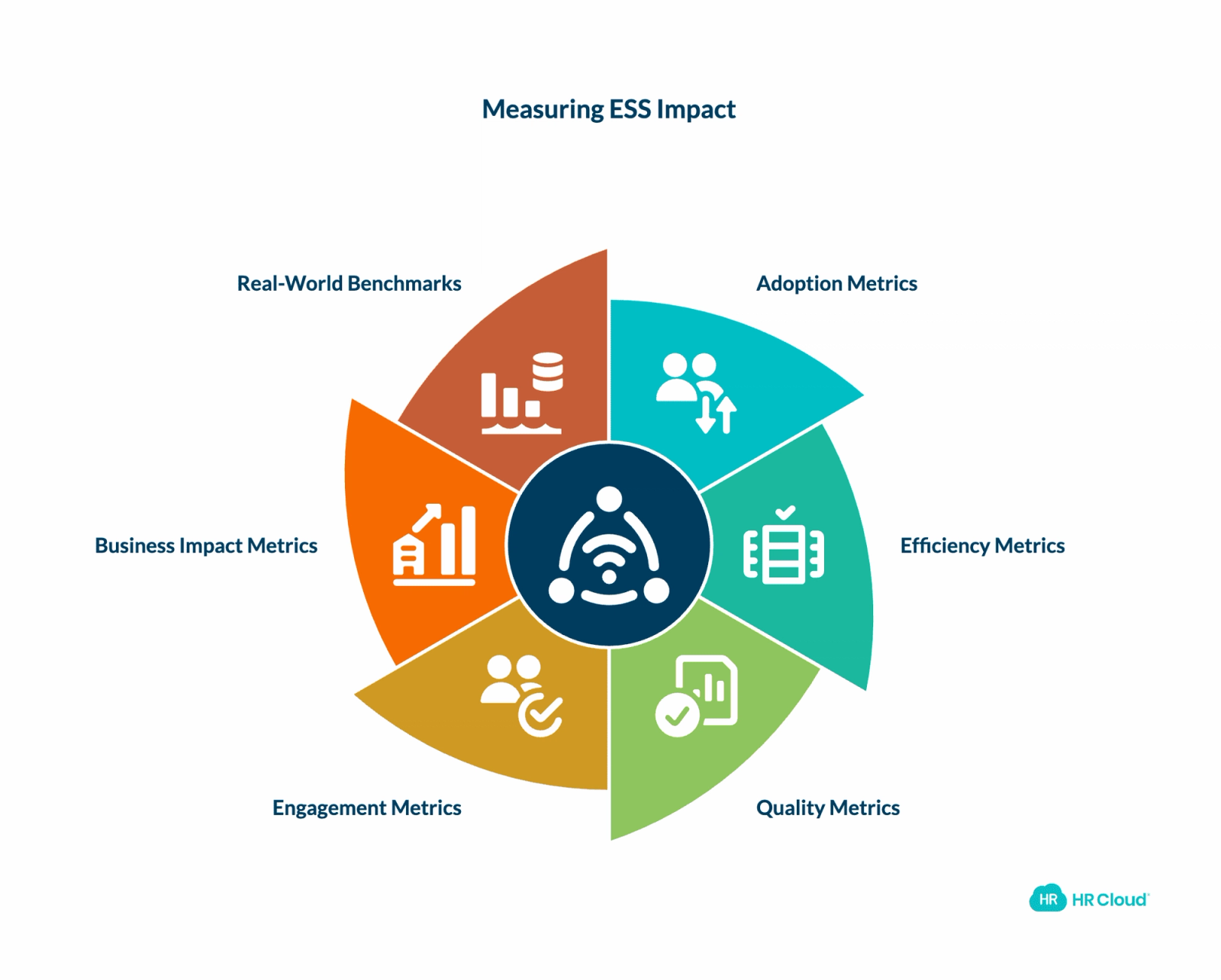
Quantifying ESS effectiveness requires tracking both leading and lagging indicators across multiple dimensions. Here are the essential metrics every organization should monitor:
Adoption Metrics:
- Platform login frequency: Target 3+ logins per employee weekly
- Feature utilization rates: Target 75%+ of employees using core features monthly
- Mobile vs desktop usage: Track device preferences (frontline workers: 80%+ mobile)
- Self-service transaction volume: Measure increase in employee-initiated actions
Efficiency Metrics:
- HR ticket reduction: Target 60-75% decrease in routine inquiries
- Time-to-complete tasks: Compare pre/post ESS implementation
- Manual processing hours saved: Calculate HR team capacity freed
- Cost per transaction: Target reduction from $25-40 to $5 or less
Quality Metrics:
- Data accuracy improvements: Target 95%+ accuracy in employee records
- First-contact resolution rate: Target 70%+ for ESS-handled requests
- Error rate reduction: Track payroll and benefits enrollment errors
Engagement Metrics:
- Employee engagement scores: Target 15-25% improvement via surveys
- ESS satisfaction ratings: Conduct quarterly user satisfaction surveys
- Manager satisfaction: Survey leaders on time savings and team productivity
- Voluntary turnover: Monitor correlation with ESS implementation
Business Impact Metrics:
- Onboarding time reduction: Target 50-60% faster time-to-productivity
- Benefits enrollment accuracy: Reduce enrollment errors by 80%+
- Compliance adherence: Track I-9, training, certification completion rates
- Employee recognition frequency: Measure peer-to-peer appreciation volume
Real-World Benchmarks: According to aggregated industry data:
- Small businesses (10-100 employees): Average 15% engagement improvement, 50% HR time savings
- Mid-market (100-1,000 employees): Average 25% engagement improvement, 60% HR time savings
- Enterprise (1,000+ employees): Average 20% engagement improvement, 70% HR time savings
Leading organizations establish baseline metrics before implementation, then measure monthly during the first quarter and quarterly thereafter. This data-driven approach enables continuous optimization and demonstrates clear ROI to leadership.
Bring ESS to Your Workplace with HR Cloud
It's time to maximize employee self-service benefits with HR Cloud's comprehensive platform. Our solution delivers seamless integration across all HR functions—from documentation and onboarding to engagement and performance management.
What HR Cloud Provides:
- Workmates: Employee engagement platform with social features, recognition, and communication tools
- Onboard: Automated new hire processes reducing admin time by 60%
- People HRIS: Centralized employee data with self-service access
- Time Off: Streamlined PTO requests and approvals
- Performance: Goal tracking and review management
- Mobile App: Full functionality for frontline workers
Deep Integrations: HR Cloud connects seamlessly with your existing systems, including ADP, Workday, UKG, Slack, and Microsoft Teams, creating a unified employee experience.
Try Workmates and transform how your team stays engaged. No more answering "How many vacation days do I have?" for the hundredth time!
Ready to empower your workforce? Book your free demo and discover how HR Cloud's self-service solutions drive engagement, reduce administrative burden, and create exceptional employee experiences.
Frequently Asked Questions About Employee Self-Service
What is employee self-service in HR?
Employee self-service (ESS) in HR refers to digital platforms that enable employees to independently manage their employment information and complete HR-related tasks without direct assistance from HR staff. ESS systems provide secure portals—accessible via web browsers or mobile apps—where employees can update personal details, request time off, access pay stubs, enroll in benefits, complete training, and view company policies 24/7.
Modern ESS solutions integrate with HRIS platforms like HR Cloud's People HRIS, creating a single source of truth for employee data. This integration ensures accuracy and eliminates the redundant data entry that plagues traditional HR processes.
How does ESS improve employee engagement?
ESS improves employee engagement through three core mechanisms:
1. Empowerment: Giving employees control over their information creates feelings of trust and autonomy—key drivers of engagement. When workers can access payroll information at 2 AM or submit PTO requests from their phones, they feel respected and valued.
2. Interactivity: Gamified elements, intuitive interfaces, and social features transform tedious HR tasks into engaging digital experiences. Platforms like Workmates incorporate recognition feeds, achievement badges, and peer-to-peer kudos that make participation enjoyable.
3. Personalization: AI-powered ESS platforms deliver tailored experiences based on role, location, and preferences. A manufacturing supervisor sees shift schedules and safety training, while a remote sales rep prioritizes expense reporting and commission statements.
Organizations implementing comprehensive ESS solutions report 25% average improvements in employee engagement scores within six months.
What features should an ESS platform include?
Essential ESS platform features include:
Core Functionality:
- Payroll access (pay stubs, W-2s, tax information, direct deposit updates)
- Time and attendance (clock in/out, timesheet review, schedule viewing)
- PTO management (request submissions, balance checking, approval workflows)
- Benefits enrollment and management (plan selection, life event changes)
- Personal information updates (contact details, emergency contacts, banking info)
Advanced Capabilities:
- Performance management (goal setting, review access, feedback submission)
- Learning and development (course catalogs, certifications, skill assessments)
- Recognition and rewards (peer-to-peer kudos, redemption portals)
- Internal communications (company announcements, team channels)
- Document management (policy access, form downloads, e-signatures)
Technical Requirements:
- Mobile optimization with native apps
- Integration with existing HR systems
- Multi-factor authentication and encryption
- Customizable workflows and approval chains
- Analytics dashboards and reporting tools
- AI-powered chatbot support
How long does ESS implementation take?
ESS implementation timelines vary based on organization size, complexity, and existing systems:
Small Businesses (10-100 employees):
- 4-6 weeks for basic deployment
- Minimal integrations, straightforward configurations
- Quick data migration, streamlined training
Mid-Market (100-1,000 employees):
- 8-12 weeks for full implementation
- Multiple integrations with payroll, benefits providers
- More complex workflows and approval hierarchies
- Phased rollout across departments or locations
Enterprise (1,000+ employees):
- 12-20 weeks for comprehensive deployment
- Complex integrations with multiple legacy systems
- Extensive customization and compliance requirements
- Multi-phase rollout with pilot groups
Implementation Phases:
1. Planning: 1-2 weeks (requirements gathering, stakeholder alignment)
2. Configuration: 2-4 weeks (system setup, workflow design, branding)
3. Integration: 2-6 weeks (connect payroll, benefits, HRIS systems)
4. Data Migration: 1-3 weeks (transfer employee records, validation)
5. Testing: 1-2 weeks (UAT, pilot group feedback)
6. Training: 1-2 weeks (manager prep, employee onboarding)
7. Launch: 1 week (go-live support, troubleshooting)
HR Cloud's implementation team provides dedicated support throughout each phase, with most clients achieving full adoption within 90 days.
Is employee self-service secure?
Yes—modern ESS platforms implement robust security measures exceeding those of traditional paper-based or email HR processes. Leading ESS providers like HR Cloud maintain SOC 2 Type II certification, demonstrating compliance with rigorous security standards.
Essential Security Features:
- End-to-end encryption: All data encrypted in transit (TLS 1.3) and at rest (AES-256)
- Multi-factor authentication: Password plus secondary verification (SMS, authenticator app, biometric)
- Role-based access controls: Employees see only information relevant to their role
- Audit logging: Complete activity tracking for compliance and investigation
- Automatic session timeouts: Inactive sessions terminate after 15-30 minutes
- Regular security testing: Penetration testing, vulnerability scanning, code reviews
Compliance Certifications: Reputable ESS platforms maintain compliance with:
- GDPR: European data protection regulations
- HIPAA: Healthcare information privacy (when applicable)
- SOC 2 Type II: Security, availability, confidentiality controls
- CCPA: California consumer privacy protections
- ISO 27001: Information security management standards
Privacy Protections:
- Data minimization: Collect only necessary information
- Purpose limitation: Use data only for stated purposes
- Consent management: Clear opt-in/opt-out mechanisms
- Right to deletion: Process removal requests within 30 days
- Breach notification: Immediate alerts if unauthorized access occurs
Employee data in modern ESS platforms is significantly more secure than traditional methods involving paper forms, email attachments, or spreadsheets stored on shared drives.
What is the ROI of employee self-service?
Organizations implementing ESS typically see positive ROI within 6-12 months through multiple value streams:
Direct Cost Savings:
- HR administrative time: 60-75% reduction in routine transaction processing
- Paper and printing costs: Elimination of physical forms, manuals, pay stubs
- Postage and mailing: Digital delivery of tax documents, benefits materials
- Storage costs: Reduced need for physical file cabinets and off-site storage
- HR support staffing: Reallocation of FTE hours to strategic work vs. answering routine questions
Efficiency Gains:
- Transaction processing time: Reduced from hours/days to minutes
- Data accuracy: 40-60% reduction in payroll and benefits errors
- Onboarding speed: 3x faster time-to-productivity for new hires
- Manager productivity: 15-20% time savings on team administration
- Compliance adherence: Automated tracking reduces audit findings
Revenue Impact:
- Employee productivity: Reduced time spent on HR tasks translates to more billable/productive hours
- Turnover reduction: Improved engagement decreases voluntary turnover by 15-25%
- Recruitment efficiency: Better candidate experience during onboarding
- Customer satisfaction: Engaged employees deliver better service
Quantified Example (100-employee company):
- HR time savings: 20 hours/week × $35/hour × 52 weeks = $36,400 annually
- Reduced turnover: 5 fewer turnovers × $15,000 replacement cost = $75,000 annually
- Eliminated paper/postage: $8,000 annually
- Improved productivity: 100 employees × 2 hours/month × $25/hour × 12 = $60,000 annually
- Total Annual Value: $179,400
- ESS Platform Cost: $15/employee/month × 100 × 12 = $18,000 annually
- Net ROI: $161,400 (897% return on investment)
SHRM research indicates companies save an average of $4,700 per employee annually through ESS automation, with larger organizations seeing even greater economies of scale.
Author:
This article is written by Ryan Walton. He is an entrepreneur with over 20 years of experience. He specializes in scaling online businesses, optimizing customer experiences, and driving growth through innovative strategies.
Keep Reading


Like What You Hear?
We’d love to chat with you more about how HR Cloud®can support your business’s HR needs.
Book Your Free Demo