Employee Onboarding Activities That Improve Engagement

For new employees, joining a new company is like visiting a different country for the first time. It's a different culture, different mindset, and even a different language sometimes!
It can be overwhelming if they don't have a welcome process, a guide, or a roadmap to their destination. The employee experience during those first days can significantly impact employee retention and reduce employee turnover.
Setting up a seamless onboarding process can make the difference between retaining top talent and scrambling to fill the gap they leave behind.
By including onboarding activities in this post,you’ll kickstart productivity from the get-go, improve employee engagement easily, and retain great hires.
Let's dive in and look at onboarding activities to set the foundation for your new employees' future success and boost employee engagement within your organization.
Key Takeaways
- Employees who go through a structured onboarding program are 58% more likely to still be with the company after three years — the first few days set the tone for everything that follows.
- A buddy program, welcome kit, and clear role-to-business connection aren't perks — they are proven drivers of faster productivity and stronger long-term retention.
- Automation removes the friction from onboarding so HR teams can focus on the human side of the process. See how HR Cloud Onboard makes this seamless.
1. Build a Welcome Process
The first few days in a new job are always daunting. By designing a welcome process – from the moment they're confirmed as hired, you can make your new employees feel excited and enthusiastic instead of intimidated, which is crucial for employee engagement.
Start by creating an onboarding checklist that outlines essential tasks, such as setting up equipment, completing paperwork, and attending orientation sessions. Also, add personal activities such as a welcome lunch with the team, a tour of the office or company facilities, and an introduction to key stakeholders to enhance the employee experience.
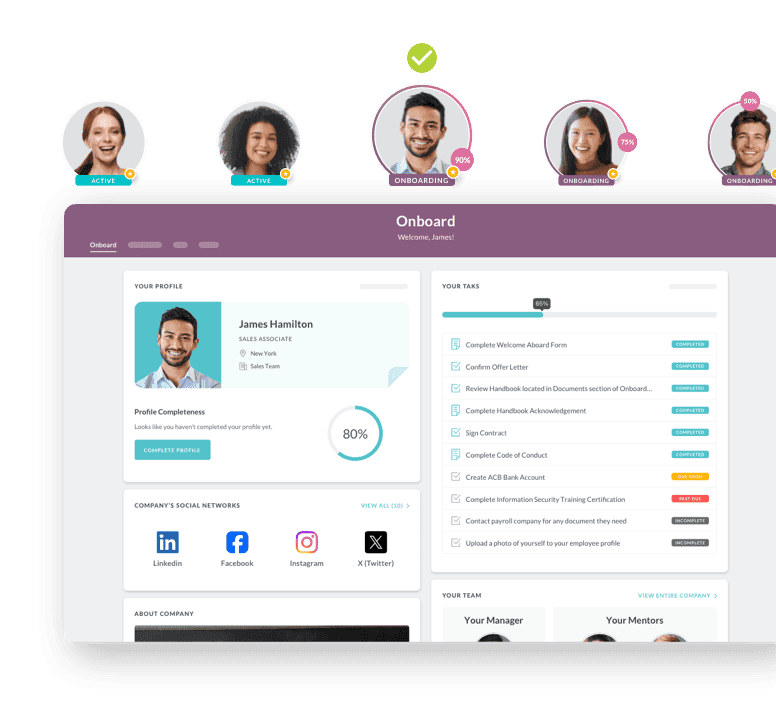
You can create an online onboarding portal where new hires can access all necessary information in one central location. This not only helps streamline the onboarding process but also ensures consistent and accurate information for everyone, supporting better employee engagement levels.
Consider adding a welcome video from the CEO or other leaders, showcasing the organizational culture and highlighting its mission and goals. This helps new hires understand the workplace culture from day one. And don't forget to update your About page or Meet the Team page to include your new hire.
By proactively welcoming new hires with these steps, you set the tone for their entire journey with your organization and establish strong employee engagement from the start.
2. Create a Network for New Employees (Buddy Program)
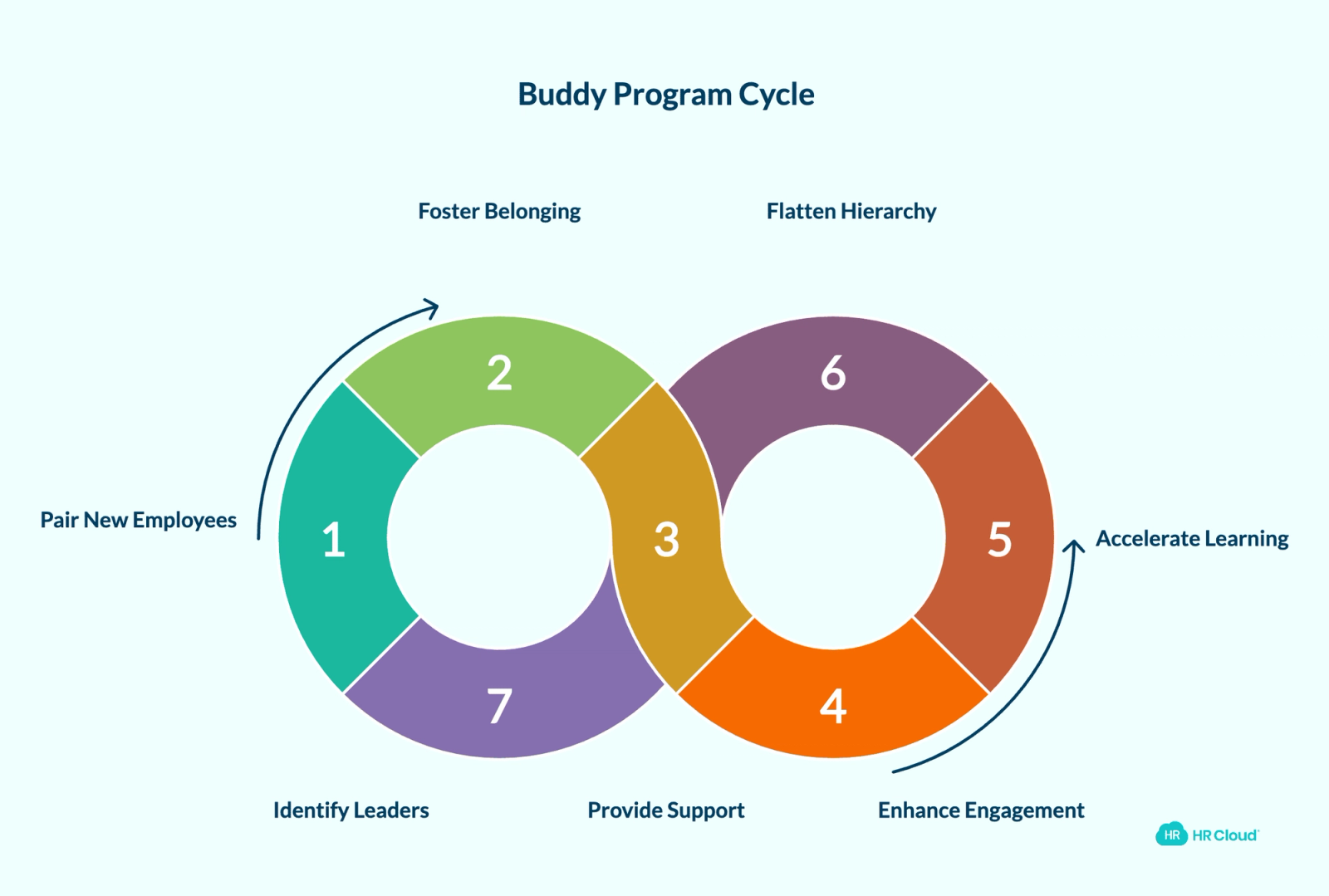
One way to get new employees feeling anchored and part of your organization is to create a buddy program for them.
This onboarding activity pairs new employees with experienced ones, creating a personal, informal network that fosters a sense of belonging and drives employee engagement.
Buddies serve as mentors, offer insider tips, and guide the new hire about their job while providing answers to questions that new hires may hesitate to ask. This approach supports both retention and engagement while facilitating professional development.
This strategy not only promotes relationship-building and collaboration but also speeds up the learning process and enhances employee involvement.
A new hire will quickly grasp company values, norms, and practices through first-hand interactions with their buddies, reducing their time to full productivity and improving job satisfaction.
Also, this system helps flatten the organization's hierarchy, and new employees will feel free to express their thoughts and ideas, which increases employee participation and employee engagement.
This networking/buddy system works if you select reliable 'buddies'. These are team members who exemplify your company culture, listen actively, and are good at what they do. They should also be from the same team or at least know about the employee's work to help them effectively.
This process is also a great time to identify people with leadership qualities whom you can advance to leadership roles.
3. Create an Onboarding Kit
Make new employees feel like part of the team immediately by providing them with an onboarding kit that strengthens employee engagement and organizational commitment.
This can include items such as company swag, office supplies, and a personalized welcome letter. You can also include important documents and resources to help new hires get acquainted with their role and the organization, improving employee satisfaction from day one.
Another idea is to create a 'survival guide' that includes tips and tricks or to-do lists for navigating the company's culture and work environment. This can include things like a list of common acronyms used in the organization, instructions on how to use various software or tools, and a breakdown of team workflows that support job autonomy.
Make a combination of digital and physical items for convenience and tactile experiences. And make the onboarding kit more than formal instructions. It's a chance to let your employees get a feel for your company culture and be a part of your organization instantly, fostering employee engagement and employee commitment.
4. Add Video and Training Courses
Incorporating multimedia into your onboarding process can make it more engaging and interactive, directly impacting employee engagement and employee development.
Consider creating short welcome videos from different team members, introducing themselves and their role in the company. These videos can provide new hires with a better understanding of the organization's structure and culture while also putting faces to names.
You can have a central hub, and video hosting platform, where you upload videos on our marketing strategies, updates, and other core news. This is a great place for new hires to explore the company without reading extensive text, enhancing their employee experience.
Also, include training courses in the onboarding content that support performance management and improve job performance. By providing new hires with these resources to do their job, you're setting them up for success early on and boosting employee engagement. Producing that onboarding video content doesn't always require a full production team, either. An AI Video Generator, housed conveniently within Higgsfield's AI creative suite, can turn a script or reference photo into a polished onboarding clip for the video hub.
Additionally, integrating an AI voice generator for narration in your videos can enhance the overall learning experience, making the onboarding process not only informative but also engaging for new hires, contributing to better engagement and performance.
5. Use Automation
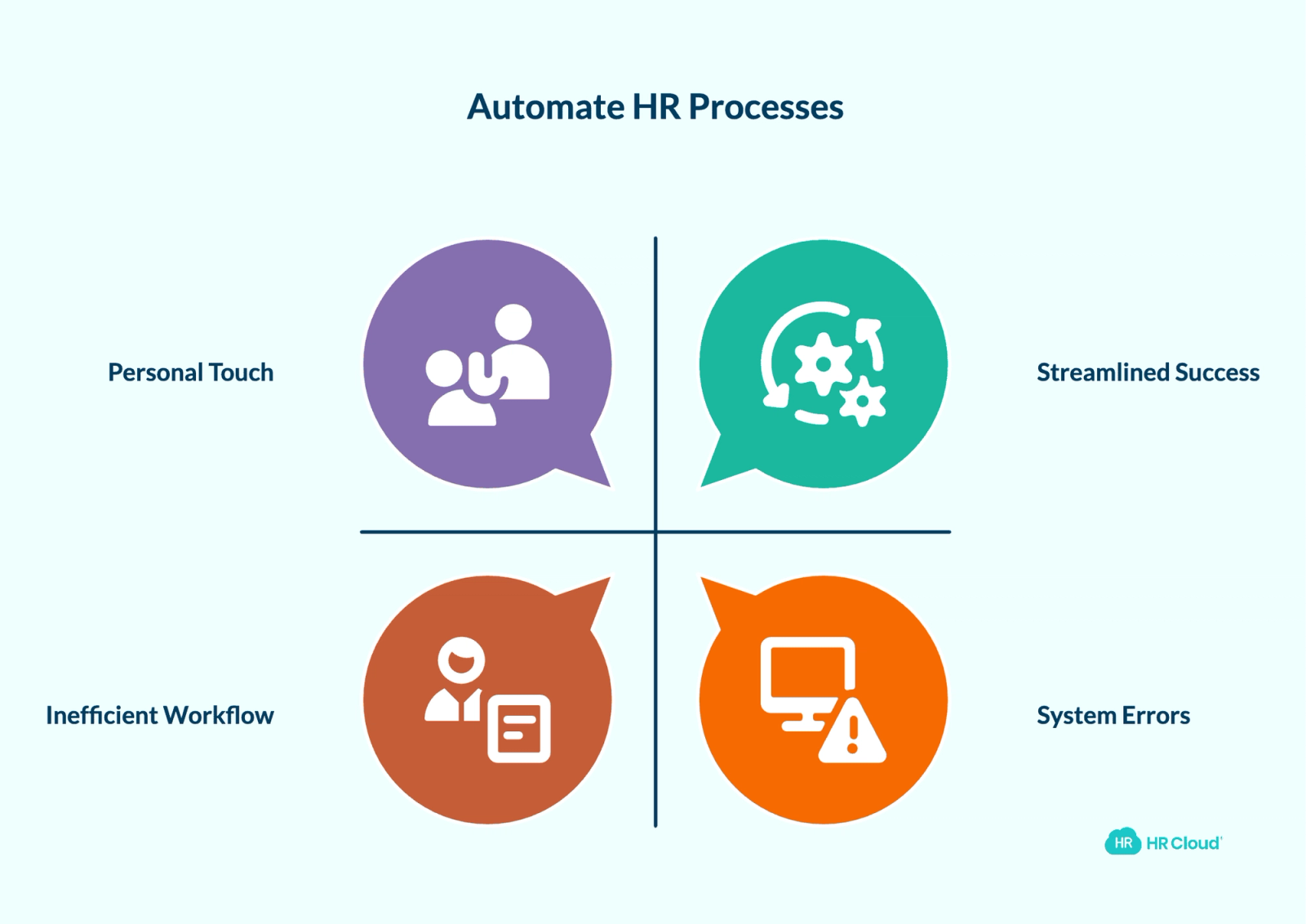
Automation benefits employees as much as it does HR personnel and businesses, improving employee productivity and employee engagement.
Typically, onboarding new hires is time-consuming. By leveraging technology, you can streamline the workflow so you can focus on troubleshooting and adding a personal touch to the onboarding process that enhances employee motivation.
For example, using a drip-email sequence, set up a series of welcome emails to new employees. You can provide them with the necessary documents and resources and guide them through various onboarding tasks.
Also, you need HR software to make the process smooth. Onboard by HR Cloud lets you build checklists, collect signatures, and more so that nothing slips through the cracks. This performance management system ensures consistent employee engagement throughout t
This tool will send automated notifications to all parties so everyone knows what to do regarding tasks, approvals, and more.
This way, new hires can transition smoothly into their roles, having completed all the necessary onboarding activities while maintaining high employee engagement levels.
Download your free employee onboarding checklist
Using this checklist ensures that you are not scrambling to make the new employees feel welcomed, prepared, and set up for long-term success.
Download Now
Best Tips for Effective Onboarding
So far, we've covered important activities to carry out during onboarding. Now, let's look at general best practices and tips for employee engagement strategies. If you remember the following fundamentals, you can devise a tailored process or setup that works for your organization.
| Best Practice | What It Means |
|---|---|
| Maintain consistency | Create a uniform process for every new hire. Doing so helps new hires understand what is expected of them and what they can expect from the organization. And it saves time and starts everyone off on an equal footing, supporting employee engagement and organizational performance. |
| Avoid information overload | It's essential to provide new hires with all the necessary information about their role, but don't overwhelm them with too much information at once. Instead, spread the information over a few days or weeks to maintain employee engagement and prevent burnout. |
| Connect individual roles to business success | Help new hires understand how their role contributes to the overall organizational success. This not only gives them a sense of purpose but also motivates them to perform at their best, improving employee motivation and performance outcomes. |
| Allow sufficient time for onboarding | Don't rush the onboarding process. Typically, it can take up to six months for a new hire to fully acclimate to their new role and environment. Acknowledge this and allow ample time for onboarding. This gives new employees the time to become comfortable in their new position, which is essential for employee engagement and job satisfaction. |
| Implement employee recognition programs | Acknowledge achievements early and often to build employee commitment and strengthen employee engagement from the beginning. |
| Gather employee feedback regularly | Conduct an employee engagement survey or employee engagement assessment, even for federal employee engagement contexts, to understand how new hires are adjusting and what improvements can be made to the onboarding process. |
By remembering these basic principles of effective onboarding, you make it easy for your business and the new hires to be productive faster while maximizing employee engagement.
Conclusion
In short, an effective onboarding process is critical to the successful integration and retention of new employees. It forms the first impressions and sets the stage for their employee experience within the organization.
There are several onboarding activities that you can implement, such as creating a welcome process, assigning a buddy, and more. These employee engagement strategies are designed to boost employee engagement and improve retention and engagement across your organization.
You can even build an onboarding process unique to your organization and thus more personalized. Just remember the key principles are consistency, providing enough time, and showing people how their contributions impact the overall business.
By following these principles, you're ready to create a seamless and useful onboarding process for your new talents that drives employee engagement, enhances engagement and performance, and contributes to long-term organizational success.

Discover how our HR solutions streamline onboarding, boost employee engagement, and simplify HR management
Book Your Free DemoFAQ’s:
Q: What are the most effective employee onboarding activities to improve engagement and retention?
A: The most effective employee onboarding activities include a structured welcome process with an onboarding checklist, a buddy program pairing new hires with experienced employees, a personalized onboarding kit, video and training course libraries, and HR automation tools that handle paperwork, signatures, and task notifications. Research from the Society for Human Resource Management (SHRM) shows employees who complete a structured onboarding program are 58% more likely to remain with the company after three years. The combination of human connection (buddy systems, welcome lunches) and process automation (digital portals, drip email sequences) produces the strongest engagement outcomes.
Q: How long should the employee onboarding process take for new hires?
A: Effective onboarding typically spans 90 days at minimum, with full role acclimation taking up to six months for most new employees. Compressing onboarding into a single day or week is one of the most common and costly mistakes organizations make. SHRM data indicates that 20% of employee turnover occurs before Day 45, meaning the first six weeks are disproportionately high-risk. A phased approach, covering orientation in week one, role immersion in months one and two, and performance alignment by month three, significantly reduces early attrition and improves new hire productivity timelines.
Q: What is a new hire buddy program and does it actually reduce turnover?
A: A new hire buddy program pairs an incoming employee with a vetted, experienced colleague who provides informal mentorship, answers cultural questions, and helps the new hire navigate processes they may hesitate to ask a manager about. When implemented with the right criteria, specifically selecting buddies who reflect company values, know the new hire's functional area, and actively listen, the program demonstrably accelerates time-to-productivity and improves 90-day retention. Buddy programs also serve a secondary function: they surface future leadership candidates from within the existing team, giving HR a pipeline signal beyond the formal onboarding process.
Q: What should be included in an employee onboarding kit?
A: An effective employee onboarding kit should include company-branded welcome items (swag, office supplies), a personalized welcome letter from a direct manager or senior leader, essential documents such as benefits summaries and role expectations, login credentials and software access instructions, a cultural survival guide explaining common acronyms, team workflows, and communication norms, and a 30-60-90 day roadmap outlining expectations by milestone. The most effective kits combine physical and digital components. Physical items create a tangible sense of belonging on Day 1; digital components housed in an onboarding portal ensure new hires can reference materials any time without requiring HR to resend.
Q: How does HR automation software improve the onboarding experience for new employees?
A: HR automation software reduces manual, repetitive tasks from the onboarding process, including document collection, e-signature routing, task assignment, and compliance tracking, so HR teams can redirect time toward human-centered onboarding activities. Platforms like HR Cloud Onboard automate drip email sequences, onboarding checklists, approval workflows, and real-time notifications to both HR and new hires, reducing errors and ensuring nothing is missed.
The business case is straightforward: faster completion of administrative onboarding tasks translates directly to faster time-to-productivity for new employees, and reduces the administrative burden that causes HR teams to cut corners on higher-value onboarding touchpoints.
Q: What is the difference between onboarding and orientation for new employees?
A: Orientation is a single event, typically lasting one day, that covers administrative basics: completing paperwork, touring the facility, and receiving an initial company overview. Onboarding is the broader, multi-month process designed to fully integrate a new hire into their role, team culture, and organizational expectations. Orientation is a component of onboarding, not a substitute for it. Companies that treat Day 1 orientation as "done" and have no structured follow-through beyond week one account for a disproportionate share of 90-day voluntary turnover. The goal of onboarding is not to process a new hire; it is to connect a person to their purpose in the organization over time.
Q: How can companies use onboarding to connect new hires to overall business goals?
A: Connecting new hires to business goals during onboarding requires deliberate design, not a slide in a deck. Effective approaches include a welcome video from the CEO framing the company mission and where the new hire's role fits within it, structured conversations between the new hire and their manager during the first two weeks focused explicitly on how their work drives measurable outcomes, and a 30-60-90 day plan that maps individual tasks to team-level objectives. SHRM research consistently shows that employees who understand how their role contributes to company success demonstrate higher engagement scores and lower voluntary turnover rates. Without this connection, new hires default to executing tasks without context, which produces both performance and retention risk.
Q: What onboarding software or platform is best for managing employee onboarding at scale?
A: The best onboarding platform for scale is one that centralizes paperwork, task management, e-signatures, and compliance tracking while integrating with existing HR systems like payroll and scheduling software. Key evaluation criteria include mobile accessibility (critical for industries with frontline or field workforces), configurable workflow automation, real-time reporting on completion rates and outstanding tasks, and integration depth with platforms like ADP, UKG, or Paylocity. HR Cloud Onboard is purpose-built for organizations with complex, high-volume onboarding needs, particularly in healthcare, construction, and field services, where desktop-first tools fail. The right platform should eliminate the manual handoff points where new hire data gets lost or compliance tasks get missed.
Author Bio
Syed Balkhi is the founder of WPBeginner, the largest free WordPress resource site. With over 10 years of experience, he’s the leading WordPress expert in the industry. You can learn more about Syed and his portfolio of companies by following him on his social media networks.
Keep Reading


Like What You Hear?
We’d love to chat with you more about how HR Cloud® can support your business’s HR needs.
Book Your Free Demo