
10 Virtual Team-Building Activity Ideas to Boost Employee Morale and Engagement

Remote work is no longer a temporary fix — it is a permanent feature of how modern organizations operate. According to Gallup's 2024 State of the Global Workplace report, global employee engagement fell to 21%, costing businesses an estimated $438 billion in lost productivity. For HR leaders managing distributed teams, that number is a wake-up call.
Isolation, communication gaps, and the absence of shared culture are the primary enemies of remote engagement — and they hit hardest when your team never shares a physical space. SHRM research on virtual team belonging confirms that when remote employees lack structured opportunities for connection, trust erodes and collaboration suffers. The good news is that intentional virtual team building directly counters these risks.
Research shows remote employees who participate in regular structured social activities report stronger team cohesion, higher morale, and lower voluntary turnover. But running these activities well requires more than a Zoom link — it requires a thoughtful approach and, increasingly, a platform built to keep distributed people genuinely connected day to day.
If you're evaluating tools to support your remote engagement strategy, HR Cloud's Workmates platform provides recognition, communication, surveys, and company challenges built specifically for distributed and frontline teams. Book a free demo to see how it works.
Here are ten proven virtual team-building activities you can implement today — plus guidance on making each one actually stick.
What is virtual team building? Virtual team building refers to structured activities and programs designed to foster connection, collaboration, and trust among employees who work remotely or in distributed locations. Unlike traditional team building, it relies on digital tools — video conferencing, engagement platforms, and collaborative apps — to create shared experiences across distance. Gartner defines it as an ongoing leadership practice requiring regular reassessment as team needs evolve.
Quick Answer: The most effective virtual team-building activities for remote teams are icebreakers, interactive web games, coordinated virtual breaks, film and book clubs, wellness challenges, mental health check-ins, recognition apps, video-call games, and personality assessments. Consistency matters more than scale — regular, structured connection outperforms infrequent large events every time.
1. Icebreakers That Actually Break the Ice
Improving relationships between staff is one of the most direct levers for boosting team morale — but it becomes harder to engineer remotely, especially when introducing new employees to an established team. Even colleagues who have worked together for years benefit from deliberate moments of informal connection.
Virtual icebreakers work because they create low-stakes conversation openers. Playful icebreaker questions for virtual meetings reveal preferences, interests, and personality in minutes. Questions like "Would you rather deal with an angry client or an angry coworker?" or "This or That: Forget your morning coffee or forget your lunch?" let people find common ground fast — and that common ground compounds over time into genuine team cohesion.
Icebreakers are also the most accessible entry point for new hires. When someone joins a remote team, there are no hallway introductions or lunch invitations to ease the transition. A structured icebreaker in the first team meeting can do the work those organic moments used to handle.
Pro tip: Rotate icebreaker ownership so different team members lead each session. This builds confidence, gives everyone a turn shaping team culture, and prevents the activity from feeling like an HR mandate rather than a genuine team ritual.
2. Interactive Web Games and Gamified Collaboration
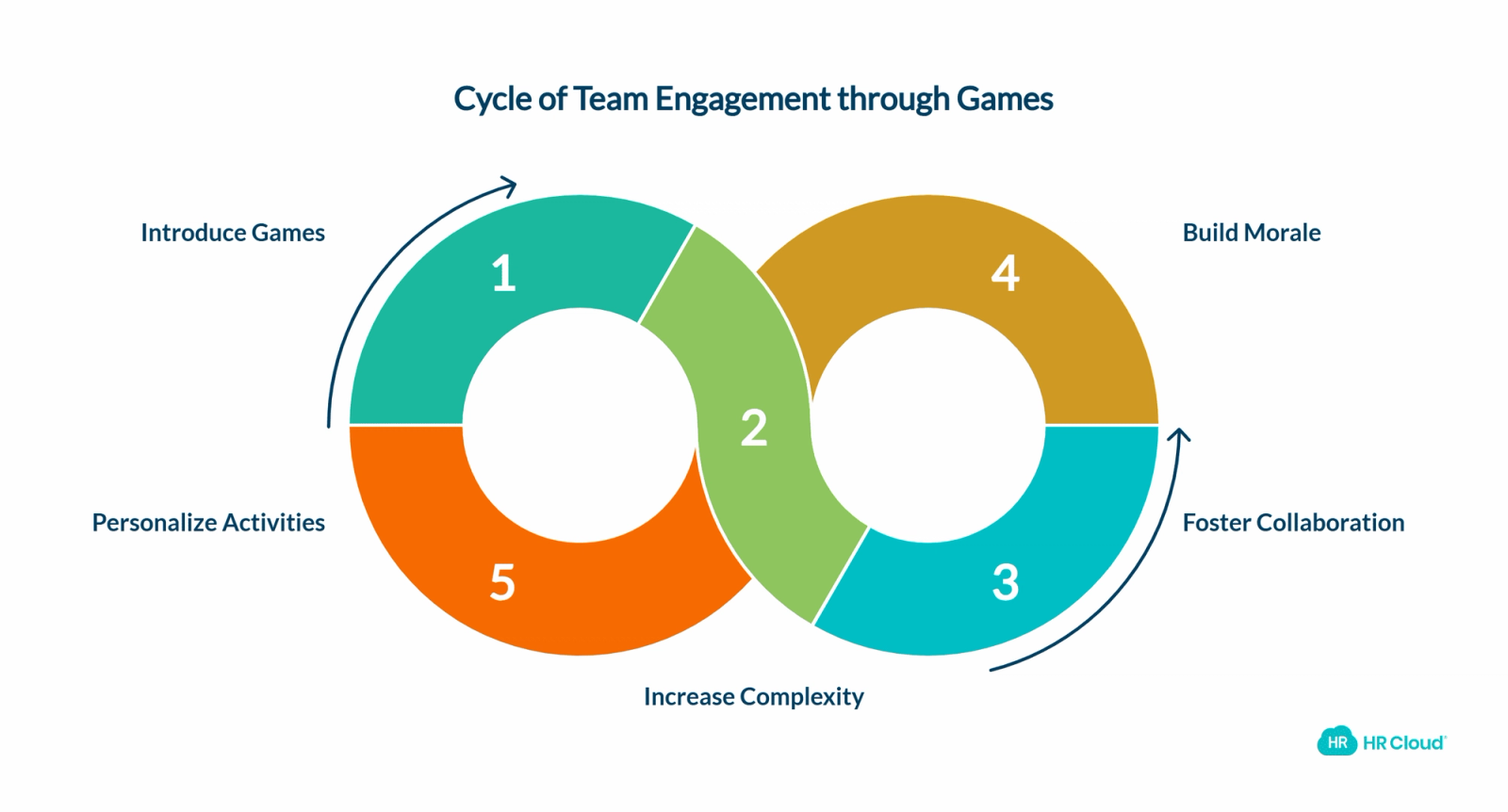
Gamification has measurably changed how teams engage at work. According to Gartner research on virtual team building, organizations that incorporate online games into team-building programs report significant increases in employee engagement and motivation. That's not a small signal — it reflects how game mechanics (progress, competition, recognition, and reward) tap into the same drivers that make work itself meaningful.
For teams that find simple icebreakers repetitive over time, escalating to more involved online games sustains energy across months. Creative teams thrive with online drawing games like Skribbl.io, a modern take on Pictionary that works seamlessly across remote setups. Problem-solving-oriented teams enjoy virtual escape rooms or Murder Mystery events that require genuine collaboration to succeed — not just proximity on a call.
Platforms like Workmates take this further with built-in Company Challenges — competitive, goal-oriented group activities that HR teams can create, customize, track participation in, and reward through the same platform they use for daily communication. This turns a one-off game into a repeatable, measurable engagement program.
You can even build personalized quizzes that test team members on coworker trivia, recent company milestones, or industry knowledge — creating both fun and a subtle mechanism for knowledge sharing across your distributed organization.
3. Coordinated Virtual Breaks — The Digital Water Cooler
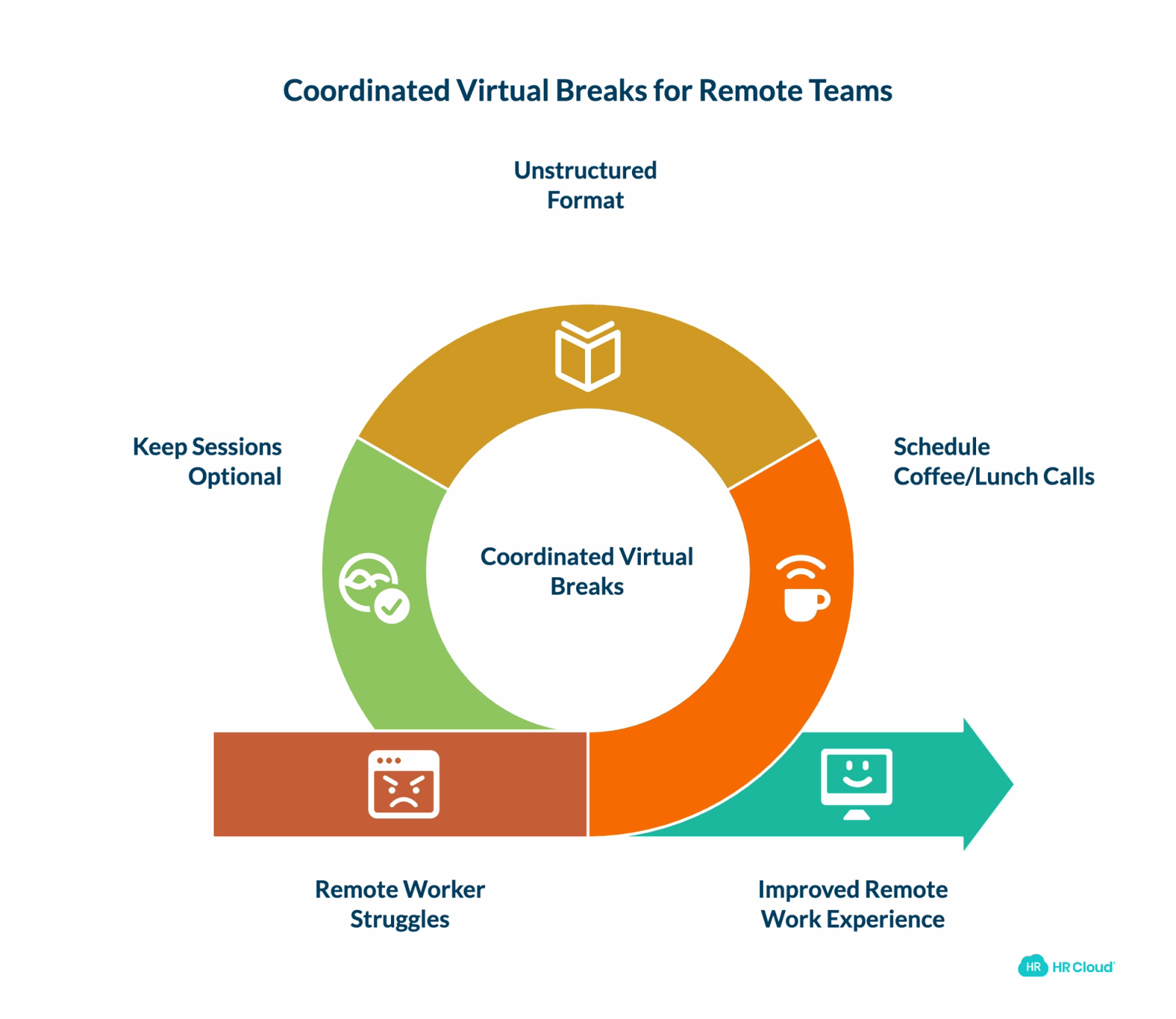
Buffer's State of Remote Work consistently finds that remote workers' top struggles are unplugging after work, loneliness, and difficulty collaborating. Coordinated virtual breaks address all three without adding a single agenda item to your team's formal meeting load.
Scheduling optional 15-minute coffee or lunch video calls creates the informal connection that office hallways used to provide organically. A 2024 LinkedIn survey found that 62% of remote employees specifically miss casual interactions with colleagues. These virtual watercooler breaks, and even a virtual happy hour at the end of the week, reduce isolation and break the monotony that makes fully remote roles feel isolating over time.
The format is deliberately unstructured: no agenda, no facilitation, no tasks. The value comes from people simply existing together on a call, the way they would in a shared office kitchen. For teams managing mental health in hybrid and remote environments, these micro-moments of social connection are not optional extras — they're infrastructure.
Keep these sessions genuinely optional and time-boxed. If attendance becomes mandatory, the break stops feeling like a break.
4. Film and Book Clubs for Shared Culture
Special interest clubs that meet virtually around books or films create ongoing shared experiences that go beyond work tasks. When your team reads the same book or watches the same series, you create organic conversation across weeks — not just during one scheduled event.
The structure is simple: agree on a book or film, set a discussion date, and let conversation flow. The debate that follows is the real value. Healthy, low-stakes disagreement about a story, a character's choices, or a theme builds the psychological safety that makes teams function better under actual work pressure. Teams that have practiced navigating disagreement in a safe context are better equipped to navigate it in a professional one.
Book and film clubs also serve as an equalizer across hierarchy. A new analyst and a department head can have a genuinely equal conversation about whether a character made the right call. That kind of horizontal connection strengthens culture in ways that formal team meetings rarely achieve.
You can manage sign-ups, post discussion prompts, and keep conversations going between sessions directly in Workmates' internal communication channels — keeping everything in one place rather than scattered across personal email threads or external group chats.
5. Chef's Club and Recipe Sharing
When working from home, meal monotony is real — and often invisible. A cooking club or recipe share is a surprisingly effective way to combine cultural exchange, personal storytelling, and team bonding in one activity. Colleagues take turns sharing a dish or personal recipe, which naturally opens conversations about background, heritage, food memories, and preference.
For global and multicultural teams, this is particularly valuable. Food is one of the most universal entry points into understanding someone's background. It builds empathy across cultural lines, which translates directly into more inclusive teamwork. A team that knows each other's food stories knows each other better, full stop.
The activity also scales flexibly: you can run it as a monthly async post in a shared channel (photos and recipes only), a live virtual cooking session, or a competitive cook-off with peer voting. Each format works for different team sizes and time zone spreads.
One inclusion note: make this activity genuinely optional and sensitive to dietary restrictions and cultural considerations. The goal is connection through sharing, not participation pressure.
6. Wellness and Workout Challenges
Maintaining exercise routines is one of the most commonly cited struggles of remote work. The structure that commuting and office schedules used to provide — which incidentally kept many people walking, moving, and active — disappears when someone's commute becomes a ten-second walk to a home office. Group wellness challenges address this by adding social accountability and community to healthy habits.
Tracking shared step counts, weekly hydration goals, or workout check-ins gives employees a reason to motivate each other and celebrate progress publicly. When someone hits a milestone — 10,000 steps a day for a full month, completing a 5K — recognizing it matters. It turns a personal achievement into a team moment.
According to Gallup, engaged employees are significantly less likely to experience burnout. Physical wellness programs are a proven contributor to that engagement, particularly when they're structured as community activities rather than individual initiatives.
Workmates' recognition features let teammates send recognition shout-outs for wellness milestones — turning a personal win into a public, culture-building moment visible to the entire team. That visibility is what separates a wellness challenge from a wellness suggestion.

7. Team-Building Platforms and Recognition Apps
The right technology dramatically expands what's possible for remote team building. Apps like HeyTaco! allow remote teams to acknowledge each other's contributions through fun, visible peer recognition — gifting "tacos" that accumulate and can be redeemed for rewards. The game layer makes recognition feel natural rather than formal.
But standalone apps come with trade-offs: separate logins, separate administration, separate data, and no connection to the broader HR system where you track engagement, conduct surveys, or manage communication campaigns.
Workmates by HR Cloud integrates peer recognition, rewards catalogs, company challenges, surveys, communication channels, and engagement analytics in a single platform your HR team manages from one dashboard. For organizations managing dozens or hundreds of remote employees, that operational efficiency is a genuine advantage — not just a convenience.
The platform works across Slack and Microsoft Teams for teams that prefer to keep recognition inside their existing communication flow, and it's fully mobile-optimized for frontline and deskless workers who aren't sitting at a desk. Recognition that reaches everyone, not just the people at computers, is recognition that actually builds culture.
8. Mental Health Check-Ins and Peer Support Sessions
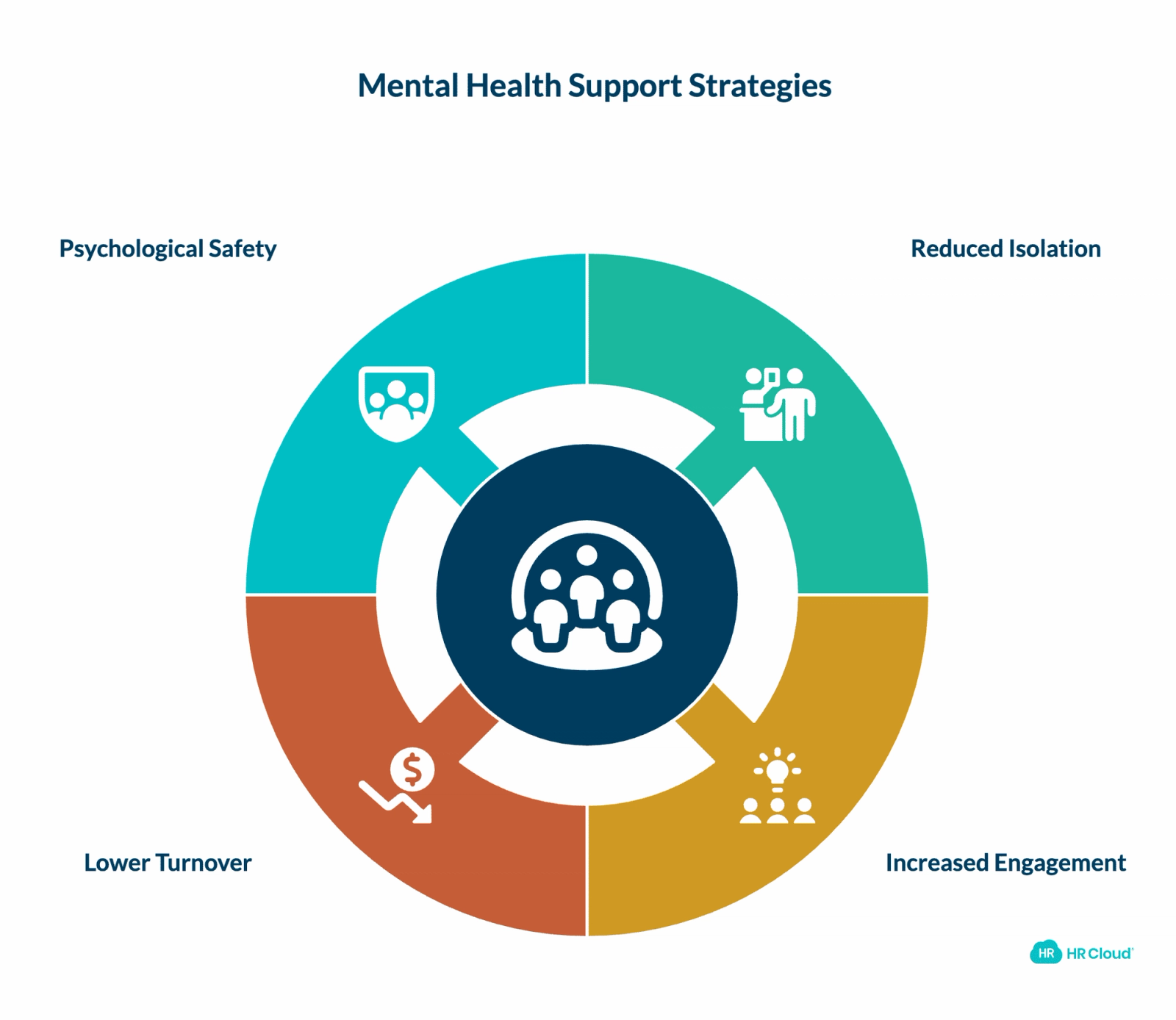
Social isolation is one of the most persistent and underacknowledged challenges of remote work. According to Buffer's State of Remote Work, 24% of remote workers identify loneliness as their top challenge at work. Left unaddressed, isolation drives burnout, disengagement, and ultimately voluntary turnover — the most expensive outcome for any HR team.
Weekly mental health debriefs — structured conversations where employees have a safe space to share what they're navigating — reduce this risk meaningfully. These sessions don't require a licensed therapist to run. They require a format that signals psychological safety: a consistent meeting time, a rotating facilitator, and explicit permission to be honest about difficulty.
You can use group video calls or dedicated channels in your engagement platform to facilitate these conversations. The key is consistency. A mental health check-in that happens once after a difficult quarter sends a very different message than one that happens every week regardless of circumstances. The latter says: this is how we work here, not this is a response to a crisis.
For HR professionals building out a broader wellbeing program, the HR Cloud blog covers evidence-based approaches to mental health in hybrid and remote teams in practical detail.
9. Video-Call Games That Require Zero Preparation
Video conferencing is standard HR infrastructure, but most teams use only a fraction of its potential for connection. You don't need to download anything extra or build a separate event to run engaging activities over a video call.
Virtual charades works perfectly on camera — the visual medium is the whole point. A "Guess the Workspace" round, where each employee briefly shows their home office and others guess whose it is, generates genuine laughter with zero preparation and gives colleagues a window into each other's lives that a standard meeting never would. Virtual bingo, scavenger hunts where participants find household items matching a prompt, and trivia rounds all run natively on Zoom, Google Meet, or Microsoft Teams.
For a creative twist, try a virtual background challenge: team members create or find the most interesting, funny, or thematic background for a call, and the team votes. Five minutes of setup, fifteen minutes of genuine connection.
The strategic value here is velocity. You can layer a 15-minute video-call game into the start or end of an existing meeting without adding anything to your team's calendar. For managers looking to build connection without increasing meeting load, this is consistently the highest-ROI item on this list.
10. Personality Assessments and Team Dynamics Workshops
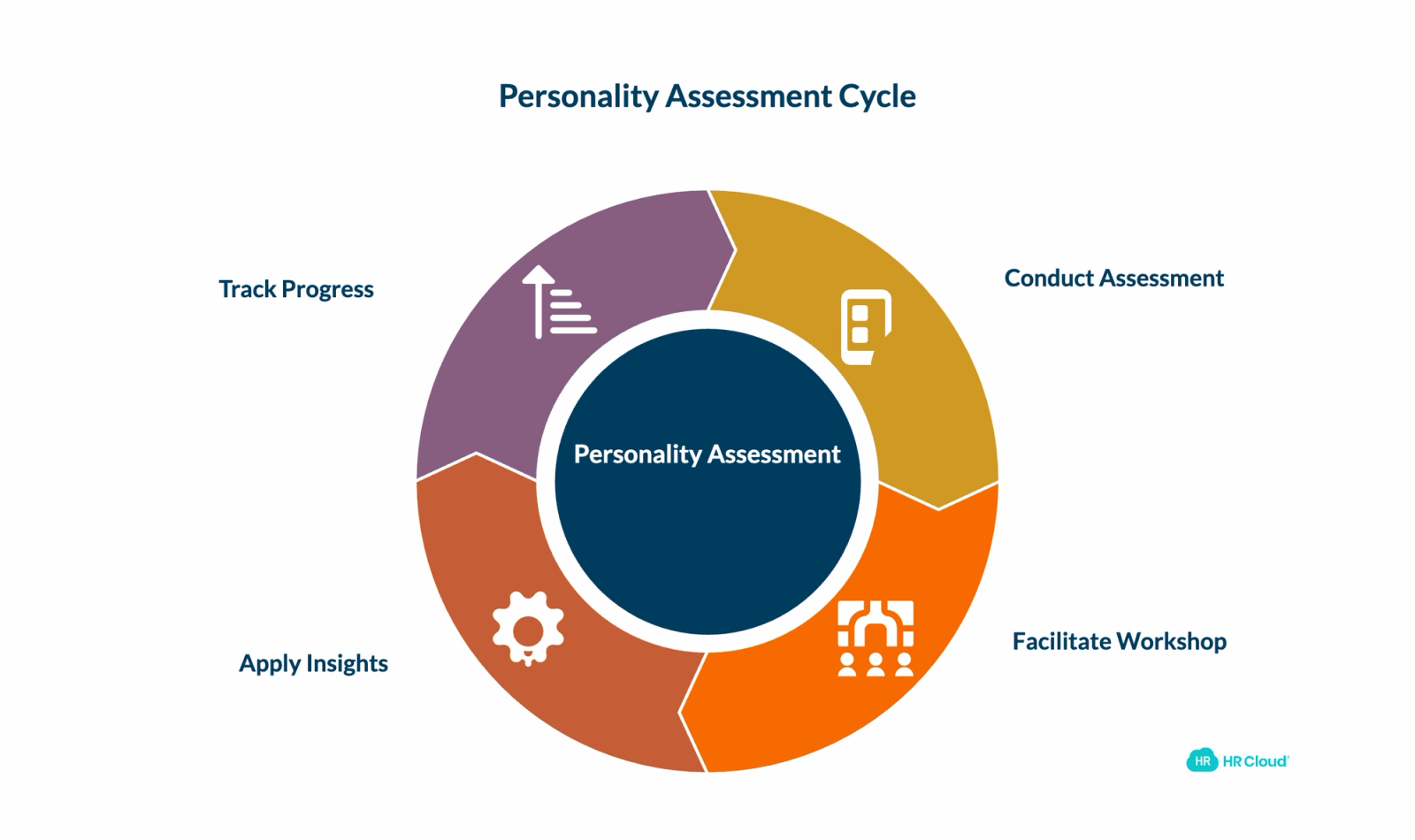
Personality frameworks like the Myers-Briggs Type Indicator (MBTI), CliftonStrengths, or the DISC assessment give teams shared vocabulary for how they work together. When used in a structured team workshop, these tools open honest conversations about communication preferences, conflict styles, and collaboration needs — conversations that would otherwise only surface during friction.
The game layer makes the entry point fun: employees compare their types to celebrities, historical figures, and fictional characters. The team call that follows the assessment is where the real work happens — discussing how different types approach deadlines, how introverts and extroverts need different processing time, and how that awareness changes day-to-day working relationships.
For HR professionals who want to connect personality assessment outcomes to ongoing development, HR Cloud's Perform platform lets you document development goals and track progress in the same system where you manage performance reviews, feedback cycles, and goal setting. The insight from a MBTI session becomes an input to a meaningful development conversation, not just a fun fact.
A quick alternative for teams that want something lighter: "Two Truths and a Lie" achieves similar goals in ten minutes with no test required.
Bonus: Expanding Your Virtual Team-Building Toolkit
As your program matures, consider adding formats that serve global and hybrid teams specifically. Asynchronous team building — shared Slack channels with daily discussion prompts, async video updates via tools like Loom, or virtual bulletin boards where employees post personal milestones — allows participation across time zones without forcing early-morning or late-night calls.
For hybrid teams, build activities that work equally well in person and on screen so remote employees never feel like observers to an in-room experience. And when designing any activity, test it for inclusivity: does it require alcohol, specific technology, physical capability, or cultural assumptions that some team members may not share? The activities that build the strongest teams are the ones everyone can fully participate in.
Make Virtual Team Building Work for Your Organization
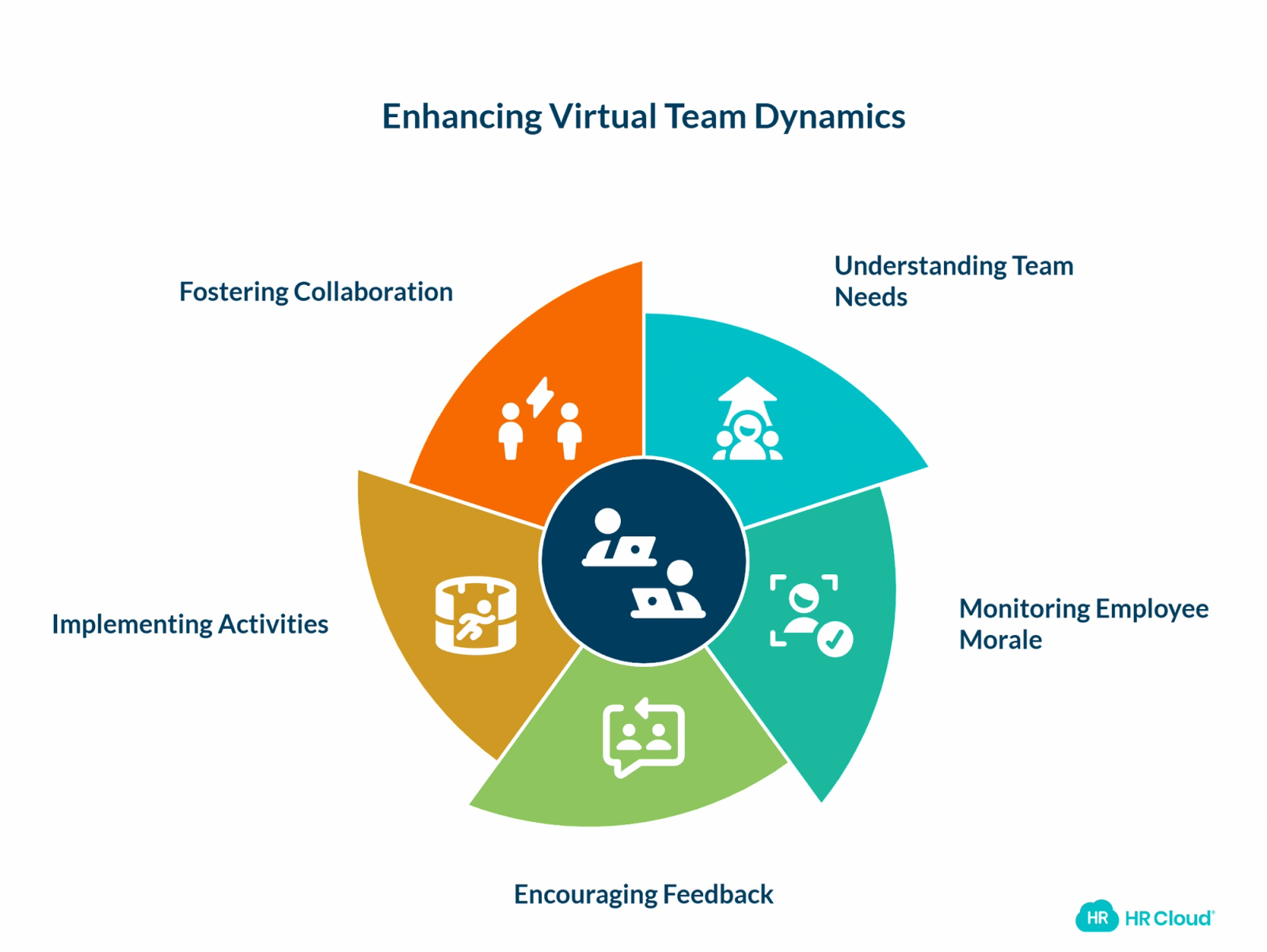
Not every activity will land the same way with every team, and that's expected. The best HR leaders treat virtual team building as an ongoing practice — not a quarterly checkbox. Collect feedback after every activity. Notice what generates genuine energy and what falls flat. Build a rotation that spans different formats: competitive, creative, reflective, and social.
Just as best practices for employee engagement in virtual meetings require consistent iteration, so does a sustainable team-building program. By meeting with employees regularly and encouraging them to suggest and feed back on activities themselves, you build a culture that shapes itself — rather than one that HR has to constantly engineer from the top down.
Most importantly, give your team the tools to stay connected between formal events. A platform like Workmates keeps recognition, communication, and culture-building happening daily — not just when you schedule it. The result is a distributed team that feels genuinely connected regardless of geography, time zone, or whether anyone's ever met in person.
Ready to see how HR Cloud supports remote engagement at scale? Book your free Workmates demo today.

Experience how Workmates can transform communication and strengthen culture—all in one powerful platform
Book Your Free DemoFrequently Asked Questions
What are the best virtual team-building activities for remote teams?
The best virtual team-building activities for remote teams include icebreakers, interactive web games, coordinated virtual breaks, film and book clubs, wellness challenges, mental health check-ins, recognition platforms, video-call games, and personality assessments. The most effective programs combine structured activities with a platform that supports daily recognition and communication between events.
How can I keep remote employees engaged and motivated?
Keep remote employees engaged by using employee engagement platforms, running regular team-building activities, providing peer recognition tools, scheduling virtual social breaks, and conducting pulse surveys to understand what your team actually needs. Consistent, intentional connection matters more than occasional large events.
How do I build relationships between remote team members?
Build remote team relationships through structured social activities like virtual book clubs, cooking clubs, and interest-based discussion groups. Peer recognition programs that let teammates acknowledge each other publicly also build trust and connection over time.
What tools can I use for virtual team-building?
Platforms like Zoom, Microsoft Teams, and Slack support virtual activities like charades, trivia, and collaborative games. For a more comprehensive approach, HR Cloud's Workmates platform integrates recognition, communication, company challenges, and surveys in one place for distributed teams.
How often should remote teams do team-building activities?
HR experts generally recommend at least one structured team-building activity per month, with lighter connection moments — virtual breaks, recognition shout-outs — built into weekly routines. Regular connection programs are directly linked to lower voluntary turnover rates.
What are quick virtual team-building activities for busy teams?
Quick activities that take 10–15 minutes include icebreaker questions, video-call charades, Guess the Workspace rounds, and digital bingo. These can be layered into the beginning or end of existing meetings without adding calendar burden.
How do you boost mental health in remote work environments?
Introduce weekly mental health check-ins, normalize conversations about work-life balance, encourage lifestyle challenges that build community, and provide open channels for employees to share challenges. Recognition programs that celebrate personal milestones also strengthen wellbeing by making employees feel seen.
Can remote team-building improve productivity?
Yes. According to Gallup research, engaged teams show 17% higher productivity and 21% higher profitability compared to disengaged teams. Regular team-building improves morale, trust, and collaboration — all directly connected to productivity and retention outcomes.
What is the role of personality tests in team building?
Personality frameworks like MBTI or CliftonStrengths give teams shared vocabulary for how they work together. They surface communication preferences and collaboration styles, helping managers structure work and coaching more effectively — and giving employees language to advocate for their own working needs.
About the author

Keep Reading


Like What You Hear?
We’d love to chat with you more about how HR Cloud® can support your business’s HR needs.
Book Your Free Demo