New Manager Training Without a Formal L&D Program

Your best individual contributor just got promoted. They know the work cold. They know the product, the customers, the quarterly targets. What they have never done — not once — is tell someone their performance isn't good enough, or figure out why two teammates who used to be friends stopped talking. Nobody told them how to do that. You didn't have a program. They didn't know to ask.
This is where most new manager failures begin. Not in the person, in the gap between the promotion and any actual preparation.
According to Gallup's 2025 State of the Global Workplace report, only 44% of managers globally have received formal management training. That means more than half of the people responsible for your team's daily experience, performance, and retention are figuring it out as they go. The same report found that even basic role-specific training — just covering role clarity and communication — can cut active manager disengagement in half.
That tells you something useful: the gap isn't about talent. It's about structure. And structure is exactly what HR can provide — with or without a formal L&D department.
This guide covers how to build a practical new manager training system that fits into the workflows you already run.
Key Takeaways
- Only 44% of managers have received formal training — and even basic role-specific training cuts active disengagement in half (Gallup, 2025)
- New managers fail most often because they manage work, not people — a structural problem, not a skills problem
- Effective new manager training doesn't require an L&D budget; it requires a checklist, a 30/60/90 plan, and repeatable HR workflows
- The 7 core skills every new manager needs can be taught through templates and structured check-ins, not classroom sessions
- HR software tools like HR Cloud Onboard, Perform, and Workmates turn one-time training into ongoing manager habits
What Is New Manager Training?
New manager training is the process of helping recently promoted or newly hired managers build the skills, habits, and systems they need to lead a team effectively.
At its core, it covers six areas: communication, delegation, performance feedback, goal setting, employee engagement, and conflict resolution. It typically also includes compliance basics — what managers are legally required to document, what goes to HR, and what they can handle directly.
Here's where most companies miss it: they treat this like an orientation event. A half-day. A handbook. A one-on-one conversation with HR that gets forgotten by week two.
New manager training works best when it's embedded into daily workflows — check-ins, performance templates, recognition habits, onboarding checklists. Not a class. A system.
That reframe is what makes it sustainable for companies without a dedicated L&D team. You don't need a curriculum. You need a structure the manager returns to every week.
Why New Managers Fail Without Structure
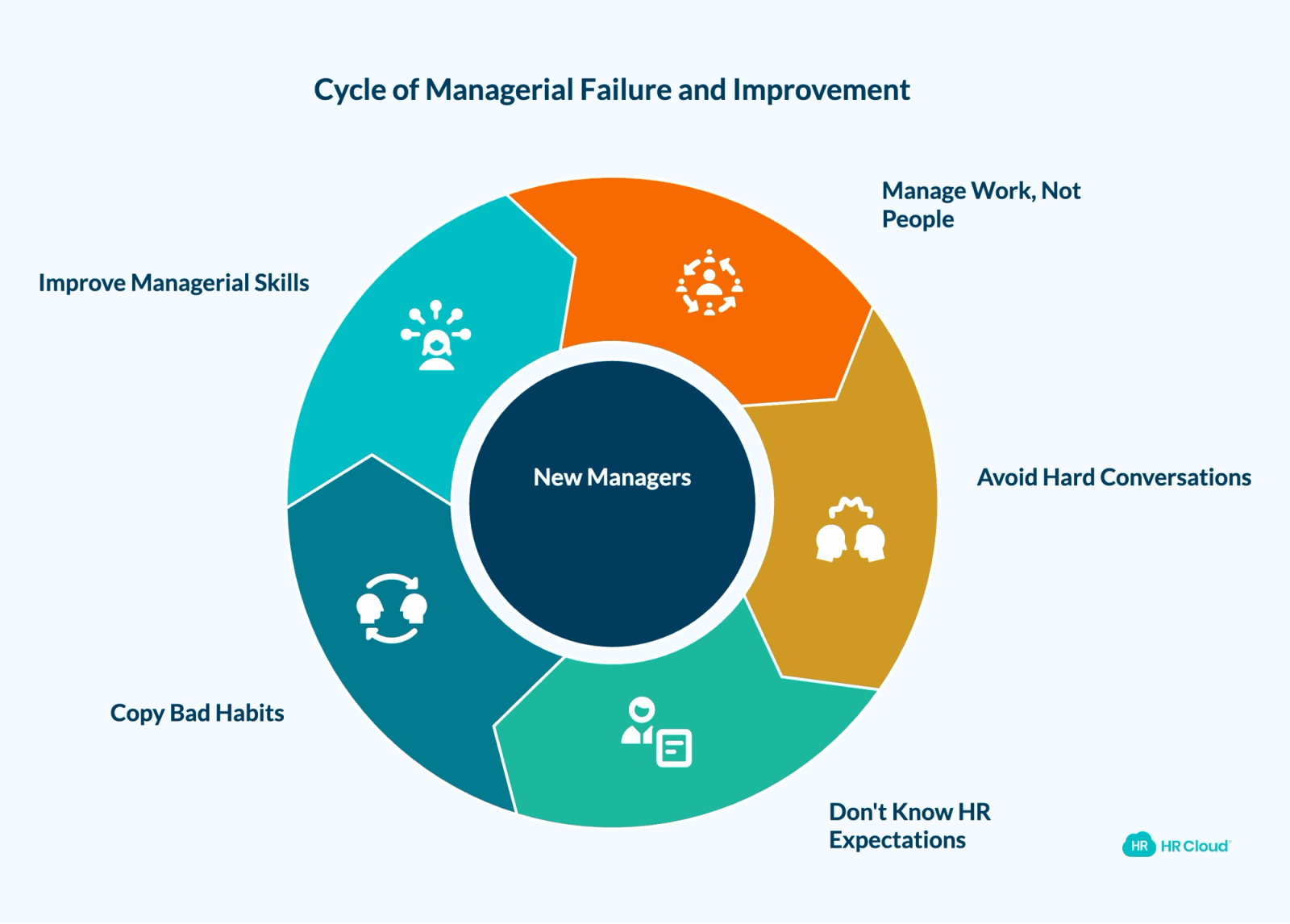
Gallup's research is direct on this: according to the State of the American Manager report, managers account for at least 70% of the variance in team engagement scores across business units. That finding has held across meta-analyses spanning more than 2.5 million work units. When managers are unprepared, the cost shows up in turnover, disengagement, and the kind of quiet performance decline that's hard to trace back to any single cause.
Here's what actually goes wrong.
They manage work, not people
New managers know how to do the job. They got promoted because they were great at it. What they've never practiced is telling someone else how to do it, correcting the way they're doing it, or motivating someone whose priorities don't align with theirs.
The result is a manager who tracks deliverables closely and ignores the team dynamics underneath them — until something breaks.
Why this costs you: Managers who can't coach create teams that can't improve. Performance gaps that should close in 60 days persist for 6 months because nobody had a direct conversation.
They avoid hard conversations
Feedback delay is one of the most common and costly habits new managers develop. The performance issue is visible by week three. The conversation happens in month four — if at all.
By then, the behavior is entrenched, the rest of the team has noticed, and the new manager has lost credibility with everyone watching.
What this looks like in practice: In lean HR teams, the delay usually isn't caused by indifference. It's caused by uncertainty. A new manager sees the missed deadlines, the attendance pattern, the team conflict — but doesn't know what to say, what to document, or when to bring HR in. A one-on-one agenda and a feedback script give them a lower-friction first step. Without those, the default is to wait and hope the problem resolves itself. It rarely does.
They don't know what HR expects from them
This one is underrated. New managers often genuinely don't know which performance issues require documentation, what the process is for approving time off, or what "running onboarding" for their new hire actually means.
They're not being negligent. They weren't told.
Pro tip: Build a manager-specific onboarding checklist that covers HR process responsibilities explicitly — not just leadership concepts. See HR Cloud's first-time manager onboarding guide for a practical starting point.
They copy bad management habits
Without a framework, new managers default to what they've seen. If their previous manager avoided conflict, they avoid conflict. If recognition was rare, they skip it. If one-on-ones were cancellation-prone calendar blocks, they treat them the same way.
This is how management culture compounds over time — in both directions.
What Changes When New Managers Lead Frontline or Deskless Teams
Most manager training content assumes a world of desks, calendars, and email inboxes. A large share of HR Cloud's buyers don't operate that way — and neither do their new managers.
New supervisors in healthcare, manufacturing, construction, retail, education, and staffing face a different set of operational realities. The training system still applies, but the delivery and documentation requirements shift considerably.
Healthcare and home care: New supervisors often manage rotating shifts, credentialing requirements, and care compliance in the same week they're learning how to give feedback. A missed documentation step isn't just a performance problem — it's a compliance exposure. Manager onboarding in these environments needs to cover incident documentation, escalation paths, and shift-handoff communication explicitly, not just "give feedback" at a general level.
Manufacturing and construction: New leads frequently manage employees who don't have company email addresses. Communication happens at shift start, via text, or not at all. Templates and check-ins only work if they're accessible on a phone or a shared device on the floor. Manager onboarding here needs to build habits around safety documentation, attendance patterns, and direct verbal communication — supported by mobile-friendly tools that don't require a laptop.
Retail and hospitality: High turnover means new managers are often onboarding new hires while they themselves are still being ramped. Recognition habits and consistent communication matter more here than in most industries — employees who feel seen by their direct manager stay longer. But the tools have to work during a shift, not after it.
Education and staffing: Seasonal cycles and location-specific onboarding create gaps where new managers inherit teams mid-year or across multiple sites. The 30/60/90 plan still applies, but checkpoint structures need to account for school calendars, grant cycles, or client placements rather than standard fiscal quarters.
The common thread across all of these: mobile access, clear escalation paths, task visibility for HR, and communication habits that work when employees aren't sitting in front of laptops.
HR Cloud is built for these environments. Workmates gives managers a mobile-friendly recognition and communication platform their frontline teams actually use. Onboard assigns and tracks manager-specific ramp tasks with automated reminders — so HR has visibility into completion without having to chase manually across locations.
Why this matters for frontline HR teams: A new supervisor who misses a documentation step at a hospital or a manufacturing plant creates risk that a missed one-on-one in a corporate office doesn't. The stakes for getting the training system right are higher — and the margin for assuming the manager will "figure it out" is lower.
These aren't soft skills. They're operational habits. Every one of them can be taught through templates, brief training conversations, and structured check-ins — no classroom required.
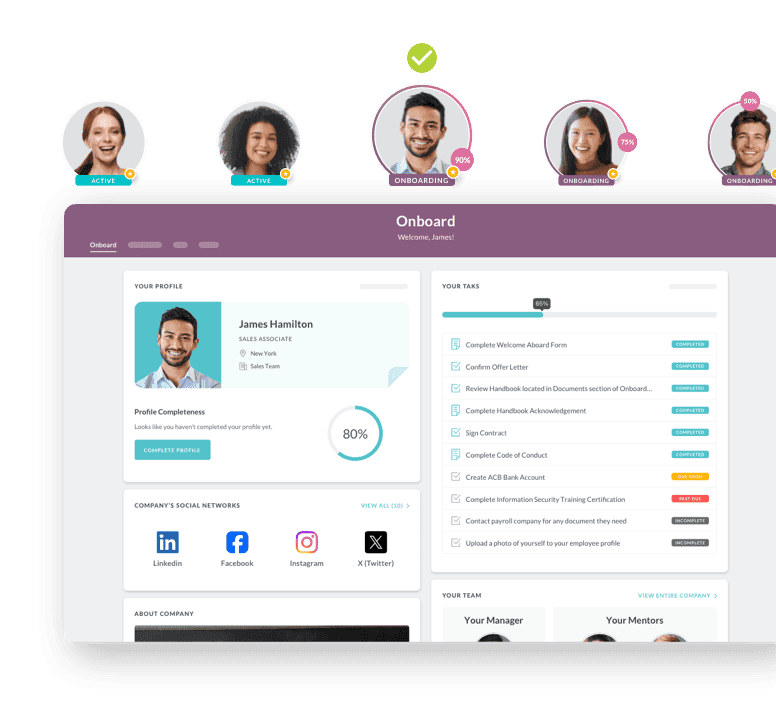
1. Setting clear expectations
New managers often assume their team knows what's expected. Most teams don't — especially after a leadership transition.
Clear expectations mean: role outcomes (what does success look like in 90 days?), success metrics (how will we measure it?), communication norms (how do you want updates — daily Slack, weekly meeting, or ad hoc?), and first-30/60/90-day priorities.
A one-page expectations document, written in the manager's first week, prevents more confusion than any training video.
2. Running effective one-on-ones
One-on-ones are the single highest-impact manager habit — and the most commonly skipped when workload spikes.
Weekly or biweekly is the standard. The agenda should be structured: what's the direct report working on, what's blocking them, what feedback does the manager have, and what does the manager need to know? That last one matters. Good one-on-ones are bidirectional.
Why this matters for retention: Gallup data consistently shows that employees who have regular meaningful conversations with their manager are measurably more likely to stay. The frequency matters less than the consistency.
3. Giving useful feedback
The most common feedback problem isn't harshness. It's vagueness. "You need to be more proactive" tells someone almost nothing actionable.
Teach SBI feedback: Situation (when this happened), Behavior (here's what I observed), Impact (here's how it affected the team or outcome). It's specific, behavioral, and unemotional. New managers can practice it in two minutes before a conversation.
For a broader look at the skills managers need to develop, HR Cloud's guide to essential manager skills covers communication, emotional intelligence, and delegation in depth.
4. Delegating without disappearing
New managers swing between two failure modes: micromanaging (doing the work themselves because it's faster) or delegating and then disengaging entirely.
Real delegation means assigning work, checking in at defined milestones, and coaching through the gaps — without hovering. It's a muscle, not a personality trait.
5. Recognizing good work
Recognition isn't a nice-to-have. Managers who recognize employees consistently produce measurably more engaged teams. HR Cloud Workmates lets managers send digital recognition in real time — a peer high-five, a team spotlight, or a direct shoutout after a strong project delivery.
The habit is the point. Managers who recognize consistently reinforce the behaviors they want repeated. Managers who don't create teams that wonder what success actually looks like.
Recognition tip: Build recognition into the one-on-one template. Make it a standing agenda item — one thing to recognize per meeting. It takes 60 seconds and changes the tone of the whole conversation.
6. Handling conflict early
Every team has friction. The new manager's job isn't to prevent it — it's to address it before it becomes a rift.
Keep this practical: if two people aren't communicating clearly, the manager facilitates a direct conversation. If someone's behavior is affecting the team, the manager names it specifically (SBI again). If it escalates beyond that, HR gets involved.
The mistake isn't handling conflict wrong. It's waiting so long that the manager has only escalation options left.
7. Documenting performance conversations
This is the one new managers most consistently skip — until they need it and don't have it.
Every meaningful performance conversation deserves a brief written record: what was discussed, what was agreed, what the follow-up timeline is. This helps create a clearer record for the employee, the manager, and HR. HR Cloud Perform supports performance review workflows, employee goals, and manager feedback cycles — giving managers a structured place to manage performance conversations from the start.
How to Train New Managers Without a Formal L&D Program
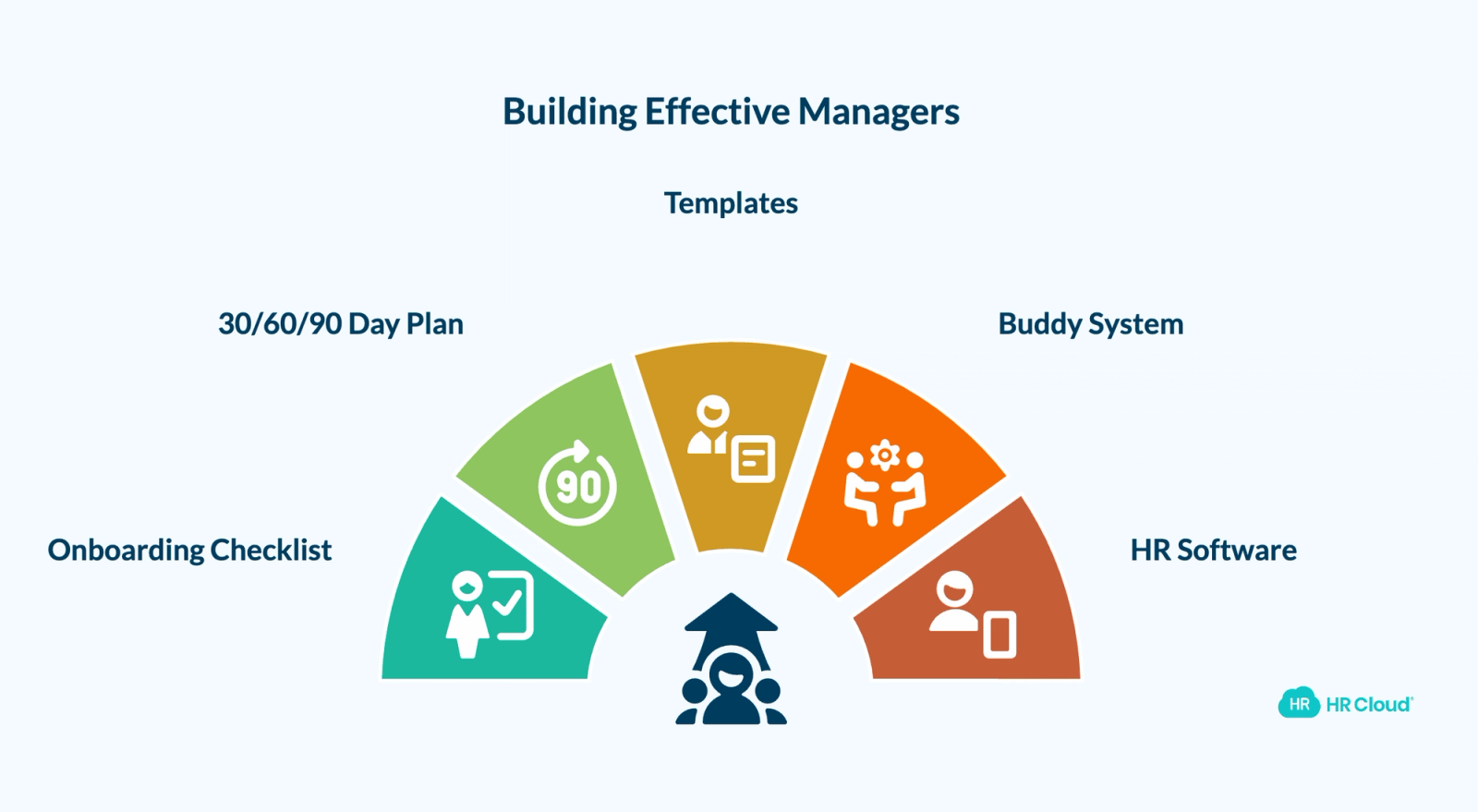
The five-step system below doesn't require a training budget, a learning platform, or an L&D headcount. It requires structure and follow-through.
Step 1: Build a manager onboarding checklist
Before week one, the new manager needs a checklist — not a handbook, a checklist. Something they can work through and check off.
Cover these areas:
- First-week expectations (who to meet, what to read, what to ask)
- HR policies managers must know (documentation requirements, PTO approval process, performance improvement steps)
- Compliance responsibilities (I-9 awareness, harassment policy, what requires HR involvement)
- How to approve time off and handle scheduling conflicts
- How to run onboarding tasks for their own future new hires
- How to document performance conversations
- How to recognize employees formally and informally
- Who their HR point of contact is and when to use them
HR Cloud Onboard can assign manager-specific onboarding workflows, track task completion, and send automated reminders — so HR doesn't have to chase follow-ups manually.
Download your free employee onboarding checklist
Using this checklist ensures that you are not scrambling to make the new employees feel welcomed, prepared, and set up for long-term success.
Download Now
Step 2: Create a 30/60/90 day manager ramp plan
The 30/60/90 plan gives new managers a clear runway and gives HR a natural checkpoint structure.
Days 1–30: Learn and observe Goal: understand the team, the systems, and the expectations before making any major changes. Meet every direct report individually. Review existing goals. Attend every HR and leadership touchpoint available.
Days 31–60: Practice core habits Goal: start running structured one-on-ones, document the first feedback conversation, set 90-day goals for each direct report, and begin recognizing employee contributions explicitly.
Days 61–90: Build team rhythm Goal: review team engagement signals, address any performance gaps identified in the first 60 days, create development plans for high-potential team members, and establish a consistent communication cadence.
Step 3: Give managers templates, not theory
Most manager training programs give new managers principles. Principles are forgettable. Templates are usable on a Tuesday afternoon when the manager has 20 minutes before their next meeting.
Templates every new manager should have in hand before week one:
| Template | Purpose |
|---|---|
| One-on-one agenda | Ensures consistent, structured weekly check-ins |
| SBI feedback script | Gives managers language for specific feedback conversations |
| Goal-setting worksheet | Aligns manager and direct report on 30/60/90 priorities |
| Performance conversation notes | Documents the key points from any notable discussion |
| New hire check-in form | Tracks the first 30-day experience from the employee's perspective |
| Recognition prompt | Reminds managers to name one specific win per one-on-one |
| Team communication checklist | Covers what gets communicated, to whom, and how often |
You don't need to build these from scratch. HR Cloud Perform supports performance review workflows, employee goals, and manager feedback cycles — giving managers a more consistent structure for performance conversations from day one.
Step 4: Pair new managers with experienced ones
A buddy model works. Keep it simple — you don't need a formal mentorship program.
- One monthly call between the new manager and an experienced manager (30 minutes, structured agenda)
- One observation of the mentor running their own one-on-one
- One feedback conversation after the new manager runs their first performance discussion
- One check-in at the 60-day mark to review what's working and what isn't
The goal isn't to shadow the mentor. It's to give the new manager a safe place to process what they're encountering — someone who's been in the same situations and can be direct about what they'd do differently.
Step 5: Use HR software to make training repeatable
This is the step that turns a one-time effort into an ongoing system.
Without software, new manager training depends on the HR team remembering to follow up. With the right tools, it runs on workflows.
Here's how HR Cloud supports each stage:
- HR Cloud Onboard assigns and tracks manager-specific ramp checklists, sends reminders for incomplete tasks, and gives HR visibility into where each manager is in the process
- HR Cloud Workmates gives managers a built-in recognition and communication platform — so the habits from training have somewhere to live in daily work
- HR Cloud Perform tracks goals, supports structured performance reviews, and keeps manager feedback in one place — so when a performance conversation needs documentation, there's already a system for it
Software doesn't make someone a better manager. But it prevents good managers from forgetting the basics when things get busy.
New Manager Training Checklist
| Training Area | What the Manager Must Learn | Simple Action | HR Cloud Support |
|---|---|---|---|
| Role expectations | Define success metrics and communication norms for their team | Write a one-page expectations document in week one | Onboard checklist |
| One-on-ones | Run weekly or biweekly structured check-ins | Use a standing agenda template every session | Perform (1:1 templates) |
| Feedback | Deliver specific, behavioral feedback using SBI | Practice one SBI feedback conversation in the first 30 days | Perform (feedback workflows) |
| Recognition | Recognize specific behaviors consistently, not just outcomes | Give one formal or informal recognition per week | Workmates (recognition tools) |
| Compliance | Know what requires documentation and HR escalation | Complete the HR policies section of manager onboarding | Onboard checklist |
| Performance documentation | Record key feedback and agreement points in writing | Log notes after every real performance conversation | Perform (notes and reviews) |
| Employee onboarding | Run onboarding tasks for any new direct reports | Follow manager onboarding checklist | Onboard workflows |
| Time off and attendance | Understand PTO approval process and escalation steps | Review time-off policy in week one | HR Cloud Time Off module |
| Conflict management | Address interpersonal friction early, before it escalates | Name the specific behavior and facilitate a direct conversation | — |
| Team communication | Establish consistent cadence: what, to whom, and how often | Write a team communication plan in the first 30 days | Workmates (communication tools) |
Example 30/60/90 Day New Manager Training Plan
First 30 Days: Learn and Observe
| Focus Area | Action |
|---|---|
| Team understanding | Meet every direct report individually — goals, strengths, blockers |
| System fluency | Learn the tools, processes, and workflows the team uses daily |
| Goal review | Understand existing team goals and how they tie to company objectives |
| HR workflow orientation | Complete manager onboarding checklist; meet HR point of contact |
| Observation | Attend leadership meetings; shadow a senior manager if possible |
Days 31–60: Practice Core Manager Habits
| Focus Area | Action |
|---|---|
| One-on-ones | Run structured weekly check-ins with every direct report |
| Goal alignment | Set documented 90-day goals for each team member |
| Feedback | Deliver at least one SBI-style feedback conversation per direct report |
| Recognition | Use Workmates or a team meeting to recognize specific contributions |
| Documentation | Log notes from every real performance or feedback conversation |
Days 61–90: Build Team Performance
| Focus Area | Action |
|---|---|
| Engagement review | Review team pulse signals; identify anyone disengaged or at risk |
| Performance gaps | Address any ongoing underperformance with a documented conversation |
| Development planning | Create a simple development goal for at least one high-potential team member |
| Communication rhythm | Establish and communicate a consistent team meeting and update cadence |
| HR alignment | Check in with HR on documentation, upcoming reviews, and compliance tasks |
Common Mistakes Companies Make When Training New Managers
Promoting without preparing. The promotion happens because the person is good at their individual role. The management training conversation happens two months after — if at all. By then, the new manager has already developed habits, some of which are hard to change.
Treating one workshop as a program. A half-day leadership training event doesn't create lasting behavior change. Skills need repetition and feedback. One session gives managers vocabulary. Repeated structure gives them habits.
Handing over policies instead of scripts. Knowing the company's performance improvement policy doesn't tell a new manager what to say when a direct report starts missing deadlines. Give them language, not just rules.
Skipping conflict and feedback training. These are the two hardest conversations managers have — and the two areas companies consistently leave out of training because they're uncomfortable to rehearse. The omission guarantees the discomfort later.
Not measuring manager effectiveness. If you're not tracking 90-day new hire retention by manager, team engagement scores by manager, or whether performance conversations are being documented, you don't know whether your training is working. Measurement doesn't have to be complex. It has to exist.
Expecting HR to own everything. HR can build the structure and the checkpoints. The manager's direct leader — their own manager — needs to be invested in the ramp process. If nobody senior is checking in with the new manager at 30 and 60 days, the system breaks regardless of how good the checklist is.
How HR Cloud Helps Companies Support New Managers
HR Cloud helps companies turn new manager training from a one-time HR conversation into a repeatable workflow.
With Onboard, HR teams can assign manager-specific ramp tasks and track completion automatically — so nothing falls through the cracks during a busy hiring season.
With Perform, managers can track goals, run structured reviews, and keep performance conversations in a consistent workflow — so documentation happens as part of the process, not as a separate task to remember.
With Workmates, managers can build the recognition and communication habits that research consistently ties to team engagement — using tools their teams already access daily.
The result isn't a perfect manager. It's a manager who doesn't forget the basics, who has somewhere to go when they're unsure, and who builds the right habits before the wrong ones set in.
For a broader look at the best tools available, see HR Cloud's comparison of the top employee onboarding software platforms.
“Our hiring managers now have a reliable system that is easy to navigate. Our HR team can actively monitor the process, and assist if needed, but Onboard has helped them save so much valuable time and effort while increasing data accuracy.”
— Kaylee Collins, HR Analyst, Osmose

How to Turn New Manager Training Into Action
Action 1: Build a manager onboarding checklist this week. Identify the 10–15 things every new manager at your company must know and do in their first 30 days. Assign it in your HR system, not a PDF. Track completion.
Action 2: Create a 30/60/90 template specific to your company. Generic plans don't stick. Customize the milestones to your performance review cycle, your team structure, and your recognition cadence. Make it something the manager and their supervisor both sign off on in week one.
Action 3: Give every new manager three templates before their first team meeting. A one-on-one agenda, an SBI feedback script, and a team communication plan. Three documents. Thirty minutes to explain. This alone will produce better first conversations than a full-day training session.
Final Takeaway
You don't need a large L&D team to train new managers. You need clear expectations, practical templates, manager-specific workflows, regular check-ins, performance documentation built into the routine, and tools that make the process repeatable.
The companies with the best-prepared managers aren't running the most elaborate training programs. They're running the most consistent ones.
Ready to make new manager ramp-up trackable? See how HR Cloud helps HR teams assign onboarding tasks, support performance workflows, and build communication habits for managers across locations — so training doesn't depend on HR remembering to follow up.

Discover how our HR solutions streamline onboarding, boost employee engagement, and simplify HR management
Book Your Free DemoFrequently Asked Questions
What is new manager training?
New manager training is the structured process of preparing recently promoted or newly hired managers to lead a team effectively. It covers communication, delegation, performance feedback, goal setting, recognition, conflict resolution, compliance basics, and documentation practices. It doesn't require a formal L&D program — it works best when embedded into onboarding workflows, check-in templates, and performance management tools.
How do you train new managers without an L&D team?
The most effective approach is workflow-based training: a manager onboarding checklist, a 30/60/90 day ramp plan, ready-to-use templates for one-on-ones and feedback, a peer mentor pairing, and HR software that tracks progress automatically. None of these require a training department. They require a structured HR process.
What should a new manager learn first?
Role expectations and team-specific context come first. A new manager who doesn't know what their team is trying to achieve or what success looks like in 90 days can't give feedback, set goals, or recognize the right behaviors. Clarity about expectations before attempting to coach.
How long should new manager training last?
The formal ramp period runs 90 days, but the habits and check-in structures should continue well beyond that. A Brandon Hall Group study commissioned by Glassdoor found that organizations with a strong onboarding process improve new hire retention by 82% and productivity by over 70%. The same principle applies to manager development — one-time training creates vocabulary; repeated structure creates habits. Manager training isn't a start event. It's an ongoing rhythm.
What should be included in a new manager training checklist?
A comprehensive new manager checklist covers: HR policy orientation, compliance responsibilities, time-off approval processes, performance documentation standards, one-on-one setup, goal-setting conversations with each direct report, first recognition moment, and contact points for HR support. It should be assigned in an onboarding system with tracked completion — not emailed as a PDF.
Can HR software help train new managers?
Yes, in a specific way: software turns training from a one-time event into a repeatable system. Onboarding tools assign and track ramp tasks. Performance tools give managers a structured place for feedback, goals, and reviews. Engagement and communication tools like Workmates build the recognition and connection habits that research links directly to team engagement outcomes.
About the author

Keep Reading


Like What You Hear?
We’d love to chat with you more about how HR Cloud® can support your business’s HR needs.
Book Your Free Demo