Free tool · No signup
Free PTO Accrual Calculator
Calculate how much PTO an employee earns per pay period, month, or hour.
Estimates for general information only. Not legal, tax, or payroll advice.
Your PTO accrual
4.62hours
earned every 2 weeks
- 120 hours per year
- 15 days per year
- 10.00 hours per month
How this was calculated
15 days × 8 hours a day = 120 PTO hours a year
Rounding check
Rounded pay periods add up to 120.12 h, 0.12 h over the yearly total. Ask payroll how the last period is trued up.
Show step-by-step
- Convert days to hours. PTO is tracked in hours, so multiply by the length of a workday. 15 days × 8 h = 120 h.
- Split the year across 26 accrual periods. Every 2 weeks means 26 periods a year. Each block below is one period of 4.62 h.
Compare by schedule
Want to keep this calculation?
Planning tools
Go further with your numbers
Turn the accrual rate into balances, first-year entitlements, and budget. Everything updates as you type.
Balance projector
How your balance builds, with an optional cap and planned time off.
Accrual pauses once the balance reaches the cap.
Balance over time
Checkpoints
At this pace the balance keeps growing. You earn 10.0 h a month and plan to take 4.0 h.
The method
How to calculate PTO accrual
PTO accrual is the paid time off an employee earns in each pay period. One formula covers every schedule.
Annual PTO hours ÷ Number of accrual periods = PTO earned per period
Full time
15 days, paid every 2 weeks
15 days x 8 hours = 120 hours. 120 ÷ 26 = 4.62.
Part time
10 days of 6 hours, per hour worked
30 hours a week x 52 = 1,560. That is about 1 hour of PTO per 26 hours worked.
Twice a month
160 hours, paid on the 15th and 30th
160 ÷ 24 = 6.67. Same year, fewer periods, so each one is larger than biweekly.
Common PTO accrual examples
Scrollable table. Use the arrow keys to scroll horizontally.
| Annual PTO | Weekly | Every 2 weeks | Twice a month | Monthly | Per hour worked |
|---|---|---|---|---|---|
| 1.54 | 3.08 | 3.33 | 6.67 | 0.0385 | |
| 2.31 | 4.62 | 5.00 | 10.00 | 0.0577 | |
| 3.08 | 6.15 | 6.67 | 13.33 | 0.0769 | |
| 3.85 | 7.69 | 8.33 | 16.67 | 0.0962 |
Hours of PTO earned per period. Per hour worked assumes 2,080 hours a year. Click a row to load it into the calculator.
Accrual methods at a glance
The math is the same. What changes is when employees see the hours.
Per pay period
A fixed number of hours posts every payroll run.
4.62 h every 2 weeks
Per hour worked
PTO builds a little with every hour on the clock.
0.0577 h per hour
Front-loaded
The full year is available on day one.
120 h on day one
Tenure tiers
The annual amount steps up at service milestones.
15 → 20 days at year 5
Edge cases that trip up payroll
Rounding drift
Rounding each period to two decimals can leave the annual total a few hundredths off. The calculator flags this when it happens. Confirm how your system trues up.
27-payday years
Biweekly payroll normally has 26 paydays, but some years have 27. Policies should say whether the extra payday accrues.
Caps and carryover
A cap stops accrual at a maximum balance. Carryover limits decide what survives into the new year. Both change what employees actually keep.
Payout on exit
Whether unused PTO must be paid out at separation depends on state law and your written policy. Confirm with counsel before budgeting.
PTO days to hours
Multiply days by the length of the workday. Prefilled from your work schedule.
Managing PTO for more than a few employees?
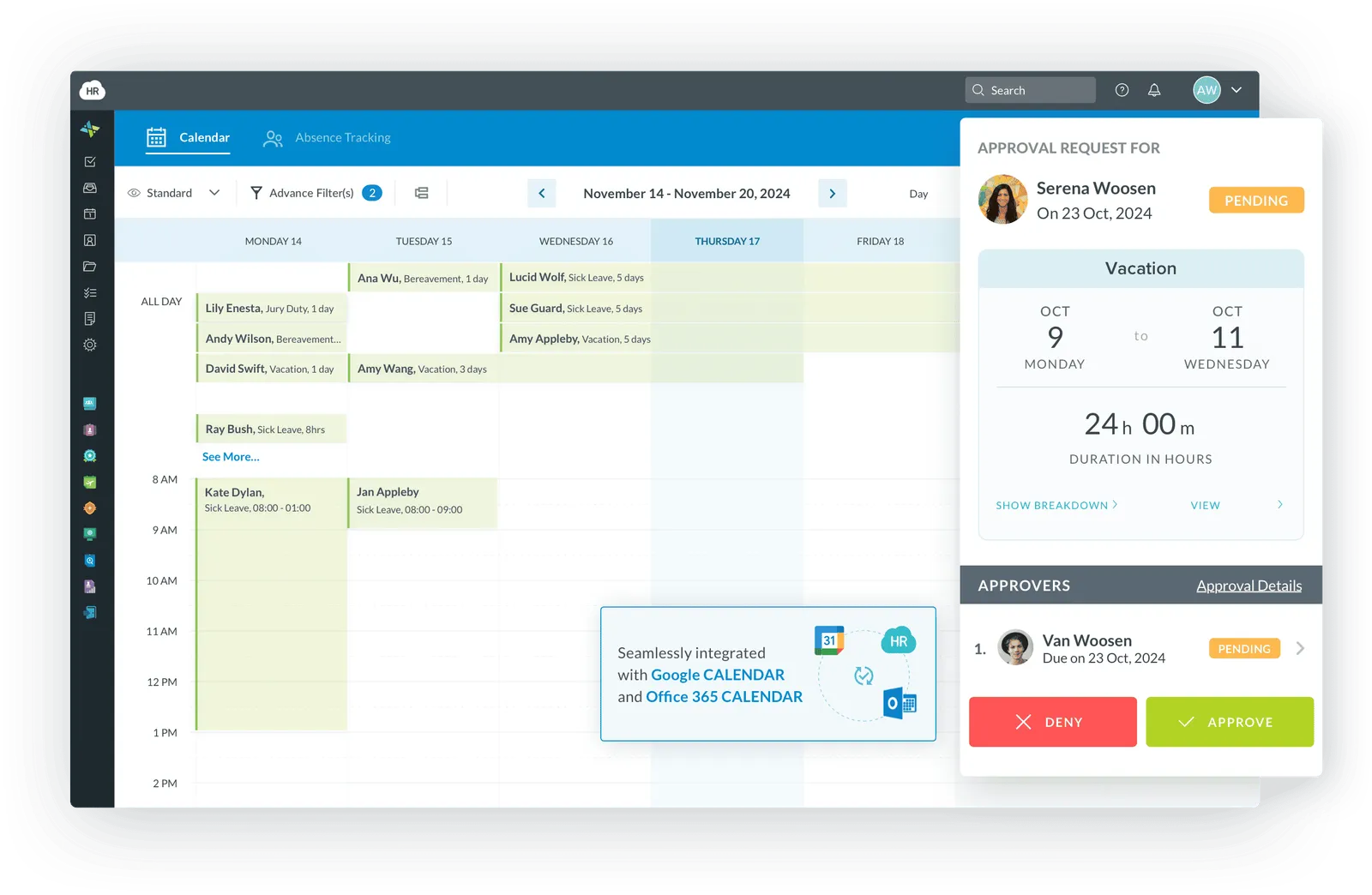
HR Cloud automatically tracks PTO balances, requests, approvals, and employee time off so HR doesn’t have to calculate it manually.
- Automatic PTO balances
- Employee time-off requests
- Manager approvals
- Real-time reporting