
3 HR Challenges for Multi-State Employers Solved

Is your company looking to expand and establish another office in a different state? If so, congratulations! It's exciting to be a part of a growing, thriving organization.
But with growth comes growing pains and multi-state employers face numerous challenges. Many times these challenges must be overcome by HR departments. In this blog, we'll discuss the three most prominent issues you'll likely face and give you tips to overcome them.
Key Takeaways
- Multi-state expansion creates immediate HR complexity. Every new state brings its own compensation laws, payroll taxes, overtime rules, and paid leave requirements — and HR is responsible for navigating all of them.
- When state laws conflict, always default to the most employee-friendly rule. The safest and most legally sound approach is to apply whichever regulation benefits your employees most.
- Maintaining company culture across locations is an active effort, not a passive one. It requires on-site HR representation, regular engagement activities, digital recognition, and technology that connects distributed teams.
- Research before you expand. Understanding city and state laws before opening a new office prevents costly compliance issues and protects your ability to attract talent in that market.
- Technology is your best tool for multi-state HR management. The right employee engagement platform, HRMS software, and digital recognition tools can bridge the gap between locations and keep your workforce connected and compliant.
Challenge #1: Providing Adequate Compensation
Every state has different laws regarding compensation. While the national minimum wage has been regulated to $7.25, many states, counties, and even cities have their own compensation requirements.
But that's not all. To further complicate matters, it's likely that the location of each new office your company opens will also have to adhere to varying payroll taxes, overtime and paid leave regulations. Talk about an HR headache!
Fortunately we have a few tips to help you navigate the compliance issues you're bound to encounter when attempting to open an out-of-state office.
| Focus Area | Tip | Why It Matters |
|---|---|---|
| Research & Preparation | Research the city laws in each of the locations that management is considering for a new office. Understand where your company may run into problems and how the HR department can help with an engagement action plan. Being prepared will go a long way. | Applies to all three challenges — getting ahead of issues early prevents costly surprises. |
| Compensation & Payroll | Balance location regulations as well as cost of living in the city where your new office will be located. Consider outsourcing payroll to a reputable company to manage multi-state payroll laws. | Ensures competitive salaries and frees HR to focus on engagement initiatives. |
| Overtime & Paid Leave | Study the applicable laws in each region and meet all standards. Consider enacting a company-wide policy that adheres to the more generous state obligations. | Simplifies compliance across locations and protects employees in every state. |
Challenge #2: Maintaining Company Culture
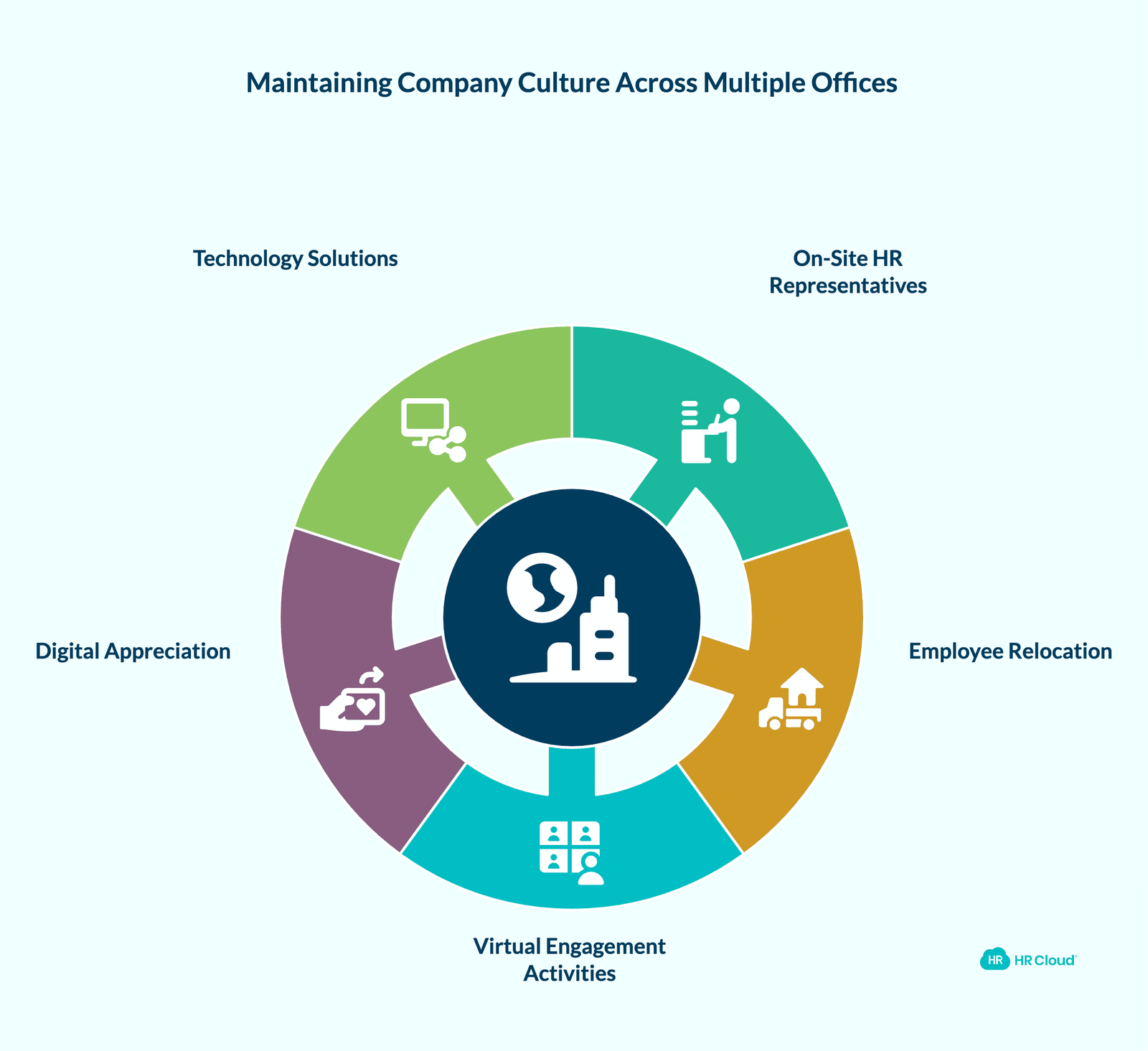
Besides addressing compliance issues inherent with multi-state employers, HR is also responsible for maintaining company culture across multiple offices. Offices that are sometimes separated by thousands of miles. This challenge becomes even more critical when considering remote employee engagement and motivating remote workers who may feel disconnected from the main office. Is it even possible?
Of course it is! It might not be easy, but the following tips will help you keep your company culture strong and thriving.
- Try your best to have at least one on-site HR rep at each location. Depending on the size of the new office, more than one rep may be needed. And make sure that the rep you assign to the new location has been with your company for a while and understands the culture. That way they can begin implementing it and hiring new talent who properly fit the mold of your organization. These reps should also focus on remote worker appreciation and implementing employee recognition ideas that resonate across all locations.
- A great way to maintain company culture is to relocate current employees (like the HR rep we mentioned in the above tip) to your new office. You might be surprised how many team members are interested in the idea. But employee relocation can be expensive. We recommend creating a relocation policy that addresses what your company is willing to provide when employees relocate and includes a "payback clause". That way your company can recoup costs if a team member bolts soon after relocation.
- Implement regular employee engagement activities and conduct employee engagement surveys to gauge how well your culture is translating across locations. Consider organizing virtual team building exercises, virtual team challenges, and even a virtual awards ceremony to celebrate achievements across all offices. These employee engagement initiatives help bridge the distance between locations and create a sense of unity.

Don't forget about employee appreciation ideas that work across distances. Digital gift cards are an excellent tool for virtual employee appreciation, allowing managers to recognize outstanding performance regardless of location. Pair these with digital employee recognition programs that highlight achievements company-wide.
- Lastly, make use of technology. There are amazing tools available today that allow distributed teams to communicate seamlessly and all but erase the miles between them. From in-depth HRMS software to choosing the right employee engagement platform that connects all your locations, research and invest in technology solutions that will allow multiple locations to work together with ease. Video conferencing applications and digital recognition tools are also essential components of your tech stack. Schedule regular virtual team meetings and encourage virtual coffee breaks to maintain personal connections. These simple touches go a long way in motivating remote workers and maintaining the human element of your company culture.
Download your free remote team culture reset checklist
Get actionable tips to realign, re-engage, and re-energize your remote team—starting today.
Download Now
Challenge #3: Navigating Contradictory Laws
There will be times where state laws contradict each other. For example, we mentioned earlier that the national minimum wage is $7.25. But in Wyoming, the minimum wage is set even lower at $5.15. Which regulation do you abide by?
When companies have multiple locations in different states, HR departments will encounter contradictions such as these regularly. Fortunately, the solution is fairly simple: always abide by the law that is most generous to the employee.
So in our above scenario, you would commit to paying workers no less than $7.25 an hour because that is the figure that benefits your staff most.
Over To You
There you have it; the three most prominent challenges multi-state employers face and how to solve them. As part of the HR team at your company, these tips will be invaluable to you as you help your organization expand to new locations.
Remember, no matter what problem you're facing, getting ahead of the issues and researching potential roadblocks before any major decisions are made is paramount. That combined with the other points made in this post will ensure your new office is up and running in no time!

Experience how Workmates can transform communication and strengthen culture—all in one powerful platform
Book Your Free DemoFAQs
1. What are the biggest HR challenges for multi-state employers?
Multi-state employers face three core challenges: managing different compensation laws, maintaining consistent company culture across locations, and handling conflicting state regulations. Each state introduces unique payroll taxes, overtime rules, and compliance requirements, making HR operations more complex. Without centralized systems, these challenges lead to errors, compliance risks, and poor employee experience.
2. How do companies stay compliant with different state labor laws?
The most effective approach is to follow the most employee-friendly regulation when laws conflict. HR teams must research state-specific requirements in advance and standardize policies accordingly. Using an HR platform like HR Cloud helps automate compliance tracking, document management, and policy enforcement across multiple locations.
3. How can HR software help manage multi-state workforce compliance?
HR software centralizes employee data, automates workflows, and ensures compliance with varying state laws. Platforms like HR Cloud streamline onboarding, payroll coordination, and document tracking while reducing manual errors. This allows HR teams to manage multiple locations efficiently without relying on spreadsheets or disconnected systems.
4. What is the best way to maintain company culture across multiple locations?
Maintaining culture requires intentional effort, not passive communication. Companies should assign HR representatives at each location, run regular engagement initiatives, and use digital recognition tools. Platforms like HR Cloud’s Workmates enable real-time communication, employee recognition, and engagement across distributed teams.
5. How do you handle conflicting labor laws across states?
When laws conflict, companies should apply the rule that provides the greatest benefit to employees. This reduces legal risk and ensures consistency. A centralized HR system helps enforce standardized policies and track compliance across all locations without confusion.
6. Why is onboarding critical for multi-state employers?
Onboarding ensures compliance from day one and sets the foundation for employee experience. Multi-state employers must manage different documentation, policies, and requirements for each location. HR Cloud’s onboarding solution automates these workflows, ensuring employees complete all requirements before their start date.
7. What tools are essential for managing a multi-state workforce?
Key tools include:
- HRIS for employee data management
- Onboarding software for compliance workflows
- Employee engagement platforms for culture
- Document management systems for audits
HR Cloud combines all these tools into one platform, reducing system fragmentation and improving efficiency.
8. How can companies scale HR operations when expanding to new states?
Scaling HR requires preparation, standardized processes, and the right technology. Companies should research regulations before expansion, implement consistent policies, and use automation to handle repetitive tasks. HR Cloud enables scalable workflows, compliance tracking, and employee engagement across all locations from a single system.
About the author

Keep Reading


Like What You Hear?
We’d love to chat with you more about how HR Cloud® can support your business’s HR needs.
Book Your Free Demo