
4 Most Effective Hiring Strategies for SaaS Companies

With everything that 2022 has to offer, we believe now is a great time to rethink the HR and recruiting strategy in your SaaS business. We will discuss how AI and machine learning will change the HR industry, whether internal mobility is a thing, and how to get the most out of SEO. We have outlined four trends that will make 2022 a year to thrive, focusing on improving retention rates and employee engagement.
1. Taking Advantage of SEO
Building an SEO strategy for your SaaS niche will bring you success in the long run. As the success of your SEO efforts highly depends on what strategies you use, it is better to work with an experienced SaaS SEO agency, especially if you are a newbie in the world of SEO. While some companies rely on performance marketing, they still depend on paid advertising. However, by staying on top of the latest trends and best practices, you can ensure that your SaaS marketing campaigns are always successful.
On the other hand, thorough SEO ensures the traffic keeps coming even if the advertisement stops. Considering that SaaS is mostly a digital product that is not restricted to a certain location, it broadens the search and is great to expand with the help of SEO. Furthermore, digital product development services play a critical role in this scenario. These services allow for constant innovation, upgradation, and maintenance of the SaaS product, ensuring it remains competitive and relevant in the market. With professional assistance from such services, SaaS companies can effectively enhance their digital presence, thereby increasing the effectiveness of their SEO strategies. Moreover, when it comes to content, there's the option to work with a content marketing agency for SaaS which will help achieve more professionalism and success in the long term.
We prepared a list of the most helpful tactics you can adopt in your SaaS business — make them a part of your marketing plans in 2022 and see the difference in your bottom line within a year. These performance metrics will help you track your hiring success.
Optimize for Google’s Job Search
Many candidates simply put what they are looking for in Google when searching for a job. Google's Job Search is what they see first, which means you can take advantage of it and make sure candidates see your job offer first. This creates a powerful first impression for potential applicants.
Post jobs both on the company website and job board — this way, your company’s website posting will be prioritized. You can also use Google's structured data guidelines. If you follow these rules, your job listings will appear correctly, making it easier for hiring managers to attract qualified candidates.
Target competitor keywords
One of the most effective ways to attract relevant leads to your website is to target competitors’ keywords. You can do that with the AdWords competitor targeting tool that allows you to bid on your competitor’s target terms. Use keywords related to the job search or career pages and get more chances to interact with your target audience.
Going forward, you can even analyze paid campaigns of your competitors with a competitive research tool from SE Ranking.
It shows their paid strategy and lets you find other brands based on similar keywords, get traffic forecasts, and more.
Enhance your career page
Once you have the content in place, it is time to take care of the SEO. Your career page creates the first impression for potential candidates, so optimization is crucial:
- Make sure your page is indexable to drive more traffic to it. You may start by ensuring that it is easy for the Googlebot to crawl your website. Crawling means following hyperlinks to discover new content.
Check SERP (Google) snippets. You can optimize for SERP features by making sure you have relevant content that answers what, when, why, and how questions.
- Ensure there are no broken links on your page so that people who run across you on the search get what they need. This maintains role clarity and helps candidates understand available positions.
- Have a mobile-friendly website. As Statista shows, over 54% of all traffic came from mobile in 2021. Businesses must pay more attention to device adaptability. Your website should be mobile-friendly so that potential clients can easily scroll through the pages, find the information they need, schedule a call, or easily make some other call to action.
2. Building a trustful company reputation
When we are talking about the company’s reputation, we cover terms such as employee value proposition, employer branding, and company culture. These elements directly impact employee engagement, employee satisfaction, and ultimately your retention rates.
Company culture is what your teams share: goals, vision, attitudes. It includes everything that characterizes an organization and shapes the employee journey from day one.
On the other hand, the employee value proposition (EVP) is the promise the company gives to potential employees: benefits, work conditions, and more. A strong EVP is one of the most effective retention strategies that reduces employee turnover and the associated cost of turnover.
You can get inspired with the SE Ranking — as an SEO agency, it adopts solid working strategies and uses them to attract relevant candidates.
You can see everything you need to understand what the company wants to convey with a clearly stated mission and values. The page gains the reader’s trust before presenting open vacancies, leaving space for an action step and further interaction. This approach positively influences employee sentiment from the very beginning.
Employer branding shows the values, mission, purpose, and culture to the world.
Think about Google. If I were to ask you how it would be to work there, what would first come to your mind? Most likely, your opinion is based on different stories you have heard, posts you have read, and everything that caught your attention on the internet. That is what employer branding is.
In this way, EVP answers the question “Why?” while employer branding defines “What” and “How.”
Your branding, social appearance, and career page give candidates an understanding of whether your culture is the right fit on a subconscious level. The candidate can get to know your company through its values and social attitude and get interested in working with you specifically.
Let’s look at an example with a restaurant chain that managed to expand during COVID-19 times — Chipotle.
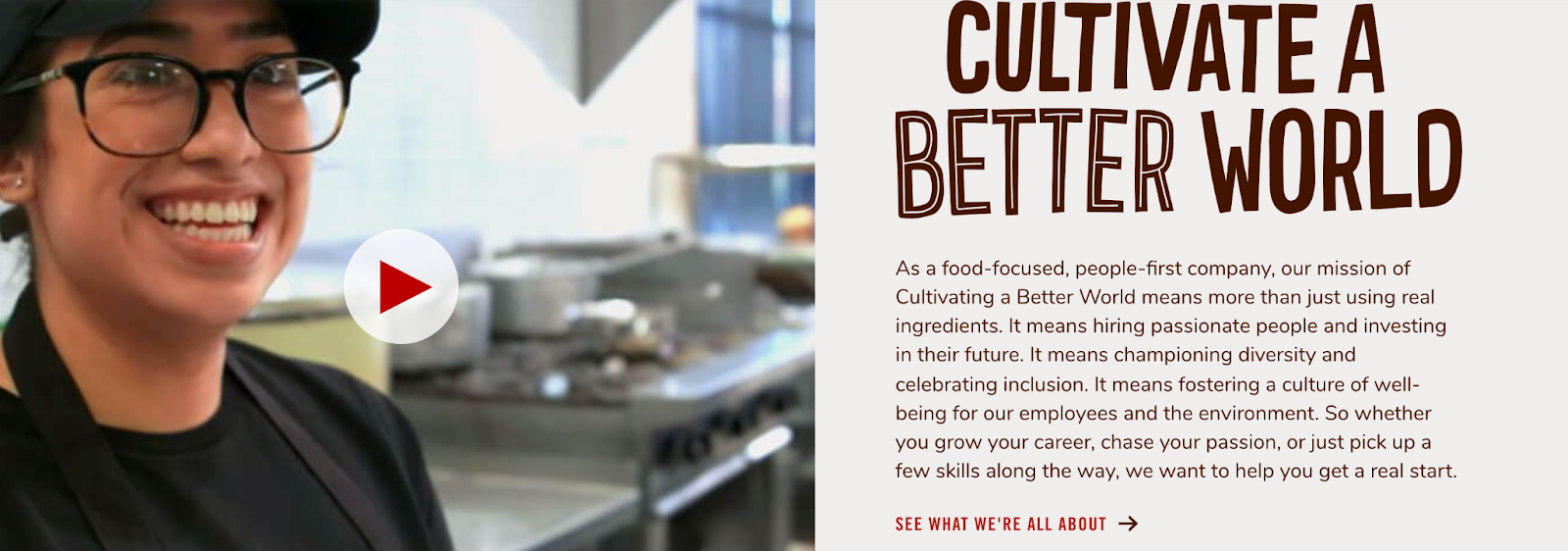
Right at the top of the company’s page, you can find a clearly stated mission focusing on people. Their values are embedded into the description: Chipotle supports diversity, well-being, and employee benefits. This is how they define their EVP, which drives their work and minimizes retention risk.
With clearly stated values, mission, and social involvement, you have higher chances to attract more relevant candidates to your website and inspire them to apply. Adding social proof, testimonials and awards will show you as a trustworthy organization: use this option to connect with potential candidates from the very start.
Specialists will be excited to work with you when you have a well-built strategy like this in place. Moreover, it will help you attract solid customers and retain your existing ones, lowering employee turnover and strengthening relationships in the company while improving overall employee satisfaction.
3. Adopting Data-Driven HR
Machine learning is here to stay, and HR is moving to the next generation of automation with it. IBM believes that data-driven decision, powered by AI, is one of the key pillars of the new HR generation. Such a concept allows HRs to make evidence-based decisions and reach a level of efficiency that would not be possible otherwise. Advanced analytics and automation tools have become great sources to drive efficiency, predict and prevent further challenges, and stay agile in the ever-changing business world. These tools enhance performance management and provide valuable performance feedback.
Currently, only 10% of companies have adopted AI-based technologies for HR, which allows you to start the new year with a big advantage. Most HR specialists spend countless hours manually processing and analyzing results — instead, they can focus on expanding business value and improving employee productivity.
Using machine learning in their job is a great chance for recruiters to shift priorities, spend less time performing manual tasks, and spend more time developing relationships with potential candidates. The average number of applicants for a position rose by 39% in 6 years, Gartner Recruiting Efficiency Survey states. Recruiters need even more time reviewing CVs, which slows down the hiring process, not to mention the cost per hire keeps increasing. Implementing performance tracking systems and establishing clear performance expectations can streamline this process.
You can benefit from AI technologies thanks to the tools already developed. We are sharing some of them below.
- Fetcher’s solution helps companies reach hiring goals by offering tools that ensure diversity, measure team metrics, and make candidates’ profiles easy to read. It supports manager engagement throughout the recruitment process.
- Humanly application has one of the highest rates from candidates. It facilitates candidates’ screening and selection process, finding relevant and strong candidates, and reducing average time-to-hire while improving time to productivity.
- Arya focuses on candidate sourcing, letting you add multi-channel sourcing, automated candidates search, and analyze previous sourcing processes with detailed performance metrics.
- Pymetrics platform has a modern approach based on AI and ethical design principles that work in two directions: talent acquisition and talent management. It helps establish performance goals and provides continuous feedback throughout the employee lifecycle.
Let’s sum up the main advantages of adopting AI and machine learning for your SaaS business:
- A combination of human and AI effort leads to better decisions and more effective performance management
- Enhance the hiring process by leveraging AI, stepping aside from manual candidates screening and application processing
- Enhance the experience of candidates and employees, improving the reputation of the business and boosting employee engagement
- Focus on what matters the most, developing business values in your SaaS niche while establishing feedback loops for continuous improvement
- Utilize performance review questions and performance tracking to measure success and identify areas for improvement
4. Retention and internal mobility
You might have struggled with implementing internal mobility during the pandemic as priorities were different then. However, this year everything seems to return to its usual pace.
While finding external candidates remains a priority, retaining existing ones should also become a focus. A comprehensive employee onboarding strategy combined with strong retention strategies can significantly improve new hire retention and reduce new hire turnover.
Internal mobility has a lot to do with digital transformation, especially true for the SaaS niche. Since the pandemic, most businesses have gone online, significantly expanding the hiring process. Now, when geographical location is not an obstacle anymore, candidates have much more space to look for better opportunities.
Internal mobility makes it possible for you to retain talented specialists, even if they decide to shift their careers. Moreover, specialists love how easy it is to get knowledge from the company — the more you can offer through employee training and a robust learning management system, the greater chances talented candidates will stay with you. This approach supports career development and employee development while maintaining high retention margins.
Implementing a structured onboarding program is essential for success. A well-designed onboarding process should include:
- A comprehensive onboarding plan that covers the first 90 days, ideally structured as a 30-60-90-day plan with clear milestones
- An onboarding template that ensures consistency across all new employee onboarding experiences
- An onboarding buddy system to facilitate team collaboration and help new hires build employee confidence
- An onboarding platform or digital solution to track onboarding completion rate and measure onboarding effectiveness
- Onboarding best practices that create a positive onboarding experience and contribute to onboarding success
- A clear onboarding framework that defines role clarity and sets performance expectations from day one
The onboarding journey is critical to the overall employee journey. A structured onboarding strategy ensures that new hires understand their performance goals and receive the support they need during their onboarding experience. This comprehensive approach to the onboarding process improves the onboarding effectiveness and creates a strong foundation for long-term success.
Yet, you should understand that such a strategy requires lots of effort, both for employees and specialists who will need time to onboard an internal candidate. Before you dive into internal mobility, make sure you have enough resources. Ideally, a combination of external and internal candidates’ searches will bring the most effective results while maintaining high employee satisfaction and strong retention rates.
Summary
Whether your business is just beginning or has been a part of the game for a while, it is high time to look at your strategy. Some of the changes may not be visible at first (such as SEO), yet they will ultimately bring amazing results. Adopting AI in your work and investing in your people through comprehensive employee onboarding, continuous performance feedback, and effective retention strategies will allow your company to expand even in the most unpredictable times. By focusing on the complete employee journey—from new employee onboarding through career development and performance management—you’ll create a workplace that attracts top talent and maintains excellent retention rates while minimizing the cost of turnover.
Author Bio: This article is written by a marketing team member at SE Ranking. SE Ranking is an all-in-one SEO solution that helps business owners and agencies fast-track every search engine marketing task that includes keyword suggestions, check rankings, search competitors, and other helpful features.
Keep Reading


Like What You Hear?
We’d love to chat with you more about how HR Cloud® can support your business’s HR needs.
Book Your Free Demo