Why HR Teams Switch from BambooHR After 200 Employees

This article explores why many HR teams outgrow BambooHR as they scale beyond 200 employees. As workforce complexity increases, organizations often require more advanced onboarding, workflow automation, employee engagement, analytics, and cross-functional integrations than basic HR systems can provide. The blog examines common growth challenges, key limitations growing companies encounter, and the features HR leaders should prioritize when evaluating a more scalable HR platform that can support long-term business growth and employee experience initiatives.
HR teams often begin evaluating alternatives to BambooHR once they reach 200+ employees — commonly because per-employee pricing scales linearly with headcount, workflow customization has a defined ceiling, native payroll only supports US-based employees, and reporting tools are optimized for operational snapshots rather than strategic analysis. These aren't design flaws — they reflect who BambooHR was built for. The challenge appears when a company's needs grow beyond that original scope.
You likely chose BambooHR for good reasons. It's clean, it deploys quickly, and for teams under 100 people it covers the essentials without a heavy implementation lift. BambooHR is consistently well-rated by small and mid-sized businesses for exactly that use case.
The question isn't whether BambooHR is a good product. It's whether it's the right product for the stage you're at now.
At 200 employees, HR stops managing individual tasks and starts managing operating risk across systems, managers, locations, and new hire readiness. Compliance requirements become multi-layered. Onboarding volume increases. Approval chains branch across departments and locations. HR leadership is expected to bring workforce analytics to executive conversations — not just headcount exports. When those needs outpace what the platform was designed to handle, the friction becomes predictable. That's when HR teams start looking.
The goal is not to prove BambooHR is wrong for everyone. It is to help you spot when your HRIS stops reducing work and starts creating workarounds.
Key Takeaways
• BambooHR's per-employee pricing scales linearly with headcount. Based on third-party buyer reports compiled by OutSail (2025) and CheckThat.ai (2026), pricing runs approximately $10/employee/month on Core, $17 on Pro, and $25 on Elite — before add-ons like payroll and time tracking, which are priced separately.
• Platform fit, not platform failure. BambooHR is consistently well-reviewed by small businesses. The limitations documented in this post reflect design choices appropriate for SMBs — not product defects. The issue arises when a company's complexity grows past the use case the platform was designed for.
• The 200-employee threshold typically introduces HR complexity that requires conditional workflow logic, multi-location compliance tools, and strategic reporting — capabilities that go beyond BambooHR's core design.
• Use the self-assessment checklist in this post to identify whether you've hit the ceiling — most HR teams recognize 4+ signals before they begin a formal evaluation.
• Migration is more manageable than most expect. HR Cloud's average go-live is 6 weeks from kickoff, with HR Cloud's implementation team handling all workflow configuration and form mapping. MCO onboarded 2,000 employees in five days using HR Cloud's Onboard solution.
• Already in the alternatives stage? The BambooHR Alternatives guide is the faster read.
What Changes at 200 Employees That Affects Platform Fit
BambooHR positions itself as HR software built for small and medium-sized businesses — and that positioning is accurate. The product is deliberately designed for that segment, and it performs well within it.
What changes at 200 employees isn't BambooHR — it's the operational profile of the company using it.
At 50 employees, HR is largely about keeping records organized, managing PTO, and getting new hires through paperwork before Day 1. At 200 employees, the work looks different. You're managing multiple locations with varying state-level compliance requirements. You're running onboarding in cohorts, not one person at a time. Approval workflows need conditional logic to route correctly across departments. And HR leaders are expected to contribute to executive planning with workforce data, not just run point-in-time headcount reports.
Here's how those requirements map to platform fit:
| Company Stage | Core HR Requirements | BambooHR Fit |
|---|---|---|
| 1–50 employees | Basic records, PTO, new hire paperwork | Strong |
| 51–150 employees | Light automation, ATS integration, simple onboarding | Adequate |
| 151–250 employees | Multi-location compliance, custom workflows, workforce analytics | Starts to strain |
| 250–500 employees | Full workflow automation, global payroll, advanced reporting | Notable gaps |
| 500+ employees | Enterprise compliance, predictive analytics, multi-entity HR ops | Outside intended use case |
The 200-employee mark matters because it's typically where HR team structures evolve from one or two generalists to a functional team with specializations — and where a platform that can't support that depth starts generating workarounds instead of reducing them.
At this stage, the HRIS problem is no longer recordkeeping. It is execution: who has completed what, what is missing, which manager is blocking progress, and whether a new hire is actually ready before Day 1.
Why this matters for your planning: Most organizations don't identify the ceiling until they're already several months past it. The workarounds become embedded, and the cost of friction becomes invisible through familiarity. Evaluating alternatives before a breaking point — rather than during one — gives you more time and leverage.
What Are the Most Common Reasons HR Teams Leave BambooHR?
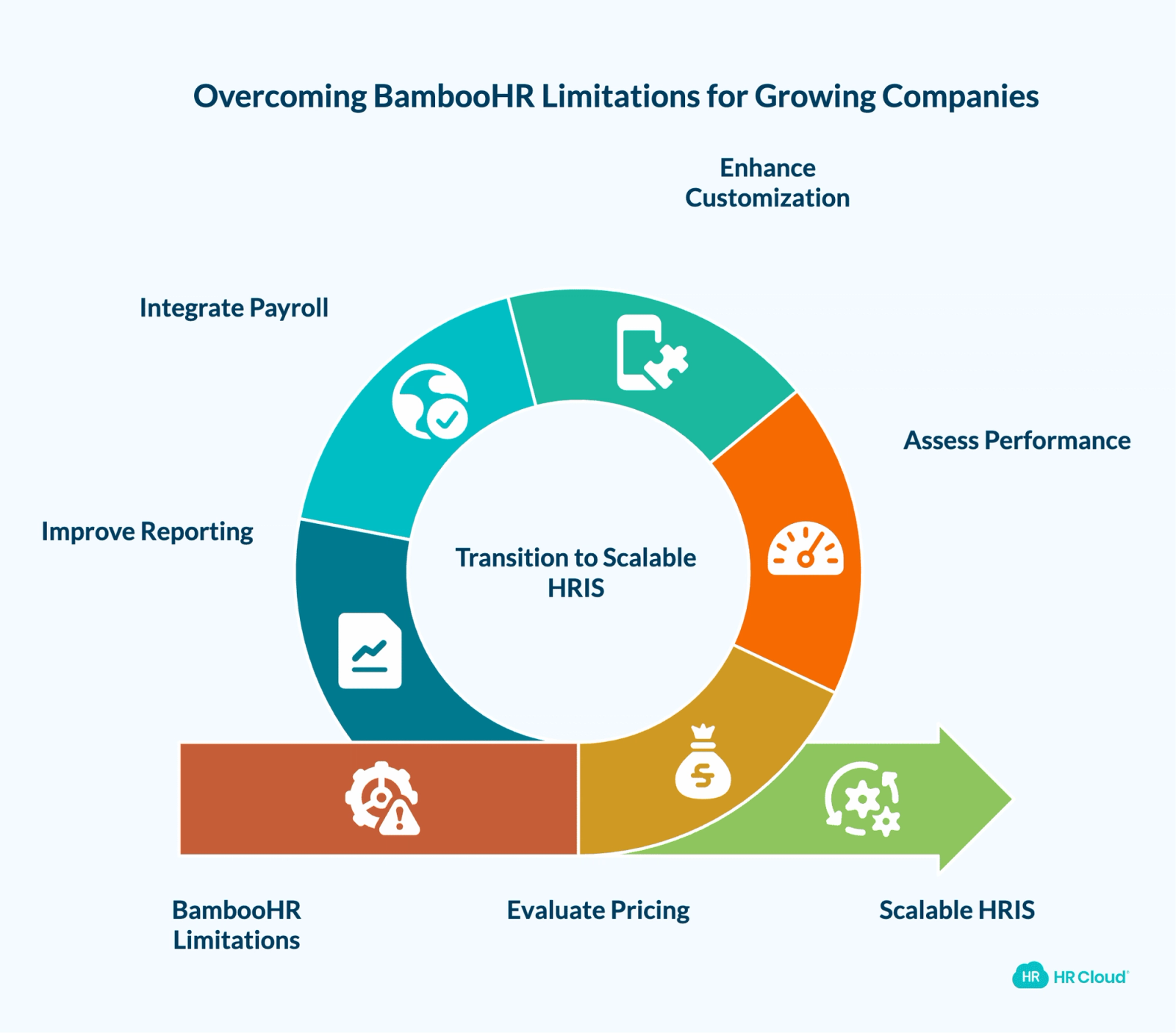
Common themes in public review data on Capterra and GetApp and in third-party buyer reports become more relevant as company size and operational complexity increase. Five patterns surface most often:
1. Per-employee pricing that scales linearly with headcount — cost compounds with every hire, before add-ons
2. System performance that can strain under high-volume conditions — at scale, platform reliability during peak periods matters more
3. Workflow customization with a defined ceiling — conditional logic, field editing, and report depth hit limits as org complexity grows
4. International payroll requiring third-party partners — BambooHR's built-in payroll is US-only; global options exist but through separate vendors
5. Reporting designed for operations, not strategy — standard reports cover headcount and PTO; strategic workforce analytics require workarounds
1. Per-Employee Pricing That Scales Linearly With Headcount
BambooHR does not publish pricing publicly — all quotes are delivered through a sales process. Based on third-party buyer reports compiled by OutSail (2025) and CheckThat.ai (2026), pricing runs approximately $10/employee/month on the Core plan, $17 on Pro, and $25 on Elite. Teams with 25 or fewer employees pay a flat $250/month minimum regardless of tier.
The linear scaling model is the core issue for growing organizations. Every new hire directly increases your software costs at the same rate. And that baseline doesn't include capabilities many mid-market HR teams need — performance management and time tracking are sold as separate paid add-ons, confirmed directly on BambooHR's FAQ page.
Multiple reviewers on Capterra and GetApp note that this opacity is one of BambooHR's hidden costs in a less obvious sense: because getting an accurate quote requires a sales call, budget forecasting is difficult ahead of renewal cycles — and renewal increases tied purely to headcount growth are rarely visible until the invoice arrives.
Why this matters: For companies in active growth mode, a pricing model that scales at the same rate as headcount — before accounting for add-ons — can make future cost planning unpredictable. Model your BambooHR cost at your projected headcount 12 and 24 months out before your next renewal conversation.
2. System Performance That Can Strain Under High-Volume Conditions
BambooHR's overall performance ratings are strong, particularly for day-to-day HR tasks at smaller scale. However, some public reviews on Capterra mention that system performance can strain under high-volume conditions — specifically during large report pulls, batch onboarding periods, and high-activity enrollment windows.
Common patterns in public review data include slow load times when generating complex reports, occasional sync delays with integrated payroll systems, and UI inconsistencies during onboarding workflows at volume.
At 50 employees, a system hiccup is a minor inconvenience. At 200 employees running a cohort onboarding the same week as open enrollment, that same hiccup becomes a material operational risk. HR teams at scale need platform reliability precisely when activity peaks — which is the same time performance constraints are most likely to surface.
Why this matters for your team: HR's credibility with department leaders is partly built on data availability and system dependability. Unpredictable platform behavior at critical periods — even occasionally — creates downstream consequences that extend beyond IT.
3. Workflow Customization With a Defined Ceiling
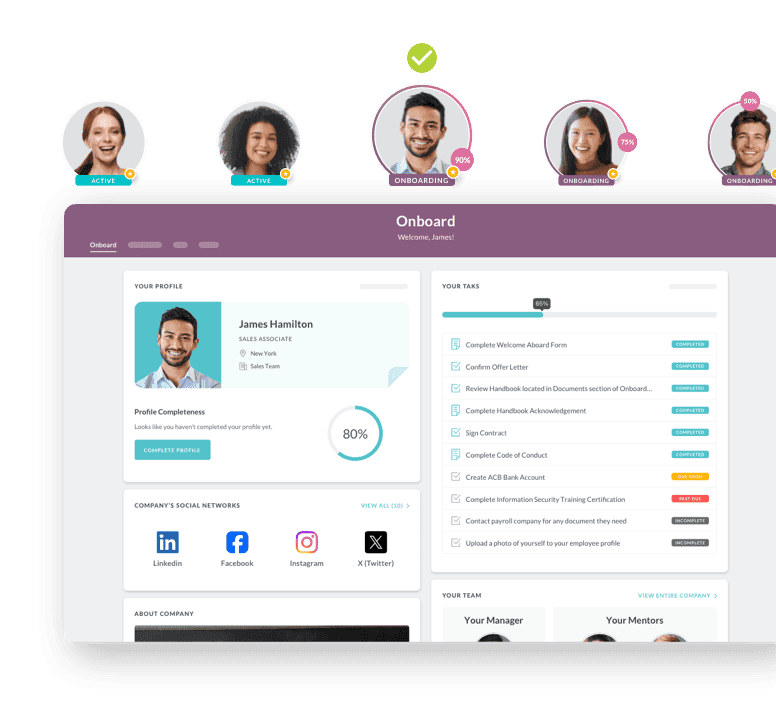
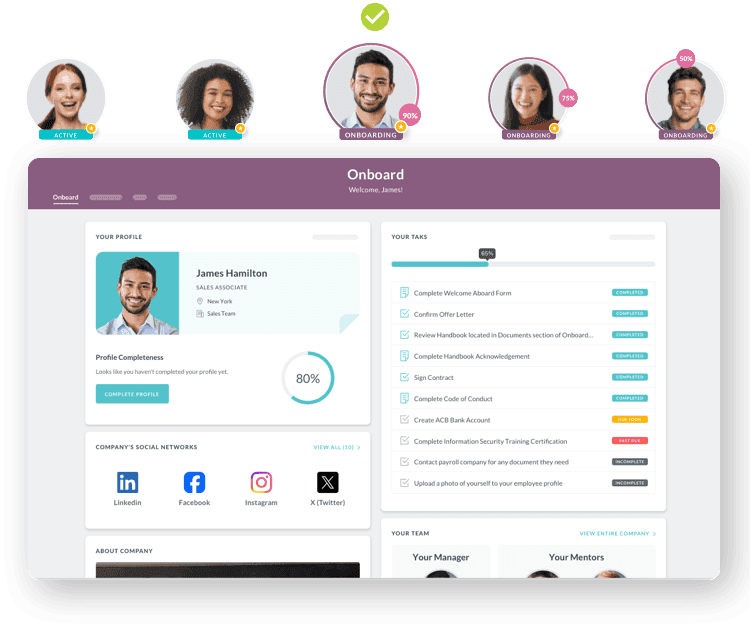
BambooHR's workflow configuration is designed to be accessible without technical expertise. That's a genuine advantage for smaller HR teams. It also means the toolset has defined limits that become more noticeable as organizational complexity increases.
Growing companies typically need onboarding workflows that branch by role, location, and employment type. They need approval chains with conditional routing based on compensation level or department. They need form logic that adapts based on prior responses. BambooHR's conditional logic capabilities are more limited than platforms designed for mid-market or enterprise configuration.
An HR consultant and tools implementation expert writing in a 2025 independent review noted that BambooHR's employee data fields are not self-editable — users need to contact BambooHR support to request field changes, which are then implemented on their behalf. At 200+ employees, routine configuration changes that require support tickets create meaningful delays.
There's also a documented ceiling in reporting: independent reviewers note that BambooHR generates an error notification when a custom report attempts to pull more than 75 fields — a constraint that limits the depth of workforce dashboards HR leaders can build for executive presentations.
Why this matters: When the platform constrains how you can design HR processes — rather than the other way around — that gap shows up as workarounds, manual steps, and time spent on administration that should be automated.
4. International Payroll Requires Third-Party Partners, Not a Native Solution
BambooHR's built-in payroll add-on is designed for US-based employees — confirmed on BambooHR's payroll page. US federal, state, and local tax filing are supported natively; international payroll is not.
For international payroll, BambooHR offers two paths — neither of which is a native built-in solution. The first is an Employer of Record (EOR) service powered by Remote, available in 90+ countries, priced separately at $199–$2,000+ per employee per month depending on country and employment type. The second is local payroll integrations for the UK, Australia, and New Zealand via Xero. Both options involve a separate vendor relationship and add-on cost on top of the base BambooHR subscription.
This means BambooHR functions as the HR record system while international payroll runs through a separate EOR or local payroll partner — with data syncing between them. That's workable for companies with a small number of international hires, but the coordination overhead and combined cost compounds as international headcount grows.
Why this matters at growth stage: The relevant question isn't whether BambooHR can support international employees — it can, through partners. The question is whether managing separate systems, separate contracts, and ongoing data synchronization is the right model for your team's scale and growth trajectory.
5. Reporting Designed for Operations, Not Strategy
BambooHR's reporting toolset covers operational HR well. Standard headcount reports, PTO balances, and turnover summaries are accessible without significant configuration. For a small HR team focused on record accuracy, that's adequate.
What it doesn't support as readily is strategic HR reporting. Growing organizations need turnover trend analysis segmented by manager, department, and tenure band. They need onboarding completion rates tracked by role and location. They need engagement data over time, not just as isolated snapshots. They need dashboards that can be shared with executive leadership without first exporting everything to a spreadsheet.
In practice, the reporting examples and user feedback suggest BambooHR is strongest for operational reporting. The 75-field report limit documented in independent user reviews is one signal — strategic workforce analytics typically requires more data dimensions than that ceiling allows.
Why this matters: HR's influence in a growing organization is built on its ability to translate people data into business decisions. Reporting limitations directly constrain that capability, and the gap between what HR can show and what executives expect tends to widen as headcount grows.
How to Tell If You've Hit BambooHR's Platform Ceiling
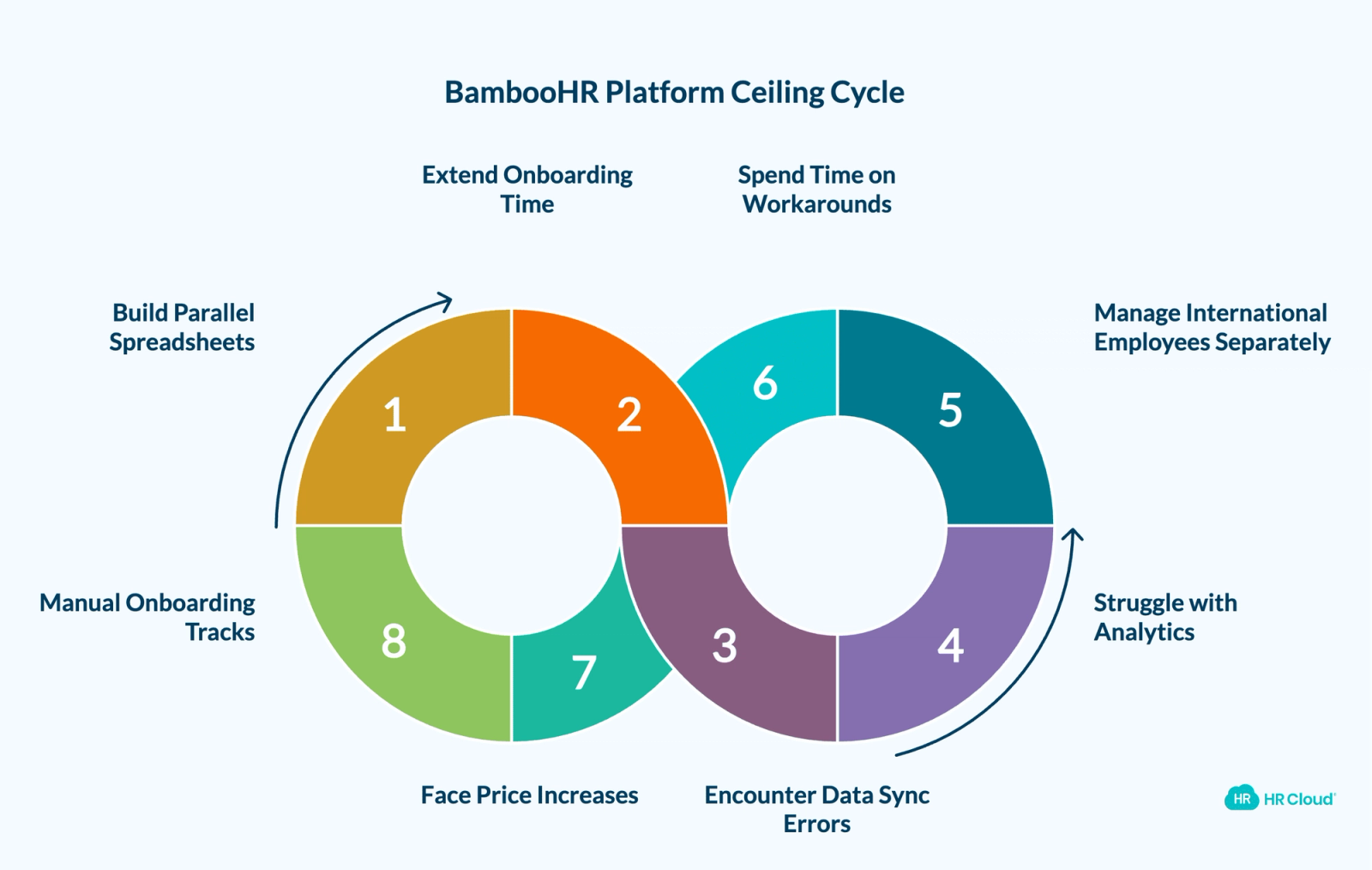
This checklist reflects the signals that most commonly precede a formal platform evaluation. HR leaders who have gone through an HRIS switch typically identify several of these in retrospect — often before they began actively looking.
Not sure whether you're experiencing normal HR friction or a platform ceiling? Run through this list first.
Signs you may have outgrown your current platform:
[ ] You've built spreadsheets that run in parallel to your HRIS to handle logic the system can't
[ ] New hire onboarding routinely takes longer than two weeks from offer acceptance to a fully configured record
[ ] Your payroll or IT team flags recurring data sync errors between your HRIS and payroll system
[ ] You can't generate a meaningful workforce analytics report without first exporting data to Excel
[ ] International employees are managed entirely outside your core HRIS
[ ] Your HR team spends more time on platform workarounds each week than on people strategy
[ ] You've received a renewal quote with a meaningful price increase driven entirely by headcount growth
[ ] Department-specific onboarding tracks are handled manually because the platform doesn't support conditional workflow branching
If you checked four or more: A formal evaluation makes sense now rather than later. The question is which platform and when, not whether.
If you checked two or three: You're in an early-signal window. Starting an evaluation now — from a position of stability — gives you better leverage than beginning one under operational pressure.
Pro tip: Before any vendor conversation, document every workaround your team has built. That list is more accurate than any RFP template you'll find online — it tells a platform vendor exactly what you need without the guesswork.
The ceiling shows up faster for deskless and multi-location teams. A 200-person software company and a 200-person healthcare, retail, construction, manufacturing, or education organization do not create the same HR workload. Frontline employees may not check email every day. Managers may be spread across locations. New hires may need documents, credentials, safety acknowledgments, equipment tasks, and location-specific steps before Day 1. When those steps live across email, spreadsheets, PDFs, payroll, and manager follow-up, HR becomes the manual system holding everything together — and the platform ceiling arrives well before the 200-employee mark.
What the Transition Actually Looks Like
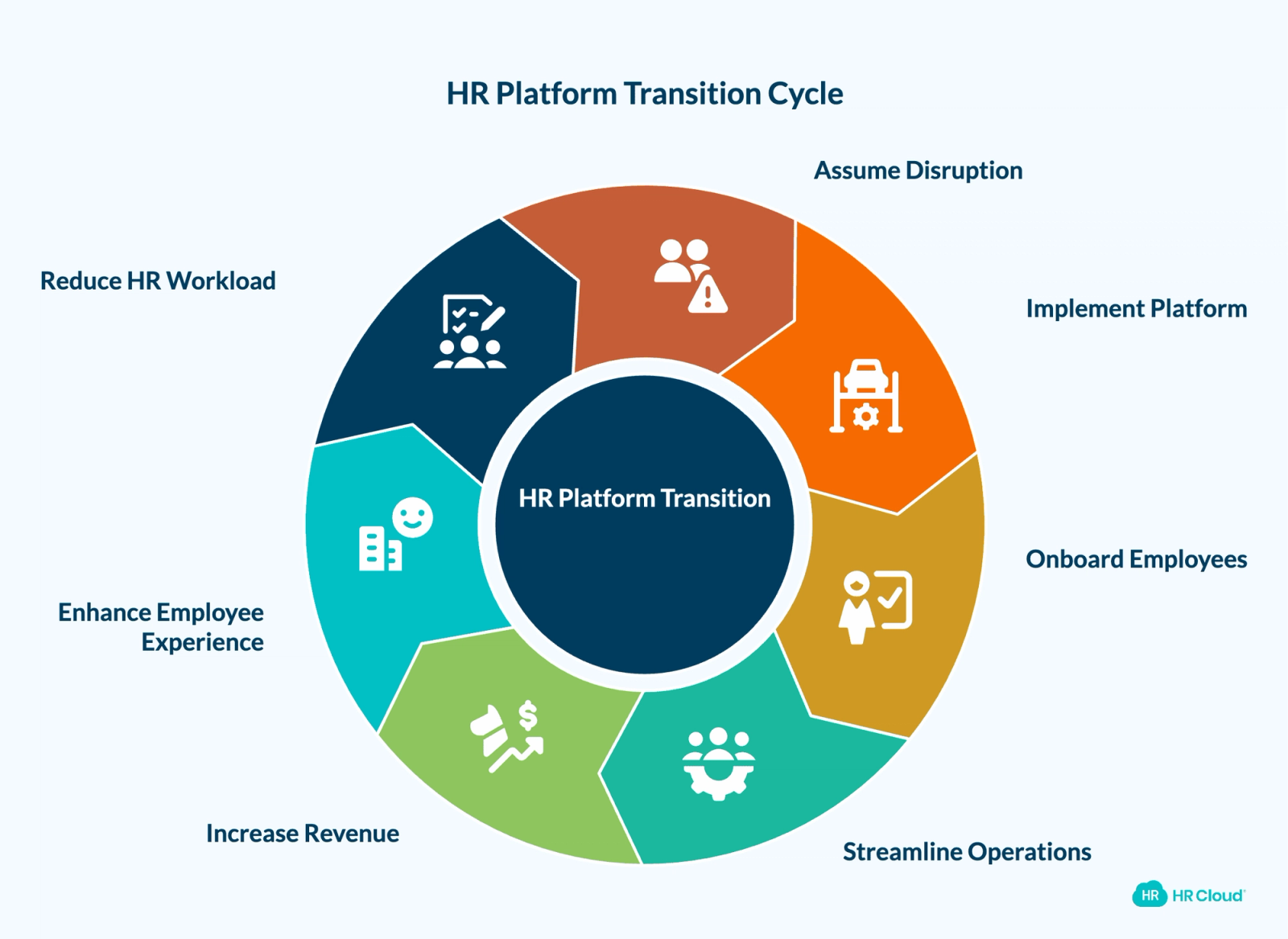
The most common reason HR teams delay a platform switch isn't cost or complexity — it's the assumption that migration will be disruptive. The reality tends to be faster and more manageable than that assumption, particularly when the platform's implementation team handles configuration rather than handing it back to HR.
MCO: 2,000 Employees Onboarded in Five Days
MCO, a portfolio management company, needed to onboard more than 2,000 employees across the US and Canada following the acquisition of La Senza. Their target was 80% completion — approximately 1,600 employees completing their agreements and formally onboarding — within five days of go-live.
Using HR Cloud's Onboard solution, MCO met that target. Hundreds of employees were completing onboarding tasks each day. "We initially wanted 80% of all 2,000 employees to complete their employee agreements and officially onboard in five days or less," said Ivana Placko, Product Manager at MCO. They achieved it.
The practical takeaway: at high volume, a trackable workflow is what prevents onboarding from turning into manual follow-up — and what allows HR headcount to stay flat even as the organization scales.
Interim HealthCare of Manassas: Revenue Doubled Following Migration
Interim HealthCare of Manassas migrated to HR Cloud from a legacy manual recruiting and onboarding process. The outcome wasn't just faster HR operations. Since implementing HR Cloud, Interim HealthCare doubled their revenue — a result they attribute to the streamlined hiring and onboarding process that enabled them to take on new clients and grow their caregiver team efficiently. Candidates could track their own progress and complete required tasks independently, reducing drop-off and improving the new hire experience without requiring additional HR staff time.
This is what the shift looks like operationally for a healthcare HR team managing high-volume hiring: instead of chasing paper forms and manually following up on incomplete onboarding packets, the system routes automated reminders, tracks completion by individual, and flags outstanding items before a new hire's first shift. HR moves from administration to oversight.
Typical Migration Timeline
| Phase | Typical Duration |
|---|---|
| Platform evaluation and selection | 2–3 weeks |
| Data migration and system configuration | 1–2 weeks |
| Pilot / soft launch with initial cohort | 1 week |
| Full deployment | ~6 weeks average from kickoff |
For context: BambooHR's own FAQ states implementation typically takes four to six weeks. HR Cloud's average go-live is also 6 weeks — comparable in timeline, but with HR Cloud's implementation team handling all workflow configuration and form mapping directly, so your HR team isn't rebuilding processes while running daily operations.
What to Prioritize When Evaluating What Comes Next
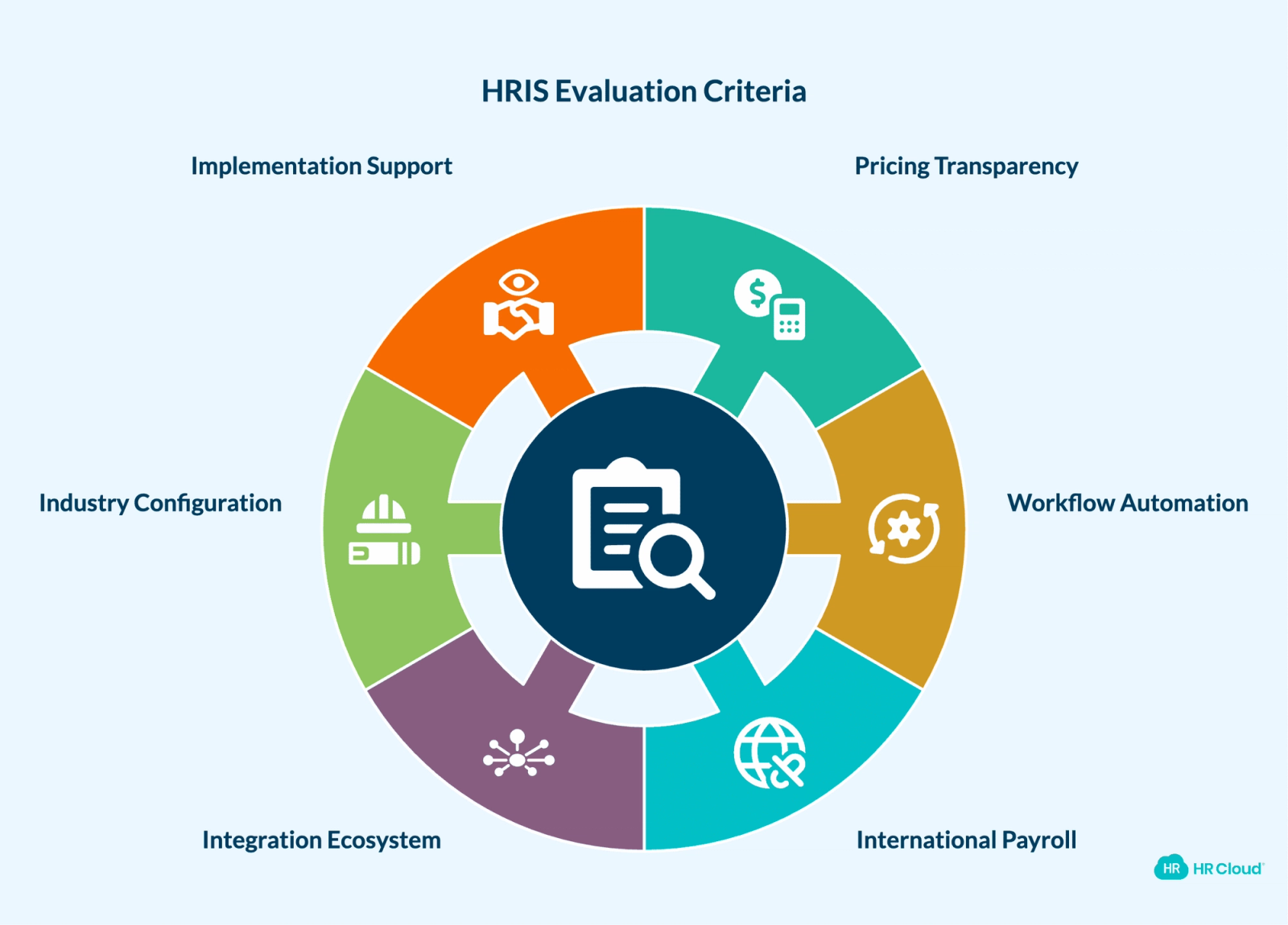
Evaluating a new HRIS after BambooHR is a different exercise than your original selection. You know what wasn't on your radar the first time. The criteria that matter at 200+ employees look different than at 50.
Six things worth evaluating in every vendor conversation:
1. Pricing transparency and structure. Does the vendor publish pricing, or does it require a discovery call? Is pricing modular — pay for what you use — or bundled with features you won't touch? Model the total cost at current headcount and at your projected headcount in 24 months.
2. Workflow automation depth. Can you configure role-based onboarding workflows and location-based onboarding workflows without involving IT? Can you build automated reminders, conditional task assignment, and document collection triggers? Don't accept a slide — ask the vendor to build one of your actual workflows live.
3. International payroll model. If you have international employees now — or expect to within 24 months — ask specifically: which system owns employee data, which partner handles payroll, and how do changes sync across countries and employment types when something changes mid-cycle?
4. Integration ecosystem. Does it connect with your payroll or HR system — ADP, UKG, Paylocity, Workday, or another platform your team already uses? Integration depth varies significantly between platforms. HR Cloud's ADP integration covers ADP Workforce Now, ADP TotalSource, ADP Vantage, and ADP RUN with direct API connections, not file imports.
5. Industry-specific configuration. Generic HRIS platforms apply the same configuration to every industry. If you're in healthcare, construction, retail, or education, you have compliance requirements, credentialing workflows, or onboarding patterns that benefit from a platform with live customers in your industry at comparable scale. Ask for a reference in your sector. If your switch is also partly driven by needing a stronger hiring-to-onboarding pipeline, ask specifically about ATS-to-onboarding handoff capability — that connection is where onboarding volume problems often originate.
6. Implementation model and post-launch support. Ask who manages configuration — vendor team or yours. Ask what support looks like after go-live. Ask references what happened after the kickoff calls were over. Weak implementations usually show up after the initial launch energy fades.
Download your free employee onboarding checklist
Using this checklist ensures that you are not scrambling to make the new employees feel welcomed, prepared, and set up for long-term success.
Download Now
Three Actions You Can Take in the Next 48 Hours
1. Run the self-assessment checklist with your HR team collectively. Each person's experience of platform friction is different — the combined list is usually more complete than any individual's. Four or more signals checked is a clear indicator to begin a formal evaluation.
2. Model your BambooHR cost at current and projected headcount. Pull your current contract including all active add-ons. Project that forward at your expected headcount in 12 and 24 months. If the number increases meaningfully without a proportional increase in capability, that projection makes the business case for switching significantly clearer.
3. Book a 30-minute platform conversation — bring your requirements list. Bring your documented workarounds, your headcount projections, and two or three specific workflows your current platform can't support. A credible vendor should be able to show you how those workflows operate in their platform before any commercial discussion begins. Schedule a free demo with HR Cloud — bring the list and we'll walk through exactly how those workflows would be configured.
Switching HR platforms is a real commitment of time and attention. But for organizations that have grown past the use case their current platform was designed for, the cost of staying — in workarounds, admin overhead, and reporting limitations — often exceeds the cost of making the change.
If you checked four or more boxes in the self-assessment above, the more useful question isn't whether to evaluate alternatives. It's whether to start from a position of stability now, or wait until a pain point forces the conversation.
HR Cloud is built for the 200–2,500 employee organizations that have outgrown SMB tools and aren't ready for enterprise-level complexity. Role-based onboarding workflows. Location-based task assignment. Automated document collection and reminders. Credential and compliance task visibility. Connects with payroll and HR systems including ADP, UKG, Paylocity, Workday, and more — helping HR manage onboarding, employee data, documents, and workflow visibility alongside the systems teams already use. 97% platform adoption rate and 7 hours of HR admin saved per week, with an average go-live of 6 weeks.
Show me how HR Cloud handles these workflows → Bring your requirements list. We'll walk through exactly how your workflows would be configured — no proposal required to see the platform in action.
Or if you're still in the research stage, the full BambooHR vs. HR Cloud comparison breaks down the differences in detail.

Discover how our HR solutions streamline onboarding, boost employee engagement, and simplify HR management
Book Your Free DemoFrequently Asked Questions
Why do HR teams leave BambooHR?
Common themes in public review data on Capterra and GetApp include per-employee pricing that scales linearly with headcount, workflow customization limits that require workarounds as org complexity grows, a native payroll system restricted to US employees, and reporting tools designed for operational snapshots rather than strategic workforce analysis. These reflect BambooHR's design priorities as a platform built for small and mid-sized businesses — not isolated product failures.
Is BambooHR suitable for companies with more than 200 employees?
BambooHR can support organizations with 200+ employees, and many do use it at that scale. However, public review data consistently documents that per-employee pricing becomes more costly as headcount grows, workflow customization hits defined limits as org complexity increases, and reporting depth becomes a constraint for strategic HR functions. BambooHR's own positioning focuses on small and medium-sized businesses, and its design reflects that.
How much does BambooHR cost per employee at scale?
BambooHR does not publish pricing publicly — all quotes require a sales process. Based on third-party buyer reports from OutSail (2025), CheckThat.ai (2026), and SoftwareFinder (2025), pricing runs approximately $10/employee/month on Core, $17 on Pro, and $25 on Elite. Teams of 25 or fewer pay a flat $250/month minimum. Performance management and time tracking are sold as paid add-ons on top of the base tier cost, confirmed on BambooHR's FAQ page.
How long does it take to migrate from BambooHR to another HRIS?
BambooHR's own FAQ states implementation typically takes four to six weeks. HR Cloud's average go-live is 6 weeks — comparable in timeline but with HR Cloud's team handling all workflow configuration and form mapping, so your HR staff isn't rebuilding the system while managing daily operations. MCO completed onboarding of 2,000 employees within five days of going live on HR Cloud.
What HR software do companies use after BambooHR?
Commonly evaluated alternatives include HR Cloud, Rippling, Paylocity, UKG Ready, and Lattice, depending on industry, growth stage, and primary requirements. HR Cloud is frequently selected by organizations in the 150–2,500 employee range that need role-based workflow automation, onboarding document collection, automated reminders, task tracking, and industry-specific configuration for healthcare, construction, retail, and education. See the full BambooHR alternatives comparison for a structured evaluation.
Does BambooHR support international employees?
BambooHR's built-in payroll add-on is designed for US-based employees, as confirmed on BambooHR's payroll page. For international payroll, BambooHR offers an EOR service via Remote (90+ countries) and local payroll integrations for the UK, Australia, and New Zealand. Both require separate vendor relationships on top of the base BambooHR subscription. Organizations managing significant international headcount will be coordinating across multiple systems — HR records in BambooHR and payroll processing through a separate partner.
When should a company start evaluating BambooHR alternatives?
The right time to evaluate is before a pain point forces it — not during one. If your HR team has built workarounds that run in parallel to your HRIS, or you've received a renewal quote with a meaningful headcount-driven price increase, those are early signals worth acting on. Platform evaluations typically take 6–10 weeks; starting from a position of stability gives you more options and better leverage than beginning under operational pressure.
About the author

Keep Reading


Like What You Hear?
We’d love to chat with you more about how HR Cloud® can support your business’s HR needs.
Book Your Free Demo