Top BambooHR Alternatives for Growing Businesses

Why are so many HR leaders actively searching for BambooHR alternatives right now?
The best BambooHR alternatives address three compounding problems that growing organizations consistently hit: escalating per-employee costs, recurring technical glitches, and a payroll system locked to US-based employees only — limitations that become dealbreakers as teams scale.
Does switching HR platforms actually move the needle?
Yes — Interim HealthCare doubled revenue after migrating to HR Cloud, and MCO onboarded 2,000 employees in five days using a platform BambooHR simply couldn't match on speed or scale.
How do you know which alternative is right for your organization?
The answer depends on your industry, growth trajectory, and integration requirements — all of which this guide breaks down platform by platform, so you can make the right call without a lengthy sales process
The HR software that once streamlined your operations can become the very thing holding you back. As organizations scale and processes grow more complex, many HR leaders discover that their current platform simply can't keep pace with evolving needs.
BambooHR has established itself as a recognizable name in HR technology, yet an increasing number of businesses are actively seeking alternatives. The reasons are compelling: recent research from GetApp reveals significant user concerns worth examining. Approximately 45% of reviewers cite pricing and value concerns, with many pointing to escalating per-employee costs and expensive add-ons as primary frustrations. Additionally, 51% report challenges with product performance, including system glitches, slow response times, and updates that disrupt daily operations.
Understanding how to choose the right HR software represents a critical strategic decision. Your HR platform should enable growth and innovation, not create barriers to progress. This comprehensive guide examines leading BambooHR competitors, with particular focus on HR Cloud as the optimal solution for organizations seeking robust HR management without common platform frustrations.
The 7 Best BambooHR Alternatives at a Glance
Most BambooHR comparison pages hand you a ranked list and leave you to work out which entry applies to you. That is backwards. The right alternative has less to do with which platform scores highest overall and more to do with the specific wall you hit. Find your situation on the left.
| If this sounds like you | Look at first | Pricing model | The honest trade-off |
| Hourly or frontline staff across several locations who never open a laptop | HR Cloud (Onboard + Workmates) | Fixed annual license by company size, all-inclusive | Not a payroll system. It layers on top of ADP, UKG, Workday or Paychex rather than replacing them. |
| You want HR records and IT provisioning in one place | Rippling | Modular per-employee, quote-based | Built and priced for desk-based teams. Over-specified if nobody needs a laptop issued on day one. |
| Under 50 employees and payroll is the real job | Gusto | Published rates from $49/mo plus a per-person fee | Thins out fast once you need workflow logic or multi-location reporting. |
| Multi-state, unionized, or heavy regulatory reporting | ADP Workforce Now | Quote-based | The interface feels dated next to newer tools, and mid-market buyers often pay for scale they never use. |
| Your CFO wants reporting they can actually interrogate | Paylocity | Quote-based | Steeper learning curve. Small HR teams feel the implementation weight. |
| Unusual HR processes you are not willing to change | Namely | Quote-based | Every customization becomes something you then own and maintain. |
| 1,500+ employees, multiple legal entities, real budget | Workday HCM | Enterprise quote | Six-month-plus implementations are normal. Overkill below roughly 1,000 people. |
When Staying on BambooHR Is the Right Call
Worth saying plainly, since most vendor pages will not: if you have fewer than about 150 employees at one or two sites, BambooHR probably does what you need, and switching will cost you more in disruption than you gain in features. It is easier to set up than anything else on this list. The reporting is clean, the brand carries enough weight that nobody on your executive team will question the choice, and its review volume on G2 and Capterra reflects a lot of satisfied small-company admins.
The picture changes past roughly 200 employees and more than two locations. That is where teams start describing the same short list of gaps: no bulk actions, no single onboarding dashboard, no reusable form library, no offboarding portal. If none of those sentences describe your week, stay where you are and spend the budget somewhere it will move a number.
The cost people forget: it is not the license fee; it is migrating twice. Switching a year too early usually means switching again eighteen months later, after you have already told everyone the first move would fix things. Better to switch once, when the reasons are specific enough to write down.
Key Takeaways
- Nearly half of BambooHR users cite pricing and value as their top concern, with per-employee costs ranging from $12–$22 monthly and essential features like performance management sold as expensive add-ons.
- Technical performance issues — including system glitches, slow response times, and disruptive updates — are reported by 51% of BambooHR reviewers, making reliability a critical factor when evaluating alternatives.
- BambooHR's native payroll is limited to US-based employees, creating significant barriers for organizations with international operations or global expansion plans.
- HR Cloud is the strongest fit for frontline and multi-location employers, with fixed all-inclusive pricing, workflow automation, and integrations into ADP, UKG, Paylocity and Slack. It is not a payroll system, so it layers on top of what you already run rather than replacing it.
- Implementation speed depends on scope. Layering onto existing payroll runs two to four weeks; a full platform replacement runs six to twelve weeks, which is comparable to BambooHR's own timeline. Compare like for like when vendors quote you.
- When choosing any BambooHR alternative, evaluate four factors above all: growth trajectory, integration requirements, total cost of ownership, and industry-specific compliance needs.
Why Organizations Switch from BambooHR
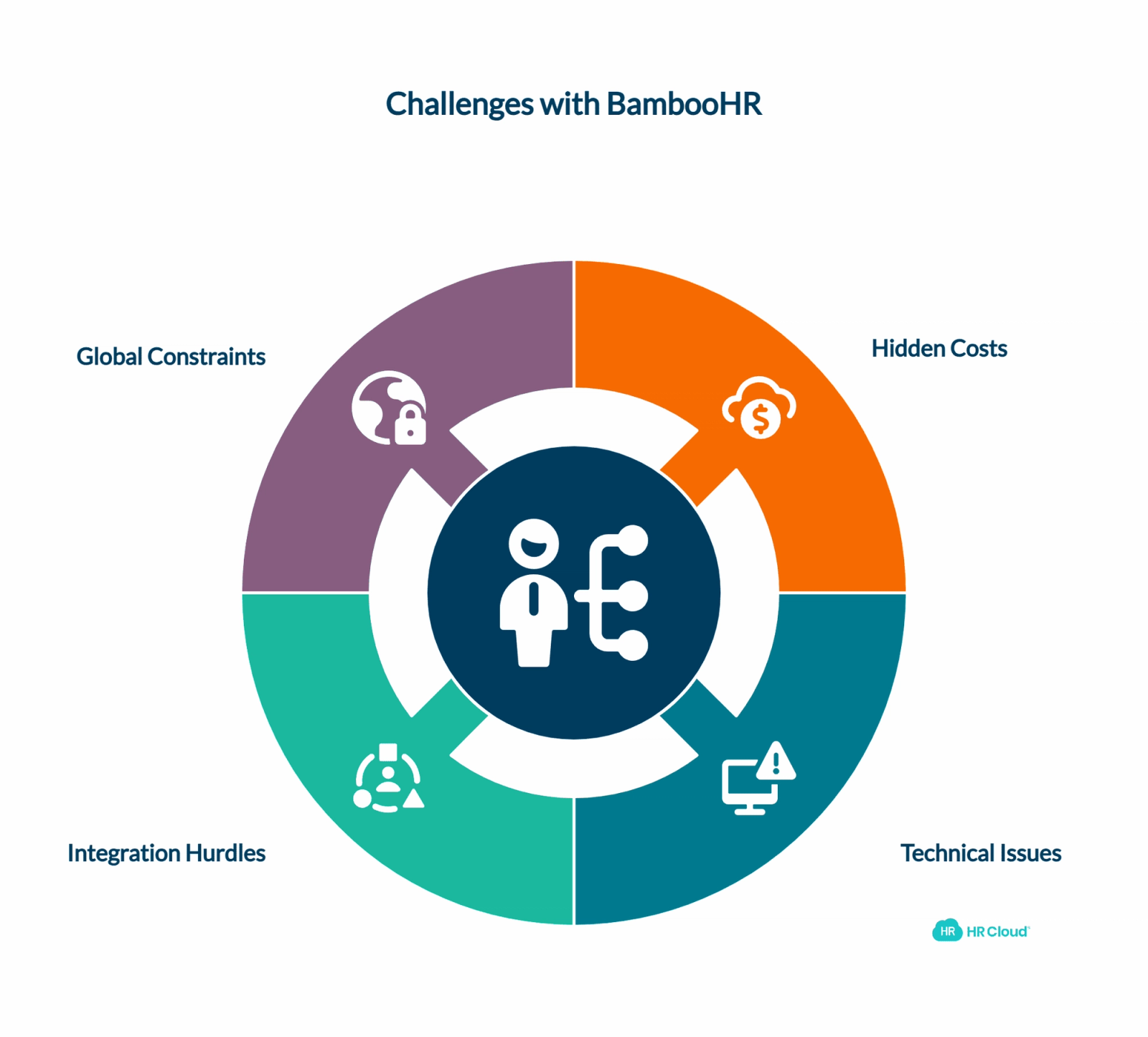
Organizations typically begin exploring alternatives when accumulated challenges start hindering rather than supporting business objectives. Understanding these pain points helps explain why so many HR leaders are reevaluating their technology investments.
Hidden Costs and Pricing Complexity
BambooHR's pricing model creates significant challenges for growing organizations. According to Software Advice analysis, BambooHR charges a flat rate per employee, but pricing transparency remains limited. Organizations often navigate lengthy sales processes just to receive accurate quotes.
Consider this experience from a verified user managing multiple entities:
"The workaround was for us to have multiple Bamboo accounts to accommodate the multiple tax IDs. But this is not cost-efficient for us."
Key pricing concerns consistently cited by users:
- Flat $250 monthly minimum for teams under 25 employees
- Per-employee costs range from $12-$22 monthly for larger organizations
- Essential features like performance management and time tracking sold as expensive add-ons
- Absence of transparent upfront pricing
- Hidden costs that emerge unexpectedly as organizations scale
Technical Performance Issues
User feedback across multiple review platforms consistently identifies technical challenges that impact daily HR operations. According to Capterra reviews, many users report frequent system glitches, including software crashes, slow performance, and problematic updates that disrupt workflows.
One frustrated administrator detailed their experience:
"We had the system for a total of 6 months, with multiple problems from the get-go that included glitches, inability to use the preview functions, and having to download all applications, resumes being uploaded into different user applications, and resume formatting being completely erased."
Integration and Scalability Hurdles
Many organizations outgrow BambooHR's capabilities as they expand operations. According to OutSail's analysis, SMB solutions typically require 6-12 weeks for implementation and often lack the configurability needed for customized workflows that reflect unique organizational processes.
This connects directly to understanding modern HR technology trends, which emphasize flexibility and adaptability as core requirements rather than nice-to-have features.
Common scalability challenges organizations encounter:
- Restrictive workflow customization that doesn't accommodate unique business processes
- Limited process optimization capabilities as complexity increases
- Basic ATS functionality that lacks critical features like interview scheduling and background check integration
- Payroll module integration issues that create data synchronization problems
- Absence of native benefits management module, requiring additional third-party solutions
Global Operations Constraints
BambooHR presents substantial barriers for organizations with international operations or expansion plans. The most significant limitation? BambooHR's native payroll exclusively serves US-based employees, creating complications for companies with global workforces or those planning expansion beyond US borders.
For organizations navigating international HR compliance, this restriction can prove particularly challenging, often requiring additional third-party solutions that increase complexity and cost.
HR Cloud: Best for Frontline and Multi-Location Teams
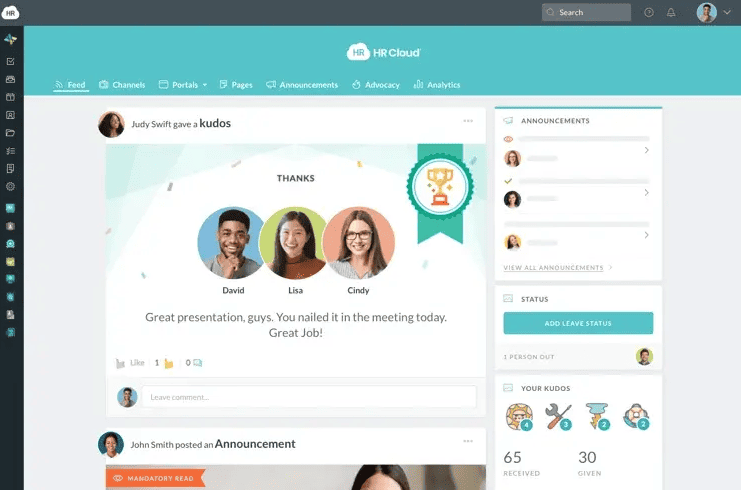
HR Cloud stands out among BambooHR alternatives by directly addressing the pain points driving organizations toward better solutions. Built on principles of flexibility, scalability, and exceptional user experience, HR Cloud provides a modern HR management platform designed to evolve alongside your organization.
Organizations prioritizing employee engagement optimization see measurable results with HR Cloud, including documented improvements in retention rates, productivity metrics, and workplace culture indicators.
Flexible Modular Investment
Unlike BambooHR's rigid all-or-nothing pricing structure, HR Cloud's modular approach allows you to select precisely the capabilities your organization needs today while maintaining flexibility to expand tomorrow.
Start with core HRIS and employee onboarding software, then strategically add performance management, time tracking, or employee engagement modules as your needs evolve. Your investment grows in alignment with actual business requirements rather than vendor-imposed package constraints.
Benefits of HR Cloud's modular approach:
- Pay exclusively for features you actually use and implement
- Scale functionality seamlessly as your organization grows
- Eliminate expensive bundled packages filled with unused features
- Access complete pricing transparency from initial conversation
Advanced Automation & Workflows
HR Cloud's automation capabilities substantially exceed what BambooHR offers. Organizations dramatically reduce manual HR administrative work through logic-based automation, smart form builders that simplify data collection, and automated compliance checklists that ensure nothing falls through operational cracks. The platform includes automated task assignments that streamline every process from initial candidate engagement through structured offboarding procedures.
Create customized workflows with conditional triggers that adapt to different scenarios, enabling your team to focus on strategic initiatives rather than repetitive administrative tasks.
Seamless Integration Ecosystem
While BambooHR users frequently struggle with connectivity limitations, HR Cloud provides broad integration capabilities. HR Cloud connects with leading platforms, including ADP, UKG, Paylocity, QuickBooks, Slack, and Microsoft Teams, plus hundreds of additional applications through its integration library and open API. The platform supports background check integration and other third-party services that HR teams depend on for complete workforce management.
Industry-Specific Solutions
Generic HR solutions often miss critical industry-specific requirements. HR Cloud adapts to your unique operational needs:
Healthcare: As a comprehensive healthcare hr software solution, HR Cloud tracks professional licenses and certifications with automated renewal reminders. Manage healthcare hr compliance workflows with built-in audit trails and automated documentation. The platform functions as specialized healthcare onboarding software that streamlines credentialing processes while maintaining detailed records for regulatory requirements. Healthcare policy management features ensure HIPAA workforce compliance through digital distribution and acknowledgment tracking. Organizations also benefit from healthcare payroll software integration and healthcare onboarding automation that reduces time-to-productivity for clinical staff.
Construction: Support safety compliance with digital documentation workflows. Enable mobile-first onboarding for field-based employees. Track certifications and manage jobsite-specific documentation requirements efficiently.
Technology: Streamline remote worker onboarding with digital-first processes. Track equipment distribution and returns automatically. Integrate seamlessly with collaboration tools like Slack and Microsoft Teams. Support distributed teams across multiple time zones effectively.
Manufacturing: Create standardized incident reporting workflows. Track safety certifications with automated renewal alerts. Distribute policies with digital acknowledgment tracking and verification.
Retail & Hospitality: Implement kiosk-based onboarding for frontline employees. Manage high-turnover environments with streamlined processes. Support multiple locations across diverse geographic areas. Enable mobile-first experiences for deskless workers.
Education: Track certifications automatically with credential management. Manage policy acknowledgments with digital distribution and confirmation. Accommodate flexible staff management aligned with academic calendars and seasonal variations.
Enhanced Employee Experience
Employee engagement represents where HR Cloud truly differentiates itself. Keep teams genuinely connected through built-in communication channels. Enable authentic peer-to-peer recognition through Kudos and structured rewards programs. HR Cloud's Workmates platform transforms traditional intranets into dynamic communication hubs where information flows naturally and culture strengthens continuously.
Download the free employee engagement checklist for managers
Use it to turn good intent into steady habits. Tick items, spot misses, and correct fast. The format is printable, one page, and built for hybrid and deskless teams.
Download Now
Enterprise-Grade Security & Compliance
HR Cloud maintains SOC 2 Type II compliance and GDPR readiness, ensuring your sensitive employee data receives enterprise-level protection. Role-based permissions, encrypted data storage, comprehensive audit trails, and robust access controls provide the security framework modern organizations require.
Actionable Analytics & Reporting
While BambooHR's reporting capabilities remain relatively basic, HR Cloud delivers powerful analytics that transform raw data into strategic intelligence. Generate customized reports examining onboarding success metrics, employee engagement levels, time-to-productivity benchmarks, turnover patterns, and workforce demographics for strategic planning.
Proven Results from Real Organizations
Interim HealthCare: Doubled Revenue Through Streamlined Onboarding
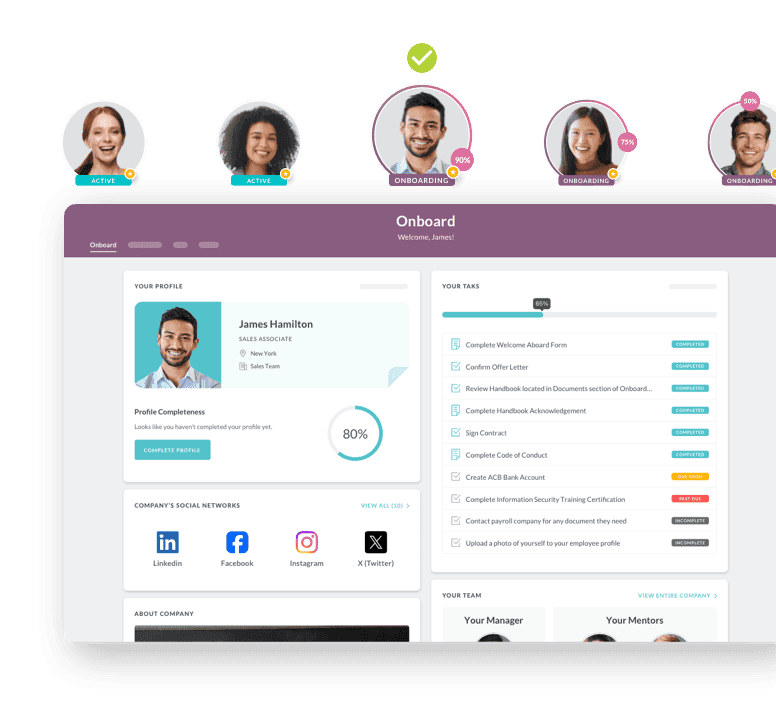
Interim HealthCare struggled with an unorganized onboarding process that frustrated candidates and led to missing documents. After implementing HR Cloud's mobile-friendly onboarding solution, candidates could submit documents easily through an app, eliminating confusion and delays. The result? Interim HealthCare doubled their revenue in subsequent years—growth they directly attribute to the streamlined hiring process that allowed them to onboard caregivers quickly and take on new clients efficiently.
MCO: 2,000 Employees Onboarded in 5 Days
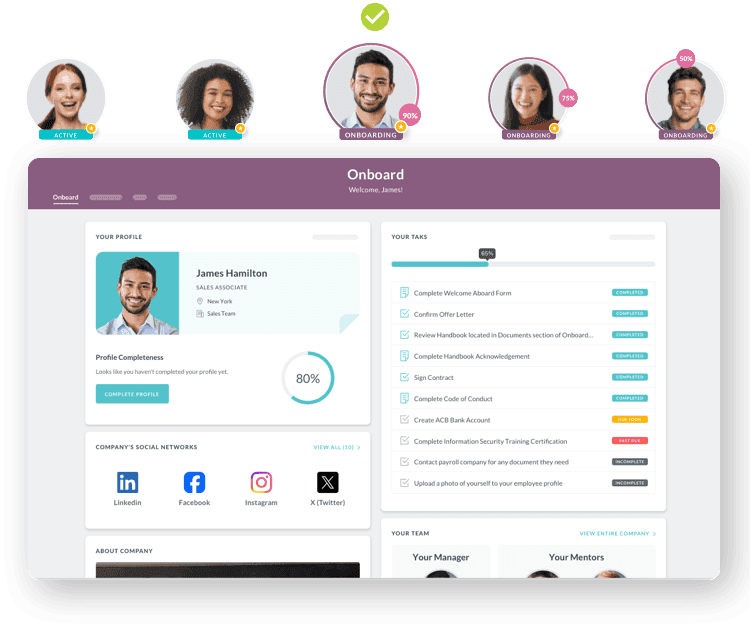
When MCO acquired La Senza retail brand with 2,000 employees across the U.S. and Canada, they needed to onboard everyone in five days or less. "We needed an onboarding solution we could deploy in a month or less. HR Cloud's Onboard was the only solution that could deliver," says Ivana Placko, Product Manager. HR Cloud exceeded their target—90% of all employees completed onboarding within the deadline, with hundreds using the system simultaneously each day.
Other Top BambooHR Competitors
While HR Cloud represents the optimal choice for most growing organizations seeking balanced functionality, flexibility, and value, several alternative platforms merit consideration based on specific needs and priorities.
| Platform | Best For | Strengths | Considerations |
|---|---|---|---|
| Rippling | Technology companies requiring tightly integrated HR/IT management | Automates employee equipment provisioning and software access management, creating seamless onboarding for technical roles | Complex pricing structure with multiple tiers. May prove over-engineered for organizations with straightforward HR requirements without significant IT management needs. |
| Gusto | Small businesses under 50 employees, prioritizing payroll simplicity over comprehensive HR functionality | Streamlined and efficient payroll processing with a user-friendly interface | Limited scalability as organizations grow. Restricted advanced workflow capabilities and customization options. |
| ADP Workforce Now | Large organizations prioritizing established compliance frameworks and established vendor relationships | Decades of payroll experience. Extensive compliance tools according to G2 reviews | Less intuitive interface compared to modern alternatives. Potentially cost-prohibitive for mid-sized companies. Slower innovation cycles. |
| Paylocity | Organizations requiring comprehensive reporting and analytics capabilities across all HR functions | Unified platform enabling data-driven strategic decisions. Comprehensive coverage across benefits, core HR, payroll, talent, and workforce management | Steeper learning curve compared to more user-friendly alternatives. Implementation complexity may challenge smaller HR teams. |
| Namely | Organizations requiring extensive HR process personalization and unique workflow configurations | Highly customizable performance management and engagement features are adaptable to specific organizational cultures | Increased administrative overhead in managing customizations. Complex implementation process requiring significant time investment. |
| Workday HCM | Large enterprises with complex global operations and substantial HR technology budgets | Comprehensive HCM suite with advanced workforce planning and analytics capabilities | Significant financial investment required. Extended implementation timelines often exceed six months. May prove excessive for mid-market organizations. |
| TriNet HR Plus (formerly Zenefits) | Small teams that want HR bundled with benefits administration or a PEO arrangement | Low entry price, with benefits administration built in rather than bolted on | The standalone Zenefits HRIS has been retired. New buyers cannot purchase the original product, existing customers were migrated to TriNet HR Plus, and some reported price increases during the move. |
One name to watch for on other lists: Zenefits no longer exists as a standalone HRIS. TriNet acquired it in 2022 and has since folded it into TriNet HR Plus, retiring the standalone product and migrating existing customers across. If a comparison page published in 2026 still recommends Zenefits as a live option, it has not been updated.
HR Software Comparison 2026
| Capability | HR Cloud | BambooHR | Rippling | Gusto | ADP Workforce Now |
|---|---|---|---|---|---|
| Ease of initial setup | ⚠️ Configuration needed | ✅ Fastest on this list | ⚠️ Complex | ✅ Very fast | ❌ Slowest |
| Review volume and brand recognition | ⚠️ Smaller footprint | ✅ Largest SMB review base | ✅ High | ✅ High | ✅ Long-established |
| Native payroll | ❌ Integrates, does not replace | ✅ US payroll | ✅ Included | ✅ Included | ✅ Core strength |
| Pricing transparency | ✅ Fixed annual, all-inclusive | ⚠️ Quote-based, add-ons extra | ❌ Complex tiers | ✅ Published rates | ❌ Quote required |
| Frontline and hourly experience | ✅ Mobile and SMS-first | ❌ Built for desk staff | ⚠️ Desk-oriented | ⚠️ Limited | ⚠️ Basic |
| Onboarding automation | ✅ Logic-based workflows | ⚠️ Basic | ✅ Strong for IT provisioning | ⚠️ Standard | ✅ Enterprise-grade |
| Multi-location visibility | ✅ Single dashboard | ❌ No bulk actions | ⚠️ Limited | ❌ Single-site focus | ✅ Strong |
| License and credential expiry tracking | ✅ Built in, with alerts | ❌ Manual workaround | ❌ Not built in | ❌ Not built in | ⚠️ Add-on |
| Multi-state compliance depth | ⚠️ Via payroll partner | ⚠️ US only | ⚠️ Growing | ⚠️ Small-business scope | ✅ Deepest on this list |
| Recognition and engagement | ✅ Workmates included | ⚠️ Basic surveys | ⚠️ Limited | ⚠️ Minimal | ⚠️ Add-on required |
| Implementation speed | ✅ 2-4 weeks layered | ⚠️ 6-12 weeks | ⚠️ Complex setup | ✅ Days | ❌ Extended |
| Global entities | ⚠️ Multi-timezone support | ❌ US-centric | ⚠️ Limited international | ❌ US-focused | ✅ International |
How to read this table: no column wins every row, and any comparison that shows one vendor sweeping the board is marketing rather than analysis. BambooHR takes setup speed and brand trust. ADP takes compliance depth and global coverage. Gusto takes price clarity. HR Cloud takes the frontline rows and gives up native payroll to get there. Pick the three rows that decide your renewal and ignore the rest.
Expert Analysis: 2026 HR Software Trends
Industry analysts predict significant shifts affecting SMBs throughout 2026 and beyond. More organizations will prioritize modular HR solutions as concerns over escalating per-employee costs drive purchasing decisions. Simultaneously, demand for specialized industry functionality continues growing as generic approaches prove insufficient for unique operational requirements.
According to Gartner's research, the HR technology market is maturing beyond one-size-fits-all approaches. This shift toward industry-specific features and transparent pricing models reflects growing buyer sophistication and unwillingness to accept vendor-imposed constraints that don't align with actual business needs.
Organizations are actively migrating away from rigid, expensive platforms toward flexible solutions that adapt as business requirements evolve. This trend strongly favors platforms like HR Cloud that offer scalable, transparent, and genuinely user-centric approaches rather than legacy systems built around vendor convenience rather than customer success.
Organizations committed to future-proofing their operations need strategic workforce planning tools as essential components of sustainable competitive advantage rather than optional nice-to-have capabilities.
Choosing Your Best HRIS for SMBs
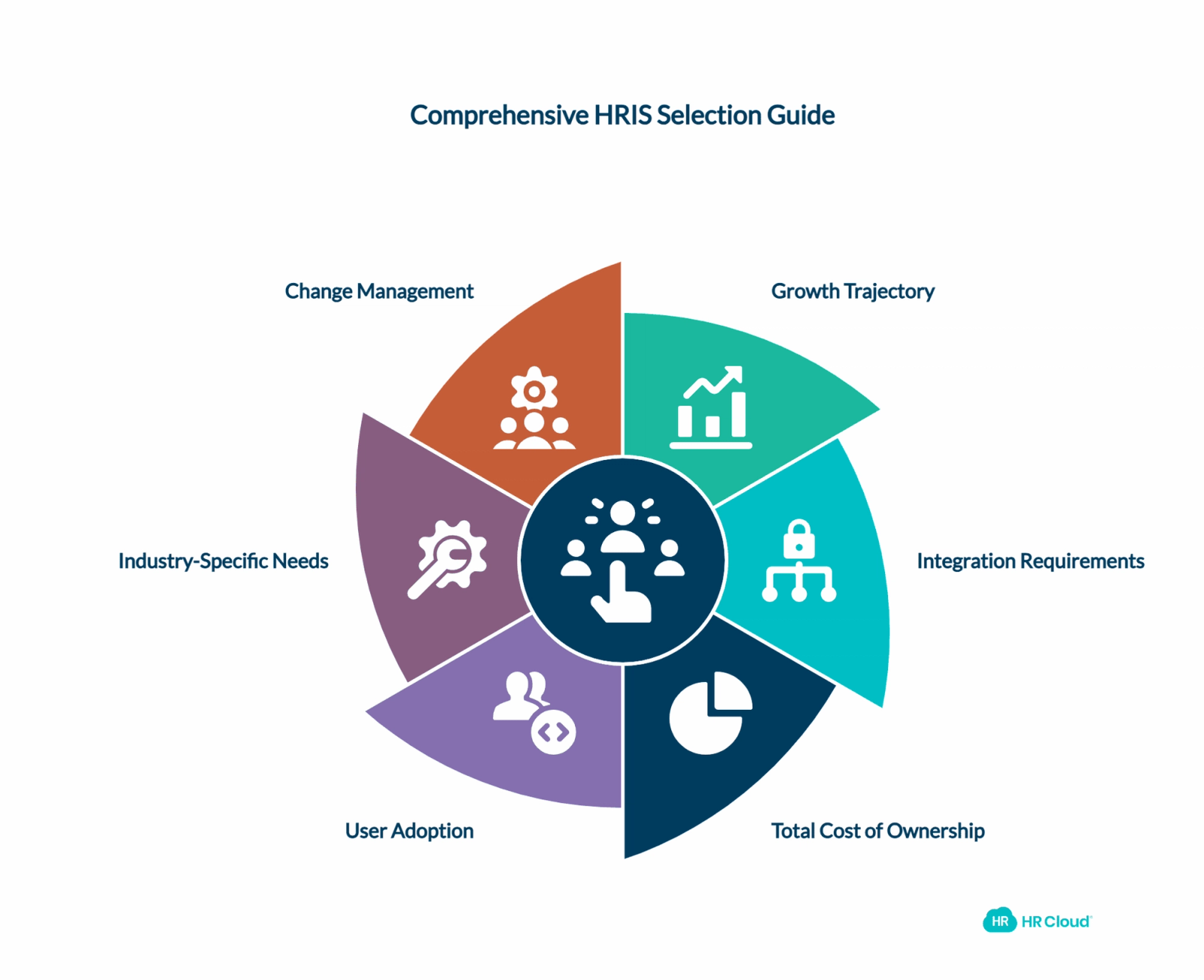
Selecting the right BambooHR alternative requires careful evaluation of your organization's specific requirements, realistic growth projections, and budget parameters aligned with business objectives rather than arbitrary constraints.
Assess Your Growth Trajectory
Organizations experiencing rapid expansion need HR software that scales seamlessly without expensive platform migrations disrupting operations mid-growth.
Start by examining your current employee count alongside projected growth over the next 24-36 months. Are you planning geographic expansion? Multiple locations or international operations introduce different compliance frameworks that your platform must accommodate.
As organizational structure matures, HR processes naturally increase in complexity. Your chosen platform should grow alongside these evolving needs, handling more sophisticated compliance requirements across different jurisdictions while fitting within realistic technology investment budgets that account for both immediate and future costs.
Evaluate Integration Requirements
Your HR platform doesn't exist in isolation—it must work harmoniously within your existing technology ecosystem.
Consider how your current payroll, accounting, and core business systems will exchange data with your new HRIS. What are your data synchronization requirements? Communication platforms like Slack or Microsoft Teams, productivity tools your workforce depends on, and industry-specific software all need seamless connectivity with your HR data.
Don't overlook data migration from current systems or the need for API capabilities that enable custom integrations unique to your environment. These technical considerations often determine implementation success more than feature lists do.
Budget for Total Cost of Ownership
Subscription pricing represents just the starting point. Understanding the complete financial impact requires looking deeper.
Implementation and configuration fees frequently exceed initial estimates. Training investments ensure successful adoption across your organization. Change management demands dedicated resources and clear communication. As your needs evolve, you'll likely require add-on modules, creating ongoing costs beyond base subscriptions.
Factor in support and maintenance expenses, integration costs for current and future systems, and hidden charges like data storage overages or user tier modifications. Organizations maintaining legacy systems during transitions face additional expenses that impact total cost calculations significantly.
Prioritize User Adoption
The most feature-rich platform delivers minimal value when users resist adoption or find the system frustrating enough to avoid it.
Seek platforms with intuitive interfaces requiring minimal training. Navigation should feel logical and natural, not like deciphering complex software. Mobile accessibility matters tremendously—field workers and remote employees need genuine functionality, not just desktop features crammed onto smaller screens.
Self-service capabilities reduce HR administrative burden while empowering employees. Comprehensive training resources should remain available on demand, complemented by responsive support when questions inevitably arise. User experience ultimately determines return on investment more than any other factor.
Consider Industry-Specific Needs
Generic HR platforms consistently miss critical requirements specific to your industry.
Healthcare organizations need license and certification tracking with automated renewals. Construction companies require safety compliance documentation and drug testing workflows. Manufacturing environments demand incident reporting aligned with OSHA requirements. Retail operations benefit from kiosk-based onboarding and high-turnover management tools.
Evaluate whether potential solutions genuinely understand your industry's unique challenges—compliance tracking, credential management, safety protocols, and scheduling that matches your operational reality rather than generic office environments.
Plan for Change Management
Technology implementation success depends heavily on effective change management rather than technical capabilities alone.
Secure executive sponsorship that demonstrates visible leadership support. Employees need to understand "what's in it for me"—clear communication about benefits matters more than technical specifications. Define realistic transition timelines with achievable milestones that maintain momentum without overwhelming teams.
Provide adequate training resources for all user groups, including frontline employees who often get overlooked in implementation planning. Adopt phased rollout approaches that minimize operational disruption, and dedicate support resources specifically for critical transition periods when questions and challenges peak.
Best BambooHR Alternative for Frontline and Hourly Teams
BambooHR was designed for people who have a company email address. That is not a criticism of the product, it is a description of who it was built for. If most of your workforce clocks in on a shared tablet, never opens a laptop, and turns over 40% a year, you are using a tool built for a different problem.
Three alternatives handle this better, and they are not interchangeable:
- Homebase suits shift-based businesses under roughly 75 employees per location. Scheduling, time clocks and team messaging sit in one place, and there is a free tier. It stops being enough once you need structured onboarding workflows or compliance document tracking.
- Paylocity works for larger hourly workforces that want payroll and workforce management in a single system. Implementation is heavier than the sales cycle suggests, so budget for it.
- HR Cloud takes a different route: it sits on top of the payroll system you already run. Onboard handles the paperwork before day one, Workmates handles communication and recognition after it, and Maya, an SMS-first onboarding agent, matters most for high-volume hiring. New hires finish their paperwork by text, with no app to download and no password to forget.
Here is what this looks like in practice. Dutch Bros Coffee moved from Paychex to HR Cloud Workmates. The problem was never payroll, which Paychex handled fine. It was that thousands of shift workers across hundreds of stands had no reliable way to hear from the company or be recognized by it. Stater Bros. Markets reached the same conclusion. Both kept their existing payroll running.
Why this distinction matters: most BambooHR alternative lists assume you want to replace everything. For frontline teams the cheaper and faster move is usually to keep the system of record and add the layer your workers actually touch.
Best BambooHR Alternative for Compliance-Heavy Industries
If compliance is the reason you are leaving, ADP Workforce Now is the honest answer for regulatory depth. Four decades of payroll tax filing across every US jurisdiction is not something a newer platform matches by shipping features faster. For multi-state payroll, garnishments, ACA reporting and union rules, ADP goes deeper than BambooHR and deeper than most of this list.
The catch is that ADP's strength is the regulatory back end, not the employee-facing experience. Credential tracking, collecting an I-9 from someone who will never visit an office, and document workflows for staff without email addresses are where mid-market teams still end up maintaining spreadsheets on the side.
That is the gap HR Cloud fills rather than competes with. HR Cloud is an ADP Platinum Marketplace Partner, and around 500 ADP Workforce Now customers run both: ADP stays the system of record, while HR Cloud handles onboarding documents, I-9 and E-Verify, and license and credential expiry tracking. Implementation for ADP Marketplace customers is a flat $500, against the $5,000 to $50,000 typical for comparable configuration work.
In healthcare this is usually what decides it. A nursing license that expires unnoticed is a staffing problem and a regulatory one on the same day. Orlando Health, Sutter Health and Team Select Home Care all track credentials this way.
Worth checking before you shortlist: ask each vendor what they mean by compliance. Tax filing, document retention and credential expiry are three different products, and vendors use the same word for all three.
How to Switch from BambooHR Without Losing Your History
Migration is the reason most teams stay on a platform they have outgrown. It is a real cost, but a smaller one than it feels like in the abstract. Five things decide how the project goes.
- Export before you negotiate. Pull employee records, documents, time-off balances and custom fields out of BambooHR while your contract is still active. Do this in week one, whatever else happens. Teams that leave it until the final month find out which fields do not export cleanly at the worst possible moment.
- Decide what you are actually replacing. A full platform swap, or keep payroll and replace the employee experience layer? That one decision moves the project from months to weeks, and it is the question most vendors will not ask you, because the bigger answer is worth more to them.
- Check your renewal date and notice period. BambooHR contracts are annual. Missing the notice window means paying for a year of a system you have stopped using. Put the date in a calendar with a 90-day warning.
- Run both systems for one pay cycle. Not longer, or people stop trusting either one. One cycle is enough to catch the field-mapping errors.
- Migrate active employees first and archive the rest. Records for former staff can live as a read-only export in cold storage. Trying to move ten years of leavers into a new system is where timelines break.
Realistic timelines: two to four weeks for a layered implementation on top of existing payroll, six to twelve weeks for a full platform replacement. Anyone promising a complete HRIS swap in a matter of days is describing the data upload, not the change management.
Before you sign anything, put a number on what your current process costs. The onboarding ROI calculator gives you a defensible figure to carry into the budget conversation, which tends to land better than a feature comparison.
The mistake to avoid: switching during your busiest hiring month. If you hire heavily in the fall, migrate in spring. A new onboarding system pays back when it is live before the volume arrives, not while you are in the middle of it.
Conclusion: Transform Your HR Operations with the Right Alternative
There is no single best BambooHR alternative, and any page that names one without asking about your situation is selling something. There is a best fit for a specific set of constraints: how many people you employ, how many of them work at a desk, how many locations you run, and how much compliance weight you carry.
Work through the table at the top of this page with your own numbers. If you are under 150 employees at a single site, the honest answer may be that you stay on BambooHR for another year and revisit when a second location or a hiring spike forces the question.
HR Cloud is the strongest fit for one profile in particular: multi-location employers with hourly or frontline staff who need onboarding, communication and credential tracking to work on a phone, without ripping out payroll that already works. If that describes you, the comparison worth running is HR Cloud against your current process rather than against BambooHR's feature list. If it does not, one of the other six alternatives above deserves the demo slot instead.
Whichever way you go, shortlist no more than three vendors and give each the same two scenarios to demo: onboarding one frontline hire from offer to day one, and pulling the compliance report your auditor actually asks for. Generic demos hide the gaps. Specific ones expose them in about ten minutes.
Ready to Experience the Difference?
Do not take our word for any of this. Ask for a demo built around your actual workflow, and ask the same of every other vendor on your shortlist.
Schedule Your Personalized HR Cloud Demo
See precisely how HR Cloud addresses BambooHR's limitations through a customized demonstration tailored to your industry and specific organizational requirements.
Contact our HR specialists today to explore flexible pricing options and implementation timelines designed around your unique organizational needs and strategic objectives.

Discover how our HR solutions streamline onboarding, boost employee engagement, and simplify HR management
Book Your Free DemoFrequently Asked Questions
What is a good alternative to BambooHR?
It depends on which limit you hit. For shift-based teams under roughly 75 people per location, Homebase. For HR and IT provisioning in one system, Rippling. For multi-state compliance depth, ADP Workforce Now. For frontline and hourly workforces across multiple sites, HR Cloud's Onboard and Workmates modules layered on the payroll you already run. Under about 150 employees at a single site, BambooHR is often still the right choice.
Is HR Cloud better than BambooHR?
They are better at different things. BambooHR is quicker to set up and simpler to run, which is why it wins for small single-site teams. HR Cloud is stronger on frontline and hourly workforces, multi-location onboarding, credential tracking and recognition, and it integrates with your existing payroll rather than replacing it. If your workforce is mostly desk-based and under 150 people, BambooHR is likely the better fit.
What is the best BambooHR alternative for frontline teams?
Look for mobile access that does not require an app download, onboarding that finishes before day one, and multi-location visibility in one dashboard. Homebase covers scheduling for smaller single-site operations. For multi-site hourly workforces, HR Cloud's Onboard module plus Maya, its SMS-based onboarding agent, let new hires complete paperwork by text. Paylocity is worth a look if you want payroll and workforce management in one system.
How does HR Cloud vs BambooHR pricing actually compare?
HR Cloud prices a fixed annual license by company size, all-inclusive, so the figure does not move mid-year on headcount swings. BambooHR is quote-based and prices several capabilities, including performance management, as separate add-ons. Compare total cost including add-ons rather than headline per-employee rates.
Can HR Cloud handle international employees better than BambooHR?
HR Cloud supports multi-timezone access and support coverage, while BambooHR's payroll is US-only. Neither is the right answer for genuinely global payroll across many legal entities. For that, Workday HCM or ADP Workforce Now have deeper international coverage than either.
What makes HR Cloud's onboarding capabilities stand out?
Logic-based workflows with custom triggers, a reusable form library, self-service portals, and industry-specific templates. The clearest difference shows up with frontline hiring, where Maya collects paperwork over SMS so new hires do not need a login or an app.
How quickly can we implement HR Cloud compared to other BambooHR competitors?
A layered implementation on top of existing payroll typically runs two to four weeks. A full platform replacement runs six to twelve weeks, which is comparable to BambooHR's own implementation window. ADP Marketplace customers pay a flat $500 implementation fee.
Which alternative offers the best value for growing companies?
Value depends on where your growth is happening. Growing headcount at one desk-based site favors BambooHR or Gusto. Growing into more locations with hourly staff favors HR Cloud. Growing across borders favors Workday HCM or ADP Workforce Now.
About the author

Keep Reading


Like What You Hear?
We’d love to chat with you more about how HR Cloud® can support your business’s HR needs.
Book Your Free Demo