
Challenges of Remote Working That Your IT Department Should be Aware of

In recent years, remote work has started gaining in popularity. While it surfaced due to necessity, it rapidly became popular because it benefited both parties, employers, and employees. Many companies have begun offering work from home options to their employees, with most introducing the hybrid workplace model of working a few days in the office and the rest at home. Slack has conducted a global survey of more than 9,000 employees, which determined that 72% prefers hybrid work arrangements, showing that any business wanting to keep its employees happy must offer remote work options. Both methods, completely remote or hybrid, positively impact employee satisfaction and productivity while increasing business savings.
However, managing remote teams can be extremely challenging, even with all of these benefits. The truth is that for most companies, the transfer to remote work has been so rapid that they haven't been able to establish clear remote-work policies or prepare their employees for the challenges. It was only due to the efficient and quick work of the IT department that companies managed to accomplish this transition. Unfortunately, their work is not done. There are still various challenges IT departments around the world need to tackle to ensure remote work success for employees and employers.
Key Takeaways
- Remote work's rapid rise left most companies without clear policies or preparation, putting the IT department at the center of making it work.
- Communication breakdowns in remote teams aren't just inconvenient — they cause project delays, misalignment, and drops in output quality.
- Time management is harder to track remotely, and without the right tools, employees can game the system without anyone catching it.
- Productivity monitoring requires the right balance — too little oversight and quality slips, too much and you spiral into mistrust.
- Cybersecurity risk multiplies in remote environments through phishing, weak passwords, unsecured file sharing, and public Wi-Fi exposure.
- IT departments that proactively train employees and enforce clear security policies can prevent the majority of these threats before they become incidents.
Communication Issues
Communication is the key to success for any team, especially the remote one. In usual circumstances, you could walk up to any team member and ask them for advice or an update, but remote work communication makes it a little more challenging. In most cases, the team works on a joint project, which means they all need to know what the others are working on to achieve the best results. By having inadequate communication methods, your team members can't keep each other updated on the progress or the next steps resulting in delays or issues with the project. Strong communication skills are essential for remote teams to collaborate effectively, whether through synchronous communication like video conferencing or asynchronous communication methods.
The IT department needs to ensure everyone can communicate quickly and efficiently, minimizing the risk of misunderstandings or delays. Implementing effective communication strategies and establishing clear communication protocols is crucial for success. Luckily, there are numerous communication tools and collaboration platforms out there that can be a perfect fit for your business. Setting up communication guidelines helps teams understand when and how to use different communication channels effectively.
Time Management
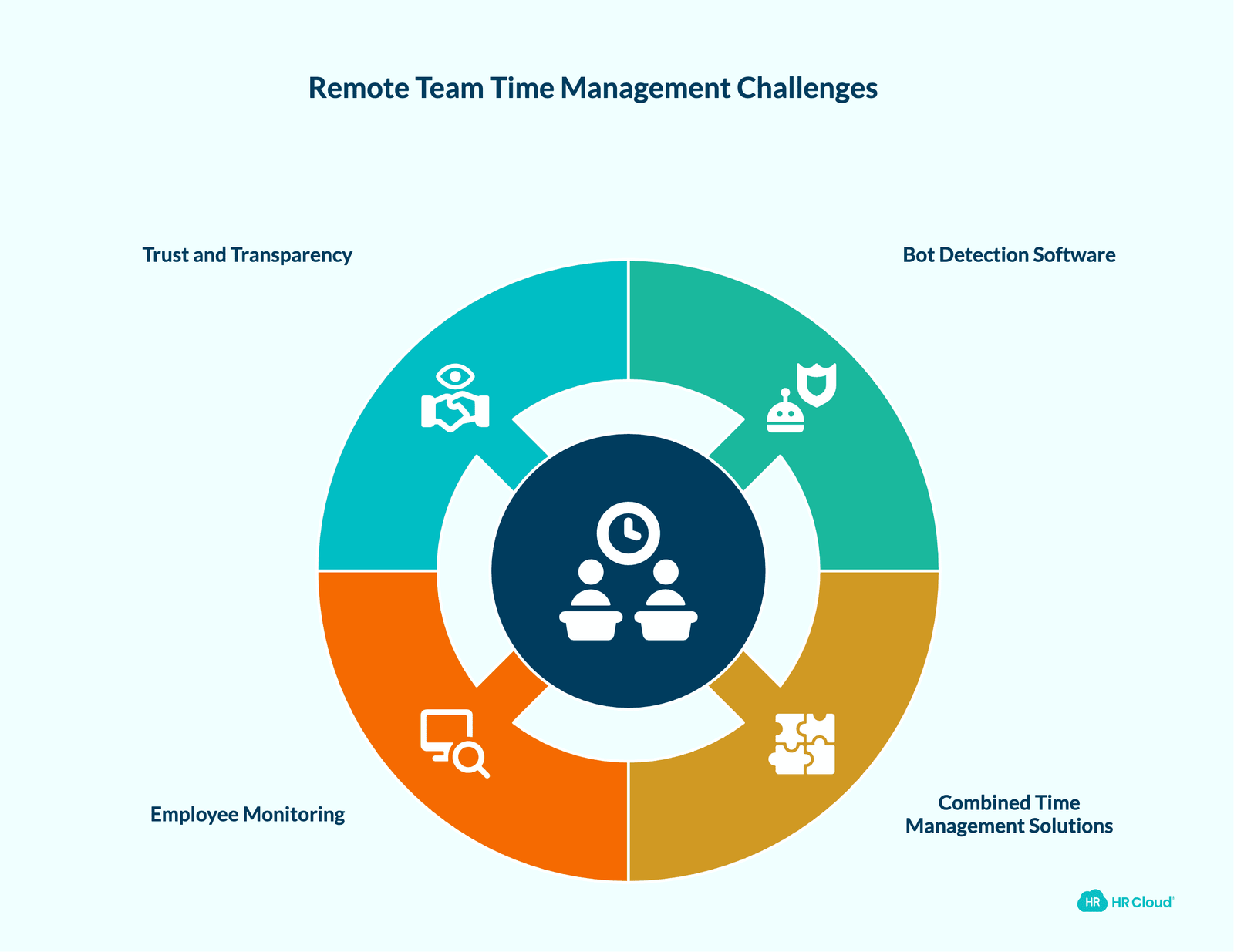
When your employees are working remotely as part of distributed teams, it can be hard to keep track of their activities to ensure they do not waste their time or impact the flow of their colleagues. While there are platforms for time management you should definitely implement, sometimes they only show part of the picture. For example, your employees could be using bots to trick them and show they have been working while they were surfing the Internet instead, or they can even use them to automatically fill up timesheets with false information. Fortunately, the IT department can take the proper steps to prevent this by implementing bot detection software or combining different time management solutions.

Productivity
It can be hard to keep track of their productivity when they are not in front of you to check. With remote work, you need to put your trust in your employees, but sometimes they can break it. For example, some employees might try to "outsource" their work to have more free time, which can result in a decline in work quality. Others could be using VPNs to hide their IP because they are traveling even though they are not allowed to work from outside your country.
Knowing what the employees are doing, who is doing what, and at what rate is essential to ensure your team stays productive. This is where your IT department comes in handy, especially when managing hybrid work communication across different locations and time zones. They can develop solutions that allow you to monitor your employees and confirm they are doing what they claim to do. At the same time, it remains up to you to continuously evaluate their performance and provide them with feedback when necessary.
It can be easy to fall into a spiral of suspicion when it comes to the productivity of your employees when they are working remotely. In the end, the only thing you can do is monitor their progress, implement necessary tools and trust the process. Just because you can't see them doesn't mean they are not pulling the weight.
Download your free remote team culture reset checklist
Get actionable tips to realign, re-engage, and re-energize your remote team—starting today.
Download Now
Cybersecurity Challenges
Employees have access to confidential data during their workday that they need to keep safe. It doesn't matter if they are working from home or the office; cybersecurity is a must to ensure GDPR compliance, data security and to reduce the risk of any online dangers.
| Cybersecurity Threat | What Happens | Why Remote Work Makes It Worse |
|---|---|---|
| Phishing Schemes | Fraudsters impersonate legitimate sources to extract confidential data | Employees can't verify the sender's legitimacy the way they would in person, making it easier to fall for impersonation |
| Bad Password Hygiene | Weak or repeated passwords give attackers easy network access | Remote access means one compromised password can expose multiple accounts and systems |
| File Sharing | Sensitive client and company data gets shared without encryption | Employees remember to encrypt files on their devices but often forget when actively sharing them |
| Unsecure Networks | Public Wi-Fi exposes company data to bots and hackers | Remote workers frequently use public networks that are unprotected and actively targeted |
These are the most common cybersecurity issues remote workers can bring to the company. Luckily, they can be easily prevented by having an efficient IT department that continuously reviews your cybersecurity practices and prevents any issues before they arise. For example, just by using the right tools, training your employees, introducing and, most importantly, enforcing security policies with clear communication standards, you can significantly reduce any risks. You can empower your employees to take responsibility for their cybersecurity by introducing them to best practices and providing them with clear and straightforward security policies.
Final thoughts
Introducing remote work to your company can bring significant benefits and even greater challenges. Managing remote teams takes time, patience, and continuous work on new solutions that can make the process simpler and more successful. By keeping an eye out for any possible challenges and utilizing the solutions that can detect early warning signs, you will be able to mitigate them before they can do any damage.

Experience how Workmates can transform communication and strengthen culture—all in one powerful platform
Book Your Free DemoFAQ's
1. What are the biggest challenges of managing remote teams?
Remote teams face consistent issues with communication gaps, time tracking, productivity visibility, and cybersecurity risks. When employees work across locations, teams lose real-time alignment, making collaboration slower and more error-prone. Without the right systems, managers struggle to track output, and IT teams must handle increased security exposure. As highlighted in your content, poor communication alone can lead to delays and reduced output quality .
2. How can HR teams improve communication in remote or hybrid workplaces?
HR teams can improve communication by implementing structured communication protocols, centralized collaboration platforms, and clear guidelines for synchronous and asynchronous interactions. Tools like employee communication platforms and intranet systems ensure everyone stays aligned. HR Cloud’s Workmates platform enables real-time updates, employee feeds, and structured communication workflows that reduce misunderstandings.
3. Why is time tracking more difficult in remote work environments?
Remote work removes physical visibility, making it harder to verify actual work activity. Employees may misuse tools, automate timesheets, or misreport hours. Traditional time tracking systems often provide incomplete data, requiring IT teams to combine monitoring tools and analytics to get accurate insights . Modern HR platforms solve this with integrated time tracking, activity insights, and automation.
4. How can companies maintain productivity with remote employees?
Productivity improves when companies focus on outcome-based tracking instead of micromanagement. This includes setting clear KPIs, using performance management tools, and providing regular feedback. HR Cloud’s solutions help track employee performance, automate workflows, and give managers visibility into progress without creating a culture of distrust.
5. What are the top cybersecurity risks in remote work?
The most common risks include phishing attacks, weak password practices, unsecured file sharing, and use of public Wi-Fi. Remote work increases exposure because employees operate outside controlled environments, making systems more vulnerable . Companies must implement strict security policies, training, and monitoring tools to reduce these risks.
6. How can IT and HR work together to support remote teams?
IT ensures secure infrastructure and tools, while HR focuses on employee experience and productivity. Together, they can implement systems that enable communication, track performance, and enforce security policies. Platforms like HR Cloud bridge this gap by combining HR workflows, communication, and compliance tools in one system.
7. What tools are essential for managing remote and hybrid teams?
Key tools include:
- Employee communication platforms
- Time tracking and attendance systems
- Performance management software
- Document management and onboarding tools
- Cybersecurity monitoring solutions
HR Cloud provides an all-in-one platform covering onboarding, engagement, time tracking, and compliance—reducing tool fragmentation and improving efficiency.
8. How does HR Cloud help solve remote work challenges?
HR Cloud simplifies remote workforce management by:
- Automating onboarding and workflows
- Centralizing communication and engagement
- Tracking employee performance and time
- Ensuring compliance and document management
- Supporting secure access to HR systems
This reduces manual work, improves visibility, and helps teams stay aligned regardless of location.
About the author

Keep Reading


Like What You Hear?
We’d love to chat with you more about how HR Cloud® can support your business’s HR needs.
Book Your Free Demo