What HR Automation Tools Save the Most Time for Manufacturing HR Teams?

The HR automation software that saves manufacturing HR teams the most time is usually the kind that targets three specific workflows: onboarding paperwork, approval routing, and duplicate data entry between payroll and the HRIS. Which one saves the most time for a given plant depends on hiring volume, how often approvals happen, and how long each one currently takes by hand. Training and credential tracking often deserve equal priority even when they save fewer raw hours, because the downside of getting them wrong is bigger than the downside of a slow PTO approval.
Manufacturing HR teams are usually small. A 400-person plant might run HR with two or three people, sometimes one. Those people are still expected to process new-hire paperwork for every shift, chase signatures for policy acknowledgments, track OSHA and safety certifications before they lapse, and keep multi-site records straight, all while fielding walk-up questions from a workforce that doesn't sit at a desk. Automation software doesn't remove HR's judgment from that work. It removes the manual, repeatable parts so HR has time left for the parts that need a person.
This guide walks through where manufacturing HR teams actually lose their time, which of that work automation can realistically take on, how to decide what to automate first, and what results teams have reported after making the switch. If you're comparing manufacturing HR efficiency tools rather than starting from zero, the framework below still applies: the platform matters less than whether it's built around the workflows a plant actually runs.
Where Manufacturing HR Teams Lose the Most Time
Manual forms, approvals, and recordkeeping
Three tasks eat the most hours on a manufacturing HR team's week: chasing paper forms, routing approvals by hand, and re-entering the same employee data into more than one system.
New-hire paperwork is the clearest example. A plant hiring 15 machine operators a month still needs I-9s, tax forms, safety acknowledgments, and equipment sign-offs for every one of them. If those forms live on paper or in a shared drive, someone on HR has to track who's turned in what, chase down missing signatures, and manually key the data into payroll and the HRIS afterward. Multiply that by every new hire, every shift, every site, and the hours add up fast.
Approvals work the same way. A shift change, a leave request, a policy exception: each one needs sign-off from a supervisor, sometimes a plant manager, sometimes both. When that approval happens over email or a hallway conversation, there's no record of who approved what, when, or why. HR ends up as the informal tracker of record, following up to confirm decisions that were technically already made.
Recordkeeping is the quiet cost. Required training and evaluation dates, plus credential expirations where applicable, need to be tracked per employee. Union and non-union employees often need different documentation. Without a system that flags expiring items automatically, someone has to remember to check, usually by opening a spreadsheet and scanning dates by eye. Research citing PwC data on in-house workforce administration puts these costs at over $1,400 per employee per year for large organizations, and nearly $2,000 per employee per year for midsize organizations.
| Task | Where the time goes | Automatable? |
|---|---|---|
| New-hire paperwork | Chasing signatures, re-keying data into payroll/HRIS | Yes |
| Shift and leave approvals | Email threads, verbal sign-offs, no audit trail | Yes |
| Certification/compliance tracking | Manual spreadsheet review for expiring items | Yes |
| Multi-site document splits | Reconciling different forms for union vs. non-union sites | Yes, with configurable workflows |
| Routine employee questions | Answering the same PTO/policy questions repeatedly | Partially, with self-service |
Multi-site manufacturers add a layer most other industries don't deal with as often. A company running three plants across two states may need different leave policies, different safety documentation, and even different languages for the same core onboarding process. Without a system built to handle that variation, HR ends up maintaining parallel versions of the same paperwork by hand, one per site, and manually keeping them in sync every time a policy changes.
The Case for HR Automation in Manufacturing
Lean HR teams supporting large hourly workforces
Manufacturing HR is a volume problem run by a small team. A plant with 500 hourly employees across two shifts often runs a leaner HR-to-employee ratio than a comparable office-based company. That ratio doesn't shrink the workload. It just means fewer people are doing the same volume of onboarding, compliance tracking, and approvals that a company with more HR staff would spread across more people.
This is where automation earns its place in manufacturing specifically, more than in most industries. A software company with 500 desk-based employees can lean on self-service and email for most HR requests. A manufacturer with 500 hourly employees across three shifts can't assume everyone checks email, has a company laptop, or sits still long enough to fill out a form at a desk. The workforce is mobile, shift-based, and often multilingual. Any HR process that assumes desk access breaks down on day one.
Automation software built for this reality does two things at once: it removes the manual admin work HR would otherwise do by hand, and it gives frontline employees a way to complete forms, get reminders, and ask questions without needing a desk or a company email address. That second part matters as much as the first. A workflow tool that only saves HR time in the back office but still requires a desktop and a corporate login to fill out a form hasn't actually solved the manufacturing problem.
Multilingual workforces add another reason automation matters more here than in office-based industries. Plants in many regions run production lines with employees whose first language isn't English, and a paper onboarding packet or safety acknowledgment written only in English creates both a comprehension gap and a compliance risk, since a signed form doesn't mean much if the person signing it didn't fully understand what they agreed to. Automation platforms that support multiple languages in employee-facing forms close that gap at the point of signature, rather than relying on a bilingual supervisor to translate on the spot.
Union and non-union splits are a related, manufacturing-specific pain point. A single company might run some sites under a collective bargaining agreement and others without one, each requiring different documentation, different approval steps, and sometimes different leave policies. Handling that split with one static set of paper forms means either maintaining two entirely separate manual processes or, worse, using the wrong version of a form for the wrong site. Configurable automation can reduce that risk by routing each employee through the correct version of the workflow automatically, based on their site and employment classification, as long as the underlying employee data (site, union status) is accurate to begin with.
There's also a practical staffing reality behind the push toward automation: manufacturing HR teams often don't get headcount added at the same rate the plant hires. When a facility scales from 200 to 400 hourly employees, HR is usually still the same two or three people. Automation is what lets that team absorb more volume without adding headcount at the same pace, since each additional new-hire packet moves through the same workflow instead of requiring someone to build a new one from scratch.
What HR Automation Can Take Off Their Plate
Approvals, document routing, reminders
The most immediate win from automation software is removing the manual steps in getting a document from "needs a signature" to "filed and tracked." A configurable workflow tool lets HR build an approval chain once (supervisor sign-off, then HR review, then filing) and reuse it for every instance of that process, instead of manually routing each one. Every step gets a timestamp and an audit trail automatically, which matters for OSHA and DOL compliance reviews where "we're pretty sure this was signed" isn't an acceptable answer.
Reminders follow the same logic. Instead of HR manually scanning a spreadsheet for expiring certifications, an automated system flags them on a schedule (30 days out, 14 days out, the day of) and sends the reminder to both HR and the employee. The task doesn't disappear. It just stops depending on someone remembering to check.
Document routing carries a second, less obvious benefit for manufacturing specifically: it standardizes what gets collected at every site. A plant manager in one location might informally accept a verbal safety acknowledgment where another location requires a signed form. A standardized workflow can reduce that inconsistency by requiring the same documented steps at every applicable site, regardless of which supervisor is handling it that day.
Onboarding and offboarding workflows
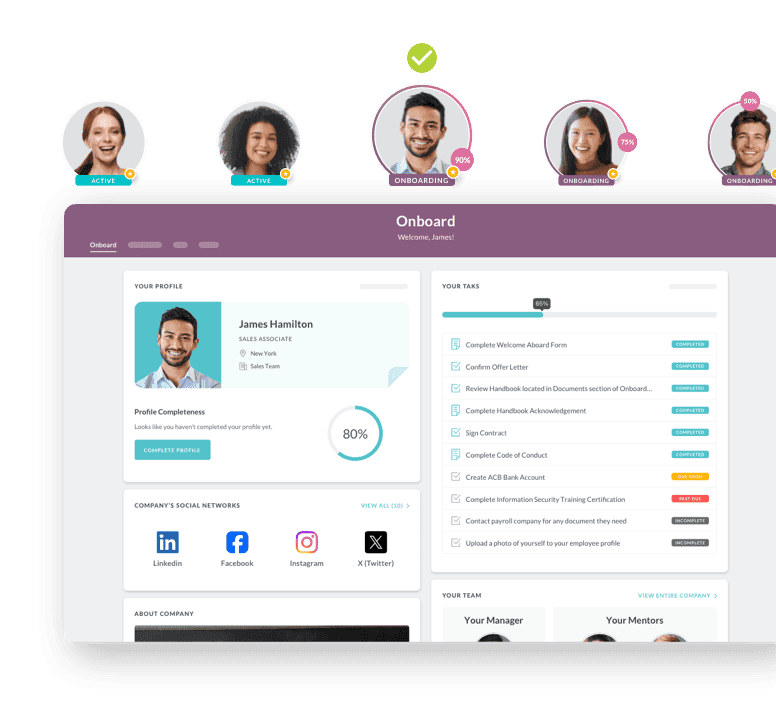
Onboarding is where manufacturing HR teams typically see the fastest return, because it's the highest-volume, most repetitive process on the calendar. A structured onboarding workflow bundles I-9 collection, tax forms, safety training acknowledgments, and equipment sign-off into one sequence that triggers automatically the moment a new hire is added to the system. New hires complete forms on a phone instead of waiting for a desktop, which matters for a workforce that may not have one.
Offboarding gets less attention but carries real compliance risk if it's handled manually: revoking building and system access, collecting equipment, processing final pay and COBRA notices, all on a deadline. An automated offboarding workflow triggers those steps the moment a termination or resignation is logged, instead of relying on HR to remember every step for every departure across every site.
Manufacturing has one offboarding wrinkle worth naming directly: equipment and access. Frontline employees often carry badges, keys, or credentials tied to machinery and restricted areas, not just a laptop and an email account. An offboarding workflow that only revokes software access and misses physical equipment return leaves a real security gap, so the checklist attached to the automated workflow needs to include equipment and badge return as explicit, tracked steps, not an afterthought handled informally by a shift supervisor.
The clearest way to see what automation actually changes is to compare the same onboarding process run manually versus through a structured workflow:
| Step | Manual process | Automated workflow |
|---|---|---|
| Forms and paperwork | Printed packet, filled out by hand or emailed as a PDF | Completed on a phone, pre-filled where data already exists |
| Safety acknowledgment | Verbal or paper sign-off, easy to lose track of | Digital signature, timestamped and stored automatically |
| Supervisor approval | Email or hallway conversation, no consistent record | Routed automatically, logged with a timestamp |
| Payroll data entry | HR manually re-keys new-hire data into payroll | Synced automatically once HR approves the record |
| Certification tracking | Spreadsheet checked periodically by hand | Automatic reminders before expiration, with escalation if missed |
| Multi-site consistency | Each site may use a slightly different version of the process | Same workflow logic applies everywhere, with site-specific rules where needed |
For plants still running onboarding on paper and email, the manual column will look familiar. It's how a lot of manufacturing HR teams operate today, not because they're behind, but because building a consistent workflow without software is genuinely difficult to do across shifts and sites.
Compliance alerts and escalations
Manufacturing carries more regulatory weight than most industries: OSHA safety training, equipment certifications, union documentation splits, and state-specific labor rules that can vary by site. Automated compliance alerts don't just remind HR that something is expiring once. A well-built system repeats the alert on a schedule, daily, weekly, or monthly, until the item is resolved, and keeps HR visible on every task by default instead of only the person it was assigned to. That's a meaningfully different safeguard than a single reminder that's easy to let slide.
OSHA's recordkeeping requirements under 29 CFR Part 1904 cover injury and illness records specifically, the OSHA 300 Log, the 300A summary, and 301 Incident Reports, which must be retained for five years. That's a separate obligation from training and credential documentation, which falls under equipment- and task-specific standards. Powered industrial truck (forklift) operators, for example, don't hold an expiring "certification" the way the term is often used. OSHA requires initial training plus a documented performance evaluation at least once every three years under 1910.178(l)(4)(iii), with refresher training triggered sooner by specific events like an accident, unsafe operation, or a switch to a different truck type. The Department of Labor's overtime rules apply differently to nonexempt employees than to exempt ones, which is a classification question, not simply a matter of hourly versus salaried pay, and that distinction is why time-tracking automation and HR workflow automation often need to work together rather than as separate systems.
Union sites add another layer. Collective bargaining agreements frequently specify documentation requirements, grievance timelines, and approval processes that differ from how non-union sites operate. An automation platform that can't distinguish between union and non-union employee records forces HR to manage that split manually outside the system, which defeats much of the point of automating in the first place.
How Manufacturing HR Teams Are Automating Today
Replacing email chains with structured workflows
The shift happening across manufacturing HR right now isn't a wholesale platform replacement. It's teams identifying the two or three processes causing the most friction (usually onboarding, approvals, and compliance tracking) and moving those specifically off email and paper into a structured workflow tool, often while keeping their existing payroll or ERP system in place.
That's a deliberate choice, not a compromise. Manufacturing companies frequently run established payroll systems (ADP Workforce Now, UKG, or similar) that they have no reason to rip out. The practical path is layering a workflow automation tool on top that integrates with what's already there, rather than migrating an entire HR tech stack to solve an onboarding-and-approvals problem. HR Cloud's ADP Marketplace listing shows a flat $500 setup fee for any company size, confirmed directly on ADP's own marketplace page. HR Cloud describes that as well below what comparable configuration work typically runs elsewhere, though that comparison is HR Cloud's own framing rather than an independently audited benchmark.
That integration approach extends beyond ADP. Manufacturing companies run a wide range of payroll and workforce systems depending on their size and history, UKG, Paychex, Paycom, Paylocity, Ceridian, and Kronos among the most common. Open API access creates the option to connect a workflow automation tool with whichever system a plant already uses, but an API alone doesn't guarantee a working integration. Confirm the specific system, the fields that sync, the direction of the sync, and what happens on exceptions before assuming new-hire data will flow automatically instead of requiring manual re-entry.
Not every platform is built for a shift-based, multi-site, frontline workforce, and the gap shows up fast once a manufacturer tries to roll it out. A few things are worth checking before committing to one, regardless of vendor: whether the system is mobile-first rather than just mobile-friendly (ask to see the actual mobile onboarding flow, not a screenshot of the admin dashboard); whether workflows and approval chains can be built and edited by HR directly, without a developer ticket every time something changes; whether it supports site-specific workflow variations and, if relevant, multiple languages for frontline-facing forms; whether it has an open API with named integrations to the payroll system already in place, rather than requiring a payroll migration to get automation benefits; whether it logs who approved what and when automatically, not just sends a notification and hopes someone acts on it; and whether the implementation timeline and cost are a specific number rather than a range described as "it depends."
Step-by-Step: Identifying What to Automate First
Not every manual process is worth automating on day one. The teams that get the most value start with a short, deliberate audit instead of automating everything at once.
To make each step concrete, walk through a hypothetical composite plant: 300 hourly employees across two shifts, one HR generalist and one HR coordinator, running ADP for payroll. This is an illustrative example, not a researched industry sample, useful only for showing how the five steps play out in practice.
Step 1 — Audit repetitive manual HR tasks
List every recurring HR task performed at least weekly: new-hire paperwork, leave approvals, certification checks, policy acknowledgments, offboarding steps. For each one, note roughly how often it happens and who currently does it. This doesn't need to be exhaustive. It needs to surface the handful of tasks that repeat often enough to be worth automating.
For the composite plant above, the audit typically surfaces three or four standouts: new-hire onboarding (roughly 8 to 12 hires a month across both shifts), safety training refreshers and performance evaluations (dozens of employees on staggered due dates), and shift-change or leave approvals (a near-daily occurrence). A task like updating the company holiday calendar, by contrast, happens once a year and isn't worth automating first, even though it's technically repetitive.
Step 2 — Prioritize by time saved and error risk
Rank the audited tasks by two factors: how much HR time they currently consume, and how much risk they carry if done wrong (a missed required safety evaluation is a bigger risk than a delayed birthday card). Tasks that score high on both are the ones to automate first. A task that's low-volume and low-risk, even if annoying, isn't worth building a workflow around yet.
At the composite plant, training and evaluation tracking ranks highest on risk (an overdue forklift operator evaluation or lapsed safety training is a real liability), while onboarding ranks highest on time consumed given the hiring volume. Those two become the first automation targets, ahead of lower-stakes items like routine PTO questions.
Step 3 — Build automated approval chains
Starting with the highest-priority task, document how the approval actually happens today: who signs off, in what order, and why. Strip out any step that exists only out of habit, confirm the remaining steps with the people who actually own them, then automate the agreed version, not the unexamined one. A shift-change request might need only a supervisor's sign-off. A new-hire safety exception might need both a supervisor and a safety officer.
For the composite plant's onboarding workflow, that chain looks like: new hire completes intake forms on a phone, the system routes safety acknowledgment to the shift supervisor, HR reviews and files the completed packet, and approved employee data moves into the plant's configured payroll workflow instead of getting re-keyed by hand. Mapping this out before building it in software prevents the common mistake of automating a chain that skips a step someone actually relies on.
Step 4 — Set up automated reminders/escalations
Once the approval chain exists, add reminders for anything time-sensitive attached to it: certification expirations, policy renewal dates, onboarding task deadlines. Set escalation rules for what happens if a reminder is ignored, so a missed deadline doesn't just sit unresolved.
For training and evaluation tracking specifically, a reasonable pattern is an upcoming alert 30 days before a due date, a second alert at 14 days, and a repeating overdue alert, daily or weekly, until the record is updated, with HR visible on the task throughout rather than finding out only when someone happens to ask. Set the repeat cadence to match how serious a lapse actually is: daily for a safety-critical item, weekly for something lower-stakes.
Step 5 — Measure time saved after 90 days
Compare HR hours spent on the automated task before and after, using the estimate from Step 1 as a baseline. Ninety days is enough time to see a real pattern without waiting so long that the comparison becomes unreliable. If the numbers hold up, expand automation to the next task on the priority list from Step 2.
For the composite plant, that might mean comparing hours spent on onboarding paperwork in the 90 days before automation against the 90 days after, factoring in hiring volume so the comparison accounts for a busier or slower quarter rather than treating the raw hour count as a clean before-and-after number. As a hypothetical illustration: if the plant processes 12 hires a month and automation cuts 60 minutes of hands-on HR admin time per hire, that's roughly 12 HR hours saved a month, before accounting for the time spent maintaining the workflow itself. Track hands-on HR time specifically, not just how many days faster an approval clears. A shorter cycle time is a real benefit, but it doesn't automatically mean HR spent fewer hours on the task, those are two different measurements.
How HR Cloud's Automation Tools Work Day-to-Day
HR Cloud's automation sits alongside its Onboard, Time Off, and Time Tracking modules rather than as a separate bolt-on, which matters for manufacturing specifically: a shift-change approval or a leave request often needs to touch scheduling and payroll data at the same time it touches HR records. Keeping those functions in one platform avoids the re-entry problem that shows up when a workflow tool and a time-tracking system don't talk to each other.
Custom workflow builder
HR Cloud's custom workflow and form builder lets HR build a process from scratch or start from a library of pre-built workflows, without needing IT or a developer to configure it. Once built, the workflow runs the same way every time: triggering the right forms, routing them to the right approver, and tracking completion automatically. HR Cloud reports 120+ hours saved every month, a 45% reduction in process cycle time, and a 35% improvement in process efficiency across its platform; these are HR Cloud's own published figures rather than an independently audited or manufacturing-specific average.
Automated approval routing
HR Cloud's Task Review feature is what handles approval chains: HR marks a task as requiring review, adds one or more reviewers, and they're prompted in the order added. An approval marks the task complete; a denial sends it back to the original assignee with the reviewer's comments attached, so nothing moves forward silently on a rejection. That covers a straightforward chain (supervisor, then HR) directly; routing different request types down genuinely different paths depends on how the checklist itself is structured.
Reminder and escalation logic
HR Cloud tracks expiring documents and certifications with configurable upcoming and overdue alerts, and overdue alerts can repeat daily, weekly, or monthly until the item is resolved instead of firing once and going quiet. HR Admins are watchers on every task by default, so a lapsed item doesn't require someone to remember to check in, it's visible without extra setup.
The clearest published example of onboarding time savings in a shift-based, field-heavy workforce comes from Osmose Utilities, a field-services and utilities customer running HR Cloud's Onboard platform since 2018, not a manufacturer, but a comparable structural case: a mobile, decentralized workforce with limited desk access. Osmose reports saving 7 hours of HR time per week on new-hire onboarding, along with a 24% improvement in data accuracy and a 65% improvement in overall HR efficiency after moving off a manual process. "Our HR team can actively monitor the process, and assist if needed, but Onboard has helped them save so much valuable time and effort while increasing data accuracy," said Kaylee Collins, HR Analyst at Osmose.
On the manufacturing side specifically, Toyota Material Handling, the U.S. distributor of Toyota forklifts and one of five forklifts sold in the U.S. carrying the Toyota name, is a named HR Cloud customer. Its published case study covers Workmates, HR Cloud's engagement and communication platform, not onboarding workflow automation specifically. "One of the biggest benefits from using HR Cloud Workmates platform is that our associates can comment, react, and provide feedback directly through the platform from their smartphone or desktop devices," said Danielle Nickerson, Human Resource Specialist at Toyota Material Handling. That's a real, verifiable manufacturing account, worth citing for credibility, but don't stretch it into an automation-hours-saved claim the published story doesn't make.


Common Mistakes When Automating HR Workflows
Automating a broken process instead of fixing it first
Automation speeds up whatever process it's given. If the underlying approval chain is confusing, has too many unnecessary sign-offs, or doesn't reflect how work actually happens on the floor, automating it just makes the confusion move faster. The audit in Step 1 exists to catch this before building anything: fix the process, then automate it, not the other way around.
No owner assigned to monitor automated workflows
An automated workflow still needs a person responsible for it. Without a named owner, escalations get ignored, exceptions pile up unresolved, and nobody notices when a workflow starts producing errors instead of catching them. Assigning ownership at setup, even if it's the same person who built the workflow, keeps automation from quietly drifting into another unmonitored system. A related version of this mistake is rolling out five or six workflows in the same week instead of one at a time: it becomes hard to tell which workflow is actually working and which one is just generating confused employees and support tickets. Piloting one high-priority workflow, confirming it's producing the expected time savings, and only then moving to the next gives HR a working template to reuse and a clear signal if something isn't performing as expected.
What Automation Delivers for Manufacturing HR Teams
Time saved and reduced processing errors
The return on HR automation in manufacturing is mostly hours given back to HR and fewer errors in the records that compliance reviews depend on. Manual data entry means the same employee information gets typed into payroll, the HRIS, and sometimes a separate compliance tracker, and every re-entry is a chance for a typo or a missed field. Automated workflows that sync data once across systems remove that repetition, which is part of why HR Cloud customers report double-digit improvements in data accuracy alongside the hours saved.
The time savings aren't evenly distributed. Onboarding and compliance tracking, the two highest-volume, highest-risk processes on a manufacturing HR team's plate, typically see the largest gains, because they're the tasks that repeat the most often and carry the most downside if handled manually and inconsistently.
There's a workforce-experience benefit too, separate from the hours HR gets back. A frontline employee who can complete onboarding paperwork, request time off, or check a policy from a phone, without needing to track down a manager or wait for a desk shift, has a materially better first impression of the company than one stuck chasing paper forms. That's not a soft metric for manufacturers competing for hourly labor in a tight market: a smoother first-week experience is one of the more direct levers HR has over early attrition, since a confusing or paper-heavy first week gives a new hire an early reason to second-guess the job before they've had a chance to settle into it.
None of this happens automatically just by buying software. The gains described here, hours saved, error rates down, faster onboarding, are what shows up when a workflow is actually built around how the plant operates day to day, not a generic template applied without adjustment. That's the reason the step-by-step audit above matters as much as the platform itself.
Conclusion
Manufacturing HR teams don't need more software. They need the specific manual bottlenecks, paperwork, approvals, and compliance tracking, off their plate so the two or three people running HR for a few hundred hourly employees can spend their time on the work that actually needs a person. Start with the audit, automate the highest-risk repetitive tasks first, and measure the results after 90 days instead of assuming the tool is working.
The platform question matters, but it's the second question, not the first. The first is whether your team has actually mapped which manual processes are costing the most time and carrying the most risk. A strong automation platform applied to the wrong starting workflow will still underperform a modest tool applied to the right one. Do the audit before you shop, then evaluate platforms against that specific list of workflows instead of a generic feature checklist. The audit is what turns a vendor demo from a features tour into a real test of whether the tool solves your plant's actual bottlenecks.
See how HR Cloud supports HR software for manufacturing beyond automation alone, or estimate your own numbers with the onboarding ROI calculator before you commit to a platform.
If you're ready to see what a structured workflow looks like for your plant's onboarding and compliance process, request a demo of HR Cloud's Onboard platform and walk through it against your own audit list.

Discover how our HR solutions streamline onboarding, boost employee engagement, and simplify HR management
Book a DemoFAQs
What HR tasks are easiest to automate first?
New-hire paperwork and required training or evaluation reminders are usually the easiest starting points. Both are high-frequency, rule-based, and low-risk to automate because the steps rarely change from one instance to the next, unlike judgment calls such as performance reviews.
Does HR automation require IT or developer support?
Not with most modern platforms. Tools built for HR teams, including HR Cloud's workflow builder, let HR configure forms and approval chains directly without writing code or filing an IT ticket, though larger integrations with existing payroll systems may need brief IT involvement during setup.
Can automated workflows be customized per plant?
Yes. Manufacturing companies with multiple sites often need different workflows for union versus non-union employees, or different compliance requirements by state. Configurable workflow tools let HR build site-specific versions of the same core process instead of forcing one workflow to fit every location.
How much time do manufacturers typically save with automation?
The answer varies by company size and which processes get automated, so treat any single number as directional rather than universal. Osmose Utilities, a field-services customer, reported saving 7 hours per week on onboarding with a 24% improvement in data accuracy. HR Cloud's platform-wide automation figures (120+ hours saved monthly, 45% shorter process cycle time) are published by HR Cloud itself and aren't broken out by industry, so treat them as the vendor's own reported range rather than a manufacturing benchmark.
About the author

Keep Reading


Like What You Hear?
We’d love to chat with you more about how HR Cloud® can support your business’s HR needs.
Book Your Free Demo