How Do You Manage Employee Certifications and Skill Tracking in Manufacturing?

You manage employee certifications and skill tracking in manufacturing in three layers: capture exactly what's required by role and equipment, keep every credential's status current and visible in one record instead of scattered across spreadsheets, and put that status in front of the people making scheduling and assignment decisions before they make them, not after. Spreadsheets can sometimes handle the first layer. They consistently fail at the second, and they can't do the third at all, which is why most manual systems fail quietly until an audit or an incident forces the issue.
Why Does Certification and Skill Tracking Matter in Manufacturing?
A manufacturing certification isn't a line item on an HR checklist. It's a condition for operating a piece of equipment, entering a restricted area, or performing a regulated task. A press operator without a current lockout/tagout qualification isn't just missing paperwork. The tracking system exists to answer one question reliably, every shift: is this specific person qualified, right now, for the task in front of them?
That question gets harder to answer as a plant scales, and harder still once you account for who's actually answering it. Manufacturing HR is managing a workforce that's largely deskless: operators, technicians, and line workers who don't sit at a company laptop, may not check a corporate inbox, and rotate across shifts and locations. A certification system that assumes desktop access and a company email address will have compliance gaps built into it before it tracks a single credential. Whatever system holds this record has to work from a phone, because that's where the workforce actually is, and that requirement doesn't stop at the initial setup. It applies just as much to the worker submitting a renewed certificate from a job site as it does to the one completing onboarding on day one.
A 40-person shop with one shift and one product line can track certifications on a whiteboard and mostly get away with it. A 300-person operation running three shifts across two buildings, with seasonal headcount swings and a mix of union and non-union roles, cannot. The number of credential types multiplies, the expiration dates stop lining up with each other, and the person who used to "just know" who was certified for what moves to a different role or gets buried under other work.
Plant size changes how visible this problem is, but not whether it exists. A small, single-shift shop can often carry the whole certification picture in one supervisor's head for a while, which masks the risk rather than removing it. The moment that supervisor takes vacation, changes roles, or leaves the company, the plant discovers it never had a system, only a person. Larger, multi-shift operations feel the pain earlier because no single person can hold the full picture, but the underlying exposure is identical at every size. Union environments add a further wrinkle, since certification and training documentation is frequently referenced in collective bargaining language around notice periods and grievance procedures, which makes a centralized, auditable record more useful, not less, if a dispute over an assignment ends up in front of a union representative.
There's a workforce-availability angle underneath the compliance angle too. Sixty-five percent of manufacturers cite attracting and retaining talent as their primary business challenge, according to a 2024 study by Deloitte and The Manufacturing Institute. A workforce shaped by that pressure skews toward multiple shifts, seasonal ramps, and frequent role changes, which makes certification currency a constantly moving target rather than a one-time setup task.
Equipment Operation Requirements and Liability
OSHA doesn't treat an expired certification as a minor paperwork lapse. Employers carry a general duty under OSHA's training standards to ensure that operators of regulated equipment, forklifts, cranes, and similar machinery, are trained, evaluated, and current. Under the current federal penalty schedule, which carried forward unchanged into 2026 with no inflation adjustment, serious violations carry a maximum penalty of $16,550 per violation, and willful or repeated violations reach $165,514 per violation. Those figures apply per violation, and a single inspection that identifies a pattern of lapsed certifications across a shift can plausibly result in more than one citation.
This article isn't legal advice, and manufacturers with specific liability questions should route them through counsel. What's straightforward is the operational point: a documented, current certification record demonstrates an active compliance process, which is a stronger position to be in during an audit or incident review than having no record at all. Certification tracking, handled correctly, functions as both a training record and a documentation trail.
What Skills and Certifications Need Tracking in Manufacturing?
Every manufacturing role carries some combination of three categories: equipment operation, safety compliance, and trade-specific competency. A tracking system that only covers one of the three still leaves exposure, since each category can raise its own documentation questions during an audit or an incident review.
Equipment operation certifications cover anyone who runs machinery with a licensing or qualification requirement attached. Forklifts, cranes, aerial lifts, and other powered industrial trucks each fall under their own federal training standard, and most plants layer manufacturer-specific equipment qualifications on top of that baseline. Safety certifications cover the broader compliance layer: OSHA 10 or OSHA 30 completions, lockout/tagout authorization, confined space entry, hazardous materials handling, and site-specific safety orientations that have to be renewed on a cycle even when no single federal standard mandates the renewal. Trade and skill certifications cover the competency layer that determines who can actually perform specialized work: welding certifications tied to a specific process and position, quality inspection credentials, and machine-specific operator qualifications for CNC or robotics equipment a manufacturer requires internally, even without a regulatory mandate behind it.
| Certification Category | Examples | Typical Renewal Cycle | Governing Standard |
|---|---|---|---|
| Powered industrial trucks | Forklifts, other powered industrial trucks | Operator performance evaluated at least once every 3 years, plus refresher training after an accident, near-miss, observed unsafe operation, or reassignment to a different truck type | OSHA 29 CFR 1910.178(l), federally mandated |
| Cranes (construction) | Mobile and construction cranes | Operators recertify at least every 5 years | OSHA 29 CFR 1926.1427, federally mandated |
| Cranes (general industry) | Overhead and gantry cranes | No fixed federal or single industry-wide interval; renewal cadence is typically set by employer policy or training-provider recommendation | 29 CFR 1910.179 sets equipment and operator competency requirements without mandating a blanket renewal calendar |
| Aerial lifts | Scissor lifts, boom lifts | No fixed federal interval; retraining triggered by an incident, observed unsafe operation, or a change in equipment or workplace conditions | OSHA general industry (1910.67) and construction (1926.453) standards |
| Safety compliance | OSHA 10/30, lockout/tagout authorization, confined space entry, HazCom | Varies by employer policy; OSHA does not set a universal renewal interval for most of these | OSHA general industry standards |
| Trade / skill competency | Process- and position-specific welding, quality inspection, CNC or robotics operator qualification | Varies by certifying body and process; for example, AWS Certified Welding Inspector credentials recertify on a 9-year cycle, while welder performance qualifications are process- and position-specific and can require re-testing sooner | American Welding Society and other trade-specific certifying bodies |
Forklift, Crane, Welding, and Machine-Specific Certifications
Forklift certification is a frequently overlooked gap, in part because it's a moving target rather than a fixed setup task. Under OSHA's powered industrial truck standard, employers must evaluate each operator's performance at least once every three years, and must also trigger refresher training sooner if the operator is observed operating unsafely, is involved in an accident or near-miss, is assigned to a different type of truck, or the workplace changes in a way that affects safe operation. Because forklift assignments shift constantly as operators move between shifts and work areas, an operator certified months ago on one line doesn't automatically stay top of mind for a supervisor covering a call-out on a different shift.
Crane certification carries higher stakes, and the specific requirement depends on which standard applies. Construction crane operators must recertify at least every five years under OSHA's crane and derricks standard, and certification alone isn't enough: employers also have a separate duty to evaluate and document that the operator can handle the specific equipment and tasks assigned. Overhead and gantry cranes used in general manufacturing fall under a different, less prescriptive standard with no single mandated renewal interval, so the record needs to capture which specific standard and evaluation applies to a given crane rather than a generic "certified" flag, since the two crane categories aren't interchangeable on paper even when the equipment looks similar on the floor.
Welding certification tracking is where generic HR systems tend to fall apart, because a welding qualification isn't a single, binary credential. A welder certified for one process and position isn't automatically qualified for a different one. A tracking system that stores "welding certification: yes/no" against an employee record is functionally useless to a quality team that needs to know exactly which processes and positions that welder is currently qualified for. The same logic applies to any machine-specific qualification: the record needs to specify which equipment or process.
Multi-state manufacturers add another layer worth accounting for. States with OSHA-approved State Plans can set requirements that differ from, or exceed, the federal baseline, provided they stay at least as protective. That doesn't mean every certification is state-specific by default, but a plant network spanning several states is worth checking against the state-plan list rather than assuming every location follows the identical federal rule.


Why Does Manual Skill Tracking Break Down?
Manual tracking doesn't fail because HR teams are careless. It fails because the format can't scale with the number of variables involved once a plant passes a certain size.
Spreadsheets That Go Stale
A spreadsheet is a snapshot, not a system. Someone has to remember to open it, check every expiration date against today's date, and update it the moment a renewal happens, and that "someone" is usually a person who also handles onboarding, PTO requests, and a dozen other responsibilities. A worker renews a certification in the field, often with no practical way to get the paperwork onto a spreadsheet before the next shift, and nobody logs it. A new hire's certification gets entered into the wrong row. A tab gets deleted during a reorganization and months of history go with it.
The Record Rarely Reaches the Person Making the Assignment
The deeper problem isn't only that spreadsheets go stale. It's that even a current spreadsheet sits apart from the moment someone actually needs it. A shift supervisor scheduling a worker onto a crane usually isn't opening a certification spreadsheet first. They're going from memory, or trusting that HR would have flagged a problem. The record and the scheduling decision live in two separate places, run by two different people, on two different timelines, and that gap is where preventable incidents happen.
What Does a Digital Certification Tracker Look Like?
A digital tracker replaces the spreadsheet with a system where the record itself does work: it watches expiration dates without being asked, surfaces status to the people who need it, and gives managers a real-time answer instead of a manual lookup.
| Capability | Spreadsheet or Paper Log | Digital Certification Tracker |
|---|---|---|
| Expiration visibility | Manual date comparison, only accurate if someone checks it | Automated alerts that fire before the deadline |
| Status at the point of decision | Relies on the scheduler's memory or a separate lookup | Dashboard visibility, and in some systems, an automated eligibility check, depending on whether the tracker is integrated with your scheduling tool |
| Multi-location visibility | Requires manually compiling data from every site | Centralized view across locations |
| Field submission | Paper form or email, often delayed until the worker is back at a desk | Mobile upload from a phone, on shift or off site |
| Audit documentation | Manual file search, often incomplete | Centralized, exportable records |
Automated Expiration Reminders
The core function is alerting before expiration, not after. A certification expiring in 90 days needs a different level of urgency than one expiring in 7, so alert logic that escalates as the deadline approaches is more useful than a single generic notice. Reminders that reach a supervisor or HR contact, not only the employee, matter for the same reason: a worker who's out on leave or transferred between shifts is exactly the kind of person likely to miss a reminder that only goes to them, and on a deskless workforce, a text to a personal phone reaches people that an email to a corporate inbox never will.
Where Scheduling Fits In
Some tracking platforms go a step further and connect certification status directly to a scheduling or workforce-management system, so an ineligible worker is flagged or excluded from an assignment automatically rather than caught after the fact. That's a real capability worth asking about, and manufacturers evaluating software should ask specifically whether a given platform does this natively, requires a separate integration, or doesn't offer it at all. It is not, however, a universal feature of "certification tracking software" as a category, and a system that gives accurate, current, easy-to-reach status to the person making the call is still a meaningful improvement over a spreadsheet, even before automated blocking enters the picture.
Manager Visibility Into Certification Coverage Gaps
A tracker that only stores individual records misses the operational question managers actually need answered: who on my team is certified for what, right now, and where are the coverage gaps that will affect next week's schedule? A dashboard view by department, shift, or location turns certification data from a compliance archive into a staffing planning tool. This is coverage visibility, not a full skills or competency assessment; the next section draws that distinction more sharply.
What's the Right Platform for This: Documentation, Skills Matrix, or Scheduling?
Before evaluating software, it helps to name which of three related but distinct problems you're actually solving. They overlap, but they're not the same purchase.
| Need | What it looks like | Typical fit |
|---|---|---|
| Compliance-document tracking | Centralized records, expiration alerts, audit-ready documentation, tied to onboarding | An HRIS or onboarding platform with credential-tracking capability |
| Skills-matrix and competency scoring | Visualizing workforce competency across machines, proficiency levels, automated skills-gap analysis | A dedicated workforce-skills or competency-management platform |
| Certification-aware scheduling | Automatically blocking or flagging an ineligible worker at the point a schedule is built | A workforce-management or scheduling system, sometimes integrated with the credential source |
A manufacturer chasing all three in one purchase is often better served asking each vendor directly which of the three they actually do, rather than assuming a platform that's strong on one automatically covers the others.
How Are Manufacturers Modernizing Skill Tracking?
Certification data becomes more operationally useful when supervisors can act on it directly in staffing and cross-training decisions, instead of it sitting in HR as a records archive. A plant that can see, at a glance, which certified crane operators are on second shift can build coverage around actual qualified availability rather than discovering a gap when someone calls out. The same visibility supports cross-training decisions: if a department shows three qualified forklift operators but only one qualified for a specific piece of equipment, that's a concrete case for who to train next.
Deloitte and The Manufacturing Institute project that U.S. manufacturers could need as many as 3.8 million additional employees between 2024 and 2033, with roughly 1.9 million of those positions at risk of going unfilled if the skills and applicant gap isn't addressed. In that environment, knowing precisely who already holds a given qualification is a workforce planning input, not just a compliance record.
How Do You Build a Skill Tracking System, Step by Step?
Building a certification and skill tracking system doesn't require replacing every HR tool at once. Work through these steps in order, since each depends on the output of the last.
Step 1: Map Required Certifications by Role and Equipment
Document what's actually required before digitizing anything: every role, and every certification, license, or qualification tied to it, including internal requirements that go beyond regulatory minimums. Most organizations find more distinct certification types than expected once they go through this exercise role by role.
- List every job title and the certifications currently assumed to be required for it
- Separate regulatory requirements from internal-only requirements
- Note which roles require more than one certification to be fully task-eligible
- Flag any role where the requirement has never actually been written down
Step 2: Digitize Current Certification Records
Move every existing record, paper or spreadsheet, into a system where each credential is tied to the employee and includes credential type, issue date, expiration date, and supporting documentation, ideally captured or uploaded from wherever the worker actually is rather than requiring a desktop session. This step alone often surfaces gaps: certifications with no documented completion date, or records that were never entered anywhere at all.
- Upload or scan supporting documentation for every active certification
- Reconcile duplicate or conflicting records where more than one spreadsheet existed
- Assign an owner for keeping each location's records current going forward
Step 3: Automate Expiration Alerts
Set escalating alerts, for example at 90, 60, and 30 days before expiration, addressed to both the employee and a supervisor or HR contact, delivered somewhere the employee will actually see them. Configure these before you need them, not after the first missed renewal makes the gap obvious in hindsight.
Step 4: Get Status in Front of the People Who Schedule
Give supervisors and schedulers direct, current visibility into certification status, whether through a shared dashboard, a report pulled before building a schedule, or, where the tooling supports it, an automated check tied to your workforce-management system. If a full scheduling integration isn't realistic yet, a dashboard a supervisor actually checks is still a real improvement over a spreadsheet nobody opens.
- Identify every point where a scheduling decision currently relies on a supervisor's memory
- If pursuing an automated eligibility check, pilot it on one high-risk equipment category, such as cranes, first
- If pursuing dashboard-based visibility instead, confirm supervisors are actually using it as part of their scheduling routine
Step 5: Audit Skill Gaps Quarterly
Even a well-built system needs a periodic human review. A quarterly audit compares required certifications by role against actual current status across the workforce, surfacing systemic gaps before they show up as an OSHA finding or a scheduling crisis.
- Pull a report of every certification expiring in the next 90 days, by location and department
- Compare headcount of certified workers per credential type against actual shift coverage needs
- Bring findings to a joint HR, safety, and operations review rather than keeping the audit inside HR alone
How Does HR Cloud Centralize Skills Data?
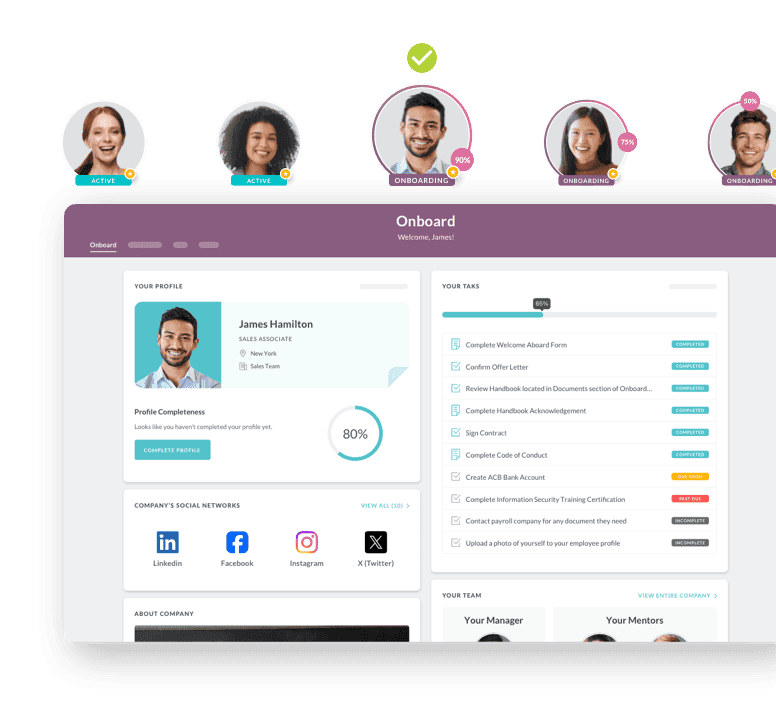
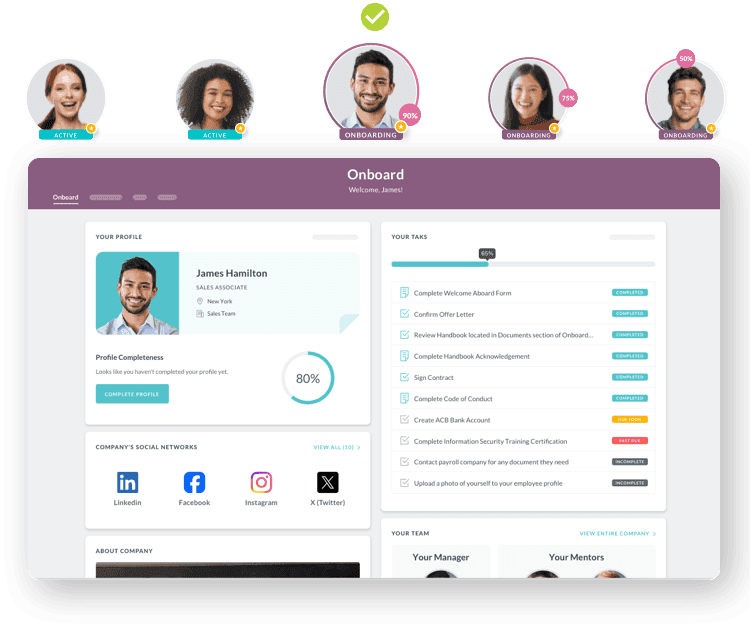
HR Cloud's Onboard module is built for the first row of the table above: getting every employee's certifications and compliance documents into one record, with mobile-first workflows for a workforce that mostly isn't sitting at a desk. It is not a skills-matrix or competency-scoring platform, and it doesn't natively run certification-aware scheduling. Manufacturers whose primary gap is either of those should evaluate a platform built specifically for it.
Certification Tracking Tied to Employee Profiles
Document request tasks let HR admins configure exactly what's required per role and route each upload to the correct folder with custom file naming. Chained task workflows enforce sequence where it matters: an employee can't be marked certified until the supporting document is uploaded and a manager has signed off, with no manual workaround to skip the step. Role-based document permissions control exactly who can see a given credential, with four visibility levels available (Only You, Everyone, Custom by security role, and Everyone Except the Related Employee). Bulk onboarding extends the same certification workflow to high-volume hiring waves, such as a seasonal production ramp, without treating each new hire as a one-off setup task.
For high-volume, frontline, or deskless onboarding specifically, Maya is HR Cloud's SMS-first onboarding agent: it sends new hires and existing employees text prompts for pending documents, training acknowledgments, and policy sign-offs, and collects credential and license documentation directly via SMS rather than requiring a portal login. On the Day 1 agent workflow specifically, a manufacturing floor hire receives role-specific safety certification and equipment authorization tasks automatically, the same way a clinical hire receives credential and HIPAA tasks in a healthcare deployment.
Expiration Alerts and Reporting
HR Cloud's Onboard platform supports configurable expiry alerts on documents and certifications tied to the employee's central record, with admins able to configure who receives them. Task completion notifications can be configured to fire when a credentialing task is completed, sent to specific employees, security roles, or HR contacts, which keeps supervisors informed without requiring them to log in and manually check status.
Because certification tracking starts at hire in HR Cloud's model, the same onboarding workflow that handles I-9 and E-Verify submission also carries the initial certification and training documentation collection, so a new operator's forklift or safety orientation records exist in the same system from day one. For manufacturers already running payroll through ADP, UKG, or Paylocity, HR Cloud is built to work alongside those systems rather than replace them; confirm the specific data your team needs synced during a demo, since integration depth varies by provider and by what's being connected.
What Are the Most Common Mistakes in Skill Tracking?
Treating It as a Records-Keeping Exercise, Not a Decision Input
A system that stores accurate certification data but never reaches the person making a scheduling call still leaves the door open to an uncertified worker getting assigned to a task that requires a credential they don't hold. Whether the fix is an automated eligibility check or a dashboard a supervisor actually consults, the record has to reach the decision, not just exist somewhere.
Inconsistent Tracking Across Plants
Multi-site manufacturers frequently run different tracking practices, or entirely different systems, at each location, often because one site has mobile-friendly tools and another is still faxing paperwork to corporate. That inconsistency means leadership can't answer a basic question, such as how many certifications are expiring company-wide in the next 30 days, without manually compiling data from every site first. Standardizing the tracking process and platform, including how field workers submit documentation, across locations is what makes company-wide compliance reporting possible instead of aspirational.
What Does Better Skill Tracking Deliver?
Fewer compliance exposures, and better-informed staffing decisions. Catching a lapsed certification before a shift starts, rather than during an audit or after an incident, is the difference between a routine renewal and a citation that can run into the tens of thousands of dollars per violation. On the staffing side, visibility into who's certified for what turns scheduling from a guessing exercise into a planning exercise, and lets HR leadership make cross-training decisions based on documented gaps rather than instinct.
Conclusion
Certification and skill tracking in manufacturing comes down to three layers a spreadsheet can only partly deliver: a single current record per employee, alerts that fire before a deadline instead of after, and a way for that status to actually reach the person making the scheduling call. Start by mapping what's actually required role by role, not by shopping for software first. From there, the platform question narrows to one worth asking directly: are you solving a compliance-documentation problem, a skills-matrix problem, a scheduling-integration problem, or some combination, because those are different tools, and assuming one vendor covers all three won't show up as a mistake until an audit or a scheduling gap makes it obvious.
If your primary gap is the compliance-documentation layer, credential collection, expiration visibility, reminders, and frontline onboarding, see how HR Cloud Onboard fits into your existing HR technology environment, including alongside the payroll and scheduling systems you already run, or request a demo to walk through a configuration built around your plant's actual certification requirements.

Discover how our HR solutions streamline onboarding, boost employee engagement, and simplify HR management
Book a DemoFAQs
What certifications are most commonly tracked in manufacturing?
The most commonly tracked certifications are forklift and powered industrial truck operation, crane operation, OSHA 10 or OSHA 30 safety training, lockout/tagout authorization, and trade-specific credentials like process- and position-specific welding certifications. Machine-specific operator qualifications for CNC or robotics equipment are also common.
Can certification tracking prevent unqualified equipment use?
Certification tracking reduces the risk but only fully prevents unqualified equipment use when accurate status actively reaches the person making the assignment, whether through an automated eligibility check tied to a scheduling system or a dashboard a supervisor checks as part of their routine. A system that stores accurate data but sits apart from the scheduling decision still leaves the gap open.
How often should skill inventories be updated?
Certification records should update continuously as renewals happen, not on a fixed calendar, since credentials expire on their own individual cycles. Most manufacturers also benefit from a quarterly audit that compares required certifications by role against actual current status across the workforce.
Does skill tracking help with succession planning?
Accurate certification data shows exactly where a department is thin on a required qualification, which makes the case for who to train next concrete instead of based on guesswork. Full succession planning typically requires broader competency and performance data beyond certification status alone, but certification records are a real, factual starting input.
Is a spreadsheet ever good enough for certification tracking?
A spreadsheet can work temporarily for a very small, single-shift operation with few certification types and one person consistently responsible for updating it. Once a plant runs multiple shifts, multiple locations, or a workforce with meaningful turnover, the spreadsheet's core weakness, that nothing actively surfaces it to the person making a scheduling decision, becomes a real gap.
What should a manufacturer look for when evaluating certification tracking software?
Look for configurable expiry alerts, role-based document permissions, integration with whatever system currently drives onboarding, mobile access for workers who don't sit at a desk, bulk processing for high-volume hiring periods, and exportable records for audits. Then ask directly whether the platform connects to scheduling, or only provides visibility, since those are different capabilities and vendors vary on which they offer.
Does certification tracking software work for a multi-shift, deskless manufacturing workforce?
Only if it's built for that specifically. A system that requires a desktop login to upload a document or acknowledge a renewal will have compliance gaps by design in a plant where most employees never sit at a company computer. Mobile, and in some cases SMS-based, access is a requirement, not a convenience feature, for shift-based manufacturing workforces.
About the author

Keep Reading


Like What You Hear?
We’d love to chat with you more about how HR Cloud® can support your business’s HR needs.
Book Your Free Demo