
The Manager's Role in Employee Retention: What the 2026 Data Shows

If your organization is spending money on engagement surveys, benefits upgrades, and HR-led retention programs — but your managers haven't changed how they work — you're solving the wrong problem.
According to Gallup's 2026 State of the Global Workplace report, global employee engagement fell to 20% in 2025, its lowest level in years, and the primary driver was a collapse in manager engagement — down nine percentage points since 2022. When managers disengage, their teams follow. And when teams disengage, turnover follows.
The short answer: The manager's role in employee retention is to create the daily conditions where employees feel supported, recognized, and able to grow. Managers influence 70% of team-level engagement variance, making them the single highest-leverage retention variable any organization controls — yet most retention programs are built above the manager layer, where they cannot reach the problem.
This guide covers the specific manager behaviors that drive retention, how HR and managers share accountability differently, and how to build the systems that make consistent manager execution possible.
Key Takeaways
- Gallup's 2026 report confirms that managers account for 70% of the variance in team-level engagement — making the manager role in employee retention the highest-leverage lever available.
- Manager engagement fell from 31% in 2022 to 22% in 2025 globally, a nine-point collapse that now threatens team-level retention outcomes directly.
- According to iHire's 2025 Talent Retention Report, 22.8% of employees who quit cited unhappiness with their direct manager or supervisor — the third most common departure reason.
- HR builds the retention strategy. Managers determine whether employees actually feel it. That gap is where most turnover happens.
- HR Cloud's Workmates platform gives managers the recognition tools, communication visibility, and engagement activity signals they need to act — not just intend.
Why Employee Retention Is a Manager Problem First
Understanding the manager role in employee retention starts with a simple observation: HR leaders are trained to think in systems — programs, policies, frameworks, surveys. That is the right instinct. But systems only work if the people closest to employees execute them consistently.
The employee does not experience "the company." They experience their direct manager. That manager sets their expectations on day one. That manager gives — or withholds — feedback. That manager decides whether a high performer gets stretched or gets burned out. That manager shapes whether the employee feels seen, stuck, or supported.
This is not a soft observation. Gallup's foundational research, replicated across decades and industries, finds that managers account for 70% of the variance in team-level engagement. Not compensation. Not benefits. Not the company's mission statement. The manager.
And yet most retention conversations in leadership meetings still start with: "Should we adjust the benefits package?"
Better benefits will not fix a manager who ignores their team.
For HR leaders: The most impactful shift in your employee retention strategies is moving from designing programs to equipping managers to execute them. That transition requires tools, workflows, and visibility — not just training.
What the 2026 Data Shows About Managers and Retention
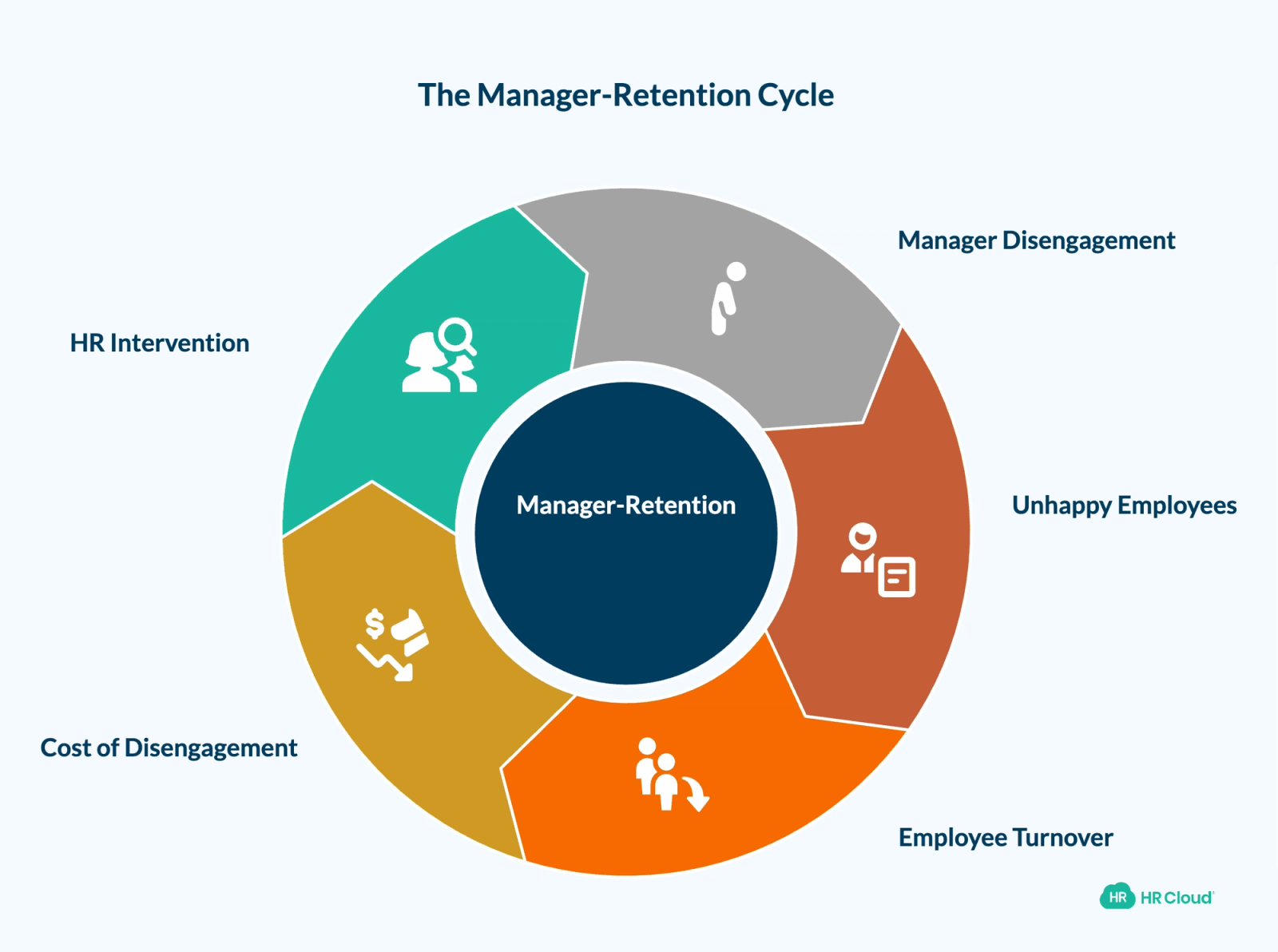
The numbers this year are unusually direct. Here is what the most current research tells us.
Manager Engagement Has Collapsed
Gallup's 2026 State of the Global Workplace report (covering 2025 data) shows manager engagement fell nine percentage points since 2022 — from 31% to 22%. The largest single-year drop hit between 2024 and 2025: a five-point decline in twelve months.
Managers used to enjoy what Gallup calls an "engagement premium" — they were measurably more engaged than the people they led. That premium has nearly disappeared. The engagement gap between managers and individual contributors went from +11 points in 2022 to just +3 points in 2025.
This matters because disengaged managers cannot do what engaged managers do: coach, communicate, recognize, develop, and catch warning signs early.
Unhappy Managers Create Unhappy Employees
According to The Predictive Index's 2021 People Management Report, teams with managers rated "poor" by employees have 63% of workers actively considering leaving within the next 12 months. By contrast, only 27% of employees with good managers said the same. The pattern is consistent: as the manager goes, so goes the team.
Managers Are a Primary Reason Employees Quit
iHire's 2025 Talent Retention Report found that 22.8% of employees who left a job cited unhappiness with their manager or supervisor — the third most common departure reason, behind toxic work environment (26.8%) and poor company leadership (24.2%). Both of those top reasons also trace directly to management behavior.
Disengagement Has a Price Tag
Gallup estimates the global cost of employee disengagement in 2025 exceeded $10 trillion in lost productivity — approximately 9% of global GDP. To put that at the organizational level: a 500-person company with an average salary of $65,000 faces roughly $1.5–2M in estimated annual disengagement costs based on Gallup's per-worker productivity loss estimates. Use HR Cloud's Cost of Employee Turnover Calculator to run the math against your specific headcount and salary range.
Why this data matters for HR: When employee engagement and retention get escalated to the C-suite, these are the numbers executives respond to. Frame the manager-retention connection in revenue terms — not survey scores — and you will get the resources for interventions that actually work.
The 7 Manager Behaviors That Improve Employee Retention
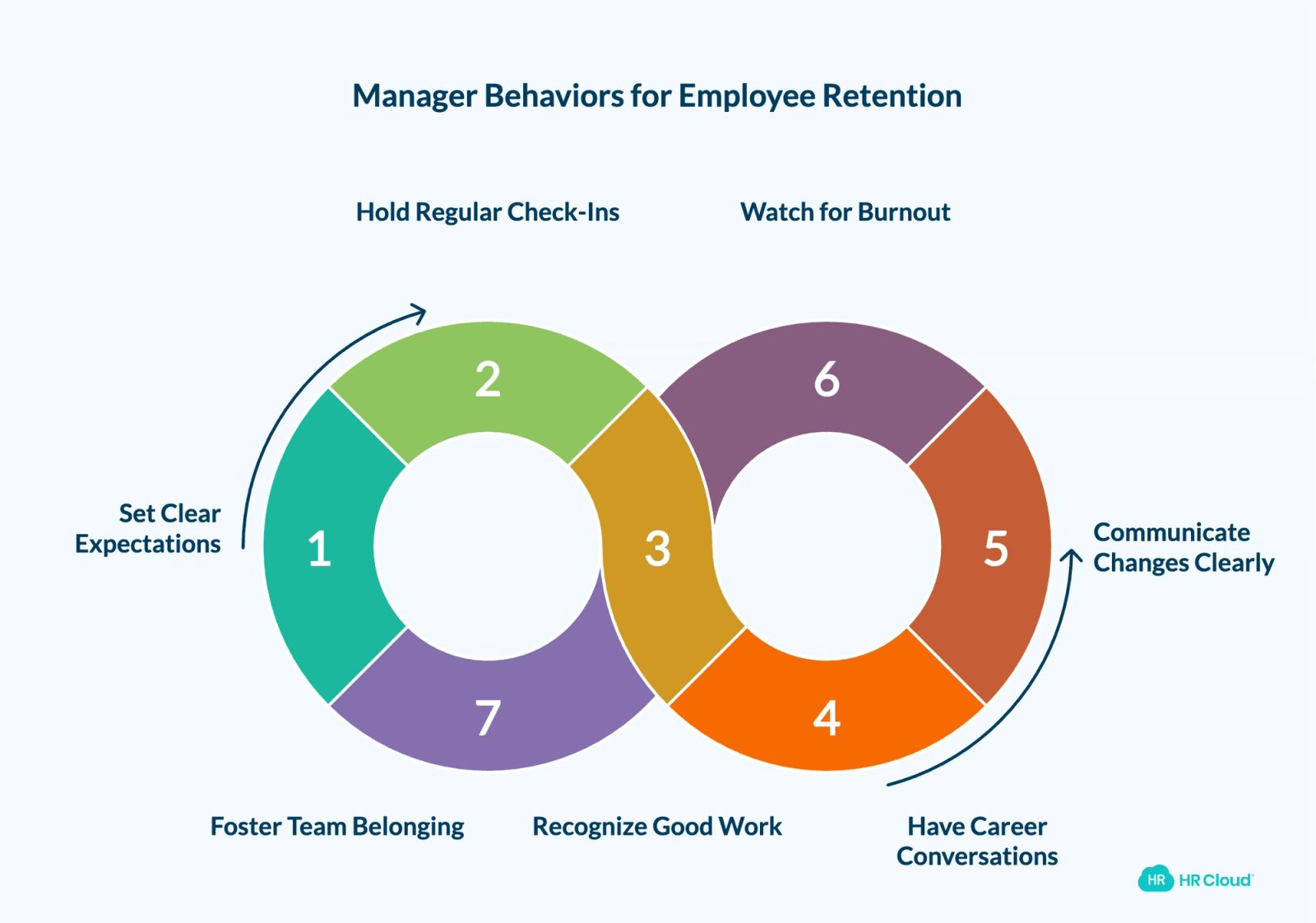
The following behaviors are not personality traits — they are learnable, auditable actions that show how managers improve employee retention in practice. HR cannot measure empathy. HR can measure whether a manager held the 30-day check-in, completed onboarding tasks, recognized a direct report, and documented a career conversation. Build accountability systems around the action, not the intention.
1. Set Clear Expectations From Day One — Not After the First Performance Issue
Ambiguity is one of the fastest drivers of early attrition. When employees are unsure what success looks like, what their priorities are, or how their work connects to team goals, they disengage quietly and leave loudly.
Managers should define role expectations, success metrics, and 30-60-90 day milestones during onboarding — not during a corrective conversation six months later. New hires who receive clear expectations from their manager in the first week are more likely to hit early wins, building the momentum that makes people want to stay.
HR Cloud's Onboard module gives managers structured task lists and automated reminders tied to each stage of the new hire journey — so critical conversations happen on schedule, not when someone happens to remember them. HR teams can configure manager touchpoints at day 1, day 7, day 30, day 60, and day 90, and track completion rates across the organization.
2. Hold Regular One-on-One Check-Ins — Not Just During Review Cycles
One-on-ones are the single most reliable early-warning system a manager has. A structured weekly or biweekly check-in creates a safe channel for employees to surface blockers, share concerns, and discuss workload — before those concerns become resignation letters.
Gallup research on high-performing teams consistently finds that frequent, quality feedback from managers is one of the strongest predictors of team engagement. Employees who know their manager will show up, listen, and respond are far less likely to start a quiet job search.
The cadence matters less than the consistency. A manager who shows up reliably for 30 minutes every two weeks builds more trust than one who schedules quarterly reviews and cancels half of them.
Manager development tip: Give managers a simple one-on-one template with four questions: What's going well? What's getting in your way? What support do you need from me? What are you working toward? That structure takes five minutes to learn and prevents a dozen reasons people quit.
3. Recognize Good Work in Real Time — Not Just at the Annual Review
Recognition that happens once a year is not an employee retention strategy. By the time the annual review arrives, employees have already formed their view of their manager and their future at the company.
Effective recognition is specific, timely, and visible. It names the behavior, connects it to impact, and happens close to the moment it occurred. This is not about elaborate reward programs — it is about managers building the habit of noticing and naming what their team does well.
HR Cloud's Workmates platform makes this practical. Managers can give kudos, post recognition to a shared feed, and participate in peer-to-peer recognition — putting acknowledgment into the daily flow of work rather than a separate process that requires effort to remember.
Here is what this looks like for a frontline manager: A nurse manager in a 400-bed hospital system could use Workmates to recognize a CNA after a difficult overnight shift, push that recognition to the unit's mobile feed, and reinforce the exact behaviors the floor needs repeated. The recognition takes 90 seconds. The impact — feeling seen, publicly valued, connected to the team — is what the annual review cannot replicate and what a competing job offer will struggle to match.

4. Have Career Conversations — Not Just Performance Conversations
Employees stay when they see a future inside the company. They leave when the only conversations with their manager center on current-role performance.
Career conversations are different. They ask: What do you want to develop? Where do you want to grow? What skills are you building? What internal opportunities interest you? For a warehouse associate, this may mean a path to shift lead. For a home health aide, it may mean cross-training or a certified nursing track. For a retail employee, it may mean a department lead role at a different location.
Managers who hold quarterly development conversations with direct reports give employees a reason to stay that a competing offer cannot always match. This is where how managers improve employee retention has its most durable long-term effect — it is harder to leave a company that is visibly investing in your future.
HR Cloud's Performance Management module helps managers structure development goals, track progress, and connect career conversations to measurable outcomes — so growth planning is not a once-a-year event that gets canceled when things get busy.
For HR leaders: Build career conversation prompts into your performance management cycle. Managers should not have to invent these questions from scratch — provide a structured template and a scheduled moment to use it.
5. Communicate Changes Clearly — Before Employees Hear Through the Grapevine
Trust erodes fastest when employees learn about changes — restructuring, leadership shifts, policy updates, strategic pivots — from someone other than their manager. The feeling of being the last to know is one of the most corrosive experiences in a workplace, and it is entirely preventable.
Managers who communicate proactively, explain the "why" behind decisions, and acknowledge uncertainty honestly build the psychological safety that makes employees willing to ride out difficult periods rather than exit them.
This is especially important for frontline and deskless workers who do not have access to company email or Slack. A warehouse supervisor managing three overlapping shifts, a healthcare supervisor covering two floors, or a construction site manager with crews across locations cannot rely on email to reach everyone. HR Cloud's Workmates platform includes mobile-accessible announcements and targeted feeds — so managers can reach every employee, on any device, regardless of location or shift.
“We highly recommend Workmates as it gives us the ability to communicate and connect our workforce.”

— Andrea Bermudez, Organizational & Talent Development Manager

6. Watch for Burnout — Especially in Top Performers
High performers are disproportionately at risk of quiet burnout. They get the hardest projects, are asked to cover for vacancies, and are often assumed to be "fine" because they never complain.
Managers are the only people close enough to the day-to-day work to see the warning signs: declining communication, missed deadlines from someone who never misses them, shorter responses, less energy in meetings. These are not personality changes — they are retention signals.
Acting on burnout early — adjusting workload, redistributing tasks, asking directly — is far less expensive than replacing a top performer who hits their limit. This is where manager behavior and employee engagement and retention connect most directly: the people most worth keeping are often the least likely to ask for help.
7. Make the Team Feel Like a Team
Belonging is a retention variable that managers control more directly than HR does. Employees who feel connected to their teammates are substantially more likely to stay, even when they receive external offers at higher pay.
Managers create belonging through small, consistent actions: proper introductions for new hires, team rituals, visible recognition of collaboration, and connecting individual work to team goals. For a warehouse worker, belonging may mean seeing recognition on a mobile feed after a hard shift. For a home health aide, it may mean receiving a team update without needing a company email inbox. For a school district employee, it may mean knowing which manager owns each step of onboarding before the first day.
None of this requires a budget. It requires intention — and the right tools to make that intention scalable across shifts, locations, and team sizes.
The overlooked variable: Belonging erodes faster in hybrid and remote environments where chance interactions do not occur naturally. See the employee engagement strategies guide for specific approaches by team type.
Download the free employee engagement checklist for managers
Use it to turn good intent into steady habits. Tick items, spot misses, and correct fast. The format is printable, one page, and built for hybrid and deskless teams.
Download Now
Give Your Managers the Tools to Execute Retention — Not Just Understand It
HR Cloud Workmates gives managers real-time recognition tools, mobile communication feeds, and employee engagement activity visibility — built for frontline, distributed, and hybrid teams. Book a demo, workmates
HR's Role vs. the Manager's Role in Retention
Most retention failures are not strategy failures. They are execution failures — the gap between what HR designed and what managers actually delivered. This table makes the accountability split explicit.
| Area | HR's Role | Manager's Role |
|---|---|---|
| Retention strategy | Designs programs and policies | Applies them in daily interactions |
| Onboarding | Builds process and workflows | Gives role clarity and team support |
| Engagement | Measures and enables engagement | Creates the daily employee experience |
| Recognition | Provides tools and frameworks | Recognizes employees consistently |
| Performance | Builds review structure | Coaches and gives real-time feedback |
| Career growth | Creates internal pathways | Holds development conversations |
| Turnover risk | Tracks trends and patterns | Spots early warning signs per person |
| Communication | Cascades company-level information | Translates it to team-level context |
Use this table as a diagnostic. If your employee retention strategies are well-designed but turnover remains high, run through each row and ask: where is execution breaking down in our manager population?
For HR leaders: This table is useful in manager training conversations too. Walk through each row and ask your managers which areas they feel most equipped to deliver — and which they have been quietly deferring back to HR.
The Manager Mistakes That Accelerate Turnover
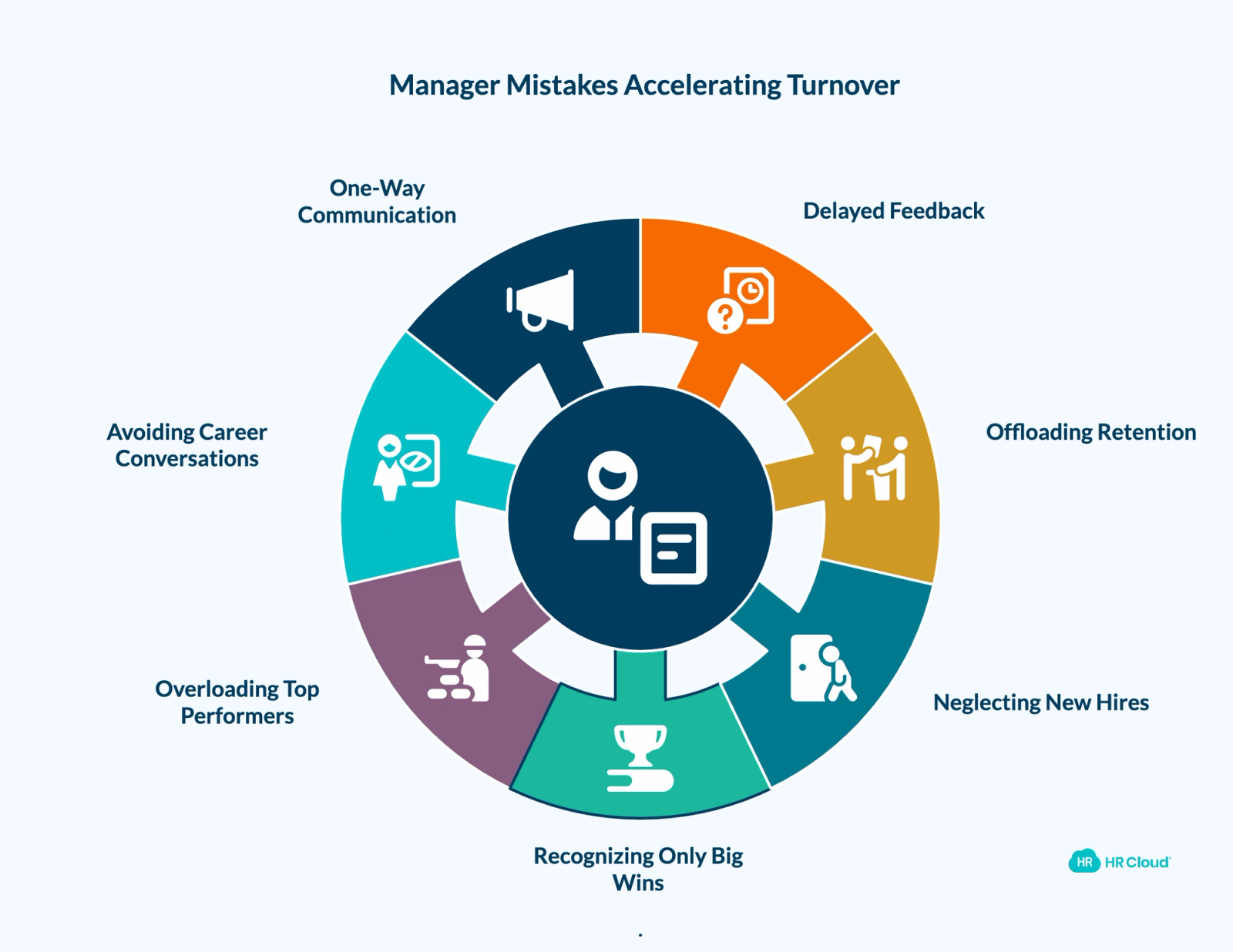
Understanding what works is only half the picture. The manager role in employee retention is not just about what managers do right — it is equally shaped by what they consistently fail to do. These are the behaviors that accelerate employee exit, often without the manager recognizing the connection.
Waiting too long to give feedback. Employees interpret silence as indifference. When feedback only arrives at annual review time, or only when something goes wrong, employees lose the sense of being seen and guided.
Assuming HR owns the entire retention problem. Managers who offload all people concerns to HR are not leaders — they are logistics coordinators. Retention outcomes are local. They happen at the team level, shaped by the manager's daily behavior.
Treating new hires as "done" after orientation. The first 90 days are when retention decisions get made. Managers who check in during onboarding and then disappear leave new employees without the anchor they need to feel committed.
Recognizing only big wins. Waiting for promotions or completed projects to express appreciation creates long stretches where employees hear nothing positive about their work. Effort, progress, and values-aligned behavior all deserve acknowledgment.
Overloading top performers. High performers who are consistently assigned more than their fair share eventually conclude that being good at their job is a punishment. They leave, and they are the hardest to replace.
Avoiding career conversations. Managers who never discuss an employee's growth goals send an unintentional message: "We only care about what you do for us right now." Career conversations are one of the highest-return investments in employee engagement and retention — at zero cost beyond time.
One-way communication. Managers who push information downward but never create space for questions, pushback, or feedback build teams that feel managed rather than led.
A manager can dismantle a well-designed retention strategy. Better benefits will not fix poor communication, unclear expectations, or a team that has stopped trusting the person running it.
For HR leaders: Retention programs that do not include manager accountability and manager support are programs that will underperform. Build both. See the 2026 employee retention strategies guide for a fuller framework.
How to Turn This Into Action: A 3-Step Starting Point
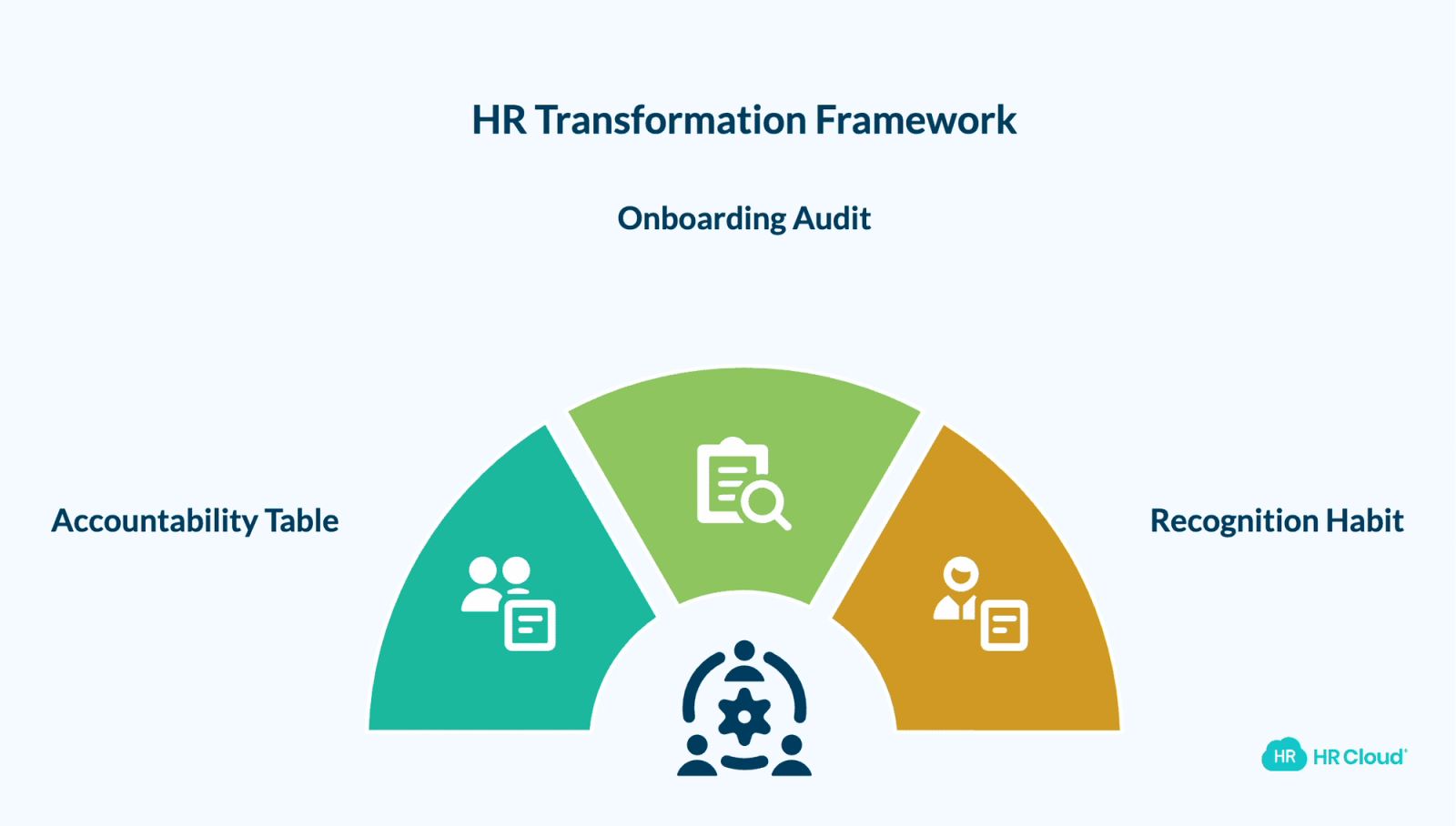
The following three actions can be started quickly and can help HR teams identify manager-execution gaps over the next 90 days.
Step 1: Run the accountability table with your manager population. In your next manager meeting or HR business partner review, go through the HR/Manager table above and ask: "Where is the execution gap in our organization?" Identify one or two areas where HR has built a strong program but manager follow-through is inconsistent. That is the highest-leverage intervention point.
Step 2: Audit your onboarding for manager touchpoints. Pull your onboarding process and map every step that requires manager action. Are those steps documented? Are managers receiving reminders? Are completion rates tracked? If the answer to any of those is no, you have a structural gap — not a manager performance problem. Fix the process before addressing the people.
Step 3: Give managers one recognition habit to build this week. Recognition does not need a platform to start. Ask every manager to send one specific, written piece of recognition to a direct report before end of the week — naming the specific behavior and its impact. Track who does it. Debrief what happened. Then build platform support around the habit, not in front of it.
How HR Cloud Supports Manager-Led Retention
HR Cloud does not replace the manager. It removes the friction that prevents managers from doing the right things consistently.
With HR Cloud Onboard, HR teams can configure manager task lists, automated reminders, and role-specific onboarding workflows for every new hire. The critical 30-60-90 day conversations happen because the system prompts them — not because the manager happened to remember. Completion rates are tracked, so HR can see which managers are executing and which need support before new hires disengage.
With HR Cloud Workmates, managers and HR teams can support employee recognition, share announcements, run surveys, and keep frontline and distributed employees connected through mobile-friendly channels. HR gets visibility into communication reach, recognition activity, and engagement patterns — giving people leaders the signals to identify where manager follow-through needs attention before it shows up in exit interviews.
The goal is not to add more tasks to a manager's plate. It is to make the behaviors that drive employee engagement and retention — recognition, communication, connection, structured onboarding — as easy as the behaviors that do not. For frontline managers stretched across shifts and locations, that infrastructure is not optional. It is the difference between a retention strategy that exists on paper and one that employees actually experience.
If your managers understand retention but are still not delivering it consistently, the problem is execution infrastructure — not intent. Workmates gives them the tools to act. Onboard gives them the structure to follow through. Start free today and see what consistent manager execution looks like at scale.

Experience how Workmates can transform communication and strengthen culture—all in one powerful platform
Book Your Free DemoFrequently Asked Questions
What is the manager's role in employee retention?
The manager's role in employee retention is to create a daily work environment where employees feel supported, informed, recognized, and able to grow. HR may design retention programs, but managers determine whether employees actually experience them. The most critical manager behaviors include setting clear expectations, holding regular check-ins, providing consistent recognition, having career conversations, and communicating transparently.
Why do managers have such a large impact on employee retention?
Managers control many of the variables that determine whether employees stay or leave: expectations, feedback quality, workload distribution, recognition, team connection, and career development conversations. According to Gallup's foundational research, managers account for 70% of the variance in team-level engagement — and employee engagement and retention are directly linked. When managers disengage, their teams follow, and voluntary turnover rates climb.
How do managers improve employee retention?
Managers can improve employee retention by holding consistent one-on-one check-ins, setting clear role expectations from day one, recognizing employees for specific behaviors in real time, holding quarterly career development conversations, communicating changes proactively, monitoring workload to prevent burnout, and deliberately building team connection. These are not personality-dependent traits — they are learnable actions that structured workflows and the right tools can support.
Is employee retention HR's responsibility or the manager's responsibility?
Both — but with different accountability. HR builds the systems: the retention programs, onboarding workflows, engagement tools, career frameworks, and recognition platforms. Managers create the daily employee experience that determines whether those systems produce results. Retention fails when HR builds the strategy but managers do not execute it. The solution is equipping managers with tools and workflows that make consistent execution a core part of your employee retention strategies — not an afterthought.
What manager behaviors most often cause employees to leave?
The most common manager-driven causes of turnover include infrequent or absent feedback, unclear expectations, lack of recognition for effort and progress, avoiding career development conversations, overloading high performers, poor communication about changes, and treating employee concerns as HR's responsibility rather than their own. According to iHire's 2025 Talent Retention Report, unhappiness with a manager or supervisor was cited by 22.8% of employees who quit their most recent job voluntarily.
How does manager disengagement affect employee retention?
When managers disengage, their teams lose the coaching, recognition, communication, and support that keep people committed. Gallup's 2026 report (covering 2025 data) found that manager engagement dropped from 31% in 2022 to 22% in 2025 — a nine-point decline that accounts for much of the broader global engagement drop. Disengaged managers become what researchers describe as "risk multipliers": their disengagement cascades to their teams, raising voluntary turnover risk across the board.
How do you measure a manager's impact on employee retention?
Measure manager impact through team-level voluntary turnover rates, 90-day new hire retention per manager, engagement survey scores by team, and one-on-one and onboarding task completion rates. Recognition activity — frequency, recency, and participation — also serves as a leading indicator. HR Cloud Workmates surfaces engagement activity signals in real time, giving HR and people leaders visibility into which managers are actively executing retention behaviors and which teams may need additional support.
Not ready for a full trial yet? Run the turnover numbers first and see what manager-driven attrition is actually costing your organization.
About the author

Keep Reading


Like What You Hear?
We’d love to chat with you more about how HR Cloud® can support your business’s HR needs.
Book Your Free Demo