
Equity in the Workplace: A Practical Guide to Building Fairness and Opportunity

Workplace equity shouldn't be an aspiration—it should be the foundation of how organizations operate. Everyone deserves fair access to opportunity, recognition, and a genuine sense of belonging. Yet the reality remains sobering: as of 2024, women hold just 29% of executive roles in S&P 100 companies and only 9% of CEO positions.
This isn't merely a pipeline problem—it reflects deeper systemic barriers in how organizations recognize contributions, allocate opportunities, and foster belonging. Research from McKinsey shows that companies with gender and ethnic diversity in leadership are 36% more profitable than their peers, yet equity gaps persist at every organizational level.
The good news? Equity isn't abstract. When organizations embed fairness into their everyday practices—particularly through consistent recognition, transparent advancement pathways, and data-driven decision-making—they create cultures where everyone can genuinely thrive. Platforms like HR Cloud's Workmates help organizations operationalize equity by making recognition visible, tracking engagement patterns across demographics, and ensuring every employee's contributions are acknowledged regardless of their location or role.
So what does workplace equity really mean, and how can organizations move from good intentions to measurable results? Let's explore the principles, strategies, and tools that make equity actionable.
What Is Equity in the Workplace?
Workplace equity means ensuring every employee has fair access to opportunities, resources, and recognition based on their individual needs and circumstances. Unlike equality, which provides identical resources to everyone, equity recognizes that people start from different places and face different barriers. Equity removes those obstacles systematically so everyone has a genuine chance to succeed.
Equity vs. Equality: Understanding the Critical Difference
Many organizations confuse equality with equity, but the distinction matters enormously for outcomes:
Equality treats everyone identically—same resources, same support, same expectations. On the surface, this seems fair. But when employees face vastly different circumstances, identical treatment perpetuates existing advantages and disadvantages.
Equity provides differentiated support based on individual needs. It recognizes that a frontline warehouse worker needs different resources than an office-based manager, that a parent balancing caregiving responsibilities may need schedule flexibility, and that employees from underrepresented backgrounds may benefit from targeted mentorship.
For example, consider two scenarios:
- Equality approach: All employees attend the same in-person leadership training during business hours
- Equity approach: Leadership training is available in multiple formats—live and recorded, in-person and virtual—scheduled across different shifts to accommodate frontline workers, with language options and accessibility features
The equity approach ensures everyone can actually access the development opportunity, not just those with schedule flexibility and proximity to headquarters.
Why Workplace Equity Matters for Business Performance
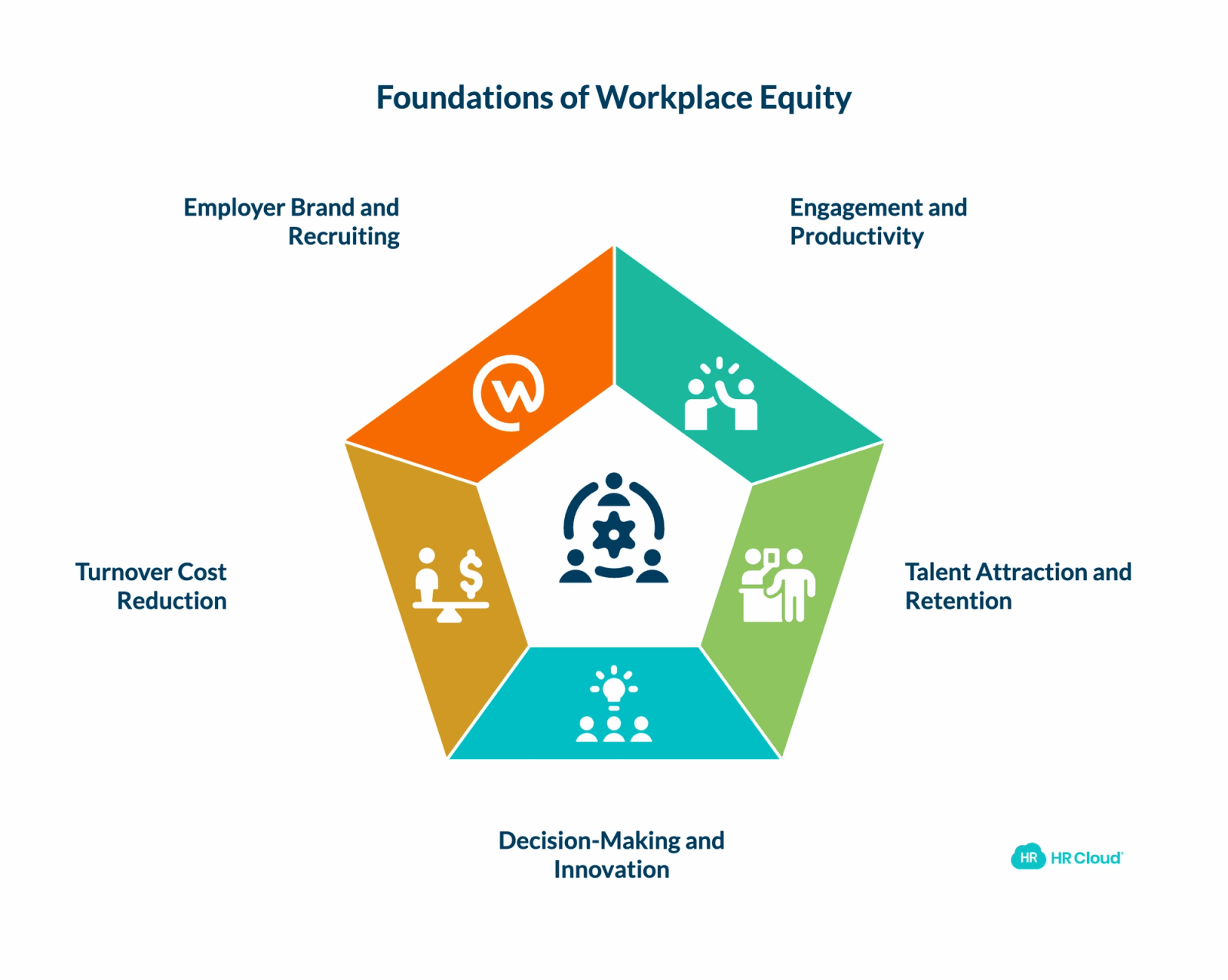
The business case for equity extends far beyond compliance or reputation management. Organizations that build equitable systems see measurable impacts:
Higher engagement and productivity. When employees trust they'll be recognized fairly and given genuine growth opportunities, engagement rises significantly. According to Gallup research, highly engaged teams show 23% greater profitability.
Stronger talent attraction and retention. Data from the 2024 Engagement and Retention Report reveals that 72% of employees would choose feeling valued and supported over a 30% salary increase. For organizations competing for talent, equity isn't optional—it's essential.
Better decision-making and innovation. Diverse teams that operate equitably solve problems 87% faster than homogeneous groups and produce 31% better decision-making outcomes. When everyone's voice carries weight and contributions are recognized fairly, organizations access their full collective intelligence.
Reduced turnover costs. Inequity drives attrition. Employees who perceive unfair treatment or limited advancement opportunities actively seek alternatives. Given that replacing an employee costs 50-200% of their annual salary, equity initiatives deliver direct cost savings.
Improved employer brand and recruiting outcomes. Today's talent, particularly Millennials and Gen Z who now comprise 55% of the workforce, actively research companies' equity track records. Organizations with demonstrated equity commitments attract 43% more qualified candidates.
Core Principles of Workplace Equity
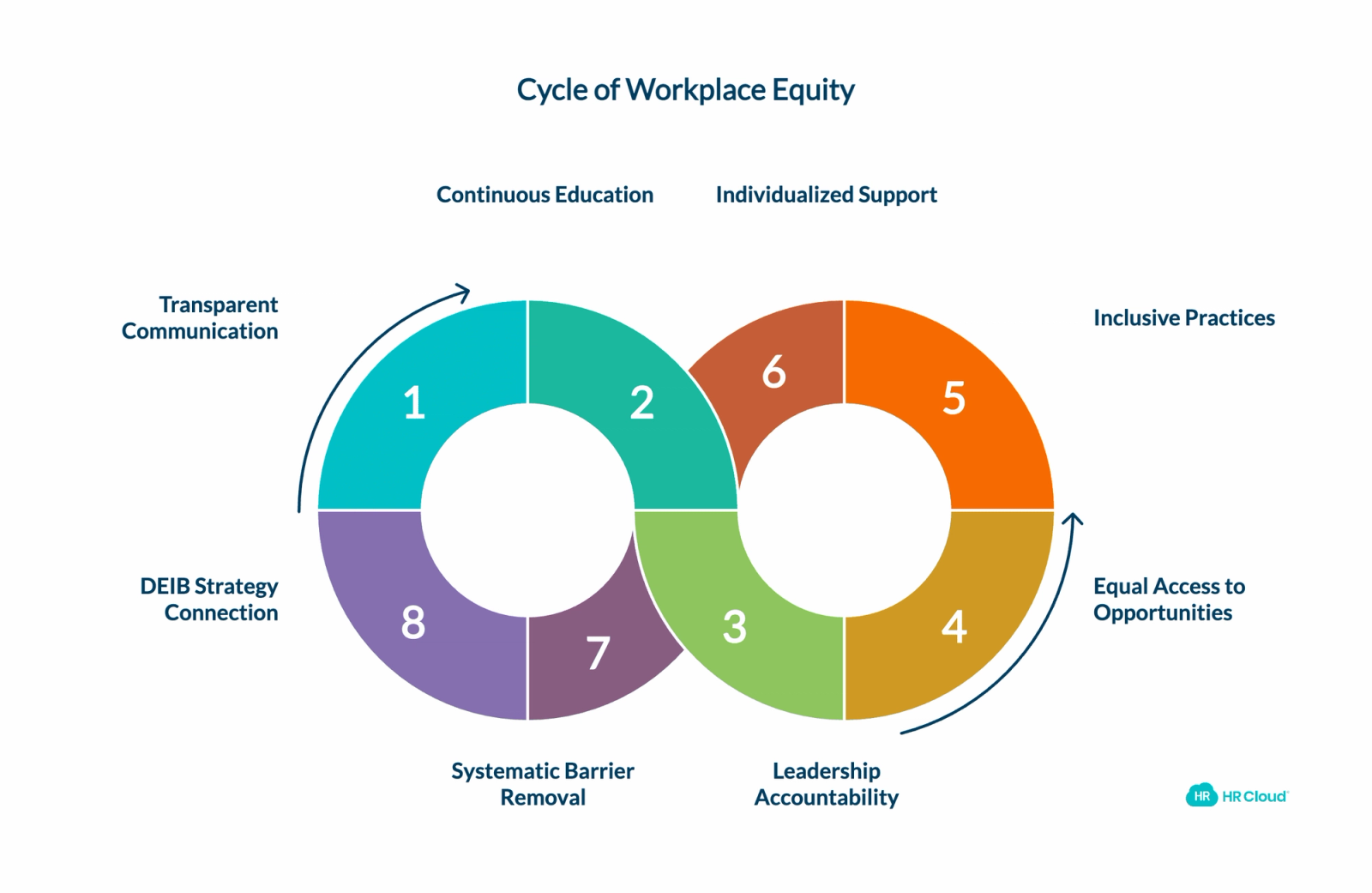
Building genuine equity requires understanding and implementing several interconnected principles that shape how your organization operates:
1. Transparent Communication and Decision-Making
Trust forms when people understand how decisions get made—not through rumors or assumptions, but through clear, documented processes. This means:
- Publishing promotion criteria and advancement pathways
- Explaining compensation structures and pay ranges
- Sharing recognition patterns and ensuring visibility across all departments
- Documenting how performance gets evaluated and who makes final decisions
HR Cloud's People platform enables this transparency by centralizing employee data, tracking advancement milestones, and providing clear visibility into career progression paths.
2. Continuous Education and Awareness
Equity doesn't happen accidentally. It requires ongoing learning about unconscious bias, structural barriers, and evolving best practices. Effective organizations:
- Implement regular bias training for all employees, especially hiring managers and leadership
- Create space for honest conversations about different experiences
- Share data on representation gaps and equity metrics
- Encourage feedback on policies and practices that may inadvertently disadvantage certain groups
3. Leadership Accountability with Measurable Goals
Equity needs executive sponsorship, but more importantly, it requires accountability. Leaders should:
- Set specific, measurable equity goals (e.g., "Achieve 40% women in leadership by 2027")
- Tie equity outcomes to performance evaluations and compensation
- Regularly review progress through dashboards and reports
- Share results transparently, including both progress and setbacks
HR Cloud's analytics capabilities help leaders track recognition patterns, engagement scores, and participation rates across demographic groups—surfacing potential equity gaps before they become retention crises.
4. Equal Access to Opportunities and Advancement
Everyone should see a clear path to growth. This requires:
- Publishing advancement criteria that focus on skills and performance, not subjective factors
- Creating structured processes for promotions that reduce bias
- Ensuring all employees have access to high-visibility projects and leadership opportunities
- Tracking promotion rates across demographics to identify and address disparities
Research shows that people who perceive promotion equity are more than twice as likely to envision long-term careers at their organization.
5. Inclusive Practices Embedded in Daily Operations
Equity can't be a separate initiative—it must be woven into how work gets done. This includes:
- Recognition programs that ensure visibility for all contributions, not just those of the most vocal or visible employees
- Performance review processes that reduce recency bias and subjective evaluation
- Meeting practices that ensure all voices are heard, not just senior leaders
- Technology choices that serve diverse work arrangements (office, remote, frontline)
HR Cloud's Workmates platform supports inclusive practices by providing mobile-first recognition tools that work for frontline employees, peer-to-peer appreciation channels that bypass hierarchical bottlenecks, and engagement features that give everyone a voice.

6. Individualized Support Based on Different Needs
Equity recognizes that fairness doesn't mean sameness. Organizations should:
- Offer flexible work arrangements that accommodate different life circumstances
- Provide resources tailored to different career stages and backgrounds
- Create mentorship and sponsorship programs that connect underrepresented employees with advocates
- Design benefits and policies with diverse needs in mind (caregiving support, religious accommodations, neurodiversity inclusion)
7. Systematic Barrier Removal
Many inequities stem from outdated policies and hidden structural barriers. Address these by:
- Auditing job descriptions for gendered or biased language
- Removing degree requirements that don't genuinely predict success
- Reviewing meeting times and locations that inadvertently exclude certain groups
- Examining performance metrics that may favor certain work styles over others
- Analyzing which employees access development opportunities and why others don't
8. Clear Connection to DEIB Strategy
Equity doesn't stand alone—it's the "how" that makes diversity and inclusion work. While diversity brings different perspectives to the table and inclusion ensures everyone feels welcome, equity ensures everyone has the resources and opportunities they need to contribute fully.
This connection matters: according to Harvard Business Review research, 60% of organizations have a DEI strategy, but only 26% have gender representation goals and 16% have race representation goals. True equity requires moving beyond aspirational statements to concrete, measurable actions.
Proven Strategies to Promote Workplace Equity
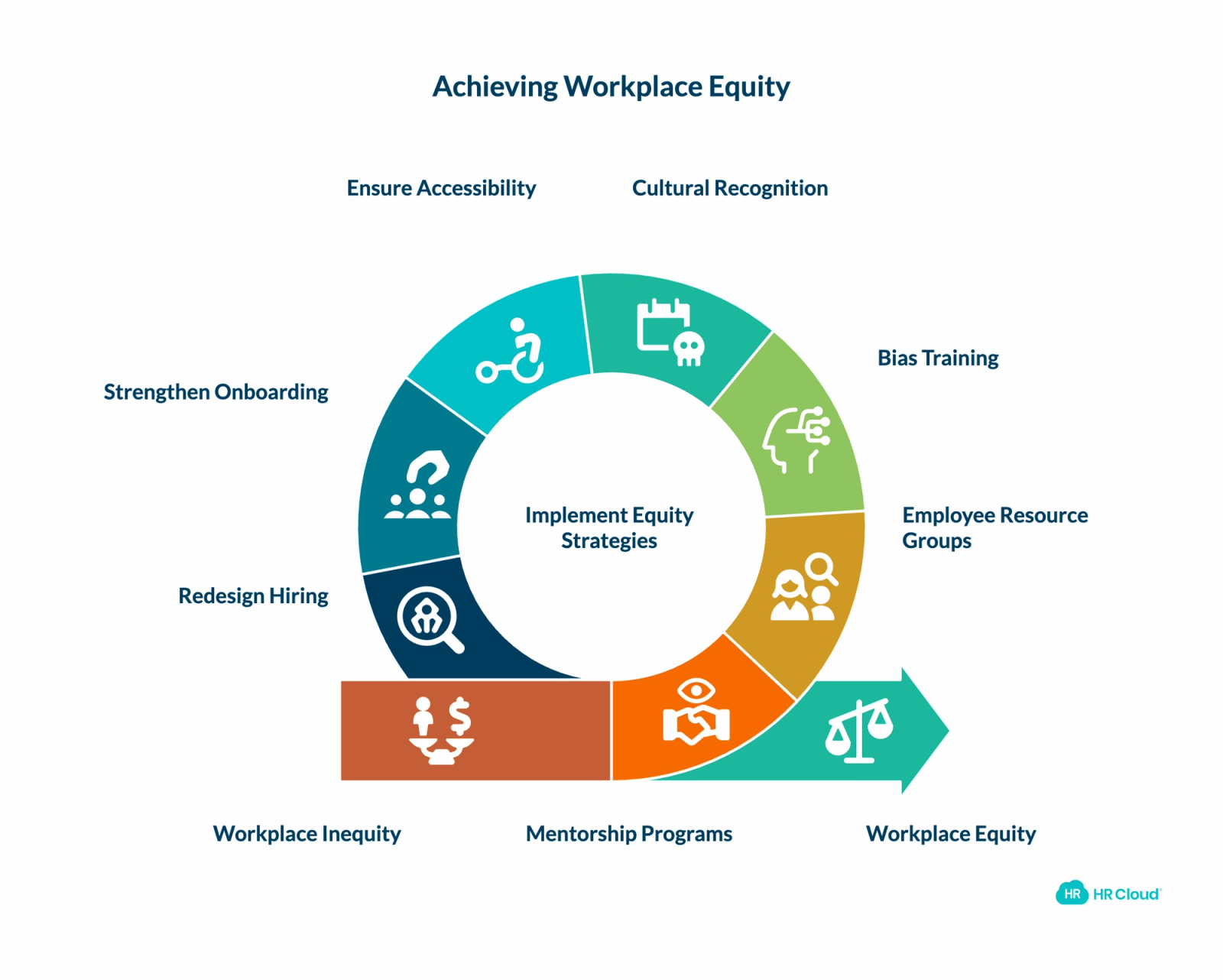
Understanding equity principles is essential, but implementation determines impact. Here are evidence-based strategies that move organizations from intention to action:
Create Structured Mentorship and Sponsorship Programs
Informal mentorship tends to benefit employees who already have access and connections. Formalized programs level the playing field by:
- Pairing senior leaders with employees from underrepresented groups
- Providing structured guidance on navigating organizational politics and advancement
- Creating sponsorship relationships where advocates actively champion their mentees for opportunities
- Tracking participation and outcomes to ensure equitable access
Organizations with robust mentorship programs see 35% higher retention rates among underrepresented employees.
“The platform connects associates to each other in a way that doesn’t happen through email.”
— Gail Gust, Director of Marketing and Business Development

Implement Employee Resource Groups (ERGs)
ERGs provide community, advocacy, and practical support. Effective ERG programs:
- Give employees space to connect with others who share backgrounds or experiences
- Provide input into policy decisions that affect their communities
- Create pathways for leadership development through ERG officer roles
- Receive executive sponsorship and dedicated budget
- Measure impact on retention and belonging
Over 60% of Fortune 500 companies have established ERGs, recognizing their value for both employees and organizational culture.
Conduct Regular Bias Training—But Make It Meaningful
One-off diversity workshops rarely change behavior. Instead:
- Integrate bias awareness into ongoing leadership development
- Focus on practical scenarios employees actually encounter (hiring decisions, performance reviews, project assignments)
- Follow training with accountability mechanisms and behavioral change tracking
- Provide resources for continued learning, not just a single session
- Measure outcomes through equity metrics, not just training completion rates
Recognize Cultural Holidays and Identity Celebrations
Inclusion shows up in the details. Simple but powerful practices include:
- Acknowledging diverse holidays in your company calendar
- Allowing flexible time off for religious and cultural observances
- Celebrating Heritage months authentically (not just through performative posts)
- Creating space for employees to share their traditions and backgrounds
These practices signal that diverse identities are valued, not merely tolerated.
Ensure Universal Accessibility
If people can't fully participate, they can't fully contribute. Prioritize:
- Physical accessibility (ramps, adjustable desks, accessible meeting spaces)
- Digital accessibility (screen readers, captions, accessible document formats)
- Cognitive accessibility (clear communication, written meeting agendas, quiet spaces)
- Geographic accessibility (distributed meeting times, async communication options)
Accessibility benefits everyone—employees with disabilities absolutely, but also working parents, neurodivergent colleagues, and remote team members.
Review and Strengthen Onboarding for Equity
Onboarding is your culture's first impression. Ensure it:
- Welcomes all employees warmly regardless of background
- Provides consistent information and resources to everyone
- Doesn't assume shared cultural or organizational knowledge
- Connects new hires with mentors and ERGs from day one
- Collects feedback on onboarding experiences across demographics
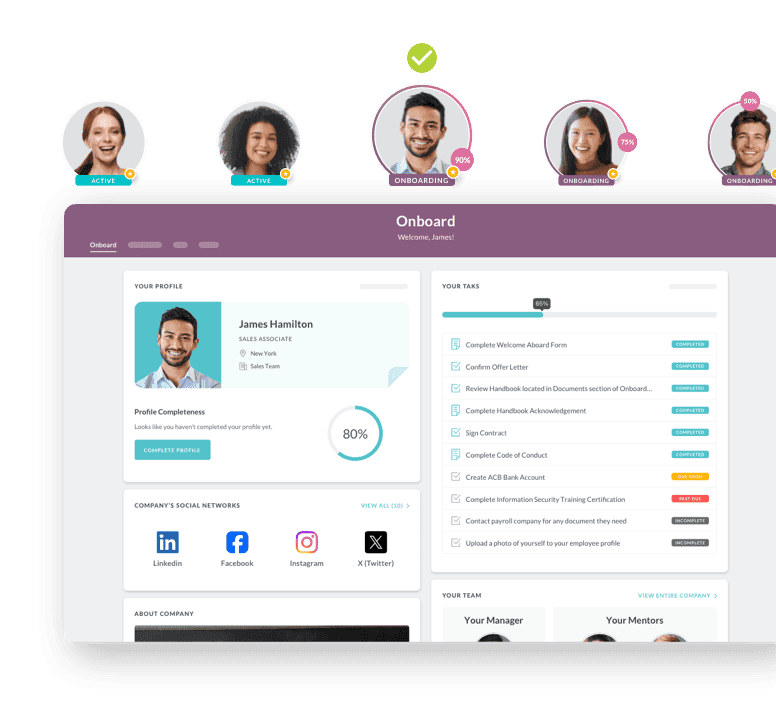
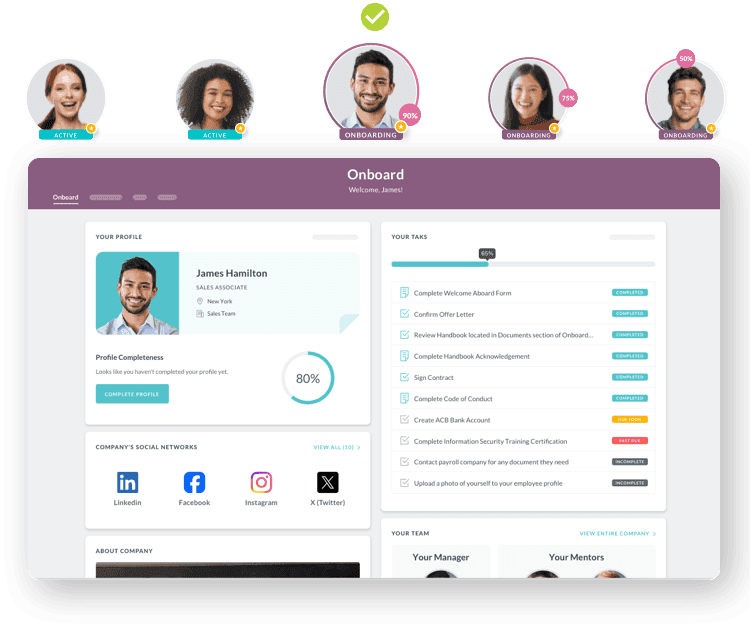
HR Cloud's Onboard platform standardizes onboarding processes while allowing customization for different roles and locations, ensuring both consistency and relevance for diverse employee populations.
Redesign Hiring Practices to Reduce Bias
Hiring equity starts before the job post goes live:
- Audit job descriptions for biased language and unnecessary requirements
- Use structured interviews with standardized questions
- Employ diverse interview panels to reduce individual bias
- Remove names and identifiable information from initial application reviews
- Track applicant demographics and hiring outcomes to identify systemic issues
Organizations that implement structured hiring processes reduce hiring bias by up to 40%.
Address Unconscious Bias in Performance Management
Performance reviews often reflect bias more than actual performance. Improve equity by:
- Using standardized evaluation criteria tied to specific competencies
- Requiring concrete examples to support ratings
- Calibrating ratings across managers to reduce individual bias
- Tracking performance ratings across demographics to identify patterns
- Reviewing for recency bias, halo effects, and similarity bias
HR Cloud's Perform platform supports equitable performance management through structured review processes, 360-degree feedback options, and analytics that surface rating disparities.
Lead DEI Efforts from the Top
Equity can't be delegated to HR alone. Executive leadership must:
- Publicly commit to specific equity goals with timelines
- Allocate budget and resources to equity initiatives
- Include equity outcomes in executive performance evaluations
- Model inclusive behaviors and acknowledge their own learning journey
- Communicate regularly about progress, challenges, and course corrections
When leadership accountability is absent, only 28% of companies hold executives responsible for DEI progress—a critical gap that undermines even well-designed programs.
Make Recognition Central to Your Equity Strategy
Recognition might seem peripheral to equity, but it's actually fundamental. Here's why:
Visibility drives opportunity. Employees whose contributions are consistently recognized gain visibility with leadership, access to high-profile projects, and consideration for advancement. When recognition patterns favor certain groups (often those already closest to power), inequity compounds.
Recognition shapes culture. What gets recognized signals what the organization truly values. If only certain types of contributions or certain employees receive acknowledgment, you're inadvertently communicating that other work—and other people—matter less.
Fair recognition correlates with retention. Employees who feel their contributions go unrecognized are 2.5x more likely to leave within the year. For underrepresented groups who already face additional workplace barriers, lack of recognition becomes the final straw.
Modern recognition platforms enable equity at scale. HR Cloud's Workmates platform democratizes recognition through:
- Peer-to-peer recognition channels that don't rely on manager awareness alone
- Mobile accessibility ensuring frontline workers can give and receive recognition just as easily as office staff
- Customizable badges aligned to company values, not just output metrics
- Recognition analytics that surface patterns and potential gaps across demographics, teams, and locations
- Integration with rewards programs that provide tangible appreciation, not just symbolic gestures
- Social visibility that amplifies recognition across the organization, not just within immediate teams
By making recognition frequent, visible, and accessible to all employees regardless of role or location, organizations can actively counteract the visibility bias that often disadvantages underrepresented groups.
How to Measure Equity in the Workplace
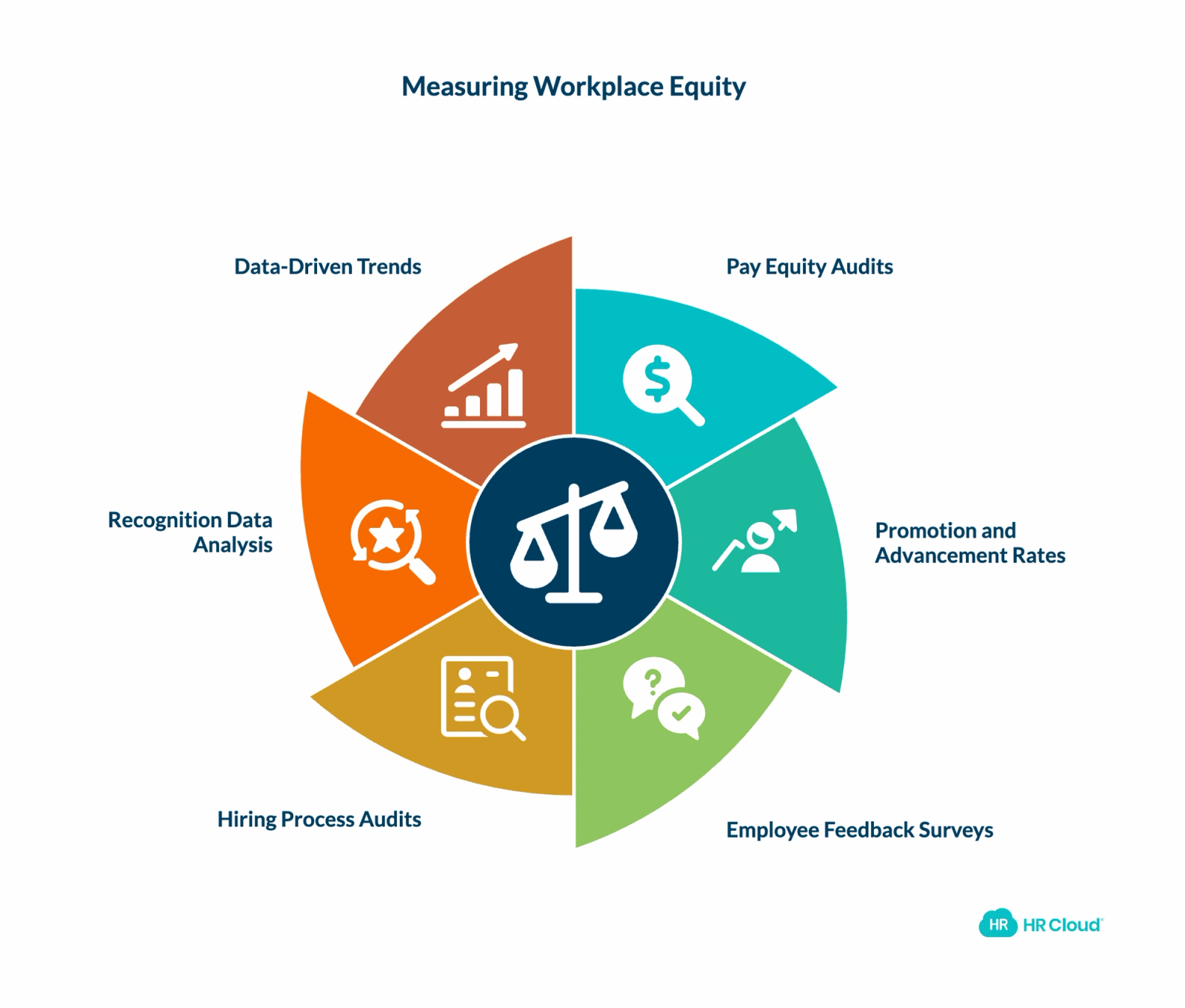
You can't improve what you don't measure. Effective equity measurement requires both quantitative metrics and qualitative insights:
Conduct Regular Pay Equity Audits
Pay equity forms the foundation of workplace fairness. Audit by:
- Analyzing compensation data across roles, departments, and demographics
- Identifying unexplained pay gaps (gaps not justified by experience, performance, or tenure)
- Adjusting compensation to eliminate unjustified disparities
- Establishing transparent pay ranges for all positions
- Tracking progress over time with annual audits
Organizations with comprehensive pay equity programs show 34% smaller gender pay gaps and 28% reduced racial pay disparities.
Track Promotion and Advancement Rates
Representation at entry level means nothing if advancement opportunities remain inequitable. Monitor:
- Promotion rates across demographics at every level
- Time-to-promotion for different groups
- Representation in leadership compared to overall workforce composition
- Which employees access high-visibility projects and development opportunities
- Attrition rates by level and demographics
If women comprise 45% of your workforce but only 20% of directors and 10% of executives, you have an advancement equity problem that needs systematic attention.
Implement Regular Employee Feedback Surveys
Numbers tell part of the story; lived experiences tell the rest. Survey employees about:
- Whether they believe advancement opportunities are distributed fairly
- If they feel their contributions are recognized consistently
- Whether they can bring their full selves to work
- If they experience bias or discrimination
- How included they feel in decision-making
- Whether they see clear paths for growth
Make surveys confidential, analyze results by demographics (while protecting individual privacy), and most importantly, act on what you learn and communicate those actions.
Audit Hiring Processes and Outcomes
Hiring equity requires scrutiny at every stage:
- Track applicant demographics at each hiring stage (application, phone screen, interview, offer)
- Identify where certain groups drop out of your funnel
- Analyze which job boards, recruiting sources, and referral programs yield diverse candidates
- Review job descriptions and requirements for potential bias
- Examine interview process consistency and structure
If your applicant pool is diverse but your hires aren't, your interview process likely contains bias that needs addressing.
Analyze Recognition Patterns and Engagement Data
Recognition data offers unique insight into organizational equity:
- Who receives recognition most frequently
- Whether recognition is evenly distributed across teams, locations, and demographics
- Which types of contributions get acknowledged (and which are overlooked)
- Whether managers recognize all team members or favor certain individuals
- How recognition correlates with advancement and retention outcomes
HR Cloud's Workmates analytics dashboard makes this analysis straightforward, surfacing recognition patterns that might otherwise remain invisible and enabling proactive intervention before inequity damages retention.
Use Data to Spot Trends Early and Act
One-time measurements accomplish little. Instead:
- Establish baseline metrics across all equity dimensions
- Set specific, time-bound goals for improvement
- Review progress quarterly with leadership
- Share aggregated results transparently with employees
- Adjust strategies based on what the data reveals
- Celebrate progress while maintaining honest conversation about remaining gaps
Organizations that treat equity as an ongoing practice, not a project, see 31% higher innovation rates and 67% better problem-solving capabilities than peers.
Common Barriers to Workplace Equity (And How to Overcome Them)
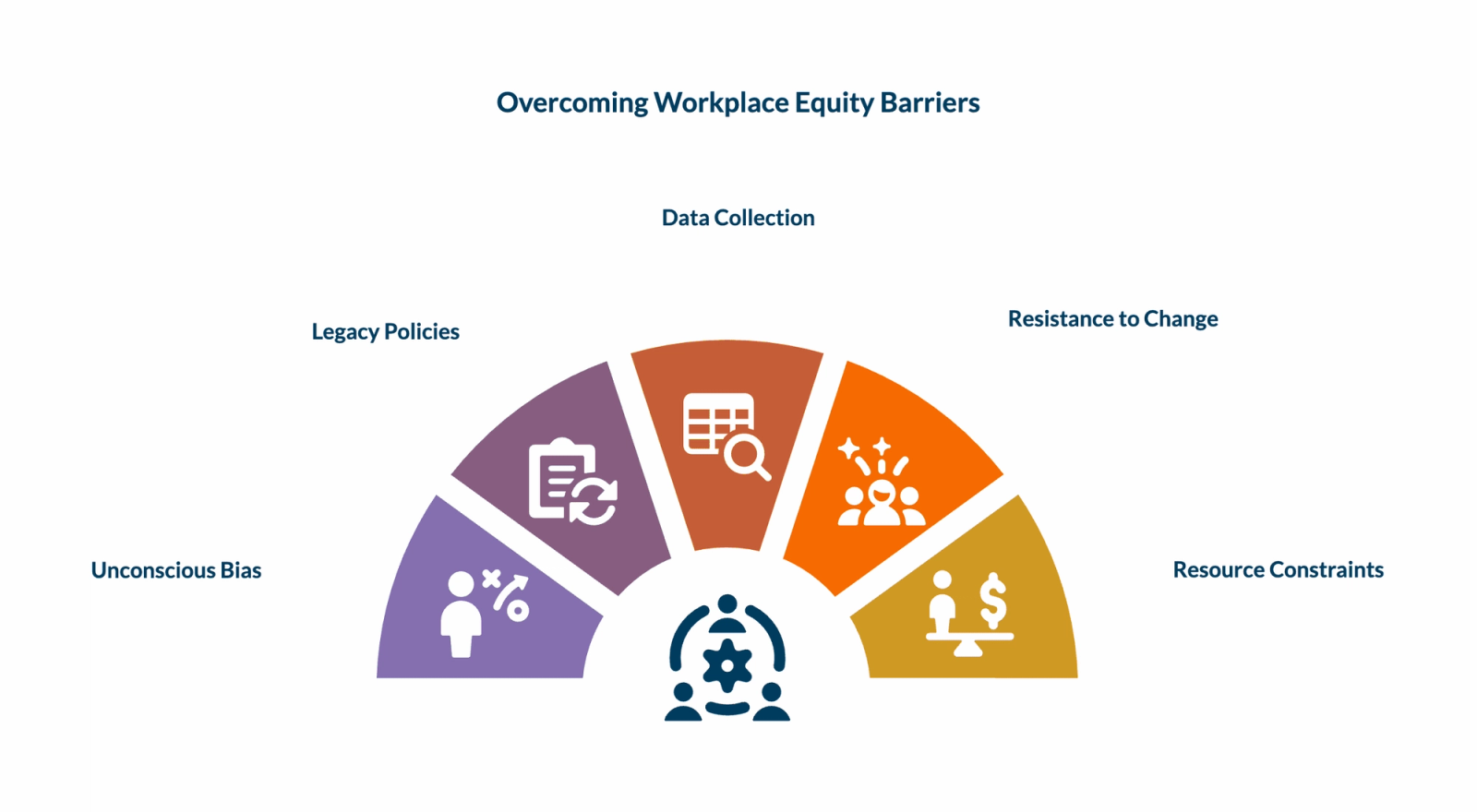
Even well-intentioned organizations encounter obstacles. Anticipating these challenges helps you navigate them:
Unconscious Bias in Decision-Making
The Challenge: Everyone holds unconscious biases shaped by our experiences, media, and social conditioning. These biases influence hiring, promotion, project assignment, and performance evaluation—often invisibly.
The Solution:
- Implement structured decision-making processes that reduce individual discretion
- Use diverse decision-making panels rather than single individuals
- Require documentation and justification for key decisions
- Regularly review decisions for patterns that suggest bias
- Provide ongoing bias training that focuses on practical application, not just awareness
Legacy Policies That Perpetuate Inequity
The Challenge: Policies created decades ago often reflect outdated assumptions about who works and how they work. These policies may disadvantage parents, caregivers, employees with disabilities, or those in different time zones.
The Solution:
- Conduct comprehensive policy audits with equity lens
- Question assumptions behind every policy (Why do we require this? Who does this benefit? Who does it burden?)
- Redesign policies for flexibility and inclusivity
- Pilot changes with affected groups and incorporate their feedback
- Sunset policies that can't be justified or modified
Inadequate Data Collection and Analysis
The Challenge: You can't address equity gaps you can't see. Many organizations lack demographic data, don't disaggregate metrics by relevant categories, or collect data but never analyze it.
The Solution:
- Invest in HRIS systems that enable demographic tracking while protecting privacy
- Establish regular reporting cadences for equity metrics
- Provide training on interpreting equity data
- Create cross-functional teams to review data and develop interventions
- Share findings transparently while protecting individual privacy
Resistance to Change and Backlash
The Challenge: Equity initiatives sometimes face resistance from employees who view them as "unfair" or who fear losing advantages they currently hold.
The Solution:
- Frame equity as expanding opportunity for everyone, not limiting anyone
- Use data to show how inequity hurts organizational performance
- Create dialogue opportunities where concerns can be voiced and addressed
- Distinguish equity from equality clearly and repeatedly
- Demonstrate how equity benefits the organization holistically
- Acknowledge that change can feel uncomfortable while maintaining commitment to fairness
Limited Resources and Competing Priorities
The Challenge: Equity work requires time, attention, budget, and personnel—resources that are always constrained.
The Solution:
- Start with highest-impact, lowest-cost initiatives (e.g., recognition program adjustments, policy reviews)
- Integrate equity into existing processes rather than treating it as additional work
- Use technology to automate tracking and reduce manual effort
- Demonstrate ROI through retention, engagement, and productivity metrics
- Secure executive sponsorship to protect resources and prioritize equity work
Turn Equity Into Everyday Practice With HR Cloud
Let's be direct: equity doesn't emerge from a values statement buried in your employee handbook. It's built through intentional, consistent practices in how you recognize contributions, allocate opportunities, and support growth.
The organizations making genuine progress on equity aren't necessarily the ones with the largest budgets or the most elaborate programs. They're the ones that have embedded fairness into their daily operations—using technology to make the invisible visible, data to guide decisions, and simple tools to ensure everyone has access to recognition and opportunity.
This is where HR Cloud helps:
Make recognition equitable and visible. Workmates recognition features ensure that contributions from frontline employees, remote workers, and underrepresented groups receive the same visibility as those from headquarters staff. Mobile-first design means a warehouse worker can receive recognition just as easily as an executive. Peer-to-peer channels mean recognition doesn't depend solely on manager awareness. Analytics help you spot and address recognition gaps before they impact retention.
Track equity metrics that matter. HR Cloud's People platform centralizes employee data, making it straightforward to analyze promotion rates, compensation equity, and development opportunity access across demographics. You can't address gaps you can't see—HR Cloud makes the invisible visible.
Build equitable performance systems. Perform supports structured review processes with standardized criteria, reducing the subjective bias that often disadvantages certain groups. 360-degree feedback ensures multiple perspectives shape evaluations, not just one manager's potentially biased view.
Create consistent onboarding experiences. Onboard ensures every new hire—regardless of location, role, or background—receives the same comprehensive introduction to your culture, expectations, and resources. Mobile accessibility means frontline workers complete onboarding as seamlessly as office staff.
Support distributed and diverse workforces. HR Cloud's mobile-first design specifically supports frontline workers, field employees, and distributed teams—populations often excluded from traditional engagement and recognition systems. If equity means ensuring access regardless of location or job type, your systems need to work for everyone.
Equity isn't about perfection. It's about consistently choosing fairness over convenience, transparency over ambiguity, and inclusive systems over informal practices that benefit whoever happens to be closest to power. It's about building a workplace where talent and contribution determine opportunity, not proximity, privilege, or who someone knows.
That's the kind of culture HR Cloud helps organizations build—one recognition, one equitable process, one fair decision at a time.
Discover how employee recognition drives equity →
Explore HR Cloud's Workmates platform →

Experience how Workmates can transform communication and strengthen culture—all in one powerful platform
Book Your Free DemoFrequently Asked Questions About Workplace Equity
How do you show equity at work?
Equity at work shows up through consistent actions, not grand statements. It appears in transparent promotion criteria everyone can access, fair compensation for equivalent work regardless of demographic background, recognition systems that value all contributions equally, and flexible policies that accommodate different needs. Most importantly, equity shows up in decisions—who gets the high-visibility project, whose idea receives credit, who has access to leadership and development opportunities. When these decisions consistently consider individual circumstances and systematically remove barriers, that's equity in action.
What are examples of employment equity?
Employment equity manifests across multiple dimensions. Pay equity means people performing similar work with similar qualifications receive comparable compensation, adjusted for legitimate factors like experience and performance—not gender or race. Promotion equity means advancement criteria are transparent, applied consistently, and result in demographic representation at senior levels that reflects your overall workforce. Recognition equity ensures all contributions receive acknowledgment, not just those from the most visible or vocal employees. Access equity means development opportunities, mentorship, and high-profile projects are allocated based on potential and readiness, not informal networks or manager preferences. Resource equity means providing differentiated support so everyone has what they need to succeed—which might mean flexible schedules for caregivers, language support for ESL speakers, or accessible technology for employees with disabilities.
What is equity theory in the workplace?
Equity theory, originally developed by psychologist John Stacey Adams, proposes that employees evaluate fairness by comparing their inputs (effort, time, skill, experience) against their outputs (recognition, pay, advancement, development opportunities) and then comparing that ratio to their perception of others' input-output ratios. When employees perceive inequity—either that they're under-rewarded relative to others or over-rewarded—motivation suffers. The theory suggests that perceived fairness, not absolute levels of reward, drives engagement and satisfaction. For HR leaders, this underscores the importance of transparent compensation systems, consistent recognition practices, and clear advancement criteria that help employees understand how inputs connect to outputs.
What does it mean to work in equity?
In startup and financial contexts, "working in equity" typically refers to receiving company ownership (stock options or shares) as part of compensation rather than cash alone. This differs from workplace equity, which refers to organizational fairness and equal opportunity. When recruiters mention "equity compensation," they mean ownership stakes that potentially appreciate with company value. While the terms share a word, the concepts are distinct—one describes how you're paid, the other describes how fairly you're treated.
How do you overcome common barriers to workplace equity?
Overcoming equity barriers requires systematic approaches across multiple fronts. For unconscious bias: Implement structured processes that reduce individual discretion in high-stakes decisions like hiring and promotion. Use diverse decision-making panels. Document decisions with concrete evidence. Provide practical bias training that focuses on real scenarios, not just awareness. For legacy policies: Conduct regular policy audits asking "who does this benefit, who does this burden, and can we justify the trade-off?" Redesign policies for flexibility and inclusion rather than one-size-fits-all approaches. For inadequate data: Invest in technology that enables demographic tracking and analysis while protecting privacy. Establish regular reporting cadences. Share findings transparently. For resistance: Frame equity as expanding opportunity for everyone. Use data to demonstrate how inequity hurts performance. Create dialogue spaces for concerns while maintaining commitment to fairness. Most importantly, secure executive sponsorship and accountability to ensure equity work receives necessary resources and protection from competing priorities.
How long does it take to see results from workplace equity initiatives?
The timeline varies by initiative type. Some changes yield quick wins: updating job descriptions to remove bias can improve applicant diversity immediately, and implementing recognition programs generates engagement lift within weeks. Other efforts require longer timelines: closing pay gaps takes months of analysis and adjustment, improving leadership representation may take years of systematic development and promotion, and cultural change always requires sustained commitment. Most organizations see measurable progress within 12-18 months if they track metrics consistently, remain committed through inevitable challenges, and adjust strategies based on data rather than assumptions. The key is treating equity as an ongoing practice, not a project with an end date. Organizations that integrate equity into operations see continuous improvement, while those that launch initiatives and then reduce attention see initial gains erode over time.
About the author

Keep Reading


Like What You Hear?
We’d love to chat with you more about how HR Cloud® can support your business’s HR needs.
Book Your Free Demo