
How to Choose a Global Employee Recognition Program

Global employee recognition programs are structured systems that acknowledge and reward employee contributions across multiple countries and regions, accounting for cultural differences, language barriers, and economic variations. These programs use both monetary rewards (bonuses, gift cards) and non-monetary recognition (badges, public praise) to motivate international workforces.
Why it matters: Organizations with effective global recognition experience 85% more peer appreciation, 80% higher internal communication, and 95% better retention rates. Recognition-driven cultures see employees who are twice as likely to stay beyond one year and deliver 14% higher productivity.
In today's distributed workforce landscape, where 70% of employees work remotely or in frontline roles across multiple time zones, choosing the right recognition platform is more critical than ever. Organizations expanding globally face unique challenges: how do you create equitable recognition experiences when employees in Tokyo, Mumbai, and São Paulo have vastly different cost-of-living standards? How do you ensure recognition resonates culturally in individualistic versus collective societies?
This guide explores six essential features every global employee recognition program must have to drive engagement, reduce turnover, and build loyalty across international teams.
What is an Employee Recognition Program
A global employee recognition program is a comprehensive process of acknowledging employee contributions through both monetary and non-monetary rewards, specifically designed to work effectively across different countries, cultures, languages, and economic contexts. The intention extends beyond simple appreciation—it aims to encourage employees, increase productivity, reduce turnover, and foster loyalty across diverse international workforces.
Unlike domestic recognition programs, global initiatives must account for:
- Cultural preferences (individual vs. team recognition)
- Language barriers (multilingual platform requirements)
- Economic differences (cost-of-living adjustments)
- Regional regulations (tax implications, data privacy laws)
- Time zone considerations (24/7 platform accessibility)
No one wants to work in an organization where their efforts go unnoticed—this is universally true whether you're a frontline healthcare worker in Germany, a manufacturing employee in Mexico, or a remote software developer in India. Modern recognition platforms ensure that every employee, regardless of location, feels valued for their contributions.
Types of Employee Recognition Programs
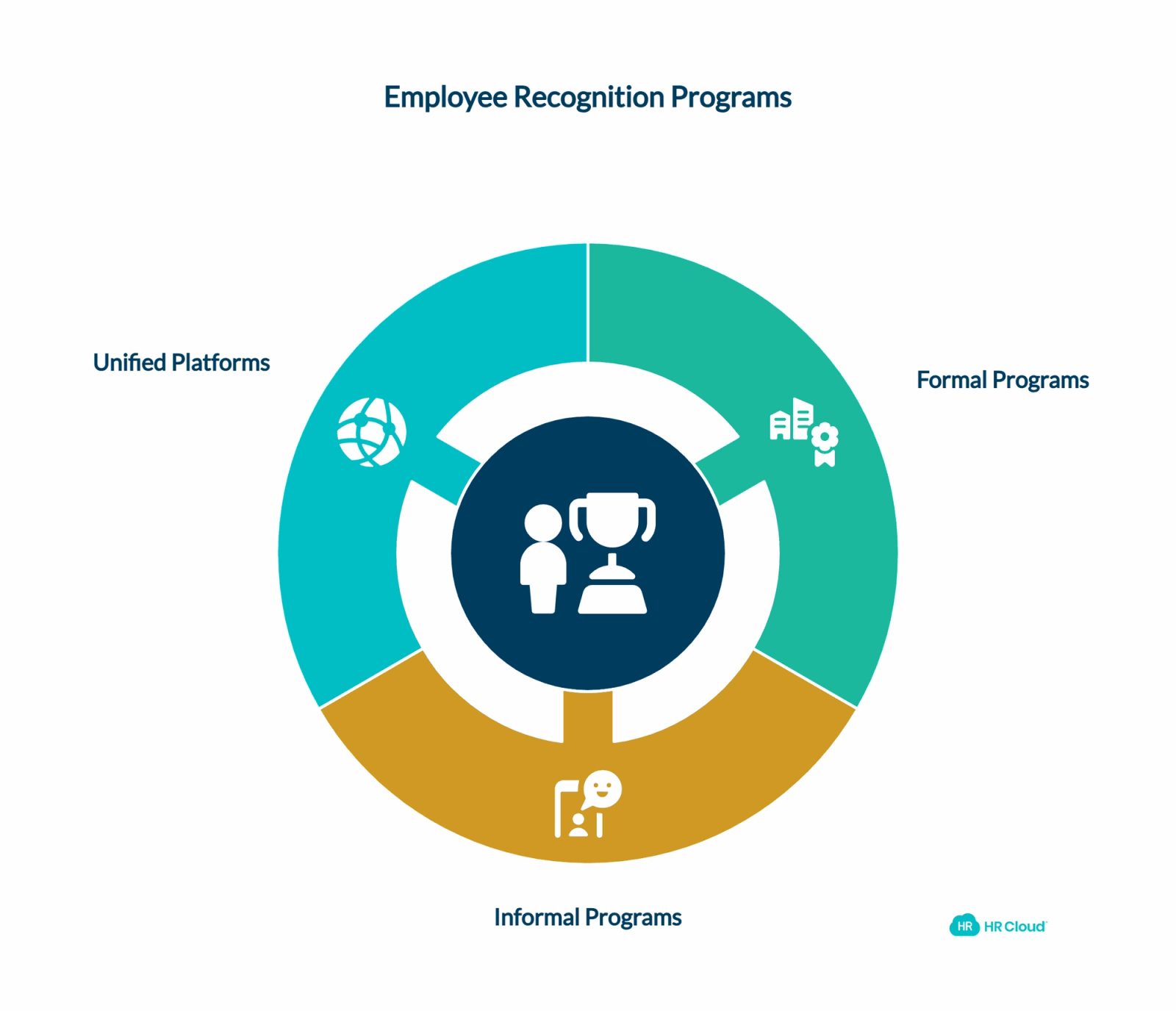
Employee recognition program can be broadly categorized into two types, each serving distinct yet complementary purposes:
1. A Formal Employee Recognition Program
Formal programs follow structured approaches with defined criteria and predetermined rewards:
- Annual or quarterly awards (Employee of the Year, Top Performer)
- Monetary incentives (bonuses, salary increases, increments)
- Milestone recognition (service anniversaries, project completions)
- Achievement-based rewards (gift cards, paid time off, experiences)
- Career advancement opportunities (promotions, leadership development)
These programs work particularly well for major achievements and provide tangible incentives that demonstrate organizational investment in employee success.
2. An Informal Employee Recognition Program
Informal programs enable spontaneous, frequent appreciation:
- Verbal acknowledgments during team meetings or one-on-ones
- Written thank-you notes or letters of appreciation
- Peer-to-peer recognition through digital platforms
- Social media shout-outs on company channels
- Spot recognition for immediate, in-the-moment appreciation
A formal recognition program includes awards, increments, bonuses, gift cards, etc., while an informal recognition program can be either verbal or a letter of appreciation. Studies show that most organizations use a combination of both formal and informal approaches for maximum output—formal programs provide structure and significant rewards, while informal recognition creates a continuous culture of appreciation that costs little but significantly impacts morale.
For global organizations, unified recognition platforms like Workmates integrate both formal and informal recognition in one system, enabling seamless appreciation across all locations, languages, and currencies.
Why Employee Recognition?
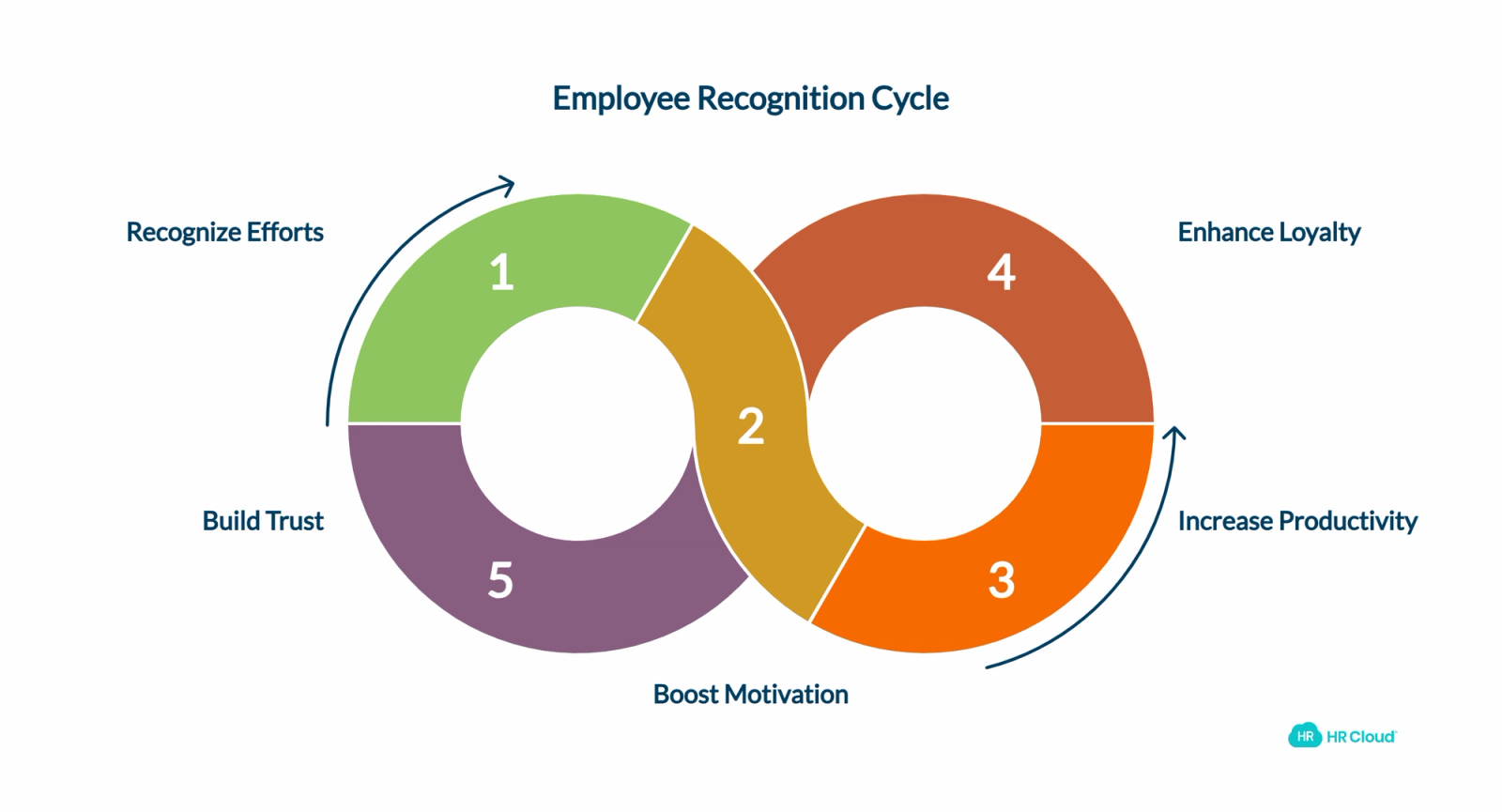
Why should companies invest hundreds of dollars in rewarding employees globally? The short answer is that a small amount of reward money pays back ten times in productivity. Time and again, research has shown that employee recognition is the best tool in HR's arsenal to motivate employees and increase productivity.
Here are some benefits of Employee Recognition for companies:
Saves Money Through Reduced Turnover
Research shows that employees are twice as likely to quit within the year if their efforts are not appreciated by the company. We all know that recruitment is a capital-intensive process; a lot of money is spent on hiring the right candidate, and if that employee quits within one year, the money is wasted.
Employee recognition is a cost-effective tool that keeps employees from quitting prematurely. Even informal and non-monetary recognition has the power to keep employees motivated and loyal to the company for a longer duration.
For international organizations managing distributed teams, recognition becomes even more critical. Remote and frontline workers often feel disconnected from corporate culture, making proactive appreciation essential for maintaining engagement and reducing regrettable turnover.
Higher Productivity Across Global Teams
In the 21st century, employees are the best resource of a company. Every company has the same access to technology and supply chain. Employee ingenuity and dedication make the difference between good and great companies.
Here, employee recognition plays the essential role of keeping employees motivated to keep doing better and better each day. Studies show that effective recognition programs increase employee productivity by as much as 14%.
Moreover, employees are more likely to go the extra mile for their organization if they feel their efforts would be recognized and appreciated. Interestingly, employees are even motivated by negative feedback. Researchers at the Harvard Business Review found that feedback tells employees that their work is being recognized, even if it is critical. It is paramount in motivating them to do more.
When thousands of employees working across time zones and cultures become even slightly more efficient, the cumulative impact transforms business outcomes. Recognition doesn't just reward past performance—it motivates future excellence, with recognized employees demonstrating 2.7x higher engagement scores.
Increases Trust and Loyalty Worldwide
Effective employee recognition programs increase the trust of your employees in the management across all locations. If their efforts are appreciated, employees are more likely to believe in company values and dedicate their time to achieving company goals.
Moreover, recognition also increases employee loyalty. Employees who are praised and rewarded for their hard work are less likely to leave the company. In this way, organizations get to keep valued resources. For global companies managing complex workforce demographics, this loyalty translates to institutional knowledge retention and cultural continuity across regions.
The following six features ensure your global employee recognition program delivers these benefits consistently across all locations.

Define the Employee Recognition Strategy
Before implementing technology or launching programs, the first thing to consider when making a global employee recognition program is to define a comprehensive strategy. Strategic clarity prevents implementation issues and ensures consistent experiences across all regions. It is the need of time to recognize the employees, but HR also has to consider some other facts too as it comes with a few limitations.
Set Clear Communication Guidelines
They should communicate the impact of the growth of the business on the employees. The workforce should know how these employee recognition programs are helping the companies and employees both. Global teams need to understand:
- Business impact: How recognition drives productivity, retention, and culture
- Individual benefits: Career development opportunities, rewards, and peer visibility
- Cultural alignment: How programs respect and celebrate regional differences
- Success metrics: How program effectiveness will be measured and improved
Transparent communication builds trust and encourages participation. Employees across all locations should feel confident that recognition is equitable, meaningful, and tied to genuine contribution rather than politics or favoritism.
Establish Transparent Eligibility Criteria
The next thing to consider is the guidelines that depend on the location and a few other things like eligibility criteria, the structure of the business, and frequency. These set guidelines make the employee recognition programs as transparent as they should be. There is no room left for confusion on both ends.
There should be fixed criteria for winning. It means that all the employees should know what the process of participation is and how a winner or employee of the month/week is selected; what are the basic criteria for selection? Create clear guidelines that address:
- Location-based considerations: Which employees in which countries qualify
- Business structure requirements: How organizational hierarchy affects recognition
- Participation processes: Exactly how employees give and receive recognition
- Winner selection criteria: Objective standards for formal awards and competitions
- Frequency guidelines: How often employees can recognize peers or receive rewards
These guidelines eliminate confusion and ensure fairness. When employees understand exactly what behaviours earn recognition and how to participate, engagement increases significantly. Automated workflows in modern platforms help enforce consistent criteria across all regions.
Allocate Appropriate Budget and Resources
Allocating a proper budget for the resources is the last thing to consider in a strategy. The resources include both financial and human resources. Determine what's required for global scale:
- Platform licensing for international deployment
- Reward funding adjusted for cost-of-living differences
- Administration costs including program managers and regional coordinators
- Implementation expenses for training, translation, and change management
- Ongoing support for troubleshooting and program optimization
Recognition program budgets typically range from 1-2% of total payroll for growing companies, up to 3-5% for enterprise organizations with mature programs. However, virtual recognition platforms like HR Cloud's Workmates significantly reduce overhead compared to traditional programs, often delivering ROI exceeding 300% through reduced turnover and productivity gains.
Multiple Programs for Global Companies
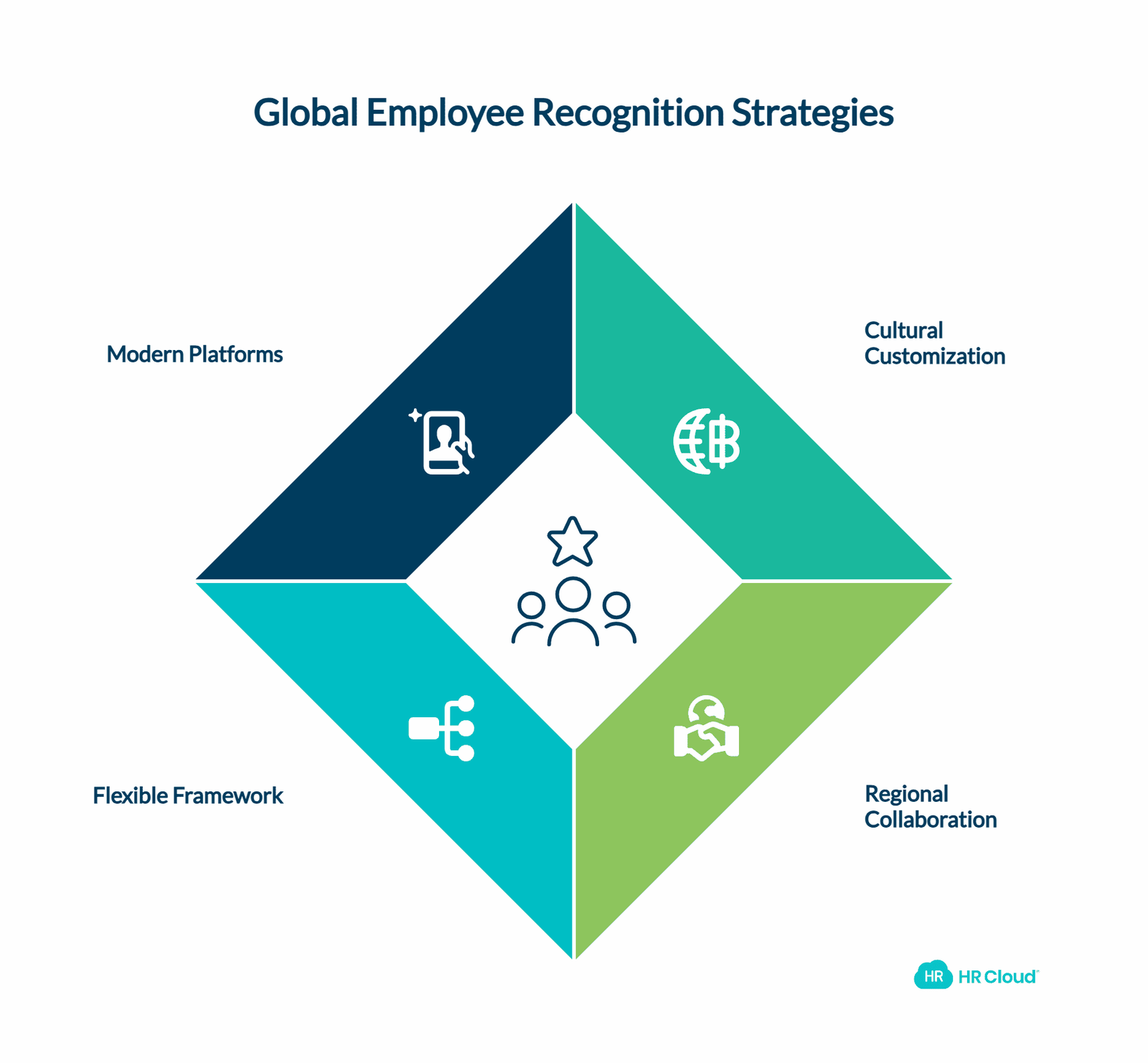
When a business runs globally, it should understand that it is not necessary that a single employee recognition program would be successful for all the employees working from different regions. A global organization has a workforce worldwide, and they cannot be motivated by the same program.
One employee program that might work best for one set of employees might not work for the other one. Various employees from various regions are motivated by different programs because of the different cultures and different mindsets.
Cultural Customization Examples
For instance, you may motivate your Muslim employees more by giving those breaks at their prayer times, while Christian employees will appreciate holidays on Christmas. In individualistic cultures (United States, United Kingdom, Australia), public individual recognition—"Employee of the Month" awards, solo achievement spotlights, personal leaderboards—typically drives engagement. Employees appreciate being singled out for excellence.
Conversely, in collective cultures (Japan, South Korea, many Southeast Asian countries), publicly recognizing individuals can cause embarrassment or discomfort. Team-based recognition—acknowledging entire departments, celebrating collaborative achievements, highlighting group contributions—resonates more effectively.
An organization should first consider the factors mentioned above and carry research before finalizing a program. What an organization can do in that case is to collaborate with the local organizations to motivate workers and distribute rewards.
Rather than forcing headquarters' preferences globally, collaborate with regional offices and local HR teams to design culturally appropriate variations. Many organizations create a global framework with regional flexibility—common platform and core values, but customized approaches for each market.
Modern recognition platforms enable this flexibility through configurable workflows, customizable badge designs, regional reward catalogs, and permission-based visibility controls that let each location tailor programs while maintaining global consistency in tracking and reporting.
Multilingualism
The language barrier is one of the most important things for an organization to consider when expanding globally and designing an employee recognition program. When employees and management have a language difference, the chances of errors and miscommunication are high, thus leading to less productive employees.
The Business Impact of Language Barriers
Language differences don't just create communication friction—they directly impact recognition program effectiveness:
- Participation drops when employees struggle to navigate platforms in unfamiliar languages
- Recognition quality suffers when managers can't clearly articulate appreciation
- Cultural nuances get lost in poor translation, making recognition feel generic
- Engagement scores decline among non-native speakers who feel excluded
Implement Multilingual Platform Features
When designing global recognition programs, organizations should categorize them according to the languages. To implement a global employee recognition program, the introduction of a virtual platform is important.
The virtual platform should have a built-in language conversion feature that allows employees to switch to the language they find suitable. This structure also allows the HR personals to keep a record and monitor the performance of employees accordingly and give them incentives.
Essential Multilingual Features:
- Instant language switching: Users select preferred language from interface
- Automatic content translation: Recognition messages, badges, and announcements translate in real-time
- Native character support: Proper display of Chinese, Arabic, Cyrillic, and other character sets
- Right-to-left layout support: Proper formatting for Arabic and Hebrew
- Localized date/time formats: Respecting regional display preferences
- Currency localization: Displaying rewards in local currencies
HR Cloud's Workmates platform enables employees to set individual language preferences, ensuring the entire interface displays in their chosen language. From recognition feeds to reward catalogs to analytics dashboards, every element adapts automatically.
Ensure Transparency and Trust
Additionally, you must ensure transparency in the global virtual platform, so all your employees from any geographical location trust the system. At times, employees may feel that they have been overlooked because the company prefers a certain location more than the others. Hence, transparency is key to avoid such misgivings.
Critically, transparent metrics, equal reward access, and visible leadership commitment help overcome concerns about fairness. When employees see recognition in multiple languages and across all regions, trust in system equity increases significantly.
SOLI
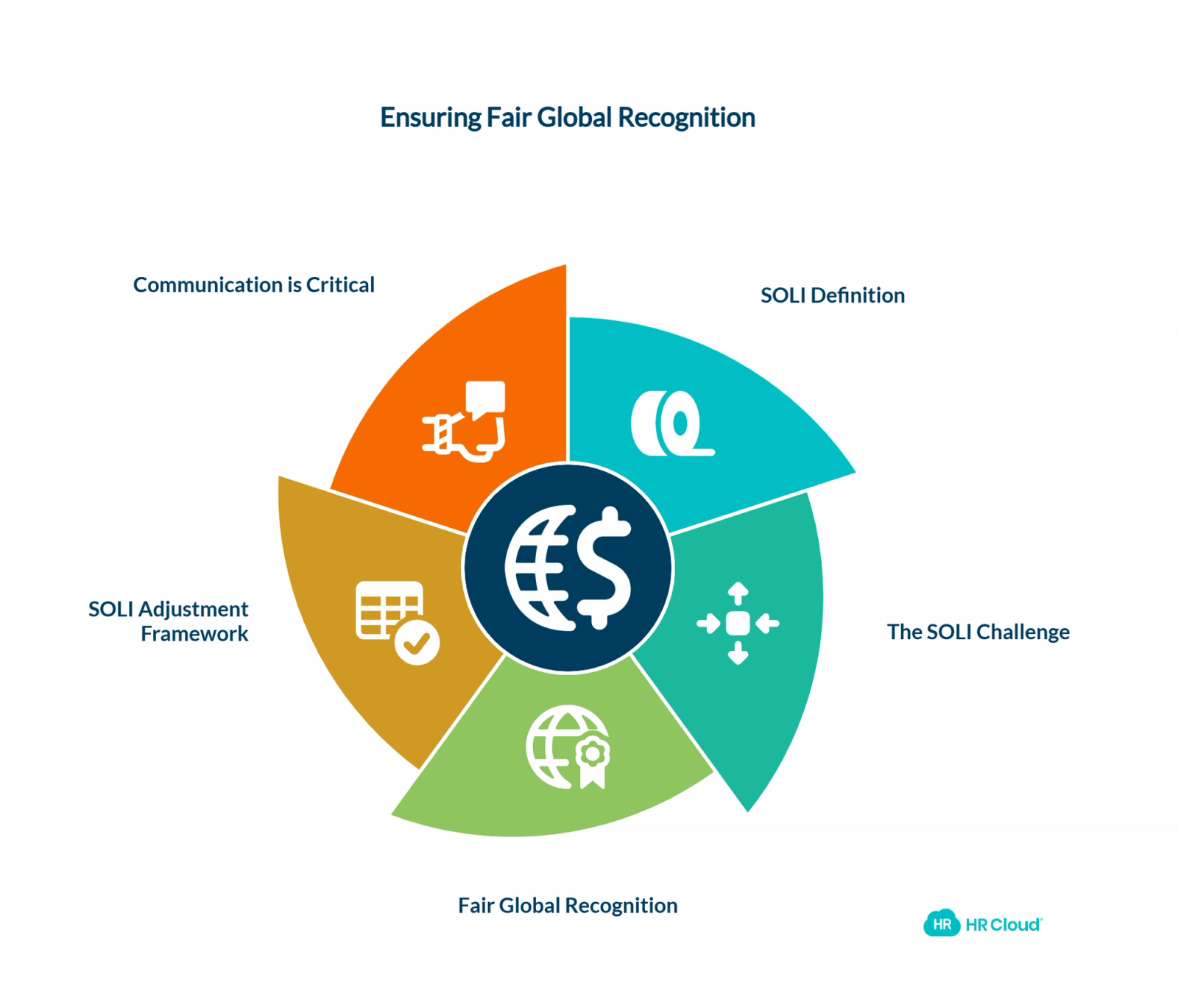
SOLI stands for Standard Of Living Index. It measures the living expenses of people. With global expansion, there comes a lot of confusion because of the workers working from different corners of the world. It means that when designing an employee recognition program, SOLI should be considered as the standard of living of the workers varies from region to region.
The SOLI Challenge and Implementation
This is not workable for two employees working from two separate regions to receive the same amount of cash reward. For instance, an organization has two remote workings, A and B‒ the former lives in Japan, and the latter resides in Pakistan. Paying them both a reward of $400 would not be fair since they both have a different SOLI.
Consider this scenario: $400 in Tokyo, one of the world's most expensive cities, might cover basic living expenses for a week. The same $400 in São Paulo, where cost-of-living is significantly lower, might cover two weeks of expenses plus entertainment. This disparity means identical rewards provide vastly different value to recipients.
Fair Global Recognition Programs
Your global employee recognition program should be fair and equitable. Hence, organizations should consider adjusting recognition rewards according to regional cost-of-living differences. One important thing to note here is that you must make sure to mention that the difference in rewards reflects economic considerations, so employees do not feel they have been treated unfairly.
SOLI Adjustment Framework:
1. Establish baseline: Choose reference location (typically headquarters) as baseline
2. Research regional indices: Determine relative cost-of-living for each location
3. Consider proportional adjustments: Evaluate how to provide equivalent value
4. Review regularly: Update considerations as economic conditions change
5. Communicate clearly: Ensure employees understand the rationale
Communication is Critical
The most important aspect of SOLI consideration? Crystal-clear communication. Employees must understand that any reward differences would reflect cost-of-living variations, not performance differentials or location bias.
Communicate: "We strive to ensure everyone receives equivalent value. Colleagues in different locations may see different monetary amounts to account for local economic conditions."
Transparency prevents misunderstandings and reinforces fairness. Modern recognition platforms with robust analytics help organizations make informed decisions about reward structures while maintaining consistency and removing potential for confusion.
Gamification
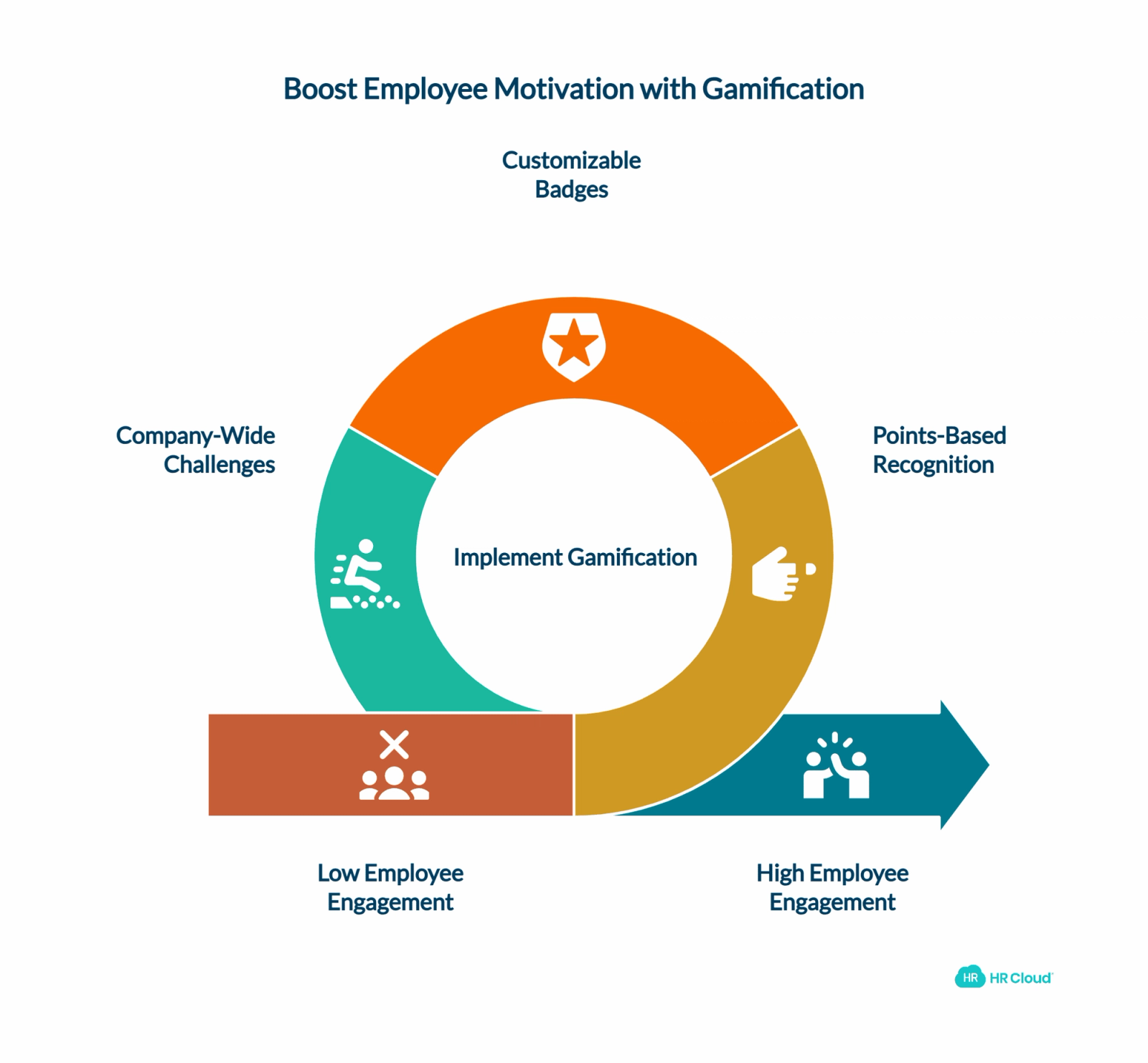
Many studies show that gamification can also play a good part in motivating employees. It makes workers more engaged. There are many examples of gaming elements in the training and learning of employees.
Why Gamification Works Globally
Adding gaming elements to the employees' recognition programs can work wonders for your firm. You can appreciate the employees with scores and badges. Gamification is also virtual. The HR team should consider their employee recognition software to boost the right behavior.
Gamification taps into universal human psychology:
- Achievement motivation: Earning badges and points satisfies accomplishment needs
- Social recognition: Leaderboards provide visibility and peer acknowledgment
- Progress tracking: Visual progress bars and milestones create engagement momentum
- Healthy competition: Friendly rivalry drives participation without toxicity
- Instant gratification: Immediate feedback satisfies reward-seeking behavior
These psychological triggers work across cultures, though implementation nuances vary by region.
Core Gamification Elements
1. Points-Based Recognition Systems
HR Cloud's Workmates platform enables managers and peers to award points alongside recognition badges. Employees accumulate points in digital wallets, creating tangible value from intangible appreciation.
Point System Benefits:
- Converts abstract recognition into concrete rewards
- Enables self-service reward redemption without HR intervention
- Creates flexibility—employees choose rewards they actually want
- Provides measurable engagement metrics for program optimization
- Scales globally with minimal administrative overhead
2. Customizable Badges and Awards
Generic recognition rarely inspires. Customizable badge systems let organizations align recognition with company values, creating meaningful connections between appreciation and culture.
Badge Customization Examples:
- Company values badges: Innovation Champion, Customer Obsession, Team Player
- Achievement badges: Project Hero, Sales Superstar, Safety Leader
- Milestone badges: 5-Year Anniversary, 100 Recognitions Given, Community Impact
- Skill badges: Certification Achieved, Mentor Excellence, Cross-Training Complete
Organizations typically create 15-25 unique badges that employees collect like achievements in video games, displaying them proudly on profiles and generating aspirational goals.
3. Company-Wide Challenges
Team challenges create time-bound competitions that drive specific behaviors:
- Safety challenges: Departments compete for most safety observations submitted
- Wellness challenges: Teams track steps, healthy meals, or meditation minutes
- Learning challenges: Employees earn points for completing training modules
- Customer service challenges: Recognition for highest customer satisfaction scores
- Innovation challenges: Ideas submitted for process improvements
Challenges work exceptionally well globally because they create shared goals that transcend cultural differences. Whether teams are in Chicago, Shanghai, or Berlin, everyone rallies around common objectives, fostering connection despite physical distance.
Workforce Metrics
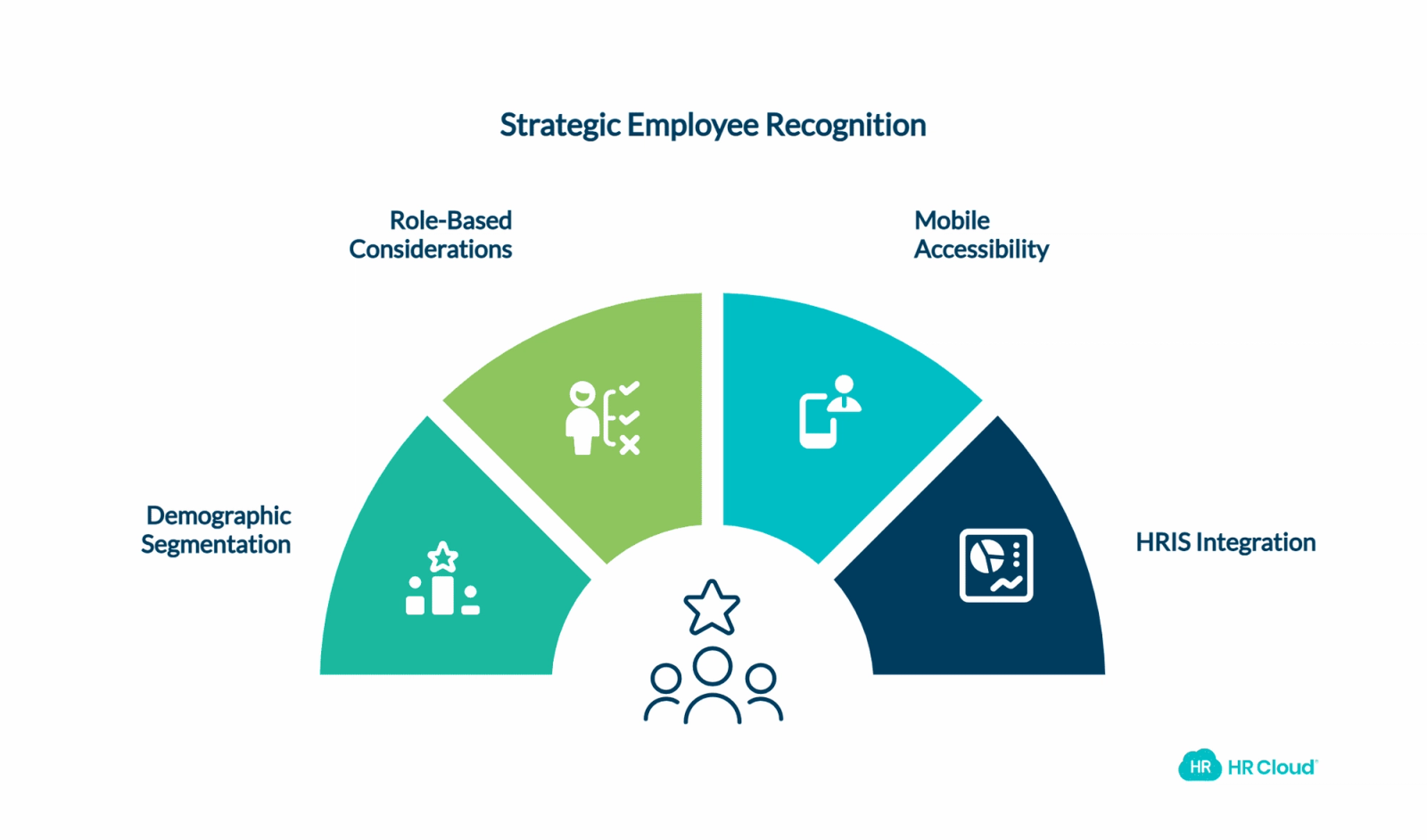
At last, when appreciating employees, it is important to consider the workforce metrics. It means that the same reward might not work for every worker. For instance, a reward for a 25 years old might not make the 55 years old employee happy.
Demographic Segmentation Strategies
The rewards should be designed such that it holds an equal position for everyone. It is important to consider the factors that motivate different age groups when designing employee recognition programs.
Workforce metrics reveal a critical truth: different employee demographics require different recognition approaches. A reward that excites a 25-year-old software engineer might not interest a 55-year-old operations manager—and vice versa.
Age-Based Preferences:
- Gen Z (18-27): Values social recognition, instant gratification, digital-first experiences, career development opportunities
- Millennials (28-43): Appreciates work-life balance rewards, experiences over items, purpose-driven recognition, frequent feedback
- Gen X (44-59): Prefers practical rewards, financial incentives, quality over quantity, private acknowledgment
- Baby Boomers (60+): Values formal recognition, face-to-face appreciation, milestone celebrations, legacy contributions
Role-Based Considerations:
- Frontline workers: Prefer immediate, tangible rewards; mobile-accessible platforms; peer recognition
- Remote employees: Need virtual recognition visibility; digital connection to company culture; frequent touchpoints
- Managers: Value resources to recognize their teams; analytics to track engagement; flexible recognition budgets
- Executives: Appreciate organization-wide impact metrics; strategic recognition program insights; cultural leadership tools
Mobile Accessibility for Frontline Workers
A critical demographic consideration: 70-80% of the global workforce comprises frontline workers in healthcare, manufacturing, retail, construction, and hospitality. These employees rarely sit at desks or have company email addresses.
Mobile-first recognition platforms become essential:
- Smartphone access: Recognition through personal devices, no corporate credentials required
- Offline capability: Programs function without constant internet connectivity
- Push notifications: Real-time alerts when recognition is received
- Simplified interfaces: Easy navigation for varying tech literacy levels
- Multilingual mobile apps: Language switching on small screens
Organizations that prioritize mobile recognition report 2-3x higher participation rates among frontline workers compared to desktop-only programs. HR Cloud's Workmates mobile app delivers full recognition functionality—giving kudos, redeeming rewards, viewing leaderboards, participating in challenges—entirely from smartphones.
Modern HRIS platforms provide demographic data that informs recognition strategy. By analyzing participation rates by age, role, location, and tenure, organizations can customize reward catalogs and adjust communication strategies for different audience segments.
Final Thoughts
When expanding your business globally, it is one of the sole responsibilities of organizations to design and implement employee recognition programs to keep them happy and motivated. Recognizing your employees saves the company money, ensures high employee productivity, and maintains loyalty which can lead to competitive advantage.
Therefore, companies must maintain an effective employee recognition program to avail its benefits. Organizations expanding globally face unprecedented opportunities to build engaged, loyal, distributed teams. However, success requires more than deploying recognition software—it demands thoughtful strategy that accounts for the complex realities of international workforces.
The Six Essential Features Recap:
Keep the points mentioned above when designing your global employee recognition program, and you won't fail! These are:
1. Strategic Foundation: Define clear goals, transparent criteria, and appropriate budget allocation
2. Cultural Flexibility: Implement regional program variations that respect local preferences
3. Multilingual Platform: Ensure language barriers don't prevent participation or engagement
4. Economic Considerations: Consider cost-of-living differences when structuring reward programs
5. Gamification Elements: Drive engagement through points, badges, challenges, and competition
6. Demographic Intelligence: Tailor approaches for different ages, roles, and work environments
When organizations implement these six features through unified platforms like HR Cloud's Workmates, they create recognition experiences that:
- Save money by reducing costly turnover across all locations (employees are twice as likely to quit without recognition)
- Increase productivity through motivated, appreciated employees (up to 14% productivity gains)
- Build trust between distributed teams and leadership
- Foster loyalty that survives competitive pressure
- Strengthen culture despite geographic dispersion
Getting Started
In the competitive landscape of global talent, organizations that master meaningful, equitable, culturally intelligent recognition will win the battle for engagement, productivity, and retention. The question isn't whether to invest in global recognition—it's whether you can afford not to.
Ready to transform your employee recognition program for global scale? Discover how HR Cloud's Workmates platform helps organizations in healthcare, manufacturing, retail, and construction build recognition experiences that resonate across 50+ countries and 20+ languages.
Book a Demo to see how leading global companies drive 85%+ increases in peer recognition, 80% improvements in internal communication, and 95% better retention rates through strategic, technology-enabled recognition programs.

Experience how Workmates can transform communication and strengthen culture—all in one powerful platform
Book Your Free DemoFrequently Asked Questions
What is a global employee recognition program?
A global employee recognition program is a structured system designed to acknowledge and reward employee contributions across multiple countries and regions. It considers cultural differences, languages, and economic factors while combining both monetary and non-monetary recognition to engage a diverse, international workforce effectively.
Why are global employee recognition programs important for organizations?
Global recognition programs are important because they help unify distributed teams, improve engagement, and build a consistent company culture across locations. Organizations with strong recognition practices often experience higher retention, better communication, and increased productivity among employees working in different regions.
How is a global recognition program different from a local one?
Unlike local programs, global recognition programs must account for cultural preferences, language barriers, and regional economic differences. They require flexible reward systems and communication strategies that resonate with employees in different countries while maintaining consistency in organizational values and goals.
What are the key features of an effective global employee recognition program?
An effective global recognition program includes multilingual support, flexible reward options, mobile accessibility, real-time recognition, and integration with HR systems. It should also provide analytics to track participation and engagement, ensuring the program remains relevant and impactful across regions.
How can companies handle cultural differences in global recognition programs?
Organizations can address cultural differences by customizing recognition approaches based on regional preferences. For example, some cultures prefer public recognition, while others value private acknowledgment. Offering flexible reward choices and localized communication helps ensure recognition feels meaningful to employees worldwide.
What types of rewards work best in global recognition programs?
The most effective global programs offer a mix of rewards such as gift cards, bonuses, experiences, and non-monetary recognition like badges or public appreciation. Flexible, points-based systems allow employees to choose rewards that match their preferences and local context, making recognition more impactful.
How can HR teams implement a global employee recognition program successfully?
HR teams should start by defining clear goals, aligning recognition with company values, and selecting a platform that supports global scalability. A phased rollout with training, feedback collection, and continuous optimization helps ensure successful adoption across different regions and teams.
What challenges do companies face with global recognition programs?
Common challenges include managing cultural diversity, ensuring fairness across regions, handling currency and tax differences, and maintaining consistent communication. Without proper planning, recognition may feel unequal or irrelevant to some employees, reducing the program’s effectiveness.
How can technology support global employee recognition programs?
Recognition platforms help automate processes, provide real-time visibility, and enable peer-to-peer recognition across locations. Modern tools integrate with HR systems and communication platforms, making it easier for employees to participate and for HR teams to track engagement and program success.
How do global recognition programs impact employee engagement and retention?
Global recognition programs significantly improve engagement and retention by making employees feel valued regardless of location. Research shows that employees who receive regular recognition are less likely to leave and are more productive, contributing to stronger overall business performance.
About the author

Keep Reading


Like What You Hear?
We’d love to chat with you more about how HR Cloud® can support your business’s HR needs.
Book Your Free Demo