What Is Agentic AI in HR? A Plain-English Guide for HR Leaders

SHRM's 2026 State of AI in HR report found that 39% of HR functions have already adopted AI. Another 23% have AI running elsewhere in their organizations. That's 62% of companies using AI in some capacity and the number is climbing fast.
But there is something that nobody is talking about. You will hear "agentic AI" in vendor pitches, analyst briefings, and conference keynotes but nobody is explaining what is agentic AI in HR without jargon.
This guide gives you a clean explanation of what agentic AI is, how it differs from the AI you already know, where it applies in HR, and what to watch out for.
Agentic AI in 60 Seconds — The Simplest Definition You'll Find
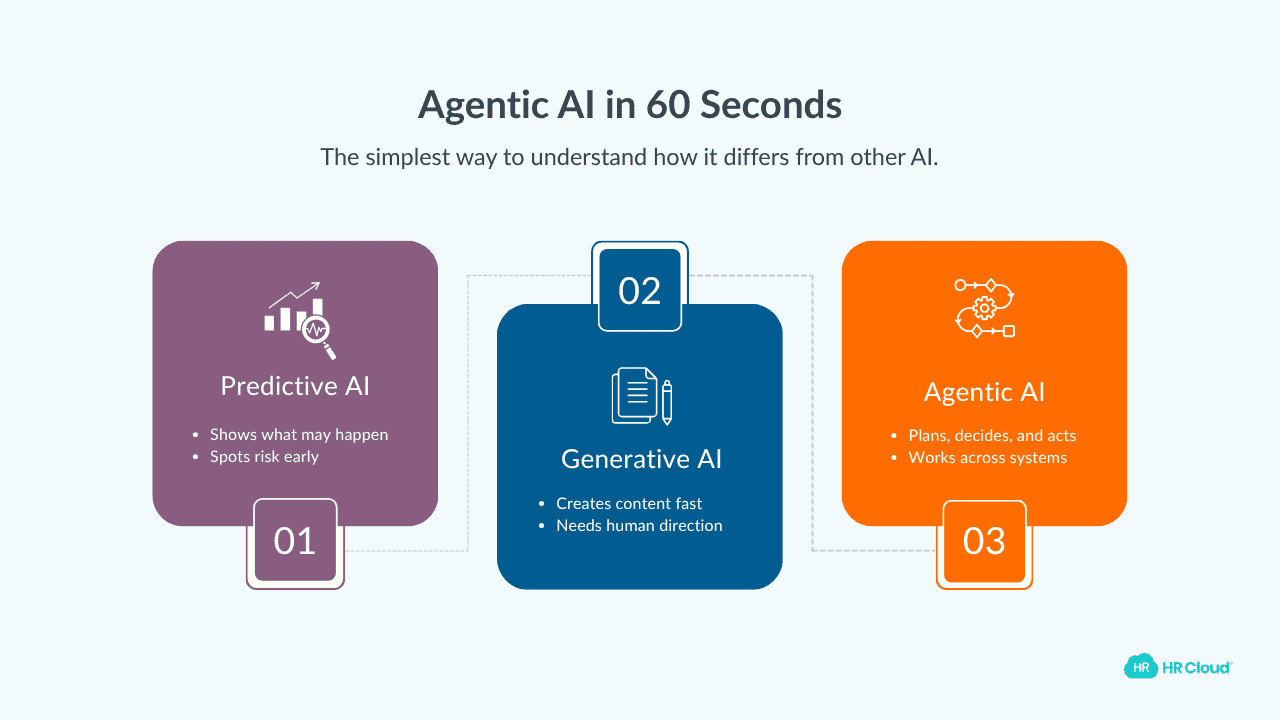
You've already used AI in HR without calling it that. Spam filters, resume parsers, chatbots, all are AI. But agentic AI is different.
Agentic AI doesn't just answer your question or generate a document. It plans, decides, and takes action across your systems. Think of it as the difference between a search engine and a capable new team member. The search engine gives you information when you ask for it. The team member reads the handbook, figures out the steps, and gets things done.
Compare Agentic AI with two other common AI types — predictive and generative — to see what makes it different.
Predictive AI tells you what is likely to happen. It identifies which employees are at risk of leaving based on signals such as engagement, performance, absenteeism, or manager feedback. It is useful for spotting risk early, but it stops at insight.
Generative AI helps you create something in response to that insight. It can draft a retention email, suggest talking points for a manager, or create a stay interview questionnaire for the at-risk employee. It is useful for content creation, but it still depends on human direction.
Agentic AI goes a step further. It not only identifies the employee at risk of leaving, but can also decide the next best actions, build a retention plan, draft the right communications, trigger follow-ups, and monitor whether engagement improves over time. AI agents developed not just to inform or create, but to act.
Gartner has reported that in a July 2025 survey of 2,986 employees, 46% of managers were already experimenting with AI to improve their work, versus 26% of employees.
KPMG's Q4 2025 AI Pulse Survey reported that 26% of organizations have deployed AI agents — up from just 11% two quarters earlier.
McKinsey added another signal in November 2025: 88% of organizations were using AI in at least one business function, and 62% were already experimenting with AI agents.
The acceleration is no longer theoretical. It is visible in HR, in management workflows, and across the enterprise.
So Why Are You Hearing About Agentic AI Now?
That’s because three things happened simultaneously in 2025–2026.
- The technology matured: Large language models became capable of multi-step reasoning. Not just answering one question, but planning a sequence of actions across connected systems.
- HR tech vendors moved fast: ADP launched persona-based AI agents in January 2026. Workday announced AI-powered digital agents. Nearly every major HCM platform embedded agent capabilities into their core product.
- Cost pressure forced the conversation. SHRM's 2026 report shows 92% of CHROs anticipate further AI integration this year. PwC's Strategy& research puts it directly — agentic AI can already support more than 70% of HR processes. That's current capability, not future projection.
What Agentic AI Actually Does in HR (5 Use Cases)
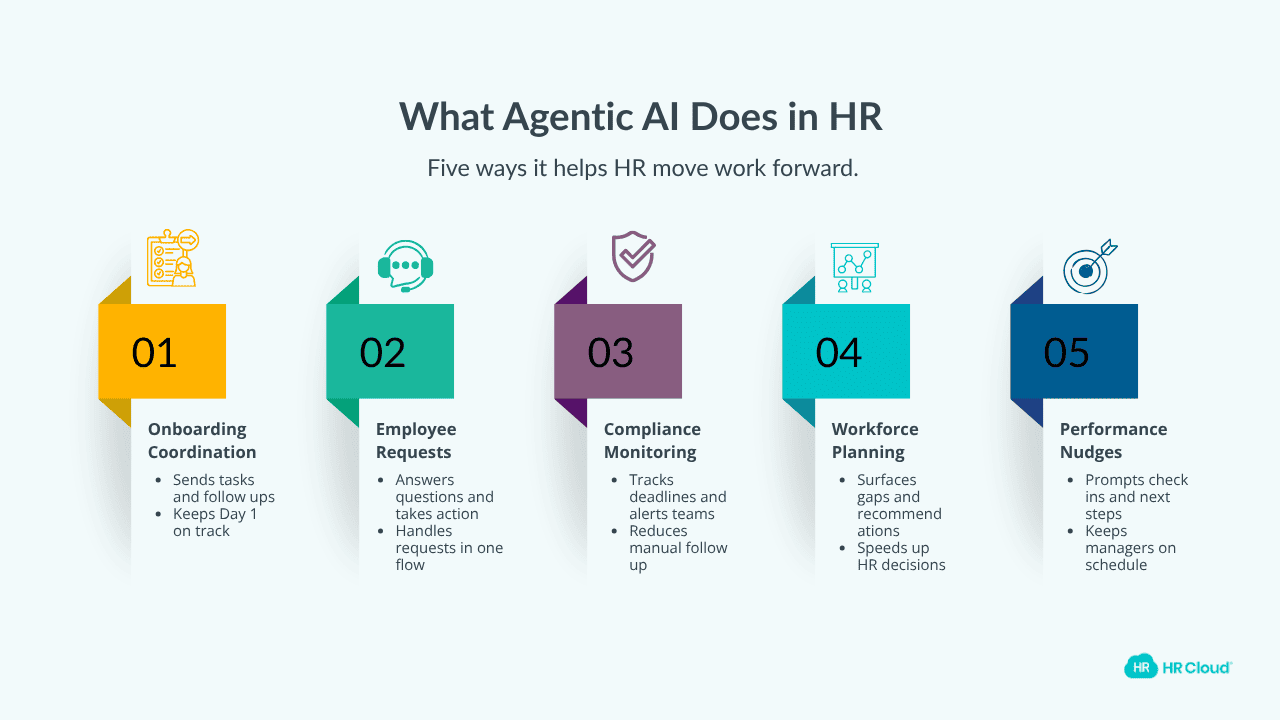
The concept becomes clearer when you bring it into the rhythm of a normal HR workday.
What does agentic AI look like on a Wednesday morning when 12 new hires are starting and a compliance audit is due next week?
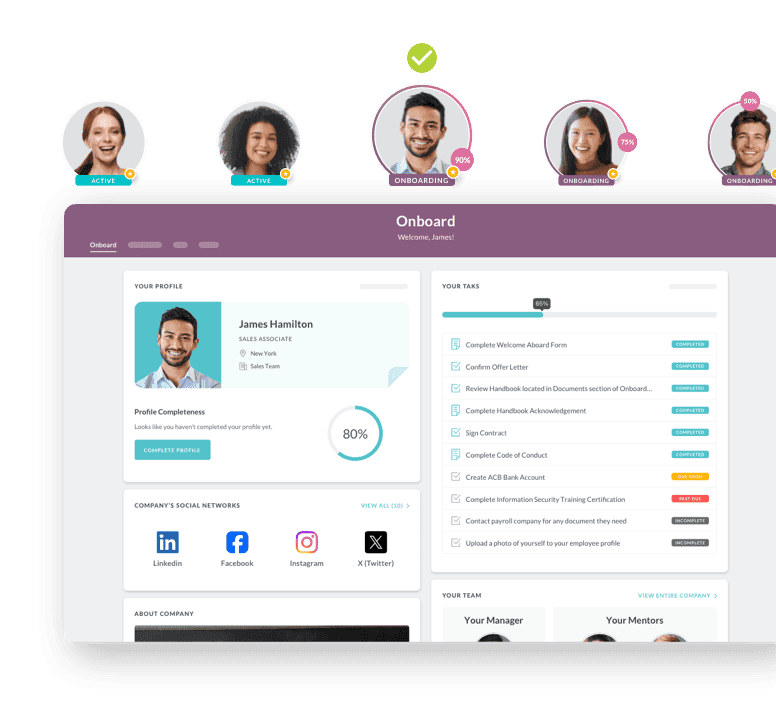
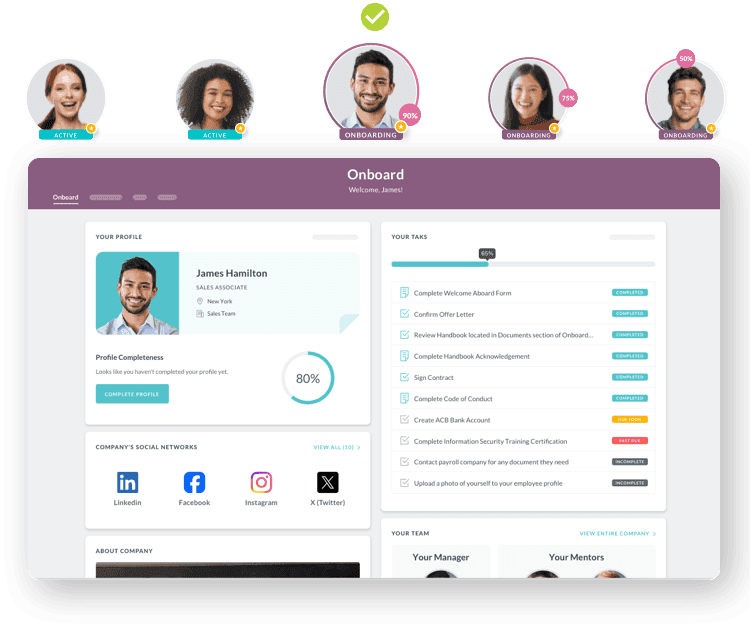
1. Onboarding coordination: An AI onboarding agent can send pre-boarding documents, follow up on incomplete items, trigger IT provisioning, and schedule orientation. It can also adjust the sequence if something changes. PwC research points to up to a 60% reduction in time-to-hire with AI-driven onboarding.
2. Employee query resolution: When an employee asks, “What’s my PTO balance?”, agentic AI does more than provide an answer. It can check the balance, offer to submit a request, and route that request to the manager — all from the same chat window. HRCI reported that 39% of HR professionals identified efficient inquiry handling as the most valuable AI chatbot capability.
3. Compliance monitoring: Agentic AI can track license expirations, I-9 deadlines, and training completions across the workforce. It sends alerts before deadlines and escalates when action is not taken. That means less spreadsheet chasing and more time for your compliance team to focus on higher-value work.
4. Workforce planning. An AI agent can pull in headcount data, attrition trends, and market benchmarks, then surface hiring gaps along with recommendations. You still make the decision. The difference is that the analysis no longer eats up three hours of someone’s day.
5. Performance nudges: Agents can identify employees due for check-ins, surface relevant learning resources, and prompt managers with timely context. You don’t need to micromanage, just ensure that the engagement infrastructure is running quietly in the background.
Taken together, these use cases show the real distinction. Agentic AI does not stop at producing content or surfacing insight. It helps HR move work forward.
Can You Trust AI Agents? Here is What to Watch Out For
That said, the moment AI begins to act, the trust question becomes unavoidable.
If someone tells you agentic AI is ready to run HR unsupervised, they're not being transparent and honest with you. The technology is powerful but it cannot replace the power of judgement.
Trust in fully autonomous AI agents dropped from 43% of executives expressing confidence in 2024 to just 27% in 2025. That kind of skepticism reflects an understanding of what is at stake when decisions affect people, pay, compliance, and careers. Gartner also predicts that more than 40% of agentic AI projects will be canceled by the end of 2027 because of weak governance.
If you are considering agentic AI for your organization know that in practice, three guardrails matter the most.
Define decision boundaries upfront
Decide which actions an agent can execute on its own, such as sending onboarding reminders or answering PTO questions. Then define which actions always require human approval, such as compensation changes, disciplinary action, or termination workflows. That line should be clear before deployment, not after a mistake happens.
Maintain audit trails
Every agent-initiated action should be visible, logged, and traceable on your agentic AI platform. For instance, HR Cloud’s AI-powered platform supports audit-ready dashboards that track AI usage, flag low-quality responses, and maintain compliance logs.
Start in read-only mode
Let the AI recommend actions first. And let humans approve them. Trust should be built through observed accuracy and consistency before execution authority is expanded.
The goal is not to slow innovation. It is to make sure that innovation earns trust from all stakeholders.
How to Get Started Without Ripping Out Your Tech Stack
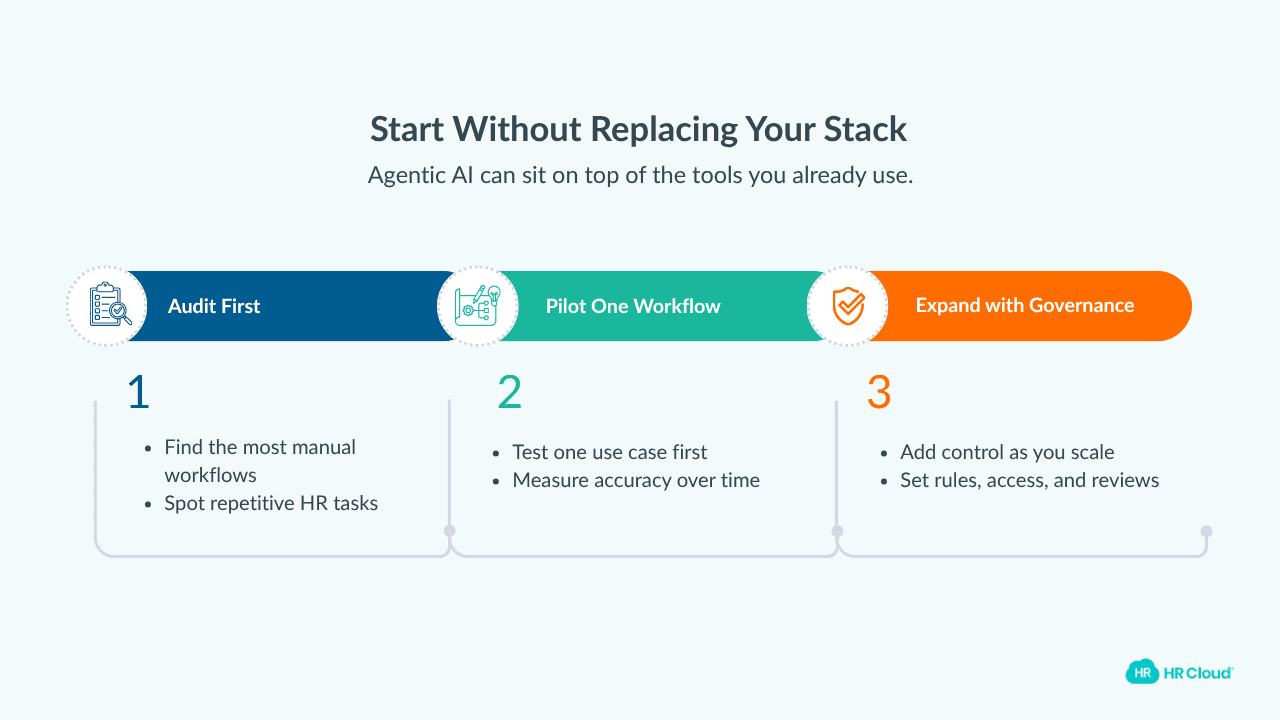
This need to earn trust is also why getting started does not have to mean a full technology overhaul.
You do not need to replace your HR stack to experiment with agentic AI. In most cases, it sits on top of existing systems through API integrations.
For example, HR Cloud’s two-way integration with ADP Workforce Now syncs employee data automatically, so new-hire information flows from onboarding into payroll without manual entry. That is agentic behavior in a practical, low-friction form.
A sensible roadmap looks like this.
1. Audit first. Identify the three workflows consuming the most HR team hours. Map every manual step. Where are people copying data from one system to another? Where do reminders depend on memory? Those are your best starting points.
2. Pilot one workflow. Deploy an agent in read-only mode and measure its accuracy over 30 days. The onboarding process is often the best candidate because it's high-volume, multi-step, and touches almost every system in your stack.
3. Expand with governance. Once trust is established, grant execution authority for that workflow. Then move to the next workflow. As you scale, build policies covering data access, decision authority, and audit schedules.
Most organizations are still early in this journey. That means you are not late and you still have time to start carefully and build well.
The Honest Caveat
Everything said, agentic AI is not a shortcut around foundational HR problems.
It won't fix weak or bad management.
It won't replace strategic HR judgment.
And it will not magically clean up bad systems.
More than 80% of organizations lack mature AI infrastructure — only 9% report high maturity in data integration. If your employee data is scattered across disconnected spreadsheets, an AI agent will only automate the mess.
That is why the order matters. Clean your data first. Define your workflows next. Then use AI to accelerate what already works.
So, is agentic AI the future of HR?
Yes.
Is it a cure-all?
No.
What it can do is remove the repetitive coordination work that keeps HR teams away from the engagement and strategic planning work they are actually meant to lead.
A practical next step is simple: this week, choose one onboarding workflow and write down every manual step. That document is not just a process map. It is your first business case for AI.

Discover how our HR solutions streamline onboarding, boost employee engagement, and simplify HR management
Book Your Free DemoFrequently Asked Questions
What is the difference between agentic AI and generative AI in HR?
Generative AI creates content such as drafting job descriptions, writing policy summaries, composing emails. Agentic AI goes further. It plans and executes multi-step tasks across systems. Instead of drafting an onboarding checklist, it sends the documents, triggers IT provisioning, and follows up automatically.
Is agentic AI safe to use for HR decisions?
Yes, when implemented with human-in-the-loop guardrails. Start in read-only mode where the agent recommends and a human approves. Define which decisions require human sign-off. Maintain audit trails for every agent action. Review for bias regularly.
What HR tasks can agentic AI automate?
Agentic AI handles multi-step workflows including onboarding coordination, employee query resolution, compliance monitoring, workforce planning, interview scheduling, training assignment, and performance review prompts.
How much does agentic AI reduce HR workload?
Results vary. PwC and Strategy& research suggests agentic AI can support over 70% of HR processes. Organizations report the biggest savings in onboarding and query handling — often reducing admin time by 50–60%.
Do I need to replace my current HR software to use agentic AI?
No. Agentic AI layers on top of existing systems through API integrations. HR Cloud integrates with ADP, UKG, Paylocity, and other platforms — syncing data and triggering actions across your current stack.
When should HR directors start adopting agentic AI?
Now. SHRM data shows 92% of CHROs expect further AI integration this year. Begin with an audit of your most time-consuming workflows, then pilot in read-only mode. Build trust before expanding.
About the author

Keep Reading


Like What You Hear?
We’d love to chat with you more about how HR Cloud® can support your business’s HR needs.
Book Your Free Demo