What Is an AI Onboarding Agent? (2026 Guide)

Your new CNA accepted the offer last Tuesday. She starts Monday. Between now and then, someone on your HR team needs to send her a welcome packet, collect her I-9, assign compliance training, notify her supervisor, provision badge access, and answer the eleven questions she texted about parking and scrub colors.
That "someone" is usually an HR coordinator already onboarding four other people this week.
According to Gallup, only 12% of employees say their organization does a great job with onboarding. That's 88% walking through the door feeling confused, undersupported, or already second-guessing their decision.
An AI onboarding agent is built to fix this specific problem. Not by replacing your HR team, but by handling the repetitive coordination work so they can focus on the parts of onboarding that actually require a human being.
This guide explains what an AI onboarding agent is, how it differs from the chatbots and workflow tools you might already use, what to look for when evaluating one, and where the technology is headed in the next 12 months.
What an AI Onboarding Agent Actually Does
An AI onboarding agent is software that uses large language models (LLMs) to autonomously manage onboarding tasks on behalf of your HR team. It doesn't wait for someone to click a button or trigger a rule. It plans, decides, and acts.
Here's a practical example. A new hire joins your organization on a Monday. The agent:
- Sends pre-boarding documents for e-signature three days before the start date, then follows up if they haven't been completed by Friday evening
- Answers the new hire's questions about benefits enrollment, dress code, or first-day logistics through text or chat, at 11 PM on a Sunday if that's when the question comes in
- Assigns role-specific training modules based on the hire's job title, department, and location
- Notifies the hiring manager to schedule a week-one check-in
- Flags incomplete compliance items (an unsigned I-9, a missing direct deposit form) and escalates them before they become audit risks
The difference between an AI onboarding agent and the workflow automation tools most HR teams already use comes down to two things: understanding and autonomy.
A traditional workflow fires a sequence of pre-set actions. If step three depends on step two, and step two didn't happen, the workflow breaks. Someone has to intervene.
An AI agent interprets context, adjusts its approach, and handles exceptions. When a new hire asks "Do I need to bring my passport on day one?", a workflow tool can't parse that question. An AI onboarding agent can, and it answers based on your company's actual I-9 documentation policy.
If you're still running manual workflows, you might want to read about common onboarding problems and how to fix them first.
Why the Timing Matters: AI Agents in 2026
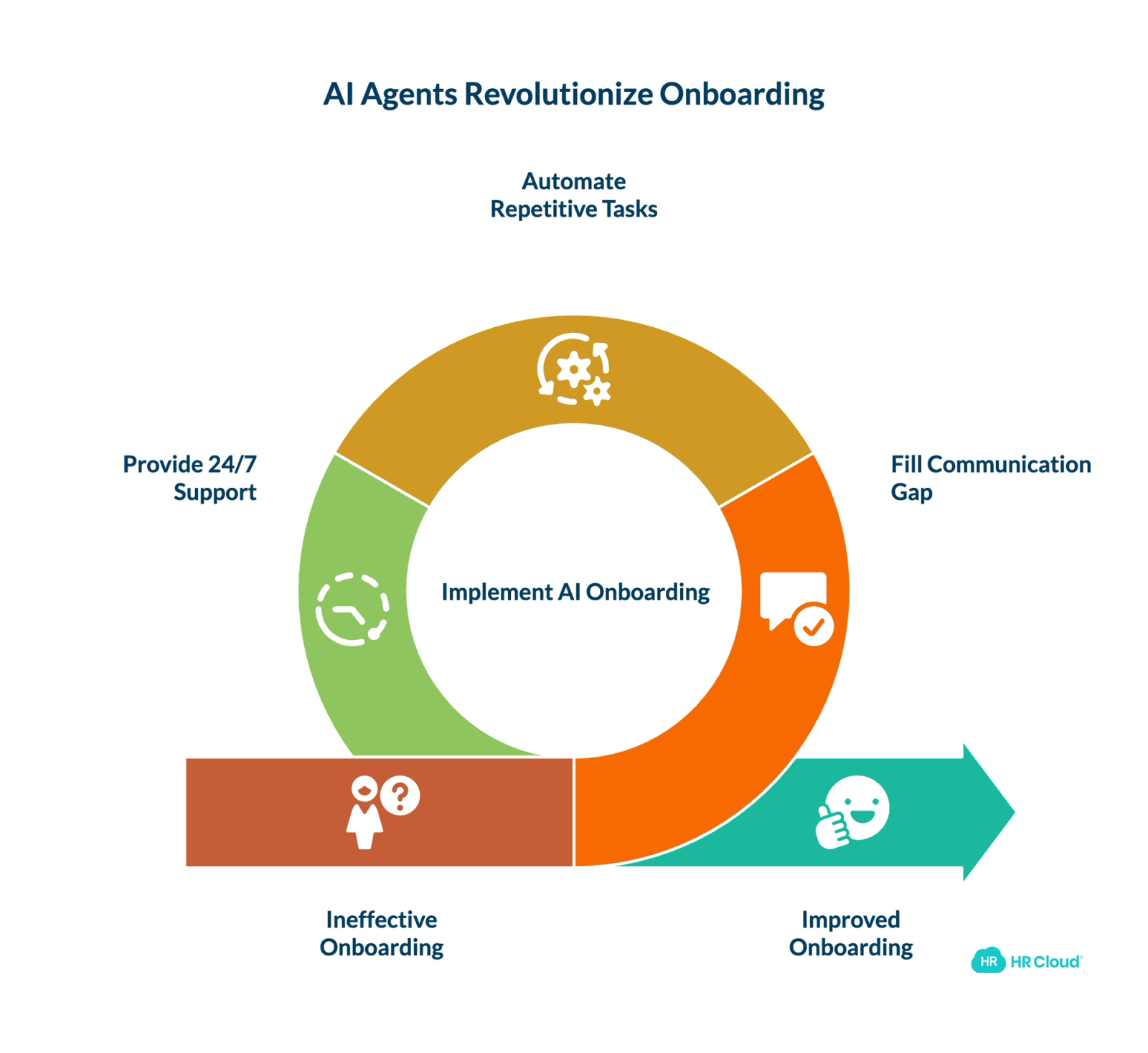
AI agents are no longer experimental. Gartner projects that 40% of enterprise applications will include task-specific AI agents by the end of 2026, up from less than 5% in 2025. That's one of the fastest adoption curves in enterprise software history.
So why is onboarding one of the first HR functions where AI agents are gaining real traction?
Three reasons. And one of them isn't what most people expect.
The biggest onboarding problem isn't paperwork. It's silence. Most organizations think their onboarding breaks down because of forms and compliance. But ask new hires what actually made them anxious, and the answer is almost always the same: the gap between accepting the offer and showing up on day one. Nobody reached out. Nobody answered their questions. They sat in limbo for two weeks wondering if they made the right choice. An AI onboarding agent fills that silence with useful, timely communication, before the new hire ever walks through the door.
Onboarding is high-volume and repetitive. Every new hire needs the same core set of tasks completed: documents collected, training assigned, systems provisioned, questions answered. That repetition is exactly where AI agents perform best. (For a full breakdown of what those tasks look like in practice, check out our onboarding checklists and templates.)
The cost of failure is measurable and immediate. When onboarding breaks down, people leave. Brandon Hall Group research shows that companies with strong onboarding improve new hire retention by 82%. For context, SHRM estimates that replacing an employee costs six to nine months of their salary. For a $50,000/year role, that's $25,000 to $37,500 walking out the door. Use HR Cloud's employee turnover calculator to see what that number looks like at your organization.
New hires ask questions outside business hours. They're anxious. They're excited. They text at 10:30 PM asking what to wear. An AI onboarding agent is available 24/7 and doesn't need to be on the clock to help someone feel welcome.
What an AI Onboarding Agent Is Not
Let's be clear about what this technology doesn't do, because the hype around AI agents has outpaced the reality in some areas.
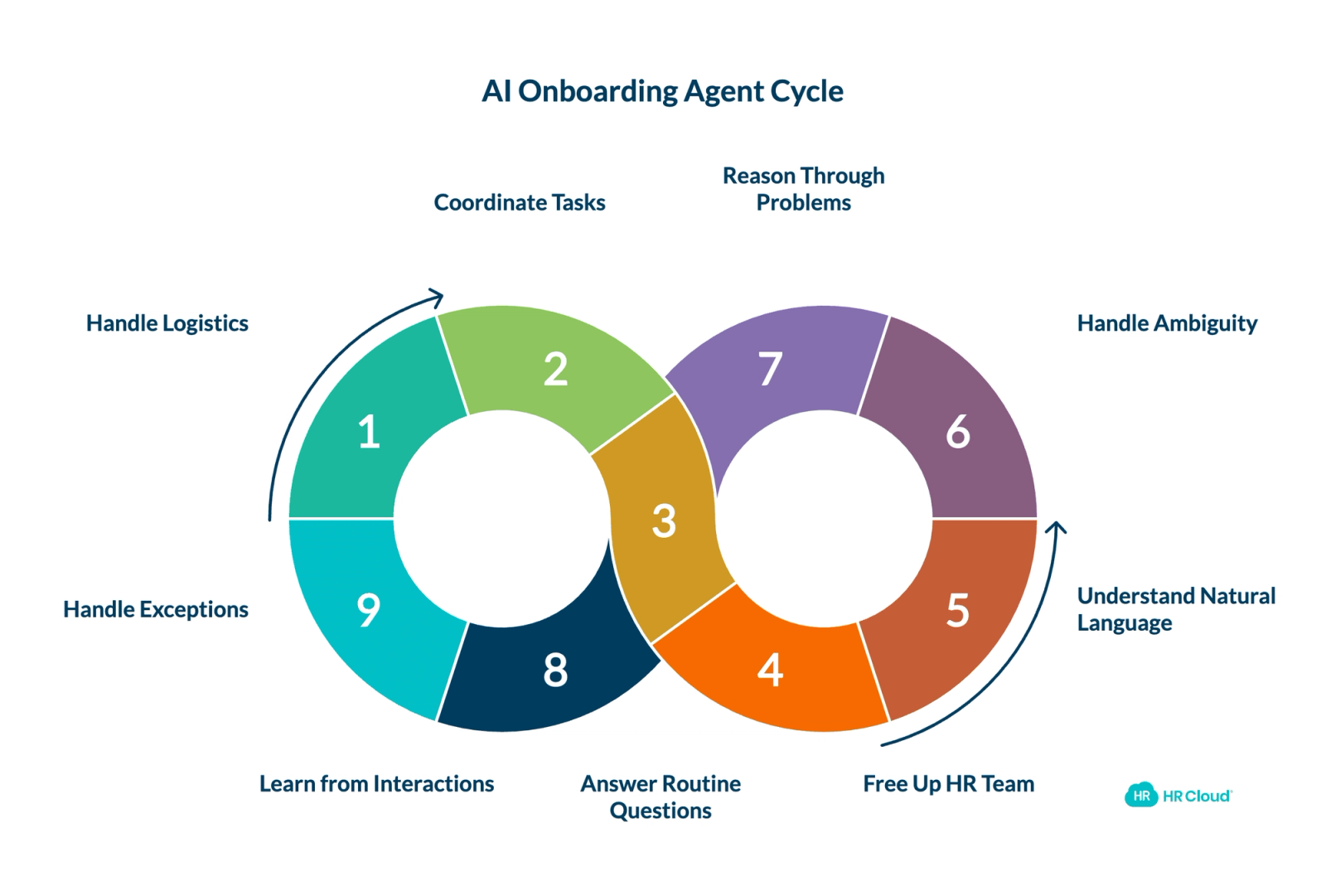
It's not a replacement for your HR team. An AI onboarding agent handles logistics, coordination, and routine questions. Culture immersion, reading the room when a new hire seems nervous, building the relationship between a manager and their new team member: those stay with your people. The best implementations treat the agent as the coordinator that frees humans to do human work. (Read more about why the human side of onboarding matters.)
It's not a traditional chatbot. Most onboarding chatbots are keyword-matching tools with pre-scripted answers. They break when a question falls outside their decision tree. An AI agent powered by an LLM understands natural language, handles ambiguity, and can reason through multi-step problems. "I lost my offer letter and I need to update my emergency contact before Monday" is two requests in one sentence. A chatbot panics. An agent handles both.
It's not a workflow automation tool with an AI label. Some vendors have taken their existing rule-based systems, added a chatbot front end, and called it an "AI agent." If the system can't make decisions, learn from interactions, or handle exceptions without human intervention, it's automation with a new coat of paint.
Five Capabilities to Look for When Evaluating an AI Onboarding Agent
Not every product calling itself an AI onboarding agent delivers the same level of capability. Here's what separates a useful agent from a rebranded chatbot.
1. Natural Language Understanding Across Channels
The agent should understand questions regardless of how they're phrased, and meet new hires wherever they are. Text message, Slack, a web portal, email. If your workforce is deskless (healthcare aides, warehouse workers, construction crews), SMS and mobile-first design are non-negotiable.
Think about how your actual new hires communicate. A 22-year-old warehouse associate isn't going to log into a portal and submit a ticket. He's going to text "do i need steel toes on day 1" at 9 PM. If your agent can't handle that, it's not built for your workforce.
2. Integration With Your Existing HR Stack
An AI onboarding agent that can't connect to your HRIS, your payroll system, your ATS, or your compliance tools is just a standalone chatbot. Look for native integrations with the platforms your team already uses. Two-way sync matters: the agent should pull data from your HRIS to personalize onboarding, and push completed tasks back so records stay current.
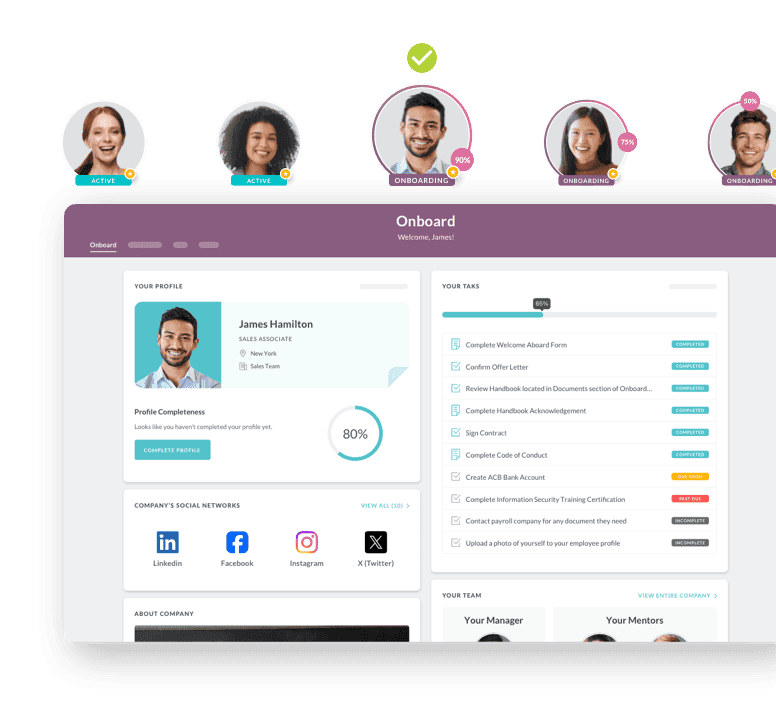
For organizations using platforms like HR Cloud's Onboard, the AI layer works on top of existing automated workflows, handling the conversational and decision-making tasks that pure workflow engines can't.
3. Compliance Awareness
This is where onboarding agents need to be especially sharp. The agent should know which documents are required by role, location, and jurisdiction. It should track completion deadlines, send reminders with appropriate urgency, and escalate to a human when a compliance item risks falling through the cracks.
In healthcare, for instance, that means tracking I-9 verification, training acknowledgments, background check clearance, and credentialing documentation. A missed item doesn't just create an HR headache. It creates legal exposure.
4. Personalization by Role, Location, and Department
A finance hire in Chicago and a registered nurse in Orlando shouldn't get the same onboarding experience. That sounds obvious, but you'd be surprised how many organizations send every new hire the same welcome email, the same training playlist, and the same 47-page handbook regardless of role.
The agent should automatically adjust training assignments, document requirements, introduction sequences, and even the tone of its communications based on who it's talking to. An experienced operations manager transferring from a competitor needs a fast-track to your specific systems. A first-time employee needs foundational context. The best agents learn from feedback and improve their personalization over time.
5. Reporting and Visibility for HR Leaders
If you can't see what the agent is doing, you can't trust it. Look for real-time dashboards that show task completion rates, bottlenecks, average time-to-productivity, and compliance gaps by location or department.
Here's why this matters more than you'd think. One multi-location healthcare organization discovered through their onboarding dashboard that new hires at two specific facilities were completing compliance training at half the rate of everyone else. The issue wasn't the training itself. It was that those facilities had poor Wi-Fi in their break rooms, the only place clinical staff could access training on their phones. Without visibility into completion rates by location, that problem would have stayed buried for months.
This data isn't just for monitoring the agent. It's for making your entire onboarding program measurably better.
Industry-Specific Considerations
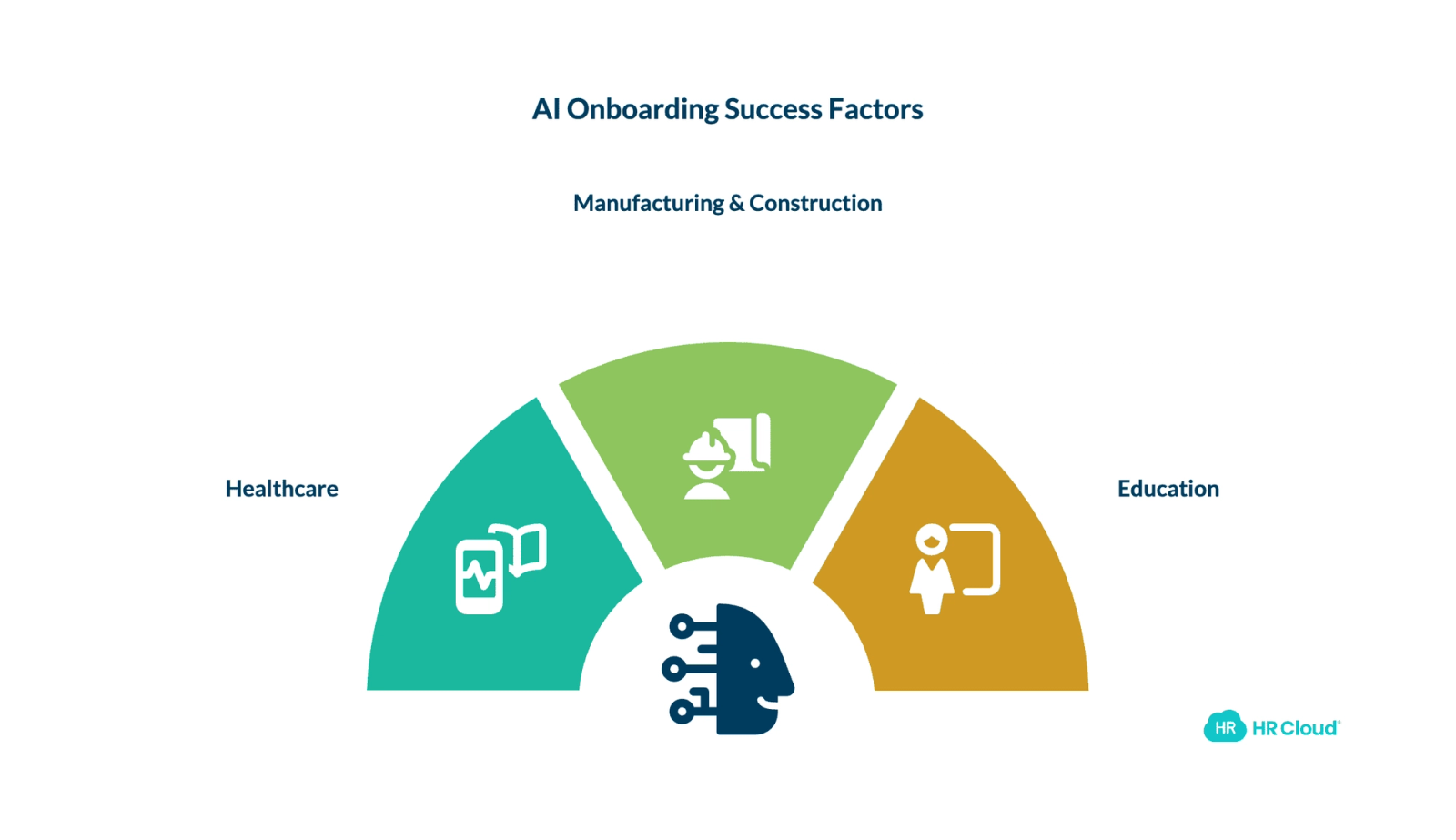
AI onboarding agents aren't one-size-fits-all. The industries where they deliver the most value tend to share a few characteristics: high hiring volumes, distributed workforces, strict compliance requirements, and employees who don't sit at desks.
Healthcare
Healthcare organizations face a unique combination of pressures: chronic staffing shortages, high turnover (particularly among CNAs and support staff), and compliance requirements that can't be missed. An AI onboarding agent in healthcare needs to manage credentialing timelines, coordinate required training before day one, handle Joint Commission audit readiness, and work via mobile because most clinical staff don't have work email during onboarding.
Healthcare companies like Interim HealthCare and Medlinks have used HR Cloud's onboarding platform to manage exactly this kind of complexity at scale, automating role-based compliance workflows across multiple facilities and shift types. (Read the Interim HealthCare case study to see what this looks like in practice.)
Manufacturing and Construction
In manufacturing and construction environments, safety training isn't optional. An AI onboarding agent needs to assign required safety certifications based on the specific equipment a new hire will operate, track certification completion before that person is allowed on the floor, and provide a way for workers to ask safety-related questions from their phone. Companies like Osmose Utilities and Comfort Systems USA Southwest have adopted automated onboarding to reduce time-to-productivity while maintaining compliance across job sites.
Unlock Success with Osmose’s Story
See how Osmose Utilities Services transformed their employee experience with HR Cloud — and discover how you can too. Download the ebook now!
Download Now
Education
School districts and education organizations often hire in waves. Summer onboarding for fall semester. January hires for spring. That creates massive spikes in onboarding volume that don't match the size of the HR team.
A district hiring 200 new teachers, aides, and support staff over six weeks can't have one HR coordinator personally walking each person through benefits enrollment, background check status, and classroom assignment. An AI onboarding agent handles the coordination layer so the HR team can focus on the exceptions: the hire whose background check is delayed, the teacher who needs a specific accommodation, the aide who hasn't responded in five days and might be slipping away.
Organizations like Bracken Christian School and Endeavor Schools use HR Cloud to manage exactly this kind of seasonal onboarding at scale.
How to Calculate Whether an AI Onboarding Agent Is Worth It
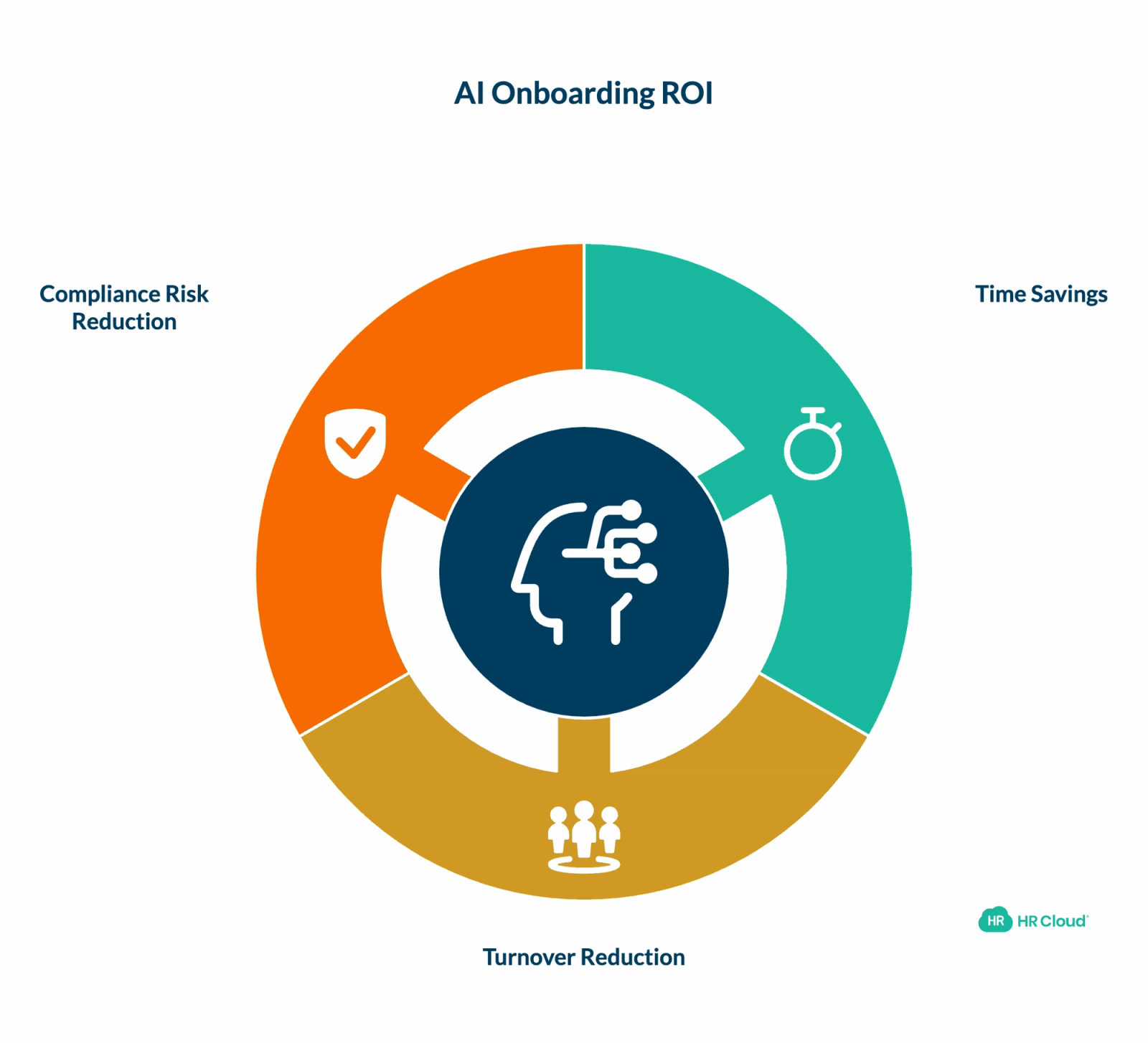
Before you invest, run the numbers. Here's a straightforward framework.
Current cost of manual onboarding per hire: SHRM benchmarks the average cost per hire at roughly $4,700 (including recruiting, HR time, training, system setup, and lost productivity during ramp-up). Your actual number depends on your industry and complexity. For organizations with compliance-heavy onboarding in sectors like healthcare, finance, or government, the real cost often runs higher.
Use HR Cloud's onboarding ROI calculator to estimate your specific numbers.
Time saved per hire: Based on what HR teams report after implementing AI-assisted onboarding, administrative time savings typically fall in the 40% to 60% range per hire. If your HR coordinator spends 8 hours per new hire on onboarding logistics, that's 3 to 5 hours recovered per person.
Turnover reduction: This is where the biggest ROI lives. If your first-year turnover is 30%, and strong onboarding improves retention by even 20% (well below Brandon Hall Group's 82% benchmark), multiply the number of retained employees by your cost-per-replacement. That number is usually large enough to justify the investment on its own.
Compliance risk reduction: Harder to quantify, but real. Every missed I-9, unsigned safety acknowledgment, or incomplete background check is a potential audit finding or legal liability. An AI agent that catches these automatically has value that extends beyond HR.
Where This Technology Is Headed
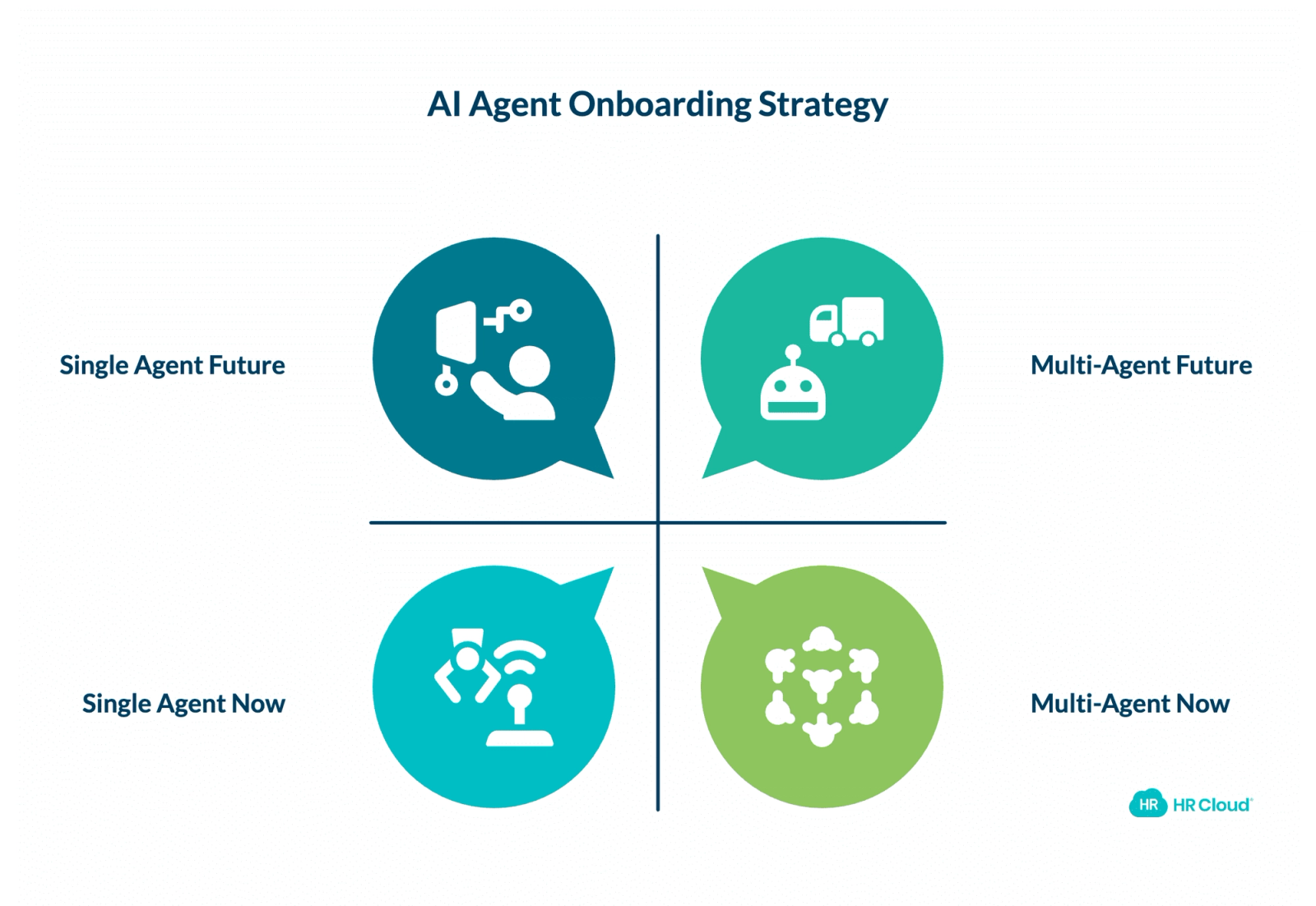
Gartner's roadmap for AI agents in enterprise software lays out a clear trajectory. In 2026, we're in the "task-specific agent" phase: individual agents handling individual workflows. By 2027 and 2028, the expectation is that multiple agents will collaborate within and across applications.
For onboarding, here's what that could look like in practice. A nurse accepts a job at a hospital system. The onboarding agent sends her pre-boarding documents and answers her questions about scrub policy. Meanwhile, an IT provisioning agent sets up her badge access and EHR login based on her department and shift. A benefits agent walks her through plan selection via text. A manager coaching agent sends her supervisor a reminder to schedule a first-week check-in, along with a summary of her background and learning preferences. No one in HR coordinated any of those handoffs manually.
Some organizations are already building toward this. HR Cloud, for example, is developing an AI-powered onboarding agent designed to guide new hires through their entire pre-boarding and day-one experience via conversational AI, connecting directly to HRIS workflows and automation.
The practical advice for 2026: don't wait for the multi-agent future to start. The single-agent implementations available today are already delivering measurable results. Start with your biggest onboarding bottleneck, pilot an AI agent on that specific problem, measure the outcome, and expand from there.
Common Mistakes That Derail AI Onboarding Agent Projects
Based on what we've seen across hundreds of onboarding implementations, here are the patterns that cause AI agent projects to fail:
Launching without clean data. An AI agent is only as good as the data it can access. If your HRIS has inconsistent job titles, missing manager assignments, or outdated location codes, the agent will personalize onboarding based on bad information. Fix your data before you flip the switch.
Skipping the pilot. Rolling out an AI onboarding agent company-wide on day one is a recipe for frustration. Start with one department, one location, or one job family. Learn what works. Adjust. Then scale.
Ignoring the employee experience. Some teams get so focused on the HR efficiency gains that they forget to test what the new hire actually experiences. Ask your pilot cohort: Did the agent answer your questions? Did you feel supported? Was anything confusing? Their feedback is more valuable than your dashboard metrics. (If you want a framework for what a good experience looks like, see our guide to onboarding best practices.)
Treating it as an IT project instead of an HR project. The technology needs IT involvement for integration and security. But the onboarding experience is HR's responsibility. If IT owns the project and HR is consulted occasionally, the result will be technically functional and experientially mediocre.
Not planning for remote and hybrid hires. If your AI onboarding agent only works for in-office employees, you've solved half the problem. Make sure the agent handles remote onboarding just as effectively, including virtual introductions, asynchronous document completion, and time-zone-aware scheduling.
Onboarding 500 people this year across multiple locations, compliance frameworks, and manager assignments takes more than good intentions and a shared Google Drive. It takes systems that handle the coordination so your team can handle the people.
See how HR Cloud helps organizations like yours automate onboarding workflows, stay audit-ready, and get new hires productive faster.

Discover how our HR solutions streamline onboarding, boost employee engagement, and simplify HR management
Book Your Free DemoFrequently Asked Questions
What is an AI onboarding agent?
An AI onboarding agent is software that uses large language models to autonomously manage new hire onboarding tasks. It answers employee questions in natural language, assigns and tracks training and document completion, sends reminders, and escalates issues. Unlike rule-based automation, it can interpret context and handle exceptions without waiting for human intervention.
How is an AI onboarding agent different from an onboarding chatbot?
Traditional onboarding chatbots rely on keyword matching and pre-scripted decision trees. They break when a question doesn't match their programming. An AI onboarding agent understands natural language, reasons through multi-step requests, and learns from interactions. It can handle ambiguous or compound questions that would stump a standard chatbot.
How much does an AI onboarding agent cost?
Pricing varies significantly based on the vendor, the number of employees being onboarded, and the level of integration required. Most enterprise solutions use per-employee-per-month pricing or annual licensing. The more relevant question is ROI: organizations typically recover their investment through reduced HR administrative time (40-60% savings per hire), lower first-year turnover, and fewer compliance gaps. Use a tool like HR Cloud's onboarding ROI calculator to estimate your specific payback period.
Can an AI onboarding agent handle compliance requirements like I-9 verification?
Yes, when properly configured. The agent can assign compliance documents based on role and jurisdiction, track completion deadlines, send escalating reminders, and flag overdue items. However, the agent should complement your compliance processes, not replace human oversight for high-risk items. Final review and sign-off on sensitive compliance matters should still involve your HR or legal team.
Is an AI onboarding agent secure enough for employee data?
Security depends on the vendor's architecture. Look for SOC 2 Type II certification, data encryption at rest and in transit, role-based access controls, and clear data retention policies. Ask specifically how the LLM processes employee data: is it sent to a third-party API, or processed within a controlled environment? For any organization handling sensitive employee information, security architecture should be a first-round evaluation criterion, not an afterthought.
What industries benefit most from AI onboarding agents?
Industries with high hiring volumes, distributed workforces, strict compliance requirements, and deskless employees see the strongest returns. Healthcare, manufacturing, construction, retail, and education consistently report the highest ROI from AI-assisted onboarding. These sectors share a common pattern: they hire frequently, can't afford compliance gaps, and need onboarding that works on a mobile device without a desk or corporate laptop.
About the author

Keep Reading


Like What You Hear?
We’d love to chat with you more about how HR Cloud® can support your business’s HR needs.
Book Your Free Demo