What's the Best Applicant Tracking System for Retail Seasonal Hiring Surges?

The best applicant tracking system for retail seasonal hiring surges is one built around mobile-first applications, bulk candidate communication, and automated screening, because a general-purpose ATS designed for salaried, low-volume hiring cannot process hundreds of applicants per store in a matter of days. Retailers evaluating a retail ATS software option for peak season should prioritize platforms that let a single recruiter or store manager move dozens of candidates through the pipeline at once, on a phone, without manual data entry at every stage, since the same generic workflow that works fine in a quiet hiring month simply cannot keep pace once application volume multiplies overnight. HR Cloud's Recruit ATS is one platform built for this specific problem, with AI-assisted job posting, async video screening, and a direct handoff into onboarding once an offer goes out.
Why Do Standard ATS Tools Struggle with Retail Hiring Spikes?
Most applicant tracking systems were built for a steady trickle of applications: a handful of roles open each month, a recruiter reviews resumes one at a time, and a hiring manager schedules a handful of interviews a week. Retail seasonal hiring breaks that model completely. A single big-box location can receive hundreds of applications in the two weeks after posting a holiday cashier role, and a regional chain opening 40 seasonal positions across a dozen stores can see that volume multiply overnight.
Generic ATS platforms handle this by making recruiters do more manual work: opening each application individually, copying candidate details into a spreadsheet to track by location, and sending status updates one email at a time. That approach worked when hiring was slow and steady. It falls apart the moment application volume spikes 5x or 10x in a single week, which is exactly what happens during back-to-school, Black Friday, and December holiday hiring windows.
Thousands of Applicants in a Short Window
Retail employers hire seasonal workers on a compressed timeline that most corporate hiring software was never designed to support. Challenger, Gray & Christmas forecasts that retailers will add roughly 450,000 seasonal jobs in the fourth quarter of 2026, and even with that total down from the 461,500 added in Q4 2025 (the lowest fourth-quarter total since 2008), it still represents hundreds of thousands of hires compressed into about eight weeks. For an individual retailer with 50 or 100 locations, that national number translates into dozens of open roles per store, all needing to be filled before the first week of November.
To put that in concrete terms: a regional retailer with 60 stores that needs an average of eight seasonal hires per location is trying to fill roughly 480 roles in the same eight-to-ten-week window, which typically means generating several thousand applications to get there, since not every applicant is qualified, available, or responsive once contacted. Spread across 60 store managers with no shared system, that volume turns into 60 separate, uncoordinated hiring processes running at once, each vulnerable to the exact same bottlenecks independently.
A platform built for slow, steady hiring cannot process that volume without recruiters working nights and weekends. Applications pile up in a shared inbox, resumes get reviewed out of order, and strong candidates accept a competitor's offer before a store manager even opens their application. The bottleneck isn't a shortage of applicants. During a seasonal surge, retailers usually have more candidates than they know what to do with. The bottleneck is a system that cannot move candidates through screening, interviews, and offers fast enough to convert that volume into hires before candidates walk down the street to the next retailer that's hiring.
Where Do Retail Hiring Pipelines Break Down at Volume?
Retail hiring pipelines rarely fail at the top of the funnel. Job postings get plenty of traffic during peak season, especially when a retailer posts to multiple job boards at once. The breakdown happens in the middle of the process, in the space between an application landing and a candidate getting an interview slot.
Manual Screening and Slow Scheduling
Manual resume screening is a major chokepoint in high-volume retail hiring. When 300 people apply for 12 open cashier and stock positions at one location, a store manager or district recruiter has to open, read, and rank every one of those applications by hand if the ATS doesn't do any of that work automatically. That process alone can eat an entire week, and every day a strong candidate sits unscreened is a day they're free to accept an offer somewhere else.
Interview scheduling compounds the problem. Retail candidates are disproportionately mobile-first: just under 65% of retail job applicants apply from a phone, according to Appcast's Eighth Annual Recruitment Marketing Benchmark Report, as reported by Retail TouchPoints. If scheduling an interview means a back-and-forth email chain instead of a text message or a one-tap calendar link, a meaningful share of candidates simply stop responding. Multiply that friction across dozens of open roles and multiple store locations, and a retailer can lose candidates it never even realized it had.
Multi-location coordination adds a third layer of difficulty. A district manager overseeing 15 stores needs visibility into which locations are behind on hiring and which have already filled their seasonal headcount, but that visibility doesn't exist if each store manager is tracking candidates in a separate spreadsheet or a personal notebook. Without a shared system, seasonal hiring becomes uneven: some stores overstaff while others walk into peak season short-handed.
Candidate Drop-Off Before an Interview Ever Happens
Seasonal candidates disengage faster than salaried candidates do, and a slow or clunky process is usually the reason. Mobile job seekers research has repeatedly found that candidates complete meaningfully fewer applications on a phone than on a desktop when the application itself wasn't built for mobile, and that a large share of candidates simply abandon an application once it takes longer than a few minutes to finish. In a seasonal hiring context, that drop-off compounds: a candidate who gives up on one retailer's application usually has three or four browser tabs open to other retailers hiring for the exact same role down the street, so a slow process doesn't just delay a hire, it often loses the candidate entirely.
Silence is just as costly as slowness. A candidate who applies and never hears anything back, not even an automated acknowledgment, has no reason to consider that retailer again next season. Since retail's baseline turnover means most retailers are re-recruiting a meaningful share of their workforce every single year, a poor candidate experience during one seasonal surge quietly shrinks the pool of past applicants a retailer can draw on the next time it needs to hire fast.
What Should a Retail-Ready ATS Offer?
A retail-ready ATS needs to be built around the two constraints that define seasonal hiring: candidates apply and expect to hear back on their phones, and recruiters need to process dozens of candidates at once rather than one at a time. Generic HR software that was designed for salaried, low-volume hiring rarely does either well out of the box.
Mobile Applications and Fast Scheduling
A mobile-first application process means a candidate can complete an application, upload any required documents, and see next steps entirely from a phone, without needing to switch to a desktop browser to finish. For hourly and frontline candidates, that isn't a nice-to-have. It's the difference between capturing an applicant and losing them before they ever submit a resume, since research on mobile job seekers consistently shows that a clunky, desktop-only application flow drives real drop-off, particularly among hourly candidates who may not have easy desktop access at all.
Fast, self-serve scheduling matters just as much. When a candidate can pick an interview slot themselves from a text message or a QR code rather than waiting for a recruiter to propose times over email, the average time between application and interview shrinks from days to hours. That speed is a competitive advantage during a seasonal surge, when several retailers in the same shopping center or strip mall are often hiring for the exact same candidate pool at the exact same time.
Bulk Hiring and Communication Tools
Bulk-hiring features let one recruiter or store manager act on many candidates at once instead of working through applications individually. That includes moving a batch of qualified applicants to the next stage with a single click, sending the same interview invitation or rejection message to a group of candidates simultaneously, and building reusable hiring workflows for roles that repeat every season, like cashier, stock associate, or seasonal sales associate.
Bulk communication tools matter for a second reason beyond speed: candidate experience. A retailer that never responds to an application, or takes two weeks to send a rejection, damages its employer brand with every candidate who has a bad experience, including the ones a retailer will want to re-hire next season. An ATS that automates timely, even if templated, communication protects that brand while freeing recruiters to spend their time on the candidates who need a real conversation.
| Feature | Why It Matters for Seasonal Retail Hiring |
|---|---|
| Mobile-first applications | The majority of retail candidates apply from a phone; a desktop-only flow loses applicants before they finish applying |
| Bulk candidate actions | Move dozens of applicants through screening and status changes at once instead of one at a time |
| Self-serve interview scheduling | Cuts the days-long email back-and-forth down to a single tap from a text or QR code |
| Reusable hiring workflows | Cashier, stock associate, and seasonal sales roles repeat every year; a saved workflow skips rebuilding the process each season |
| Multi-location visibility | District and regional managers can see which stores are behind on seasonal headcount in real time |
| Direct connection to onboarding | A signed offer should trigger onboarding automatically instead of a second round of manual data entry |
What Should Retailers Look for When Evaluating Any ATS?
This checklist applies to any retail ATS software a retailer is evaluating, whether that ends up being HR Cloud or a different platform entirely. The underlying question is the same for any vendor: does this system remove manual work during the two or three months a year when hiring volume is highest, or does it just digitize the same slow process?
| Evaluation Question | What a Strong Answer Looks Like |
|---|---|
| Can candidates finish the entire application on a phone? | No forced switch to desktop, no broken form fields on small screens, a resume upload that also accepts a photo |
| Can one recruiter act on many candidates at once? | Bulk stage changes, bulk messaging, and saved hiring workflows for roles that repeat every season |
| Does interview scheduling remove the email back-and-forth? | Candidates pick their own slot from a text or link rather than waiting on a recruiter's reply |
| Does an accepted offer trigger onboarding automatically? | I-9, tax forms, and role-specific tasks start the moment an offer is signed, with no manual re-entry |
| Can a district or regional manager see hiring status across stores? | Time-to-fill and pipeline status are visible by location, not just company-wide |
| Does pricing scale with headcount instead of per seat? | A fixed license avoids a surprise bill after a retailer adds 200 seasonal accounts for eight weeks |
Retailers evaluating vendors should ask each one to demonstrate the mobile application flow live, on an actual phone, rather than relying on a desktop demo screen. A platform that looks capable in a sales presentation can still fail candidates in the field if nobody has stress-tested it on the exact device most applicants will actually use.
What Compliance Risks Come with Seasonal and Teen Retail Hiring?
Seasonal hiring compresses months of onboarding risk into a few weeks, and the two biggest exposure points are federal I-9 compliance and minor labor law, both of which apply to seasonal workers exactly as they apply to any other employee.
Form I-9 verification is required for every new hire, seasonal or not, and civil penalties for I-9 paperwork violations currently range from roughly $281 to $2,789 per violation for a first offense, according to guidance summarized by Experian's employer services team. Retailers hiring across dozens of stores at once are especially exposed here, because the risk isn't usually a deliberate violation, it's a manager who plans to "finish the I-9 later" during a busy week and never circles back before the new hire's first shift.
Retail seasonal hiring also pulls in a meaningful number of workers under 18, and minor labor rules vary by state on top of the federal Fair Labor Standards Act. Under the FLSA, workers under 16 face restricted hours outside of school, and several states, California among them, separately require a signed work permit before a minor can start working at all. A retailer hiring across state lines during the same holiday push needs a way to track these requirements by the candidate's age and location rather than expecting every store manager to memorize every state's rules while running a holiday floor. When evaluating any ATS, retailers should ask specifically whether it captures date of birth and location at the point of application and whether it can flag or block a start date until required documentation, including a minor work permit where one applies, is on file. Not every ATS on the market does this today, so it's worth confirming directly with a vendor rather than assuming the capability exists.

Post Jobs, Evaluate Candidates, and Hire the Best with Our Applicant Tracking System
Book Your Free Demo
Which Retailers Need This Most?
Retailers with more than one location and any meaningful seasonal swing in headcount get the most value from high-volume retail recruiting software, because the coordination problem gets worse, not better, as store count grows. A single independent shop hiring three extra people for the holidays can usually manage with a simple process. A regional chain hiring 500 seasonal workers across 60 stores cannot.
Grocery and big-box retailers, where seasonal volume is highest and turnover among hourly staff is a year-round reality rather than a holiday-only event, see the largest return from bulk hiring tools and reusable workflows, since the same cashier and stock-associate roles reopen constantly. Specialty and apparel retailers with a shorter, sharper holiday-only surge benefit most from mobile-first applications and fast scheduling, since their hiring window is compressed into just a few weeks and there's little time to recover from a slow start. Multi-location retailers of any size benefit from store-by-store visibility into time-to-fill, since a district manager overseeing a dozen locations otherwise has no way to know which stores are falling behind until the surge has already begun.
How Are Retailers Preparing for Seasonal Surges Today?
Retailers that consistently hit their seasonal headcount targets treat peak-season hiring as a planning exercise that starts months before the surge, not a scramble that begins the week job postings go live. That shift matters more this year than in recent memory: the National Retail Federation's most recent full-year forecast put 2025 holiday seasonal hiring at between 265,000 and 365,000 workers nationally, down sharply from 442,000 seasonal hires in 2024, and Challenger, Gray & Christmas's newer outlook for the 2026 season points to a similarly cautious hiring environment. When the overall labor market is tighter and retailers are hiring fewer seasonal workers in aggregate, competition for the candidates who are applying gets sharper, not softer.
Pre-Building Seasonal Hiring Pipelines Months in Advance
Retailers that plan ahead build a talent pool before they need it. That means keeping records of past seasonal employees who performed well and inviting them back directly instead of starting from zero every year, and it means posting "always-on" seasonal job listings during slower months so a pipeline of interested candidates is already partially screened by the time peak hiring begins. It also means locking in interview slots and store manager availability on the calendar in advance, so the moment a strong candidate applies, there's already a time to get them in front of someone.
This kind of advance planning also depends on retail turnover being what it is. Retail and wholesale carry the highest annual turnover of any major industry sector, at 26.7% according to Mercer's 2025 US Turnover Survey, as reported by WorkTime's employee turnover research. That baseline turnover means most retailers are hiring continuously, not just during the holidays, which is exactly why a talent pool built over the course of a year, and a seasonal hiring ATS that keeps that pool organized and searchable, pays off disproportionately once the seasonal surge hits.
Step-by-Step: Preparing for Seasonal Hiring Surges
Retailers that get ahead of seasonal hiring follow a consistent sequence: they forecast headcount early, remove friction from the application itself, automate the repetitive parts of screening and scheduling, connect hiring directly to onboarding, and measure how each location is performing throughout the surge.
Step 1: Forecast Seasonal Headcount Needs Early
Seasonal headcount planning should start by looking at last year's actual hiring numbers by store or region, not a single company-wide estimate. A retailer with 80 locations rarely needs the same number of seasonal hires at every store. Sales forecasts, foot traffic patterns, and last year's turnover during the surge itself all feed into a more accurate, location-specific headcount target. Setting that number three to four months before peak season, rather than three to four weeks before, gives recruiters enough runway to build a pipeline instead of reacting to a shortage in real time.
Step 2: Shorten the Mobile Application Process
Every extra field, every required account creation step, and every screen that doesn't render properly on a phone costs a retailer completed applications during peak season. The fix is a short, mobile-native application: a handful of essential questions, a resume upload that also accepts a photo of a printed resume, and a confirmation screen that tells the candidate exactly what happens next. Retailers should test their own application flow on an actual phone, on a cellular connection, before peak season starts, since a process that looks fine on an office desktop monitor can be nearly unusable on a small screen with a slow signal.
Step 3: Automate Screening and Scheduling
Automated screening rules, like flagging candidates who meet minimum availability requirements or have relevant experience, let recruiters focus their limited time on the applications that need a real human decision instead of reading every single resume in the order it arrived. Pairing that with self-serve interview scheduling, where a qualified candidate picks their own slot from a text message, removes a major source of delay between application and interview, since the wait no longer depends on a recruiter finding time to propose times back and forth over email.
Step 4: Connect Your ATS Directly to Onboarding
A signed offer should trigger onboarding automatically: I-9 and E-Verify paperwork, tax forms, and any location-specific training requirements should be waiting for a new hire the moment they accept, not sitting in a separate system a manager has to remember to set up manually. This handoff matters even more for seasonal roles than for standard hires, because seasonal workers often have only a few days between accepting an offer and their first shift. A gap between the ATS and onboarding software is where new hires quietly no-show on day one, after already accepting the job, simply because nobody sent them the paperwork in time.
Step 5: Track Time-to-Fill by Store and Region
Time-to-fill, measured separately for each store or region rather than as a single company-wide average, tells a retailer which locations are falling behind while there's still time to intervene. A store that's taking twice as long to fill seasonal roles as the chain average might have a local labor-market problem, a manager who isn't reviewing applications quickly, or a job posting that isn't reaching the right candidates. Reviewing this metric weekly during the surge, rather than only after the season ends, is what turns it from a postmortem statistic into something a retailer can actually act on before peak season begins. A simple weekly cadence works well in practice: pull time-to-fill and open-role counts by store every Monday, flag any location trending more than a few days slower than the chain average, and route district-manager attention to those stores first, rather than spreading equal attention across every location regardless of where the actual problem is.
How Does HR Cloud's Recruit ATS Handle Seasonal Volume?
HR Cloud's Recruit ATS is high-volume retail recruiting software built around the two problems that matter most for retail hiring at volume: getting a mobile-first application in front of candidates, and letting one recruiter act on many candidates at once instead of working through applications one by one.
Mobile-First Applications
Candidates can complete a Recruit application entirely from a phone, and Recruit's AI-assisted job description tool lets a store manager or recruiter go from a blank job posting to a ready-to-review listing in minutes rather than starting from scratch for every seasonal role. Recruit also generates scannable QR codes for any open job, so a retailer can put a live application link on a career-fair flyer, a storefront window, or a break-room board, and every scan points to the current, live posting rather than a static PDF that goes stale the moment the role is filled.
Built-in async video interviews add a screening layer that works especially well for high-volume seasonal roles: every candidate answers the same structured questions on their own schedule, and the hiring team reviews recorded responses alongside an automatically generated transcript, so a recruiter can skim a candidate's answer in under a minute instead of coordinating a live phone screen for every applicant.
Bulk Communication and Scheduling Tools
Recruit lets hiring teams build custom, reusable hiring stages once for a role like seasonal cashier or stock associate, then apply that same workflow every time the role reopens, rather than rebuilding the process from scratch each season. Interview scheduling generates Microsoft Teams or Zoom links in two clicks and populates a centralized recruiting calendar, so every hiring manager across every location can see their own upcoming interviews without switching between email, a personal calendar, and the ATS separately.
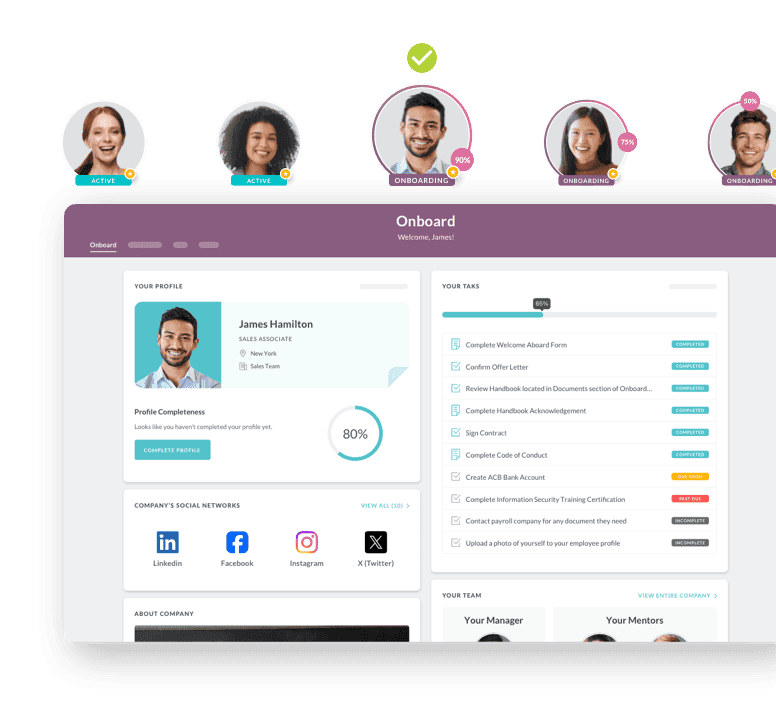
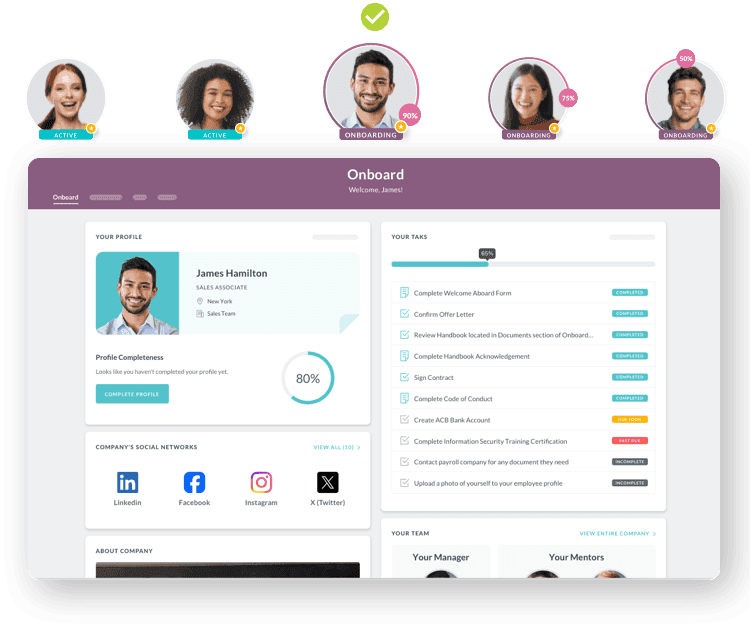
Once an offer is accepted, Recruit and HR Cloud's Onboard module share the same underlying database, so a new hire's record moves directly into onboarding automatically, including I-9 verification, company documents, and any role-specific tasks, without a recruiter re-entering candidate information a second time. Interim HealthCare, one of HR Cloud's customers running high-volume frontline hiring, uses this same connected handoff to clear new hires for fieldwork immediately after onboarding, because every required form is completed before the new hire's first day. HR Cloud also serves multi-location, frontline-heavy retail organizations directly: Public Group, a Greece-based retailer operating 64 stores and more than 2,000 employees, unified five separate HR tools into one mobile-first platform, and Konzum, a retail chain with more than 10,000 employees across 600-plus locations, uses HR Cloud to keep communication and HR processes consistent store to store. HR Cloud is rated 4.7 out of 5 on both G2 and Capterra from 399 reviews, and Recruit connects to ADP, UKG, Workday, and other payroll systems a retailer may already run, rather than requiring a retailer to replace its existing payroll platform to adopt a new ATS.
HR Cloud prices Recruit as part of a fixed annual license rather than charging per seat, which matters specifically for seasonal hiring: a retailer that temporarily adds hundreds of seasonal candidate records for eight to ten weeks isn't charged a per-user fee that spikes during the exact months it's hiring the most. There's no self-serve free trial; instead, a specialist walks through the Onboard Suite or full HR Suite (which includes Recruit) against a retailer's actual store count and seasonal calendar, then provides a custom quote, since implementation, training, and support are bundled into every plan rather than billed separately. For a directional sense of the broader market, entry-level standalone ATS tools for small teams commonly start around $50 to $100 per month, while mid-market platforms bundled with onboarding, HRIS, and payroll integrations run from a few hundred to several thousand dollars per month depending on headcount and modules, though exact pricing depends heavily on which features and integrations a given retailer actually needs.
What Are the Most Common Mistakes in Seasonal Hiring?
Retailers repeat a handful of avoidable mistakes every peak season, and nearly all of them come down to treating seasonal hiring as an emergency rather than a planned, recurring event.
Starting the Hiring Process Too Late
The single most common mistake in seasonal retail hiring is waiting until a few weeks before peak season to start recruiting. By the time a retailer posts seasonal roles in late October for a holiday rush, the strongest candidates, the ones with prior seasonal retail experience and open availability, have often already accepted offers from competitors who started hiring in August or September. Late-starting retailers are then left choosing from a shrinking, less-qualified pool, right when they need their best hiring decisions to happen fastest.
A second common mistake is failing to pre-plan onboarding logistics alongside recruiting. A retailer might successfully hire 50 seasonal workers on schedule, only to have half of them show up on day one to find that I-9 paperwork, register training, or safety certifications haven't been arranged, because onboarding was treated as a separate task to figure out later rather than something built into the hiring plan from the start.
What Does a Faster Hiring Process Actually Deliver?
A faster, mobile-first hiring process isn't just a recruiter convenience. It shows up directly in a retailer's ability to open peak season with full store coverage instead of scrambling through the first few weeks of the surge short-staffed.
Fully Staffed Stores Before Peak Season Begins
When a retailer can move a candidate from application to offer in days instead of weeks, it can complete seasonal hiring before peak season starts rather than during it, which means new hires get trained and ramped up before the busiest shifts hit rather than learning the job while a line is already out the door. Fully staffed stores also protect the customer experience that drives holiday revenue in the first place: a customer who can't find help on the floor or waits too long at checkout during Black Friday or the December rush is a customer a retailer may not get back in January.
Faster hiring also protects the retailer's employer brand with candidates it didn't ultimately hire this round. A candidate who applies, hears back quickly, and gets a clear answer, even a rejection, is a candidate who's far more likely to apply again next season than one who submitted an application into a system that never responded at all.
Conclusion
The best applicant tracking system for retail seasonal hiring surges is the one that treats mobile applications, bulk candidate actions, and a direct connection to onboarding as the baseline, not as advanced features to add on later. Retailers evaluating retail ATS software should walk away with a clear answer to one question: does this system get faster and more organized as application volume rises, or does it just add more manual steps. Retailers that plan seasonal headcount months in advance, shorten their mobile application flow, and automate screening and scheduling consistently walk into peak season fully staffed instead of playing catch-up through the busiest weeks of the year. HR Cloud's Recruit ATS was built around exactly this workflow, from AI-assisted job postings and async video screening through to a direct, automatic handoff into onboarding once an offer is signed. If seasonal hiring has felt like a scramble in past years, book a demo of HR Cloud's Recruit ATS to see how the mobile application flow and bulk hiring tools work against your own store count and hiring timeline.
Discover how our HR solutions streamline onboarding, boost employee engagement, and simplify HR management
Book a DemoFrequently Asked Questions
How far in advance should seasonal retail hiring start?
Most retailers should begin building a seasonal talent pool three to four months before peak season, not three to four weeks. That gives enough time to post roles, screen candidates in smaller batches, and lock in interview availability before the highest-volume application weeks hit.
Can an ATS handle thousands of applicants at once?
Yes, but only if it's a genuine seasonal hiring ATS built for high-volume hiring specifically. A retail-ready ATS should support bulk candidate actions, automated screening rules, and self-serve interview scheduling so one recruiter can process dozens of applicants at a time instead of reviewing each one individually.
Does a retail ATS connect directly to onboarding software?
It should. HR Cloud's Recruit and Onboard modules share a single database, so an accepted offer automatically starts onboarding, including I-9 verification and company documents, without a recruiter manually re-entering the new hire's information a second time.
Can hiring managers review applicants from a phone?
Yes, on a platform built for mobile-first retail hiring. HR Cloud's Recruit lets store managers review applications, watch async video interview responses alongside an automatic transcript, and move candidates through hiring stages entirely from a phone, without needing a desktop computer.
Why do seasonal candidates apply on mobile more than other job seekers?
Retail and hourly candidates are disproportionately mobile-first: just under 65% apply from a phone, according to Appcast's Eighth Annual Recruitment Marketing Benchmark Report. Many seasonal candidates don't have easy desktop access, so an ATS that isn't fully functional on a small screen loses applicants before they finish applying.
What happens if a retailer starts seasonal hiring too late?
Late-starting retailers are typically left choosing from a smaller, less-experienced candidate pool, since applicants with prior seasonal retail experience tend to accept offers from the retailers who started recruiting earliest. This often means stores open peak season short-staffed and spend the first few weeks of the surge training new hires during the busiest shifts instead of before them.
Does a retail ATS need to handle I-9 and minor work permit compliance?
Yes, both apply to seasonal hires exactly as they apply to any other employee. Form I-9 verification is required for every new hire regardless of how long they'll work, and several states require a signed work permit before a worker under 18 can start, so it's worth confirming with any ATS vendor whether the system can flag these requirements by age and location during high-volume hiring.
How much does a retail ATS typically cost?
Pricing varies by vendor and by how many modules a retailer needs. Entry-level standalone ATS tools for small teams often start around $50 to $100 per month, while platforms bundled with onboarding, HRIS, and payroll integrations, like HR Cloud's Recruit and HR Suite, are quoted as a fixed annual license sized to headcount and modules rather than charged per seat.
Does a retail ATS replace an existing payroll system?
No, a well-built retail ATS should integrate with the payroll system a retailer already runs rather than requiring a replacement. HR Cloud's Recruit connects with ADP, UKG, Workday, Paylocity, and several other payroll platforms, so hired candidates flow into an existing payroll setup instead of forcing a separate migration project.
Should every store manager have their own login to the ATS?
Yes, for multi-location retailers. Giving each store or district manager their own access, scoped to their own location's candidates, is what makes store-by-store time-to-fill tracking possible in the first place. Without individual logins, hiring status usually lives in whichever manager's head happens to be tracking it that week, which disappears the moment that person is out sick or the store changes management mid-season.
About the author

Keep Reading


Like What You Hear?
We’d love to chat with you more about how HR Cloud® can support your business’s HR needs.
Book Your Free Demo