What HR Software Handles Certification Expiration Alerts for Construction Crews?

HR software with automated certification tracking flags credentials approaching a renewal deadline, whether that deadline is a hard expiration date, a required reevaluation, or a company refresher schedule, then routes reminders to the worker, their supervisor, and HR at set intervals, typically 90, 60, and 30 days out. That distinction matters from the first sentence: an OSHA 10 or 30-hour Outreach card does not itself expire under federal rules, but the state, local, or project-specific training-recency requirement attached to it can still lapse, and a good system tracks those as separate fields rather than treating every credential as a simple expiration date. Buyers evaluating this category are generally weighing two things: certification tracking software built for construction specifically, and whether it lives inside a broader construction workforce management software platform, sometimes called project-based HR software, rather than as a standalone credential wallet disconnected from onboarding and payroll. The features worth asking for, regardless of vendor, are mobile document upload, visibility rolled up above the individual worker, and an audit trail, so a superintendent can confirm every worker on a jobsite is currently qualified without opening a spreadsheet or calling around to five different site offices. The distinction that matters most when evaluating options is whether certification tracking lives inside the same system that already manages onboarding, payroll data, and employee records, or whether it sits in a separate, single-purpose tool that has to be reconciled against everything else by hand.
Why Are Certification Lapses a Major Risk on Job Sites?
A lapsed certification is a real operational and compliance problem, though what exactly it triggers depends on which kind of requirement lapsed: a missing document, an expired credential with a hard legal deadline, and a missed employer-set refresher date are not the same situation and don't carry the same consequence. In the more serious cases, a worker may no longer be legally or contractually qualified to do the job they showed up to do, and the longer that goes unnoticed, the more expensive the eventual discovery tends to be.
OSHA compliance and insurance implications
Federal OSHA does not require the OSHA 10-hour or 30-hour Outreach Training course on its own; both were built as voluntary programs, and course completion cards carry no federal expiration date. But several states have written a version of the requirement into law for public works projects, each with its own dollar threshold and its own rule for whether a completion card ages out. This table reflects primary-source verification for each row below; state and local rules change, so confirm current requirements before relying on it for compliance decisions:
| State | Requirement | Renewal or training-recency rule |
|---|---|---|
| Connecticut | OSHA 10-hour for public works contracts over $100,000; a completion card must be dated no more than 5 years before the project's start date | Effectively a 5-year card-age limit per project, not a recurring retraining cycle |
| New York | OSHA 10-hour for public work contracts of $250,000 or more (NY Labor Law §220-h) | No renewal required at the state level; New York City requires renewal every 5 years |
| Massachusetts | OSHA 10-hour before starting on a public project over roughly $10,000 | No stated renewal requirement |
| Missouri | OSHA 10-hour within 60 days of starting on a public works project | No renewal requirement |
| Rhode Island | OSHA 10-hour for municipal or state construction projects of $100,000 or more (R.I. Gen. Laws §37-23-1) | No stated renewal requirement |
| New Hampshire | OSHA 10-hour for public works employees | Varies by contract |
| West Virginia | OSHA 10-hour for public-improvement contracts over $50,000, completed within 21 calendar days of assignment (W. Va. Code §21-3-22) | No stated renewal requirement |
| Nevada | OSHA 10-hour (all construction workers) or 30-hour (supervisors); the only state requiring it beyond public work | Cards do not expire under Nevada law |
Miss the applicable threshold in a state that enforces it and a crew can be turned away at the gate outright. One OSHA training provider describes exactly that scenario: a contractor lost access to a jobsite for several days because several workers' cards had lapsed, and locating a trainer to requalify the crew took longer than the delay itself would have if the gap had been caught in advance.
Equipment certifications run on their own clocks, and those clocks are frequently longer than a company's normal HR review cycle, which is part of why they get missed. A National Commission for the Certification of Crane Operators (NCCCO) credential, whether for mobile, tower, overhead, or articulating cranes, is valid for five years, and all recertification requirements have to be completed in the twelve months before the certification's expiration date. Operators with at least 1,000 hours of documented crane-related experience during that period can skip the practical exam and recertify through the written exam alone, but there is no grace period once the five-year window closes.
The insurance exposure compounds from there. Insurers underwrite workers' compensation and general liability coverage on the assumption that certified operators are running certified equipment and that safety-critical training is current, and a documented gap in that record is not something a company wants to discover for the first time during a claim. This is a general operational risk, not a legal or insurance opinion specific to any policy or jurisdiction, and a company should work through the actual coverage implications with its own broker or counsel rather than assume a particular outcome. General contractors and project owners have formalized the underlying concern through third-party prequalification platforms like ISNetworld and Avetta, which verify contractor safety documentation, including worker training and certification records, on behalf of hiring clients before a subcontractor is ever allowed to bid on or work a job. A firm that cannot produce current certification documentation on demand, whether the request comes from a prequalification platform, an owner's safety team, or a bonding company, risks delay, remediation cost, or exclusion from future bids.
Consider a hypothetical scenario to make the stakes concrete: a mechanical contractor is running three active jobsites with a combined 140 field workers, split between direct employees and two subcontractor crews. Nobody owns certification tracking as a full-time responsibility; it is split informally between two site superintendents and an HR generalist who also handles payroll and benefits. A crane operator's NCCCO card, current when the project started, quietly expires in month four of a six-month job. Nobody catches it until an owner's safety audit asks for proof of current certification for every operator on site. The company has to pull the operator, delay a critical lift, and pay a premium to get a substitute certified operator on short notice, all for a gap that a 90-day alert would have caught with weeks to spare.
What Certifications Typically Need Tracking in Construction?
Most construction firms are tracking more certification types than they initially assume, because the requirements arrive from three different directions at once: federal and state safety law, equipment manufacturers and third-party certifying bodies, and the trade licensing boards in each state a project touches.
OSHA 10/30, equipment operation, and trade licenses
| Certification type | Typical holder | Renewal cycle |
|---|---|---|
| OSHA 10-hour Outreach | Entry-level field workers | No federal expiration; state renewal varies (see table above) |
| OSHA 30-hour Outreach | Supervisors, foremen | Same as above |
| Crane operator (NCCCO or equivalent) | Mobile, tower, overhead, and articulating crane operators | 5 years |
| Forklift / powered industrial truck | Operators | Employer evaluation at least every 3 years under OSHA rules |
| Aerial lift / scissor lift | Operators | Employer-set, commonly annual |
| Rigging and signal person | Riggers, signal persons | Multi-year, provider-dependent |
| Confined space entry | Entrants, attendants, supervisors | Initial training, plus retraining when duties, hazards, procedures, or equipment change, or when a knowledge gap is identified; some employers add a fixed refresher schedule on top of that |
| Fall protection | Any worker exposed to fall hazards | Initial training, plus retraining triggered by workplace or equipment changes or inadequate demonstrated knowledge, not a fixed calendar cycle under the OSHA standard itself |
| Trade licenses (electrical, plumbing, HVAC) | Licensed tradespeople | State-set, usually 1 to 2 years, often with continuing-education hours required |
| First aid / CPR | Designated safety personnel | 2 years (standard Red Cross / AHA cycle) |
| Hazmat / HAZWOPER | Workers handling hazardous materials, per the specific category of work under 29 CFR 1926.65 | Initial training length (24 or 40 hours) depends on the category of work; covered hazardous-waste-site personnel additionally require 8 hours of refresher training annually |
| Site-specific safety orientation | All workers on a given project | Per project, regardless of prior orientations elsewhere |
A single foreman on an active jobsite can reasonably be carrying five to eight active certifications at once, each on a different renewal clock, some tied to a calendar date and some tied to a condition, like an incident, an equipment change, or a supervisor flagging a knowledge gap. Scale that across a workforce of a few hundred field employees and a construction HR or safety team is realistically managing well over a thousand individual expiration dates at any given time, none of which share a schedule.
Why Does Manual Certification Tracking Fail on Job Sites?
Spreadsheets and shared calendars are not a design flaw that better formatting can fix. They fail for structural reasons that get worse, not better, as a company grows, and the failure mode is rarely dramatic. It is usually one missed row in a file nobody had opened in three weeks.
Crews spread across multiple active projects
Construction workforces move between projects far more often than office-based teams do. A worker who completes a certification while assigned to one job may transfer to another within weeks, and the paperwork does not always travel with them if it lives in a folder on that project's server rather than on the worker's own record. A general contractor running five active jobsites, each with its own superintendent and its own informal tracking habit, ends up with five partial pictures of workforce compliance and no single source of truth that spans all of them.
Subcontractor crews add a second layer of the same problem. General contractors are frequently responsible, contractually and sometimes legally, for confirming that subcontracted workers on their sites hold current certifications, even though those workers are not on the GC's own payroll or HRIS. Chasing that documentation by phone and email, especially across several subcontractors working the same project simultaneously, means the GC's compliance picture is only as current as the last time someone manually followed up, which in practice is often "whenever there's time," not "on a fixed schedule."
Because certifications do not expire on any shared calendar, the real weakness in a spreadsheet-based process is not the record-keeping, it is the alerting. A well-built spreadsheet with conditional formatting can flag an approaching expiration date visually, but only for the person who opens that specific file and looks at that specific row. The moment tracking depends on a person remembering to check, rather than a system that pushes a notification without being asked, the process is one busy week, one vacation, or one turnover in the HR seat away from a miss.
| Manual tracking (spreadsheet or paper) | Automated tracking | |
|---|---|---|
| How a gap is caught | Someone opens the file and notices the date | System compares dates continuously and alerts on its own |
| Subcontractor visibility | Separate file or none at all | Same system, same profile structure as direct employees |
| Who has to remember | One person, across every project | No one; the trigger is the expiration date itself |
| What an auditor sees | Whatever file existed as of the last update | Timestamped record with upload date, verification date, and alert history |
| What happens during turnover in the HR seat | Tracking knowledge frequently leaves with the person | Tracking lives in the system, independent of who is watching it |
There is also a documentation problem that only shows up when someone actually asks for proof. When a prequalification platform, an owner's safety officer, or an OSHA inspector requests certification records, they are asking for evidence, not a status update. A spreadsheet can show that a field is currently marked "current," but it usually cannot show when that status was last verified, who verified it, or whether the underlying document was ever actually reviewed rather than just typed in from memory. An automated system that timestamps every upload, every verification, and every alert sent produces exactly the kind of record a spreadsheet was never designed to keep.
What Do Automated Certification Alerts Look Like?
Automated certification tracking replaces the recurring manual check with a system that watches every credential continuously and initiates contact when action is needed, instead of waiting for a person to go looking for a problem that may or may not exist yet.
Renewal reminders tied to individual workers
Each certification lives as a structured record on the worker's own profile: certification type, issuing body, issue date, and expiration date, often alongside the uploaded document itself for audit purposes. The system compares the recorded expiration date against the current date on an ongoing basis and fires alerts on a tiered schedule, commonly at 90, 60, and 30 days out, sometimes tightening further to 14 and 7 days as the deadline nears, with urgency increasing at each stage. Alerts typically reach three audiences at once: the worker directly, often by text message rather than email, since a meaningful share of field crews do not check a company inbox during the workday; their direct supervisor; and whoever on the HR, safety, or compliance side owns renewal follow-up.
Manager visibility by project and crew
Alerting solves one problem: whether anyone individually notices a certification approaching its deadline. Aggregation solves a different one: whether anyone above that individual worker's level actually knows about it. A project manager or safety director should be able to open a single view and see certification status rolled up by project, by crew, or by trade, not just scroll through alerts one worker at a time. That rollup is what turns "someone on my crew has an expiring cert" into "here are the three fall-protection certifications expiring on the Fifth Street job in the next two weeks, and here is who still hasn't uploaded proof of renewal." Without that aggregated view, a compliance gap on one project can go unnoticed by anyone above the individual worker level until it surfaces at the gate, in an audit, or after an incident.
Delivery channel matters more in construction than in most other industries, because so much of the workforce is deskless. A system that requires logging into a desktop portal to acknowledge a renewal or upload a document is going to have compliance gaps built into its design, simply because the people holding the certifications are rarely at a desk. Mobile-first upload, ideally from a phone with no app download required, closes that gap directly.
How Are Construction Firms Managing Certifications Today?
Adoption varies across the industry. Firms working heavily on public or bonded projects have a specific, documented reason to move toward centralized, software-based tracking, since prequalification platforms and public-contract audits create a paper trail that a spreadsheet handles poorly. Firms relying heavily on subcontracted labor, and smaller firms generally, more often still lean on a mix of spreadsheets, paper files kept in a site trailer, and reminders set informally by whoever happens to own the task that particular week.
Centralizing records across subcontractors and crews
The firms managing this well share a common pattern regardless of size: one system of record for every worker's credentials, whether that worker is a direct employee or a subcontractor's crew member, with expiration data visible at the project level rather than scattered across individual site offices or a dozen different subcontractor spreadsheets. It gives HR and safety leadership one place to answer an owner's or auditor's question about current compliance across the entire workforce. And it lets a project manager confirm a crew is fully qualified before mobilizing them to a new site, rather than discovering a gap after the crew has already arrived and started work.
The firms still relying on manual processes are generally not doing so out of neglect. Construction HR and safety teams are frequently thin relative to the size of the field workforce they support, covering multiple active sites with limited headcount, and building a truly centralized system has historically meant choosing between two different kinds of tools. One path is a standalone, jobsite-focused certificate tracker built specifically around expiry alerts and credential wallets, but disconnected from payroll, onboarding, and the rest of the HR stack. The other is a broader construction workforce management software platform that treats certifications as one type of employee document among many, tied to the same profile that already holds pay, time-off, and onboarding data, and organized around projects rather than a single fixed office. Neither approach is wrong on its own, but the disconnect created by running a separate, single-purpose credentialing tool is a large part of why so many firms default back to a shared spreadsheet in the meantime: it is imperfect, but at least everyone already knows where it lives and how to open it.
Whichever direction a firm leans, a short buyer's checklist helps separate certification tracking software that will actually get used from a demo that looks good but doesn't fit how a project-based HR software buyer actually works day to day:
Alert logic. Can alerts be tiered (90/60/30 days, for example) and escalate automatically as a deadline approaches, without someone manually re-checking a list?
Mobile upload. Can a field worker photograph and upload a renewed certification from their own phone, with no app download or company email required?
Subcontractor coverage. Does the system support certification records for workers who are not on the company's own payroll?
Role-based visibility. Can a project manager see certification status for their own crew without gaining access to every employee's full HR record?
Audit trail. Does the system timestamp when a document was uploaded and verified, not just what the current status shows today?
Connection to onboarding and HRIS. Does certification tracking live inside the same system that already manages new-hire paperwork and employee records, or does it require a separate login and a separate export to reconcile the two?

Step-by-Step: Building a Certification Tracking Process
A certification tracking process does not need to be built all at once, and trying to overhaul everything in a single push is one of the more common reasons these projects stall before they finish. The sequence below works whether a firm is building its first real process or replacing a spreadsheet system that has already failed once.
Step 1: Inventory required certifications by trade
Start by listing every certification type required across every role and trade the company employs, cross-referenced against the specific states and project types where the company actually works. Include federal OSHA standards, any state-specific requirements like the state OSHA 10/30 mandates described above, equipment manufacturer requirements, and any owner- or general-contractor-specific requirements written into current contracts. Most firms find this list runs longer than expected once continuing-education requirements tied to trade licenses and the site-specific orientations required by individual general contractors get added in.
Step 2: Digitize current certification records
Move whatever exists today, paper files, scattered spreadsheets, certifications emailed as PDFs and never filed anywhere central, into a single digital repository with structured fields for certification type, issuing body, issue date, expiration date, and the specific worker it belongs to. This step alone typically surfaces certifications that were never centrally recorded in the first place, workers whose documentation is incomplete or missing, and records tied to people who no longer work for the company. Treat the migration itself as a data-quality exercise rather than a simple file transfer: an error carried over from the old system becomes an error baked into the new one from day one. Where subcontractor crews are involved, this is also the point to decide whether their certification records will live inside the same system as direct employees or in a parallel process; keeping them separate reintroduces the exact visibility gap the migration is meant to close.
Step 3: Automate expiration alerts
Once records live in a system that can read and compare dates, configure tiered alerts, at minimum 90, 60, and 30 days out, addressed to the worker, their direct supervisor, and the HR or safety contact responsible for follow-up. Set these before there is an urgent renewal to test against, not after. A common and avoidable mistake is configuring the alert logic and assuming it works correctly without ever confirming, with a real test record, that a notification actually fires on schedule and reaches the intended recipient.
Step 4: Assign compliance ownership per project
Every active project needs a named person, typically the project manager or site superintendent, who is accountable for confirming crew compliance before mobilization and for responding to alerts as they arrive. Without a named owner attached to each project, alerts land in a shared inbox that nobody individually treats as their responsibility, and the automation quietly turns into noise instead of a functioning safeguard. This is also where escalation matters: a 90-day alert that goes unanswered should not sit quietly for another 60 days waiting on the same person to act. Building a simple escalation path, from the individual worker, to their supervisor, to the named project owner, and finally to HR or safety leadership if a certification reaches its final week still unresolved, keeps a single missed notification from turning into a missed deadline.
Step 5: Audit before each new project kickoff
Before a crew mobilizes to a new site, run a compliance check against every worker slated for that project, confirming that every certification required for that specific job will remain current through the expected duration of the assignment, not just that it happens to be current as of today. A worker whose crane certification expires three weeks into a six-month project is a foreseeable, avoidable gap if the check happens before mobilization, and an unplanned crisis if it only surfaces mid-project. This is also the natural point to reconcile subcontractor rosters against certification records one more time, since crew composition on a subcontracted trade can shift between when a bid is accepted and when work actually begins.
How Does HR Cloud Track Certifications Across Crews and Projects?
HR Cloud treats certification tracking as part of the same document and workflow infrastructure that already handles onboarding and employee records, rather than as a separate, bolted-on module construction teams have to learn on top of everything else. The document request tasks, automated reminders, and role-based permissions that HR Cloud has built out for healthcare license and credential tracking apply directly to construction certifications: an OSHA card, a crane operator credential, or a trade license is handled as a certification record with an expiration date and a renewal cycle, not as a fundamentally different type of data that needs its own system.
Automated renewal alerts
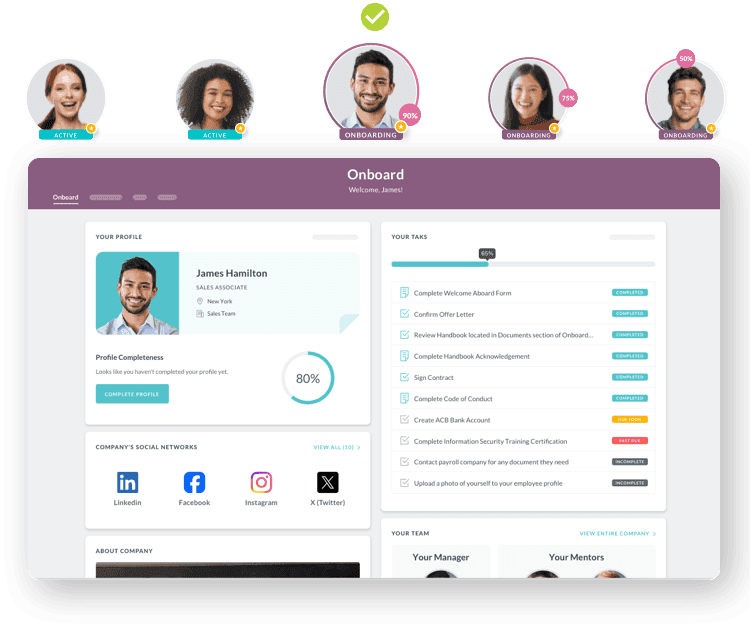
Within HR Cloud's Onboard and People HRIS products, HR admins can configure document request tasks tied to specific certification types, assign them to individual workers, and set the destination folder and file-naming convention so a card uploaded by one worker is never confused with a similarly named document from another. Bulk onboarding extends this to a group of new hires at once, which is the documented path for handling a crew or project roster rather than a separate crew-level object. Reminders are set on that task's due date: an admin sets the certification's expiration date as the task's due date, then adds one or more Upcoming Alerts, each specifying a number of days before that date, so a certification can carry alerts at 90, 60, and 30 days out from the same underlying deadline. Overdue Alerts continue firing on a repeating daily, weekly, or monthly schedule once the deadline passes, until the renewed document is uploaded and the task is marked complete, at which point a task completion notification fires automatically to whoever is configured to receive it. Chained task logic can enforce sequence where it matters, for example requiring a supervisor sign-off only after the underlying document has actually been uploaded. That controls the workflow step, not the content of the document itself: a required upload confirms that something was submitted and reviewed by a supervisor, not that the document was independently verified as authentic or still current, so the sign-off step is a control point, not a guarantee. For firms running Maya, HR Cloud's SMS-first onboarding agent, document collection and reminder prompts can reach a new hire as a text message rather than an email during onboarding, which matters directly for crews who do not carry a company laptop or check a corporate inbox during a shift.
Centralized records across job sites
HR Cloud's People HRIS keeps every employee's documents, certification uploads included, in one profile with version tracking and a full audit trail. Role-based, granular access controls let a manager see certification status for their own team without exposing sensitive records they have no reason to see, while HR and safety leadership retain a company-wide view. Because HR Cloud's onboarding workflows are explicitly built for construction, alongside healthcare, manufacturing, and field services, certification and credential collection happens on the worker's own phone before their first day on a new site, not after they have already arrived at the gate without the paperwork a superintendent needs to see.
Two other documented parts of the platform matter specifically for construction workforces. Bulk onboarding lets HR initiate the full onboarding and certification-collection workflow for a group of new hires at once, which matters when a project mobilizes twenty or thirty new field workers in the same week rather than hiring one person at a time. HR Cloud also has a documented Procore integration: for general contractors already running subcontractor and vendor rosters through Procore, it syncs a specific set of fields, name, email, job title, vendor and location details, and active status, from Procore into HR Cloud. That covers the identity and roster side of the problem; it does not sync certification documents themselves, and whether a subcontractor's workers then flow into the same certification-tracking workflow as direct employees, or require a separate setup, is a question worth confirming directly rather than assuming. And because HR Cloud is built as an onboarding and employee-experience layer that sits on top of a company's existing payroll system, rather than replacing it, a construction firm already running ADP, UKG, Paylocity, or another payroll provider can add certification tracking without re-platforming payroll to get it. HR Cloud is an ADP Platinum Marketplace Partner, and ADP Marketplace customers of any size get a flat $500 implementation fee.
HR Cloud already works with construction and utility employers, including Osmose Utilities Services and Comfort Systems USA Southwest, both listed as construction case studies on HR Cloud's own customer page, on the onboarding and HRIS workflows this certification-tracking approach builds on.
“The flexibility of the HR Cloud system is invaluable in ensuring compliance. It helped us stay a step ahead of changing document collection requirements.”

— Jesse Rose, Provider recruitment, onboarding, and compliance manager

Common Mistakes in Construction Certification Tracking
Even firms that have already moved past spreadsheets tend to repeat a small, predictable set of mistakes.
Relying on subcontractors to self-report
Subcontractor crews are frequently assumed to be managing their own certification compliance, and general contractors often accept a subcontractor's word for it rather than independently verifying documentation. That assumption holds right up until an owner, insurer, or auditor asks the GC to produce proof directly, and the GC discovers it never actually held the records, the subcontractor did. Requesting that documentation for the first time under audit pressure, after work has already started, is a materially worse position than collecting it as a condition of onboarding the subcontractor's crew in the first place.
No pre-project compliance check
Certification tracking that only runs on a recurring calendar basis, rather than being specifically checked before a crew mobilizes to a new project, misses a predictable category of gap: certifications that are current today but will expire partway through the upcoming assignment. A pre-mobilization check catches that gap on paper, before the crew ever leaves for the site, instead of mid-project when it surfaces as a work stoppage.
What Does Better Certification Tracking Actually Deliver?
Reduced insurance risk and project delays
The direct payoff of automated certification tracking is fewer of the scenarios described above actually happening: fewer workers pulled from a site over an expired card, fewer scrambles to locate a trainer on short notice, and fewer moments where a request for documentation catches the HR team without an answer. That last scenario is becoming more common, not less, as prequalification platforms push certification verification earlier into the bidding process rather than leaving it until a question forces the issue. A firm that can produce current, timestamped certification records on request moves through prequalification and audit cycles faster than one that has to reconstruct the picture from a spreadsheet under time pressure. Centralized, automated tracking does not remove the underlying compliance burden that construction firms carry, states, equipment manufacturers, and trade boards will keep setting their own renewal and retraining rules regardless of what software a company runs, but it moves the company from discovering a gap after it has already caused a problem to catching it weeks ahead, when the fix is a scheduled renewal rather than an emergency.
Every time a worker gets pulled off a task because a certification lapsed unnoticed, someone else has to cover, a schedule slips, or a project sits idle waiting on a replacement. That kind of disruption is exactly the sort of avoidable friction that erodes morale on a crew and can contribute to a worker leaving over something that was entirely preventable. Construction's total-separations rate ran at 3.9% in January 2026 on a seasonally adjusted basis, per BLS JOLTS data, one of the higher rates across major industries and shaped heavily by seasonal hiring swings; losing a certified crane operator or a licensed tradesperson to a compliance gap, rather than to the ordinary churn of the labor market, is an avoidable way to add to that number.
Conclusion
Certification tracking in construction is not a compliance afterthought. It is a direct line to whether workers remain qualified for the specific tasks they're assigned, under whatever regulatory, contractual, and project requirements apply, and whether a project stays on schedule as a result. Manual tracking fails for structural reasons that do not improve with better spreadsheet formatting: too many workers, too many certification types, and too many expiration dates that never share a calendar. Automated alerts tied to individual worker records, rolled up to project and crew visibility, close that gap without adding headcount to chase it manually. When evaluating options, the question worth asking is whether certification tracking software connects to onboarding, employee records, and payroll, or whether it sits apart as a separate purchase, a separate login, and a separate export to reconcile against the rest of the HR stack. That connection is usually the difference between construction workforce management software, or project-based HR software, that gets adopted and one that quietly goes unused after the demo. HR Cloud handles certification and credential tracking as part of the same onboarding and HRIS workflows construction firms already use to manage their field crews, so certification data lives with the rest of the employee record instead of in a separate system nobody remembers to open. Whether a firm builds this process from a blank spreadsheet or migrates off one that has already failed once, the fix is the same: fewer places for the data to live, and a system that watches the calendar so nobody on the team has to.

Discover how our HR solutions streamline onboarding, boost employee engagement, and simplify HR management
Book a DemoFAQs
What certifications are legally required on most job sites?
There is no single federal list. OSHA 10 or 30-hour Outreach cards are required by law in several states, including Connecticut, New York, Massachusetts, Missouri, Rhode Island, New Hampshire, West Virginia, and Nevada, for public works projects above a state-specific dollar threshold, and most sites separately require equipment certifications like NCCCO crane credentials, state trade licenses, and employer-specified safety training such as fall protection or confined space entry, layered on top of whatever the project owner or general contractor requires by contract.
How do you track certifications for subcontracted crews?
Request certification documentation from subcontractors during onboarding rather than accepting verbal assurance, and store it in the same system used for direct employees so it appears in one compliance view. General contractors remain responsible for confirming subcontractor compliance on many projects, so verified documentation, not a subcontractor's word, is what actually protects the GC under an owner's or auditor's review.
Can certification alerts be set per project timeline?
Yes, in a properly configured system. Rather than checking only whether a certification is current today, alerts and pre-mobilization audits can be set to confirm a worker's credentials will remain valid through the expected duration of a specific project assignment, catching a mid-project expiration before the crew ever mobilizes to the site.
What happens if a worker's certification lapses mid-project?
The worker is typically no longer qualified to continue that task and may need to be pulled from the site until the certification is renewed, which can mean lost productivity, emergency training costs, or a scramble to bring in a qualified replacement. For NCCCO crane credentials specifically, there is no grace period once the five-year certification expires.
About the author

Keep Reading


Like What You Hear?
We’d love to chat with you more about how HR Cloud® can support your business’s HR needs.
Book Your Free Demo