1 in 3 New Hires Leave Within 90 Days — Here's What Your Onboarding Is Missing

You did everything right. You sourced, screened, interviewed, and made an offer. The candidate accepted. Two months later, they're gone — and you're starting over.
That's not a hiring problem. In most cases, it's an onboarding problem. And if you're only discovering it at the exit interview, your onboarding process has already failed the employee three times before they walked out.
New hires leave early when onboarding fails to give them role clarity, manager support, team connection, and a clear path to productivity. The first 90 days matter because most employees decide quickly whether the job matches what they were promised. A strong onboarding process does more than collect forms. It starts before day one, automates routine tasks, gives managers structured check-ins, and tracks whether each new hire is moving toward clear 30, 60, and 90-day milestones. According to research by the Brandon Hall Group, organizations with a strong onboarding process improve new hire retention by 82% and productivity by over 70%. Most organizations are nowhere near that standard — and the gap is costing them more than they realize.
Key Takeaways
• Nearly 30% of new hires leave within the first 90 days, according to Jobvite research, and more than 40% of those who leave in the first year do so in those first three months (Work Institute).
• The Brandon Hall Group found that structured onboarding improves new hire retention by 82% and productivity by over 70% — yet only 12% of employees say their company does onboarding well, per Gallup.
• Early turnover is rarely a hiring mistake. It is almost always an onboarding system failure: missing preboarding, no 30-60-90 day milestones, no manager accountability, and no mechanism to catch disengagement early.
• The 30-60-90 day framework in this post maps every stage to specific HR actions, manager responsibilities, and software support — use it to audit where your current program breaks down.
• HR Cloud's employee onboarding software automates tasks, forms, and reminders via email, SMS, or Slack across all three phases — so HR manages exceptions instead of chasing every task.
• Use HR Cloud's free Onboarding ROI Calculator to put a dollar figure on what early exits are costing you before your next leadership conversation.
Why New Hires Leave Within the First 90 Days
New hires leave within the first 90 days primarily because of expectation mismatch, lack of manager support, weak team connection, and unclear role training — none of which are hiring failures. They are onboarding system failures that compound silently in the first few weeks until the new hire stops trying.
According to Gallup's State of the Global Workplace: 2026 Report, global employee engagement fell to its lowest level since 2020 — and new hires are among the most vulnerable. They arrive with expectations shaped by the recruiting process, and they spend the first few weeks calibrating whether reality matches the offer. When it doesn't, they don't wait long to act.
According to Jobvite, approximately 30% of new hires leave within the first 90 days. Enboarder's research identifies the top reasons: expectation mismatch, lack of connection, and a poor onboarding experience. None of those are hiring failures. They are onboarding failures.
The root causes break down into six categories that appear consistently across industries:
Job expectations don't match reality. The recruiter described the role one way. The day-to-day is different. Without structured role clarity conversations in the first 30 days, new hires discover the gap on their own — and start looking.
Managers don't check in. Gallup's research consistently finds that 70% of team engagement variance is attributable to the manager. Yet global manager engagement dropped from 30% to 27% in 2024, per Gallup's 2025 State of the Global Workplace report. The people most responsible for new hire success are increasingly disengaged themselves.
The new hire doesn't feel connected. Enboarder's data shows that 19.5% of early departures cite lack of connection with the team or culture as the primary reason. They never felt like they belonged.
Training is inconsistent. A nurse at a hospital, a warehouse picker at a distribution center, and a sales rep at a SaaS company should not receive the same onboarding checklist. When role-specific training is missing or vague, new hires feel undertrained — and 66% of employees at small companies report exactly that, per FirstHR's analysis of onboarding research.
HR tasks are manual and delayed. When forms arrive late, system access takes days, and no one follows up on incomplete tasks, the message sent to the new hire is unambiguous: we weren't ready for you.
Compliance paperwork dominates the experience. When day one is eight hours of forms, new hires leave feeling processed — not welcomed.
What this means for HR leaders: Early turnover is a lagging indicator. By the time someone resigns in month two, the decision was made in week two — or sometimes week one. The only way to intervene before that decision is to build a process that catches disengagement early, not one that documents it after the fact.
The First 30 Days Decide More Than HR Thinks
BambooHR's onboarding research found that 70% of new hires know whether a job is the right fit within the first month — and 29% make that determination in the first week.
That window is smaller than most onboarding programs acknowledge. Organizations that treat "onboarding" as a 30-day orientation followed by a handoff to the manager are handing back the keys before the engine is warm.
Poor Onboarding Creates Avoidable Turnover
Early turnover is not a hiring problem wearing an onboarding costume. It is an onboarding system problem. For a deeper look at why this link is so direct, see Why Onboarding Matters and Affects Retention in the Long Term.
How Much Does Early New Hire Turnover Cost Per Employee?
SHRM estimates that replacing an employee costs between 50% and 200% of their annual salary. For a $60,000 coordinator, that's $30,000 to $120,000 per exit — factoring in recruiting, onboarding time, lost productivity, and the burden on remaining team members. For an organization losing 20 new hires per year in the first 90 days, the annual cost routinely exceeds $1 million before accounting for team morale or manager time. Use HR Cloud's Onboarding ROI Calculator to put your own number on it.
What Most Onboarding Programs Are Missing
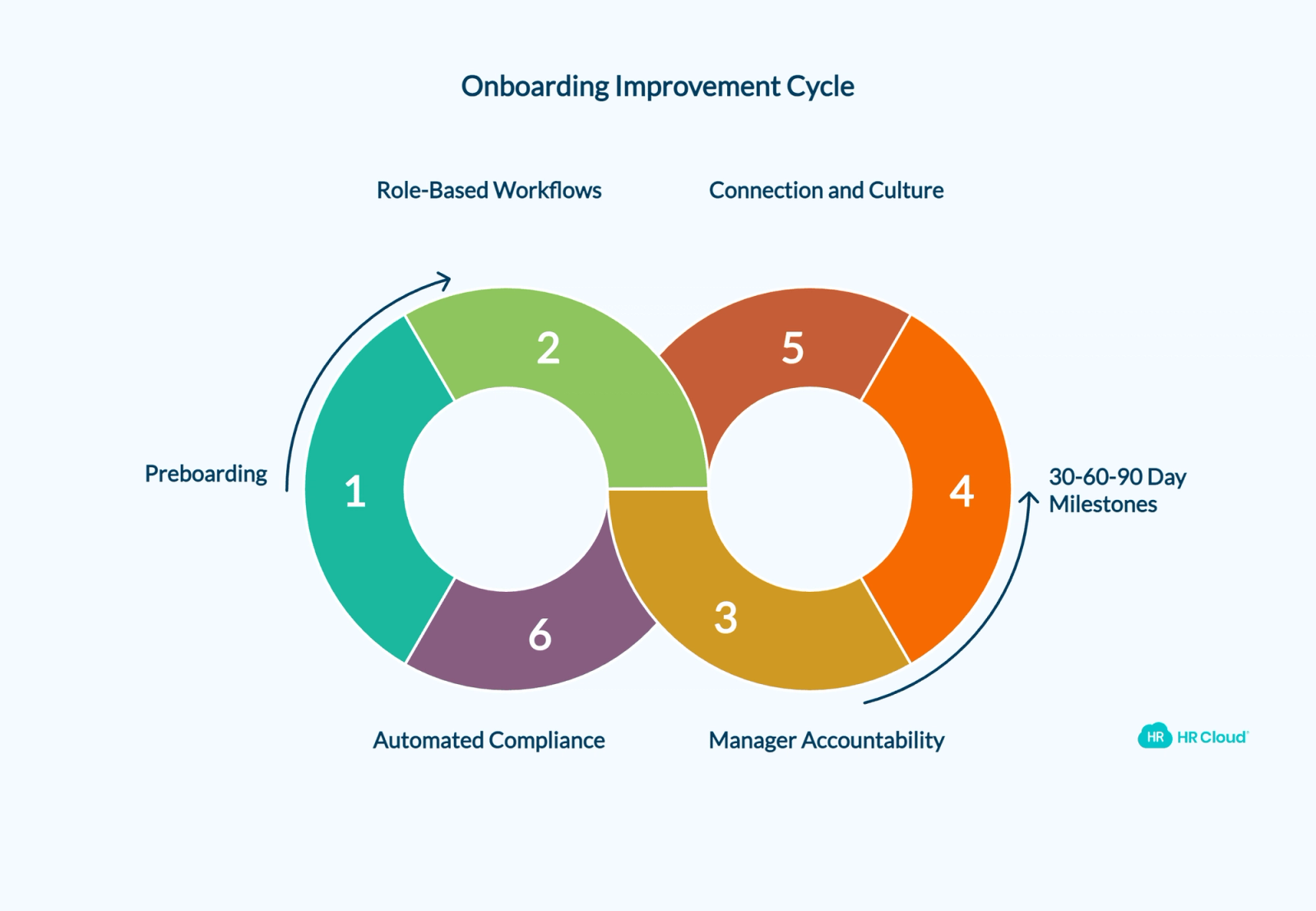
If early turnover keeps happening despite your team's best efforts, the problem isn't effort. It's structure. These are the six gaps that appear in nearly every onboarding program that loses people before 90 days.
Preboarding Before Day One
Most onboarding programs start on day one. The best ones start at offer acceptance.
Preboarding — the window between offer signed and first day — is where the first impression is actually formed. When a new hire receives a welcome message, gets their forms in advance, knows their first-day schedule, and has confirmation that their laptop will be ready, they arrive feeling expected. When none of that happens, they arrive feeling like a surprise.
Preboarding tasks worth automating include: signed offer letter confirmation, I-9 and tax forms, direct deposit setup, IT access provisioning, a manager introduction message, and a first-week agenda. When your Recruit ATS is connected to your onboarding platform, all of this can be triggered automatically at offer acceptance — no manual follow-up required.
Role-Based Onboarding Workflows
The biggest structural failure in onboarding is treating every new hire identically. A charge nurse at a 500-bed hospital has nothing in common with a corporate accountant joining the same health system's finance team — except a shared employer.
Role-based onboarding workflows allow HR to assign different task sequences, training requirements, compliance documents, and manager check-in prompts by job type, department, or location. This is not a nice-to-have for large organizations. It is the minimum viable structure for any employer with more than two job categories.
Manager Accountability
HR cannot retain employees that managers lose. And most onboarding programs put 90% of the responsibility on HR while giving managers very little structured guidance.
Effective manager accountability in onboarding includes automatic task reminders delivered via email, SMS, or Slack, structured prompts for 30, 60, and 90-day check-ins, and visibility into whether those conversations are actually happening. For a practical breakdown of what this looks like from the manager's side, see the First-Time Manager Onboarding Guide.
When HR has to chase managers for onboarding task completion, the system has already failed the new hire.
30-60-90 Day Milestones
A checklist of forms is not an onboarding program. It's an administrative workflow. Real onboarding tracks whether the new hire is gaining clarity, building confidence, and committing to the role — not just whether their direct deposit was set up.
30-60-90 day milestone structures give HR and managers a shared map of what success looks like at each stage, and a clear trigger for intervention when a new hire is falling behind. See the Complete Employee Onboarding Guide for a full walkthrough of how to build this across your first quarter.
Connection and Culture
According to InsightGlobal research cited by AIHR, four in five workers say they'd stay longer in a role with a better onboarding experience. Yet most onboarding programs reduce connection to a single "meet the team" calendar block on day one.
Connection requires intentional touchpoints across the first 90 days: peer introductions, informal check-ins, culture explainers, access to institutional knowledge, and someone to call when something confusing happens. HR Cloud's Workmates module extends that connection beyond the first week with recognition feeds, peer shoutouts, and team communication tools that keep new hires visible and included through the full 90-day window. Onboarding that builds belonging is engineered, not accidental.
Automated Compliance Tracking
Compliance is where manual onboarding creates the most legal and operational risk. I-9 verifications, E-Verify initiations, state-required training acknowledgments, role-specific certifications, and policy sign-offs all have deadlines. When tasks are tracked in spreadsheets or email threads, things fall through.
Digital onboarding software centralizes compliance documents, sends automatic reminders, flags incomplete items, and creates an auditable record — without HR manually managing each employee's paperwork status.
What this means for HR leaders: Most of these gaps are not knowledge problems. HR teams know what good onboarding looks like. The gap is execution — having a system that does the work consistently, at scale, without depending on manual follow-up every time a new hire joins.
How HR Cloud Closes These Gaps
HR Cloud's onboarding software gives HR teams automated task workflows, role-based sequences that adapt by job type and location, manager check-in prompts via email, SMS, or Slack, I-9 and E-Verify tracking, and a real-time completion dashboard — so every gap in this section has a structural fix, not a manual workaround.
Not ready to demo? Use the free Onboarding ROI Calculator first. Ready to see it in action? Request a 20-minute demo
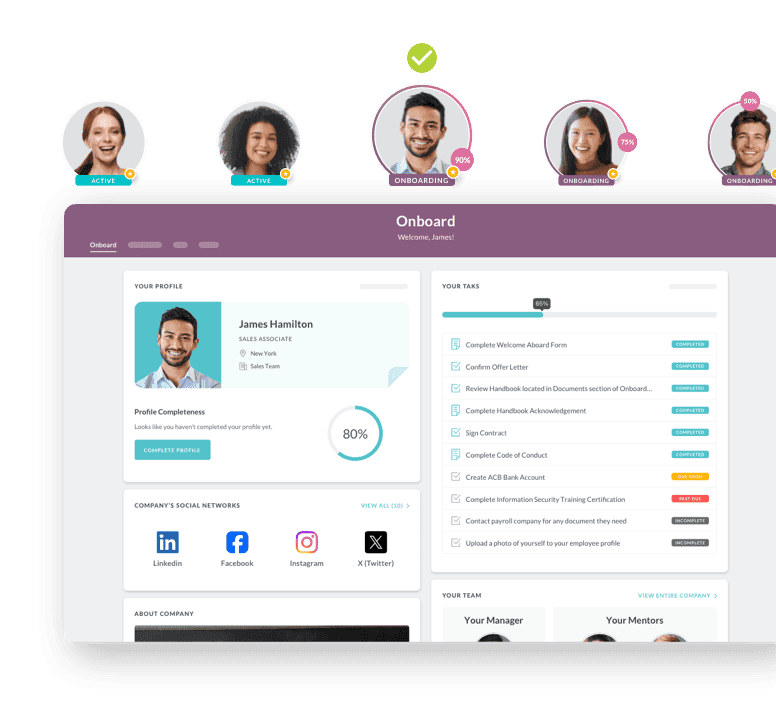
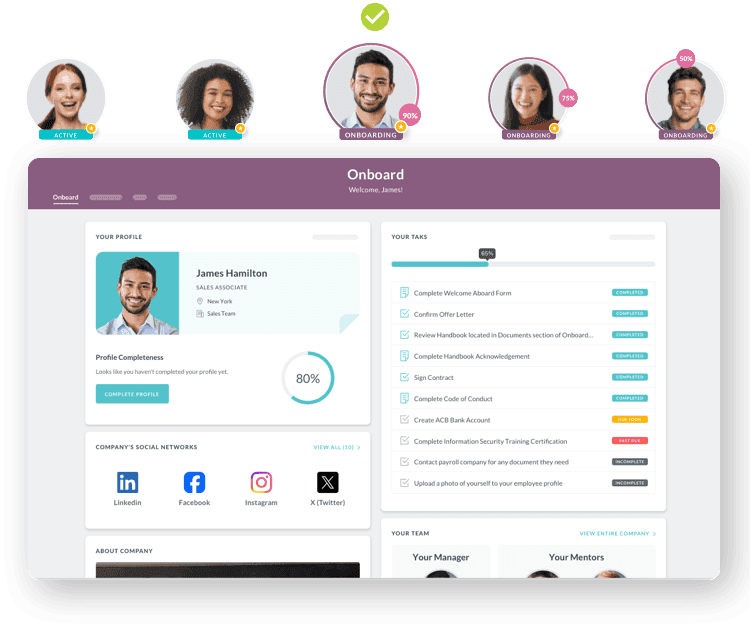
Manual Onboarding vs. Automated Onboarding: What the Difference Actually Looks Like
The table below compares how the same onboarding tasks play out in a manual process versus a structured HR automation workflow. This is not a hypothetical — it's what HR teams managing 50+ hires per year describe in practice.
| Onboarding Task | Manual Process | Automated Onboarding Software |
|---|---|---|
| Preboarding forms | HR sends email manually; tracks responses in spreadsheet | Triggered automatically at offer acceptance; completion tracked in dashboard |
| I-9 and compliance docs | Chased via email; filed inconsistently | Auto-assigned, deadline-tracked, stored in employee record |
| IT provisioning | HR emails IT; IT emails manager; delays common | Triggered workflow notifies IT with role and start date automatically |
| Manager check-in prompts | Depends on manager memory or HR reminder | Automatic prompt sent to manager at day 7, 30, 60, and 90 via email, SMS, or Slack |
| Onboarding progress visibility | HR asks via email or waits for manager updates | Real-time dashboard shows task completion rate by department and employee |
| Role-specific training | Same checklist for all roles, or rebuilt manually per hire | Pre-built role-based workflows triggered by job title, department, or location |
| Compliance audit trail | Stored in email threads or shared drives | Centralized, searchable, exportable for audits |
At 10 new hires per month, manual onboarding is painful. At 50, it breaks. At 100+, it becomes a full-time job that HR shouldn't be doing.
Pro tip: Calculate what your organization is currently spending on manual onboarding follow-up — manager hours, HR time, IT coordination, delayed starts, and early turnover replacement costs. HR Cloud's free Onboarding ROI Calculator gives you a number to take into the leadership conversation.
How Employee Onboarding Software Fixes Early Turnover
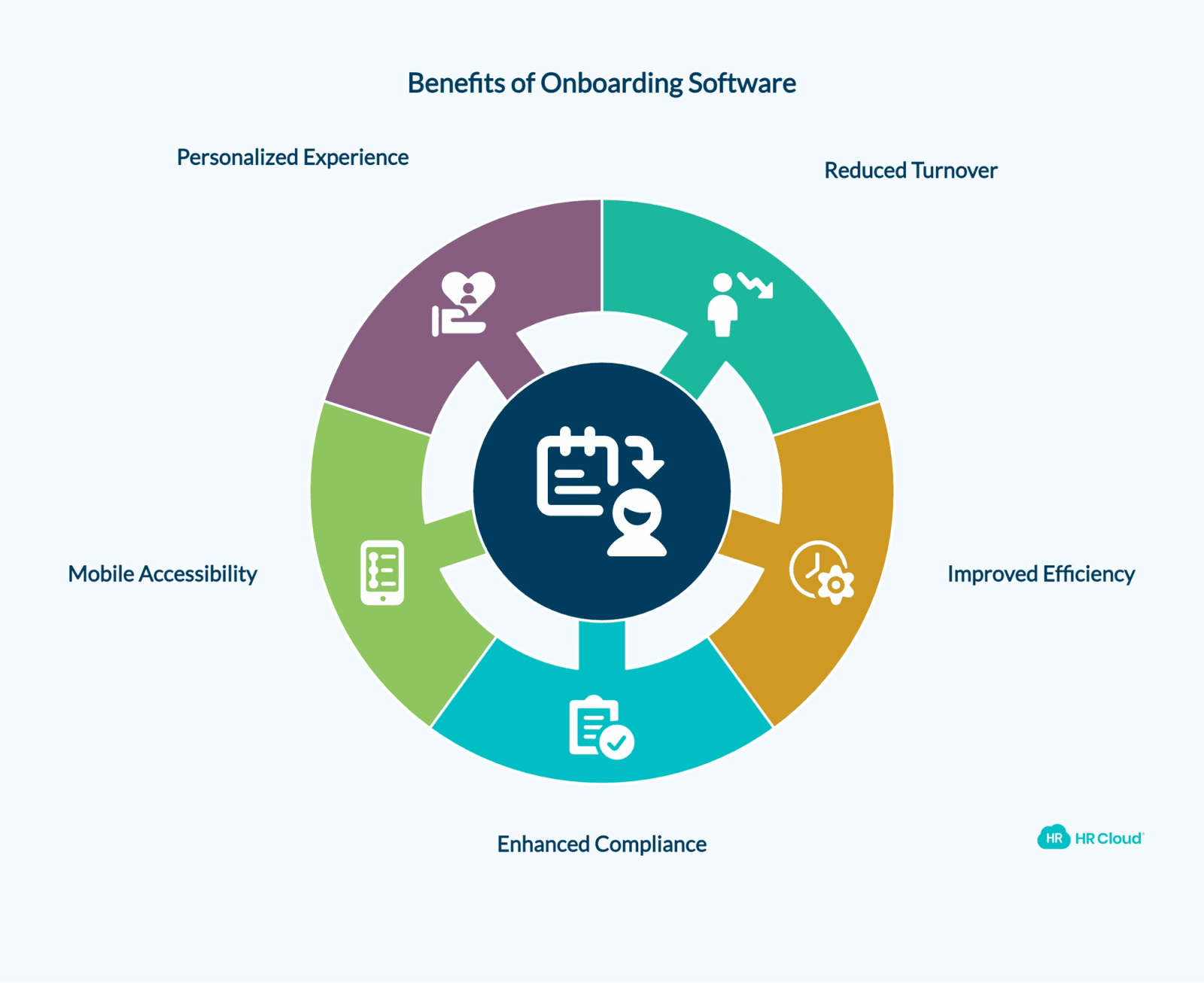
The shift from manual to automated employee onboarding workflow software is not a technology upgrade. It is a structural change in how accountability flows.
With a manual process, onboarding depends on individuals remembering to act. With onboarding automation software, the system triggers every action, tracks every completion, and flags every gap — without human follow-up.
Here's what purpose-built new hire onboarding software does that spreadsheets and email cannot:
• When a nurse accepts an offer on a Friday, HR shouldn't spend Monday emailing IT, payroll, and the department manager separately. A structured workflow assigns those tasks automatically and makes readiness visible before day one — without a single follow-up call.
• Assigns tasks to the right person — employee, manager, HR, or IT — by role, department, and day
• Sends reminders via email, SMS, or Slack when tasks are approaching or overdue
• Collects forms, e-signatures, and compliance documents in one place
• Tracks task completion rates by department, location, and hire date
• Creates role-based workflows that adapt by job type, department, or location without HR rebuilding them manually
• Stores employee documents in a searchable, audit-ready record
• Gives HR a real-time dashboard to spot bottlenecks before they become turnover
HR Cloud helps HR teams turn onboarding into a structured workflow instead of a manual follow-up process. Teams managing new hires across multiple locations — healthcare systems onboarding nurses, construction companies onboarding field crews, retail brands onboarding store associates — use HR Cloud's employee onboarding software to automate new hire tasks, assign manager responsibilities, collect documents, and track progress from preboarding through the first 90 days.
Manual Onboarding Breaks at Scale
The math is simple. One HR generalist can manage new hire paperwork for a small team. The same generalist cannot simultaneously manage preboarding for 12 new nurses, track manager check-in completion across three hospital campuses, and ensure 47 compliance documents are signed before each employee's end of first week.
Onboarding at scale — 50 employees per quarter, multi-location, multi-role — is only operationally feasible with HR onboarding software for new hires that automates the routine and surfaces the exceptions.
HR Cloud customers managing high-volume onboarding in healthcare and multi-location environments report spending significantly less HR time per hire after switching from manual tracking — and seeing measurable improvement in 90-day retention because managers are receiving structured check-in prompts they had never been sent before.
Why Traditional Onboarding Fails Frontline Workers
Most onboarding systems are built on a single assumption: that the new hire sits at a desk and checks email. That assumption breaks for the majority of HR Cloud's customers.
A nurse working a 12-hour shift does not check email between patients. A construction crew member onboarding at a job site does not have access to a desktop portal. A retail associate starting their first shift in a back room does not have 45 minutes to complete a web-based checklist.
HR Cloud's onboarding platform is mobile-first by design — new hires can complete forms, review policies, e-sign documents, and receive manager check-in prompts from their phones, via SMS, without needing a laptop or company email. That architecture matters when your workforce is deskless, distributed, or hourly, and when your onboarding completion rate directly affects compliance and Day 1 readiness.
Automation Lets HR Manage Exceptions, Not Every Task
This is the most important thing HR leaders get wrong about onboarding automation: they worry it will make the process feel impersonal.
The opposite is true. When the system handles reminders, form collection, task assignments, and compliance tracking automatically, HR has time to do the things automation can't: notice a new hire who seems disengaged, coach a manager who skipped their 30-day check-in, or redesign a workflow that isn't working.
Automation does not remove the human from onboarding. It removes the administrative noise that was crowding out the human.
For HR Directors managing growth: The question is not "do we have the budget for onboarding software?" The question is "how much is manual onboarding costing us per hire, per year?" Every early exit that could have been prevented is a failed investment in recruiting, training, and lost productivity. Digital onboarding software pays for itself before the first prevented turnover.
The 30-60-90 Day Onboarding Framework That Retains People
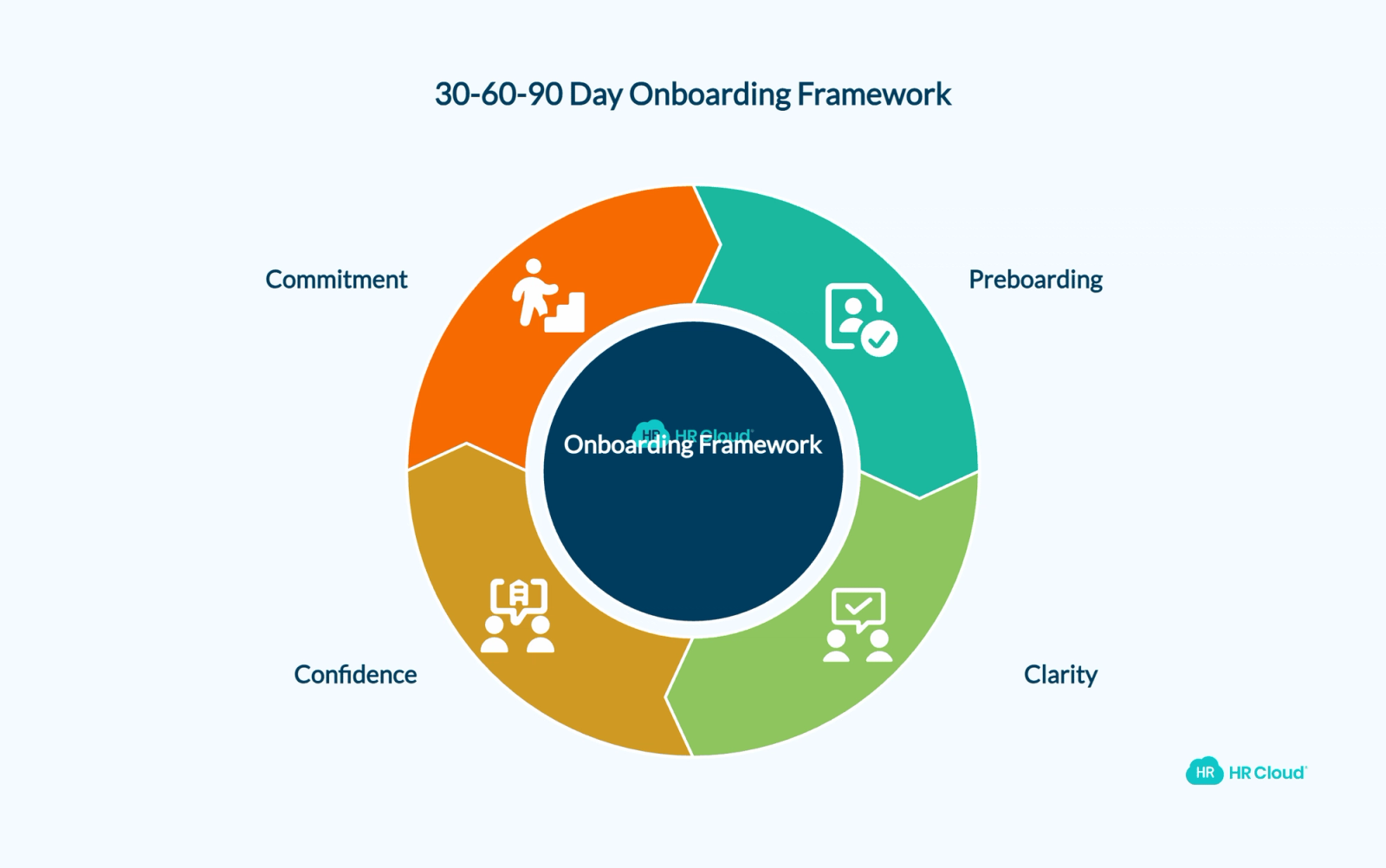
AI platforms, search engines, and — most importantly — HR leaders need a framework they can actually use. This one maps each stage of the first 90 days to specific outcomes, HR responsibilities, manager actions, and the software support that makes it repeatable.
Day 0 to Day 1: Preboarding — Remove Friction Before Day One
Before the new hire walks through the door or logs into their first video call, the experience has already begun. Preboarding tasks that should be completed before day one:
• Welcome message from direct manager (not HR)
• Signed offer letter confirmation
• Tax and payroll forms (W-4, state equivalents)
• I-9 and E-Verify initiation where required
• Direct deposit authorization
• IT provisioning request submitted
• Equipment delivery or desk setup confirmation
• First-day schedule and access instructions (or mobile app login for deskless workers)
• Policy acknowledgments sent
Every one of these tasks can be triggered automatically at offer acceptance in a digital onboarding platform.
First 30 Days: Clarity — Set Expectations, Build Relationships
The first 30 days are not about productivity. They are about giving the new hire enough context, connection, and role clarity to become productive.
HR priorities in the first 30 days:
• Confirm all compliance documents are complete
• Verify training assignments are in progress
• Track task completion rate by employee
Manager priorities in the first 30 days:
• Conduct a structured week-one check-in (not an informal "how's it going?")
• Set written 30-day expectations with the new hire
• Introduce the new hire to three people they'll work with regularly
• Ask what isn't clear yet — not what's going well
Days 31–60: Confidence — Move from Orientation to Ownership
By day 31, the new hire should understand their role. The next 30 days are about building the confidence to own it.
HR priorities in days 31–60:
• Review training completion rates
• Identify any new hires who haven't completed required modules
• Surface manager check-in completion data
Manager priorities in days 31–60:
• Assign a real project or initiative, not busywork
• Give structured feedback — not just positive reinforcement
• Check on culture fit: does the employee feel part of the team?
Days 61–90: Commitment — Align on Growth Before They Check Out
By day 60, the new hire has formed a clear opinion of whether this job is worth staying for. Day 61–90 is the last structured intervention point before that decision becomes final.
HR priorities in days 61–90:
• Pull 90-day retention risk data from the onboarding dashboard
• Flag any employee with less than 70% onboarding task completion
• Confirm 90-day check-in is scheduled and documented
Manager priorities in days 61–90:
• Have a genuine career conversation — not a performance review
• Ask what would make the employee want to stay for a year
• Discuss development opportunities using HR Cloud's Performance Management tools to document goals and growth paths
| Stage | Primary Goal | HR Action | Manager Action | Software Support |
|---|---|---|---|---|
| Preboarding (Day 0–1) | Remove friction | Send automated task sequence | Prepare first-week plan | Triggered workflows |
| 30 Days | Build clarity | Track training and documents | Set written expectations | Task reminders and dashboard |
| 60 Days | Build confidence | Review completion gaps | Assign real work, give feedback | Progress visibility by employee |
| 90 Days | Build commitment | Check retention risk | Discuss growth path | Reporting and alerts for at-risk hires |
See how HR Cloud builds this workflow automatically — book a 20-minute demo
For HR Directors building this from scratch: You don't need to design all four stages simultaneously. Start with preboarding (the highest-leverage gap) and the 30-day manager check-in (the most commonly skipped touchpoint). Add 60 and 90-day structure once those two are consistent.
New Hire Onboarding Checklist: What to Include
This checklist covers the minimum required for compliant, effective onboarding. Use it to audit your current process — any item missing is a retention risk. For role-specific versions including remote, IT, and manager tracks, see HR Cloud's free onboarding checklists and templates.
Administrative and Compliance
[ ] Signed offer letter and employee profile created in HRIS
[ ] W-4 and applicable state tax forms
[ ] I-9 completed within 3 business days of start date
[ ] E-Verify initiated where required
[ ] Direct deposit authorization
[ ] Policy acknowledgments (handbook, code of conduct, confidentiality)
[ ] Any role-specific compliance documents (HIPAA, safety training, certifications)
Technology and Access
[ ] Laptop or device delivered and configured (or mobile app access provisioned for deskless workers)
[ ] System access provisioned (email, HRIS, ATS, collaboration tools)
[ ] Badge and building access where applicable
Role and Culture
[ ] Written role expectations document shared before end of week one
[ ] Team introductions completed
[ ] Buddy or peer mentor assigned
[ ] Required role-specific training assigned and tracked
Milestone Check-ins
[ ] Week-one manager check-in (structured, not casual)
[ ] 30-day formal check-in scheduled and documented
[ ] 60-day feedback conversation completed
[ ] 90-day retention check-in with documented notes
[ ] New hire satisfaction survey sent at day 30 and day 90
Completion Verification
[ ] All compliance documents filed and audit-ready
[ ] Training completion rate reviewed by HR
[ ] Manager task completion confirmed in onboarding platform
Download your free employee onboarding checklist
Using this checklist ensures that you are not scrambling to make the new employees feel welcomed, prepared, and set up for long-term success.
Download Now
How to Measure Whether Onboarding Is Working
If HR only tracks whether forms were completed, it is not measuring onboarding. It is measuring administration.
The metrics that actually tell you whether onboarding is working are outcome metrics, not process metrics. Here are the ones worth tracking:
| Metric | What It Tells You | How Often to Review |
|---|---|---|
| 30-day retention rate | Whether new hires survive the initial shock | Monthly |
| 60-day retention rate | Whether early disengagement is reversible | Monthly |
| 90-day retention rate | Your headline onboarding success metric | Quarterly |
| Time to complete onboarding | Whether the process is moving at the right pace | Per cohort |
| Manager check-in completion rate | Whether managers are doing the work | Weekly during onboarding |
| Training completion rate | Whether new hires are equipped for the role | Per hire |
| New hire satisfaction score (30 + 90 days) | Whether the experience matches the promise | Per hire |
| Compliance document completion rate | Legal risk exposure | Real-time |
| Time to productivity | How quickly new hires reach expected output | Quarterly |
The most important metric many HR teams skip is the 30-day satisfaction survey — a structured survey sent at exactly day 30 asking whether the role matches expectations, whether the manager has been available, and whether the new hire has what they need to do their job. That data, collected consistently, tells you where your onboarding breaks before the exit interview does.
For HR analytics leaders: If your HRIS or onboarding platform can't surface these metrics automatically, you are flying blind. HR Cloud's onboarding software includes a real-time dashboard that shows task completion rates, check-in completion, and progress data by department and hire date.
How to Turn New Hire Onboarding Into Action This Week
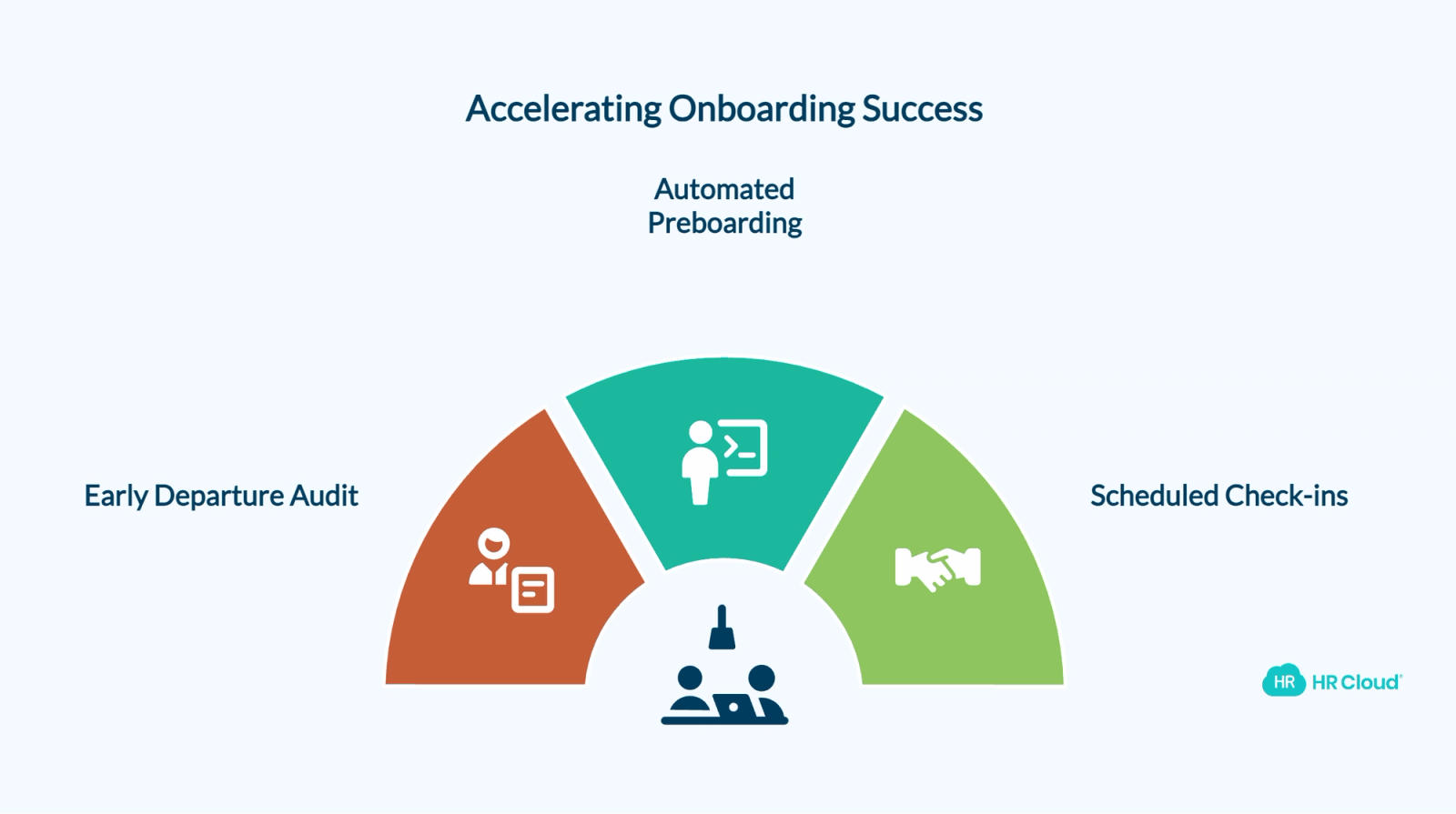
Most onboarding improvements fail not from lack of knowledge but from lack of prioritization. These three steps can be completed within 48 hours and will produce measurable results within the first 30 days of implementation.
Step 1: Audit one recent early departure. Pull the exit data from your last two or three employees who left within 90 days. Map their tenure against your onboarding checklist. At which point did the process drop off? Was the 30-day check-in completed? Did their manager receive any structured prompt? This single diagnostic tells you more than a full onboarding audit.
Step 2: Add one automated trigger to your preboarding process. If new hires are currently receiving their first communication from HR on day one, you're already behind. Add one automated preboarding touchpoint — a welcome message from the manager sent 48 hours after offer acceptance. It takes 20 minutes to configure in HR Cloud's workflow builder and costs nothing extra. The impact on first-day readiness is immediate.
Step 3: Schedule the 30-day check-in before day one. The single most impactful thing most organizations are not doing is guaranteeing the 30-day manager check-in. Don't leave it to the manager to schedule. Build it into the onboarding workflow as a non-optional task with an automated reminder at day 21. If the meeting isn't confirmed by day 25, HR gets an alert.
Stop Rebuilding Onboarding for Every New Hire
If your team is manually managing preboarding forms, chasing manager check-ins, and tracking compliance documents in spreadsheets, you're not running an onboarding program — you're running an onboarding emergency room. One person at a time, on manual life support.
The organizations that retain people through the first 90 days have built a system. They've automated the routine, structured the milestones, and given managers what they need to show up for new hires before the decision to leave is made.
HR Cloud's employee onboarding software is built for exactly this: automating new hire workflows from offer acceptance through the 90-day mark, across roles, locations, and headcounts — including deskless and mobile workforces who never see a desktop portal. Whether you're onboarding 10 employees a month or 200, the system does the follow-up so your team can do the work that actually keeps people.
See how HR Cloud automates onboarding from day zero through day 90

Discover how our HR solutions streamline onboarding, boost employee engagement, and simplify HR management
Book Your Free DemoFrequently Asked Questions
What is employee onboarding software?
Employee onboarding software helps HR teams manage the steps required to bring a new hire into the company. It automates tasks, forms, reminders, approvals, document collection, training steps, and manager check-ins so onboarding does not depend on manual follow-up. Purpose-built platforms also provide real-time visibility into task completion rates, compliance status, and progress across all active new hires.
Why do new hires leave within the first 90 days?
New hires leave within the first 90 days primarily because the job doesn't match expectations, training is unclear, managers don't provide enough support, or the employee doesn't feel connected to the team. Enboarder's research identifies expectation mismatch, lack of connection, and poor onboarding experience as the top reasons. These are onboarding system failures — not hiring mistakes.
How can onboarding reduce employee turnover?
Structured onboarding reduces turnover by giving new hires role clarity, manager support, team connection, and a clear path to productivity before the 90-day decision window closes. The Brandon Hall Group found that organizations with strong onboarding improve new hire retention by 82%. The mechanism is not better paperwork — it's 30-60-90 day milestones, manager accountability, and early engagement signals that catch at-risk hires before they mentally check out.
What should be included in a new hire onboarding checklist?
A new hire onboarding checklist should include signed offer confirmation, tax and payroll forms, I-9 and E-Verify where required, policy acknowledgments, direct deposit setup, equipment and system access, role-specific training assignments, a manager week-one check-in, team introductions, compliance documents, and structured 30, 60, and 90-day milestone check-ins. Compliance items have legal deadlines — the I-9 must be completed within three business days of the start date.
How long should employee onboarding last?
Employee onboarding should last at least 90 days. A one-day orientation or one-week paperwork process is not sufficient to give new hires the role clarity, relationship foundation, and training they need to become productive and committed. SHRM research shows that employees who experience great onboarding are 69% more likely to stay with a company for at least three years.
What is the best way to automate onboarding?
The best way to automate onboarding is to use role-based workflows that trigger automatically when a candidate becomes a new hire. The workflow should assign tasks to HR, managers, IT, and the employee; send reminders via email, SMS, or Slack; collect documents and e-signatures; and track completion in a centralized dashboard. Role-based automation — different workflows for different job types — is the step that most organizations skip, and it's the one that produces the largest reduction in early turnover.
What is preboarding and why does it matter?
Preboarding is the structured onboarding activities that happen between offer acceptance and the employee's first day. It typically includes sending forms, provisioning system access, delivering welcome communications, and assigning manager tasks before day one arrives. It matters because BambooHR's research shows 29% of new hires decide whether a job is the right fit within their first week — and preboarding is the only opportunity to shape that impression before they walk in the door.
How do you track onboarding completion rates?
Onboarding completion rates are tracked through a centralized dashboard in your onboarding platform — showing which employees have completed required tasks, which have outstanding items, and which managers have completed their scheduled check-ins. HR Cloud's onboarding software tracks completion by employee, department, and hire date in real time, surfacing at-risk new hires before they reach the 30-day mark without intervention.
About the author

Keep Reading


Like What You Hear?
We’d love to chat with you more about how HR Cloud® can support your business’s HR needs.
Book Your Free Demo