
Employee Recognition: The Ultimate Guide to Getting It Right in 2026

Employee recognition isn’t just a feel-good gesture but a necessary tool for improving engagement and productivity, reducing turnover, and strengthening team culture.
In 2026, the workplace looks very different.
Teams are hybrid or remote. Managers are stretched thin. Employees can get disengaged in the blink of an eye due to multiple reasons.
And to top it, employees expect more than just a thank you as recognition in the quarterly review.
They want timely, meaningful recognition that feels genuine. They want the organization to need and value them. Irrespective of whether they’re in an office or across the country.
But here’s the problem: most recognition efforts fall short.
Primarily because they’re inconsistent, vague, or only focused on financial rewards. They don’t recognize that employees want to be treated as individuals rather than workers. Individuals with dreams, aspirations, and life challenges.
And that’s where this guide comes in.
According toresearch, only 21% of workplaces worldwide have highly integrated employee recognition programs. Is yours one of them?
Clearly not, if you are here, reading this.
Whether you’re starting fresh or updating an existing program, this guide will walk you through how to get employee recognition right. How to ensure employees don’t feel overlooked and you don’t miss an opportunity to build strong teams. You’ll learn what effective recognition looks like, how to design a system that fits your team, and what to measure along the way.
This guide will cover:
- What employee recognition really means
- Why it matters now more than ever
- The most effective types of recognition (and when to use them)
- Ready-to-use ideas, scripts, and templates
- How to build a recognition program from scratch
- How to scale recognition across remote and global teams
- What to track and how to improve over time
Let’s start by defining what employee recognition is and why it’s often misunderstood
What Is Employee Recognition?
At its core, employee recognition is about acknowledging an employee’s effort, progress, or achievement in a way that feels timely, specific and personal.
It doesn’t need to be fancy. It doesn’t always need a reward attached. But it should answer one key question:
“Does the employee feel seen and valued for what they’ve done?”
Rewards vs. Recognition
Rewards and recognition are two terms that are often used interchangeably, but they’re not the same. Recognition is tied to performance or behavior. Something that is measurable or observable. For example: “You handled that customer issue really well under pressure.”
Appreciation, on the other hand, is broader. It acknowledges a person’s attitude, presence, or impact. For example: “I’m really glad you’re on this team.”
Both recognition and rewards are important. Recognition, when done right, helps reinforce what matters most in your culture. It tells employees that your behavior and effort matters.
Formal vs Informal Recognition
There are many ways to recognize someone, but most fall into two categories:
- Formal recognition: These are structured programs with defined criteria. Think annual awards, performance bonuses, or “Employee of the Month.” These carry weight, but can feel distant or slow if used alone.
- Informal recognition: It includes everyday acknowledgments like a thank-you message, a quick shoutout in a team meeting, or a manager sending a handwritten note. These are fast, flexible, and often the most meaningful.
Recognition works best when both formal and informal forms work together. A formal program may give structure, but it’s the informal and peer-led moments that bring it to life daily.

Why Employee Recognition Is Important
Employee recognition isn’t just about making people feel good. It shapes how they show up to work and whether they stay. Because when people feel recognized, they’re more likely to stay engaged, go the extra mile, and commit to long-term goals.
And when they don’t?
The disengagement results in:
- drop in productivity
- delayed projects
- higher employee turnover
- erosion in overall team culture
- dissatisfied clients & customers
According to a Gallup Workplace survey, disengagement cost the global economy $438 billion in 2024.
Employee Recognition Builds a Healthier Workplace Culture
Consistent recognition efforts send a message that you care. It also tells employees which behaviors to repeat, what success looks like, and that their work doesn’t go unnoticed. Over time, that builds trust.
It also helps shape a stronger sense of team identity, especially in hybrid or distributed environments.
Recognition also plays a key role in inclusion. When done right, it ensures that contributions across all levels and roles are visible. Not just the loudest voices or the most measurable results.
Get started on your own employee recognition program using this Recognition Program Starter Kit.
Download Now
Why Recognition Often Falls Flat
Despite all the benefits, many recognition efforts miss the mark. Here are some of the most common reasons:
- It’s too generic. “Great job!” doesn’t land if there’s no context. You need to provide context and be more specific.
- It’s inconsistent. If recognition is tied to mood or memory of the person giving it out, some people may get left out. There has to be framework in place that is followed by everyone for recognizing others.
- It’s not timely. Praise delivered weeks after the work was done or behavior noticed, loses its impact. Provide immediate informal recognition and if it’s important, follow up with a formal one.
- It’s seen as performative. Employees know when you treat recognition as a checkbox to be ticked. Take genuine interest, show empathy, use the right means (communication channels and message) to recognize.
Getting it right means treating recognition as part of your workflow, not just a feel-good spur of the moment act.
Types of Employee Recognition (And When to Use Each)
Recognition isn’t one-size-fits-all. A public shoutout might energize one person while embarrass another. The key is knowing your people, your options, and matching them to the need of the hour.
Let’s break down the most common types of recognition and when each is most effective.
1. Verbal Recognition
It is quick, direct, and personal. It can happen in a one-on-one chat, a team huddle, or even a video call.
When to use it:
- To acknowledge effort in real time
- To reinforce specific behaviors
- To encourage someone after a tough task
Pro Tip: Keep it specific. “You handled that call with real patience and clarity” goes further than “Nice work.”
2. Written Praise
This includes emails, Slack messages, or a note in a team newsletter. It gives people something to look back on and share with others.
When to use it:
- When you want the praise to be visible to others
- When a manager or leader wants to reinforce public recognition
- As a way to encourage consistent values across teams
Pro Tip: A shoutout in the company’s #kudos channel or a weekly email from the CEO.
3. Day-to-Day Recognition
Small, frequent gestures such as a coffee gift card, a thank-you Post-it, a quick message after a meeting are much appreciated by employees. Because it tells them they are important and valued and needed on a daily basis.
When to use it:
- To build a culture of everyday acknowledgment
- When time is tight but the impact is meaningful
- To make recognition feel human and unplanned
4. Peer-to-Peer Recognition
Praise doesn’t always need to come from managers. Sometimes, it’s most powerful coming from teammates who are more aware of their effort.
When to use it:
- To promote collaboration and mutual respect
- In flat or cross-functional teams
- As part of a points or nomination system
Pro Tip: Peer recognition often highlights work that managers miss. So you should encourage regular use of peer-to-peer recognition.
5. Leader-to-Team Member Recognition
Recognition from senior leaders, whether a department head, VP, or CEO, sends a strong message: your work is important for the company.
When to use it:
- For high-impact work that ties to company goals
- To reinforce strategic priorities or values
- To motivate rising talent and show visibility from the top
Formats that work:
- A direct message from the leader
- A mention in a town hall or all-hands
- A handwritten note or video message
Pro Tip: This type of recognition boosts morale, especially when it feels earned, not formulaic. It can further drive retention and deepen loyalty.
6. Group or Team Recognition
Sometimes, success is due to the shared effort. Recognizing a team for their collective achievement reinforces collaboration.
When to use it:
- After project launches or sprint completions
- For cross-team efforts or process improvements
- When you want to build a culture of “we” not “me”
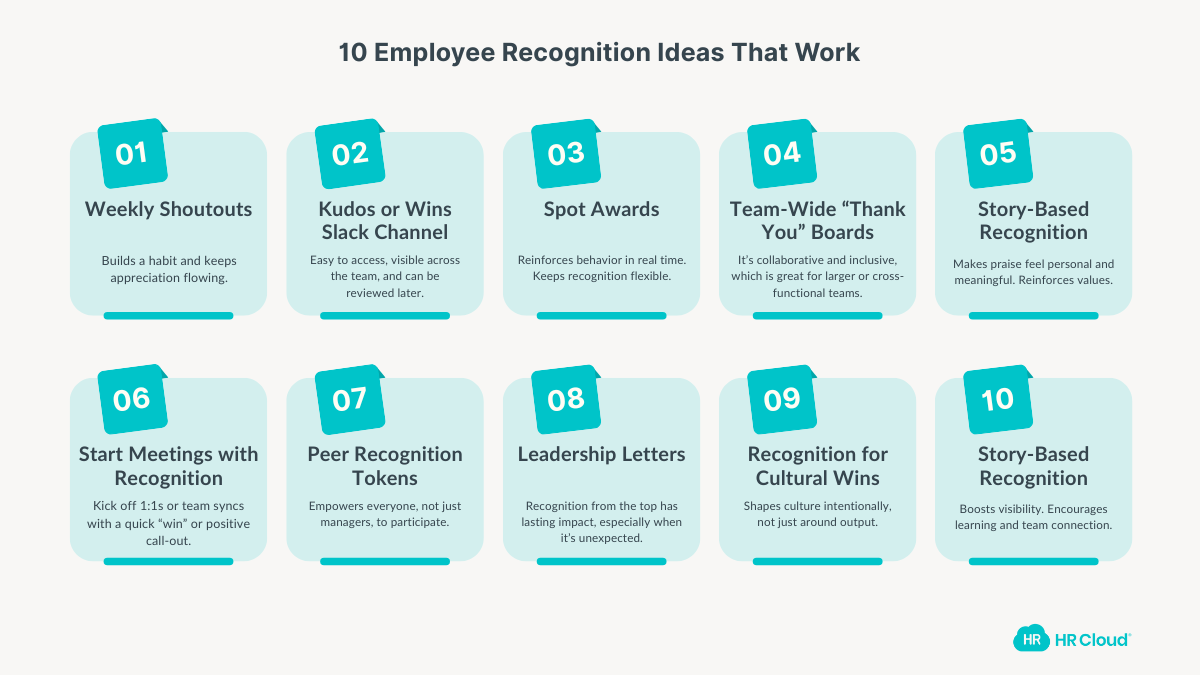
10 Employee Recognition Ideas That Work
You don’t need a big budget to make recognition meaningful. What matters most is timing, specificity, and genuine intent.
Here are proven recognition ideas you can adapt to your culture, whether your team is in-office, remote, or hybrid.
1. Weekly Shoutouts
Dedicate 5 minutes during a team meeting to quick recognitions. Encourage both managers and peers to speak up.
Why it works: Builds a habit and keeps appreciation flowing.
2. #Kudos or #Wins Slack Channel
Create a space where anyone can give a quick shoutout — peer to peer or manager to team.
Why it works: Easy to access, visible across the team, and can be reviewed later.
3. Spot Awards
Give managers a small budget to recognize exceptional effort on the spot. Think digital gift cards, lunch delivery, or small perks.
Why it works: Reinforces behavior in real time. Keeps recognition flexible.
4. Team-Wide “Thank You” Boards
Use noticeboards or tools like Workmates to create rotating appreciation walls. Fix a day, say Friday, when the weekly Thank You’s get posted.
Why it works: It’s collaborative and inclusive, which is great for larger or cross-functional teams.
5. Story-Based Recognition
When someone goes above and beyond, tell the story. What they did, how it helped, and why it mattered. Share it in a newsletter or team post.
Why it works: Makes praise feel personal and meaningful. Reinforces values.
6. Start Meetings with Recognition
Kick off 1:1s or team syncs with a quick “win” or positive call-out.
Why it works: Shifts tone, boosts morale, and makes recognition routine, not random.
7. Peer Recognition Tokens
Allow employees to send each other digital tokens, points, or badges that can be redeemed or showcased.
Why it works: Empowers everyone, not just managers, to participate.
8. Leadership Letters
Ask senior leaders to write a short, personal note to someone who made an impact that quarter.
Why it works: Recognition from the top has lasting impact, especially when it’s unexpected.
9. Recognition for Cultural Wins
Don’t just reward results. Recognize behaviors that support your values—like mentoring, inclusion, or collaboration.
Why it works: Shapes culture intentionally, not just around output.
10. Spotlight in Company Comms
Feature employees in newsletters, intranet posts, or town halls. Let them share what they worked on, what they learned, or who helped them.
Why it works: Boosts visibility. Encourages learning and team connection.
Do you want more employees recognition ideas? Read this massive list of 50 Employee Engagement Ideas.
How to Build an Effective Employee Recognition Program
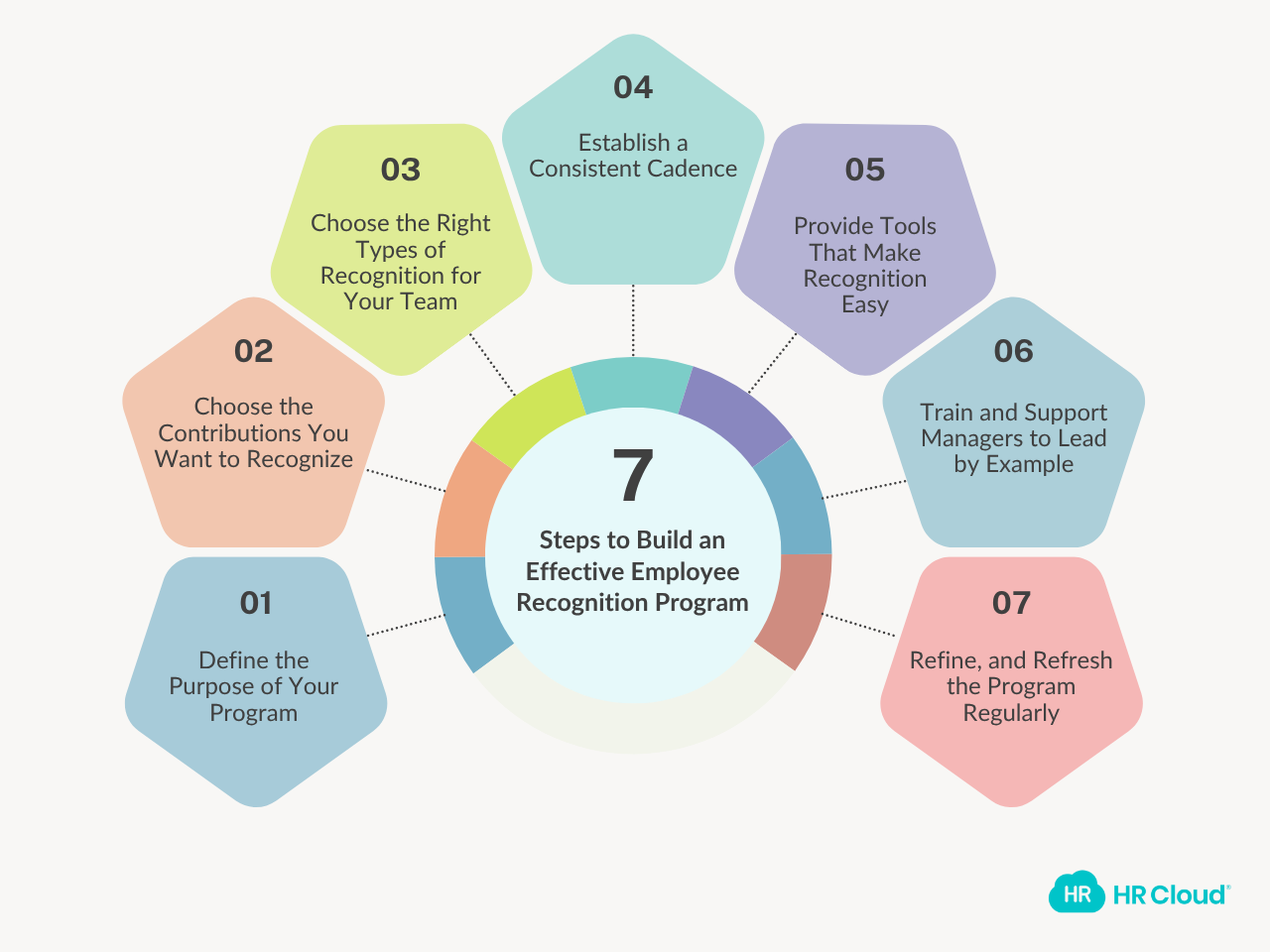
Recognition works best when you build a structured program to ensure employee appreciation is consistent, fair, and aligned with your company’s values.
Without structure, recognition often becomes reactive, uneven, or overly dependent on individual managers.
Whether you're starting from scratch or refining an informal system, the following steps will help you build a recognition program that fits today’s hybrid, fast-moving workplace.
Step 1: Define the Purpose of Your Program
Start by identifying what you want your recognition program to achieve. Is your goal to
- reduce turnover?
- boost employee morale?
- reinforce company values?
- improve cross-team collaboration?
- increase visibility for behind-the-scenes contributors?
- support DEI efforts by making recognition more inclusive?
Being specific about the purpose will help you shape every other element of the program. From who gets recognized to how you measure success.
Without a clear objective, recognition risks becoming performative or disconnected from business outcomes.
Step 2: Choose the Behaviors and Contributions You Want to Recognize
The most impactful recognition programs go beyond results. They reward behaviors that reflect your organization’s values. It can be
- collaboration
- innovation
- resilience
- empathy
- consistent effort
- learning progress
- behind the scenes contributions
By defining what “recognition-worthy” looks like in your culture, you help employees understand what’s expected and appreciated. You also make it easier for managers and peers to spot and call out the right things, which keeps the program focused and fair.
Step 3: Choose the Right Types of Recognition for Your Team
Formal awards are valuable, but they shouldn’t be the only way employees are recognized.
A well-rounded program combines formal recognition with frequent informal praise, peer-to-peer shoutouts, and acknowledgment from leaders.
For example, you might offer quarterly team awards alongside weekly shoutouts in team meetings or a Slack channel. Leader-to-team member recognition, especially from someone outside the employee’s direct reporting line, can also have a powerful impact.
The goal is to create a culture of recognition that feels natural, not forced.
Step 4: Establish a Consistent Cadence
One of the most common reasons recognition programs fail is inconsistency.
It’s important to set a regular cadence for both informal and formal recognition. For instance, informal peer recognition might happen weekly, manager-led shoutouts could be monthly. And formal awards or milestone celebrations might take place quarterly or annually.
You can also create rituals around recognition.
Like starting meetings with a “recognition round” or including a recognition section in your team newsletter. This ensures recognition becomes a part of the culture rather than a sporadic initiative.
Step 5: Provide Tools and Templates That Make Recognition Easy
Even the best intentions fall flat without the right tools.
Make it easy for employees and managers to recognize each other by providing simple templates, digital cards, suggested language, and accessible channels. For remote teams, this might include a Slack integration or a mobile-friendly recognition platform. Engagement & Communication platforms like Workmates can provide you all these rolled neatly under one umbrella.
For in-office teams, organize physical thank-you cards or whiteboards for an extra personalized touch.
Think about the communication tools your team already uses, and find ways to embed recognition into those workflows. The easier it is, the more likely people are to do it regularly.
Step 6: Train and Support Managers to Lead by Example
Managers play a key role in the success of any recognition program.
But not all managers are naturally comfortable with giving praise. Some may be unsure what to say, while others worry about appearing biased or being inconsistent. Offer training and practical examples to help them recognize in a way that feels genuine.
Support your managers with message scripts, checklists, or even regular reminders so that recognition becomes a habit, not an afterthought.
Step 7: Revisit, Refine, and Refresh the Program Regularly
Once your recognition program is up and running, it’s tempting to set it aside and assume it’s working.
But even the best programs need maintenance. Employee expectations evolve, teams grow, and company goals shift. And your recognition program needs to keep up.
Schedule regular reviews (quarterly or biannually) to evaluate what’s working and what needs adjustment.
Look at the data:
- Who is being recognized regularly?
- Are some departments participating more than others?
- Are certain roles being overlooked?
Also, collect feedback from employees. Ask:
- what forms of recognition feel meaningful
- Which initiatives feel performative or outdated.
Use this input to refine your approach, test new ideas, or sunset what no longer fits.
Getting Employee Recognition Right in 2026
Recognition programs must evolve to reflect how people work today.
In 2025, this means making your program digital-first, inclusive by design, and flexible across locations and schedules.
Start by focusing less on costly rewards and more on timely, human-centered praise. Make sure your recognition program is easy to access from any device, especially for remote and frontline employees. Use analytics to understand who is being recognized and who isn’t to spot gaps or patterns of bias.
Finally, ensure your program works across time zones, languages, and cultural norms.
A strong recognition culture doesn't just reflect where your company is today; it helps shape the workplace you want to build tomorrow.
Measuring the Impact of Recognition
Recognition programs should drive real outcomes: stronger engagement, better performance, and improved retention.
But how do you track something that can feel so personal, at times intangible, and culture-driven?This section breaks down how to measure recognition in a way that’s both practical and meaningful.
Start by Defining What Success Looks Like
Before jumping into metrics, get clear on what success means for your organization. Are you aiming to:
- Improve employee engagement scores?
- Reduce voluntary turnover?
- Increase peer-to-peer recognition activity?
- Strengthen alignment with company values?
The answers will guide what you measure and how you report progress to leadership.
Quantitative Metrics to Track
You don’t need a complex dashboard to start. These basic metrics can give you a good sense of how your program is performing:
- Recognition frequency: How often are recognitions happening? Are they regular (daily, weekly, quarterly, etc.) or sporadic?
- Participation rate: What percentage of employees are giving or receiving recognition? Are some departments or roles underrepresented?
- Manager activity: Are managers regularly recognizing their teams? Are some more active than others?
- Tool usage: If you use software (like HR Cloud’s Workmates), track how many shoutouts, badges, or rewards are being sent through the platform.
These numbers can highlight both strengths and blind spots. For instance, if only 20% of employees have received recognition in the past quarter, that’s a red flag.
Qualitative Insights to Collect
Numbers tell you how much is happening. But qualitative feedback tells you whether it’s working.
Use these approaches to gather context:
- Pulse surveys: Ask employees how recognized they feel, and how recognition could improve.
- Manager feedback: Check in with team leads about what tools or training they need.
- Focus groups: Invite employees to share stories of the best recognition they’ve received as well as the moments that were missed.
- Exit interviews: Include a question about recognition. Often, a lack of acknowledgment is a silent reason for leaving.
Track Business Outcomes Over Time
Recognition isn’t just about morale. It ties to real business metrics. Over time, compare recognition trends with:
- Engagement survey scores
- Voluntary attrition rates
- Internal promotion or mobility rates
- Customer satisfaction (if teams are client-facing)
You don’t need to prove a direct causal link. Some improvement in business metrics justifies continued investment and refinement.
What to Watch For
As you track impact, stay alert to these signals:
- Inconsistency: Some teams may have high recognition activity, while others lag behind.
- Perceived bias: Recognition feels like a popularity contest, or favors loud/high-visibility roles.
- Recognition fatigue: Employees feel overwhelmed by too much low-effort praise.
- Stale formats: Recognition rituals that once worked may need a refresh.
Metrics are a starting point. Your real goal is to create a culture where people feel seen, valued, and motivated to keep doing their best work.

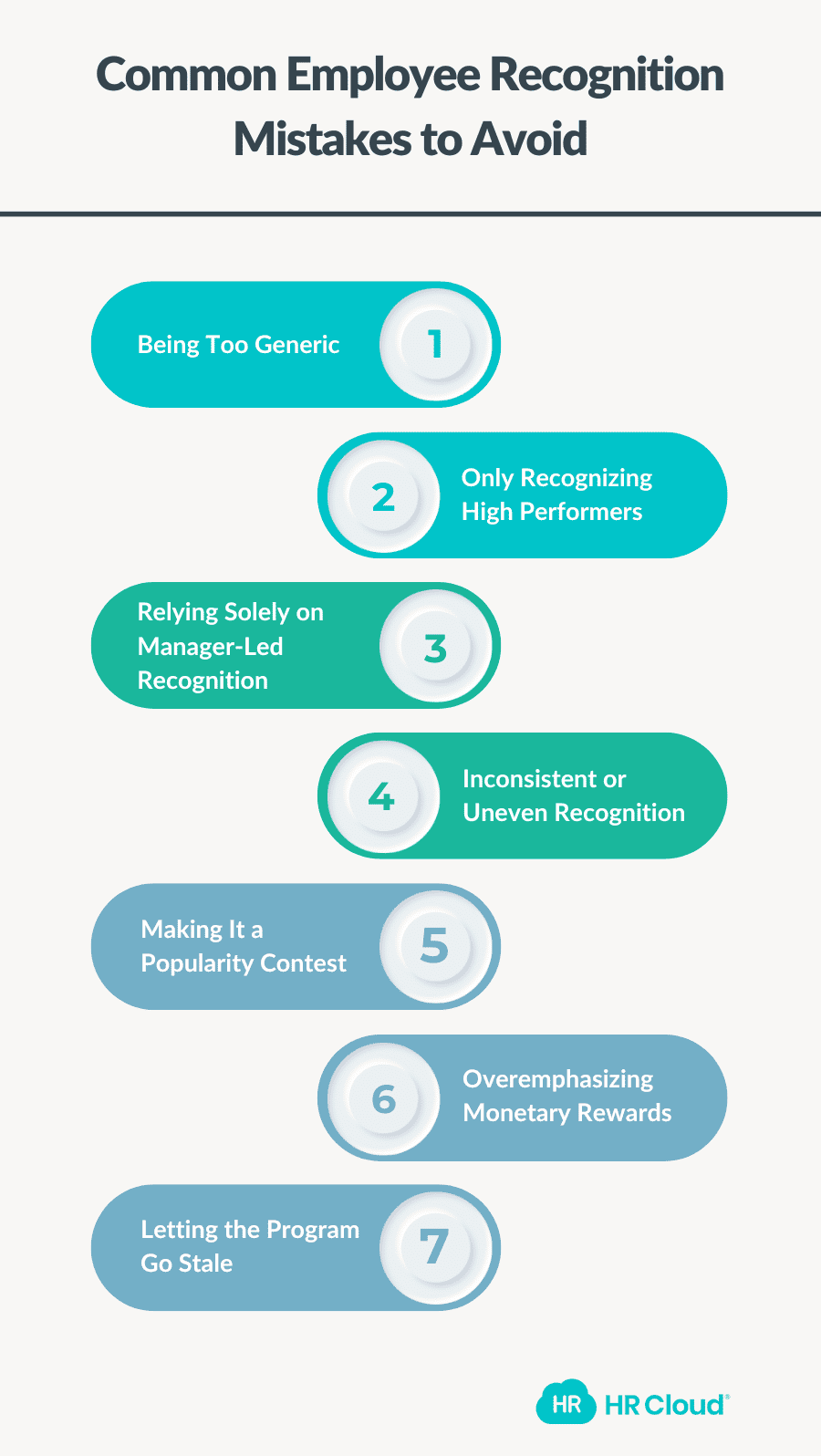
Common Employee Recognition Mistakes to Avoid
Even well-intentioned recognition can backfire if it’s inconsistent, unclear, or biased.
And when recognition feels off, it doesn’t just lose its impact. It can actually create resentment.
Here are some of the most common pitfalls companies face, and how to avoid them.
1. Being Too Generic
Saying “great job” might sound positive, but it rarely lands unless the recipient knows what they did well. Generic praise tells people they’re being acknowledged but not necessarily understood.
What to do instead: Be specific and provide context. Say what the employee did, why it mattered, and how it aligned with team goals or company values.
2. Only Recognizing High Performers
It’s easy to recognize people who exceed targets or deliver visible results. But when recognition only flows to the loudest or most measurable contributors, others feel invisible. Especially when they’re working just as hard.
What to do instead: Broaden your definition of success. Celebrate progress, effort, teamwork, and behind-the-scenes contributions. Not just headline wins.
3. Relying Solely on Manager-Led Recognition
Recognition that only comes from managers can feel hierarchical and limited. Plus, it often misses the informal wins that peers notice more easily. Everyone wants to be recognized among their peers.
What to do instead: Build in opportunities for peer-to-peer recognition. It helps uncover unseen work and creates a culture of appreciation across levels.
4. Inconsistent or Uneven Recognition
When some teams have active recognition cultures and others don’t, it sends a confusing message. Inconsistency can lead to feelings of favoritism or neglect.
What to do instead: Monitor the managers and team leads to ensure they are implementing the recognition framework. Use dashboards or reports to spot gaps.
5. Making It a Popularity Contest
When recognition is tied to public voting or visible platforms without moderation, it can skew toward outgoing personalities or social cliques.
What to do instead: Mix public and private recognition. Rotate who gets to nominate others. Offer options that work for different personalities, including introverts.
6. Overemphasizing Monetary Rewards
Bonuses and gift cards are appreciated, but they’re not enough on their own. If rewards are always financial, you risk creating transactional relationships instead of emotional connection.
What to do instead: Combine rewards with personal messages. Use storytelling and acknowledgment to make recognition feel human, not just like a prize.
7. Letting the Program Go Stale
Recognition initiatives often launch with enthusiasm and then fade into the background. When this happens, people stop participating and start seeing the program as another checkbox.
What to do instead: Refresh your program regularly. Update messaging, add new badge categories, rotate spotlight formats, or invite new employee input. Make it feel alive, not automated.
Recognition in Remote, Hybrid, and Global Teams
The shift to hybrid and remote work hasn’t just changed where we work but also how we build culture.
Casual praise that once happened in hallways or over team lunches now has to be intentional, digital, and often asynchronous. That doesn’t mean recognition is harder. It just means it needs to be designed for the way people work today.
Let’s see how.
Recognizing Remote and Hybrid Teams
When employees work from home or in split locations, you can’t rely on body language, casual chats, or spontaneous desk drop-ins to express appreciation. You need to formalize and formulize what would seem natural in an in-person setting.
Here’s how you can ensure recognition feels meaningful in a distributed workplace:
- Use digital channels with intention: Set up dedicated Slack or Teams channels (#kudos, #shoutouts) where recognition can be public and searchable.
- Make it asynchronous: Not everyone is online at the same time. Use tools that don’t require real-time participation so recognition reaches people when they log in.
- Celebrate virtually, but visibly: Use newsletters, company intranets, or video messages to highlight wins. Give employees something they can save, share, or show.
- Keep managers accountable: Train remote team leads to recognize regularly and thoughtfully. Especially for quieter contributors who may not be as visible.
Equity Tip: Watch for Employee Recognition Gap
In hybrid teams, in-office employees often get more informal recognition simply because they’re physically present. Remote employees can be unintentionally left out.
To fix that, balance public and private recognition, and review participation data to see if certain locations or roles are underrepresented.
Adapting Recognition Across Cultures
Global teams bring more than time zone differences. They bring different norms, expectations, and preferences around praise.
Here’s what to keep in mind when designing a global-ready program:
- Tone matters: In some cultures, direct public praise may feel uncomfortable. In others, it’s expected. Offer both public and private options.
- Language counts: Avoid idioms or overly casual language if your team is spread across countries. Keep recognition messages clear, warm, and inclusive.
- Local calendars: Consider local holidays or work cycles when scheduling recognition events or campaigns.
- Visual cues: Use universal symbols (e.g., badges, icons) when language is a barrier. A thank-you emoji or reaction can still be understood and make a difference.
Recognition doesn’t have to be limited by distance or cultural nuance. It just has to be thoughtful. The most inclusive programs give people multiple ways to recognize others, in formats and languages that feel natural to them.

Turning Insight Into Action: What to Do Next
A great recognition program doesn’t need to be flashy.
It needs to be consistent, inclusive, and rooted in what your people value.
Done right, recognition becomes a strategic part of how your company operates. It helps you retain talent, reinforce culture, and build stronger teams across locations, time zones, and job functions.
But recognition isn’t something you “launch” once and forget. It’s a habit. A set of behaviors. A signal to employees that they and their work matters.
Here’s How to Start (or Improve) Today
- Audit your current state: Ask who’s being recognized? How often? For what? What tools are being used? Where are the gaps?
- Choose one area to improve: It could be increasing peer-to-peer recognition, updating your tools, or helping managers be more consistent.
- Test, measure, and refine: Recognition is a living system. Start small, gather feedback, and adjust as your culture evolves.
- Lead by example: Culture change begins at the top. When leaders recognize meaningfully, others follow.
Ready to Make Recognition a Habit?
Download our free Recognition Program Starter Kit to map out your own system.
Or book a quick tour of Workmates by HR Cloud to see how modern teams are making recognition easy, visible, and real.

Experience how Workmates can transform communication and strengthen culture—all in one powerful platform
Book Your Free DemoFrequently Asked Questions (FAQs)
Are employee recognition awards taxable?
Yes, in most cases, monetary awards or tangible gifts (like gift cards) are considered taxable income. However, de minimis items — small, infrequent gifts like a coffee or T-shirt — may not be. Check local tax regulations or consult your payroll provider to stay compliant.
How often should employees be recognized?
Recognition should happen frequently and consistently. While there’s no hard rule, a good goal is for employees to receive some form of recognition—formal or informal—at least once every two weeks. Peer-to-peer and day-to-day recognition can happen even more often.
Should peer recognition be part of performance reviews?
Peer recognition can offer valuable context. But it should supplement, not replace, formal evaluation criteria. Use it to identify hidden contributors, surface values-aligned behavior, or validate manager feedback. Just be mindful of bias or popularity effects.
What’s the difference between employee recognition and employee appreciation?
Employee recognition is typically tied to performance, results, or specific behavior, i.e. something observable. Appreciation is broader and speaks to a person’s value or presence. Both matter. Recognition reinforces what is valued; appreciation reinforces who is valued.
What are the risks of getting recognition wrong?
Poorly executed recognition can feel insincere, biased, or tokenistic. It may erode trust instead of building it. Common mistakes include vague praise, only rewarding extroverts or top performers, and letting the program fade over time.
Can recognition programs improve retention?
Yes. Multiple studies including those by Gallup and SHRM have linked strategic recognition programs to higher engagement, better morale, and lower voluntary turnover. Recognition helps people feel seen, which strengthens their commitment to the company.
What’s the ROI of a recognition program?
While exact numbers vary, recognition correlates with improvements in engagement, productivity, and customer satisfaction. You can track ROI through lower attrition, improved eNPS scores, higher internal mobility, and increased participation in culture initiatives.
This article is written by Shweta in close association with HR Cloud. HR Cloud is a leading provider of proven HR solutions, including recruiting, onboarding, employee communications & engagement, and rewards & recognition. Our user-friendly software increases employee productivity, delivers time and cost savings, and minimizes compliance risk.
Keep Reading


Like What You Hear?
We’d love to chat with you more about how HR Cloud® can support your business’s HR needs.
Book Your Free Demo