
9 HR Challenges in the Hospitality Industry

Human resources drive service excellence in the hospitality industry. From hotels to restaurants, HR teams face unique workforce challenges that directly impact guest satisfaction and business profitability. With annual turnover rates reaching 74% in 2026 and over 60% of employers struggling to find qualified candidates, hospitality HR leaders need strategic solutions.
HR departments in hospitality manage everything from hiring frontline staff to ensuring compliance with complex labor laws. Whether you operate a 50-room boutique hotel or a multi-location restaurant chain, your HR function determines whether you deliver consistent service or struggle with perpetual staffing crises. Modern HR software solutions designed for hospitality operations can transform these challenges into competitive advantages.
This guide examines nine critical HR challenges facing hotels, restaurants, and hospitality businesses in 2026—with proven strategies to address each one.
High Staff Turnover Rates (74% Annual Turnover)
The hospitality industry leads all sectors with turnover rates between 70-80% annually, according to 2024-2025 Bureau of Labor Statistics data. For context, most industries average 12-15% annual turnover. This means hospitality employers replace nearly their entire workforce every 12-14 months.
The costs compound quickly. Research from Cornell University's School of Hotel Administration shows replacing a single hospitality employee costs $5,864 on average, with hotels averaging $9,932 per replacement when factoring in recruitment, training, and productivity loss. For a 100-employee hotel experiencing 74% turnover, that's $734,000 in annual turnover costs.
Front-of-house positions see 41% annual turnover, back-of-house roles hit 43%, and even management positions experience 28% turnover—nearly double the national management average. Housekeeping roles face the steepest challenge, with 55% of room attendants leaving within their first 90 days.
Solutions that work:
Create meaningful recognition programs that acknowledge daily contributions, not just annual achievements. HR Cloud's Workmates platform enables peer-to-peer recognition, manager kudos, and milestone celebrations accessible from mobile devices—critical since 67% of hospitality employees work primarily from phones or tablets rather than computers.
Implement employee referral programs with financial incentives. Referred employees stay 70% longer than traditional hires. Offer competitive compensation packages that include flexible scheduling, earned wage access, and clear advancement pathways. Document and communicate these opportunities through your employee self-service portal.
Difficulty Recruiting Skilled Hospitality Employees
Over 60% of hospitality employers report difficulty finding qualified candidates for even entry-level positions in 2026, according to the American Hotel & Lodging Association. The challenge intensifies for specialized roles requiring bilingual capabilities, certifications (ServSafe, alcohol service permits), or technical skills (PMS systems, POS platforms).
The pandemic accelerated this crisis. Many hospitality workers transitioned to retail, logistics, or gig economy roles offering higher pay, predictable schedules, and better work-life balance. Gen Z and Gen Alpha workers—now entering the workforce—expect instant mobile access to schedules, digital-first communication, and self-service HR functions that many hospitality operators still haven't implemented.
Solutions that work:
Deploy applicant tracking system technology optimized for high-volume hospitality hiring. HR Cloud's mobile-first ATS allows candidates to apply from their phones in under 5 minutes, schedule interviews via SMS, and complete initial screening without desktop computer access.
Leverage video interviewing and remote hiring capabilities to expand your talent pool beyond your immediate geography. Use virtual interview platforms to assess candidates in different regions without travel expenses.
Partner with hospitality training programs, culinary schools, and hotel management degree programs to build talent pipelines. Offer apprenticeship programs that provide paid training while building long-term employment relationships. Create compelling employee value propositions that emphasize growth opportunities, not just current compensation.
Evaluating Employee Performance in Customer-Facing Roles
Measuring performance in customer-facing hospitality roles presents unique challenges. Guest satisfaction depends on intangible qualities—warmth, attentiveness, problem-solving—that don't fit neatly into traditional performance metrics. A housekeeper's speed matters, but so does thoroughness. A front desk agent's check-in time is measurable, but their ability to de-escalate upset guests isn't captured in transaction data.
Traditional annual reviews fail hospitality operations where turnover happens quarterly. By the time you conduct a formal review, the employee may have already left or the feedback is too delayed to drive behavioral change.
Solutions that work:
Implement continuous feedback systems using performance management software that enables real-time recognition and course correction. HR Cloud's Perform platform allows managers to document guest compliments, capture coaching moments, and track goal progress from mobile devices during shift walks.
Combine multiple data sources: guest feedback surveys, peer reviews, manager observations, and operational metrics (table turnover rates, room inspection scores, check-in times). Create role-specific performance scorecards that weight customer service competencies alongside productivity metrics.
Establish clear service standards documented in your employee intranet that all staff can access. Use video training and scenario-based assessments to ensure consistent understanding. Schedule monthly check-ins rather than annual reviews—particularly critical for seasonal employees who may only work 3-6 months.
Managing Employee Scheduling for Hotels and Restaurants
Hospitality scheduling complexity exceeds most industries. You're managing fluctuating demand (weekday vs. weekend, seasonal peaks), varying shift lengths, split shifts, on-call requirements, multiple locations, compliance with predictive scheduling laws, union agreements, and employee availability constraints. Manual scheduling consumes 4-6 hours weekly for a 50-employee property.
Ineffective scheduling creates cascading problems: overstaffing inflates labor costs (typically 30-40% of hospitality revenue), understaffing damages service quality and triggers burnout, last-minute changes frustrate employees, and compliance violations generate fines in jurisdictions with fair workweek laws.
Solutions that work:
Deploy shift scheduling software designed for hospitality operations. Modern platforms use historical demand data, forecast occupancy or covers, and auto-generate optimized schedules. HR Cloud's shift planning tools integrate with your PMS or POS system to align staffing with actual demand rather than gut feelings.
Offer employees self-service shift swapping through your mobile app, eliminating the "call the manager at 6 AM" scenario. Enable shift bidding where qualified employees bid on open shifts, giving staff control over their schedules while ensuring coverage. This autonomy dramatically improves retention—employees with schedule flexibility stay 45% longer.
Implement predictive scheduling compliance features that ensure advance schedule posting (typically 14 days), track change penalties, and document employee consent for schedule modifications. For multi-location operations, enable cross-property scheduling so employees can pick up shifts at sister properties, maximizing utilization.
Employee Engagement in Frontline Hospitality Teams
Hospitality employee engagement scores historically trail other industries, with Gallup reporting only 29% of hospitality workers feeling engaged versus 36% across all sectors. The correlation between engagement and performance is undeniable: engaged hospitality employees deliver 18% higher guest satisfaction scores and generate 21% higher profitability per room or table.
The engagement challenge stems from structural factors: irregular schedules disrupt work-life balance, limited growth visibility discourages long-term commitment, insufficient recognition makes daily excellence feel invisible, poor communication between management and frontline staff creates disconnection, and physically demanding work without adequate support leads to burnout.
Solutions that work:
Deploy a comprehensive employee engagement platform accessible from mobile devices. HR Cloud's Workmates creates digital communities where dispersed teams connect, share wins, and build culture despite never working the same shift.
Implement instant recognition programs where peers and managers award points redeemable for rewards. Our rewards catalog includes gift cards, merchandise, extra PTO, and experiences—letting employees choose meaningful rewards. Real-time recognition (thanking a housekeeper immediately after a perfect room inspection) drives 3x more behavioral change than delayed annual bonuses.
Conduct pulse surveys monthly rather than annual engagement surveys. Short 3-5 question check-ins via SMS identify emerging issues before they trigger resignations. Track engagement analytics by department, shift, location, and manager to pinpoint specific problems rather than organization-wide averages.
Create digital channels for department-specific communication. Housekeeping teams get housekeeping updates. Kitchen staff see BOH news. Front desk receives FOH information. Targeted communication increases relevance and reduces noise.
Ensuring Employee Safety and Security in Hospitality
Hospitality employees face elevated safety risks: late-night shifts (graveyard front desk, overnight security), isolated work environments (housekeepers cleaning rooms alone), cash handling (front desk, restaurants, bars), intoxicated or difficult guests, physical demands (lifting, repetitive motion), and slippery kitchen floors or pool areas.
Workplace safety directly impacts turnover. Employees who feel unsafe leave 73% faster than those confident in their security. Workers' compensation claims in hospitality average 40% higher than other sectors, and liability claims from inadequately trained staff cost operators millions annually.
Solutions that work:
Implement comprehensive safety training delivered through your learning management system integration. Track completion of required certifications (ServSafe, alcohol service, OSHA, bloodborne pathogens) with automatic renewal reminders. HR Cloud's compliance tracking prevents lapses that trigger fines or increase liability.
Install panic button systems or mobile safety apps for employees working alone (housekeepers, night audit, maintenance). Establish buddy system protocols for late shifts. Create clear escalation procedures for threatening guest situations, documented in your employee handbook accessible via mobile.
Deploy incident reporting workflows through digital forms that employees complete immediately after safety concerns. Time-stamped documentation protects both employees and employers. Use data from incident reports to identify patterns—if third-floor rooms generate 60% of housekeeper safety concerns, investigate environmental factors.
Compliance with Hospitality Employment Laws and Regulations
Hospitality compliance complexity exceeds most industries. You're managing federal labor law (FLSA, ADA, FMLA), state-specific regulations (predictive scheduling, sick leave, break requirements), local ordinances (minimum wage variations, tip credit rules), industry-specific requirements (alcohol service, food handling, health department), and multi-location complications when properties span different jurisdictions.
Non-compliance costs are severe. According to the Society for Human Resource Management (SHRM), Department of Labor violations average $10,000-$50,000 per incident, class-action wage-and-hour lawsuits cost millions, and OSHA penalties for safety violations range from $7,000-$70,000. A single misclassified employee can generate six-figure liability.
Solutions that work:
Leverage payroll integration between your HR system and specialized hospitality payroll providers. HR Cloud integrates with ADP, UKG, Paylocity, and other platforms that handle complex tip reporting, tip credit calculations, and multi-jurisdiction tax compliance.
Automate I-9 and E-Verify processing with built-in validation that prevents common errors. Electronic I-9 systems reduce Section 2 failures by 87% compared to paper forms. Set automated reminders for expiring work authorization documents (critical for international hospitality workers on visas).
Implement electronic signature capabilities for all employment documents. Digital audit trails prove compliance during DOL investigations—timestamp evidence showing when employees acknowledged policies, completed training, or received schedule changes. Store documents in cloud-based employee database systems with role-based access and automatic retention schedules compliant with recordkeeping requirements.
Implementing Effective Training Programs for High-Turnover Environments
Training effectiveness determines guest experience quality and operational consistency. Yet hospitality training faces unique obstacles: high turnover means perpetual new hire training, diverse workforce speaks multiple languages requiring translated materials, shift work prevents group training sessions, rapid service requires fast competency development, and limited training budgets constraint program quality.
Inadequate training shows immediately in guest reviews, safety incidents, and operational errors. Employees who receive comprehensive onboarding stay 69% longer and reach full productivity 54% faster than those receiving minimal training.
Solutions that work:
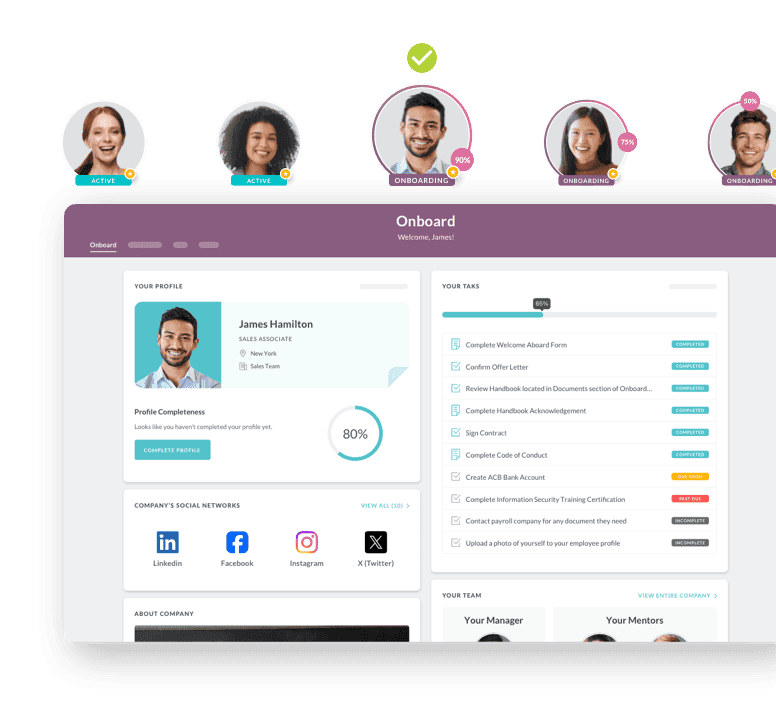
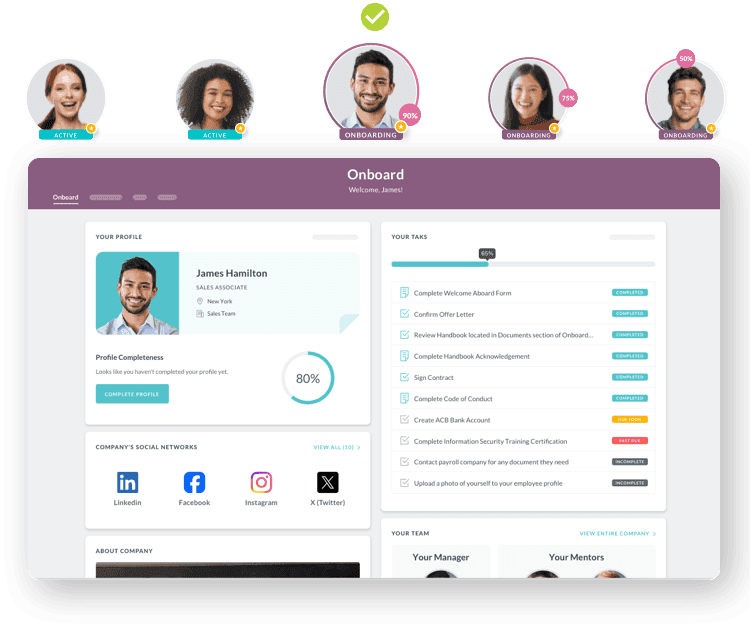
Deploy mobile-responsive onboarding software that employees complete from phones or tablets. HR Cloud's Onboard platform delivers role-specific training via video, interactive modules, and assessments—all accessible in Spanish and English. Back-of-house staff without computer access complete onboarding from shared tablets in break rooms using kiosk mode.
Create role-based training paths: front desk, housekeeping, food & beverage, kitchen, maintenance. Each path delivers only relevant content, reducing time-to-productivity. Use micro-learning—5-10 minute modules on specific skills (checking in VIP guests, folding fitted sheets, using POS system)—that employees complete between tasks.
Implement cross-training programs that build workforce flexibility. Employees trained in multiple roles provide scheduling flexibility and create internal promotion pipelines. Track training completion with automatic reminders for recertification (ServSafe every 5 years, alcohol service every 2-3 years depending on state).
Build a knowledge management system where standard operating procedures, recipes, service scripts, and troubleshooting guides live in searchable digital format. When a housekeeper encounters a cleaning challenge, they search the knowledge base from their phone rather than hunting down a supervisor.
Fostering Diversity and Inclusivity in Hospitality Workplaces
Hospitality workforces naturally reflect the diverse communities they serve, yet achieving genuine inclusion requires intentional effort. The industry employs significant immigrant populations (23% of hospitality workers are foreign-born vs. 17% economy-wide), multilingual teams serving international guests, age diversity from high school students to retirement-age workers, and varied socioeconomic backgrounds.
Inclusive workplaces reduce turnover by 27%, improve innovation, and better serve diverse guest populations. Yet many hospitality operators lack structured diversity programs or bias training.
Solutions that work:
Offer multilingual HR systems supporting Spanish, Mandarin, and other languages prevalent in your workforce and guest base. HR Cloud's platform delivers policies, training, and benefits information in employees' preferred languages, ensuring genuine understanding rather than mere compliance.
Create employee resource groups for cultural communities, working parents, LGBTQ+ employees, or veterans using digital communication channels. These groups build belonging for dispersed teams who rarely overlap shifts. Celebrate cultural events through company announcements that educate the broader team.
Implement blind resume screening in your recruiting process to reduce unconscious bias. Train hiring managers on behavioral interviewing techniques that assess skills rather than cultural fit stereotypes. Set diversity goals for shortlists (ensuring candidate pools reflect community demographics) without quotas.
Review compensation data by demographic groups to identify unexplained pay gaps. Offer flexible scheduling that accommodates religious observances, childcare needs, and school schedules. Provide advancement pathways accessible to employees without traditional educational backgrounds—creating supervisor training programs that recognize experience over degrees.
Strategic HR Management for Hospitality Success in 2026
Hospitality organizations that treat HR as strategic—not administrative—gain measurable competitive advantages. The data is clear: hotels with structured HR programs achieve 32% lower turnover, 28% higher guest satisfaction scores, and 23% better profit margins than peers relying on ad-hoc people management.
Modern HR technology is essential, not optional. Spreadsheet-based scheduling, paper I-9 forms, and email-only communication fail hospitality's distributed, mobile-first workforce. Gen Z employees—now your frontline staff—expect instant mobile access, self-service functionality, and digital communication. Operations without these capabilities lose talent to competitors who provide them.
Prioritize mobile-first HR platforms. Unlike office workers, hospitality employees rarely sit at desks. They're setting up conference rooms, cleaning suites, preparing meals, or greeting guests. HR systems designed for knowledge workers fail frontline teams. HR Cloud's mobile app delivers full HR functionality from any smartphone—employees clock in, request time off, swap shifts, complete training, receive recognition, and view pay stubs without ever touching a computer.
Integrate rather than replace. Most hospitality operators have substantial investments in existing systems—established POS platforms, property management systems, or payroll providers. The solution isn't rip-and-replace. HR Cloud maintains native integrations with ADP, UKG, Workday, Paylocity, SAP, and other hospitality systems, creating unified workflows without disrupting proven operations.
Focus on measurable outcomes. Track turnover by department, location, and hiring source. Monitor time-to-productivity for new hires. Measure manager effectiveness through team retention and engagement scores. Calculate employee turnover costs to quantify HR improvements in financial terms executives understand. HR Cloud's analytics dashboard surfaces these insights without manual report building.
Start with quick wins. Full HR transformation is a journey, not an overnight change. Begin with highest-pain areas: if scheduling consumes excessive time, implement shift planning first. If turnover is catastrophic, prioritize onboarding and engagement. If compliance is risky, address training and documentation. HR Cloud's modular approach lets you implement components in priority order rather than forcing all-or-nothing deployments.
The hospitality industry's challenges are real, but solvable. Organizations embracing strategic HR management—powered by purpose-built technology—transform perpetual hiring crises into competitive advantages through stronger teams, better service, and sustainable growth.

Experience how Workmates can transform communication and strengthen culture—all in one powerful platform
Book Your Free DemoFrequently Asked Questions About Hospitality HR Challenges
1. What tools can help manage HR in hospitality?
HR management software designed for hospitality streamlines recruiting, onboarding, scheduling, time tracking, performance management, and compliance. Essential features include mobile-first access for frontline workers, multilingual support, kiosk mode for shared devices, payroll integration with ADP, UKG, or Paylocity, and automated compliance tracking. Look for platforms offering 4-6 week implementation versus 12-18 month enterprise systems.
2. How do you handle seasonal hiring in the hospitality sector?
Deploy scalable onboarding workflows that activate for high-volume periods without manual recreation. Use applicant tracking systems with bulk hiring capabilities, SMS-based candidate communication, and self-service applications. Create separate training paths for seasonal versus permanent roles. Implement flexible scheduling that accommodates students, retirees, and seasonal workers. Maintain engagement with strong performers through off-season communication so they return next peak.
3. What are best practices for employee engagement in hotels or restaurants?
Implement continuous recognition programs accessible via mobile devices where peers and managers award points redeemable for meaningful rewards. Conduct monthly pulse surveys to identify issues before they trigger resignations. Create department-specific communication channels delivering relevant updates without information overload. Provide clear advancement pathways through cross-training and documented promotion criteria. Offer schedule flexibility via shift swapping and self-scheduling features.
4. How can hospitality HR ensure legal compliance?
Integrate HR systems with specialized hospitality payroll providers that handle complex tip reporting, minimum wage variations, and multi-jurisdiction tax compliance. Automate I-9/E-Verify processing with built-in validation preventing common errors. Implement electronic signature systems creating audit trails for policy acknowledgments and training completion. Set automated renewal reminders for expiring certifications (ServSafe, alcohol service, work authorization). Track predictive scheduling compliance including advance posting requirements and change penalties.
5. How do hospitality companies promote diversity and inclusion?
Offer multilingual HR platforms delivering policies, training, and benefits in employees' preferred languages (Spanish, Mandarin, etc.). Implement blind resume screening in recruiting processes reducing unconscious bias. Create digital employee resource groups for cultural communities using team channels. Review compensation data by demographic groups identifying unexplained pay gaps. Provide advancement pathways recognizing experience over formal education. Offer flexible scheduling accommodating religious observances and childcare needs.
6. Why is HR important in the hospitality industry?
HR directly determines service quality—engaged, well-trained employees create satisfied guests while disengaged staff drive negative reviews. With 74% annual turnover costing $5,864-$9,932 per replacement, effective HR dramatically impacts profitability. HR ensures compliance with complex labor laws spanning federal, state, local, and industry-specific regulations. Strategic HR builds competitive advantages through superior talent, stronger culture, and operational excellence that guests notice immediately.
7. What are the biggest HR challenges in hospitality?
The industry faces 70-80% annual turnover (5x higher than other sectors), difficulty recruiting qualified candidates (60% of employers report this challenge), complex compliance across multiple jurisdictions, managing shift scheduling for fluctuating demand, engaging dispersed frontline workers, ensuring safety in high-risk environments, implementing effective training despite constant turnover, controlling labor costs while maintaining service quality, and fostering inclusion across diverse workforces.
8. How can hotels reduce high employee turnover?
Provide competitive compensation, including flexible scheduling, earned wage access, and clear advancement pathways. Implement instant recognition programs acknowledging daily contributions. Deploy mobile-accessible onboarding, accelerating time-to-productivity and building confidence. Conduct stay interviews identifying retention risks before resignation. Offer meaningful benefits, including consistent scheduling, cross-training opportunities, and promotion-from-within programs. Use analytics to identify department, location, or manager-specific turnover drivers.
About the author

Keep Reading


Like What You Hear?
We’d love to chat with you more about how HR Cloud® can support your business’s HR needs.
Book Your Free Demo