What HR Software Simplifies I-9 and E-Verify Compliance for Construction Employers?

Construction employers carry a specific kind of I-9 exposure most industries don't: high-volume hiring, constant crew turnover between projects, a workforce that includes both direct employees and subcontracted labor, and, increasingly, state laws that make E-Verify mandatory specifically for construction contractors rather than employers generally. Getting I-9 and E-Verify compliance right in this environment isn't a matter of filling out one form correctly once. It's a matter of running the same correct process, reliably, across dozens or hundreds of hires a year, on projects spread across multiple job sites and sometimes multiple states with different rules. A company that gets the rule right in theory but fails to execute it consistently in practice ends up in exactly the same audit finding as a company that misunderstood the requirement outright, which is why this guide focuses less on explaining what I-9 and E-Verify require, most construction HR teams already know the basic rule, and more on why the same team, following the same rule they understand correctly, still ends up with inconsistent, incomplete, or late records once volume and multiple sites enter the picture. That's the more useful, and more honest, question to actually answer. This guide covers why that specific combination makes construction one of the higher-risk industries for I-9 compliance failures, what actually breaks down in practice, what an automated I-9 workflow changes, and how construction employers are building construction HR compliance automation that survives contact with an actual, chaotic hiring season rather than looking good in a policy document nobody follows on-site. That's the actual scope of I-9 compliance construction employers need to solve for: not a smarter interpretation of the form, but a process reliable enough to survive volume, turnover, and multiple job sites at once.
Why I-9/E-Verify Compliance Is High-Risk in Construction
It's worth starting from the baseline everyone already knows, because the failure this guide is describing isn't a failure to know the rule. The federal I-9 requirement is the same for every employer: Section 1 completed by the employee no later than their first day of work, Section 2 completed by the employer within three business days of the start date, records retained for three years after hire or one year after termination, whichever is later. That covers the basic timing framework, though employers should follow current USCIS and DHS guidance for the complete requirements. Even at that level, it sounds simple, right up until a company is trying to execute it correctly across dozens of simultaneous hires spread over several active job sites with no shared administrative system connecting them. What makes construction high-risk isn't a different rule. It's a workforce structure that makes the same rule far harder to execute correctly at scale, repeatedly, under time pressure.
High contractor and subcontractor turnover
A construction company staffing up for a new project can be processing dozens of new hires in a short window, on a job site with no central HR office, often blending direct employees with subcontracted crews who may or may not fall under the general contractor's own I-9 obligations depending on how the relationship is structured. That structural ambiguity is worth naming directly rather than glossing over: a general contractor's own I-9 obligation covers its direct employees, not a subcontractor's workforce, which the subcontractor is separately responsible for verifying under its own employer obligation. Confusion about where that line actually falls, assuming a subcontractor's crew is somehow covered by the general contractor's own process, or assuming the opposite when a worker is actually misclassified, is its own distinct source of I-9 compliance risk in construction specifically. A general contractor that wants visibility into subcontractor compliance without taking on the subcontractor's own I-9 obligation typically needs to build that as a separate contractual requirement, documentation the subcontractor provides as a condition of working on the project, rather than assuming its own I-9 process automatically extends to cover workers it doesn't directly employ.
That volume and pace is exactly the condition under which I-9 errors accumulate: a rushed Section 2 review, a missed three-business-day deadline because the paperwork sat in a job trailer, a form completed correctly but then never actually retained anywhere auditable once the project wrapped and the site administrator moved to the next job. Industry-wide, audits of I-9 records consistently find errors in the large majority of forms reviewed, 65 to 75 percent according to one compliance-services analysis of DHS audit patterns, a rate that reflects how easy the form is to get wrong, in small, seemingly harmless ways, even without construction's added layer of volume and turnover. That baseline error rate matters because it means a construction employer isn't starting from a clean slate and introducing risk through carelessness. It's starting from a form that a large majority of employers, across every industry, get at least partially wrong, and then adding construction-specific pressure on top of that already-high baseline: more hires per year relative to headcount, more physical job sites, and more handoffs between whoever happens to be running paperwork on a given project.
Construction also faces a regulatory dimension most industries don't: a growing number of states now mandate E-Verify specifically for construction employers or public-works contractors, rather than applying a general private-employer mandate. Ohio's E-Verify Workforce Integrity Act, effective March 19, 2026, requires nonresidential construction contractors, subcontractors, and labor brokers operating in the state to use E-Verify for covered employees, a requirement that applies to the construction industry specifically rather than Ohio employers broadly. Pennsylvania's E-Verify mandate applies to private construction businesses and state contractors specifically, not to Pennsylvania employers generally. Georgia requires E-Verify for public-works contractors and for private employers above a size threshold, obtained and renewed as a condition of the business license itself. A construction company operating across several states, running projects under different contracts with different clients, can be genuinely uncertain, without deliberately tracking it, whether E-Verify is legally required on a given project, voluntary, or somewhere in between, and that uncertainty is itself a compliance risk independent of how carefully any single I-9 is completed. This is exactly the gap E-Verify software construction employers adopt is meant to close in the workflow sense: giving a company one place to record, project by project, which E-Verify obligation applies once someone has determined it, rather than leaving that determination undocumented and dependent on whichever site administrator happens to remember it. Determining which legal requirement actually applies to a given project remains the employer's own responsibility, not something software decides on a company's behalf.
Common I-9 Compliance Failures in Construction
The failures that actually show up in construction I-9 audits tend to be procedural rather than dramatic: not fraud, but process breakdowns that compound across a high-volume, multi-site hiring pattern.
Missed deadlines and inconsistent documentation
Of everything this guide covers, the three-business-day Section 2 deadline is the single most common failure point, because it depends on a specific person, often a site supervisor without dedicated HR training, physically reviewing original documents within a fixed window while also running an active job site. A form completed on day five instead of day three misses the federal timing requirement regardless of how minor the delay feels in practice, and the rule itself doesn't carve out an exception for a busy week. Documentation inconsistency compounds the same way: one project's site administrator files I-9s one way, another project's administrator files them differently, and by the time a company faces an actual audit, sometimes years after the hires in question, its I-9 records may be scattered across job sites in formats that don't match each other, making a complete, organized response to an inspection request far harder to assemble than it should be. An inspector doesn't wait for a company to reconcile its own records before starting the clock on a response; the request typically comes with a fixed deadline, commonly a matter of days, and a company scrambling to physically locate paper I-9s scattered across several active and closed-out job sites is working against that deadline with a real disadvantage baked in before the review even starts.
This isn't a hypothetical enforcement risk, and construction employers specifically, given the volume of forms typical hiring patterns generate, have more exposure to it than most. According to a June 2026 employer alert from the law firm Whiteford, Taylor & Preston, ICE updated its I-9 inspection guidance in March 2026 to recategorize a substantial number of errors previously treated as minor, curable technical mistakes into the substantive-violation category that carries an immediate fine with no correction window. That's a law firm's interpretation of an unpublished policy change made without formal rulemaking, not a citation to a primary government release, so construction employers should confirm current ICE guidance directly rather than treating this summary as the final word. Under the earlier, longstanding framework, a company with 100 I-9s containing what were previously classified as technical errors typically had a 10-business-day cure period to fix them before any penalty applied at all. Under the revised guidance as described in that alert, that same set of errors can trigger fines in the range of $28,000 to $286,100 before accounting for any knowing-hire violations, which carry substantially higher penalties on top of that. That policy shift is worth dwelling on specifically because of how it interacts with construction's error-prone hiring pattern. A category of mistake that used to come with a built-in second chance, a missing date, an incomplete field, a form filed a day or two late, now carries the same immediate fine exposure as a more serious violation, which means the margin for the ordinary, procedural mistakes a busy hiring season produces has shrunk considerably, right at the moment construction employers most need that margin.


What Automated I-9 Workflows Include
An automated I-9 workflow doesn't change what the form legally requires. It changes how reliably the same correct process runs every time, across every hire, regardless of which site administrator happens to be handling that particular new hire.
Digital verification and error checking
A digital I-9 built with structured, required fields catches the errors a paper form doesn't: a missing signature, a Section 2 review started before Section 1 was actually complete, a date that doesn't logically fall within the required window. That built-in error checking is what actually reduces the error rate the audit data above describes, not by making anyone more careful, but by making certain categories of mistake structurally harder to submit in the first place, the way a required field that can't be left blank is structurally harder to skip than a paper line someone forgets to fill in. That distinction matters for how a company should think about what automation actually buys it: it's not a promise that every I-9 will be perfect, it's a structural reduction in the specific, mechanical error categories, missing fields, illogical sequencing, incomplete signatures, that a paper process has no way to catch before the form is already filed and the deadline has already passed. Nothing about digitizing the form changes the underlying legal standard a company is held to, and a construction employer shouldn't treat a digital workflow as a substitute for actually training the people running Section 2 reviews on what the form legally requires. Automation removes a specific category of preventable, mechanical error. It doesn't remove the need for someone to correctly and honestly review the original documents a new hire presents.
Centralized storage across projects
The retention requirement, three years after hire or one year after termination, whichever is later, only means something if the records are actually findable when an audit request arrives. Centralized digital storage means every I-9 the company has ever filed lives in one searchable system regardless of which project, which site administrator, or which year it originated from, rather than scattered across whichever job trailers happened to still exist when the request came in. That's a meaningful distinction for a company running projects on a multi-year cycle: a job site that wrapped two years ago, with its records boxed up and stored somewhere, or worse, not stored at all, is exactly the scenario centralized digital retention is built to prevent, since the three-year retention clock doesn't stop just because a specific project finished. The obligation follows the employment relationship and the hire date, not the project timeline, which is a distinction easy to lose track of in practice even when it's obvious in theory.
How Construction Employers Are Automating Compliance Today
The construction employers making real progress here are generally standardizing the I-9 process itself first, before adding E-Verify or reporting on top of it, because a well-built process for the base requirement is what everything else depends on.
Standardizing I-9 collection across all hires
Standardization means the same digital form, the same required fields, the same chained approval steps, whether a new hire is starting at the home office or on a remote job site three states away. That consistency is what closes the documentation-inconsistency gap described above: when every project uses the identical process, an audit response becomes a search across one system rather than a reconstruction project across several inconsistent ones. Standardization also solves a problem that's easy to overlook until it actually happens: staff turnover in the HR or administrative role itself. A construction company where I-9 knowledge lives in one experienced site administrator's head, rather than in a documented, repeatable digital process, is one resignation away from losing whatever institutional consistency it had, right as a new administrator starts making their own version of the same judgment calls the previous one made differently.
Step-by-Step: Automating I-9/E-Verify Compliance
Step 1: Digitize I-9 collection
Move I-9 completion onto a digital form accessible from any device, so a new hire on a remote job site can complete Section 1 the same way a home-office hire would, rather than depending on a paper form physically present at whichever site they happen to start on. This step alone closes a meaningful share of the deadline-related failures described earlier, since a worker who can complete Section 1 from a phone before their first shift removes the single biggest obstacle to meeting that requirement on time: physical access to the right form, in the right place, on the right day.
Step 2: Integrate E-Verify
Connect the digital I-9 process directly to E-Verify submission so that once Section 2 is complete, the case is submitted automatically rather than requiring a separate manual step someone has to remember to perform, on a separate system, after the I-9 itself is already filed. That handoff, from I-9 completion to E-Verify submission, is one of the more common places a company technically completes the federal requirement but still fails a state or contractual E-Verify mandate, simply because the second step depended on someone remembering to log into a separate system and never got automated alongside the first.
Step 3: Set automated error checks
Build required-field validation and logical date checks into the form itself, so a Section 2 review dated before Section 1 was completed, or a signature field left blank, gets flagged before submission rather than discovered months later during an audit. The value here compounds with volume: a single hire's error is a minor annoyance to fix. The same error repeated across fifty or a hundred hires in a busy staffing season, uncaught until an audit surfaces the pattern, is the exact scenario the 2026 ICE guidance change makes materially more expensive than it used to be.
Step 4: Centralize storage for audits
Route every completed I-9, regardless of originating project or site, into one searchable, retained system, so an audit response is a query rather than a multi-site document hunt across job trailers and old project files. Centralizing storage this way also solves a problem specific to construction's project lifecycle: when a job site closes out, its records need to survive that closure rather than being packed away with the rest of the project's paperwork and effectively becoming unfindable the moment the site itself no longer exists.
Step 5: Track reverification deadlines
Some employees present work authorization documents with an expiration date, which creates a reverification obligation the employer has to track and act on before that date passes. Automated expiration tracking on those specific records, flagged well before the actual expiration date rather than discovered on it, is what prevents a valid hire from quietly becoming a compliance gap months or years later, purely because nobody was watching a date on a document filed at the start of employment. Reverification tracking is easy to deprioritize precisely because it applies to a minority of hires, those who presented a document with an expiration date rather than one that doesn't expire, which makes it exactly the kind of low-frequency, high-consequence requirement a manual process is most likely to quietly drop.

How HR Cloud Simplifies Compliance for Construction Employers
Digital I-9 and E-Verify integration
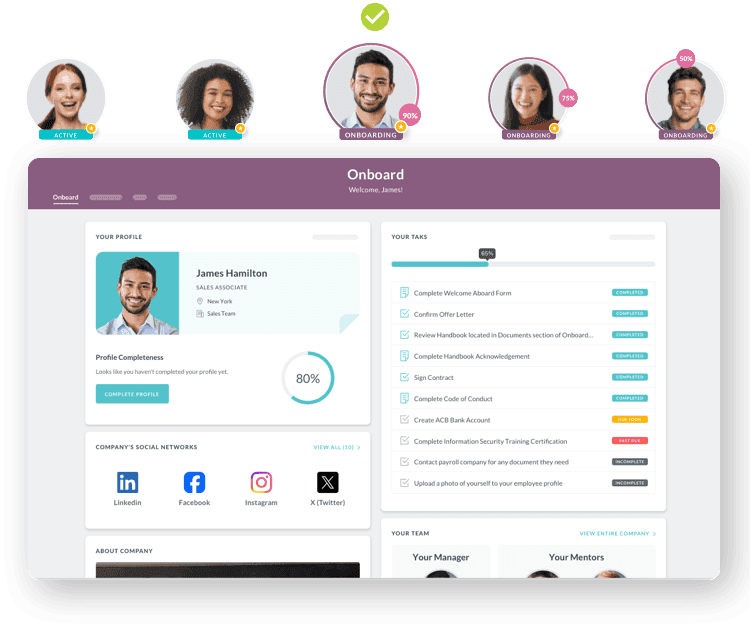
HR Cloud's I-9 and E-Verify product lets new hires complete, e-sign, and submit I-9 forms from any device, including before their first day of employment rather than only once they physically arrive on-site. Once submitted, the information is automatically stored and submitted for approval through the federal E-Verify program, connecting the two steps that too many manual processes leave as separate, easy-to-forget actions. For a construction employer specifically, completing an I-9 before day one matters in a way it might not for an office role: a new hire showing up to an active job site is often expected to start working immediately, and a paperwork bottleneck that delays that start, or worse, pressures a supervisor to let someone begin work before Section 2 is actually complete, is exactly the kind of shortcut this guide has been describing as the source of real compliance exposure. The platform also documents an I-9 dashboard that shows approval status across the workforce and tracks expiration dates on work-authorization documents that require reverification, rather than leaving that tracking to a spreadsheet or an individual administrator's memory. Federal law requires I-9 records be retained for three years after the hire date, or one year after termination, whichever is later, and centralized digital storage is what makes that retention requirement actually auditable years later rather than dependent on whether a specific job site's paper files survived that long. That distinction, whether records survive a project's own lifecycle rather than the company's overall retention policy, is precisely the gap construction employers run into that a single-site business generally doesn't, and it's what makes centralized, cloud-based storage a materially bigger deal for a construction employer than for a business operating out of one fixed location. A single-office company can, in a pinch, walk to a filing cabinet and pull a three-year-old record. A construction company whose relevant job site closed out and demobilized two years ago has no equivalent fallback unless the record was captured somewhere that outlives the project itself.
Centralized compliance dashboard
For a construction employer specifically, the dashboard view matters more than it would for a single-site business, because it's the mechanism that closes the cross-project visibility gap described earlier in this guide: an HR team can see I-9 and E-Verify status across every active project from one screen, rather than needing to check in separately with each site's administrator to confirm the same information. HR Cloud's Onboard checklist system also supports chained tasks and bulk onboarding, which matters directly for construction's hiring pattern: a project staffing up with a large crew at once can move a batch of new hires through the same I-9 workflow simultaneously, with the same required steps and the same automated E-Verify submission, rather than processing each hire as a separate, manual, one-off case. It often needs fifteen or thirty people onboarded in the same week, and a workflow built for processing one hire at a time, however well-designed, becomes a genuine bottleneck at that scale. Bulk onboarding done right doesn't mean cutting corners on any individual worker's review, it means running the same complete, correct process for thirty people in parallel rather than in sequence, so a large crew's paperwork clears at the speed the project actually needs rather than at the speed one administrator can process forms one at a time.
Osmose Utilities Services, a construction and utility-structure inspection company with a heavily field-based workforce, offers a directly relevant example here, since its documented onboarding problem centered specifically on I-9 and E-Verify compliance rather than paperwork generally. Before adopting HR Cloud's Onboard product, the company's HR staff had to onboard new hires outside of any central office, and a typical onboarding took up to two hours per new hire, sometimes producing data entry errors that created real risk around meeting I-9, E-Verify, and industry-specific deadlines consistently. After implementation, HR Analyst Kaylee Collins described the change directly: "Our hiring managers now have a reliable system that is easy to navigate. Our HR team can actively monitor the process, and assist if needed, but Onboard has helped them save so much valuable time and effort while increasing data accuracy. All of this has helped us improve compliance." That's one customer's documented result, specific to a field-based workforce with the same structural challenge this guide has described throughout, not a guarantee every construction employer will see an identical outcome. What makes the example useful here specifically is that Osmose's stated problem, and the compliance risk it created, is the exact same problem this guide has been describing from the start: a field-based workforce, no central office, and a slow, manual process creating both wasted time and real exposure around meeting I-9 and E-Verify deadlines consistently.
“Our hiring managers now have a reliable system that is easy to navigate. Our HR team can actively monitor the process, and assist if needed, but Onboard has helped them save so much valuable time and effort while increasing data accuracy.”

— Kaylee Collins, HR Analyst, Osmose

Common Mistakes in Construction I-9 Compliance
Inconsistent processes across job sites
The most damaging pattern in construction I-9 compliance is letting each project run its own version of the process, one site using a paper form, another using a digital one, a third skipping E-Verify entirely because nobody on that particular project realized the state or the client contract required it. That inconsistency, not any single dramatic failure, is exactly what turns a routine audit into a real financial exposure, because an inspector doesn't average across a company's best-run project and its worst-run one, every individual I-9 gets evaluated against the same federal standard regardless of which site produced it. That's a genuinely uncomfortable fact worth sitting with for a company that's proud of how well one flagship project is run: a spotless I-9 process on the company's best-managed job site provides zero protection against a fine generated by a poorly managed one, because an audit doesn't credit a company's average performance, it evaluates whatever records happen to get pulled.
This mistake is also rarely the result of a deliberate decision to run things differently at each site. It's the default outcome of a company that never built one central process in the first place, so each new project's site administrator reasonably does what seems sensible to them, without necessarily realizing their version differs meaningfully from what another project's administrator is doing at the same time. The fix isn't punishing individual site administrators for inconsistency they didn't create. It's building the one process everyone follows, digitized and centrally managed, so consistency stops depending on every individual administrator independently arriving at the same correct judgment calls. Fixing this doesn't require a different process at each site. It requires the same process, digitized and centrally managed, applied everywhere the company hires, so that a new project's I-9 workflow is a known, repeatable procedure, something a new site administrator can pick up and follow correctly on their first day, rather than something reinvented, with whatever gaps that reinvention introduces, every time a new job starts.
The ROI of Automated Compliance
Reduced fines and administrative burden
The fine exposure described earlier in this guide, potentially tens of thousands to hundreds of thousands of dollars for a company with a meaningful number of flawed I-9s under the revised 2026 ICE guidance, is the clearest financial argument for automation, and the size of that number scales directly with how many I-9s a company has filed, which for a growing construction employer only increases year over year, though it's worth being precise about what automation actually reduces: the rate of the specific errors, missing fields, illogical dates, missed deadlines, that a structured digital workflow catches before submission, not a guarantee against every possible violation category. That precision matters because overselling automation's protection is itself a risk: a company that believes a digital I-9 tool makes it immune to fines may relax exactly the human diligence, actually reviewing original documents carefully, actually knowing which projects require E-Verify, that no software substitutes for. The administrative burden reduction is more directly measurable and less speculative: less time spent physically locating paper records during an audit request, less time reconciling inconsistent documentation across projects, and no separate manual step to remember for E-Verify submission once an I-9 is complete. There's a third category worth naming that doesn't fit neatly into either fines or hours saved: the cost of a delayed start date. A construction project that can't get a crew onto a site because their I-9 and E-Verify paperwork isn't complete is losing schedule time that a faster, digital, before-day-one process would have avoided entirely, and that schedule cost, while harder to attach a single dollar figure to than a DHS penalty, is often the one a project manager actually feels first. A fine arrives months after the fact, often after an audit process that takes time to unfold. A stalled crew on day one of a project is felt immediately, by the people actually responsible for hitting a schedule, which is part of why the administrative case for automation often lands harder with operations leadership than the compliance case does with anyone else.
Conclusion
I-9 and E-Verify compliance in construction fails less often because of a misunderstood rule and more often because the same correct process doesn't run consistently across every hire, every project, and every job site a company operates. HR Cloud addresses that directly: digital I-9 completion from any device, automatic E-Verify submission once Section 2 is complete, an I-9 dashboard with expiration tracking for reverification, and centralized, retained storage that makes an audit response a search rather than a multi-site scramble. None of that changes what federal law requires, and none of it substitutes for knowing which state-specific E-Verify mandates actually apply to a given project. What it changes is whether a construction employer is running one consistent, auditable process everywhere it hires, or a different, informally managed version of that process at every site, discovered to be inconsistent only once an inspection notice arrives. That's the practical test worth applying before this guide's argument is accepted at face value: could this company hand every I-9 it has on file to an inspector today, from every project it has ever run, in a format that's complete, consistent, and retained for the required period. Most construction employers, honestly assessing the state of their own paper and scattered digital files, will find the answer is no, and that gap, not a misunderstanding of what the form requires, is the actual problem this guide has been describing. Closing that gap doesn't require predicting every future rule change. It requires a process solid enough that the answer to that test stays yes, project after project, regardless of which state a job happens to be in or which administrator happens to be running the site.

Discover how our HR solutions streamline onboarding, boost employee engagement, and simplify HR management
Book a DemoFAQs
Is E-Verify mandatory for construction employers?
It depends entirely on where the work is happening, and a blanket answer would be inaccurate. Federal contractors with the FAR E-Verify clause in their agreements must use it. A growing number of states mandate it specifically for construction or public-works contractors, Ohio's E-Verify Workforce Integrity Act as of March 2026, Pennsylvania for private construction businesses, Georgia and Utah for public-works contractors, among others, while several states, Alabama, Arizona, South Carolina, mandate it for all private employers regardless of industry. None of this is settled permanently, either: Ohio's construction-specific mandate only took effect in March 2026, which means the list of states treating construction as its own E-Verify category is more likely to grow than shrink. A construction company operating across multiple states needs to check each project's specific state and contract requirements rather than assuming one company-wide policy covers every job. Building a simple, current reference for exactly which active projects fall under an E-Verify mandate, whether federal, state, or contractual, and which don't, is a small exercise that most construction companies have never actually done, even though the underlying facts are publicly available for every state they operate in.
How do you manage I-9s for short-term project hires?
The same federal deadlines apply regardless of how long the assignment is expected to last, Section 1 by the first day, Section 2 within three business days, so a short-term hire needs the same complete, timely I-9 as a permanent one. There's no separate, lighter-weight version of the form for a two-week assignment versus a two-year one. A digital process that a new hire can complete remotely, before or on their first day, removes the biggest practical obstacle to meeting that deadline for a worker who may only be on a specific project for a matter of weeks. It's worth being direct about one thing this doesn't solve: a short-term hire's employment status doesn't change the federal requirement in any way, and treating a temporary or project-based worker as somehow exempt from the same I-9 and, where applicable, E-Verify process that applies to a permanent hire is itself a compliance mistake, not a shortcut.
What's the penalty for I-9 errors in construction?
Paperwork violations currently range from $288 to $2,861 per form under DHS's inflation-adjusted 2025 penalty schedule, and that range applies per I-9, so a company with a pattern of errors across many hires faces that penalty multiplied across every affected form. Knowingly hiring, recruiting, or retaining an unauthorized worker carries substantially higher penalties, starting at $716 per worker for a first offense and escalating for repeat violations. The knowing-hire penalties are separate and considerably steeper: $716 to $5,724 per worker for a first offense, rising to $5,724 to $14,308 for a second offense and $8,586 to $28,619 for a third or subsequent offense, per the same DHS 2025 inflation-adjusted schedule, figures that reflect a genuinely different, more serious category of violation than a paperwork error, but ones a company should understand exist on the same enforcement continuum. Construction employers should also know that ICE's 2026 update to its inspection guidance, as reported by employment-law firms tracking the change, moved a number of previously curable technical errors into the fined category, removing the correction window that used to apply to some of the mistakes construction's high-volume hiring pattern makes most common.
Can I-9 verification happen remotely?
Section 1 can be completed remotely by the employee on any device. Section 2, the employer's review of original identity and work-authorization documents, generally requires physical document inspection, though DHS has at various points authorized alternative procedures, including remote examination, for E-Verify-participating employers under specific conditions. A construction employer relying on remote verification for any portion of its workforce should confirm current DHS guidance applies to its specific situation rather than assuming a past flexibility is still in effect, since these accommodations have changed more than once over the past several years. The safest practical approach for a construction employer with workers spread across multiple job sites is to treat physical document inspection as the default expectation unless a specific, currently valid alternative procedure has been confirmed to apply, rather than assuming a flexibility read about once still holds.
About the author


Like What You Hear?
We’d love to chat with you more about how HR Cloud® can support your business’s HR needs.
Book Your Free Demo