How Can Tech Companies Automate Custom Approval Workflows for Equipment, Expenses, and Access?

Tech companies automate custom approval workflows by replacing Slack threads and email chains with role-based routing rules built in a no-code workflow builder: a request for a laptop, a software license, or a travel expense moves automatically to the right approver based on department, spend level, or request type, with every step logged for an audit trail. The result is fewer stalled requests, less manual chasing, and a permanent record of who approved what and when, instead of a scrolled-past chat thread nobody can search six months later.
That single sentence answers the question. The rest of this guide walks through why generic HR workflows break down in a tech company specifically, what real custom HR workflows software and approval automation software need to include, how to handle IT provisioning inside an HR workflow rather than a separate spreadsheet, how to roll one out in stages without creating a system nobody uses, and what HR Cloud's Custom Forms & Workflows product does for equipment, expense, and access requests in practice.
Why Generic Workflows Don't Fit Tech Company Needs
Most HR platforms ship with one workflow, out of the box: an employee submits a request, one designated manager approves it, done. That covers a single-office company with a flat approval structure and one kind of request to process. It does not cover a tech company running distributed engineering, product, design, and go-to-market teams, each with its own budget owner, its own equipment standards, its own vendor relationships, and its own rules about who can grant system access.
The mismatch shows up fastest at the request-type level. A tech company juggles at least three distinct categories of approval on any given week, and each one has different stakes attached: hardware and software provisioning, which touches IT and security; discretionary spend, which touches finance and a department budget owner; and system access, which touches security and compliance directly, since granting the wrong person production access is not a paperwork error, it's an incident. A single generic approval track cannot represent all three without either becoming so rigid that half the requests don't fit the form, or so loose that it stops capturing the information finance or security actually needs to act on the request.
Equipment requests, access provisioning, expense approvals
Consider three requests that might land in an HR inbox on the same Monday. A new backend engineer needs a laptop, a second monitor, and admin access to a staging environment before their first standup. A product manager needs a paid Figma seat and sign-off on a $600 conference registration, which by policy needs both their manager and the department head. A sales rep needs their company card's monthly limit raised temporarily for a client dinner circuit. Each of these is, in the broadest sense, "a request that needs approval." Past that, they have almost nothing in common: different approvers, different required fields, different systems that need to be notified once the request clears, and different consequences if the approval gets routed to the wrong person or takes too long.
Forcing all three through the same generic workflow produces one of two failure modes. Either the workflow captures only the lowest common denominator of information, in which case IT still has to follow up manually to find out which staging environment the new engineer needs access to, or the workflow becomes so branched and conditional that nobody outside the person who built it understands how it actually routes a request. Neither outcome is what a growing tech company needs from its HR stack. What it needs is a workflow builder where the request type itself determines the form fields, the approval chain, and what happens after approval, not a single template stretched to cover cases it was never designed for.
There's also a compliance dimension that generic workflows tend to ignore entirely. Equipment and software provisioning increasingly touch data security directly: a laptop shipped without the right disk encryption policy applied, or a SaaS seat granted without the right data-access scope, is a security gap that traces back to a workflow that never asked the right question at request time. Access provisioning carries the same risk in the other direction, since revoking access correctly when someone leaves or changes roles matters just as much as granting it correctly when they join. A generic workflow that only tracks "approved or not approved" has no way to capture any of that context, which is exactly the kind of detail a request-type-specific form is built to collect.
Where Manual Approval Processes Break Down
Before a company builds a formal workflow, most approvals happen somewhere between a group chat, a shared spreadsheet, and a manager's memory of who is supposed to sign off on what. That informal system works fine while headcount is under roughly 20 people and everyone sits within earshot of each other. It stops working the moment there is more than one approver in a chain, more than one office or time zone, or more than one department with its own spending rules, and for most tech companies that threshold arrives well before the org chart looks complicated on paper.
Slack DMs and email threads with no audit trail
A request that lives inside a Slack DM has effectively no record once the thread scrolls past the visible window. Nobody outside that conversation can see the request's current status, nobody can search for it later without knowing the exact channel and rough date, and if the one person who was supposed to approve it is out sick or in back-to-back meetings, the request simply sits there until someone remembers to chase it down again. Email threads fail the same way, just with a slightly longer memory: a forwarded chain with six people cc'd is not a system of record, it's a paper trail that happens to be digital, and it breaks the moment someone forgets to hit reply-all.
An analysis published by workflow-automation vendor ApprovalMax put real numbers on what this actually costs. Their modeling found that manual approval routing built on email and spreadsheets takes roughly an hour of staff time per request once data entry, chasing down approvers, and re-keying the outcome into another system are all counted, compared with 10 to 15 minutes for the same request moving through an automated workflow. For a company processing 3,000 such requests a year, a volume many mid-size tech companies clear well before their headcount hits a thousand, their model put the annual cost of the manual version at close to £36,600 in wasted staff time alone, against a fraction of that once the same volume runs through an automated approval chain with the labor cost of the software itself included.
The deeper cost isn't just the hours. It's that nobody outside the thread can prove what happened after the fact. If a compliance review surfaces a question six months later about who approved a specific vendor purchase, "check the Slack history" is not an audit trail a reviewer will accept. If an employee disputes a rejected expense or claims they never received a response, there's no timestamped record of who reviewed the request, when, or what they decided. A structured workflow keeps that record automatically, as a byproduct of how the request moves through the system, and that matters far more once a company scales past the size where a manager could plausibly remember every approval they made that quarter.
What Custom Workflow Builders Enable
Custom HR workflows software is built around exactly this problem: it differs from a single hard-coded approval chain in one specific way. It lets HR, finance, or IT define the routing rules once, for each request type, and have every future request of that type follow the rule automatically, without a person manually deciding where to forward it each time. That's also the core job of approval automation software specifically, as distinct from general task-tracking tools: it doesn't just list what needs doing, it owns the routing, the timing, and the record of every decision along the way.
Multi-step, role-based approval chains
Role-based routing means the system looks at who is making the request and what they're requesting, then sends it to the correct approver automatically based on a rule the company defined in advance, not a static name typed into a form. A $200 equipment request from an individual contributor might only need their direct manager's sign-off. A $5,000 software contract renewal might need both the department head and finance to approve, in sequence, before it's considered final. The rule lives in the workflow configuration, not in a spreadsheet someone updates twice a year and forgets to share when a new hire joins the approval chain.
This is a meaningfully different setup from a flat to-do list or a shared checklist. A to-do list tracks that something needs doing, full stop. A role-based workflow tracks who is specifically responsible for each step, and moves the request forward the instant the current approver acts, without anyone having to manually notice that a step cleared and forward the request to whoever comes next. As the organization grows and approval chains get longer, this difference compounds: a three-step approval chain managed by hand is annoying; the same chain managed by hand across 40 simultaneous requests a week is a job nobody signed up for.
Automated routing and notifications
Once the routing rule is configured, the system does the forwarding on its own. The requester gets an immediate confirmation the moment they submit, so there's no ambiguity about whether the request actually went through. The approver gets a notification the instant it becomes their turn to act, rather than discovering a pending item buried in an inbox days later. A mature workflow tool builds in reminders and escalation paths so a request doesn't stay stuck indefinitely behind one unavailable approver. HR Cloud's workflows carry alerts tied to each task, so approvers are notified as steps become their responsibility; check with your HR Cloud rep on the exact timing and escalation rules available in your plan before you design a chain that depends on a specific threshold.
None of this requires someone in HR or IT to sit and manually track who has and hasn't responded to a given request. The workflow does that by design, and as a direct byproduct it produces a timestamped log of every step the request passed through, which is precisely the record a Slack thread or an email chain can never reliably produce. For a tech company managing access requests specifically, this notification layer also closes a real security gap: a request for elevated system access that sits unnoticed in someone's inbox for a week is a request that either gets rubber-stamped without real review once someone finally opens it, or gets ignored entirely while the new hire works around the missing access by asking a teammate to share their own credentials, which is its own compliance problem.
Distributed and remote-first tech teams feel this gap earlier than office-based companies do, simply because there's no hallway conversation to fall back on when a Slack thread stalls. A manager in one time zone and an approver in another means a request that would have been resolved with a two-minute in-person check-in instead sits overnight waiting for someone to wake up and see the notification. A workflow built with clear ownership and reminders closes that gap by design, since the system doesn't need anyone to be awake at the exact right moment to keep a request moving.
How Tech Companies Are Automating Approvals Today
Companies that have moved off ad hoc, chat-based approvals onto real custom HR workflows software typically do it in deliberate stages rather than trying to automate every process across HR, finance, and IT at once, which almost always stalls the project before anything ships.
Replacing ad hoc requests with structured workflows
The starting point is usually the highest-volume, highest-friction request type a company processes, and for most growing tech companies that's new-hire equipment and access provisioning. A laptop, a monitor, the right software licenses, and the correct system access all need to be requested and approved before a new hire's first day, and doing that by chasing three separate people through Slack for every single new hire scales badly the moment hiring picks up. Once that first workflow exists, is configured correctly, and people actually trust that it routes their requests correctly, the same builder typically gets reused for expense approvals, ad hoc software purchase requests, and access changes when an employee moves teams or takes on a new role.
Illustrative example, not a verified HR Cloud customer story: picture a mid-size, Series B software company hiring at a steady clip of six to eight engineers a month across two time zones. Before automating anything, the People team fields the same three-message Slack exchange for every hire: "does this person need a MacBook or a Linux box," "who approves the Okta group they need," and "has finance signed off on the license cost yet." After mapping and automating that single workflow, the same three questions get answered by the request form itself: the hiring manager selects the role type, which auto-populates the standard equipment bundle for that role, routes hardware and software cost to the budget owner for sign-off, and routes the access request separately to IT security, all inside one submission instead of three separate conversations that had to be manually cross-referenced.
The failure mode worth naming explicitly, because it derails a lot of otherwise well-intentioned automation projects, is trying to digitize every existing process exactly as it runs today, including the parts that only exist because of a manual workaround nobody ever questioned. A three-person sign-off chain that exists because nobody fully trusted the second approver's judgment a few years ago is not a rule worth preserving in software. It's a rule worth fixing first, in conversation with whoever actually owns that budget line today, and only then automating the version that reflects how the company genuinely wants approvals to work going forward.
Step-by-Step: Building Custom Approval Workflows
Step 1: Map current approval processes
Before configuring anything in a workflow builder, write down every request type that currently needs sign-off: equipment provisioning, software purchase requests, expense reports, system access changes, and contractor onboarding are the common ones for a tech company. For each request type, note who approves it today, in what sequence, and what has to happen after approval clears, for example whether IT needs to be notified to provision an account, whether finance needs to be notified to process a payment, or whether both do.
This map becomes the functional specification for the workflow builder, and skipping it is the single most common reason a new workflow tool gets configured, launched, and then quietly ignored within a few months: it was built to match what the software vendor assumed a typical company's approval chain looks like, not what this specific company actually does. Budget an actual working session for this step, not a five-minute guess, and involve at least one person from finance and one from IT alongside HR, since each of them usually knows a wrinkle in the process the other two don't.
Step 2: Identify approval chain owners
For every request type mapped in Step 1, name the actual person or defined role responsible for each approval step, not just the department in general terms. "Finance approves it" is not specific enough to build a workflow around; "the department budget owner approves anything under $1,000, and the CFO approves anything at or above that threshold" is specific enough to configure directly. This is also the right point in the process to decide what happens when the named approver is unavailable: a designated backup approver, so that one person's vacation or sick day doesn't stall every equipment or expense request routed through them that week.
Write these ownership rules down alongside the process map from Step 1, since the two together are what actually gets entered into the workflow builder in Step 3. A common gap at this stage is defining the primary approver clearly but never assigning a backup, which works fine until the exact week that approver is unreachable and a dozen requests back up behind them with nowhere else to go.
Step 3: Build workflows in a no-code builder
With the process map and the ownership rules defined in Steps 1 and 2, the actual build is form-and-rule configuration, not custom software development. For an equipment request specifically, that typically means fields for role or job title, which can auto-suggest the standard hardware bundle for that role, requested items, cost center, and a target need-by date tied to the new hire's start date. For an access request, it means fields for the specific system or environment, the access level requested, the manager approving the business justification, and a separate security or IT approver confirming the access itself, since the person who approves that someone needs access to a system is not always the same person qualified to approve exactly what level of access is appropriate. A no-code workflow builder lets HR or IT set up the request form, choose which fields it collects, define the approval sequence, and set the notification triggers, all without writing code or filing a ticket with an engineering team that has its own roadmap to worry about. This is the core difference between a generic form tool and real approval automation software: the routing logic lives with the form, not in a separate system someone has to maintain by hand.
Start with the single highest-volume request type identified in Step 1 rather than trying to configure every workflow at once. Building and testing one workflow end to end, correctly, teaches the team how the builder actually behaves before they're configuring five workflows in parallel and troubleshooting all of them simultaneously. HR Cloud's own help center documents the field-by-field mechanics of setting up a workflow, including how conditional logic and role-based triggers work, which is worth a read before the first build session rather than during it.
Step 4: Test with a pilot team
Roll the new workflow out to one team first, usually whichever team generates the most requests of that type, before opening it to the entire company. A pilot reliably surfaces the edge cases the original mapping exercise missed: a request type that doesn't quite fit the form as built, an approver who exists in practice but wasn't accounted for in the routing rule, or a notification that fires at an unhelpful time, like a reminder that goes out at 2 a.m. because nobody set the workflow to respect the approver's working hours. Fixing issues like these for a pilot group of 15 to 20 people is a quick configuration adjustment. Fixing the same issues after 500 employees have already hit the identical snag, and half of them have already given up and gone back to Slack, is a much bigger cleanup with a trust problem attached to it.
Run the pilot for at least one full cycle of the request type in question, not just a single test submission, so real edge cases have a chance to surface naturally rather than only in a scripted walkthrough.
Step 5: Roll out company-wide with training
Once the pilot has run cleanly for a full cycle, extend the workflow to the rest of the company, paired with a short walkthrough for both requesters and approvers covering what changed, where to find pending requests, and who to contact if something routes incorrectly. The rollout communication should be specific about what request types are now handled through the new workflow versus what's still handled the old way, since a half-migrated process where some requests go through the new system and others still go through Slack is more confusing than either extreme on its own.
Treat the first few weeks after a full company-wide rollout as an active monitoring period rather than a "configure it once and walk away" launch. Even a well-piloted workflow will surface a request type, an unusual org-chart exception, or an edge case in employee location or role that the smaller pilot group simply never generated, and catching those quickly in week two is far easier than untangling them after they've compounded into a backlog of misrouted requests.


How HR Cloud's Custom Forms & Workflows Adapt to Tech Ops
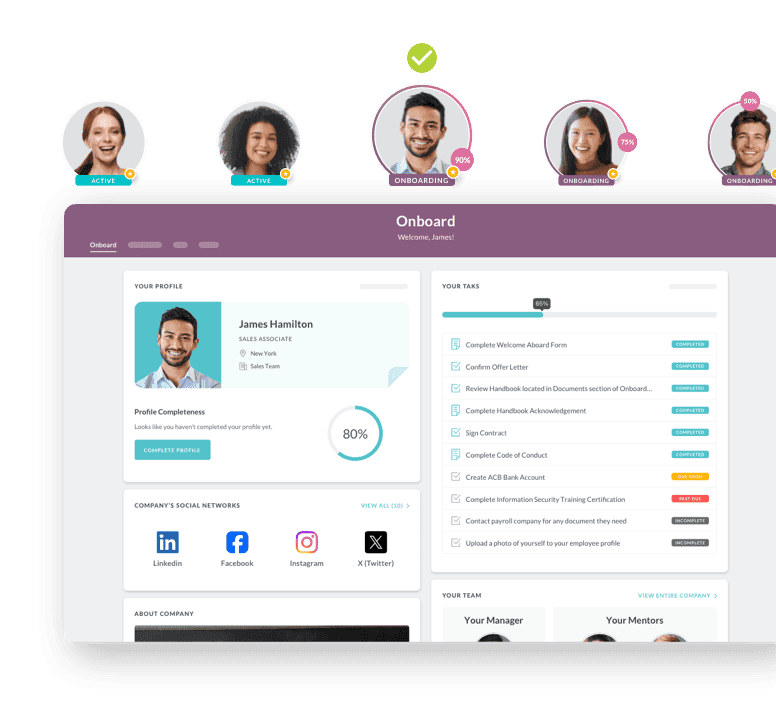
HR Cloud is a modular HR platform, and its Custom Forms & Workflows product lets any user build a form for the exact request type a tech company needs, whether that's equipment provisioning, a software purchase request, or an access change, without needing to file a ticket with IT to have it built for them.
No-code workflow builder
The Form Builder lets a team member create a custom form using existing fields or a template pulled from HR Cloud's form library, and the resulting form can be filled out and completed on any device, which matters for a distributed engineering team that isn't all sitting at a company laptop when a request comes up. Once a form is built, users can attach a signing-order workflow complete with specific tasks, permissions, and alerts, so everyone involved in the approval chain, whether it's for a hiring process or any other HR request, knows exactly what they're responsible for and when their part of it is due.
Customers running this in production report using it at real volume, not as a one-off configuration that sits idle. Medlinks manages more than 70 distinct workflows through HR rather than routing them through IT, and Veolia runs more than 80. That kind of volume only holds up in practice if building or adjusting a workflow doesn't require a developer every time something needs to change, which is the entire premise of a no-code builder: the people who own the process are also the people who can maintain it. More detail on both of these results, and others across industries, is available in HR Cloud's customer story library.
“Our hiring managers now have a reliable system that is easy to navigate. Our HR team can actively monitor the process, and assist if needed, but Onboard has helped them save so much valuable time and effort while increasing data accuracy.”

— Kaylee Collins, HR Analyst, Osmose

Multi-step approval routing
Once a workflow is live, HR Cloud provides real-time visibility into exactly where every request stands: what's been approved, what's still pending, and where a specific request has stalled longer than expected. HR or a team lead can trigger bulk task completion when a batch of requests needs to move at once, for example clearing a backlog of standard equipment approvals after a hiring surge, rather than clicking through each one individually. The platform's role-based routing, documented in more depth in HR Cloud's glossary entry on role-based workflows, sends each request to the correct approver automatically based on the rule the team configured, not a static assignee list that quietly goes stale the moment someone changes roles or leaves the company. This sits under the same underlying automation HR Cloud documents more broadly in its HR workflow automation glossary entry, applied specifically here to the approval-chain use case rather than onboarding checklists alone.
For a tech company specifically, this matters in two concrete ways. First, an IT provisioning HR workflow built this way is configured directly by non-technical HR or ops staff through HR Cloud's IT-facing solution, which keeps IT out of the loop for routine workflow changes and frees that team's time for the security and infrastructure work only they can do. Second, the platform tracks equipment and access as a named category on its own, called Assets, covering asset list and detail management, assignee tracking, warranty management, history tracking, and receipt collection, which is exactly the piece of this workflow most generic HR tools skip entirely, leaving equipment tracking to live in a separate spreadsheet that never quite stays in sync with the approval record. HR Cloud also connects to identity and access tools tech teams already run, including Okta and OneLogin, along with Slack for notifications, so a workflow's approval step and the actual access grant don't have to live in two disconnected systems.
The table below summarizes how a manual process, a generic single-track HR tool, and a custom workflow builder compare across the dimensions that matter most for equipment, expense, and access requests.
| What you need | Manual (Slack / email) | Generic single-track HR tool | Custom workflow builder |
|---|---|---|---|
| Different rules per request type | No, one process fits all | Limited, usually one fixed chain | Yes, configured per form |
| Role-based, multi-step routing | Manual, person-dependent | Rare, often a single approver only | Built in, rule-based |
| Reminders and visibility into stalled requests | None | Sometimes, not customizable | Built into the workflow |
| Audit trail for compliance review | None, informal only | Partial | Full, timestamped per step |
| Who can build or edit a workflow | Anyone, informally | Usually requires admin or IT | Any authorized user, no code |
| Equipment and access tracked with the request | No, separate spreadsheet | No | Yes, via a dedicated Assets category |
Security is worth calling out on its own here, since it's the part of this workflow most likely to get treated as an afterthought. HR Cloud is SOC 2 Type II certified and GDPR compliant, which matters directly for an access-provisioning workflow: the same system routing the approval for "grant this employee access to X" is also holding a record of who approved it, when, and under what justification, and that record needs to meet the same security bar as the systems it's granting access to, not a lower one.
Common Mistakes in Workflow Automation
Building overly complex approval chains
The most common mistake is adding an approval step for every conceivable edge case up front, before the workflow has even run for real. A five-step sign-off chain for a $50 software subscription is not a meaningful control, it's a bottleneck, and it trains employees to route around the official system entirely, usually straight back to the Slack DM the workflow was supposed to replace in the first place. The better default is sizing the approval chain to the actual size of the decision: one approver for routine, low-cost requests, two approvers for anything with real budget or security impact, and an explicit path for anything unusual, rather than simply adding a longer chain and hoping it covers every case.
A closely related mistake is launching every workflow at once instead of following the staged approach described above. A company that tries to automate equipment provisioning, expense approvals, access requests, and contractor onboarding in the same sprint usually ends up with four half-tested workflows and no single team member who fully understands how any of them actually route a request end to end. A workflow that takes longer to clear than the old manual process it replaced will get abandoned within a few months, regardless of how strong its audit trail is on paper, because employees will always find the path of least resistance to getting what they need approved.
A third, quieter mistake is training only the people submitting requests and skipping the approvers. Requesters usually get a walkthrough of the new form because someone in HR sends it to them directly. Approvers often just get added to a routing rule and left to figure out the notification emails on their own, which means the first time a department head sees the new system is the first time a request lands in their queue, with no context for what changed or why. A rollout that trains both sides of the approval, not just the person filing the request, avoids a predictable wave of confusion in the first few weeks.
What Custom Workflows Deliver
Faster approvals and a clear audit trail
The direct payoff of moving to custom HR workflows software is speed: automated routing removes the delay created when a request depends on someone remembering to manually forward or follow up on it, because the system, not a person's memory or their inbox triage habits, is responsible for routing it to the correct next step. The secondary payoff, and arguably the one that matters more once a company scales past a hundred employees, is the audit trail itself. Every approval, rejection, and escalation is timestamped and permanently attached to the original request, which is exactly the record a compliance review, a security audit, or a disputed expense claim actually needs to be resolved quickly instead of becoming a weeks-long game of reconstructing what happened from memory and scattered screenshots.
Conclusion
Custom approval workflows solve a problem generic, single-track HR tools were never built to handle in the first place: a tech company doesn't process one kind of request, it processes several, each with its own approver, its own required fields, and its own downstream system that needs to be updated once approval clears. Building the workflow around the request type itself, rather than forcing every request into the same rigid shape, is what turns approvals from a Slack thread nobody can search six months later into a system with a real, defensible audit trail. See how HR Cloud's Custom Forms & Workflows handle equipment, access, and expense approvals, or book a free demo to walk through your own approval chains with an HR process consultant.

Discover how our HR solutions streamline onboarding, boost employee engagement, and simplify HR management
Book a DemoFrequently Asked Questions
Can approval workflows be customized per department?
Yes. A workflow builder that supports role-based routing lets each department define its own approval chain, its own required fields, and its own spending or access thresholds. Engineering's equipment request workflow does not need to look like finance's expense approval workflow, and a properly built custom workflow tool, the kind of approval automation software a tech company actually needs, keeps them as separate, independently configurable paths running inside the same underlying system.
Does this replace tools like Slack workflows or Zapier?
Not necessarily, and for most tech companies it shouldn't try to. Many companies keep Slack or Zapier in place for lightweight, informal notifications while routing anything that needs a compliance record, such as equipment provisioning or an IT provisioning HR workflow, through a dedicated tool instead. The deciding factor is whether the request needs an auditable approval history; if it does, a purpose-built workflow with real-time visibility into approval status is the safer choice.
How long does it take to build a custom workflow?
A no-code builder removes most of the technical overhead of setting up a request type, since it's form-and-rule configuration rather than custom development. How long it actually takes depends on how many approval levels the request needs and how clearly Step 1's process map was done beforehand; a fast build of the wrong workflow still has to be rebuilt from the ground up once the gap is discovered.
Can workflows include multiple approval levels?
Yes. Multi-step, role-based approval chains are a core feature of a real workflow builder, not an advanced add-on. A single request can require sign-off from a direct manager, then a department head, then finance, in strict sequence, with the system automatically forwarding it to the next approver only once the prior step is fully complete.
About the author

Keep Reading


Like What You Hear?
We’d love to chat with you more about how HR Cloud® can support your business’s HR needs.
Book Your Free Demo