
AI-Driven Employee Experience: 2026 Playbook for HR Leaders

Organizations leveraging AI for employee experience are seeing dramatic improvements in retention, productivity, and cost savings. This playbook provides a practical roadmap for HR leaders to implement ai-powered hr solutions that transform workplace experiences while delivering measurable business results.
The employee experience revolution isn't coming—it's here. As talent markets tighten and employee expectations soar, the smartest organizations are discovering a powerful competitive advantage: artificial intelligence that transforms routine HR interactions into strategic employee engagement opportunities.
The transformation is already underway. Forward-thinking companies are using AI to reduce HR response times by up to 75%, cut operational costs significantly, and predict employee turnover with remarkable accuracy. Meanwhile, according to Gallup research, only 64% of employees intend to stay at their current organizations, down from 70% in 2021, signaling a retention crisis that demands immediate talent retention strategies.
This isn't about replacing human connection—it's about amplifying it. By automating routine tasks and providing personalized experiences at scale, AI enables HR professionals to focus on what matters most: building cultures where employees thrive and businesses succeed.
Key Takeaways
- The employee experience crisis is a financial crisis. Poor engagement drives turnover costs of 0.5 to 2 times an employee's annual salary — and disengaged employees create ripple effects across customer satisfaction and operational efficiency.
- AI shifts HR from reactive to predictive. Traditional HR addresses problems after they surface. AI enables organizations to anticipate turnover, personalize experiences, and proactively support employees before issues escalate.
- Implementation success is about change management, not technology. The biggest risk in AI adoption isn't technical failure — it's poor employee communication and insufficient stakeholder buy-in.
- A phased roadmap reduces risk and builds confidence. Foundation setting, pilot launch, and scale-and-optimize — in that order — gives organizations the best chance of lasting impact.
- ROI is measurable and substantial. Even modest engagement improvements deliver significant financial returns. For a 1,000-person organization, a 5% reduction in turnover saves approximately $750,000 annually in replacement costs alone.
- Data privacy, bias prevention, and transparency are non-negotiable. They must be built in from the beginning, not retrofitted after deployment.
- Organizations that act now gain a durable competitive advantage. Employees in 2026 expect intelligent, personalized, and efficient experiences. Organizations that can't deliver them will struggle to attract and retain the talent needed for success.
Why Employee Experience Has Become Business-Critical
The Hidden Costs of Poor Employee Experience
The financial impact of neglecting employee experience extends far beyond simple turnover statistics. Organizations with disengaged workforces face cascading costs that directly impact their bottom line through reduced productivity, increased absenteeism, and higher replacement costs.
According to Gallup's State of the Global Workplace report, high-engagement teams in high-turnover businesses experience 18% less turnover than their low-engagement counterparts. For low-turnover businesses, the gap widens dramatically—highly engaged teams see 43% less turnover than those with low employee engagement strategies.
The replacement cost alone tells a sobering story. Many organizations face costs ranging from 0.5 to 2 times an employee's annual salary when factoring in recruitment, training, and productivity ramp-up time. Beyond direct costs, disengaged employees create ripple effects across customer satisfaction and operational efficiency.
The Competitive Advantage of Experience-First Organizations
While many organizations struggle with retention challenges, those prioritizing employee experience are reaping substantial rewards. Companies with highly engaged workforces experience 19.2% growth in operating income over 12-month periods—not correlation, but causation driven by motivated, productive employees aligned with organizational goals.
The talent acquisition benefits are equally impressive. Organizations with strong employer brands find recruitment significantly easier and more cost-effective. AI recruitment tools can reduce hiring costs by up to 30%, but the real advantage comes from attracting higher-quality candidates who actively seek out companies known for exceptional employee experiences.
Customer satisfaction creates another competitive advantage. Highly engaged employees understand their role in customer-centric experiences. Because they're more invested and passionate about their work, they're more likely to create positive customer interactions, ultimately resulting in cost reduction and enhanced productivity.
How AI Transforms Employee Experience
From Reactive to Predictive HR
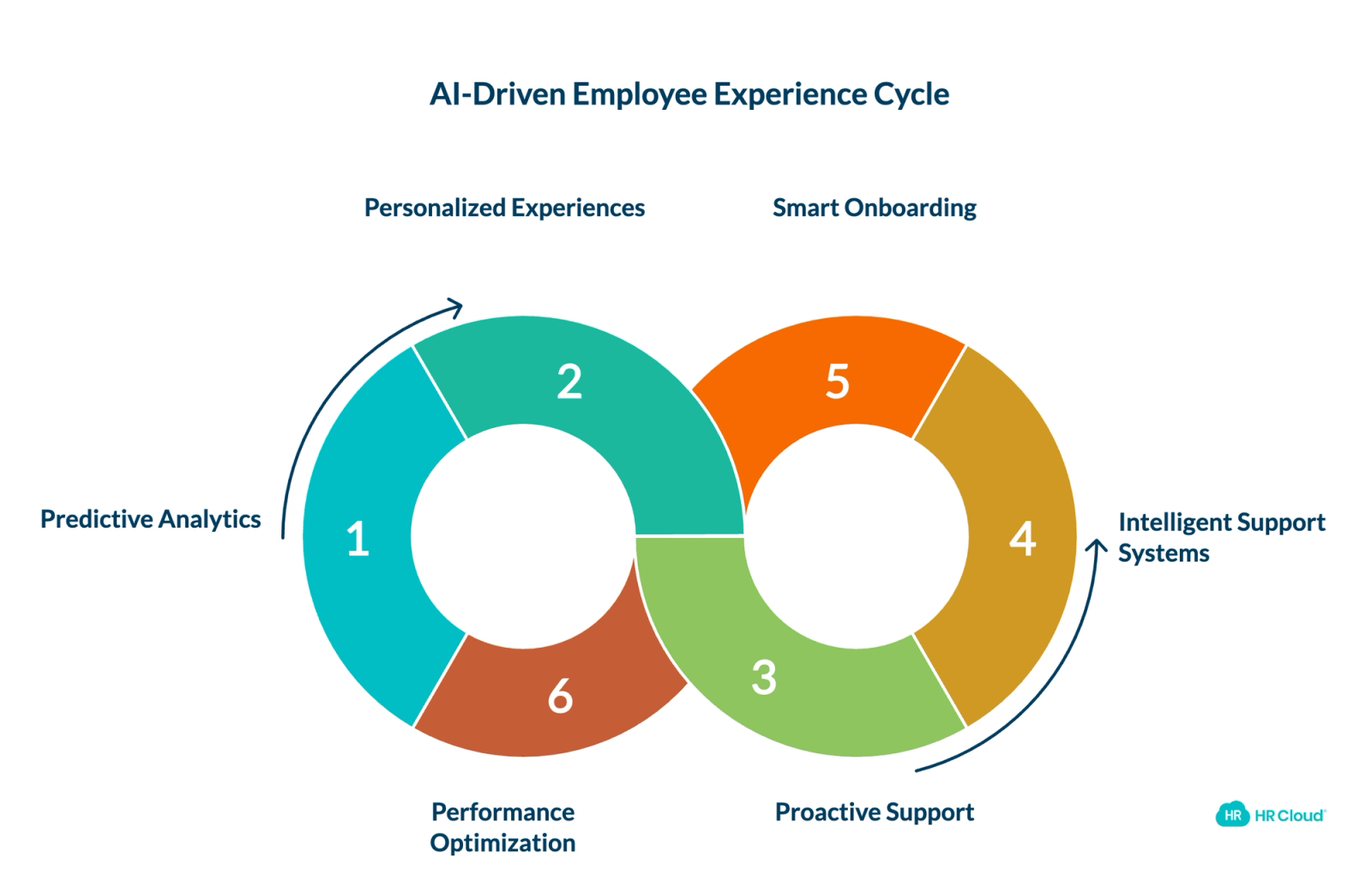
Traditional HR operates in reactive mode—addressing problems after they surface, responding to employee requests individually, and relying on annual surveys for engagement insights. AI fundamentally changes this paradigm by enabling predictive analytics, personalized experiences, and proactive employee support.
Predictive AI can anticipate employee turnover with high accuracy, allowing organizations to address retention risks before they become departures. This shift from reactive to predictive represents a fundamental transformation in workforce management.
Modern AI systems don't just process data—they understand context, learn from interactions, and adapt to individual employee needs. This creates experiences that feel genuinely personal and relevant, rather than generic and bureaucratic.
Real-World AI Applications Driving Results
The most successful AI implementations focus on solving real employee pain points while delivering measurable business value. Current applications span the entire employee lifecycle, from ai recruitment solutions through retention.
Intelligent Support Systems represent one of the most immediate wins. AI-powered chatbots handle routine questions, freeing HR professionals for strategic work. According to IBM research, their watsonx Assistant has reduced the time employees spend on common HR tasks by 75%. Many teams hire remote AI developers to deliver HR chatbots that plug into knowledge bases and ticketing systems while meeting security and compliance requirements
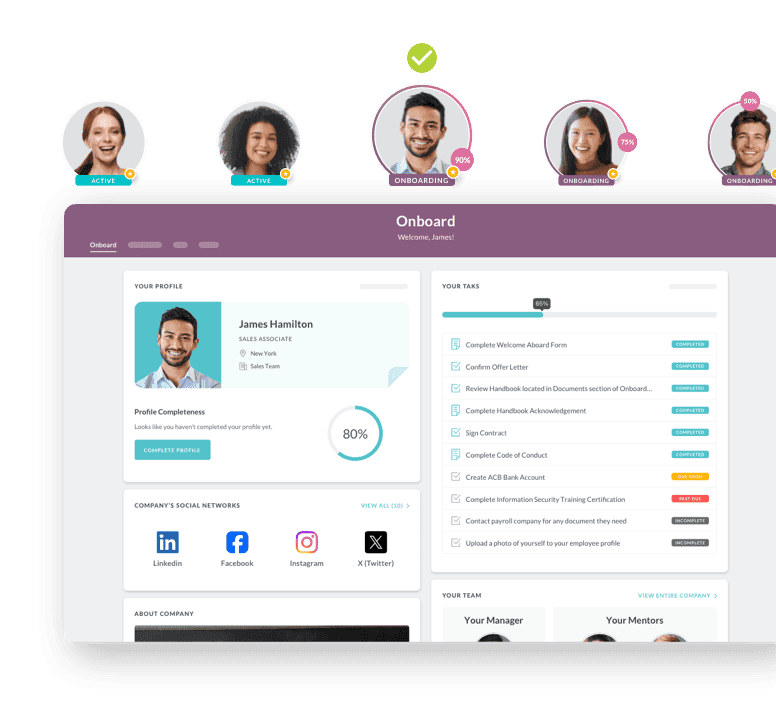
Smart Onboarding transforms what's traditionally a frustrating, paper-heavy process into a streamlined, engaging experience. An employee experience platform automate document submission, training assessments, and learning plans, converting the traditionally long onboarding journey into efficient self-service tasks.
Performance Optimization goes beyond traditional annual reviews. AI-driven performance management provides continuous feedback, identifies skill gaps, and suggests development opportunities in real-time. AI-led mentorship platforms match employees with tailored coaching opportunities based on career aspirations, skills, and personality traits.
Strategic Implementation: Your AI Roadmap
| Phase | Timeframe | Focus Areas | Key Actions |
|---|---|---|---|
| Phase 1: Foundation Setting | Months 1–3 | Assessment, quick wins, stakeholder alignment | Conduct an honest evaluation of existing processes, technology capabilities, and employee pain points. Document current workflows, identify bottlenecks, and catalog existing HR technology investments. Look for high-volume, routine processes that can be automated without complex integrations. Build a coalition of champions across HR, IT, and business leadership. Address concerns proactively and communicate that AI enhances rather than replaces human capabilities. |
| Phase 2: Pilot Program Launch | Months 4–6 | Technology selection, employee communication, success metrics | Choose platforms that integrate with existing HRIS, communication tools, and workflow systems. The most successful implementations feel seamless to employees rather than requiring new logins or processes. Communicate clearly about what AI will and won't do, how decisions are made, and how employee privacy is protected. Beyond traditional engagement scores, track resolution times, employee self-service rates, and HR productivity metrics. |
| Phase 3: Scale and Optimize | Months 7–12 | Expansion strategy, continuous improvement, advanced applications | Build on proven successes while addressing new use cases. If chatbots succeed for policy questions, extend them to benefits enrollment or performance reviews before introducing entirely new AI applications. Use regular employee feedback, usage analytics, and outcome measurement to enable continuous optimization. As foundational capabilities mature, tackle more complex predictive and strategic applications including future health risks, skills gaps, and hiring needs. |
Overcoming Implementation Challenges
Addressing Common Barriers
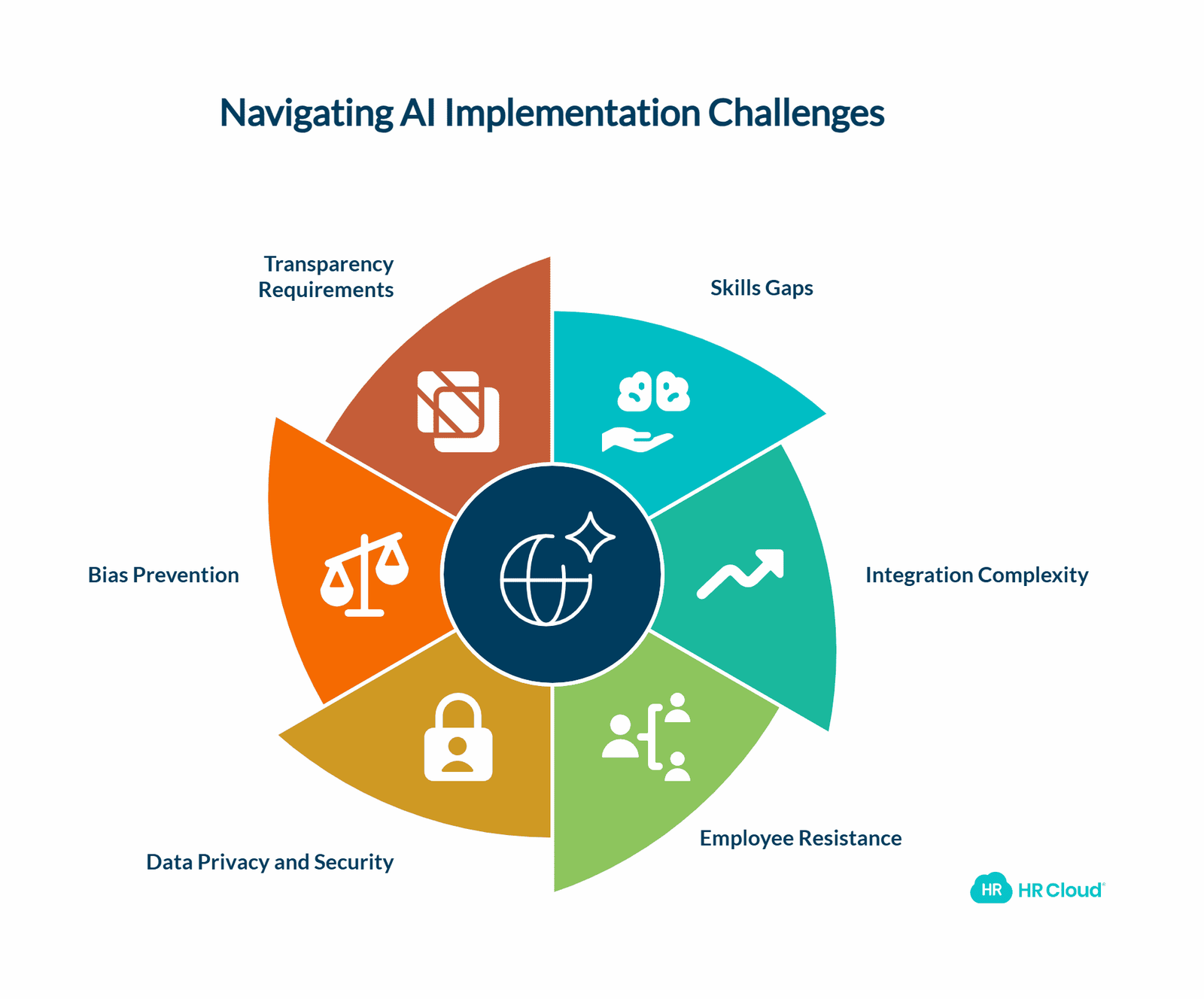
While AI's potential is clear, successful implementation requires navigating real challenges that have derailed many initiatives. Understanding and preparing for these obstacles dramatically increases success probability.
Skills Gaps represent the most commonly cited barrier. According to McKinsey research, the solution isn't hiring AI experts for every function—it's building AI literacy across the organization while partnering with experienced providers for specialized capabilities. Develop internal champions who can bridge technical capabilities with business needs.
Integration Complexity challenges many organizations. Success requires choosing AI solutions designed for integration rather than standalone operation. Prioritize platforms with robust API capabilities and pre-built connectors to popular HR systems.
Employee Resistance often stems from fear and misunderstanding rather than inherent technology problems. Address concerns through transparent communication, gradual introduction, and clear demonstration of AI's role in making work easier, not eliminating jobs.
Best Practices for Sustainable Success
Long-term AI success requires more than initial implementation—it demands ongoing attention to ethics, performance, and organizational change management.
Data Privacy and Security must be built in from the beginning, not retrofitted later. Following GDPR and other privacy regulations, implement robust encryption, access controls, and audit trails. Ensure AI systems handle sensitive information according to the highest security standards.
Bias Prevention requires ongoing vigilance and systematic approaches. Establish diverse review committees for AI system outputs, particularly in hiring, promotion, and performance evaluation applications. Using an AI checker to review AI-generated outputs before they inform hiring or performance decisions adds an extra layer of quality control, helping HR teams catch inconsistencies and ensure decisions remain fair and human-verified. Regular testing with diverse data sets helps identify and correct biased patterns.
Transparency Requirements reflect growing employee and regulatory expectations. Develop clear explanations for how AI systems make decisions, what data they use, and how employees can appeal or request human review.
The Business Case: Quantifying AI's Impact
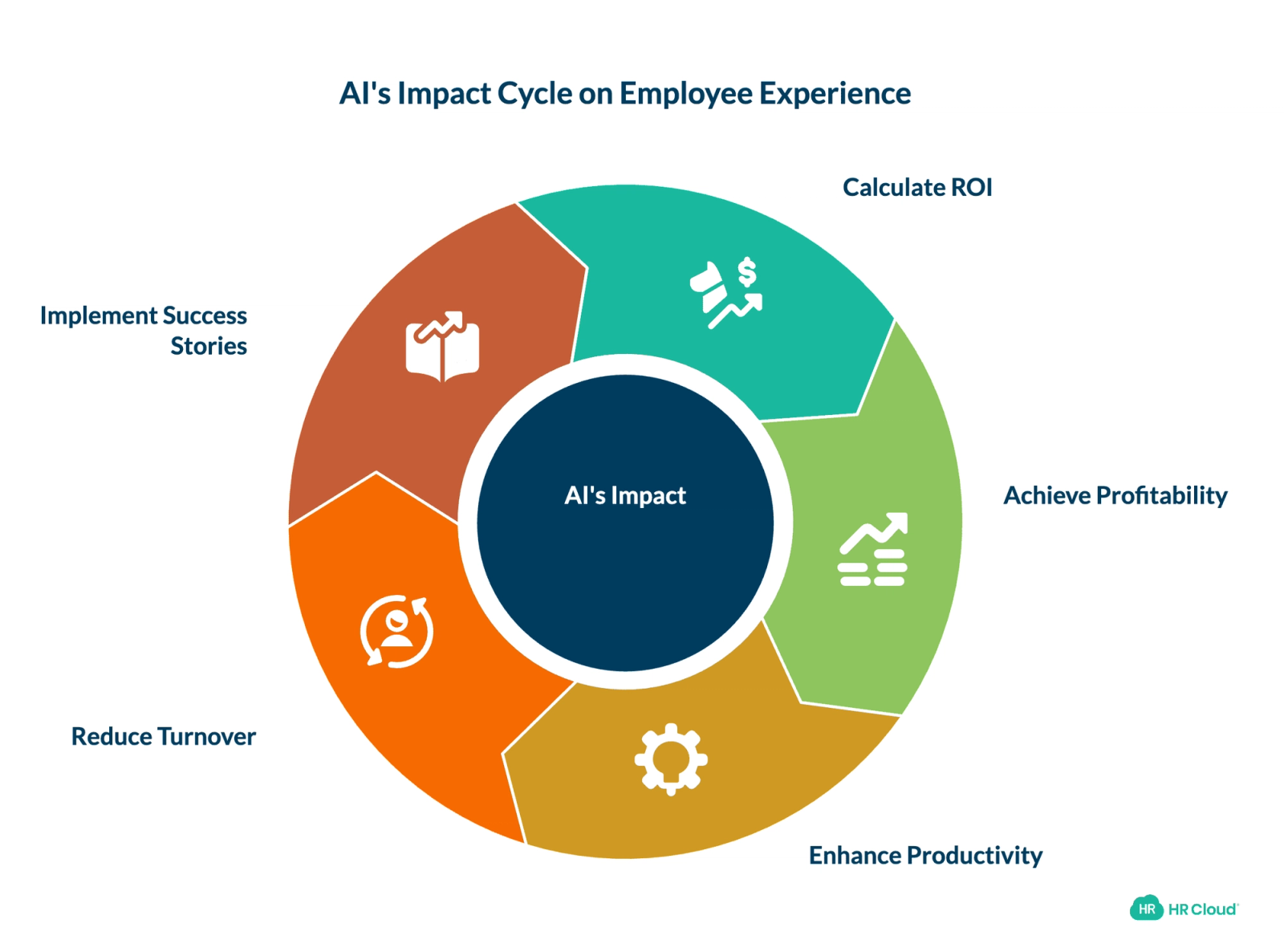
Calculating ROI
Understanding the financial impact of AI-powered employee experience requires looking beyond traditional engagement metrics to measurable business outcomes. The most successful organizations develop comprehensive ROI frameworks that capture both direct cost savings and indirect productivity gains.
Even modest improvements in profitability through increased employee engagement can translate to substantial gains. For a $100 million revenue organization, a 0.5% improvement equals $500,000 in additional profit annually.
The productivity improvements alone justify significant investment. When HR staff can redirect even 25% of their time from routine tasks to strategic initiatives, the organizational impact multiplies dramatically.
For organizations with 1,000 employees and average salaries of $75,000, a 5% reduction in turnover saves approximately $750,000 annually in replacement costs alone.
Success Stories from the Front Lines
Real-world implementations provide compelling evidence of AI's transformative potential. A large pharmaceutical company manages a team of 6,000+ scientists and manufacturing experts with only ten people in learning and development by automating training, compliance tracking, onboarding, and leadership support.
Australia's largest telco, Telstra, used AI to build a chatbot named Codi that handles multiple internal and external tasks, saving an estimated AUD 10 million. The scale of savings possible through intelligent automation becomes clear when AI handles high-volume, repetitive interactions.
Download the free employee engagement checklist for managers
Use it to turn good intent into steady habits. Tick items, spot misses, and correct fast. The format is printable, one page, and built for hybrid and deskless teams.
Download Now
Your Next Steps
The opportunity for AI-powered employee experience transformation exists now, but competitive advantages go to organizations that act decisively. Start with a comprehensive readiness assessment that evaluates current processes, technology capabilities, and organizational readiness.
Identify pilot program opportunities by selecting high-value, low-complexity initiatives that can demonstrate AI's potential while building organizational confidence. Focus on use cases where success can be measured clearly and communicated effectively.
The employees of 2026 expect intelligent, personalized, and efficient experiences from their employers. Organizations that can't deliver these experiences will struggle to attract and retain the talent needed for success.
Success requires more than just implementing AI technology—it demands strategic thinking, careful planning, and ongoing optimization to ensure AI truly enhances rather than complicates the employee experience.

Experience how Workmates can transform communication and strengthen culture—all in one powerful platform
Book Your Free DemoFrequently Asked Questions
Q: How quickly can we expect to see ROI from AI implementation?
A: Most organizations see initial productivity gains within 3-6 months, with measurable ROI typically achieved within 12-18 months. Quick wins like automated FAQ responses can deliver immediate value.
Q: Will AI replace HR professionals?
A: No. AI augments human capabilities by handling routine tasks, enabling HR professionals to focus on strategic initiatives like culture development, complex problem-solving, and employee coaching.
Q: What's the biggest risk in AI implementation?
A: Poor change management and inadequate employee communication. Technical failures are less common than adoption failures due to insufficient stakeholder buy-in.
Q: How do we ensure AI decisions are fair and unbiased?
A: Implement diverse review committees, use varied training data, conduct regular bias audits, and maintain human oversight for critical decisions like hiring and promotions. MIT's research on algorithmic bias provides excellent frameworks for bias detection and prevention.
Q: What size organization can benefit from AI-powered employee experience?
A: Organizations of all sizes can benefit. Smaller companies might start with chatbots for basic queries, while larger enterprises can implement comprehensive predictive analytics and automation platforms.
About the author

Keep Reading


Like What You Hear?
We’d love to chat with you more about how HR Cloud® can support your business’s HR needs.
Book Your Free Demo