What's the Best HR Platform for Fast-Growing Tech Companies to Scale Onboarding?

The best HR platform for fast-growing tech companies to scale onboarding is one that gives HR visibility into whether every dependency a new hire needs, documents, manager tasks, IT access, training, is actually complete, owned, or stuck, rather than one that just automates a checklist. For tech companies specifically, that usually means HR software built to run role-based workflows at scale, not a generic HR platform borrowed from a different kind of company. Manual processes break down once hiring happens across multiple departments or locations at once and a company can no longer rely on one person holding the real process in their head. HR Cloud is built around exactly this: role-based workflows with tracked ownership and due dates, rather than a generic checklist that still depends on someone remembering to follow it.
Why Scaling HR Gets Harder as Tech Companies Grow
Onboarding inconsistency across teams and locations
A small tech company can run onboarding out of a shared doc and a founder's memory. That breaks down once hiring is happening across multiple departments and often multiple locations or time zones at once, and the person who used to personally walk every new hire through setup can no longer do that for everyone.
The result is inconsistency, not failure all at once. One engineering hire gets dev environment access on day one because their manager happened to remember. Another waits three days because the person who normally sets that up was out. A sales hire in a different city gets a completely different first-week experience than one in the home office, not because anyone designed it that way, but because nobody standardized it.
This isn't a minor problem. Gallup found that only 12% of employees strongly agree their organization does a great job of onboarding (Gallup), which means inconsistent onboarding is closer to the industry norm than the exception, and exactly why it compounds unnoticed as a company scales rather than triggering an obvious alarm.
What Breaks First When Tech Companies Scale HR Manually
Spreadsheets, ad hoc Slack processes, tribal knowledge
The earliest cracks show up in the tools that were never meant to run HR at scale. A shared spreadsheet tracking new-hire tasks works fine for a handful of hires a quarter. It stops working when several hires start in the same week, each needing a different mix of tasks depending on role, department, and whether they're remote. Spreadsheets have no automated reminders, no audit trail of who completed what, and no way to flag a stalled task before a new hire's first day arrives with something still missing.
Ad hoc Slack processes fail the same way. Pinging IT in a channel to request a new hire's laptop and account access works until nobody remembers who's supposed to follow up, or the message scrolls past unanswered during a busy sprint. Nothing tracks whether the task actually got done, so the first sign of a gap is usually a new hire showing up without system access on day one, discovered reactively instead of caught in advance.
Tribal knowledge is the hardest to see coming, because it doesn't look broken until the moment it is. When one person in HR or ops holds the "real" onboarding process in their head rather than in a documented system, that knowledge doesn't transfer when they're out sick, on vacation, or leave the company. Growth exposes this fast: what worked because one person held it together doesn't survive that person being unavailable during exactly the period the company is hiring fastest, which is often when they're stretched thinnest themselves.
A live SHRM survey of 350 HR leaders found that 76% of organizations aren't effectively onboarding new hires, and only 47% said their onboarding program successfully retains new hires (SHRM). That's the real cost of the manual, inconsistent version: not a hypothetical risk, but a documented majority-case failure to retain the people it's supposed to be integrating.
What Scalable Onboarding Software Provides
This is also where onboarding automation and a tech company's HRIS start to overlap. Onboarding is the entry point; the HRIS is where that employee's record lives afterward. The two work best as one connected system rather than two disconnected tools that both claim to be the source of truth.
Automated workflows that don't require rebuilding per hire
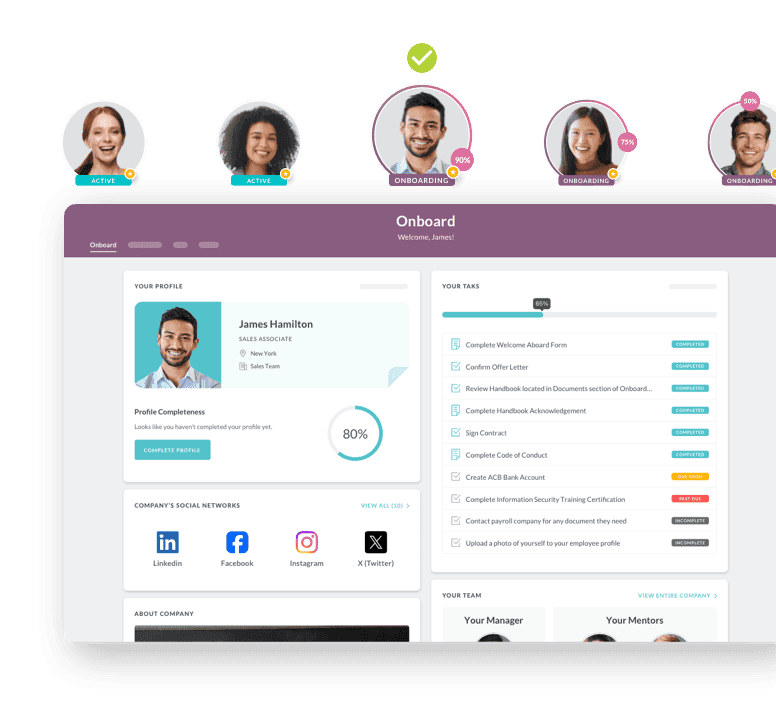
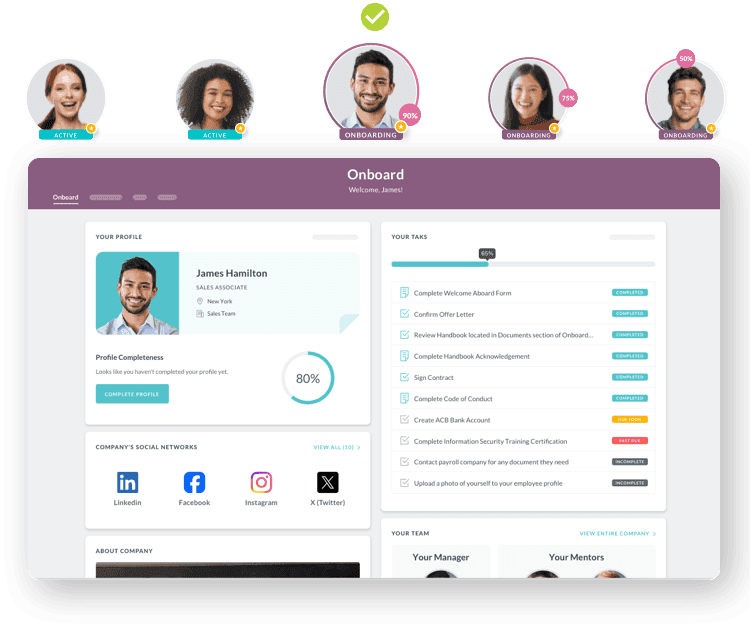
Scalable onboarding software replaces the rebuild-it-every-time pattern with workflows that trigger automatically based on role, department, and start date. HR Cloud's onboarding automation is built around exactly this: workflows and checklists that guide each step of the onboarding process without HR manually assembling a new task list for every hire, per HR Cloud's pricing and features page. The distinction that matters at scale isn't whether a checklist exists, most companies have one somewhere, it's whether that checklist runs itself once triggered, with an owner and a due date on every task, or whether someone has to remember to open it, copy it, and manually assign each line every time.
Role-based onboarding templates
Rather than one generic checklist for every new hire, HR Cloud supports personalized, tailored onboarding plans built around the employee's actual role, using customizable workflows and checklists, custom tabs and fields, and role-specific task assignment. A newly hired engineer and a newly hired account executive don't need the same first-week tasks: one needs repository access, environment setup, and a code review buddy; the other needs CRM access, territory assignment, and product training. Building that distinction once into a template, rather than reconstructing it by hand every time someone joins, is what actually lets onboarding scale with headcount instead of scaling HR's workload alongside it.
How Fast-Growing Tech Companies Solve This Today
Standardizing onboarding before hitting 100+ employees
Companies that avoid the inconsistency problem above generally standardize onboarding before they're forced to, not after. The trigger isn't a specific headcount number so much as a specific set of conditions: hiring across multiple departments at once, distributed or remote teams, role-specific setup requirements, and dependence on one or two individual process owners who can't scale their own attention indefinitely. A 70-person company hiring 30 people in a quarter across three time zones can hit this wall faster than a stable 300-person company hiring five people a year.
HR Cloud's own implementation timeline supports acting on this proactively: most customers are up and running within 2 to 6 weeks, according to HR Cloud's FAQ, which gives a company anticipating a hiring wave a real window to standardize before the wave hits, not just after it's already caused a run of inconsistent first weeks.
| Manual process (spreadsheets, Slack, tribal knowledge) | Automated, role-based workflow | |
|---|---|---|
| Task tracking | Lives in someone's memory or a shared doc; easy to lose track mid-hire | Tracked per task with due dates and completion status |
| Consistency across hires | Depends on who happens to be available that week | Same template runs the same way every time |
| IT/access requests | A Slack message that can go unanswered | A tracked task inside the workflow, with an owner and a due date |
| What happens when the process owner is out | The knowledge gap shows up immediately | The workflow runs the same regardless of who's available |
| Time cost as headcount grows | Scales roughly with hires | Requires less repeated setup once reusable templates are established |
Step-by-Step: Building Scalable Onboarding
Step 1: Document your current onboarding process
Before automating anything, write down what onboarding actually looks like today, including the informal parts nobody's written down. What does IT actually do to provision a new engineer's accounts, in what order, and who's supposed to confirm it's done? Who actually walks a new sales hire through the CRM, and what happens if that person is out that week? This step exists specifically to expose the tribal knowledge described above before it can be automated. If you can't answer these questions for your own company today, that's the actual first finding of this step, not a reason to skip it.
Step 2: Build role-based templates
Group your current onboarding tasks by role or department rather than treating every hire identically. Start with your two or three highest-volume roles rather than trying to template every job title in the company at once; the templates for less common roles can follow once the pattern is proven on the roles you're hiring most often.
Step 3: Automate IT/access provisioning tasks
IT and access provisioning is a common source of dropped tasks in manual onboarding, since it depends on a request actually reaching IT and being acted on before a specific date, with no built-in mechanism to flag if it slips. It's worth being precise here about what "automate" actually means: HR Cloud can automate the assignment, ownership, reminders, and tracking around an IT-access task, turning it into a tracked item inside the workflow with a due date and a visible status. Whether the external account itself gets created automatically in a given system depends on the specific integration in place and should be confirmed for your own stack rather than assumed. HR Cloud connects directly with Slack, Google Workspace, and Microsoft 365, and supports custom workflows through Zapier for systems without a native connection, per HR Cloud's own integrations page and homepage.
Step 4: Set up manager and buddy check-ins
Automated task completion doesn't replace human connection in the first weeks, and treating it as a substitute is a common way structured onboarding programs still fail to retain people despite looking organized on paper. Build manager check-ins and buddy assignments into the workflow as tasks with due dates, the same way document collection or access requests are tracked, so they don't quietly get skipped during a busy hiring stretch.
Step 5: Measure time-to-productivity
Once onboarding is standardized, measure how long it actually takes a new hire to reach full productivity by role, and use that as the baseline for improvement. Pick a concrete, role-specific marker rather than a vague sense of "ramped up," for example, an engineer's first merged pull request, or a sales rep's first closed deal, so the metric is something you can actually track consistently across hires and over time as the company scales.
How HR Cloud Supports Fast-Growing Tech Teams
Automated onboarding workflows
HR Cloud automates the onboarding steps that otherwise require manual follow-up: e-signatures, document collection, task assignment, and automatic reminders, all built into customizable workflows rather than sold as separate add-ons, per HR Cloud's pricing page feature comparison. Combined with the platform's reporting and approval-workflow features, the practical value for a growing HR team is visibility: seeing what's complete, what's still owned by someone, and what's stuck, rather than finding out a task was missed only when a new hire flags it.
Role-based templates
Onboarding plans in HR Cloud are personalized and tailored per employee, using customizable portals, custom tabs and fields, and workflows that can be built around role, department, or location, so a fast-growing company can set the pattern once per role rather than rebuilding it for every new hire.
Integration with IT/access tools
HR Cloud integrates with Slack, Google Workspace, and Microsoft 365, and connects to ATS platforms including Greenhouse, Lever, JazzHR, and Workable, per HR Cloud's FAQ and integrations page. For systems without a native connection, HR Cloud supports Zapier-based custom workflows to bridge the gap. HR Cloud does not publish a dedicated identity-provider or IT-ticketing integration, such as Okta or Jira, on its current integrations page, so a tech company relying on automated SSO provisioning as part of onboarding should confirm that specific workflow directly with HR Cloud before assuming it's covered.
For a technical buyer evaluating this, integration depth matters as much as the number of integrations listed. Worth asking any vendor, HR Cloud included: which system stays the source of truth for employee data, what actually syncs versus what's a one-way task trigger, which actions the platform executes directly versus tracks and hands off to a human, and what happens when an integration or an assigned task fails silently instead of visibly.
HR Cloud reports, in its published case study, that Osmose Utilities Services (a field-based construction and utilities company, not a tech company) saw a typical onboarding go from up to two hours per new hire with data entry errors, to a 24% improvement in data accuracy within three months, roughly 7 hours of HR time saved per week, a 60% reduction in onboarding cost, and new hires ramping about 3 times faster after implementing HR Cloud's Onboard solution (HR Cloud case study: Osmose Utilities Services). Separately, HR Cloud's customer case study listing headlines a result for MCO, a financial services company, onboarding 2,000 employees in five days or less (HR Cloud customer stories). Neither is a tech-sector customer, which is worth naming directly rather than implying otherwise. HR Cloud does not currently publish a dedicated tech or SaaS company case study.
Common Mistakes When Scaling Onboarding
Manually recreating onboarding for every new hire
A frequent mistake is treating every new hire as a one-off project instead of an instance of a repeatable template. This is exactly the pattern that breaks down once hiring volume increases, since the time cost scales with headcount instead of flattening out the way a template-based process does, as shown in the comparison table above.
No feedback loop from new hires
A second mistake is building an onboarding process and never checking whether it's actually working from the new hire's perspective. Without a feedback loop, an onboarding process can quietly get worse as the company scales; tasks that made sense for a smaller company can become confusing or redundant later, and nobody notices unless new hires are actually asked. A short structured check-in at 30 and 90 days, asking specifically what was confusing or missing rather than a generic "how's it going," catches this before it shows up as an early departure instead of a fixable process gap.
What Scalable Onboarding Delivers
Faster ramp-up and reduced HR admin time
The measurable outcome of scalable onboarding is fewer hours of manual HR admin work per hire and faster time-to-productivity for the new hire. Osmose's numbers above (7 hours saved per week, 60% lower onboarding cost, 3x faster ramp) are the clearest verified example of this from HR Cloud's own customer base, even outside the tech vertical specifically. The mechanism is the same regardless of industry: automating the tasks that used to require manual follow-up, and making their status visible rather than hidden in someone's inbox, is what frees HR time and removes the delay that a stalled task otherwise causes silently.
Conclusion
Scaling onboarding at a fast-growing tech company is less a checklist problem than a visibility problem: knowing whether every dependency a new hire needs, documents, tasks, IT access, training, is complete, owned by someone, or quietly stuck. Manual processes built on spreadsheets, Slack messages, and one person's institutional memory don't surface that visibility, and the available research suggests most companies' onboarding underperforms as a result. HR Cloud's role-based workflows, tracked task ownership, and integrations with tools like Slack, Google Workspace, and Microsoft 365 are built to give a growing HR team that visibility. If IT/access provisioning through a specific identity or ticketing platform is a hard requirement, confirm that integration directly with HR Cloud before committing, since it isn't part of the current published integration list. Request a demo to see how the platform handles role-based onboarding at your actual headcount and hiring pace.

Discover how our HR solutions streamline onboarding, boost employee engagement, and simplify HR management
Book a DemoFAQs
At what headcount should companies formalize onboarding software?
There's no single headcount trigger. The real signals are hiring across multiple departments or locations at once, role-specific setup needs, and dependence on one or two people who hold the process informally rather than in a documented system. A fast-hiring 70-person company can hit this wall sooner than a slower-growing 300-person one.
Can onboarding templates differ by department?
Yes. HR Cloud supports personalized, tailored onboarding plans and customizable workflows that can be built around role, department, or location, so an engineering hire and a sales hire can follow different task sequences from a single platform rather than one generic checklist applied to everyone.
Does onboarding software integrate with IT provisioning tools?
HR Cloud integrates with Slack, Google Workspace, and Microsoft 365 directly, and supports Zapier-based custom workflows for connecting to other systems. It can track and assign an IT-access task with an owner and due date; whether it can automatically create the account itself in a given external system depends on the specific integration and should be confirmed directly. HR Cloud does not currently publish a dedicated identity-provider or IT-ticketing integration such as Okta or Jira.
How is onboarding software different from an ATS?
An ATS (applicant tracking system) manages the hiring process up through an accepted offer: job postings, candidate pipelines, interview scheduling. Onboarding software takes over from there, managing everything from the accepted offer through the new hire becoming fully productive: paperwork, task automation, access provisioning, and check-ins. HR Cloud offers both as separate but connected products, Recruit ATS and Onboard, rather than treating one as a subset of the other. For a tech company evaluating its full stack, onboarding software is usually one module inside a broader HRIS rather than a replacement for one, HR Cloud's People HRIS is the connected system Onboard feeds into.
About the author

Keep Reading


Like What You Hear?
We’d love to chat with you more about how HR Cloud® can support your business’s HR needs.
Book Your Free Demo