What Is an HRIS and Why Every Business Needs One

What is an HRIS?
A Human Resource Information System (HRIS) is software that centralizes employee data, records, documents, compliance status, and job history, and automates the HR workflows built around that data, including onboarding, time off, and reporting. Instead of employee information living across spreadsheets, email threads, and paper files, an HRIS gives a company one searchable, permission-controlled source of truth that every HR process reads from and writes to.
Most HR software still assumes employees sit at a desk, check email regularly, and log into systems on their own. Healthcare workers, plant employees, field crews, retail associates, and school staff often do not work that way, which is exactly where a lot of HRIS platforms fall short before an employee ever finishes onboarding. A good HRIS is judged less by whether it stores data correctly, and more by whether the work required around that data, documents, approvals, tasks, actually gets completed on time, for every employee, regardless of where or how they work.
How Does an HRIS Actually Work?
At a functional level, an HRIS is built around one employee record that multiple workflows plug into, rather than a single tool that does everything in isolation. When someone is hired, their information is entered once, name, role, compensation, start date, required documents, and that record becomes the reference point for everything that happens next.
From there, the system triggers and tracks the work tied to that record. Onboarding tasks fire automatically based on the start date: e-signatures, I-9 collection, equipment requests, welcome messages. Time-off requests route to the right manager and update accrual balances without a spreadsheet. Compliance requirements, license renewals, policy acknowledgments, required training, get flagged with due dates instead of relying on someone remembering to check. Reporting dashboards pull live from the same record, so headcount, turnover, and task-completion numbers reflect what's actually true today, not what was true the last time someone exported a spreadsheet.
The practical difference this makes shows up most clearly in what happens when something needs to change. If a manager updates an employee's department, a well-built HRIS reflects that change everywhere at once, in the org chart, in reporting, in whoever's approval chain depends on it, without anyone needing to update five separate places by hand. That single-record architecture is also what makes self-service possible: an employee can update their own address or check their own time-off balance because the system trusts one record instead of reconciling several.
Most modern HRIS platforms are cloud-based and accessed through a browser or mobile app, rather than installed software, which is part of why mobile access has become a baseline expectation rather than a premium feature, especially for organizations where a meaningful share of the workforce does not sit at a computer during the day.
Permissions work the same way underneath all of this. A manager typically sees their direct reports' schedules and time-off requests but not another department's compensation data. HR administrators see more, but even they are usually scoped by location or division in larger organizations. That layered access is what makes it safe to let more people touch the system directly instead of routing every request through a single HR inbox, which is part of what actually drives adoption once an HRIS is live.
What are the Core Features of an HRIS?
Not every HRIS ships with every one of these fully built out, but most mature platforms share this core set of components. Evaluating a vendor module by module, rather than trusting a single feature-list page, is usually the only way to know which gaps actually matter for a given company.
Employee Records and Self-Service
A searchable, permission-controlled database of job history, compensation, documents, and personal information, paired with self-service so employees can update their own details, check a balance, or find an answer without filing a request with HR.
Onboarding and Offboarding Workflows
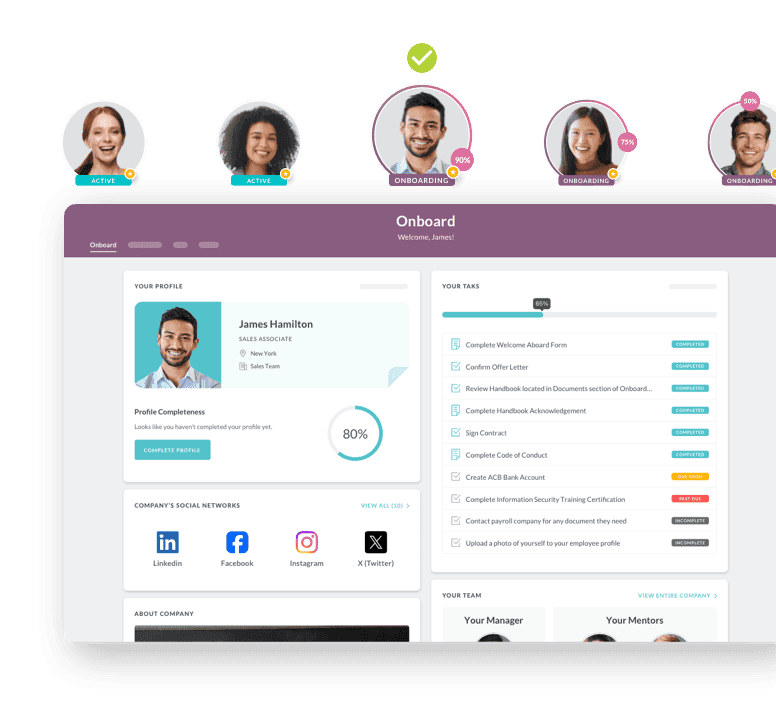
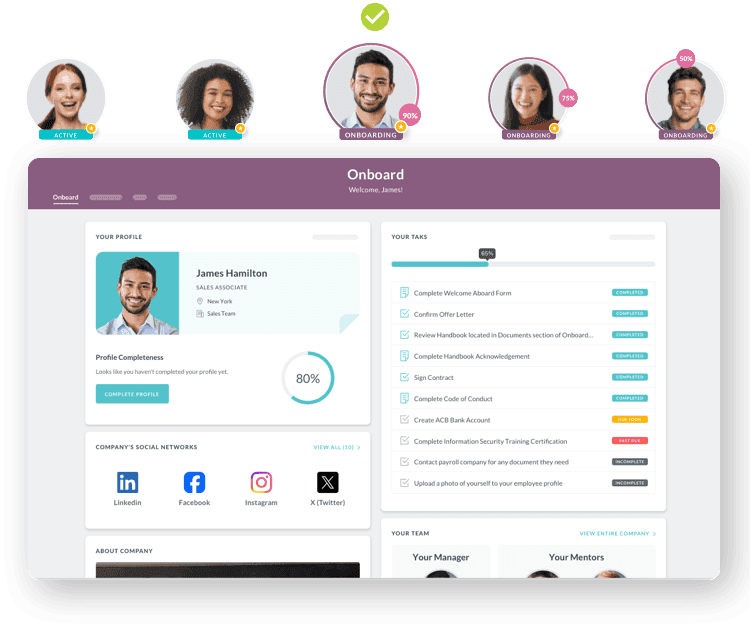
Automating the sequence of tasks tied to a new hire's first days, e-signatures, document collection, welcome communications, and the reverse process when an employee departs, including access revocation and asset recovery. A well-built version of this covers both directions equally; offboarding is where compliance risk and unreturned equipment tend to slip through if it's treated as an afterthought.
Time and Attendance Tracking
Time-off requests and accrual tracking so managers can approve requests and HR can see coverage without exporting data to a separate tool. For hourly and shift-based workforces, this often extends to clock-in/clock-out tracking tied to the same employee record used everywhere else.
Compliance and Document Management
A system of record for required forms and policy acknowledgments, with an audit trail. A strong HRIS timestamps every change and keeps documents retrievable when a regulator or auditor asks for them, rather than requiring someone to search through a filing cabinet.
Org Charts and Reporting Structures
Tracking who reports to whom, updated automatically when a manager or department changes, instead of a static chart someone forgets to edit after a reorganization.
Workflow Automation
Position changes, promotions, and policy updates typically require the same sequence of approvals every time. Configurable workflow automation lets HR build that sequence once and reuse it instead of chasing signatures over email.
Reporting and Visibility
Headcount trends, task completion, and compliance status visible in a dashboard rather than reconstructed from raw exports every time leadership asks a question. This is usually where the value of centralizing data first becomes obvious to leadership outside HR, since it's the first time they can pull an answer themselves instead of waiting on a request.
Payroll Coexistence and Integrations
Very few companies want to replace a payroll provider they already trust just to get a better HRIS. HR Cloud maintains direct integration paths with platforms including ADP and UKG, so a company keeps its existing payroll relationship while adding a modern HRIS layer on top.
How these features interact matters as much as whether each one exists. A workflow automation engine that cannot see the same employee record used by onboarding will generate duplicate or conflicting tasks. A reporting dashboard pulling from a stale nightly export instead of live data shows leadership numbers that are already out of date. The strongest HRIS platforms are built so a change made in one module is visible everywhere else immediately, rather than requiring a manual sync.
What are the Benefits of an HRIS?
HR stops chasing the same missing tasks. Workflow automation removes manual follow-up. Instead of an HR administrator manually emailing a reminder and waiting for a reply, a task triggers automatically based on a date or status change, and HR can see who is behind without asking.
Frontline employees can complete HR tasks without living in email. For a workforce that does not sit at a computer, mobile access is not a nice-to-have, it is the difference between an HRIS people actually use and one that quietly reverts to paper and phone calls. HR Cloud's onboarding is built to be completed entirely from a phone, and its AI assistant, Maya, is designed to resolve routine employee questions directly rather than routing them to HR as a ticket.
HR can see what is missing or expiring before it becomes a problem. An HRIS with built-in document tracking gives HR a clear picture of outstanding requirements instead of discovering a gap during an audit. It does not guarantee compliance on its own, but it replaces guesswork with visibility into what is actually outstanding and for whom.
Fewer manual data errors. When one employee record feeds every downstream workflow, the same name, pay rate, or start date does not have to be manually re-entered into five different spreadsheets, each with its own chance of a typo. Osmose Utilities Services, an HR Cloud customer, reported a measurable improvement in data accuracy within months of centralizing onboarding on the platform.
Onboarding gets faster and more consistent. Every new hire follows the same sequence of tasks and reminders, regardless of who is running HR that week. Behavioral Progression, another HR Cloud customer, cut new therapist onboarding time substantially after moving the process onto HR Cloud, while also improving data accuracy.
Leadership gets a straight answer, faster. Real-time dashboards showing headcount, turnover, and compliance status let leadership spot a problem while it is still small instead of discovering it three months late in a quarterly report.
The financial stakes behind these benefits are not abstract. HR Cloud's own product data cites an average cost of roughly $4,700 to onboard a single employee, and that about 30% of new hires quit within their first 90 days when onboarding is handled poorly. Gallup research separately puts the cost of replacing an employee at 50% to 200% of that person's annual salary, and estimates voluntary turnover costs U.S. businesses more than $1 trillion a year, figures reported in detail by Qooper's turnover cost research. An HRIS will not fix a broken culture, but a slow, error-prone onboarding process is one of the most controllable contributors to early attrition.
Ventana Research has separately estimated that HR departments spend an average of 18 hours a week managing spreadsheets manually, a figure reported by Employee Cycle, close to half of a full-time role spent reconciling data instead of doing work that affects retention or compliance.
“ Our hiring managers now have a reliable system that is easy to navigate. Our HR team can actively monitor the process, and assist if needed, but Onboard has helped them save so much valuable time and effort while increasing data accuracy.”

— Kaylee Collins, HR Analyst, Osmose

Who Needs an HRIS?
Small businesses typically need an HRIS that replaces spreadsheets with a centralized employee record and basic onboarding automation, without a long or expensive implementation. HR Cloud's SMB-focused pricing is built around this need, offering core HRIS and onboarding capability without enterprise-level cost or complexity.
Mid-market companies usually need multi-location compliance tracking, deeper workflow automation, payroll integration, and enough reporting to support real workforce planning. This is often the stage where companies discover that the lightweight HR tools that worked at 50 employees were never designed for 500, particularly around multi-location compliance and frontline workforce management. It's also the stage where a second office, warehouse, or region typically forces the issue, since informal processes that worked for one location rarely survive contact with a second one intact.
Enterprises and multi-location, frontline-heavy organizations need an HRIS built for scale from the start: thousands of employees across multiple states, compliance requirements that vary by location, and mobile-first access for a workforce that may not sit at a desk.
What that looks like varies by industry. A hospital or senior care facility needs credential and license verification completed before a new hire's first shift, not discovered as a gap afterward. A manufacturer running multiple shifts across several plants needs safety checklists coordinated across locations without every plant manager keeping a separate spreadsheet. A construction employer needs site-specific requirements, safety certifications, equipment sign-off, completed before someone steps onto a job site, often for a workforce that moves between sites regularly. A retail or hospitality chain hiring seasonal staff across dozens of locations needs I-9 and direct deposit information collected before day one, at volume, without assuming every new hire checks a company email daily.
The common thread is that the employee record is the easy part. The harder part is whether the required work around that record, credential checks, safety sign-offs, seasonal onboarding at scale, gets completed reliably across every location and every shift. A company evaluating an HRIS is better served asking which of these situations describes their own workforce than asking which vendor has the longest feature list, since the fit that matters is operational, not just functional.
How do you Choose the Right HRIS?
Feature lists are easy to compare and easy to misjudge, since almost every vendor's page claims to check the same boxes. A more useful test is five direct questions, answered honestly against how your workforce actually operates, before signing anything.
- Can an employee complete required tasks from a phone, without a company laptop? If onboarding or document uploads only work well on a desktop browser, adoption will lag for anyone who does not sit at a desk. This is worth testing directly during a demo, on an actual phone, rather than taking a vendor's word for "mobile-friendly."
- Can HR see what is missing without opening five different systems? Status visibility, who has completed what, who is overdue, should live in one place, not require cross-referencing a spreadsheet against a portal against an inbox.
- Can workflows vary by role and location? A single-location office and a multi-state, multi-site employer have different compliance requirements, and the HRIS needs to handle that variation without a separate manual process for each site.
- Can a manager see what they owe before a new hire's start date? Equipment requests and manager-side tasks need the same visibility and accountability as HR-side tasks, or onboarding stalls on the manager's desk instead of HR's.
- Can it work alongside the payroll system you already trust? Very few companies want to replace payroll just to get a better HRIS. Confirm the platform integrates with your existing provider rather than requiring a full migration.
Beyond those five questions, confirm the vendor's security baseline before signing anything: SOC 2 Type II certification, GDPR compliance for any EU workforce data, encryption in transit and at rest, and role-based access controls. HR Cloud is SOC 2 Type II certified and GDPR compliant, with enforced encryption and role-based access. None of these standards guarantee compliance on their own, but they're the baseline that makes it possible to demonstrate good-faith controls if a regulator or auditor asks.
Once a platform is selected, define what success looks like before go-live, not after. Track onboarding time, data accuracy, HR hours spent on manual admin, and mobile task-completion rate before implementation, then check the same numbers again three to six months in. That comparison is what turns "this feels better" into a number someone can put in front of leadership.
Common HRIS Implementation Mistakes
Migrating dirty data. Importing years of inconsistent, duplicate, or outdated spreadsheet data into a new HRIS just moves the same problems into a nicer interface. A short data audit before migration, checking for duplicate records, missing fields, and mismatched formats, prevents this from becoming a bigger cleanup job after go-live.
Skipping change management. An HRIS only delivers value if employees and managers actually use it instead of continuing to email HR directly. Rollouts that skip training and internal communication tend to see low adoption regardless of how good the software is, and old habits, especially emailing a familiar HR contact directly, are hard to break without a clear, repeated reason to use the new system instead.
Trying to configure everything on day one. Companies that attempt to build every workflow and integration before going live often stall for months. A phased rollout, starting with the highest-impact workflow like onboarding, tends to produce faster, more durable results than a "big bang" launch that tries to solve every process at once.
Buying more platform than the team can use. It's tempting to buy the most feature-rich suite available in case it's needed later. A modular HRIS that expands as the organization is actually ready for it tends to produce a better return than an all-in-one platform bought years ahead of need, and configured by a team that doesn't yet have the bandwidth to manage the extra complexity.
Treating mobile access as an afterthought. For any organization with frontline, retail, healthcare, or field-based employees, an HRIS that only works well on a desktop browser will see poor adoption from most of the workforce, and the process quietly reverts to email and paper for the employees it was supposed to help most.
The Bottom Line
An HRIS is judged less by whether it stores employee data correctly, and more by whether the work required around that data actually gets done, on time, for every employee, regardless of where or how they work. That's the test worth applying before choosing one: can a frontline employee complete what's required without sitting at a computer, and can HR see what's missing without opening five different systems.
None of that happens by accident. It's the product of a system built around one connected employee record instead of a stack of disconnected tools, and it's worth treating that as the actual buying criterion, not a feature on a checklist.
Organizations evaluating their options can explore how HR Cloud's HRIS platform turns employee records into trackable, mobile-friendly workflows, review HR Cloud's onboarding automation, see results across industries in HR Cloud's case studies, or book a free demo to see the platform against a real onboarding and compliance scenario.

Discover how our HR solutions streamline onboarding, boost employee engagement, and simplify HR management
Book Your Free DemoFrequently Asked Questions
What does HRIS stand for?
HRIS stands for Human Resource Information System. It refers to software that centralizes employee data and automates core HR administrative workflows, including records management, onboarding, time off, and compliance tracking.
Is an HRIS the same as payroll software?
No. An HRIS manages employee records, workflows, and compliance data, while payroll software calculates and processes pay, taxes, and deductions. Many organizations keep their existing payroll provider and connect it to a separate HRIS rather than replacing payroll entirely.
What is the difference between an HRIS and an HCM system?
An HRIS focuses on employee records, administrative workflows, and compliance tracking. An HCM (Human Capital Management) system includes everything in an HRIS plus strategic capabilities like talent acquisition, performance management, and predictive workforce analytics. Most companies are better served starting with a strong HRIS and expanding as their needs grow.
What's the difference between an HRIS and an HRMS?
An HRMS (Human Resource Management System) includes everything in an HRIS plus payroll and benefits administration. An HRIS is the foundational layer, employee records and the workflows tied to them, while an HRMS adds operational management on top.
Do I need an HRIS if I already use payroll software?
Yes, usually. Payroll software handles pay calculation, taxes, and deductions. It typically doesn't manage onboarding workflows, document compliance, org charts, or self-service in the depth an HRIS does. Most companies run the two together, an HRIS connected to their existing payroll provider, rather than trying to make payroll software do a job it wasn't built for.
How long does it take to implement an HRIS?
Timelines range from a few weeks to several months depending on company size and data complexity. Enterprise HCM suites can take six months or longer. HR Cloud runs a guided, HR-led rollout with a dedicated customer success manager rather than a multi-month IT project.
What size company needs an HRIS?
There is no fixed headcount threshold, but most companies feel the need once spreadsheet-based HR administration starts producing errors, and the need arrives earlier for any organization with multiple locations or a frontline, non-desk workforce, where compliance complexity scales faster than headcount.
Can a small business use an HRIS, or is it only for large companies?
Small businesses can and should use one. Many platforms, including HR Cloud, offer pricing and feature sets scoped specifically for organizations under 250 employees, so a small business gets centralized records and onboarding automation without paying for enterprise-level complexity it does not need yet.
Does an HRIS replace the need for an HR team?
No. An HRIS automates repetitive administrative work, data entry, document routing, status tracking, so it reduces the manual burden on HR staff. It does not replace the judgment and relationship-building HR professionals bring to hiring, culture, and workforce planning.
What should I ask an HRIS vendor before signing a contract?
At minimum, ask how the platform performs on mobile for employees who do not sit at a desk, how it integrates with your current payroll provider, what the realistic implementation timeline looks like, whether pricing is per-seat or a fixed license, and what security certifications the vendor holds.
Is HRIS data safe to store in the cloud?
Cloud-based HRIS platforms are generally more secure than spreadsheets stored on local drives or shared over email, provided the vendor meets baseline standards: SOC 2 Type II certification, encryption in transit and at rest, role-based access controls, and an audit trail on record changes. Ask any vendor to show evidence of these controls directly rather than accepting a general assurance of security.
About the author

Keep Reading


Like What You Hear?
We’d love to chat with you more about how HR Cloud® can support your business’s HR needs.
Book Your Free Demo