12 Common Problems with Onboarding New Employees

Why do new hires who seemed like a strong fit leave within 90 days?
Problems with onboarding new employees are rarely random — they follow predictable patterns, from the absence of any pre-boarding process to first days buried in paperwork, and they compound directly into the statistic that one in three new hires walk out the door before completing their first quarter.
Does fixing onboarding require a complete overhaul?
Not necessarily — most of the 12 problems covered here are structurally fixable without rebuilding everything from scratch, and organizations that address even a handful of them see measurable gains, including faster time-to-productivity and the 82% retention improvement Brandon Hall Group attributes to structured programs.
So where do most onboarding programs actually break down?
Often it starts before Day One — with outdated job descriptions that set false expectations, or a pre-boarding gap that leaves new hires in the dark for weeks — and this guide walks through every failure point, what causes it, what it costs, and exactly how to fix it.
Employee onboarding is the structured process of integrating new hires into your organization from offer acceptance through their first 90 days and beyond. According to Brandon Hall Group research, companies with effective onboarding programs achieve 82% higher retention rates and 70% faster time-to-productivity. Yet despite these compelling outcomes, recent data shows troubling gaps:
- 33% of employees report negative onboarding experiences (Gallup, 2025)
- One in three new hires leave within 90 days (Jobvite, 2025)
- Only 12% of employees say their company does onboarding well
- 60% of companies fail to set clear goals during onboarding
The financial impact is staggering. Replacing an employee costs between 50-200% of their annual salary depending on role complexity. For a $60,000 position, poor onboarding leading to early turnover can cost your organization $30,000-$120,000—multiplied across multiple failed hires, this becomes a six or seven-figure problem.
Beyond turnover costs, disengaged new hires drain productivity. Research from Gallup shows disengaged employees cost U.S. companies $450-500 billion annually in lost output. When onboarding fails, new hires take 4-6 months to reach full productivity instead of 2-3 months with structured programs.
This guide identifies the 12 most common onboarding problems causing new hire disengagement, plus 8 proven strategies to create seamless experiences using employee onboarding software designed for today's hybrid, mobile-first workforce.
How Long Should Employee Onboarding Last? Timeline Recommendations
There's no universal onboarding timeline, but research consistently demonstrates that longer, structured programs deliver superior outcomes:
Key Statistics:
- 52% of companies limit onboarding to 7 days or less—far too short for meaningful impact
- Organizations with 90+ day programs see 31% higher new hire productivity (HR Effectiveness Report, 2025)
- The critical window is 44 days—the average timeframe where exceptional onboarding influences long-term retention decisions
- 70% of new hires decide if a job is the right fit within the first month, and 29% know within the first week
The Four Phases of Effective Onboarding
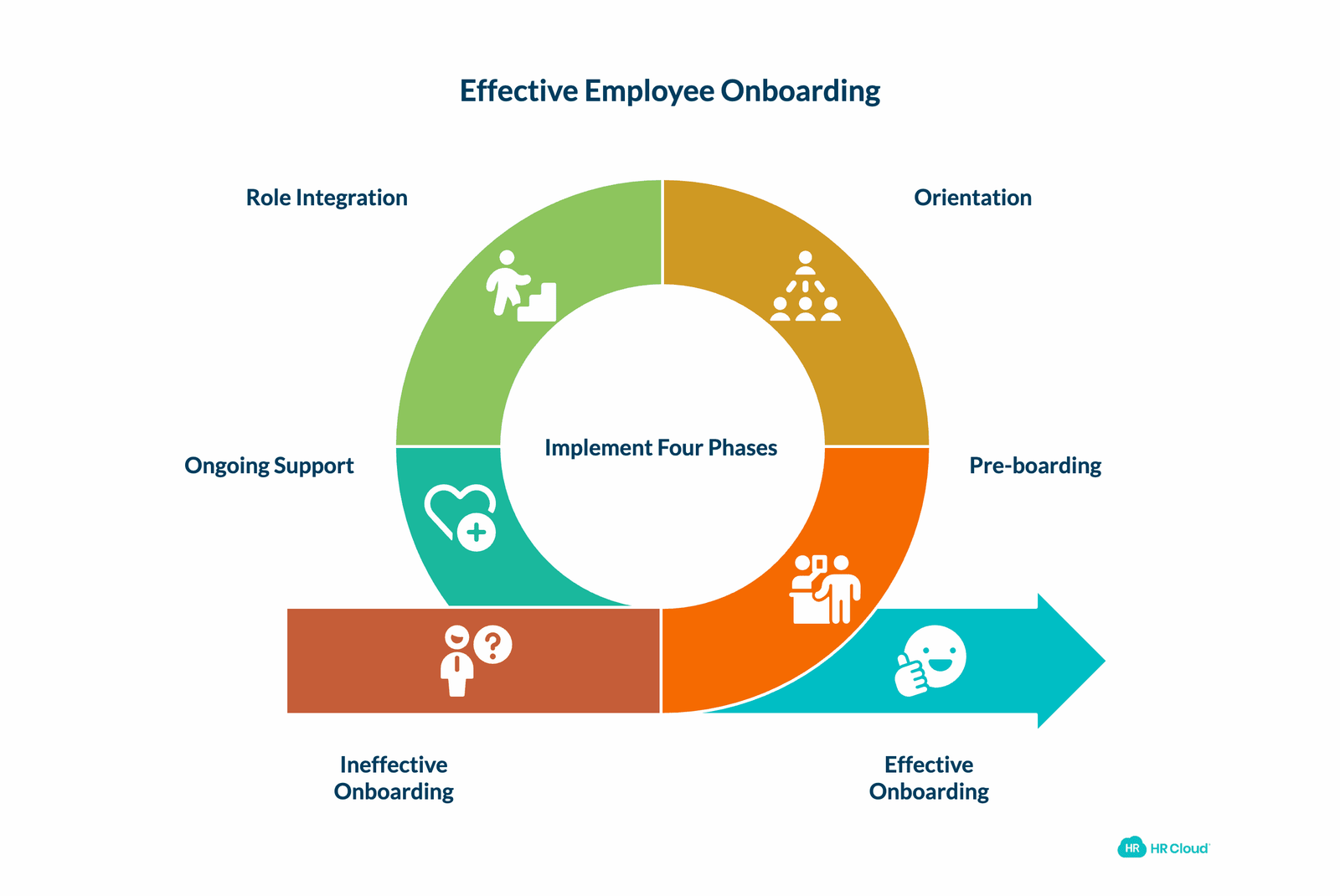
1. Pre-boarding (Offer Acceptance → Day 1)
Pre-boarding begins immediately after offer acceptance and continues until the new hire's start date. This often-overlooked phase sets the tone for the entire employee experience.
Critical Pre-boarding Activities:
- Send personalized welcome email within 24 hours of acceptance
- Provide digital access to employee self-service portal for paperwork completion
- Complete I-9 Section 1, W-4, direct deposit, and benefits enrollment forms digitally
- Share employee handbook, org chart, and team introductions
- Ship equipment (laptop, mobile device, security badge) to arrive before day one
- Schedule first-week meetings and assign onboarding buddy
HR Cloud's pre-boarding capabilities enable new hires to complete 90% of administrative tasks before their first day, eliminating paperwork bottlenecks and allowing day one to focus on cultural integration and relationship building.
2. Orientation (Days 1-7)
Orientation is the formal introduction to your organization covering company culture, policies, and initial role training.
First Week Focus Areas:
- Facility tour and workspace setup
- IT system access and tool training
- Team introductions and welcome lunch
- Safety training (especially for manufacturing, healthcare, construction)
- Company mission, values, and culture overview
- Initial job training and role responsibilities
- Onboarding buddy assignment for peer support
Research from SHRM shows that employees whose managers participate actively in orientation are 3.5x more likely to rate onboarding as exceptional. Manager involvement shouldn't be delegated entirely to HR.
3. Role Integration (Weeks 2-12)
This phase focuses on job-specific skill development, performance expectations, and cultural immersion.
Role Integration Components:
- Job-specific training programs
- Clear 30-60-90 day goals and success metrics
- Regular manager check-ins (weekly in month one, bi-weekly thereafter)
- Introduction to cross-functional teams and stakeholders
- Access to learning management systems and training resources
- Cultural immersion through employee engagement activities
- Early recognition and rewards for quick wins
4. Ongoing Support (Months 3-12)
Onboarding doesn't end at 90 days. The first year is critical for retention, skill development, and cultural fit.
Long-term Onboarding Elements:
- Formal performance reviews at 90 and 180 days
- Career development discussions and growth planning
- Continued access to training and upskilling opportunities
- Regular pulse surveys measuring engagement and satisfaction
- Connection to employee advocacy programs
- Integration into performance management systems
Organizations extending onboarding through the first year see 50% higher retention rates than those with sub-30-day programs.
12 Common Employee Onboarding Problems (And How to Solve Them)
Problem 1: Misleading or Outdated Job Descriptions
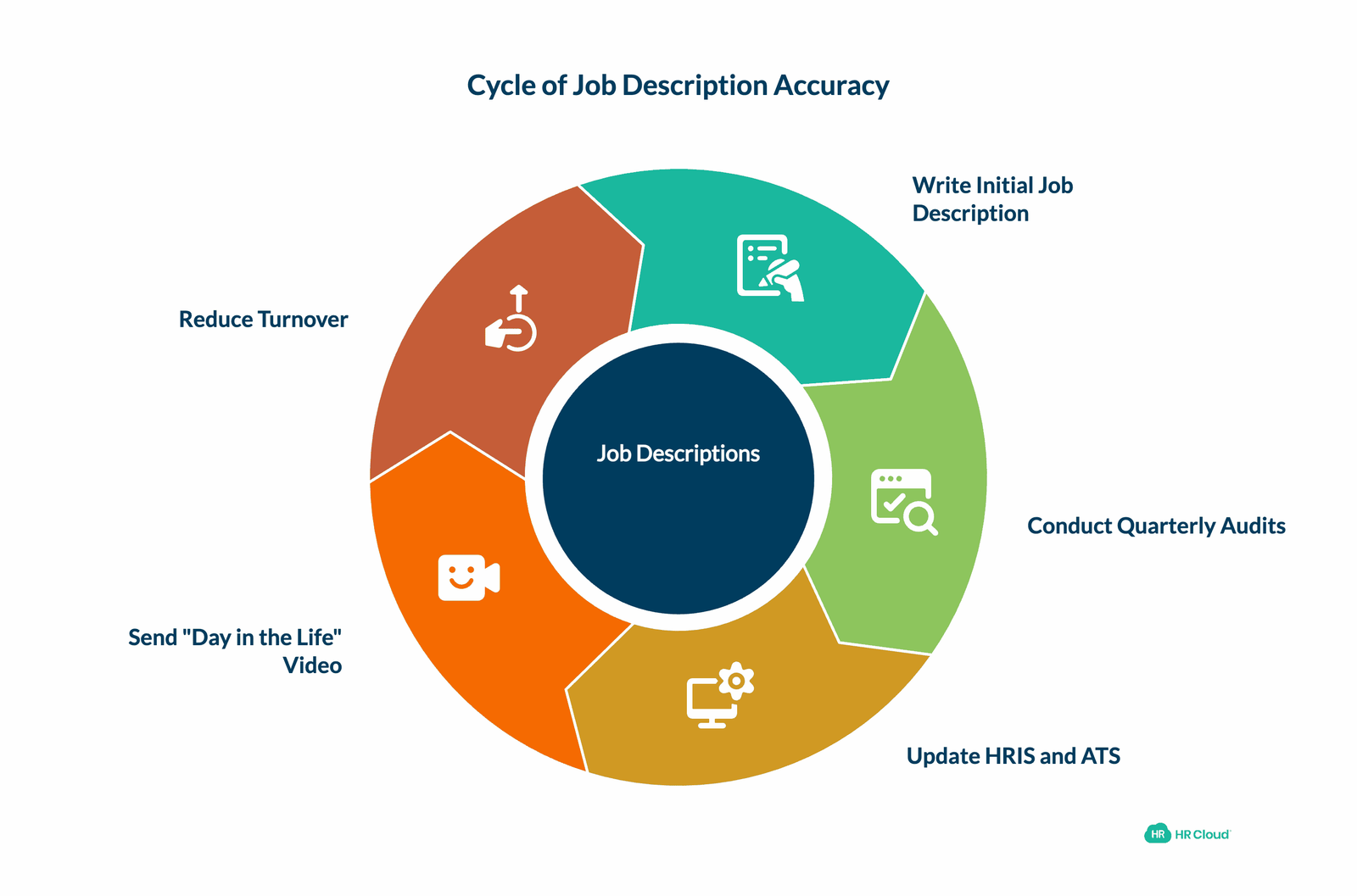
The Issue:
Onboarding problems often begin during recruitment. When job descriptions don't accurately reflect actual responsibilities, new hires experience immediate misalignment between expectations and reality. This "expectations gap" is a leading cause of early turnover.
According to research from APQC, 39% of new hires had to independently discover parts of their responsibilities—indicating job descriptions failed to provide complete role clarity.
Why This Happens:
- Job descriptions written years ago and never updated
- Responsibilities evolved but documentation didn't follow
- Hiring managers adding requirements during interviews not reflected in writing
- Generic templates used without role-specific customization
The Cost:
When employees realize the job doesn't match what they signed up for, 40% begin searching for new opportunities within six months. At an average replacement cost of 50-200% of salary, this becomes a six-figure problem for growing organizations.
The Solution:
Conduct quarterly job description audits to ensure accuracy. Use HR Cloud's HRIS system to maintain centralized, version-controlled job descriptions that automatically sync with your applicant tracking system and onboarding workflows. This ensures candidates and new hires always see current, accurate role information.
Pro Tip: During pre-boarding, send new hires a "Day in the Life" video showing actual employees performing the role. This visual confirmation builds confidence and reduces first-day anxiety.
Problem 2: No Pre-boarding Process
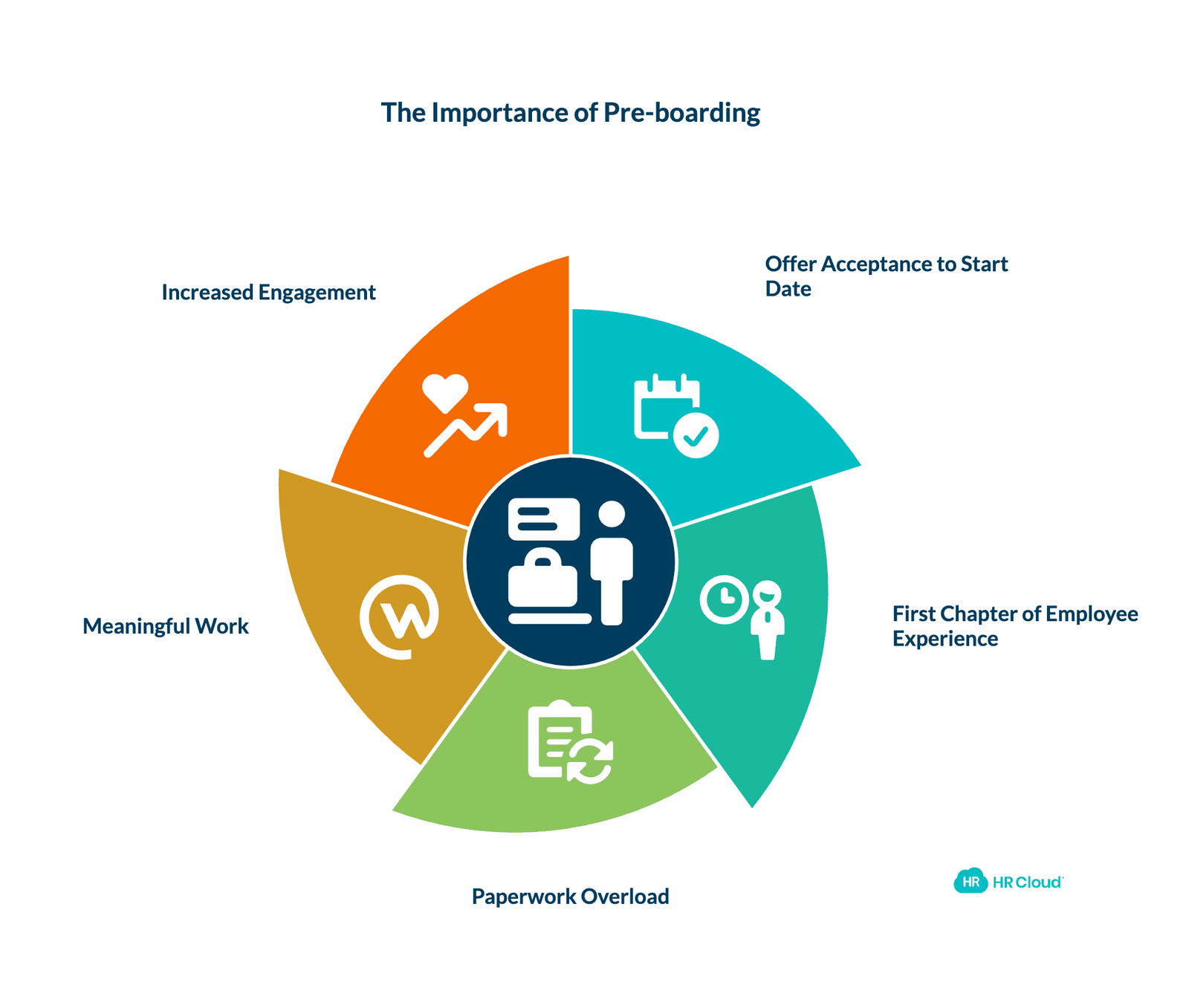
The Issue:
Many organizations treat the gap between offer acceptance and start date as "dead time" when it's actually the first chapter of the employee experience. Without pre-boarding, new hires arrive on day one to a mountain of paperwork instead of meaningful work.
Research shows that organizations with formal pre-boarding programs see 33% higher new hire engagement in the first 90 days.
Why This Happens:
- HR teams wait for the official start date to begin processes
- Fear of overwhelming candidates before they've started
- Lack of technology to enable pre-boarding workflows
- Legal concerns about having candidates complete work before employment begins
The Cost:
Without pre-boarding, the first day (and often the first week) becomes administrative overhead rather than productive integration. New hires spend hours completing forms instead of building relationships with teammates, learning company culture, or beginning actual job training. This delays time-to-productivity by 2-3 weeks on average.
The Solution:
Implement a structured pre-boarding program starting immediately after offer acceptance:
Week 1 After Acceptance:
- Send personalized welcome email from hiring manager
- Provide employee self-service portal access for document completion
- Share company overview video and culture deck
Week 2-3:
- Complete I-9 Section 1, tax forms, direct deposit, benefits enrollment
- Introduce onboarding buddy via email/video call
- Send employee handbook and key policies for review
Week 4-Start Date:
- Ship equipment and confirm arrival
- Schedule first-week calendar (meetings, trainings, lunch with team)
- Send "what to expect on day one" guide
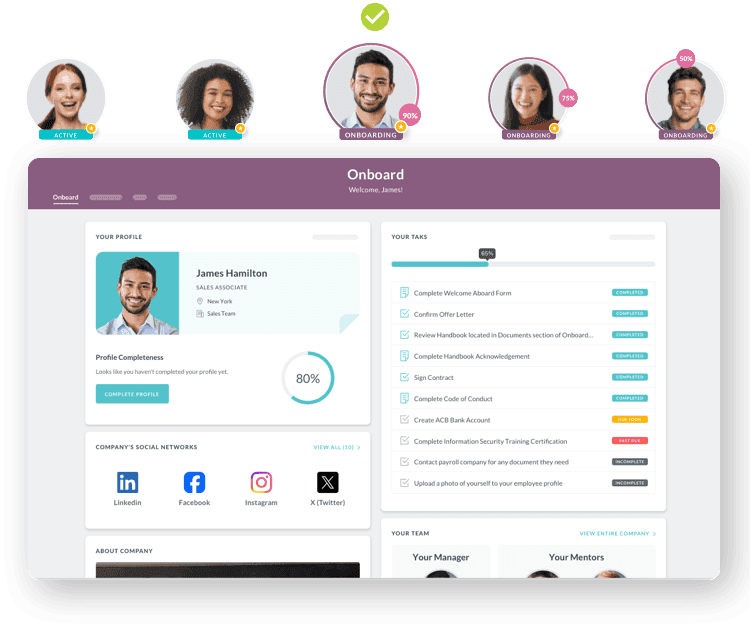
HR Cloud's Onboard platform automates these workflows with customizable templates, automated reminders, and progress tracking—ensuring no new hire falls through the cracks during pre-boarding.
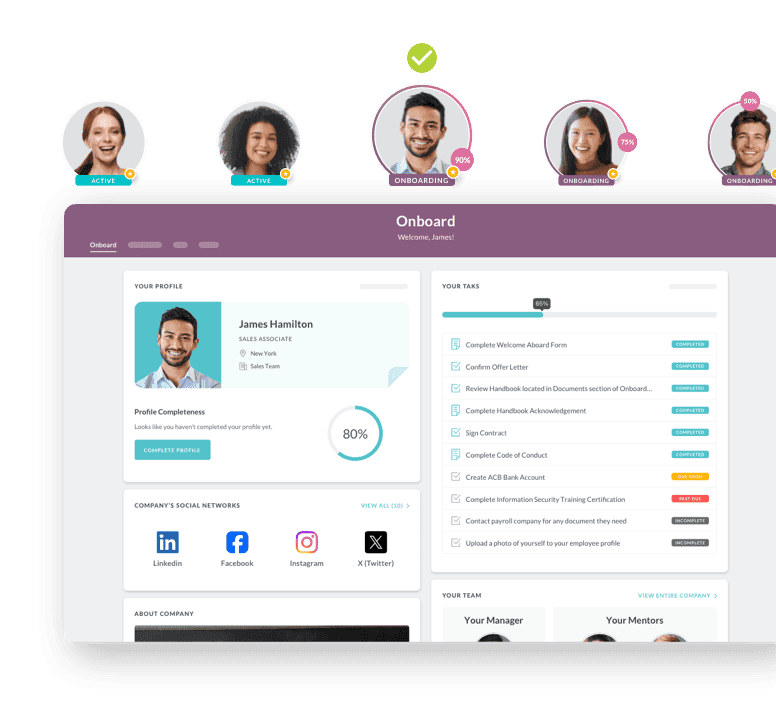
Problem 3: Overwhelming First-Day Experience
The Issue:
The infamous "drinking from a firehose" problem. New employees arrive to find their desk covered in forms, their calendar packed with meetings, and expectations to absorb company history, meet 30 people, and learn complex systems—all before lunch.
Gallup research shows that 31% of employees describe their onboarding as overwhelming, leading to disengagement before they've completed week one.
Why This Happens:
- Organizations try to "get onboarding over with" to accelerate productivity
- HR teams front-load administrative tasks for compliance reasons
- Lack of structured pacing and information architecture
- No consideration for cognitive load and retention capacity
The Cost:
Information overload creates immediate stress, reduces retention of critical information, and sets a negative tone for the employment relationship. Employees overwhelmed on day one are 2.3x more likely to experience burnout in their first 90 days.
The Solution:
Design first-day experiences around relationship building and cultural integration, not paperwork. Since pre-boarding handles administrative tasks, day one should focus on:
Morning (9am-12pm):
- Welcome by manager (30 min)
- Workspace setup and IT orientation (30 min)
- Facility tour (30 min)
- Coffee with onboarding buddy (30 min)
Afternoon (1pm-5pm):
- Team lunch (60 min)
- Company overview presentation (45 min)
- Department introductions (60 min)
- First assignment review with manager (30 min)
- End-of-day check-in (15 min)
Notice the absence of form-filling. If pre-boarding was executed properly, new hires should sign zero paper documents on day one. Instead, they're building relationships, absorbing culture, and feeling welcomed—creating emotional connection that drives long-term retention.

Fix Broken Onboarding Before It Costs You
- Eliminate paperwork chaos
- Automate tasks and reminders
- Give new hires clarity from day one
Problem 4: No Feedback Collection Mechanisms
The Issue:
Organizations onboard new hires but never ask how the experience went. Without feedback loops, the same problems recur for every new hire, and HR teams remain blind to improvement opportunities.
Research shows that 75% of organizations don't survey new hires about their onboarding experience—missing critical insights that could prevent turnover and improve processes.
Why This Happens:
- "No news is good news" mentality
- Fear of negative feedback
- Lack of structured pulse survey tools
- Belief that feedback is only needed at annual performance reviews
The Cost:
Without feedback, onboarding problems compound. A broken technology setup that frustrates one hire will frustrate 50 more. A confusing policy explanation that causes anxiety repeats indefinitely. Small fixable issues become systemic problems causing measurable turnover.
The Solution:
Implement structured feedback touchpoints at predictable intervals:
Day 3 Pulse Survey (2 questions):
- "On a scale of 1-10, how welcomed do you feel by your team?"
- "What's been your biggest challenge so far?"
Day 30 Check-in (5 questions):
- Clarity of role expectations
- Quality of training received
- Effectiveness of onboarding buddy
- Manager support rating
- One thing to improve
Day 60 & 90 Surveys:
- More comprehensive assessment
- Cultural fit perception
- Career growth visibility
- Likelihood to recommend company
- Open-ended improvement suggestions
HR Cloud's Workmates platform includes built-in pulse survey tools that automatically trigger at key onboarding milestones, with analytics dashboards showing trends across all new hires to identify systemic issues requiring attention.
Problem 5: Poor Quality or Inaccessible Information
The Issue:
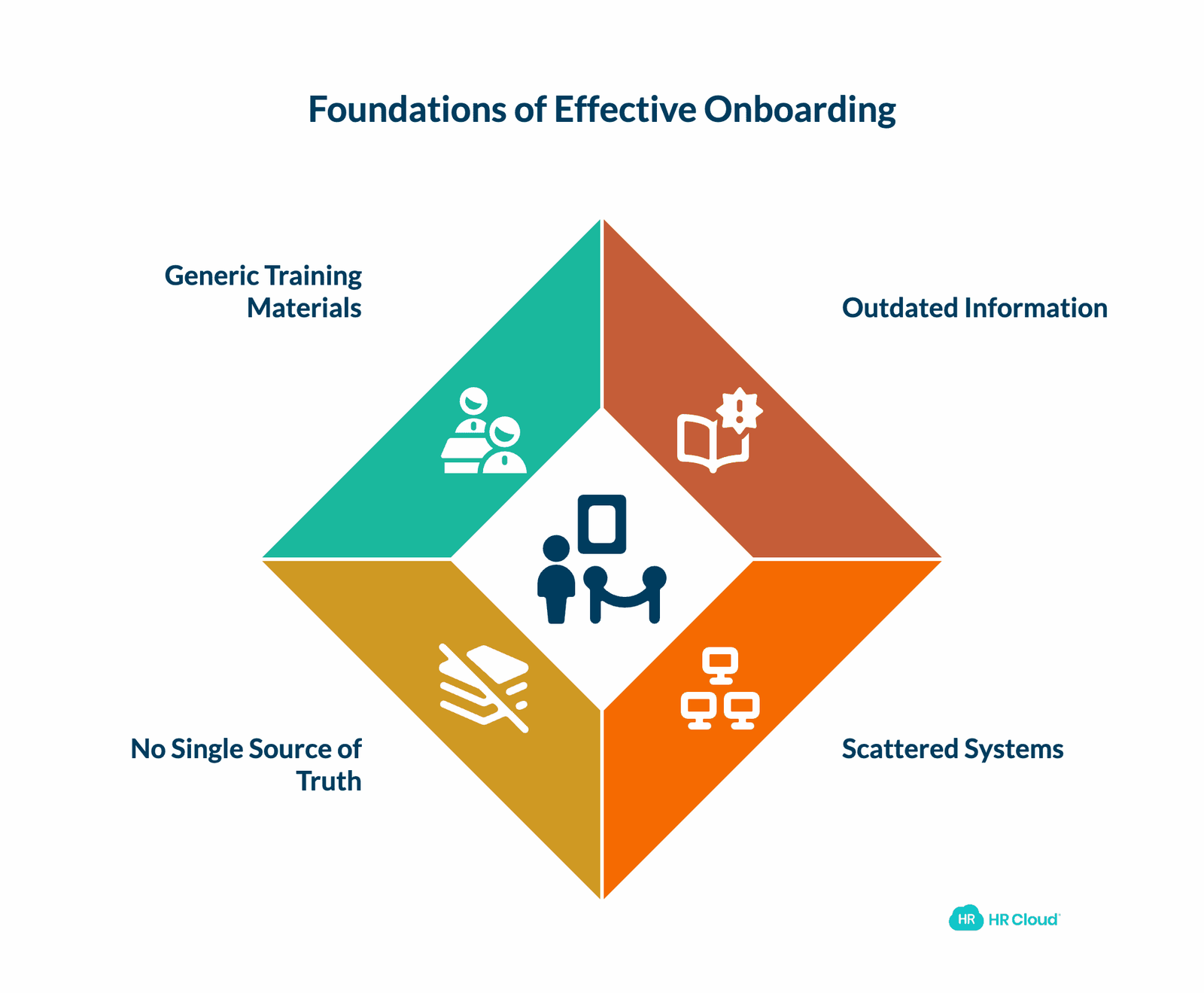
New hires receive outdated handbooks, broken links to training resources, or verbally delivered information they immediately forget. Critical information is trapped in individual inboxes or on paper forms instead of accessible digital repositories.
47% of employees report their onboarding information was outdated or inaccurate.
Why This Happens:
- Information scattered across multiple systems and formats
- No single source of truth for company policies and procedures
- Employee handbooks haven't been updated in years
- Training materials created for different roles used generically
The Cost:
When new hires can't find answers to basic questions, they interrupt colleagues, make preventable mistakes, or disengage in frustration. This extends time-to-productivity and damages the impression of organizational competence.
The Solution:
Create a centralized, searchable knowledge base accessible to all new hires:
Essential Components:
- Digital employee handbook (updated quarterly minimum)
- Role-specific training materials and videos
- Policies and procedures library
- Org chart with searchable employee directory
- Benefits information and enrollment guides
- IT setup documentation and troubleshooting
- Safety protocols and compliance training
- FAQ section addressing common new hire questions
HR Cloud's Content Management System provides a structured knowledge repository with version control, search functionality, and mobile app access—ensuring frontline workers in healthcare, manufacturing, and retail can access information from any device, anywhere.
Problem 6: Unclear Goals and Expectations
The Issue:
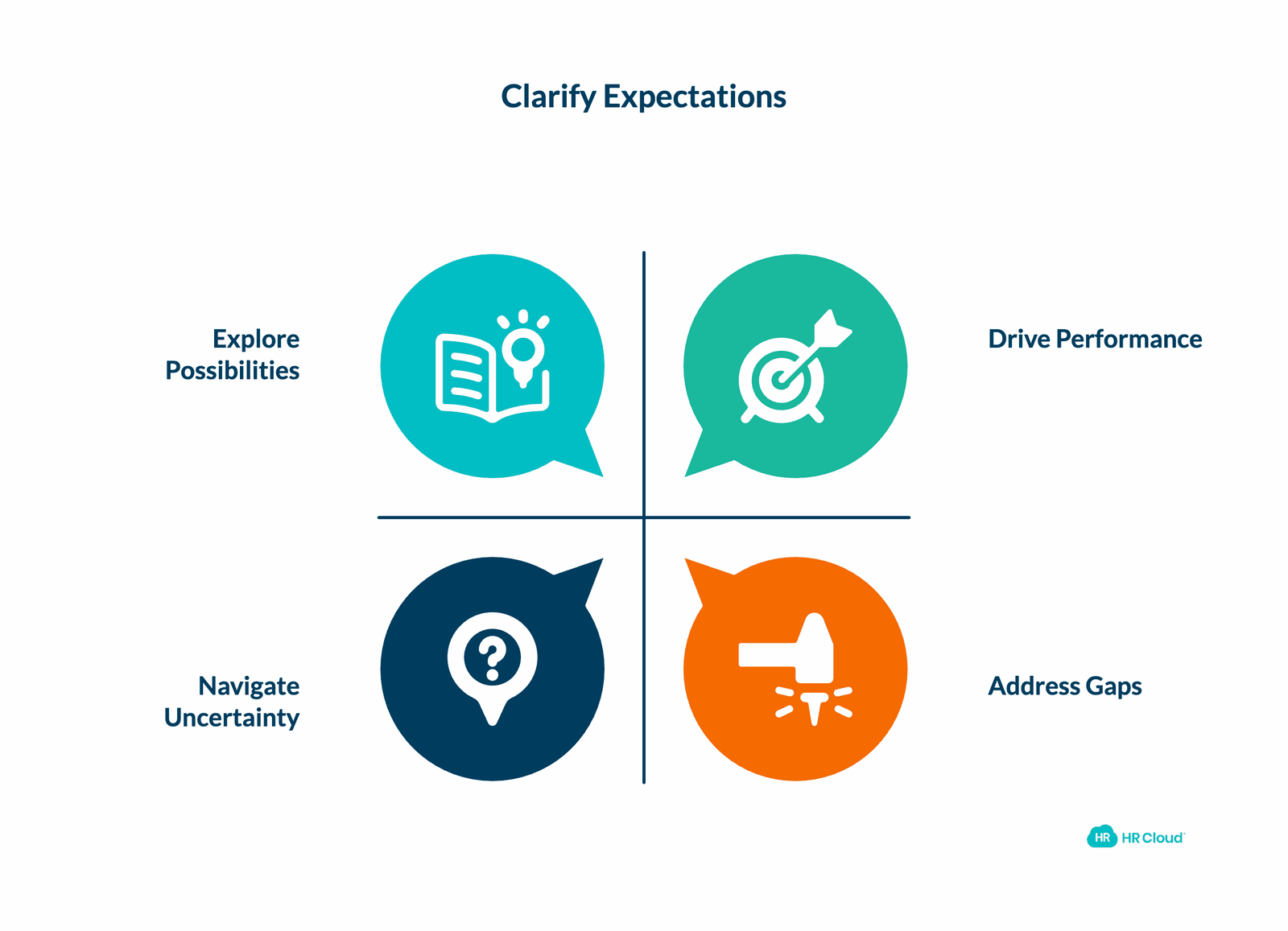
New employees are told "jump in and start contributing" without clear success metrics, priorities, or performance expectations. This ambiguity creates anxiety, misaligned effort, and early performance problems.
60% of companies don't set clear goals or milestones during onboarding, leaving new hires guessing what success looks like.
Why This Happens:
- Managers assume role clarity from job description alone
- Belief that employees should "figure it out" through osmosis
- Lack of structured goal-setting frameworks
- Pressure to get new hires "productive" without proper orientation
The Cost:
When expectations aren't explicit, new hires either underperform (afraid to take initiative) or overperform in wrong areas (working hard on low-priority tasks). Both scenarios lead to frustration, and unclear expectations are cited as the #1 reason for new hire turnover in the first 90 days.
The Solution:
Implement the 30-60-90 day goal framework:
First 30 Days (Learning Mode):
- Complete all required training and certifications
- Meet with 10+ cross-functional stakeholders
- Shadow experienced team members
- Deliver one small project to demonstrate capability
- Understand company systems and tools
Days 31-60 (Contributing Mode):
- Own 2-3 projects with manager oversight
- Begin participating in team meetings with ideas
- Build relationships across departments
- Demonstrate competency in core role functions
- Identify one process improvement opportunity
Days 61-90 (Performing Mode):
- Operate independently on 80% of responsibilities
- Manage projects from start to finish with minimal supervision
- Contribute to team goals measurably
- Mentor newer employees joining team
- Participate in strategic planning discussions
Use HR Cloud's Performance Management platform to document these goals, track progress, and conduct structured check-ins—creating accountability and clarity throughout the onboarding journey.

Turn Onboarding Problems Into Process
- Centralize documents and tasks
- Track progress in real time
- Keep managers and hires aligned
Problem 7: No Onboarding Software Training
The Issue:
Organizations invest in sophisticated employee onboarding software but don't train new hires how to use it. Employees struggle to navigate systems, miss important tasks, and revert to asking HR basic questions—defeating the purpose of self-service technology.
Why This Happens:
- Assumption that software is "intuitive enough" to learn independently
- No dedicated training time in onboarding schedule
- HR teams too busy to provide software walkthroughs
- Poor documentation and help resources
The Cost:
When new hires can't navigate onboarding platforms, they miss deadlines, skip required training, and create compliance gaps. IT and HR teams spend hours troubleshooting avoidable issues. Self-service benefits evaporate when users can't self-serve.
The Solution:
Build platform orientation into day one and week one:
Day 1 (30 minutes):
- Guided walkthrough of onboarding portal
- How to access and complete required forms
- Where to find employee handbook and policies
- How to reach HR support with questions
Week 1 (ongoing):
- Tutorial videos embedded in platform
- Tooltips and contextual help throughout interface
- "Getting Started" checklist tracking platform orientation
- Dedicated Slack/Teams channel for platform questions
HR Cloud's platform includes built-in video tutorials, searchable help center, and intuitive navigation requiring minimal training—but organizations should still allocate dedicated orientation time to ensure confidence and adoption.
Problem 8: Information Overload (Too Much, Too Fast)
The Issue:
Organizations compress weeks of information into a few days, overwhelming new hires' ability to retain critical knowledge. Employees nod along in eight-hour training sessions, then forget 90% within 72 hours.
Research shows that learners forget 70% of information within 24 hours unless repeated, yet most onboarding delivers content once in concentrated bursts.
Why This Happens:
- Desire to accelerate time-to-productivity
- Compliance requirements demanding immediate training
- Logistical efficiency of batch training sessions
- No understanding of cognitive load and spaced repetition principles
The Cost:
Information overload leads to mistakes, repeated questions, and safety incidents (especially in manufacturing, healthcare, and construction where procedures are critical). Employees feel incompetent because they can't remember everything thrown at them.
The Solution:
Apply microlearning and spaced repetition principles:
Microlearning Approach:
- Break training into 5-10 minute modules covering single topics
- Deliver training over weeks, not days
- Use video, interactive elements, and quizzes for engagement
- Make content accessible for on-demand review
Spaced Repetition Schedule:
- Introduce concept in week one (initial exposure)
- Review in week two (first reinforcement)
- Practice in week three (application)
- Assess in week four (mastery check)
Example Application:
Instead of a 4-hour "Company Policies" training on day two, deliver:
- 10-minute "Attendance Policy" video on day 3
- 10-minute "PTO Requests" tutorial on day 5
- 10-minute "Performance Review Process" walkthrough in week 2
- 10-minute "Professional Development" overview in week 3
This spacing dramatically improves retention and reduces cognitive overwhelm.
Problem 9: Inconsistent Onboarding Experiences
The Issue:
Different departments onboard differently. Different managers onboard differently. Some new hires get comprehensive 90-day programs while others get "here's your desk, good luck." This inconsistency creates unfair advantages, confusion, and resentment.
36% of HR leaders describe the handoff between recruiting, HR, and hiring managers as merely "adequate" with occasional gaps.
Why This Happens:
- No centralized onboarding standards or templates
- Decentralized hiring with minimal HR oversight
- Manager discretion over onboarding approach
- Lack of enforcement and accountability
The Cost:
Inconsistent onboarding creates legal risk (compliance gaps), operational inefficiency (no economies of scale), and poor employee experience (some hires feel undervalued). Organizations with inconsistent onboarding see 28% higher turnover in the first year compared to standardized programs.
The Solution:
Implement standardized onboarding workflows while allowing customization:
Universal Components (All Hires):
- Pre-boarding paperwork completion
- Day 1 welcome and orientation
- Company culture and values training
- IT setup and system access
- Safety training (if applicable)
- 30-60-90 day goals
- Feedback check-ins
- Onboarding buddy assignment
Role-Specific Additions:
- Department-specific training
- Job-specific certifications
- Specialized tool instruction
- Client/project introductions
Use HR Cloud's workflow automation to create templated onboarding journeys that automatically assign tasks to new hires, managers, HR, and IT—ensuring every employee receives the same foundation while allowing role-specific customization.
Pro Tip: Create an onboarding checklist that managers must complete for every new hire, with HR oversight and reporting to identify gaps.
Problem 10: Ignoring Cultural and Generational Differences
The Issue:
One-size-fits-all onboarding ignores diverse needs. Gen Z employees may want rapid Slack-based communication while Baby Boomers prefer structured email. International hires need visa support. Working parents need schedule flexibility. Disabilities require accommodations.
Why This Happens:
- Efficiency focus on standardization
- Lack of awareness about diverse needs
- Fear of "special treatment" perceptions
- No system flexibility for customization
The Cost:
Employees who don't see themselves reflected in onboarding feel alienated from the start. DEI-focused onboarding programs show 35% higher retention (Gallup, 2025), indicating that inclusion from day one directly impacts long-term engagement.
The Solution:
Build flexibility and personalization into standardized frameworks:
Cultural Considerations:
- Multi-language onboarding materials
- International compliance training (visa, work authorization)
- Cultural holidays and observances acknowledged
- Diverse representation in training materials and examples
Generational Adaptations:
- Multiple communication channel options (email, Slack, Teams, SMS)
- Self-paced learning for digital natives
- Structured guidance for those preferring traditional approaches
- Reverse mentoring opportunities (younger teaching older)
Accessibility Accommodations:
- Screen reader-compatible onboarding platforms
- Closed captioning on all training videos
- Flexible scheduling for medical or family needs
- Ergonomic workspace setup support
Ask during pre-boarding: "What can we do to make your onboarding experience great?" This simple question demonstrates care and surfaces needs before problems arise.

Ready to Fix Onboarding for Good
- Faster time-to-productivity
- Fewer errors and follow-ups
- Better first-day experience
Problem 11: Assuming Skills Don't Need Refreshing
The Issue:
Organizations train new hires once on critical skills, then never revisit them. Muscle memory fades, procedures change, and employees develop bad habits—leading to quality problems, safety incidents, and compliance violations.
Why This Happens:
- "One and done" training mentality
- Budget constraints limiting ongoing development
- Belief that initial training is sufficient
- No mechanisms for skill assessment and refresher training
The Cost:
Skill decay causes mistakes, rework, customer complaints, and safety incidents. In regulated industries like healthcare and manufacturing, outdated skills create audit failures and legal liability.
The Solution:
Implement continuous learning culture with regular refresher training:
Quarterly Skill Refreshers:
- Safety protocol reviews
- Compliance training updates
- System feature updates
- Process improvement workshops
Annual Recertification:
- Critical skills assessment
- Regulatory requirement renewals
- Equipment operation tests
- Emergency procedure drills
On-Demand Learning:
- Video library for self-guided review
- Microlearning modules accessible anytime
- Peer teaching and knowledge sharing
- Cross-training opportunities
HR Cloud's training capabilities allow you to automatically assign refresher training on customized schedules—ensuring skills stay sharp throughout employee tenures.
Problem 12: Generic Onboarding for Role-Specific Needs
The Issue:
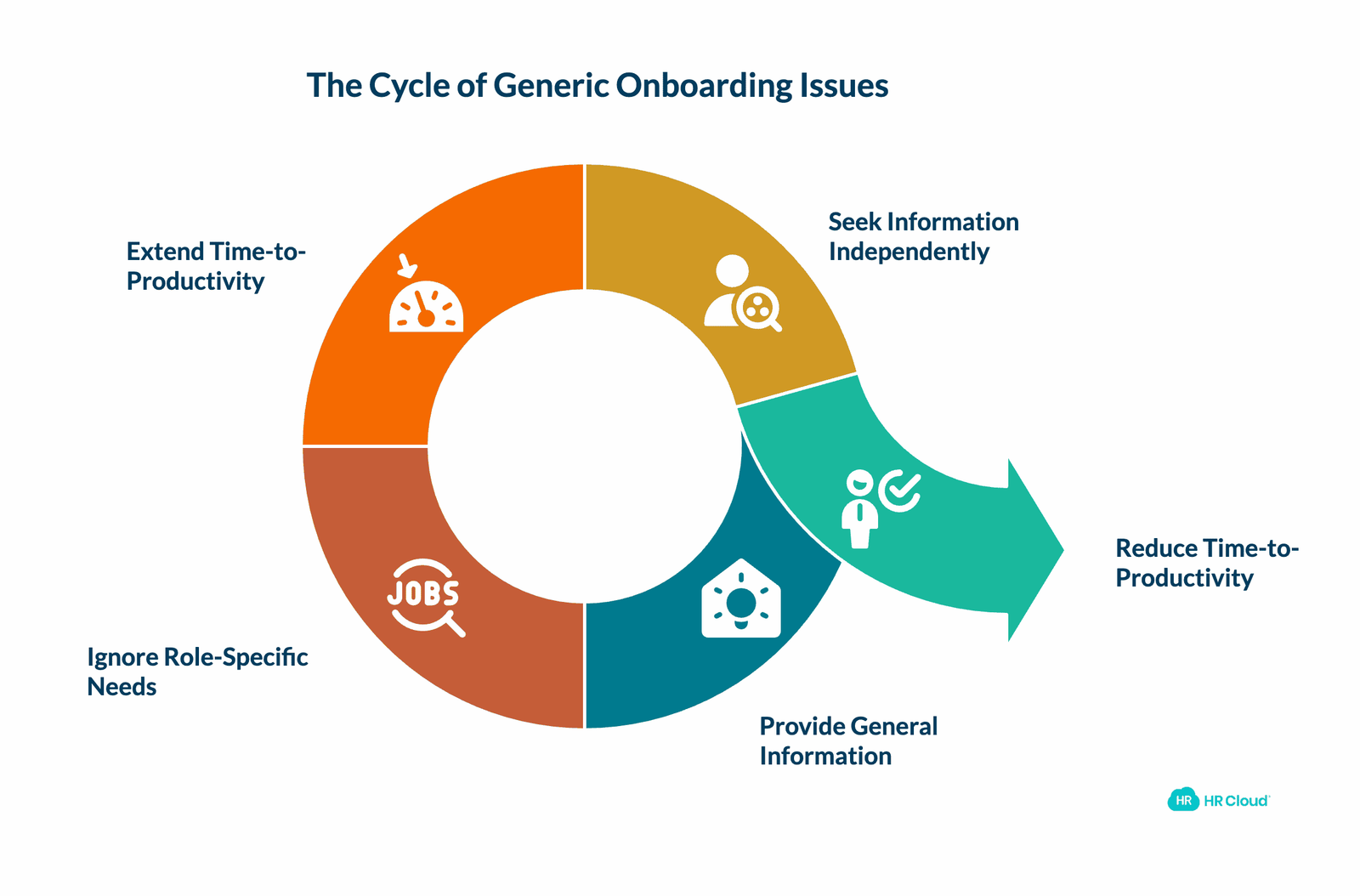
Cookie-cutter onboarding provides general company information but ignores role-specific knowledge critical for success. A sales hire needs different information than an engineer. A frontline warehouse worker has different requirements than an office manager.
Why This Happens:
- Efficiency drive toward standardization
- Limited resources to create role-specific content
- Lack of input from department managers
- One HR team managing all onboarding
The Cost:
Generic onboarding extends time-to-productivity because employees must seek out role-specific information independently. Role-specific onboarding reduces time-to-full-productivity by 40% compared to generic programs.
The Solution:
Layer role-specific training onto universal foundation:
Universal Foundation (All Employees):
- Company mission, values, culture
- Benefits and compensation overview
- IT setup and security training
- Facilities and safety orientation
- Compliance and regulatory training
Role-Specific Layers:
- Sales: CRM training, product knowledge, sales methodology, pipeline management
- Engineering: Code repositories, development workflows, architecture documentation, sprint planning
- Manufacturing: Equipment operation, safety protocols, quality standards, shift procedures
- Healthcare: HIPAA compliance, patient care protocols, EMR systems, credentialing requirements
- Retail: POS systems, inventory management, customer service standards, merchandising
Department-Specific Additions:
- Team-specific tools and systems
- Client/customer introductions
- Project context and priorities
- Cultural norms and working styles
HR Cloud's customizable workflows enable you to create role-based onboarding tracks that automatically assign relevant training based on job title—scaling personalization without manual overhead.
8 Proven Strategies for Effective Employee Onboarding
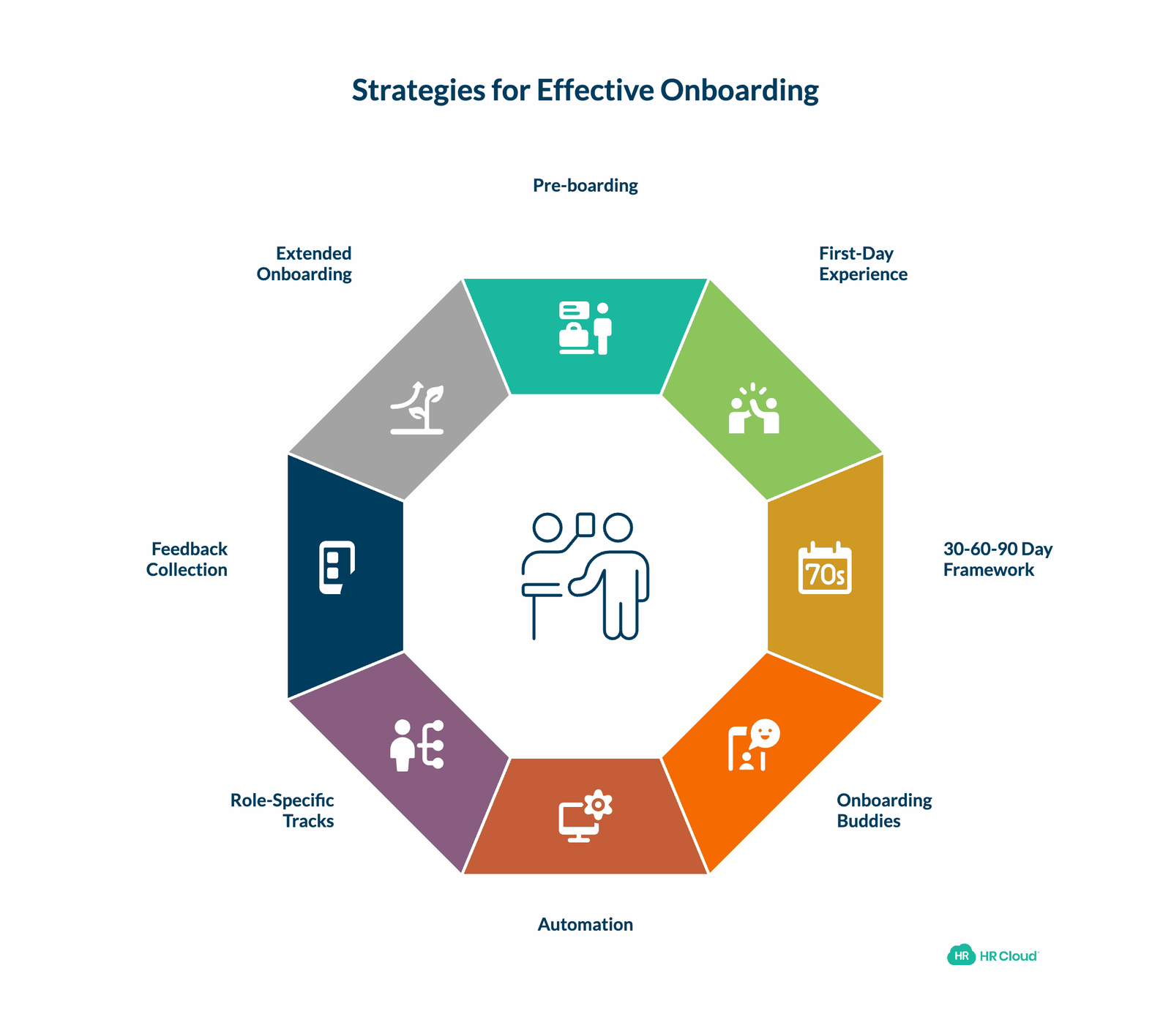
Now that you understand common pitfalls, here are eight evidence-based strategies for creating exceptional onboarding experiences:
1. Start Pre-boarding Immediately After Offer Acceptance
Don't wait for day one. Research shows organizations with formal pre-boarding programs see 33% higher engagement in the first 90 days. Use the weeks between acceptance and start date to:
- Complete paperwork digitally via employee self-service portal
- Ship equipment to ensure day-one readiness
- Introduce onboarding buddy via video call
- Share culture deck, employee handbook, and welcome video
- Schedule first-week meetings and set expectations
HR Cloud's Onboard platform automates pre-boarding workflows with customizable templates, ensuring no new hire falls through the cracks.
2. Design First-Day Experiences Around Relationships, Not Paperwork
If pre-boarding succeeded, day one should involve zero form-filling. Instead, focus on:
Morning:
- Manager welcome and role overview
- Workspace setup and IT orientation
- Facility tour and introductions
- Coffee with onboarding buddy
Afternoon:
- Team lunch
- Company culture presentation
- Department introductions
- First assignment discussion
Goal: By end of day one, new hires should feel welcomed, understand company culture, know their teammates, and feel excited about their role.
3. Implement the 30-60-90 Day Goal Framework
Days 1-30 (Learning):
- Complete required training and certifications
- Meet cross-functional stakeholders
- Shadow experienced colleagues
- Deliver one small project
Days 31-60 (Contributing):
- Own 2-3 projects with oversight
- Participate actively in team meetings
- Demonstrate role competency
- Identify improvement opportunities
Days 61-90 (Performing):
- Operate independently on 80% of responsibilities
- Manage projects start-to-finish
- Contribute measurably to team goals
- Mentor newer employees
Document these goals in HR Cloud's Performance Management system for visibility and accountability.
4. Assign Onboarding Buddies for Peer Support
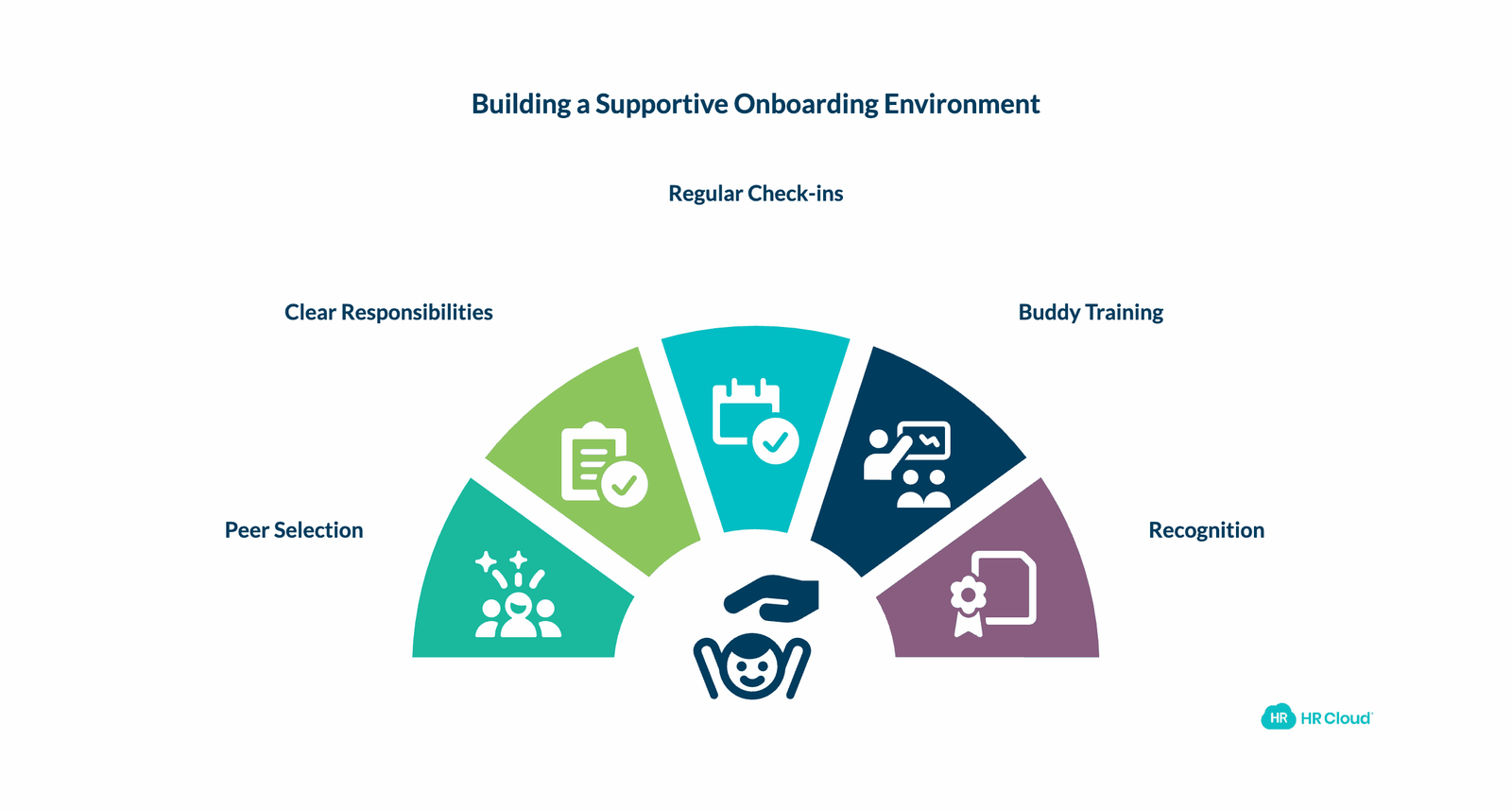
Onboarding buddies (peer mentors) provide informal guidance and reduce new hire anxiety. Research shows buddy programs increase new hire productivity by 97% when structured properly.
Effective Buddy Programs Include:
- Peer selection (same role or department, 1+ years tenure)
- Clear responsibilities and expectations
- Regular check-in schedule (weekly in month one)
- Training for buddies on mentorship skills
- Recognition for buddy participation
Buddies answer "silly questions" new hires fear asking managers, provide unfiltered cultural insights, and accelerate social integration.
5. Automate Compliance and Administrative Tasks
Manual I-9 processing, E-Verify submissions, and document tracking create bottlenecks and compliance risk. 26% of bad hires result from poor hiring and onboarding practices.
HR Cloud's compliance automation includes:
- Built-in I-9 validation preventing incomplete forms
- Automatic deadline tracking for Section 2 completion
- E-Verify integration for instant work authorization verification
- Digital audit trails proving compliance during inspections
- Automated reminders for expiring documents
This eliminates manual oversight and ensures zero compliance gaps.
“The flexibility of the HR Cloud system is invaluable in ensuring compliance. It helped us stay a step ahead of changing document collection requirements.”

— Jesse Rose, Provider recruitment, onboarding, and compliance manager

6. Create Role-Specific Onboarding Tracks
While maintaining universal foundation, customize 40-50% of onboarding for role-specific needs:
Frontline Workers (Retail, Manufacturing, Healthcare):
- Mobile-first onboarding accessible from smartphones
- Video-based training for shift flexibility
- Safety and equipment training prioritized
- Minimal desk-based paperwork
Remote/Hybrid Employees:
- Virtual onboarding workflows
- Digital signage for company updates
- Structured video call schedule
- Home office setup support
Knowledge Workers:
- System and tool training
- Project management methodologies
- Collaboration platform orientation
- Cross-functional introductions
Customize without recreating everything—use HR Cloud's flexible workflows to add role-specific modules to universal templates.
7. Collect Feedback at 3, 30, 60, and 90 Days
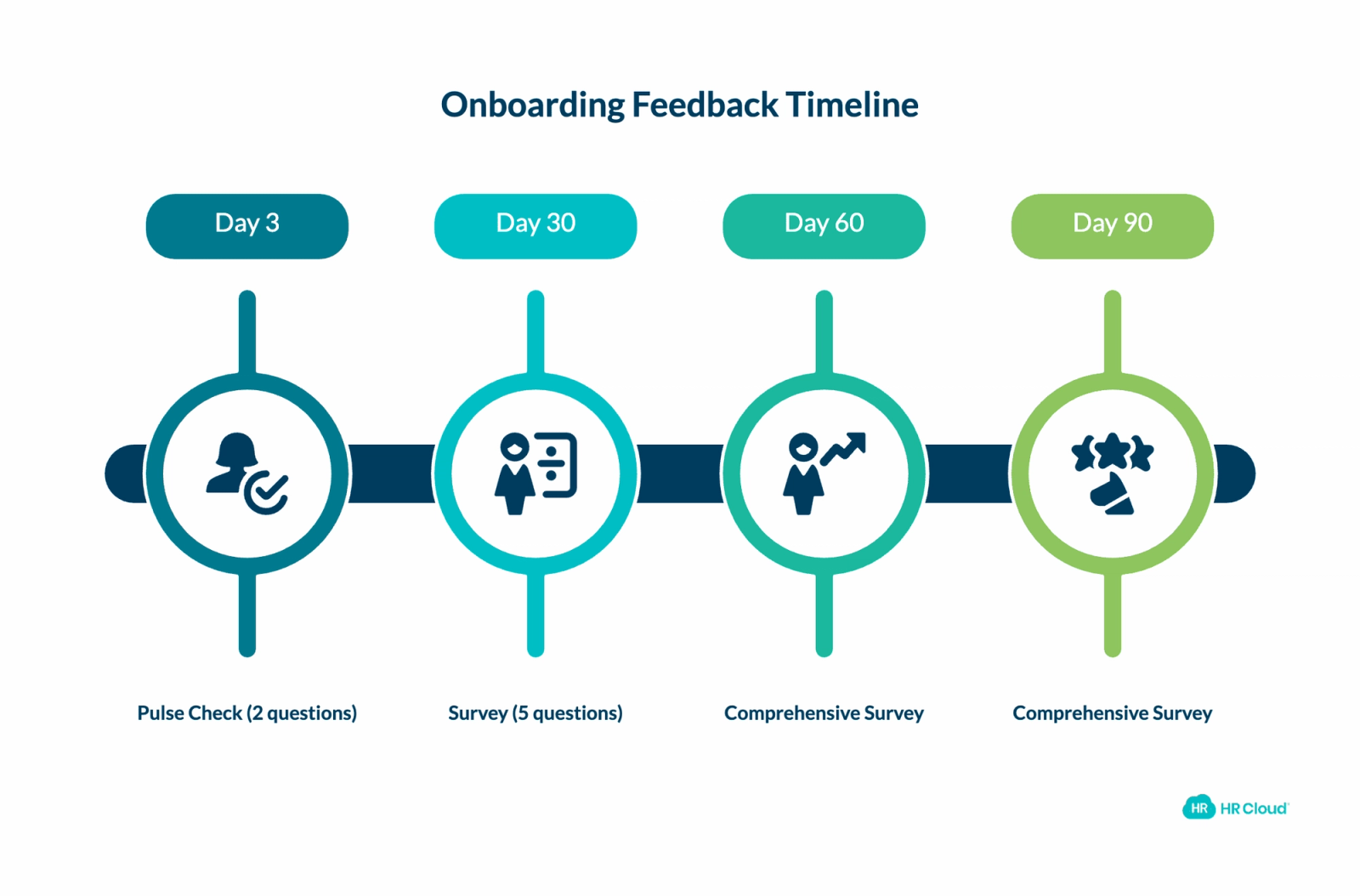
Day 3 Pulse Check (2 questions):
- How welcomed do you feel?
- What's been your biggest challenge?
Day 30 Survey (5 questions):
- Role clarity rating
- Training quality assessment
- Manager support score
- Buddy effectiveness
- One improvement suggestion
Day 60 & 90 Comprehensive Surveys:
- Cultural fit perception
- Career growth visibility
- Likelihood to recommend company
- Detailed improvement feedback
Use Workmates pulse survey tools to automate distribution and aggregate insights across all new hires.


8. Extend Onboarding Through the First Year
Research proves organizations with year-long onboarding programs see 50% higher retention. Don't stop at 90 days.
Months 4-6:
- Formal performance review
- Career development discussion
- Skills assessment and training needs
- Expanded project ownership
Months 7-12:
- Leadership development opportunities
- Cross-functional project involvement
- Mentor assignment for new hires
- Anniversary recognition event
HR Cloud's platform supports extended onboarding with automated touchpoints, milestone tracking, and integrated recognition programs celebrating onboarding completion.
The ROI of Effective Onboarding: Statistics Every HR Leader Should Know
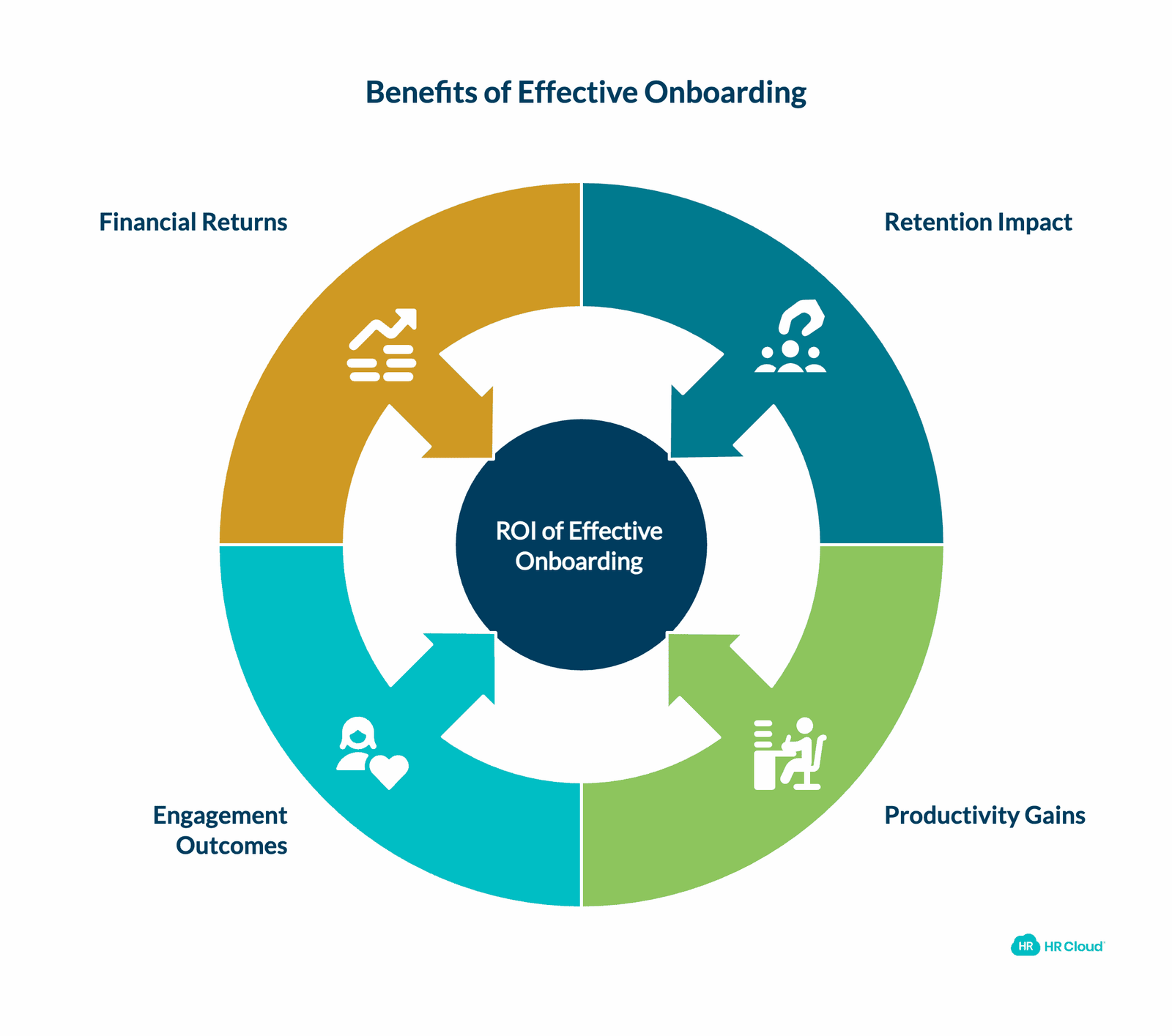
Investing in structured onboarding delivers measurable returns:
Retention Impact:
- 82% higher retention rates with structured onboarding (Brandon Hall Group)
- 50% lower turnover in first year compared to ad-hoc onboarding
- 33% fewer new hires leave in first 90 days with preboarding
Productivity Gains:
- 70% faster time-to-productivity with effective programs (Brandon Hall Group)
- 31% higher output from new hires with 90+ day onboarding
- 54% productivity improvement for remote employees with structured virtual onboarding (Gallup)
Engagement Outcomes:
- 18x more commitment to employer with excellent onboarding (Gallup)
- 89% report feeling "very engaged" after positive experiences
- 2.6x more likely to be extremely satisfied at work (Gallup)
Financial Returns:
- Organizations investing in onboarding see 40% ROI increase in first year
- 26% reduction in employee replacement costs
- Replacing an employee costs 50-200% of annual salary—preventing one turnover pays for entire onboarding program
Manual Onboarding vs. HR Cloud Automation: A Comparison
| Factor | Manual Process | HR Cloud Onboarding |
|---|---|---|
| Pre-boarding | Email documents, hope they're completed | Automated portal with digital forms, e-signatures, progress tracking |
| Time to Complete Forms | 4-6 hours over multiple days | 45-90 minutes self-service before day one |
| Manager Involvement | Inconsistent, often minimal | Automated task assignments with reminders |
| Compliance Risk | High (manual I-9 errors common) | Low (built-in validation, audit trails) |
| New Hire Experience | Overwhelming, confusing | Structured, guided, welcoming |
| HR Admin Time | 8-12 hours per hire | 1-2 hours per hire (83% reduction) |
| Consistency | Varies by department/manager | Standardized with role-specific customization |
| Feedback Collection | Rarely happens | Automated at key milestones |
| Integration | Manual data entry across systems | Automatic sync to payroll, HRIS, ATS |
| Cost Per Hire | $600-1,800 | $200-500 (67% reduction) |
Industry-Specific Onboarding Challenges
Healthcare:
Challenge: Complex credentialing, license verification, HIPAA compliance, and The Joint Commission requirements
HR Cloud Solution:Healthcare-specific workflows with credential tracking, automated license expiration alerts, and compliant documentation storage
Manufacturing:
Challenge: Safety training, equipment certification, OSHA compliance, and shift-based workforce with minimal computer access
HR Cloud Solution: Mobile-first onboarding accessible via smartphone, video-based safety training, and digital certification tracking
Retail:
Challenge: High-volume seasonal hiring, rapid onboarding timelines, distributed locations, and part-time workforce
HR Cloud Solution: Automated workflows enabling same-day onboarding, mobile POS training, and centralized multi-location management
Construction:
Challenge: Site-based workers, frequent project changes, safety compliance, and transient workforce
HR Cloud Solution: Mobile credentialing, site-specific safety training, and equipment asset tracking
Unlock Success with Osmose’s Story
See how Osmose Utilities Services transformed their employee experience with HR Cloud — and discover how you can too. Download the ebook now!
Download Now
Integrating Career Path Discussions into Onboarding
When integrating career path discussions into the onboarding process, it's crucial to help new hires see a future within your organization. A clear outline for career advancement can significantly impact their perception of the onboarding experience. Here's how you can weave career development into your onboarding strategy:
Initiate the Conversation Early: Begin discussing career goals during orientation. This indicates that your organization values long-term growth and is invested in each employee's future.
Regular Feedback Sessions: Schedule regular sessions throughout the onboarding period to gather feedback and discuss career aspirations. This helps tailor their development path and shows you're attentive to individual goals.
Showcase Development Opportunities: Highlight the various career development opportunities your company offers. Consider including options like:
- Skills and Leadership Training: Programs to enhance necessary skills or prepare employees for leadership roles
- Financial Assistance: Offering tuition reimbursement to encourage further education
- Industry Exposure: Providing access to career fairs, professional conferences, or industry group memberships to broaden their network
Celebrate Successes: Recognize and celebrate achievements and milestones. Acknowledgment can be done through means like company-wide peer recognition, fostering a positive and motivational environment.
By embedding these strategies into your onboarding process, new employees not only feel welcomed but also see a promising future for themselves within your organization.
How Do the First 90 Days Facilitate Integration into Company Culture?
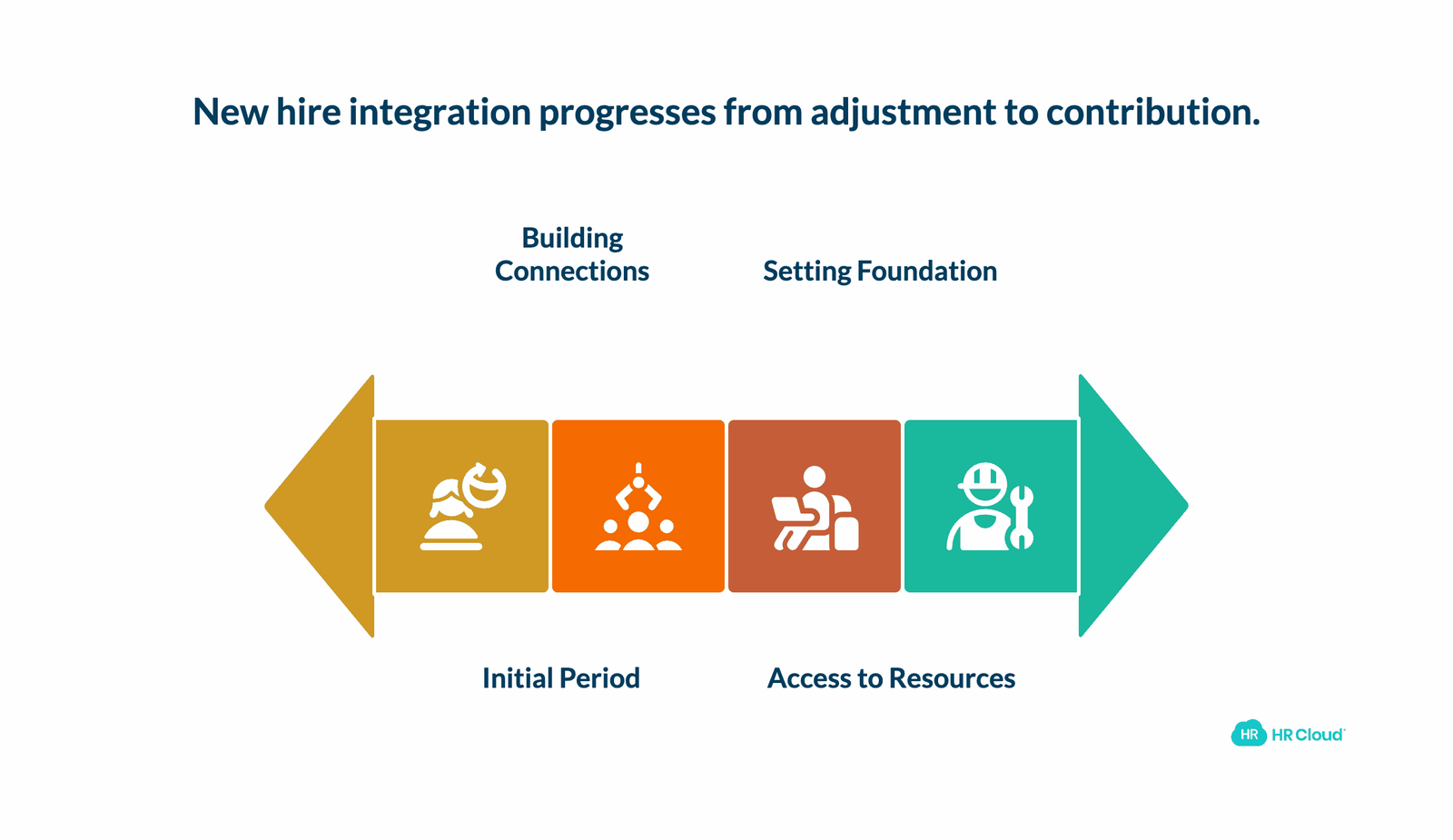
Initial Period of Adjustment: The first three months in a new position are a pivotal period for new hires to acclimate to the company environment. This timeframe allows them to gain a deep understanding of the organization's values and day-to-day operations.
Building Connections: During this time, establishing solid relationships within their team is essential. Regular interactions with colleagues and participation in team activities help newcomers feel like part of the community through Workmates engagement features.
Access to Resources and Guidance: Providing new hires with access to resources, such as training materials and company guidelines via HR Cloud's content management system, is crucial. Equally important is mentorship, where experienced team members offer guidance to help new employees navigate their roles effectively.
Setting a Foundation for Success: The emphasis during these 90 days should be on delivering the tools necessary for the new employees to succeed. This approach enables them to contribute meaningfully, fostering a sense of belonging and encouraging long-term commitment to the company through performance management tools.

See How Modern Onboarding Works
- Designed for HR leaders
- Works with your existing tools
- Live walkthrough with an expert
Transform Your Onboarding with HR Cloud
Poor onboarding doesn't just cost you new hires—it costs you productivity, engagement, and competitive advantage. Organizations that invest in structured, technology-enabled onboarding programs consistently outperform competitors on retention, productivity, and employee satisfaction.
HR Cloud's Onboard platform provides everything you need to create world-class onboarding experiences:
- Automated workflows eliminating manual tasks
- Pre-boarding portals engaging new hires before day one
- I-9 and E-Verify integration ensuring compliance
- Mobile-first design for frontline workers
- Customizable templates for role-specific onboarding
- Progress tracking dashboards showing real-time status
- Feedback collection tools driving continuous improvement
- Seamless integrations with payroll, HRIS, and ATS
See HR Cloud in action: Schedule a personalized demo to experience how our platform can transform your onboarding process, reduce administrative burden by 60%, and improve new hire retention by 82%.
Calculate your ROI: Use our Onboarding ROI Calculator to see exactly how much time and money you'll save by automating onboarding.
Your next great hire is waiting. Give them an onboarding experience they'll remember—for all the right reasons.

Discover how our HR solutions streamline onboarding, boost employee engagement, and simplify HR management
Book Your Free DemoFrequently Asked Questions About Employee Onboarding
Q1. What is onboarding new employees?
Employee onboarding is the structured process of integrating a new hire into your company—covering job training, cultural immersion, and team integration—from the moment they accept the offer through their first 90+ days.
Q2. What is the first step in onboarding?
Preboarding is the first step—sending welcome emails, collecting documentation digitally, and introducing company values before Day One. This phase starts immediately after offer acceptance.
Q3. What are the 5 C's of employee onboarding?
The 5 C's are: (1) Compliance (paperwork and policies), (2) Clarification (role expectations), (3) Culture (company values), (4) Connection (team relationships), and (5) Checkback (regular feedback).
Q4. What is the biggest challenge in onboarding?
Lack of structure is the biggest challenge—leading to poor communication, missed expectations, and early turnover. Research from SHRM shows 29% of HR leaders cite high attrition during onboarding as their top challenge.
Q5. What are the three phases of employee onboarding?
The three core phases are: (1) Preboarding (offer to day 1), (2) Orientation (days 1-7), and (3) Training & Integration (weeks 2-12+), though best practices extend through the first year.
Q6. How do you make employee onboarding fun?
Add welcome kits, gamified training, buddy systems, virtual tours, social introductions, and peer recognition to make the experience enjoyable and engaging.
Q7. Why is onboarding taking so long?
Often due to manual processes, unclear role definitions, or delays in equipment/document readiness. Automation via onboarding software reduces completion time by 60%.
Q8. How to speed up the onboarding process?
Use onboarding software to automate workflows, provide digital resources, implement self-service portals, and structure checklists—while maintaining personalization and cultural connection.
Q9. What does poor onboarding mean?
Poor onboarding refers to an unorganized, confusing, or impersonal process that leaves new hires feeling lost or unsupported—often leading to disengagement or early exits.
Q10. Should HR check in with new hires?
Absolutely. HR should conduct regular check-ins (30-, 60-, and 90-day reviews) to offer support, gather feedback, and reinforce company culture. Employees with regular check-ins are 3.5x more likely to rate onboarding positively.
Keep Reading


Like What You Hear?
We’d love to chat with you more about how HR Cloud® can support your business’s HR needs.
Book Your Free Demo