Rehire Onboarding Process: Stop Making Returning Workers Start Over

Your former employee just accepted an offer to come back. Someone on your team is already building them the same 40-field new-hire packet you'd send a total stranger. That packet ignores the fact that this person already knows your systems, your managers, and half your org chart. Treating a rehire onboarding process like a copy-paste of new-hire onboarding either wastes their first week on information they already have, or worse, skips the handful of things that genuinely did change while they were gone.
This guide breaks the rehire onboarding process into what actually needs to happen based on how long someone was away and what changed, not a generic checklist borrowed from Day 1 orientation.
Key Takeaways
- Boomerang hires made up 35% of new hires in March 2025, according to ADP Research, up from 31% a year earlier. This is a large enough share of hiring that treating it as an edge case is a real gap, not a minor oversight.
- The right onboarding depth depends on time away and what changed, not a flat "condensed new-hire checklist." Use the framework table below to decide.
- A rehire doesn't automatically need a new Form I-9. The rule depends on how much time has passed since the original I-9 was completed, covered in detail further down.
- HR Cloud's onboarding checklists can be configured with a dedicated rehire schedule that archives an employee's old tasks and assigns new ones automatically when their status changes back to active, so this doesn't have to be rebuilt by hand every time.
- Rehired employees who return after a layoff earn a 5% pay increase on average, compared to 2% for employees who stayed, according to Visier's analysis of 2.4 million employees.
Why Rehire Onboarding Deserves Its Own Process
Boomerang hiring isn't a fringe scenario anymore. ADP Research, published May 20, 2025, found that boomerang employees made up 35% of new hires in March 2025, up from 31% a year earlier and 26% at the March 2022 low point. In the information sector specifically, nearly two-thirds of new hires that same month were returning employees, roughly double the rate from a year prior.
A rehire isn't a new hire and isn't a current employee either. They already know how to badge into the building, but they don't know that the expense policy changed in March or that their old team now reports to someone new. Running them through the full new-hire sequence wastes their time and signals that the company doesn't remember they worked there. Skipping onboarding entirely assumes nothing changed while they were gone, which is rarely true.
Why this matters: A rehire onboarding process that's neither "treat them like day one" nor "skip it, they know the drill" is the actual gap most HR teams haven't built yet, and it's the gap this guide addresses directly.
How Much Onboarding Does This Rehire Actually Need?
The right depth of onboarding depends on two things: how long the person was gone, and what changed while they were away, not a blanket policy applied to every returning worker. This is a separate question from whether a new Form I-9 is required, which turns on a different clock entirely and is covered in its own section below.
| Situation | Recommended onboarding depth |
|---|---|
| Short absence, same role, no major system changes | Policy refresher, account reactivation, manager check-in |
| Longer absence, same or similar role, no major system changes | Condensed onboarding: updated policy acknowledgments, systems refresher, reintroduce any new teammates |
| Returning to a different role or department, or the company has changed core systems since they left | Near-full onboarding: new systems training, updated benefits enrollment, full policy walkthrough |
| Rehired after a layoff or involuntary departure | Add an explicit conversation with the new manager about what's different this time, and why the departure happened, on top of whichever row above applies |
A seasonal employee with a reasonable expectation of returning, or someone coming back from approved leave, may not be a "rehire" in the formal sense at all if their employment is considered continuous. That distinction matters most for the I-9 question next, but it also means a lighter onboarding touch is usually appropriate. HR Cloud's guide to managing seasonal staff covers how to track and re-engage workers who return on a predictable cycle.
Pro tip: Ask two questions before building any rehire's onboarding plan: how long were they gone, and did their role, team, or your core systems change in that time? Those two answers determine onboarding depth. They have no bearing on the I-9 question, which is a separate legal test covered next.
Do You Need a New I-9 for a Rehired Employee?
Not always, and getting this wrong in either direction creates real risk. According to USCIS's Handbook for Employers, the rule turns on one specific date: when the employee's original Form I-9 was completed, not how long they've been gone or what changed about their role. Someone who worked for eight years before leaving and returns two months later can already be outside the window, while someone with a short original tenure could still be inside it after a longer absence. The two clocks aren't the same, and onboarding-depth questions like role or system changes have no bearing on this one at all.
| Original Form I-9 completion date | I-9 requirement |
|---|---|
| Within the last 3 years | Employer's choice: complete Supplement B, Reverification and Rehire, attached to the original I-9, or complete a brand new Form I-9 |
| More than 3 years ago | A new Form I-9 is required; the employee is treated as a new hire for I-9 purposes |
There's an exception worth knowing before you assume every returning worker counts as a rehire in the first place. An employee returning from an approved leave of absence, or a seasonal worker with a reasonable expectation of returning for the next season, is generally considered to have had continuous employment. In that case, they haven't technically been "rehired" at all, and a new I-9 isn't required. The same principle applies to a role, department, or pay change on its own: none of those trigger a new I-9 by themselves.
Same-year rehires create a second, unrelated compliance wrinkle worth flagging to payroll: if someone leaves and returns within the same calendar year, their prior wages still count toward the FUTA wage base cap. HR Cloud's FUTA compliance glossary names this specifically as one of the more common mistakes, happening "when employees leave and return during the same calendar year." Missing it can mean overpaying FUTA tax if prior wages aren't credited correctly. HR Cloud's I-9 and E-Verify software tracks these dates and deadlines automatically instead of relying on someone remembering the original completion date three years later.
What this prevents: Guessing wrong on the I-9 question either creates unnecessary paperwork for a rehire who didn't need it, or, more seriously, leaves a required reverification undone, which is the kind of gap an I-9 audit actually catches.
What's Changed Since They Left?
Even a rehire who left on excellent terms six months ago is walking back into a company that kept moving without them. A rehired employee should go through the same onboarding and orientation process as a new hire in structure, even though their ramp-up time will be faster, since they already have the underlying context a true outsider doesn't.
The specific things worth confirming before their first day back:
- Policy changes: benefits, PTO accrual, remote work rules, and anything in the handbook that shifted while they were gone
- Org changes: who they report to now, whether their old team still exists in the same form, and who their new peers are
- System changes: any software, timekeeping, or expense tool that's different from what they used before
- Culture shifts: values language, new leadership, or a changed strategic direction they'd have no way of knowing about
Watch for this: The confidence a rehire projects in an interview can mask real knowledge gaps about what specifically changed, not whether they remember how to do the job in general.
What to Automate vs. Do by Hand in a Rehire Onboarding Checklist
Manually rebuilding a rehire's checklist from scratch, or worse, reactivating their old one exactly as it was, creates two different problems: duplicate work for HR, and stale tasks that don't reflect what this specific rehire actually needs.
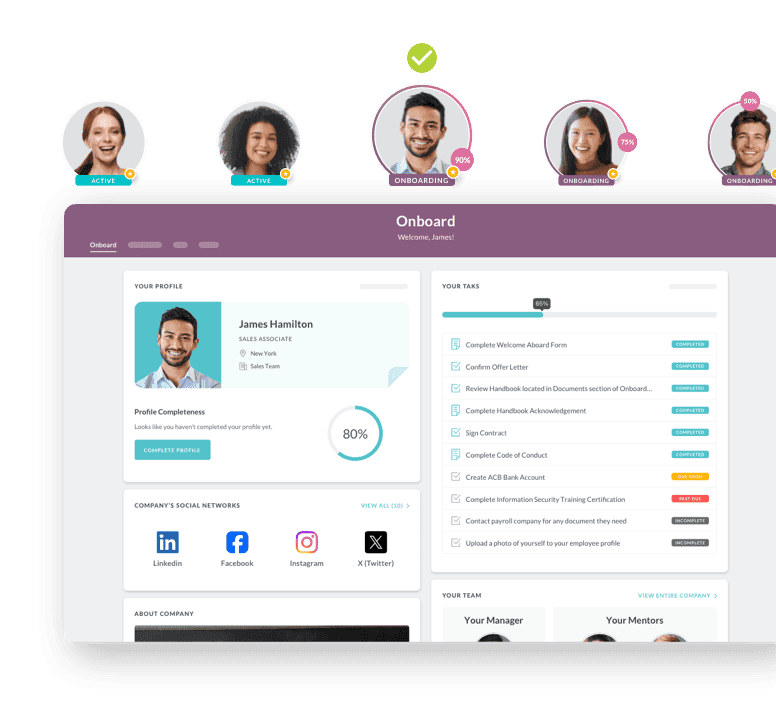
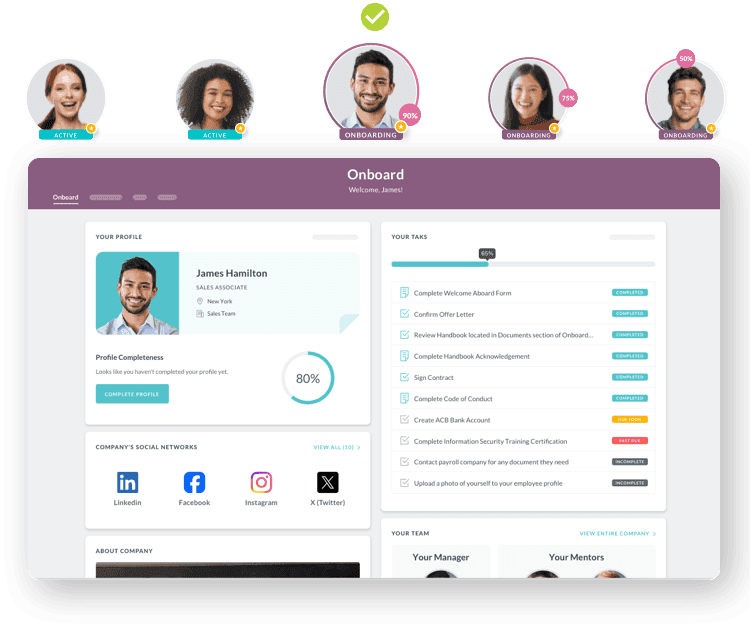
HR Cloud's onboarding checklists support a dedicated rehire schedule as a setup option separate from the standard new-hire schedule. When an admin initiates a hire for a previously terminated employee, the checklist tied to that schedule triggers automatically. New tasks get assigned based on the rehire's trigger dates, while the employee's prior tasks and forms are archived rather than deleted, visible to HR admins but no longer cluttering the employee's own view.
Here's what this looks like in practice: Interim HealthCare of Sioux Falls is a healthcare staffing franchise managing credential requirements by role and state across three offices. Staff cycling in and out is common in that business, and the company previously had to reconstruct a returning employee's full document history from scratch every time.
After moving onboarding onto HR Cloud, rehires retain that document history instead, so nothing has to be rebuilt. "Anytime we hire someone, they come through HR Cloud. This is our giant file cabinet, essentially," said Ali, the company's Staffing Manager. The team also reported 85% employee satisfaction with onboarding in 2025.
For organizations rehiring through HR Cloud's ADP integration specifically, changing the employee's status to active and setting a rehire date and reason in ADP Workforce Now can automatically import those updates into HR Cloud. That import assumes position, department, and salary changes were already made effective on the ADP side first.
One thing worth checking manually even with automation in place: old system access and badge permissions from before their termination. A rehire checklist that only adds new tasks, without confirming old accounts, VPN access, and building credentials were properly deprovisioned at departure, can leave a returning employee with a mix of stale and current permissions. That's a security gap most rehire workflows aren't built to catch on their own.
What still belongs in a human's hands, regardless of automation: the actual "welcome back" conversation with their new or returning manager, and any judgment call about how much of the original onboarding content still applies to this specific person.
Pro tip: Don't assume a returning employee is covered just because your new-hire automation is set up. A rehire checklist needs its own dedicated schedule to trigger correctly, so confirm that's configured before the next rehire shows up, rather than finding out the day they start.
Is Rehiring the Right Call for This Person?
Rehiring saves real time and money when it works. Rehired employees are already familiar with your systems, customers, and culture, which typically means less ramp-up time than an external hire. They also tend to earn more on the way back in: a 5% pay increase on average, compared to 2% for the colleagues who stayed. That's according to Visier's analysis of 2.4 million employees across 142 enterprise organizations. Most boomerang employees return within about six months of leaving, and nearly all return within ten.
The risk sits on the other side of the same coin. Familiarity can mean a returning employee defaults to the way things used to work instead of adapting to how the team operates now, and any unresolved conflict with a manager or teammate that contributed to their original departure doesn't automatically disappear because they're back.
The single most useful screening question before extending a rehire offer is also the simplest one: why did they leave the first time, and has that specific reason actually changed? A rehire who left over a compensation gap that's since been closed is a very different bet than one who left after a conflict with a manager who's still in the same role.
The real risk: Skipping the "why did they leave" conversation is the single fastest way to rehire the same problem you solved by letting them go, or that they solved by resigning.
How to Turn This Into a Real Rehire Onboarding Process
- Build the two-question intake now, before your next rehire shows up. Add "how long were they gone" and "what changed while they were away" as required fields in your rehire workflow, so the answer determines the onboarding path instead of a generic default.
- Confirm your I-9 policy in writing. Decide, as a documented policy, whether your organization defaults to Supplement B reverification or a fresh I-9 for eligible rehires within the three-year window, so individual admins aren't making that call inconsistently.
- Set up a dedicated rehire schedule in your onboarding system this week, separate from your standard new-hire schedule, so a returning employee's checklist reflects what they actually need rather than either the full new-hire sequence or nothing at all.
Rehiring is only getting more common, and an onboarding process built specifically for returning employees is what keeps that trend from creating compliance gaps and repeat mistakes instead of the fast, low-risk hire it should be. HR Cloud's onboarding platform supports a dedicated rehire schedule, automated I-9 tracking, and ADP-integrated status changes, so returning employees get a process built for exactly their situation instead of a copy of Day 1.

Discover how our HR solutions streamline onboarding, boost employee engagement, and simplify HR management
Book Your Free DemoFrequently Asked Questions
Do you need a new I-9 for a rehired employee?
Not always. If you rehire someone within three years of the date their original Form I-9 was completed, you can either complete Supplement B, Reverification and Rehire, or complete a new I-9. After three years, a new Form I-9 is required. Employees returning from approved leave or seasonal workers with continuous employment generally aren't considered "rehires" at all for I-9 purposes.
Is it a good idea to rehire a former employee?
It can be, particularly when the reason they left has genuinely changed. Rehired employees typically ramp up faster than external hires because they already know your systems and culture, and data shows they often return at a higher pay rate than employees who stayed. The main risk is bringing back the same conflict or gap that caused their original departure, so confirming what's actually different is worth doing before extending the offer.
How long should onboarding be for a rehired employee?
It depends on how long they were away and what changed, not a fixed timeline. Someone returning after a few months in the same role may only need a short policy and systems refresher, while someone returning after several years or into a different role should go through most of a full onboarding sequence, particularly for systems, policies, and org structure that changed while they were gone.
What is a boomerang employee?
A boomerang employee is someone who leaves a company and is later rehired by that same employer. The term applies whether the original departure was voluntary or part of a layoff. Boomerang hiring has grown steadily in recent years, accounting for roughly a third of all new hires as of early 2025.
Should a rehired employee go through the same onboarding as a new hire?
They should go through a structured process, though not an identical one. Rehired employees benefit from the same core elements, an updated policy walkthrough, systems training on anything that changed, and clear reintroduction to their team, but typically move through that content faster since they already understand the fundamentals of how the company operates.
What's the difference between rehiring and reboarding?
Rehiring refers to bringing back a former employee who left the company, whether voluntarily or through a layoff. Reboarding is a broader term that also covers employees returning from an extended leave, a remote-to-office transition, or any other gap in day-to-day work, even if they never technically left the company's payroll. The two overlap but aren't identical, which matters because the I-9 and continuous-employment rules covered above apply specifically to rehires, not to every reboarding scenario.
About the author

Keep Reading


Like What You Hear?
We’d love to chat with you more about how HR Cloud® can support your business’s HR needs.
Book Your Free Demo