HR Cloud for Nonprofits: Features and Pricing

HR Cloud for Nonprofits means running onboarding, employee records, time off, performance reviews, hiring, and time tracking for a nonprofit team on HR Cloud's modular platform. For organizations with 1 to 250 employees, HR Cloud publishes package pricing that starts at $295 per month for up to 50 employees. HR Cloud is not a payroll system, and its published pricing pages do not list a nonprofit discount.
For a nonprofit with several programs or sites, the problem is rarely just storing employee records. A new residential care worker, outreach employee, or program coordinator may need different documents, approvals, and schedules before starting, and when those steps sit in email, paper forms, and shared files, HR cannot easily see who is ready and what is still open. HR Cloud's role is to coordinate those workflows alongside the payroll system you already use.
Key takeaways
- Price structure: HR Cloud charges a flat package price by employee band, not a per-seat fee. Published small-business plans run from $295 to $1,995 per month. Above 250 employees, HR Cloud quotes a fixed annual license.
- Nonprofit evidence: HR Cloud publishes a customer story from SHELTER Inc., a nonprofit charity that works to prevent and end homelessness, plus stories from other mission-driven and small organizations.
- Strongest fit: Nonprofits with paper-heavy HR files, steady onboarding, shift-based or field-based program staff, or several sites.
- Real limits: No payroll, no published nonprofit discount, no volunteer-management or fund-accounting module in the help center, and no documented grant-code reporting.
- Next step: Ask for a quote that names your employee band, the modules you need, and the payroll provider you plan to keep.
How much does HR Cloud for Nonprofits cost?
HR Cloud prices as a flat package rather than per seat. For teams of 1 to 250 employees, HR Cloud's small-business pricing page lists three plans: Essential HR at $295 per month, Professional HR at $595 per month, and Culture HR at $895 per month, each for up to 50 employees. Prices step up at 51 to 100 employees and again at 101 to 250. The page states that annual billing saves 20 percent.
HR Cloud small-business pricing by plan and employee band (monthly billing)
| Plan | Up to 50 employees | 51 to 100 employees | 101 to 250 employees | What the plan includes |
|---|---|---|---|---|
| Essential HR | $295 | $495 | $795 | Onboard Suite (Core), time off management and time tracking, basic HRIS functionality, standard integrations, email and chat support |
| Professional HR | $595 | $995 | $1,495 | Everything in Essential HR, plus performance management, applicant tracking, assets management, and Kudos recognition |
| Culture HR | $895 | $1,395 | $1,995 | Everything in Professional HR, plus a custom branded mobile app, task management, personalized journeys by role and location, company announcements, eNPS and pulse surveys, employee engagement tools, secure chat, and digital signage |
Prices come from HR Cloud's small-business pricing page, checked in October 2026. Confirm current figures in your quote.
What changes above 250 employees?
Above 250 employees, HR Cloud's standard pricing page describes a fixed annual license quoted to your organization. Price depends on three things: team size, whether you choose the Onboard Suite or the HR Suite, and any add-ons. The add-ons are Employee Engagement, Assets, and Time Clock. Ask your specialist to list the exact modules in each suite on your quote.
The same page states a 12-month minimum term, says smaller businesses may qualify for special monthly contracts, and says multi-year agreements are available. HR Cloud does not offer a self-serve trial. Instead, a specialist gives a personalized demo and prepares a custom quote.
What does implementation cost?
On the small-business page, standard implementation is included at no cost when you prepay 90 days upfront. Without prepayment, a one-time $500 implementation fee applies to standard packages. That page says implementation covers data migration, workflow setup, and integration configuration by your Account Manager.
On the standard pricing page, setup, configuration, data import, and training are included. The two pages describe different pricing tracks, so read each figure against the track your quote uses and ask your specialist to confirm implementation terms in writing.
Does HR Cloud offer a nonprofit discount?
The small-business and standard pricing pages do not list a nonprofit-specific discount. Do not assume one exists, and do not assume one does not. Ask during the demo.
Some other HR vendors do publish nonprofit pricing. WebHR advertises a 20 percent discount for nonprofits, and HR Partner advertises up to 30 percent off annual plans for registered charities. Treat those figures as questions to put to any vendor you evaluate, not as expectations of HR Cloud.
What does each plan cost per employee?
Because pricing is by band, cost per employee falls as headcount approaches the top of a band. The table divides each published monthly price by the top of its band. This is arithmetic from list prices, not an HR Cloud figure.
| Plan | Employee band | Monthly list price | Per employee at top of band |
|---|---|---|---|
| Essential HR | Up to 50 | $295 | $5.90 |
| Essential HR | 51 to 100 | $495 | $4.95 |
| Essential HR | 101 to 250 | $795 | $3.18 |
| Professional HR | Up to 50 | $595 | $11.90 |
| Professional HR | 51 to 100 | $995 | $9.95 |
| Professional HR | 101 to 250 | $1,495 | $5.98 |
| Culture HR | Up to 50 | $895 | $17.90 |
| Culture HR | 51 to 100 | $1,395 | $13.95 |
| Culture HR | 101 to 250 | $1,995 | $7.98 |
The reverse also holds. A 51-person organization pays the 51 to 100 band price, so check where your headcount sits against the band edges before you choose a plan.
The step at each threshold can matter more than the average cost per employee. Moving from 50 to 51 employees raises the Essential HR list price from $295 to $495 per month, a $200 monthly increase, or $2,400 over twelve months at monthly list price. On Professional HR the same move goes from $595 to $995, a $400 monthly increase. Moving from 100 to 101 employees on Essential HR adds $300 per month. Model the next band as well as the current one before you sign.
What does Workmates cost on its own?
Workmates is HR Cloud's engagement product, and it has its own pricing page with three plans.
- Recognition covers peer-to-peer recognition, custom awards and rewards, 1,400+ global gift cards, automated milestones, Slack and Microsoft Teams connections, and mobile apps.
- Essential adds announcements and broadcasts, channels and communities, surveys and polls, employee advocacy, and engagement analytics.
- Premium adds a branded mobile app, personalized journeys, checklists and forms, eNPS and pulse surveys, secure chat, and digital signage. Premium is a custom quote.
Pricing is tailored to workforce size and selected capabilities, and annual billing saves 20 percent. Reward funding, such as gift cards, is separate from the software subscription, so budget the rewards line on its own.
What is HR Cloud, and who is it built for?
HR Cloud combines onboarding, employee records, time tracking, and workforce communication modules for organizations that want to improve HR operations without replacing their payroll platform. Teams can add modules as needs grow. Modules named on HR Cloud's site include Onboard, People HRIS, Workmates for engagement and recognition, Recruit ATS, Perform for performance management, Time Off, Time Clock, Shift Planner, Assets, and Offboard. HR Cloud is an ADP Platinum Marketplace Partner.
HR Cloud describes its platform as built for "frontline-heavy enterprises," and its onboarding page speaks to deskless and hourly teams. The small-business pricing page says the packages fit organizations of roughly 50 to 250 employees, with a band that starts at one employee.
HR Cloud suits nonprofits whose staff include people who do not sit at a desk, such as program, residential, outreach, or field staff. It also suits organizations that want a central place to coordinate onboarding and employee records in place of shared folders and spreadsheets.
HR Cloud sits alongside payroll rather than replacing it. Its onboarding page describes HR Cloud as working above your HR and payroll stack, with your payroll remaining the system of record. If you want a wider market view of low-cost options, HR Cloud's roundup of affordable HR platforms compares several vendors. This guide stays on one vendor and one sector.
Why is HR administration different at a nonprofit?
A nonprofit may have to coordinate paid employees, volunteers, grant-funded positions, and multiple program locations, each with different documentation requirements. Each of those shapes what to ask a software vendor.
The sector is large. The U.S. Bureau of Labor Statistics reports that in 2022, over 300,000 nonprofit establishments accounted for 12.8 million jobs, or 9.9 percent of all private-sector jobs (BLS nonprofit research data). HR software for nonprofits serves a very large employer group, and the HR work inside it varies widely.
Funder documentation can reach into HR records. If your organization charges salaries to federal awards, 2 CFR 200.430 sets documentation standards. Charges for salaries and wages must be based on records that accurately reflect the work performed. Budget estimates alone do not qualify as support, though estimates can serve for interim accounting with periodic after-the-fact review. For nonexempt employees, the rule also calls for records of total hours worked each day (eCFR, 2 CFR 200.430(g)). This is general information, not grant-compliance advice. Confirm requirements with your grants manager or auditor.
Volunteers and employees follow different rules. The U.S. Department of Labor says a volunteer generally will not be considered an employee for Fair Labor Standards Act purposes when the person volunteers freely for public service, religious, or humanitarian objectives without contemplation or receipt of compensation. It also says paid employees of a nonprofit cannot volunteer to provide the same type of services they are employed to provide (DOL Fact Sheet 14A). Your HR system should hold employee records cleanly, and volunteer records may need a separate home.
Wage and hour coverage depends on facts. The same fact sheet says nonprofit charitable organizations are not covered enterprises under the Act unless they engage in ordinary commercial activities, such as operating a gift shop, and that individual coverage can still apply to employees. State law may also apply. General information, not legal advice. Consult counsel for your situation.
Program models drive scheduling. Residential, outreach, and field programs can mean overnight, weekend, or off-site shifts. That affects timekeeping, scheduling, and how new hires receive paperwork when they have no desk and no work email.
Headcount is a poor measure of complexity. As an illustration, not a research finding, a 50-person nonprofit running five programs at five locations can face more HR coordination than a 150-person organization working from one office.
HR can be a shared job. In the SHELTER Inc. story below, onboarding sits with a Human Resources Assistant and Payroll Specialist. When one person covers several functions, manual paperwork consumes time that program work needs, and every hour spent chasing forms is an hour not spent supporting the people the organization serves.
Three illustrative scenarios. These are examples, not HR Cloud customer stories. A residential program adds overnight coverage, and a new hire must clear paperwork before the first shift, yet the supervisor works at another site and cannot see who is ready. An outreach worker has no work email, so document requests sent by email may never reach them. A volunteer coordinator tracks unpaid helpers in a spreadsheet, and HR must keep those records out of the employee file. Each one is a coordination problem across sites, devices, and record types, which is what the lifecycle section below tests.
How does HR Cloud for Nonprofits cover the employee lifecycle?
HR Cloud for Nonprofits uses the same modules every HR Cloud customer uses. The sections below map those modules to nonprofit needs, using HR Cloud's product pages and help center. Where a capability is not documented, the section says so.
How does HR Cloud handle nonprofit onboarding and paperwork?
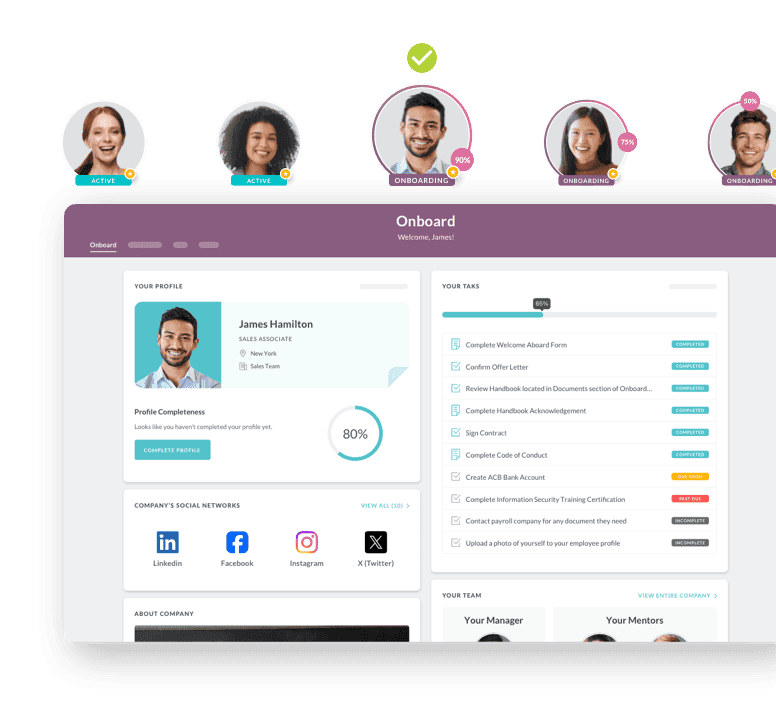
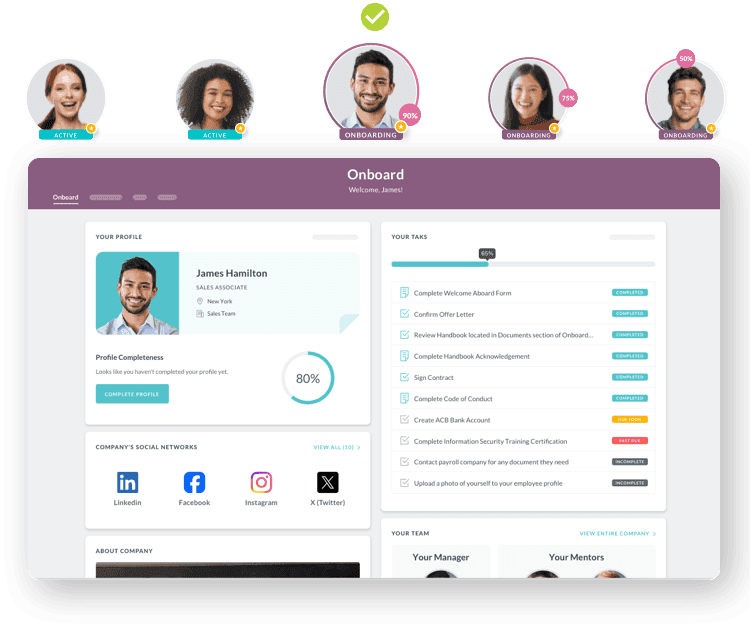
Onboard is HR Cloud's onboarding module. Its published feature list includes personalized onboarding plans, customizable portals, employee profiles, I-9 verification, welcome emails, workflows and checklists, approval workflows, automatic notifications, bulk data import, a mobile app, and access and security profiles.
The help center adds detail. Checklists can be recurring, mandatory, no-trigger, or rehire checklists. Task types include document requests, document downloads, form tasks, and e-signatures. Admins can set reminders and overdue alerts, add a task review step, and start bulk onboarding. HR Cloud's onboarding page says new hires can receive documents before day one and that no company email is required. That matters for program staff who never had a work inbox. SHELTER Inc., covered in the customer section below, used Onboard to replace a manual, paper-based process.
Does HR Cloud support I-9, E-Verify, and background checks?
HR Cloud's I-9 and E-Verify page describes a four-step flow. The new hire completes Section 1 electronically from any device. HR reviews documents in person or remotely, completes Section 2, and captures signatures. HR then submits E-Verify cases from the dashboard, and forms move to secure storage with audit trails and automated alerts for expiring documents.
Software supports those steps, and verification remains the employer's responsibility. Rules for remote document review are set by federal agencies and carry eligibility conditions, so confirm that your organization qualifies before you rely on a remote process. Train the staff who complete Section 2, and decide who covers that role at each site.
For background screening, the help center lists integrations with Checkr and Verified First. If your programs require screening, confirm that your provider appears on the integration list or ask HR Cloud how a different provider would connect.
How does HR Cloud support nonprofit hiring?
Recruit is HR Cloud's applicant tracking module. Recruit is included in Professional HR, Culture HR, and the HR Suite. The help center lists job board and applicant tracking integrations, including Indeed and JobTarget.
Great Kids & Awesome Adults, a provider of early intervention services, used Recruit and Onboard. Before HR Cloud, the organization posted jobs on Indeed and used Google Drive to hold resumes, references, and interview notes. After centralizing applicants in Recruit, it reported a 24 percent increase in applications over six months. These are customer-reported results from one 50 to 100 employee organization in Alabama, not a forecast for yours.
Can HR Cloud track time against projects?
Time Clock includes a Projects feature. Per the help center's Time Clock projects article, admins create a project with a name, an optional description, assigned users (all employees or specific ones), and an Active or Inactive status. Employees can pick a project when they enter time manually, or start and stop a project for automatic tracking. Only one project can run at a time under automatic tracking, project selection is optional, and inactive projects stay visible in past records. Employees can open View Project Hours on their timesheet to see hours by project for the pay period, and project time updates Time Clock dashboards and project reports. If the Projects tab is not visible, the help center says to contact your account manager.
Project tracking is not fund accounting. The help article does not describe grant codes, funding sources, or funder-ready cost reports. Three records get confused here. An employee timesheet records hours worked. A project-hours summary splits those hours by project. A funder-ready allocation report ties salary cost to specific awards under the documentation standard described above. The help article documents the first two and does not describe the third, so plan for finance or your grants system to produce it. If you charge salaries to awards, bring your auditor's sample report to the demo.
Can HR Cloud schedule shift-based program staff?
Shift Planner is HR Cloud's scheduling module. Its page describes smart and recurring scheduling, bulk actions to plan, assign, copy, publish, or unassign shifts, conflict detection, real-time alerts, role-based access, and mobile access so employees can check schedules and confirm assignments from a phone.
HR Cloud's retail HR software guide states the limit plainly. Shift Planner builds and manages schedules, and it is not the same as scheduling driven by live demand data. A nonprofit that schedules by census, caseload, or client demand should ask how that input would reach the schedule.
How does HR Cloud manage time off and leave?
HR Cloud's Time Off module describes tracking PTO, vacation, and leave requests in one system, with calendar integrations and automatic notifications. The help center covers time off settings, a balance grid, and a time off overview. Essential HR includes time off management and time tracking, and the HR Suite includes time off.
Test the places where your own policies are unusual: accrual schedules that differ by program, leave for staff who split time across sites, and any leave rules tied to a funder. Bring two of your real policies to the demo and ask HR Cloud to configure them live.
Does HR Cloud include performance reviews?
Perform is HR Cloud's performance management module. HR Cloud's small-business FAQ says it covers reviews and self-evaluations, custom questions, 360-degree feedback, and goal tracking. It is included in Professional HR and Culture HR and can be added to Essential HR as a paid add-on.
The operating decision for a multi-site nonprofit is who owns each review. Decide whether program managers at each site write reviews and central HR sets the questions and deadlines, or whether HR runs the full cycle. Settle that before you configure anything. Bracken Christian School, a private K-12 school with 100+ staff, used Perform to run evaluations and collect digital sign-offs alongside Recruit and Onboard.
How does HR Cloud keep dispersed staff connected?
Workmates handles communication and recognition. The Workmates pricing page lists peer recognition, announcements, channels, surveys and polls, and mobile apps for iOS and Android. HR Cloud describes Workmates as connecting deskless, remote, and hybrid teams in one tool.
Culture HR bundles engagement tools with the HR modules. Workmates can also be bought alone. Buy Workmates alone when onboarding, records, and time off already run in another system and the gap is communication and recognition. Choose Culture HR when you want the engagement tools sold together with the HR modules in one package.
How secure is HR Cloud?
HR Cloud's SOC 2 page describes SOC 2 Type 2 compliant software. Separately, its FAQ page names GDPR among the data protection standards it complies with. Both are vendor statements, so treat the SOC 2 report and your contract terms as the evidence. HR Cloud's security FAQ states that data is encrypted at rest using AES256 at the device level and in transit using TLS/1.2. It also says HR Cloud conducted a pen test of all products using Praetorian and that the report can be provided under NDA.
On access control, the People HRIS page describes granular role-based access. HR Cloud's integrations list names single sign-on options including SAML, Okta, OneLogin, and Office 365, and lists a Microsoft Entra ID integration.
Ask for the SOC 2 report and the penetration test summary under NDA during diligence, and have your IT contact or board risk committee review them.
Does HR Cloud connect to payroll and accounting tools?
HR Cloud does not run payroll. The small-business FAQ says HR Cloud operates independently of payroll systems, that payroll is not required to use core features, and that no payroll is bundled into the package price. Payroll integrations listed in the help center include UKG, Paycor, Paylocity, Dayforce, SAP, and several ADP products, including ADP Workforce Now and ADP RUN.
For accounting, the help center documents a QuickBooks Online integration. Admins can export employee data from HR Cloud to QuickBooks Online and import employees into HR Cloud, either overnight or manually. The article says updates to employees that exist on both sides flow from QuickBooks to HR Cloud. It also cautions that employee status data from QuickBooks accounts with payroll can be incorrect, so test status sync before relying on it.

Post Jobs, Evaluate Candidates, and Hire the Best with Our Applicant Tracking System
Book Your Free Demo
What do HR Cloud's nonprofit and mission-driven customers report?
HR Cloud's customer stories page lists one story labeled Nonprofit and several others from small, mission-driven, or community-serving organizations. Only the first is labeled a nonprofit on the page. The others are included because their size and needs resemble many nonprofits.
SHELTER Inc.: nonprofit charity, onboarding
HR Cloud's SHELTER Inc. case study describes a nonprofit charity that works to prevent and end homelessness for low-income, disadvantaged families and individuals. The challenge was a manual, paper-based onboarding approach that took too much time and could not keep pace with an aggressive hiring plan. SHELTER Inc. had taken over management of a new homeless facility, and hiring growth could possibly double its workforce.
HR Cloud's Onboard solution reduced the time needed to complete paperwork during onboarding. Jim Stanley, SHELTER Inc.'s Human Resources Assistant and Payroll Specialist, estimates HR Cloud has helped him save 60 to 70 percent of the time he used to spend on onboarding tasks. That is a customer estimate, not an audited result.
Great Kids & Awesome Adults: early intervention services
Great Kids & Awesome Adults provides early intervention services for young children at risk of developmental delays or disabilities and case management for individuals six and older. The organization has 50 to 100 employees in Alabama and uses Recruit and Onboard. Its HR director described the main problem before HR Cloud as inconsistency in HR processes, especially onboarding, where communications were missed or not relayed properly. The case study does not label the organization a nonprofit, so treat it as a mission-driven services provider of similar size.
“The flexibility of the HR Cloud system is invaluable in ensuring compliance. It helped us stay a step ahead of changing document collection requirements.”

— Jesse Rose, Provider recruitment, onboarding, and compliance manager

Bracken Christian School: small staff, small HR budget
Bracken Christian School is a private K-12 school with 100+ staff. Its case study says it needed a practical way to manage recruiting, onboarding, and performance reviews without a large HR budget or a complex system. Before HR Cloud, HR lived in Google folders, paper files, and manual coordination. The school moved to Recruit, Onboard, and Perform, replacing paper storage with digital records and e-signatures.
The case study also records a gap. Absence management ran in Red Rover, and substitute teacher information had to be duplicated manually outside HR Cloud. If your organization runs a specialist scheduling or absence tool, list it in your demo request and ask how data would move.
What does a support review from a nonprofit administrator say?
HR Cloud's customer support page includes a review from an administrator in nonprofit organization management. The reviewer described steady communication during the transition and quick, professional answers once the account was running. Read it as one reviewer's account, then ask for references from organizations that match your size and program type.
What do implementation and support look like?
HR Cloud's customer support page lists a six-step implementation for Onboard: kick-off call, building forms and importing employees, training for HR admins, managers, and employees, configuring checklists and portals, system testing, and go-live. Workmates follows its own six steps: kick-off call, importing employees, system training, configuring channels and pages, customizing kudos and rewards, and go-live.
Rollout effort depends on how many employee records you import, how many forms and checklists you build, how many sites need training, and how many integrations you connect. A single-site nonprofit with standard policies has a simpler rollout than a multi-site organization that needs different onboarding checklists for each program. Ask for a written timeline that names each of those factors, and who on your side owns forms, data import, and testing.
The help center offers video tutorials about HR Cloud features and curricula designed for admins, managers, and employees. Ongoing support lists live in-app support, email support, and a dedicated Account Manager.
Ask HR Cloud which support channels and hours apply to your plan, especially if your programs run overnight, and get the answer in writing before you sign.
Where does HR Cloud for Nonprofits fall short?
An honest evaluation lists gaps. This table pairs each gap with what HR Cloud's documentation shows and what to ask.
| Gap | What the documentation shows | What to ask |
|---|---|---|
| Payroll | HR Cloud operates independently of payroll and bundles none | Which payroll provider will you keep, and which fields sync? |
| Nonprofit pricing | The pricing pages reviewed do not list a nonprofit discount | Does any nonprofit pricing apply to our quote? |
| Volunteers | Help center categories cover employee modules, with none for volunteers | Where will volunteer records live? |
| Grant or fund cost allocation | Time Clock projects track time against projects, and grant coding is not described | Can you demonstrate the report our funder or auditor requires? |
| Trial | No self-serve trial, with a personalized demo and custom quote instead | Can we test our own checklist in the demo? |
| Contract term | Standard track states a 12-month minimum term | What term applies, and what happens at renewal? |
| Packaging | Perform is an add-on to Essential HR, and the Projects tab may need account manager enablement | Which of these are in our quote? |
| Adjacent systems | Bracken's absence tool required manual duplication | How would data move from our other tools? |
| Rewards cost | Gift card and reward funding is separate from the subscription | What reward budget should we plan? |
Who should choose HR Cloud, and who should look elsewhere?
HR Cloud for Nonprofits fits some organizations better than others. Use this table as a screening step before a demo.
| Your situation | HR Cloud is likely a fit when | Look elsewhere or add tools when |
|---|---|---|
| Size | You have 1 to 250 employees, or more with a custom quote | You need a very small free tier or a tool built only for volunteers |
| Workforce | Staff are deskless, hourly, or spread across sites | Your whole team works at desks and needs mainly payroll |
| Onboarding | Paper or folders slow new hires | Hiring is rare and paperwork is light |
| Payroll | You keep your payroll provider and want HR alongside it | You want HR and payroll bundled in one product |
| Funders | Your funder needs employee records and time data | Your funder needs fund-level cost allocation inside the HR system |
| Volunteers | Volunteers are managed in a separate tool | You need one record for staff and volunteers |
How should a nonprofit evaluate HR software?
Nonprofit buyers carry risks that general software checklists miss: funder documentation, separate volunteer records, and program sites with different shift patterns. Use this checklist on any vendor, including HR Cloud.
- Define the payroll relationship. Name your payroll provider and ask which employee fields sync, in which direction, and how often.
- Test grant and time documentation. Bring a sample funder report or audit request and ask the vendor to produce it from demo data.
- Decide where volunteers live. If the HR system is employee-only, plan the volunteer record before you buy.
- Check credential and background screening. List the checks your programs require and confirm each provider connects.
- Test mobile completion. Ask a staff member without a work email to complete a task on a personal phone during the demo.
- Read the security documents. Ask for the SOC 2 report and penetration test summary, and have the right person review them.
- Compare pricing structure. Per seat and per band can differ sharply at your headcount, so price your real number and the number you will reach in two years.
- Match support hours to program hours. If you run overnight programs, get the support schedule in writing.
- Confirm exit and data export. HR Cloud's pricing table lists import and export of data as included, and any vendor should state how you retrieve your records.
- Ask for matched references. Request customers of your size and program type, and ask each how long go-live took.
If you want to estimate the value of faster onboarding, HR Cloud offers an onboarding ROI calculator. Treat any vendor calculator as a starting model and replace its inputs with your own: hires per month, HR hours per hire, percent of hires incomplete on day one, and manager time spent chasing paperwork.
What would HR Cloud cost a real nonprofit?
The examples below apply published small-business list prices and the stated 20 percent annual-billing saving. They are illustrative arithmetic. Your quote may differ, and the saving applies as HR Cloud states it in your agreement.
| Example organization | Plan | Monthly list price | Annual at monthly list price | Annual with 20 percent saving |
|---|---|---|---|---|
| 35 employees, onboarding, time off, basic records | Essential HR | $295 | $3,540 | $2,832 |
| 80 employees, adds hiring, reviews, recognition | Professional HR | $995 | $11,940 | $9,552 |
| 180 employees, adds engagement and surveys | Culture HR | $1,995 | $23,940 | $19,152 |
Add implementation, which is a one-time $500 for standard packages unless you prepay 90 days, and any reward funding. The numbers above exclude payroll, because HR Cloud does not provide it.
The bottom line on HR Cloud for Nonprofits
HR Cloud for Nonprofits is a reasonable fit for organizations with 1 to 250 employees that want onboarding, records, time off, reviews, hiring, and time tracking in one system alongside their existing payroll. Published prices run from $295 to $1,995 per month by plan and band, with a 20 percent annual-billing saving and a one-time $500 implementation fee unless you prepay 90 days.
The evidence base is real but narrow. HR Cloud publishes one story labeled Nonprofit, from SHELTER Inc., and several from small mission-driven organizations. The documentation does not show payroll, volunteer management, fund accounting, or a nonprofit discount. Treat payroll and volunteer management as adjacent-tool needs: pair HR Cloud with your payroll provider and a separate volunteer tool. Treat fund-level cost allocation as the one that can be a blocker. If your funder or auditor requires it from the HR system itself, test that report before anything else. A missing nonprofit discount is a pricing question, not a fit question.
The deciding question is not whether HR Cloud has enough features. It is whether the modules in your proposed package can run your real workflows. Test them with sample employee records, an onboarding checklist, a time report, and your payroll requirements before you buy.
To test fit, book a demo of HR Cloud Onboard and bring your current onboarding checklist, your payroll provider, and a sample funder report. A specialist walks through the Onboard Suite or HR Suite against your process and prepares a custom quote. You can also review the pricing page first.
Discover how our HR solutions streamline onboarding, boost employee engagement, and simplify HR management
Book Your Free DemoFrequently asked questions about HR Cloud for Nonprofits
Is HR Cloud for Nonprofits priced per employee?
No. HR Cloud prices by package and employee band, not per seat. Small-business plans cover 1 to 50, 51 to 100, and 101 to 250 employees, and organizations above 250 employees receive a fixed annual license quote. Adding employees inside a band does not change the monthly price.
How much does HR Cloud cost for a 50-person nonprofit?
On HR Cloud's small-business pricing page, a 50-person organization pays $295 per month for Essential HR, $595 for Professional HR, or $895 for Culture HR with monthly billing. Annual billing saves 20 percent. Implementation is a one-time $500 for standard packages unless you prepay 90 days upfront.
Does HR Cloud offer a nonprofit discount?
HR Cloud's small-business and standard pricing pages do not list a nonprofit discount. Some other HR vendors publish one. Ask HR Cloud during your demo whether any nonprofit pricing applies, and get the answer written into your quote before you sign.
Does HR Cloud include payroll?
No. HR Cloud operates independently of payroll, requires no payroll provider to run core features, and bundles no payroll in its package price. It integrates with payroll providers including UKG, Paycor, Paylocity, Dayforce, SAP, and several ADP products, so you keep your existing payroll system.
Is there a free trial of HR Cloud?
HR Cloud does not offer a self-serve trial. Buyers get a personalized demo from a specialist, who then prepares a custom quote for the team size and modules. Bring your own onboarding checklist and forms to the demo so you can judge the fit with real material.
Can HR Cloud track volunteers?
HR Cloud's help center lists modules for onboarding, people records, recruiting, time off, performance, time clock, assets, and shift planning, and it lists none for volunteers. The Department of Labor generally treats genuine volunteers as non-employees, so many nonprofits keep volunteer records in a separate tool.
Can HR Cloud help with grant time reporting?
HR Cloud's Time Clock lets admins create projects and lets employees log time to them, with project hours visible on timesheets and reports. The help article does not describe grant codes or funder-ready cost reports. Ask for a demo of the exact report your funder or auditor requires.
How long does HR Cloud implementation take?
HR Cloud's Onboard implementation follows six steps: kick-off call, building forms and importing employees, training, configuring checklists and portals, system testing, and go-live. Timelines depend on scope, so ask for a written schedule that names your scope and each owner.
Is HR Cloud secure enough for sensitive HR data?
HR Cloud publishes several security assurances and controls, but suitability for sensitive HR data depends on your organization's requirements. HR Cloud states that it encrypts data at rest with AES256 and in transit with TLS 1.2, and that a penetration test report is available under NDA. Request the SOC 2 report before signing.
Which nonprofit customers does HR Cloud have?
HR Cloud's customer stories page labels one story Nonprofit, from SHELTER Inc., a charity working to prevent and end homelessness. Other stories come from small mission-driven organizations such as Great Kids & Awesome Adults. Ask HR Cloud for references that match your size and program type.
About the author

Keep Reading


Like What You Hear?
We’d love to chat with you more about how HR Cloud® can support your business’s HR needs.
Book Your Free Demo