Best HR Software for Startups Under 50 Employees in 2026

The best HR software for startups under 50 employees in 2026 includes HR Cloud, Gusto, OnPay, Justworks, Rippling, BambooHR, Deel, Homebase, Factorial, and TriNet HR Plus (formerly Zenefits). At this headcount, the right tool depends less on feature breadth and more on one question: does your startup want payroll and compliance handled for you (a PEO like Justworks or TriNet), or do you want a lighter system that connects to payroll you already have (an HRIS like HR Cloud or BambooHR)?
This guide breaks down what each platform actually costs at startup scale, what it includes, and who it fits, using only pricing and features verified directly on each vendor's own site.
A generic "affordable HR platforms" roundup written for any company size misses most of what actually matters at this stage. A 40-person startup and a 400-person mid-market company are both technically "affordable HR platform" shoppers, but they're solving different problems: the 400-person company is optimizing an existing HR function, while the 40-person startup often doesn't have one yet. This guide is written for that second situation specifically, which is why a few platforms here (Homebase, Factorial, Justworks) rarely show up on broader HR software lists aimed at larger buyers.
What Should a Startup With Under 50 Employees Actually Look For?
A company this size rarely has a dedicated HR department. Usually it's a founder, an office manager, or one generalist handling HR alongside other work. That changes what "good HR software" means compared to a 500-person company:
- Setup speed matters more than depth. A startup can't afford a multi-month implementation. Every tool on this list is built to be running within days, not quarters.
- Per-employee pricing hits differently at this scale. A $5/employee/month difference is a rounding error at 500 employees and a real budget line at 12 employees. Small pricing gaps matter more here than anywhere else in HR software shopping.
- Compliance risk doesn't shrink just because the company is small. A 12-person startup still owes payroll taxes correctly, still has to classify contractors correctly, and still needs I-9 and onboarding paperwork done right. Small headcount doesn't mean small consequences for getting this wrong.
- You're choosing between "do it for me" and "give me the tool." A PEO (Professional Employer Organization) or ASO (Administrative Services Organization) offloads payroll, compliance, and often benefits access. A standalone HRIS or payroll tool hands you the tool and you (or your accountant) still run it.
- Your first international hire changes the requirements more than your fifth domestic hire does. A tool built for a single-country team can handle a lot of domestic growth without strain. One contractor or employee outside your home country introduces tax and compliance requirements that most of the tools on this list were never built to handle as an afterthought.
None of these considerations are unique to startups in the abstract sense; a 2,000-person company cares about setup speed and compliance too. What's different is the ratio. A large company can absorb a bad HR software decision for a year while a dedicated team works around it. A 20-person startup usually can't; the person handling HR is also doing three other jobs, and a clunky tool becomes a daily tax on someone who doesn't have the hours to spare.
The ten platforms below split roughly into three categories: PEOs that take on co-employment and compliance (Justworks, TriNet HR Plus), payroll-first tools that hand you a lighter system to run yourself (Gusto, OnPay, Homebase), and broader HRIS or unified platforms that layer onboarding, engagement, and sometimes IT on top (HR Cloud, BambooHR, Rippling, Factorial, Deel). Knowing which category actually solves your problem narrows this list to two or three before you look at a single feature comparison.
1. HR Cloud: Best Overall for Startups That Want Room to Grow Past 50
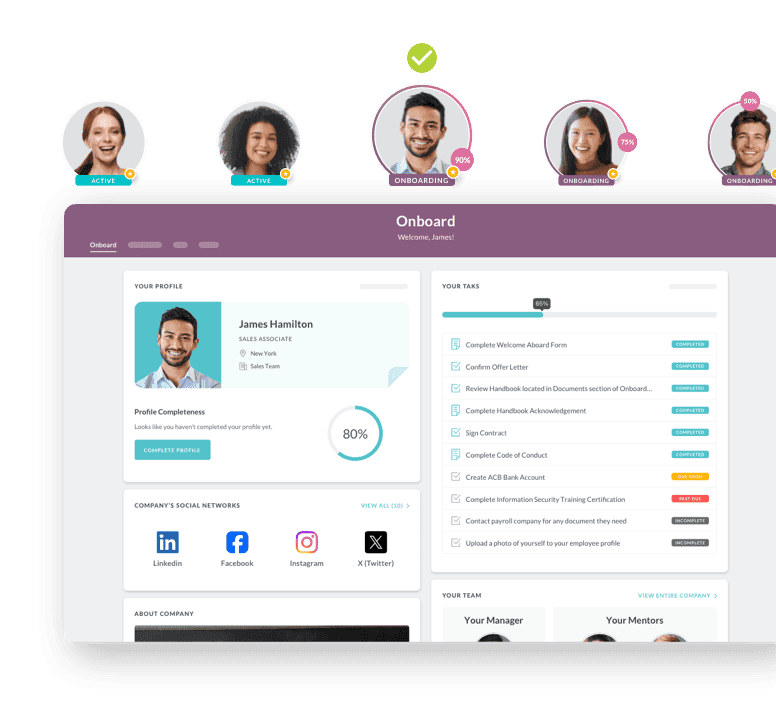
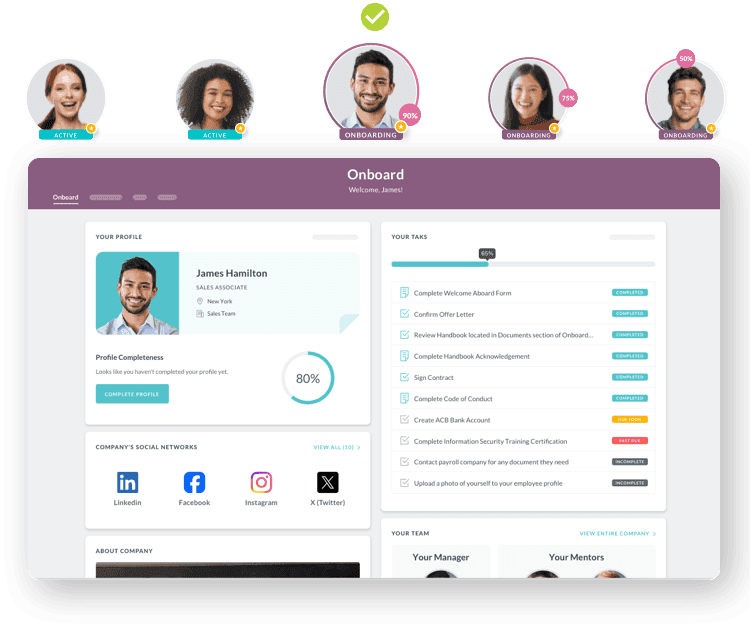
HR Cloud publishes a pricing tier built for exactly this headcount: Essential HR starts at $295/month for companies with 1 to 50 employees, covering the Onboard Suite, time off management and tracking, basic HRIS functionality, standard integrations, and email/chat support. That's a flat rate by employee band, not a per-seat charge, so hiring your next few employees inside that same 1-to-50 band doesn't change the bill. Paying annually instead of monthly saves 20%.
The practical reason to consider HR Cloud at this stage rather than later: the same platform scales into Professional HR ($595/month) and Culture HR ($895/month) tiers as the company grows past 50 employees, adding recruiting, performance management, and engagement tools without a system migration. For a startup that expects to double or triple headcount in the next year or two, avoiding a full HR platform switch at 60 employees is a real, if hard-to-quantify, cost saving.
HR Cloud's Recruit ATS module and I-9/E-Verify module (95% of cases resolved instantly through automated case management) cover hiring compliance from the first hire, and average implementation runs about 6 weeks. The platform is rated 4.7 out of 5 on G2 (183 reviews) and 4.7 out of 5 on Capterra (84 reviews).
For the founder or office manager actually running HR day to day, the I-9/E-Verify module's mobile-first design lets a new hire complete Section 1 electronically from their own phone, with employer review and E-Verify submission handled from the same system, rather than the paper-and-spreadsheet process a lot of very early-stage startups start with by default.
Best for: Startups under 50 employees that expect meaningful headcount growth and want onboarding, HRIS, and engagement tools that scale with them rather than a system they'll outgrow.
Honest limitation: HR Cloud is not a payroll processor or a PEO. You'll need to run payroll through a separate provider (or connect an existing one) rather than getting payroll bundled in. Its own published case studies also skew toward larger, multi-location organizations rather than sub-50-employee startups specifically, so most of its proof points come from bigger deployments even though its pricing explicitly covers this band.
2. Gusto: Best for Straightforward US Payroll and HR in One Tool
Gusto is the default choice for a lot of small US startups, and its published pricing explains why: Simple starts at $49/month plus $6/month per person for single-state payroll, Plus runs $80/month plus $12/month per person and adds multi-state payroll and time tracking, and Premium runs $180/month plus $22/month per person with a dedicated service advisor and access to certified HR experts. Gusto holds a 4.6-star average across 4,137 reviews on both Capterra and Software Advice.
For a startup under 50 employees, the Simple or Plus tier is usually the realistic starting point, and Gusto runs contractor payments on the same per-person fee as employee payroll with automatic 1099-NEC filing, which matters for early-stage teams that mix a few employees with contractors before they've built out formal HR.
Gusto's Premium tier also adds performance and compensation management on top of payroll, which matters for a startup that's outgrown the "just pay people" stage but isn't ready to evaluate a separate HR platform yet.
Best for: Small, US-based startups that want payroll to just work and are fine with a lighter HR feature set around it.
Honest limitation: Gusto's HR tools are thin outside of payroll and time off. There's no engagement, recognition, or performance layer built in, so a startup that wants those will be adding a second tool eventually.
See HR Cloud vs Gusto: Best Choice for Payroll + HR for a full comparison of where each platform's strengths actually lie.
3. OnPay: Best Budget Multi-State Payroll for a Lean Team
OnPay's own pricing page states a starting rate of $49/month base fee plus $6/month per person, with unlimited pay runs, W-2 and 1099 filings, and multi-state payroll included at no extra cost. There's no separate charge for implementation, and the site references a "get one month free" offer for new signups.
The multi-state detail matters more than it sounds for a startup under 50 employees: many small teams are already distributed across two or three states from day one, and OnPay includes that rather than charging extra per state, unlike some competitors on this list.
OnPay has also picked up recognition specifically in the small-business category: it's been named "Best Value" by PCMag, "Best for Small Businesses" by Business.com and CNBC, and "Best for Combined HR, Benefits and Payroll" by USA Today, all cited on OnPay's own homepage.
Best for: Cost-conscious startups that need clean multi-state payroll without paying for HR features they don't have the headcount to use yet.
Honest limitation: OnPay is payroll-first. HR tooling beyond payroll (onboarding workflows, performance, engagement) is minimal, so it's a better fit for a startup whose HR needs are still mostly "pay people correctly" than one that's ready to build out a fuller HR stack.
4. Justworks: Best PEO Option for Offloading Compliance Entirely
Justworks runs three main US plans, all confirmed directly on its own pricing page: Payroll at $8/month per employee plus a $50/month base fee, PEO Basic at $79/month per employee with no base fee (compliance, HR tools, and 24/7 support included), and PEO Plus at $124/month per employee, which adds medical, dental, and vision administration, HSA/FSA accounts, and mental health benefits. A Global Employer of Record option runs $599/month per employee for hiring full-time internationally.
The PEO structure is the real differentiator here: under a PEO, Justworks becomes a co-employer, taking on payroll tax filing, compliance, and (on PEO plans) access to larger group health insurance rates than a 12-person startup could get on its own. That's a meaningfully different legal and practical arrangement than every HRIS or payroll-only tool on this list.
Justworks also sells add-ons separately from the core plans, confirmed on its own pricing page: international contractor payments run $39/month per paid contractor across 60+ countries, US-based contractor payments run $8/month per paid contractor, and dedicated HR consulting runs $30/month per employee for startups that want a human strategic partner rather than just a support line.
Best for: Startups that want compliance, payroll tax filing, and benefits access handled entirely by someone else, and are willing to pay a per-employee premium for that.
Honest limitation: PEO pricing scales directly with headcount and benefits elections, so it can get expensive fast compared to a flat-rate HRIS. A startup planning to build its own HR function soon should weigh whether it's paying for convenience it'll want to unwind later.
5. Rippling: Best for Tech Startups That Also Need IT From Day One
Rippling doesn't publish standard pricing at all : its pricing page is a quote-request form, not a rate table, confirmed by loading it directly. An independent analysis of 281 verified Rippling purchases by procurement platform Vendr found a median annual contract value of $45,691, ranging from $5,898 to $190,266 depending on which modules are included. Rippling itself displays 4.8/5 on G2, 4.9/5 on Capterra, and 4.9/5 on GetApp.
What makes Rippling relevant specifically for a startup under 50 employees is the IT device management layer: a tech startup issuing laptops and software licenses to every new hire can provision HR, payroll, and IT access in the same workflow, instead of HR and IT running as two disconnected processes with a two-person team.
Rippling's Identity & Access Management product also handles single sign-on, multi-factor authentication, and automatic app provisioning and deprovisioning, which matters for a startup whose entire tech stack (Slack, GSuite, GitHub, and a dozen SaaS tools) needs to be locked down the moment someone leaves, not manually revoked tool by tool by whoever remembers to do it.
Best for: Tech-forward startups that need unified HR, payroll, and device/software provisioning, and don't mind a fully custom quote instead of published pricing.
Honest limitation: Cost is unpredictable until you're deep into a sales conversation, and the platform's breadth is more setup complexity than a 15-person startup with simple needs may actually want.
See HR Cloud vs Rippling: Which HRIS Wins for Startups? for a full pricing and feature comparison.
6. BambooHR: Best Pure HRIS if Payroll Is Already Handled
BambooHR publishes real pricing: Core starts at $10 per employee/month, Pro at $17, and Elite at $25, or a flat $250/month for companies with 25 or fewer employees. A 15% discount applies when bundling payroll with benefits administration.
For a startup under 50 employees that already has payroll sorted out (through an accountant, a separate payroll tool, or a parent company) and just needs employee records, time off, and basic onboarding, BambooHR's mobile app and Employee Community feature cover the HRIS side without forcing a payroll switch.
The tier differences matter for compliance specifically: Core includes one compliance training course, Pro adds 15 compliance training courses, and Elite adds 300+, which starts to matter once a startup crosses into multiple states with different training requirements even at well under 50 employees.
Best for: Startups that want a standalone HRIS and already have payroll handled elsewhere.
Honest limitation: BambooHR's per-employee pricing climbs in a straight line as headcount grows, and it doesn't run payroll natively, so it's an additional line item alongside whatever payroll tool you're already using.
See 7 Best BambooHR Alternatives & Competitors for a fuller comparison.
7. Deel: Best for Startups Hiring Internationally From the Start
Deel publishes real pricing: its contractor management product starts at $49 per contractor/month ($325/month if Deel acts as Contractor of Record), its PEO option starts at $125 per employee/month, and its Employer of Record service, for hiring full-time employees abroad without a local entity, starts at $599 per employee/month. Deel states there are no hidden fees and no long-term contract requirement.
A growing number of startups under 50 employees hire their first few engineers or contractors outside their home country before they hire employee number 20 domestically. Deel is built specifically for that pattern in a way none of the domestic-only tools on this list are.
Worker classification is the specific risk Deel is built to manage: misclassifying an international contractor as a full employee, or the reverse, carries real legal and tax exposure in that person's country, and Deel's contractor management product is built around getting that classification right by country before payments go out.
Best for: Startups whose early hires include contractors or employees outside their home country.
Honest limitation: If your team is entirely domestic, Deel's cross-border compliance infrastructure is overhead you don't need, and its per-worker fees run higher than domestic-only tools for the same headcount.
8. Homebase: Best for Non-Tech Startups With Hourly or Shift-Based Teams
Homebase publishes real pricing: a Basic plan is free for one location with up to 10 employees, covering basic scheduling and time tracking. Essentials runs $24/month per location for unlimited employees (discounted from $30 on annual billing) and adds advanced scheduling and team communication. Plus runs $56/month per location (from $70) and adds AI-powered scheduling and PTO controls. A payroll add-on runs $49/month plus $6/month per employee paid.
Not every startup under 50 employees is a software company. A new retail location, restaurant, or service business with shift-based staff has fundamentally different needs than a 12-person SaaS team, and Homebase is built around hourly scheduling and shift management in a way the other tools on this list aren't.
Homebase also sells add-ons specific to hourly, tip-based work that none of the other tools on this list offer, confirmed on its own pricing page: a Tip Manager that automatically pulls tips from a point-of-sale system and calculates the tip pool for $25/month per location, and a Task Manager for building and assigning shift task lists at $13/month per location. Neither is relevant to a software startup, and both are exactly the kind of detail that shows this tool was built for a different kind of small business than most of the others on this list.
Best for: Non-tech startups with hourly, shift-based employees, especially retail, food service, or single-location small businesses just past the founding stage.
Honest limitation: Homebase's HR feature depth (performance, engagement, structured onboarding beyond basics) is thinner than dedicated HRIS platforms, since its core strength is scheduling and time tracking, not full HR administration.
9. Factorial: Best Modular All-in-One for a Startup That Wants to Pick Its Own Features
Factorial's own pricing page states it starts at $8 per user per month, with a base "Factorial Core" (employee directory, onboarding/offboarding, payslip distribution, e-signature) and add-on modules across time management, talent management, finance, and IT management that a startup selects based on what it actually needs. Factorial doesn't publish fixed tier pricing beyond that starting rate; it builds a quote around the modules selected.
That modularity is the appeal for a very early-stage startup: instead of paying for a bundled suite of performance reviews and compensation planning it doesn't need yet, a 10-person startup can start with just Core plus time tracking and add modules as the team grows.
Factorial's module categories, confirmed on its own pricing page, span Time Management (time off, time tracking, shift management), Talent Management (performance, recruitment, engagement, training), Finance (expenses, project management, procurement), and IT Management (SaaS management, IT inventory, device management), so a startup can genuinely start with just Core and payroll basics and add a specific module the day a real workflow breaks, rather than paying for the finance or IT modules from day one.
Best for: Early-stage startups that want to pay only for the specific HR functions they need right now, not a bundled suite.
Honest limitation: Because pricing is built module-by-module rather than published in clear tiers, it's harder to predict the final cost upfront compared to a tool with fixed pricing bands.
10. TriNet HR Plus (formerly Zenefits): Best for Startups Wanting Bundled Payroll, HR, and Compliance Support
Zenefits was a standalone small-business platform, discontinued as its own product after TriNet's 2022 acquisition. What a startup evaluates today is TriNet HR Plus, which bundles payroll administration, HR support, benefits administration, and compliance assistance on one platform. TriNet no longer publicly lists pricing for this product; it's quote-only.
One structural detail matters here: HR Plus is TriNet's Administrative Services Organization (ASO) offering, and TriNet's own explanation of its HR outsourcing models states plainly that "unlike a PEO, there is no co-employment relationship with an ASO," meaning your startup remains the employer of record. That's different from TriNet's separate full PEO product, where TriNet itself becomes a co-employer, so confirm which one you're actually being quoted.
That ASO distinction is worth sitting with for a moment, because it's easy to assume the opposite: a startup evaluating "the old Zenefits" often expects a PEO-style co-employment arrangement, and TriNet HR Plus specifically isn't that. If a startup actually wants co-employment and the group-benefits access that comes with it, that's TriNet's separate PEO product, priced and structured differently.
Best for: Startups that want payroll, HR, and compliance support bundled with a vendor while staying the legal employer of their own staff.
Honest limitation: Anyone still shopping by the name "Zenefits" should know upfront they're evaluating one of TriNet's two current products, not a standalone tool that still exists under that name.
See HR Cloud vs Zenefits: Which Platform Fits Your Team Size? for more detail on this shift.
How Do You Choose Between These for a Team Under 50 Employees?
Do you want compliance and payroll run for you, or do you want the tool and keep control? Justworks and TriNet HR Plus are built around someone else handling payroll tax filing and compliance. Gusto, OnPay, HR Cloud, and BambooHR hand you the system and expect you (or your accountant) to run it. There's no universally right answer here : it's a real tradeoff between cost and offloaded responsibility.
Is your team entirely domestic, or are you hiring outside your home country already? If any of your first 50 hires are outside your home country, shortlist Deel first. Cross-border payroll and compliance is not a feature most of the other tools on this list handle well as an afterthought.
Are your employees salaried knowledge workers, or hourly and shift-based? A 30-person SaaS startup and a 30-person restaurant group both count as "under 50 employees," but they need different tools. Homebase is built for the second case; most of the others on this list assume the first.
How much do you expect to grow in the next 12 to 24 months? A platform that's ideal at 15 employees can become a poor fit at 80. HR Cloud and Justworks are both built to scale past 50 without a system change; a flat-rate tool like Homebase's per-location pricing or a strictly per-employee tool like BambooHR will simply cost more as headcount grows, which isn't a problem, just a number worth modeling out before you commit.
What does the pricing actually look like at your real headcount? A per-employee tool and a flat-tier tool can look similarly priced at 20 employees and diverge sharply at 45. Run your actual current headcount, and a realistic 12-month growth number, against each vendor's real pricing structure before comparing quotes side by side.
What kind of support comes with the plan, and is it included or an upsell? This matters more at a startup than anywhere else, since there's no dedicated HR or IT person to escalate to internally. HR Cloud includes training, support, and unlimited chat in every plan with no per-seat support upsells. Justworks' Dedicated HR Consulting, by contrast, is a $30/month per employee add-on rather than something bundled into the base PEO plans. Ask directly whether support is included at your specific tier before assuming it is.
What Mistakes Do Startups Make When Choosing HR Software at This Stage?
A few patterns show up repeatedly when a startup under 50 employees ends up switching HR software within its first year of picking one.
Choosing a PEO before checking whether it's actually cheaper. A PEO's group health insurance rates can be a genuine win for a startup that couldn't get comparable rates alone, but that math only works out at certain headcounts and benefit elections. Run the actual PEO quote against buying insurance directly before assuming the bundle is the deal it's marketed as.
Picking per-employee pricing without modeling next year's headcount. A per-employee tool that looks cheap at 8 employees can cost more than a flat-tier platform at 35. Model your realistic 12-month hiring plan against both pricing structures, not just today's headcount, before signing.
Treating international hiring as a "figure it out later" problem. A startup that hires one contractor outside its home country without the right classification and tax setup can create real, expensive compliance exposure well before it has an HR person dedicated to catching it. If international hiring is even a possibility in the next year, factor that into the platform choice now.
Assuming a payroll tool includes real HR functionality. Gusto, OnPay, and similar payroll-first tools are excellent at what they do, but "payroll software" and "HR software" are not the same thing. A startup that needs onboarding workflows, performance tracking, or engagement tools alongside payroll should check for that explicitly rather than assuming a payroll platform will grow into it.
Not confirming what happens to data and workflows if you switch providers later. Migrating payroll history and employee records mid-growth is disruptive at any size, but a startup usually has the least slack to absorb that disruption while it's also trying to hire and ship product. Ask any vendor directly what a future migration would actually involve before treating switching costs as a future problem.
Comparing the advertised "starting at" price instead of the price at your actual headcount. Every per-employee tool on this list quotes a starting rate that assumes the cheapest tier and no add-ons. A startup that needs multi-state payroll, a compliance module, or dedicated support will pay more than the homepage number suggests. Price out the specific tier and add-ons you'll actually need before comparing two vendors' headline rates against each other.
Cloud HR Software for Startups Under 50 Employees at a Glance
| Platform | Starting Price | Pricing Published? | Best For | Startup-Specific Standout |
|---|---|---|---|---|
| HR Cloud | $295/month (1-50 employees) | Yes | Startups expecting to grow past 50 | Dedicated 1-50 employee pricing band |
| Gusto | $49/month + $6/mo per person | Yes | Simple US payroll + basic HR | Fast setup, contractor payments included |
| OnPay | $49/month + $6/mo per person | Yes | Budget multi-state payroll | Multi-state included at no extra cost |
| Justworks | $79/employee/month (PEO Basic) | Yes | Full compliance/benefits offload | True PEO co-employment structure |
| Rippling | Custom quote (median $45,691/year per Vendr) | No | Tech startups needing HR + IT | Unified HR + device/software provisioning |
| BambooHR | $10/employee/month (Core) | Yes | Standalone HRIS, payroll elsewhere | Mobile self-service, employee community |
| Deel | $49/contractor/month; $599/employee/month (EOR) | Yes | Hiring internationally from day one | Compliant hiring in 130+ countries |
| Homebase | Free (up to 10 employees, 1 location) | Yes | Hourly/shift-based non-tech startups | Free tier, per-location pricing |
| Factorial | $8/user/month (Core, modular add-ons) | Partial | Pay-only-for-what-you-need startups | Modular pricing by feature |
| TriNet HR Plus | Custom quote | No | Bundled payroll/HR/compliance | ASO structure, client stays employer of record |
Which HR Software Is Right for Your Startup?
If your startup is on a clear growth path and you don't want to migrate systems again at 60 or 80 employees, HR Cloud's dedicated 1-to-50-employee pricing band is built for exactly that transition. If you want payroll and compliance handled entirely by someone else, Justworks or TriNet HR Plus trade a per-employee premium for that. If your first hires are outside your home country, Deel solves a problem the domestic-only tools on this list don't touch. And if your team is hourly and shift-based rather than salaried knowledge workers, Homebase fits a reality most HR software on this list wasn't built around.
None of these ten platforms are wrong choices in the abstract. The mistake at this stage is usually picking based on brand recognition or whatever a previous employer used, rather than the specific combination of headcount trajectory, worker type, and geography your startup actually has right now. A tool that's genuinely the best fit for a 15-person, single-state, salaried software team will be the wrong fit for a 15-person, multi-state, hourly retail operation, even though both are technically startups under 50 employees.
Whatever you pick, run your actual headcount and a realistic 12-month growth number against the real pricing structure, not just the marketed starting price, before you sign anything.
Ready to see whether HR Cloud's 1-to-50-employee plan fits your startup?

Discover how our HR solutions streamline onboarding, boost employee engagement, and simplify HR management
Book Your Free DemoFrequently Asked Questions About HR Software for Startups Under 50 Employees
What's the difference between a PEO and a regular HR software tool for a small startup?
A PEO like Justworks or TriNet's full PEO product becomes a co-employer of your staff, taking on payroll tax filing and compliance and often giving access to larger-group benefits rates. A regular HRIS or payroll tool, like HR Cloud, BambooHR, or Gusto, gives you the system to run HR yourself; you or your accountant remain fully responsible for compliance.
How much does HR software actually cost for a 20 to 30 person startup?
It varies by structure. Flat-tier tools like HR Cloud price by employee band ($295/month covers 1 to 50 employees). Per-employee tools like BambooHR or Gusto scale with headcount, typically landing in the $10 to $22 per employee per month range depending on features. PEOs like Justworks run $79 to $124 per employee per month before benefits costs.
Does a startup under 50 employees actually need a PEO?
Not always. A PEO makes the most sense when a startup wants group health insurance rates it couldn't get on its own, or wants payroll compliance fully offloaded. A startup that already has an accountant or a simple payroll setup and just needs employee records and onboarding often does better with a standalone HRIS at a lower cost.
Can HR software for startups handle both employees and contractors?
Yes, several platforms on this list do, including Gusto and Deel, which each run standard payroll for employees while handling contractor payments and 1099 filing separately. Confirm a platform treats contractors as a genuinely distinct category with correct tax handling rather than forcing them into an employee-shaped workflow.
Is it worth paying for a platform built to scale past 50 employees, or should a startup just pick the cheapest option now and switch later?
It depends on your growth timeline. Migrating HR records and payroll history mid-growth is more disruptive than picking a platform with room to scale from the start. If you expect to double headcount within a year or two, weigh the migration cost into your decision now rather than treating it as a future problem.
Do international hires change which HR software a startup under 50 employees should pick?
Yes, significantly. Hiring even one employee or contractor outside your home country introduces compliance and tax requirements that domestic-only tools like OnPay, Homebase, or BambooHR aren't built to handle. Deel is purpose-built for exactly this situation.
What's the real difference between a flat monthly HR platform fee and a per-employee fee at this scale?
A flat-tier platform like HR Cloud's $295/month for 1 to 50 employees means your cost doesn't change as you hire within that band. A per-employee platform's total cost rises with every hire. At 10 employees, per-employee pricing is often cheaper; by 40 employees, a flat-tier plan can become the better deal. Model your actual headcount against both structures before choosing.
Is there a genuinely free HR software option for a very early-stage startup?
Homebase's Basic plan is free for one location with up to 10 employees, covering basic scheduling and time tracking. It's worth a look for a founding team before any outside funding closes, though it comes with real feature ceilings, no payroll or full HRIS functionality, once the team grows past that limit.
Does a startup need a different HR platform once it crosses 50 employees, or does it just need a bigger plan on the same one?
It depends on the platform. HR Cloud and Justworks are both built with tiers that extend past 50 employees on the same system, so crossing that threshold means upgrading a plan, not migrating data to a new vendor. Tools built specifically around very small teams, like Homebase's free tier, are more likely to require an actual switch once a startup outgrows them.
What should a founder without an HR background actually check before signing up for any of these?
Confirm three things directly on the vendor's own site rather than taking a sales call's word for it: the real price at your actual headcount (not just the advertised "starting at" rate), whether payroll is included or a separate add-on, and whether support is included at your plan tier or requires an upgrade. All three tend to matter more once the bill arrives than they seemed to during the demo.
About the author

Keep Reading


Like What You Hear?
We’d love to chat with you more about how HR Cloud® can support your business’s HR needs.
Book Your Free Demo