HR Cloud vs Zenefits: Which Platform Fits Your Team Size?

Quick take
If you're searching for a Zenefits alternative because your Zenefits account is being migrated to TriNet HR Plus, HR Cloud is generally the stronger fit for growing, multi-location teams of roughly 50–2,500 employees that already have payroll in place and want a dedicated onboarding and engagement layer on top of it, while TriNet HR Plus may be the stronger fit for smaller, single-location businesses that want payroll, benefits, and core HR bundled with outsourced HR support.
If you signed up for Zenefits any time before 2025, the product you're using today isn't the one you bought. TriNet, which acquired Zenefits in 2022, has discontinued the standalone Zenefits product and folded it into a new offering called TriNet HR Plus. New customers can no longer sign up for "Zenefits" directly, and existing accounts are being transitioned onto HR Plus pricing, which is no longer published and now requires a sales quote. HR Cloud, by contrast, publishes flat, package-based pricing from $295 to $1,995 per month depending on company size, runs independently of any single payroll provider (syncing instead with ADP, UKG, Paylocity, and Workday), and is built specifically for onboarding, HRIS, and engagement across multi-location, frontline, and deskless workforces. That said, TriNet HR Plus isn't a weaker product post-transition: its native payroll, benefits, and compliance tooling remain genuinely strong, and the platform has grown to over 40,000 users since relaunching. The right pick genuinely comes down to team size and whether you want payroll bundled in or kept separate.
At-a-Glance Table
The table below is built from each vendor's own current pricing and product pages, fetched and verified as part of this article's research, not third-party estimates. Full sourcing and a detailed pricing breakdown appear in Section 5.
| Feature | HR Cloud | Zenefits (TriNet HR Plus) |
|---|---|---|
| Starting price | $295/month flat (up to 50 employees, Essential HR) | Not published; per-employee-per-month, quote-based only |
| Pricing model | Package-based, flat rate by employee band (1–50, 51–100, 101–250, 250+ custom) | Per-employee-per-month (PEPM), varies by employee count and service level selected |
| Free trial | Free demo; no self-serve free trial | No self-serve signup, sales-assisted quote only |
| Core modules | Onboarding, HRIS, time off/time clock, Recruit ATS, Perform, Workmates engagement | Core HR, payroll, benefits admin, time & attendance, hiring, bundled together on one platform |
| Payroll | Not required, integrates with your existing payroll provider (ADP, UKG, Paylocity, Workday) | Built-in and included; payroll is not sold separately from the HR Plus platform |
| Mobile app | Included on every plan, plus Maya AI onboarding agent for frontline/deskless teams | Included; mobile app for benefits, PTO, and HR self-service |
| Support hours | Live chat, email, and ticket support Monday–Friday, 5:00 AM–5:00 PM PST, plus an unlimited Account Manager | Advisory-level or dedicated HR/payroll expert support, tiered by service level chosen |
| Best for | Multi-location, frontline-heavy companies (roughly 50–2,500 employees) that want onboarding + HRIS + engagement in one system without giving up their existing payroll provider | Small and mid-sized businesses wanting payroll, benefits, and core HR bundled with outsourced HR support |
What Is HR Cloud?
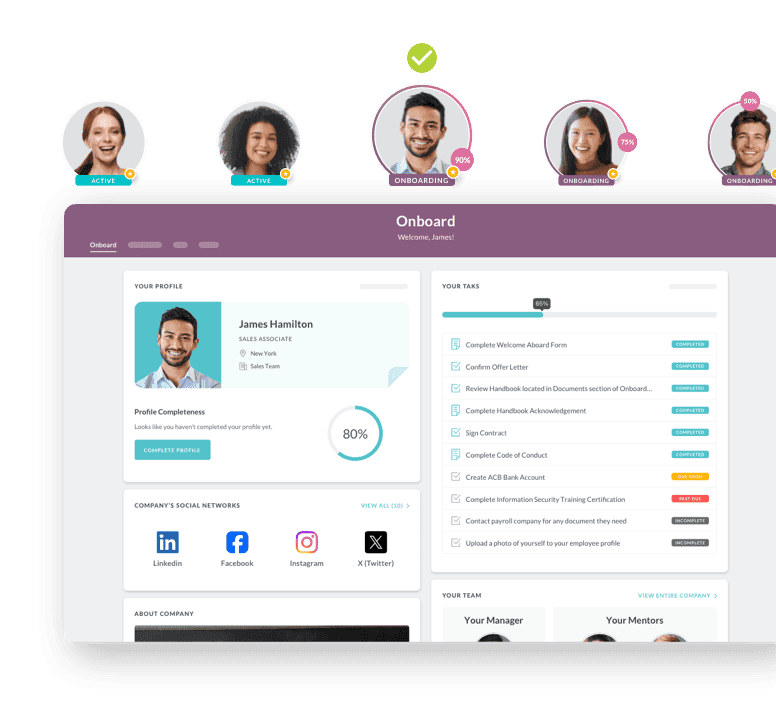
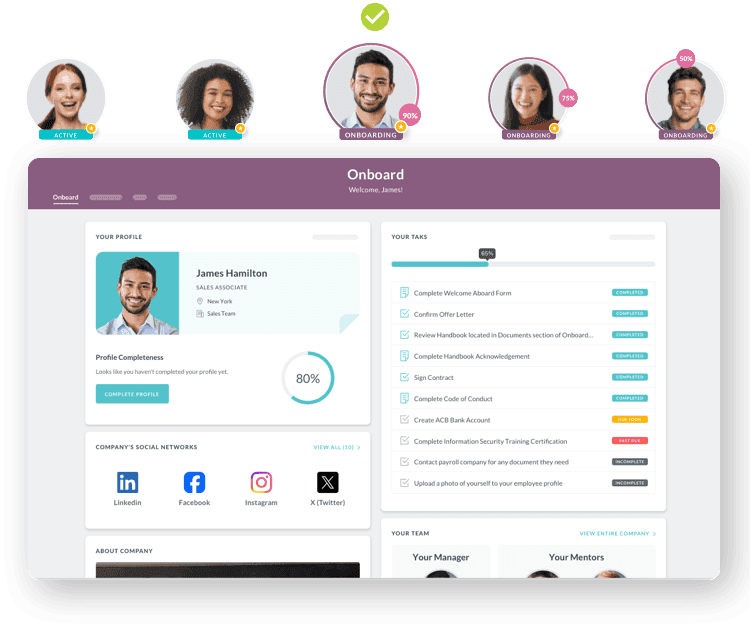
HR Cloud is a modern HR and employee experience platform built around three connected modules: Onboard, People HRIS, and Workmates, designed for companies with multi-location, frontline, or deskless workforces. Rather than positioning itself as a payroll-first system, HR Cloud runs on top of whatever payroll provider you already use (ADP, UKG, Paylocity, Workday, or others via open API), which means switching to HR Cloud doesn't require ripping out your existing payroll infrastructure.
The platform is organized into three package tiers: Essential HR, Professional HR, and Culture HR, priced flat by employee band rather than charged per seat. HR Cloud is a SOC 2 Type II certified, GDPR-compliant company, and is an ADP Platinum Marketplace Partner, with roughly 500 ADP Workforce Now customers currently running HR Cloud as their onboarding and employee-experience layer on top of ADP for payroll.
Key differentiators:
- Flat, package-based pricing instead of per-employee billing that climbs with every hire
- Payroll-agnostic, no forced migration off your current payroll provider
- Maya, HR Cloud's AI onboarding agent, reaches new hires through text-based messaging on any phone, built specifically for frontline and high-volume hourly workforces without company email addresses
- 2–4 week average implementation timeline (varies by module scope), with a flat $500 implementation fee for ADP Marketplace customers (waived with 90-day prepayment on standard packages)
- Built-in performance management (Perform) and applicant tracking (Recruit ATS) available from Professional HR upward
Platform-wide, HR Cloud cites a 97% average platform adoption rate and roughly 7 HR hours saved per week across its customer base, per the metrics displayed on its own onboarding product page, figures worth verifying against your own use case rather than taking as a guaranteed outcome, but directionally consistent with the specific customer results in Section 11.
What Is Zenefits?
Zenefits launched in 2013 as a free, ad-supported HR platform for small businesses, later moving to paid tiers after a 2016 regulatory shakeup that led to new leadership and a rebuilt compliance program. On February 15, 2022, TriNet (NYSE: TNET) completed its acquisition of Zenefits, rebranding it "TriNet Zenefits," then later "TriNet HR Platform." The product's self-serve, standalone pricing tiers have since been phased out, and it's now sold as "HR Plus", still listed on review sites as "HR Plus (formerly Zenefits)."
Zenefits was historically built for small and mid-sized businesses, combining core HR, benefits administration, payroll, time tracking, and compliance in one dashboard, with published Essentials/Growth/Zen pricing tiers. That published, self-serve pricing structure is gone: TriNet's own HR Plus pricing page confirms pricing is quote-based only, arrived at through a sales conversation rather than an online calculator, and varies by "your number of employees and the service level selected."
Key differentiators:
- Payroll and benefits administration bundled into the core platform rather than kept as a separate integration
- Historically positioned for small and mid-sized businesses rather than large multi-location enterprises
- Now operates under TriNet's broader ASO/PEO umbrella, with an optional upgrade path to full TriNet PEO co-employment
- Broker flexibility, TriNet's own benefits page confirms businesses can manage benefits on their own, keep their current broker, or work with a TriNet-referred broker
- ESAC-accredited since 1995, and a TriNet subsidiary is IRS-certified as a Professional Employer Organization, relevant if a business later wants to move from HR Plus into full PEO co-employment
TriNet also offers two paid support upgrades on top of the base HR Plus platform: Payroll Pro (dedicated payroll and payroll-tax specialists) and People Pro (dedicated HR expertise and talent/organizational consulting). Whether these add-ons are worth it depends on how much hands-on payroll and HR guidance a business needs beyond the self-service platform itself.
Pricing Breakdown
HR Cloud's current published pricing (verified directly from hrcloud.com):
| Plan | 1–50 employees | 51–100 employees | 101–250 employees |
|---|---|---|---|
| Essential HR | $295/month | $495/month | $795/month |
| Professional HR | $595/month | $995/month | $1,495/month |
| Culture HR | $895/month | $1,395/month | $1,995/month |
Annual billing saves 20% off any tier. Beyond 250 employees, pricing moves to a custom enterprise quote. Implementation is free with 90 days of prepayment; otherwise a flat one-time $500 fee applies for standard packages, and the same flat $500 rate applies to ADP Marketplace customers integrating on top of an existing ADP Workforce Now account.
Zenefits/TriNet HR Plus pricing is not publicly listed. TriNet's HR Plus pricing page (linked in Section 4) states plainly that cost is "based on a per employee per month (PEPM) model" that depends on headcount and the service level selected, and directs prospective buyers to "connect with our team" rather than offering a self-serve calculator. TriNet does note that HR Plus carries "very few add-ons or additional charges," which is a genuine point in its favor for cost predictability once a quote is in hand, it just isn't visible before that conversation happens. Netchex's 2026 comparison and TriNet's own G2 product listing (see Section 8) both confirm new customers can no longer sign up for the original self-serve "Zenefits" product directly.
Hidden costs to watch for on each side: HR Cloud's package pricing does not include payroll processing itself. You keep your existing provider, so budget for that separately if you don't already have one. On the Zenefits/HR Plus side, because pricing isn't published, the only way to know your true monthly cost is to complete TriNet's quote process; buyers should ask directly whether payroll, benefits administration, and HR advisory support are all included at the quoted rate or priced as separate service tiers (TriNet's site describes optional "Payroll Pro" and "People Pro" add-on service levels on top of the base HR Plus offering).
The concrete number to take away: a 60-person company on HR Cloud's Professional HR plan pays a flat $995 per month, regardless of turnover or new hires within that band, and can see that number before ever talking to sales. A comparably sized company evaluating Zenefits/HR Plus today cannot get an equivalent number without requesting a custom quote from TriNet.
Feature Breakdown
Onboarding and Pre-Boarding
HR Cloud's Onboard module builds role-specific, location-specific workflows once and reuses them for every hire, using SmartFlow to route tasks, reminders, and approvals by role, location, and hire date. This includes automated I-9/E-Verify, custom PDF form mapping, mobile document capture, and pre-boarding portals that fire automatically on offer acceptance (see Section 3 for the source page). TriNet's HR Plus platform handles onboarding differently but competently: per TriNet's own capabilities page, self-service onboarding gets new hires "up and running in 10 minutes" before their first day, with automated I-9 and new-hire tax document collection built in. The difference shows up at scale, HR Cloud's role/location branching is built for coordinating onboarding differently across multiple sites at once, while HR Plus's flow is optimized for a single, standardized path.
AI-Assisted, High-Volume Onboarding
HR Cloud's Maya is a text-based, message-driven AI onboarding agent purpose-built for frontline and deskless workforces, new hires complete tasks over text on any phone with no app download or company email required. HR Cloud's broader AI layer can also handle up to 60% of routine employee questions automatically, according to HR Cloud's HRIS page. TriNet's HR Plus has no directly comparable agent-driven onboarding tool; its self-service onboarding runs through the standard TriNet HR Platform / Zenefits app rather than a conversational AI agent.
HRIS and Employee Records
Both platforms centralize the employee directory, org chart, and document storage. Per HR Cloud's HRIS page (linked above), the platform offers a single source of truth for job, pay, and performance data, granular role-based access and custom fields, e-signatures with version tracking, and self-service profile updates, with HR Cloud citing up to 60% less manual admin work and 3× faster onboarding as a result. TriNet's Workforce Management tools, confirmed on TriNet's capabilities page (linked above), cover automated workflows for key employee events, custom document folders with bulk download, and an audit view filterable by type, status, location, and department, solid record-keeping, but built around TriNet's own payroll and benefits data model rather than an open, provider-agnostic one.
Payroll
This is a genuine, well-documented HR Plus strength. TriNet's capabilities page confirms "three-click" payroll processing with unlimited payroll runs, garnishment support, direct deposit, tips reporting, multiple pay schedules and rates, contractor payments, general ledger reporting, and mobile pay stubs, plus automatic federal, state, and local tax filing. HR Cloud deliberately does not build its own payroll engine; it syncs bidirectionally with ADP, UKG, Paylocity, and Workday instead. The trade-off is straightforward: HR Plus gives you one vendor for HR and payroll together, while HR Cloud lets you keep payroll exactly as it is and layer onboarding, HRIS, and engagement on top without a payroll migration.
Benefits Administration
Also a genuine HR Plus strength. Per TriNet's benefits page (linked in Section 4), the platform supports medical, dental, vision, and life coverage plus HSAs, FSAs, and commuter benefits, syncs elections automatically, and gives employees a step-by-step mobile enrollment flow. Broker flexibility is real: businesses can self-manage benefits, keep their existing broker, or work with a TriNet-referred broker. One detail worth flagging precisely, automated carrier data exchange (EDI) for enrollment is confirmed to apply only to groups of 50 or more employees, so smaller HR Plus customers should confirm exactly which enrollment steps are automated versus manual at their headcount. HR Cloud does not include native benefits administration; companies needing that functionality keep it in a dedicated benefits platform or their payroll provider and use HR Cloud for onboarding, HRIS, and engagement instead.
Time Off and Time Tracking
Per HR Cloud's time-off page, the platform automates leave requests, accrual calculations, and approval workflows across vacation, sick leave, personal days, and parental leave, updating balances in real time and eliminating the 4–6 hours per week of manual reconciliation HR Cloud says unmanaged PTO tracking typically costs. TriNet's Workforce Management tools cover the same core ground, time-off approval, custom PTO policies, and blackout dates, with automatic overtime calculation built into TriNet's compliance layer based on applicable state and local rules. Both are competent here; the difference is less about features than about which system PTO data lives inside.
Applicant Tracking and Hiring
HR Cloud's Recruit ATS, confirmed on its own product page, is built specifically for companies with 50 to 2,500 employees, offering AI-generated job descriptions, multi-board job posting, custom candidate request fields, and a direct handoff into HR Cloud's HRIS once an offer is accepted. TriNet's HR Plus includes basic hiring support ("attract and source top talent") within its Workforce Management tools, but it is not positioned as a dedicated, structured ATS in the way HR Cloud's Recruit is, companies with a real hiring volume to manage should weigh this gap directly against their own hiring needs.

Ready to simplify hiring from job post to offer?
Track candidates, customize hiring stages, schedule interviews, and connect recruiting to onboarding in one easy-to-use ATS.
Book Your Free Demo
Performance Management
HR Cloud's Perform module, per its own performance page, covers goal setting, review templates, feedback cycles, and 1:1s, is GDPR- and SOC 2-compliant, and integrates with existing HR and payroll systems. TriNet's HR Plus includes a comparable native Performance Management tool, confirmed on TriNet's capabilities page, covering goal setting, performance reviews, and 1:1s with customizable templates and mobile-first access, a genuine strength that goes beyond what some SMB-focused HR platforms offer natively.
Employee Engagement and Internal Communications
This is where the two platforms diverge most. HR Cloud's Workmates, per its own engagement page, combines real-time feedback, pulse surveys, peer-to-peer recognition and rewards, company announcements, digital signage, and an intranet/content management system built specifically for connecting deskless and frontline workers with corporate teams. TriNet's HR Plus offers Employee Engagement Surveys and a "People Hub" social feed/intranet tool, confirmed on TriNet's capabilities page, genuinely useful for a single-location small business, but not built around the multi-location, frontline-specific engagement problem HR Cloud's Workmates targets directly.
Multi-Location and Compliance Management
HR Cloud is explicitly built for companies managing multiple sites: credential and license expiration alerts, compliance audit trails per hire, and I-9/E-Verify tracking built into onboarding. TriNet's HR Plus compliance layer, confirmed on TriNet's capabilities page, is genuinely robust for a small-business-focused product: a Compliance Assistant that tracks federal deadlines, automated ACA and COBRA administration, FLSA overtime support, and access to a Fisher Phillips-powered legal hotline for employment-law questions. TriNet's compliance tooling is strong on the regulatory/payroll-tax side; HR Cloud's is strong on the operational, multi-site workflow side, which one matters more depends on whether your biggest compliance risk is filing deadlines or coordinating hundreds of hires across different locations.
Support Model
HR Cloud provides live chat (under 30-second response time), email/ticket support (under 1 hour), and an unlimited Account Manager that continues past go-live, on every tier, including Essential HR. TriNet's HR Plus offers a choice between advisory-level support (on-demand access to HR professionals) and dedicated support (a named HR or payroll expert paired to your account), per TriNet's own FAQ, with deeper, hands-on expert support available as the paid Payroll Pro and People Pro add-ons.
Implementation and Migration
HR Cloud's average go-live time is 2–3 weeks for the Onboard module specifically (source linked in Section 3): week one is the kickoff call and workflow/form building, week two is training and checklist configuration, and week three is go-live. Full HRIS implementations that also involve data migration and workflow automation across the broader platform run closer to 2–4 weeks, per HR Cloud's HRIS FAQ (linked in Section 6). For companies integrating on top of an existing ADP Workforce Now account, implementation is a flat $500 regardless of company size; HR Cloud connects via ADP's SSO for employee login and syncs employee data from ADP separately, so records don't require manual re-entry. Training and unlimited ongoing Account Manager support are included in every package from day one.
Zenefits' original self-serve model let small businesses set up plans directly online in a matter of days, since data and payroll all lived inside one system. TriNet's current HR Plus self-service onboarding still moves fast for new employees once a business is live on the platform. TriNet's own capabilities page states new hires can be "up and running in 10 minutes," but getting a company onto HR Plus in the first place is now sales-assisted rather than instant self-serve. Existing Zenefits customers being transitioned to HR Plus should expect a guided migration process managed by TriNet, and businesses with contractor or international workers should confirm pricing for those groups directly, since TriNet's site notes small additional fees apply outside the core PEPM rate for contingent and international workers.
Proof and Credibility Signals
On G2, HR Cloud holds an aggregate 4.6-star rating across 177 verified reviews spanning its Onboard, Workmates, People HRMS, and Time Off products, with reviewers most commonly citing ease of use and straightforward onboarding setup. On Capterra, HR Cloud is listed with 5-star user reviews as a featured badge holder.
HR Plus (formerly Zenefits) holds a 3.9-star rating across 467 reviews on G2 and a 4.2-star rating across 823 reviews on Capterra, where ease of use scores 4.4/5 but customer service scores notably lower at 3.9/5. That gap between a strong ease-of-use score and a weaker customer-service score is itself a useful signal: many reviewers report a genuinely positive experience with straightforward onboarding, PTO, and benefits self-service, while support responsiveness is the area most likely to draw complaints when something goes wrong.
Both companies are established, audited platforms. HR Cloud is SOC 2 Type II certified and GDPR compliant. TriNet is a publicly traded company (NYSE: TNET), and its own June 2026 press release confirms HR Plus has surpassed 40,000 users since its launch in 2025: genuine evidence that the post-transition product has found real traction with small and mid-sized businesses, even as the standalone Zenefits brand itself has been phased out.
Is HR Cloud the Right Zenefits Alternative for You?
HR Cloud is the stronger fit if:
- You manage employees across multiple locations, shifts, or job sites rather than a single office
- A meaningful share of your workforce is frontline, hourly, or deskless and doesn't reliably check company email
- You already have payroll working (ADP, UKG, Paylocity, Workday) and don't want onboarding software to force a payroll migration
- You want predictable, flat monthly pricing that doesn't climb with every new hire inside your employee band
- You're evaluating vendors specifically because your current Zenefits account is being migrated to TriNet HR Plus and you want a clean, direct transition rather than a forced upgrade path
- You expect to keep growing past small-business headcount, HR Cloud's own platform page states the system is built to scale for teams "from 50 to 5,000+ employees," well beyond where HR Plus is positioned to compete
If your business runs 50 or more employees across more than one site and payroll isn't the problem you're trying to solve, HR Cloud is very likely the better-fit platform.
Who Should Choose Zenefits (TriNet HR Plus)
TriNet positions HR Plus (see Section 4) as an Administrative Services Organization (ASO) built for small and medium-sized businesses. Zenefits/HR Plus remains a reasonable choice if:
- You're a small, single-location business that wants payroll, benefits, and core HR bundled under one vendor rather than run separately
- Benefits administration, carrier connections, automated enrollment, broker flexibility, is your primary buying driver
- You're comfortable working through a sales-assisted quote process rather than needing published self-serve pricing
- You may eventually want the option to upgrade into full TriNet PEO co-employment as you scale
If you're a very small, single-site business whose main need is bundled payroll and benefits rather than multi-location onboarding or engagement, staying inside the TriNet ecosystem may still make sense.
Real-World Proof
HR Cloud's customer base skews toward exactly the multi-location, frontline-heavy profile this comparison is built around. Per HR Cloud's own case study listing and product pages, Medlinks, a healthcare organization, reported 96% monthly active usage and more than 70 onboarding workflows now managed entirely by HR rather than IT after implementing HR Cloud. Osmose Utilities Services, managing field technicians across multiple sites, cut its onboarding data-accuracy issues by 24% and reclaimed roughly seven hours of HR time per week within three months. Behavioral Progression, an education-sector customer, cut therapist onboarding time by more than a third, from four weeks to 2.5 weeks, after go-live. Great Kids & Awesome Adults saw a 24% increase in job applications and 14% more hires after adopting HR Cloud's Recruit-to-onboard workflow, and Interim Healthcare reported that HR Cloud freed up meaningfully more time for direct patient care by reducing its administrative onboarding burden.
These results track with the pattern this article describes: companies with distributed, multi-site, or frontline workforces consistently report the onboarding-workflow and compliance-tracking gains that a payroll-bundled small-business tool like Zenefits/HR Plus was never specifically built to solve. To be fair to the other side, TriNet's 40,000-user growth (Section 8) is real evidence the reverse is also true: small, single-location businesses that mainly need payroll and benefits bundled together continue to find HR Plus a solid fit for that narrower job.
“ Our hiring managers now have a reliable system that is easy to navigate. Our HR team can actively monitor the process, and assist if needed, but Onboard has helped them save so much valuable time and effort while increasing data accuracy.”

— Kaylee Collins, HR Analyst, Osmose

How to Switch From Zenefits to HR Cloud
- Export your data. Pull employee records, onboarding documents, benefits elections, and time-off history from Zenefits/HR Plus before your migration window closes. TriNet's own site notes HR Plus documents can be bulk-downloaded, segregated by employee and document type, which makes this step straightforward, but TriNet's transition timelines for standalone accounts have moved faster than typical multi-year sunset windows, so don't wait for a deadline notice to start.
- Keep your payroll provider, or pick a new one. Since HR Cloud doesn't require a specific payroll system, decide whether to keep running payroll through TriNet, or migrate to ADP, UKG, Paylocity, or Workday. HR Cloud integrates natively with all four, and separately with QuickBooks, SAP, and Dayforce.
- Decide what you actually need to replace. If benefits administration and broker relationships are working well under TriNet, you don't have to move those. HR Cloud is built to sit alongside an existing benefits and payroll setup rather than replace every function at once. Scope your switch to the gaps that matter most: onboarding, HRIS, engagement, or hiring.
- Book a demo scoped to your headcount and industry. HR Cloud's implementation team configures the platform around your actual payroll system and company size rather than running a generic walkthrough.
- Kickoff and workflow build (Week 1). Your Account Manager builds role- and location-specific onboarding workflows based on your current process, using SmartFlow to route tasks by role, location, and hire date.
- Training and configuration (Week 2). HR and site managers get trained on the dashboard; compliance rules (I-9, credential tracking, license expirations) get configured per location.
- Go-live (Week 3–4). New hires start onboarding through HR Cloud; existing employee records sync from your payroll provider with no manual re-entry.
- Ongoing support. An unlimited Account Manager continues past go-live to help with adoption, not just break-fix tickets, a different support model than TriNet's tiered advisory/dedicated-expert structure, where deeper hands-on help is a paid Payroll Pro or People Pro upgrade.
Final Verdict
If your Zenefits account is being pulled into TriNet HR Plus and you're a small, single-location business that mainly wants payroll and benefits bundled together, staying inside the TriNet ecosystem is a defensible choice. HR Plus's payroll, benefits, and compliance tooling are genuinely strong for that specific job, and TriNet's 40,000-user milestone (Section 8) shows the post-transition product is working for a lot of businesses in that category. But if you're managing employees across more than one site, if a meaningful share of your team is frontline or deskless, or if you simply want flat, predictable pricing and a platform that doesn't force you to migrate payroll providers to fix your onboarding process, HR Cloud is built specifically for that situation, not retrofitted onto it after an acquisition.
The clearest signal isn't which vendor has a longer feature list. Both platforms are well-built for the customer they're designed around. It's matching your platform to your actual headcount, site count, and payroll setup, not to whichever vendor happens to already have your data. If you're mid-migration right now because of the Zenefits-to-HR-Plus transition specifically, that's also a natural moment to re-evaluate from scratch rather than default into whatever TriNet routes you toward. You're already re-onboarding either way.
Ready to see how HR Cloud handles your specific team size and payroll setup? Book a free demo scoped to your headcount, industry, and existing payroll provider, not a generic walkthrough.

Discover how our HR solutions streamline onboarding, boost employee engagement, and simplify HR management
Book Your Free DemoFrequently Asked Questions
Is Zenefits shutting down?
Zenefits as a standalone, self-serve product has been discontinued by its parent company TriNet, which acquired Zenefits in 2022. New customers can no longer sign up for Zenefits directly, and the product now operates under TriNet's HR Plus offering, with existing accounts being transitioned as part of that shift.
What happened to Zenefits?
TriNet completed its acquisition of Zenefits in February 2022, rebranding it TriNet Zenefits and later TriNet HR Platform. As TriNet has consolidated its technology offerings into its broader ASO and PEO service lines, the standalone Zenefits product has been folded into "TriNet HR Plus," and self-serve signup for the original Zenefits tiers is no longer available.
How much does Zenefits cost now?
Zenefits' legacy published pricing tiers have been discontinued alongside the standalone product. TriNet's own HR Plus pricing page (Section 4 and 5) confirms current pricing is a per-employee-per-month model that varies by headcount and service level, available only through a custom quote, there is no public rate card.
Is TriNet the same company as Zenefits?
TriNet is the parent company that acquired Zenefits in 2022. Zenefits now operates as a product line within TriNet, currently branded HR Plus, rather than as an independently sold platform.
What is the best Zenefits alternative for a growing company?
For multi-location or frontline-heavy companies, HR Cloud is a strong Zenefits alternative because it offers flat, transparent package pricing and doesn't require migrating away from an existing payroll provider. For very small, single-location businesses that specifically want payroll bundled in, Gusto or staying within the TriNet ecosystem may also fit.
Does HR Cloud require me to switch payroll providers?
No. HR Cloud integrates with ADP, UKG, Paylocity, Workday, and other providers through open API, so you can keep your existing payroll system and use HR Cloud specifically for onboarding, HRIS, and employee engagement.
How much does HR Cloud cost?
HR Cloud's Essential HR plan starts at $295 per month for up to 50 employees, with Professional HR at $595 per month and Culture HR at $895 per month for the same employee band. Pricing increases by employee band (51–100 and 101–250 employees) and moves to a custom enterprise quote beyond 250 employees. Annual billing saves 20%.
What size company is HR Cloud built for?
HR Cloud is built primarily for companies with roughly 50 to 2,500 employees, particularly those with multiple locations or a significant frontline, hourly, or deskless workforce. Companies under 50 employees can still use HR Cloud's Essential HR tier, but the platform's location- and role-based workflow tools are most valuable once a company operates across more than one site.
Does HR Cloud offer a free trial?
No. HR Cloud does not offer a self-serve free trial; the company instead offers a free, personalized demo scoped to your headcount, industry, and existing payroll provider. This mirrors the current Zenefits/HR Plus model, where pricing and access are also sales-assisted rather than self-serve.
What happens to my data if my Zenefits account is being migrated to TriNet HR Plus?
TriNet manages the migration directly and existing Zenefits customers should expect outreach with a specific transition timeline. If you're evaluating alternatives during this window, export your employee records, onboarding documents, and time-off history early rather than waiting for a deadline notice, see Section 12 for a full switching checklist.
Can I still use Zenefits if I'm already a customer?
Existing Zenefits customers are being transitioned to TriNet's HR Plus offering rather than continuing on the original standalone product. If you're currently on Zenefits, expect communication from TriNet about your account's migration timeline and new pricing structure.
About the author

Keep Reading


Like What You Hear?
We’d love to chat with you more about how HR Cloud® can support your business’s HR needs.
Book Your Free Demo