HR Software With Fast Implementation: Best Platforms to Launch in Under 8 Weeks (2026)

You've been living with the wrong HR system long enough. The paper-chase onboarding, the manual PTO requests piling up in your inbox, the compliance documents stored in a shared drive no one can find. You're ready to switch — but every vendor promises a fast implementation, and the last time someone in HR committed to a "10-week timeline," it took nine months.
Here's the number that matters before you sign anything: according to a 2022 Gartner survey, the average HRIS is used by only 32% of employees after go-live. That isn't a software problem. It's an implementation problem — one that starts at vendor selection, long before a single data file is migrated.
This guide gives HR Directors at organizations with 200 to 2,000 employees a clear, scenario-based lens for evaluating implementation speed. You'll see what actually causes delays, what "fast implementation" genuinely requires from your team, how six major platforms compare on real-world timelines, and how to ask the questions that reveal whether a vendor can deliver what they're promising.
The short answer: Most mid-market HR software platforms take 4–8 weeks to implement for organizations with 200–2,000 employees. Cloud-based platforms with pre-built integrations and dedicated implementation specialists — like HR Cloud (avg. 6 weeks), BambooHR (4–6 weeks), and Rippling (1–3 weeks for small businesses) — consistently achieve faster go-lives than platforms requiring custom API integrations or complex payroll reconfiguration. Implementation speed depends more on your data quality, scope definition, and internal project owner than on the software itself.
Key Takeaways
• Most HR software implementations take between 4 and 12 weeks for small and mid-market organizations — but 55–75% of HRIS projects fail to meet their original objectives, usually due to data migration issues, over-customization, or inadequate change management, not the software itself (Gartner).
• A platform's advertised timeline and its realistic timeline are often different. Rippling states most small business deployments go live in 1–3 weeks; mid-market deployments with multiple integrations or custom workflows typically run 4–8 weeks.
• Implementation speed depends on four variables more than anything else — what we call the Implementation Readiness Model: employee count, number of locations, integrations required, and how clean your existing data is.
• HR Cloud averages a 6-week go-live based on customer data, supported by pre-built integrations with ADP, UKG, and Paylocity and a dedicated implementation specialist model.
• Use the comparison table in this guide to map your organizational scenario to the platform most likely to meet your actual timeline — not just the one with the lowest advertised number.
• The HR Software Evaluation Checklist includes questions to ask every vendor about their implementation methodology before you commit.
Why HR Software Implementations Often Take Longer Than the Sales Deck Said
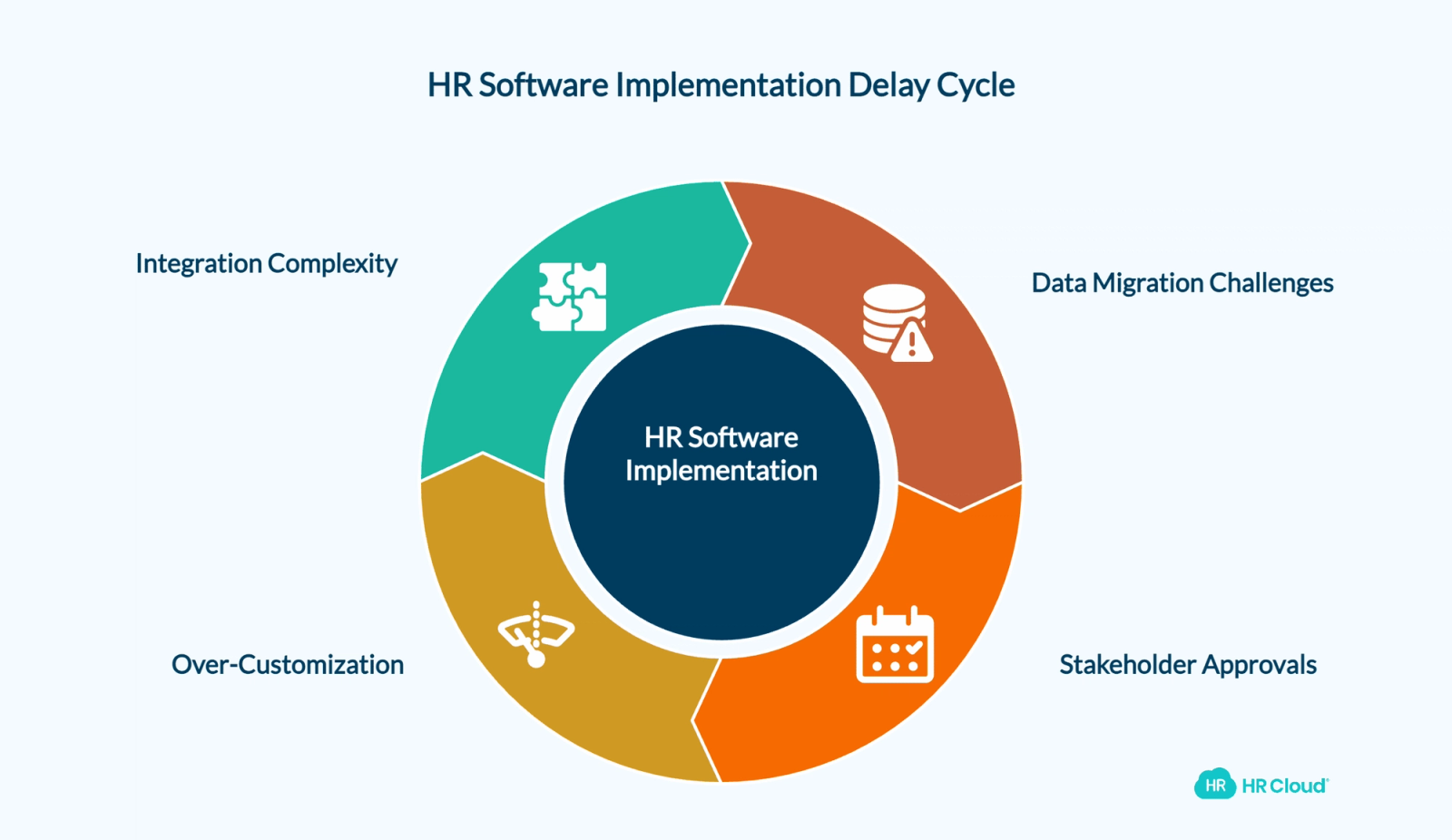
Implementation delays almost never show up in vendor demos. They show up at week three, when your data migration uncovers duplicate employee records across four locations. They show up at week six, when legal requests a configuration change nobody scoped in the original contract. Understanding the four root causes of delay makes you a much better buyer.
Data Migration Is Harder Than Anyone Tells You
Moving employee records from spreadsheets, a legacy system, or disconnected point solutions into a new platform takes longer than any vendor timeline assumes. The issue is rarely the migration tool — it's data quality. Date format mismatches, inconsistent job titles, missing fields, duplicate records, and historical documents stored in three different places all have to be resolved before a single record goes live. Organizations that audit and clean their data before the implementation kickoff consistently go live faster than those that treat cleanup as someone else's job.
What this means for your evaluation: Ask every vendor specifically how data migration is structured. Who validates your data? Does the timeline include migration testing cycles, or does it start the clock at kickoff and assume clean data?
Stakeholder Approvals Add Calendar Time, Not Just Hours
Even well-run implementations stall on approvals. HR, IT, payroll, legal, and finance rarely have synchronized calendars. A single approval cycle that takes four days instead of one day can add two weeks to a project when it happens repeatedly. This isn't a vendor problem — it's a governance problem that the buyer controls.
Pro tip: Before you sign a contract, identify your executive sponsor and get their explicit commitment to decision-making turnaround times. Implementations with an empowered decision-maker go live significantly faster than those where every configuration question escalates to committee.
Over-Customization Turns a 6-Week Project Into a 6-Month One
The most common implementation trap: buying a platform, then spending the first eight weeks trying to make it perfectly mirror your current broken process. Modern HR software is built around best practices. When you customize every default workflow, every approval chain, every notification, you create a configuration that no implementation specialist has tested and no customer success manager fully understands. The result is scope creep, delays, and a system that's harder to maintain.
The fix: Define the minimum viable configuration that takes you live — everything else is Phase 2. HR Cloud's HRIS Implementation Playbook covers this specific failure pattern in detail, including how to document scope in writing before kickoff.
Integration Complexity Is the Silent Timeline Killer
Every integration point — payroll, applicant tracking, identity management, benefits administration — adds testing cycles. A native, pre-built integration between your new HR system and your existing payroll provider can be configured in hours. A custom API integration that requires IT resources, vendor coordination, and testing can add weeks to the project. The integration question is one of the most important you can ask during evaluation and one of the least frequently asked before contract.
Bottom line on delays: According to Gartner, HRIS and ERP implementations fail to meet their original objectives at a rate of 55–75%. The failure almost never lives in the software. It lives in the rollout — specifically when the project team underestimates how much organizational readiness work has to happen before a single workflow goes live.
What HR Software Can Realistically Be Implemented in Under 8 Weeks?
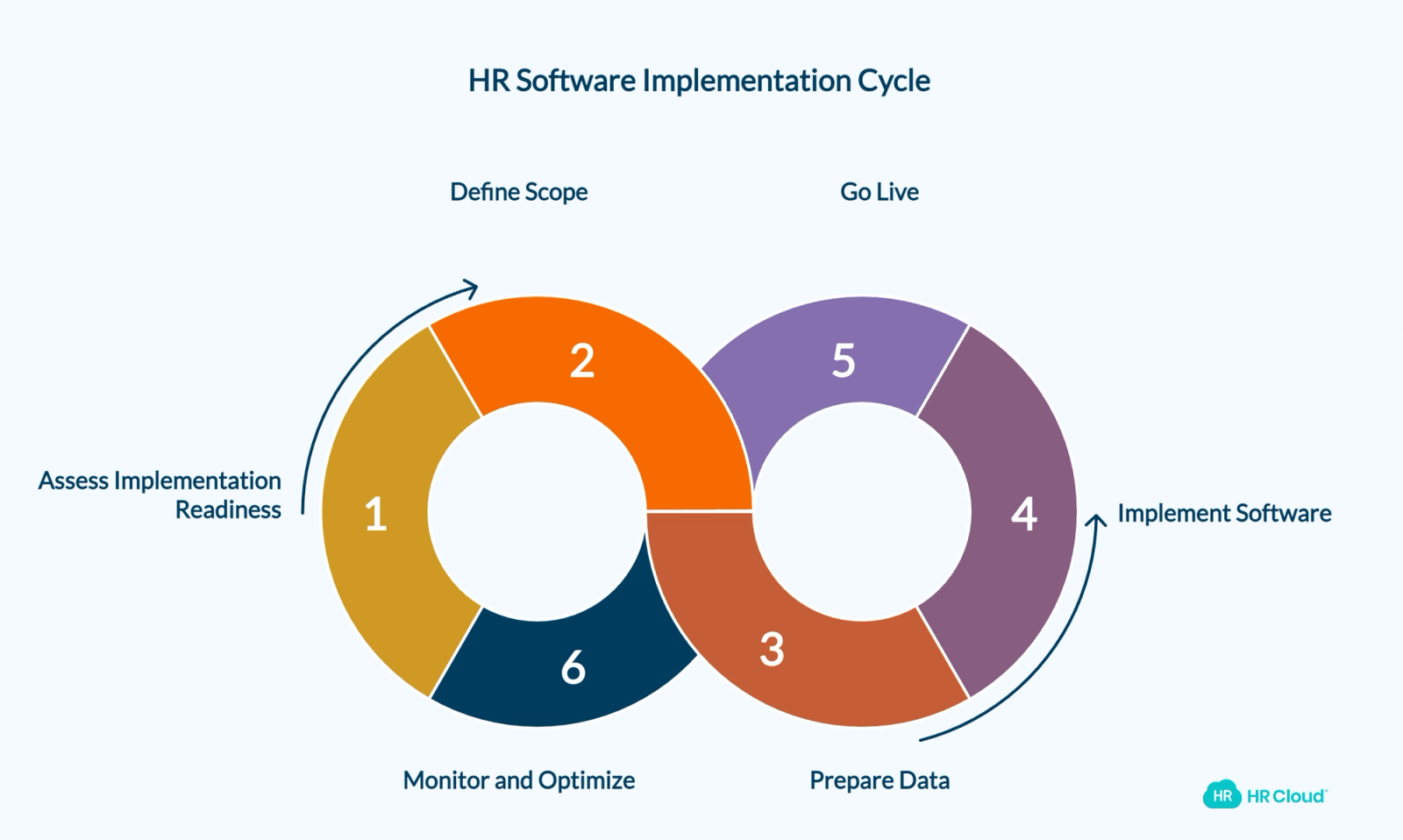
The answer depends on four variables your vendor's sales team will not raise unless you ask. We call this the Implementation Readiness Model — four factors that predict go-live speed more reliably than any vendor's advertised timeline: employee count, number of locations, number of integrations, and data migration complexity. Here's how it plays out across three organizational profiles.
Small Organizations (50–250 Employees): 2–4 Weeks Is Achievable
With a relatively small employee population, limited integrations, and typically cleaner data, small organizations can go live in 2 to 4 weeks with the right cloud-based platform. The key assumption: you're implementing a defined scope (onboarding + time-off + employee records), not a full HRIS replacement with payroll reconfiguration. Most delays at this size come from not having a dedicated internal project owner — not the software complexity.
Mid-Market Organizations (250–2,000 Employees): Target 4–8 Weeks
This is the sweet spot where fast implementation is genuinely achievable but requires active project management. At 500 employees across three locations with payroll already running on a major provider like ADP or Paylocity, a cloud-based platform with pre-built integrations can realistically go live in 4 to 8 weeks. The variables that push you toward 8 weeks rather than 4: more than two integrations, significant historical data migration, multi-state payroll rules, or a workforce where a large percentage of employees are hourly and don't regularly access email.
Here's what this looks like in practice (composite example based on typical mid-market deployment patterns): A healthcare staffing company with 650 employees across four facilities decided to implement an onboarding platform before rolling out a full HRIS. Their scope included digital onboarding, I-9/E-Verify workflows, document management, and a Paylocity payroll integration. By limiting scope to onboarding for launch, cleaning their employee data two weeks before kickoff, and designating an HR director as the sole internal project owner, they went live in 5.5 weeks. Phase 2 — adding time-off management and performance modules — launched 60 days later once the team was fully comfortable with the platform.
Enterprise Organizations (2,000+ Employees): Plan for 8–16+ Weeks
Enterprise deployments add layers that are difficult to compress: complex pay rules that nobody wrote down, multi-location data audits, legacy integrations with ERP systems, and the organizational change management required to reach thousands of employees across dozens of locations. Even the fastest enterprise platforms rarely go live in under 8 weeks at this scale. If an enterprise vendor promises 4 weeks, ask specifically which modules are included in that timeline.
Speed is determined by scope, not just size. An organization of 3,000 employees implementing a focused onboarding module with two native integrations can go live faster than a 500-person company attempting a full HRIS replacement with custom API connections.
The 7 Features That Genuinely Accelerate HR Software Implementation
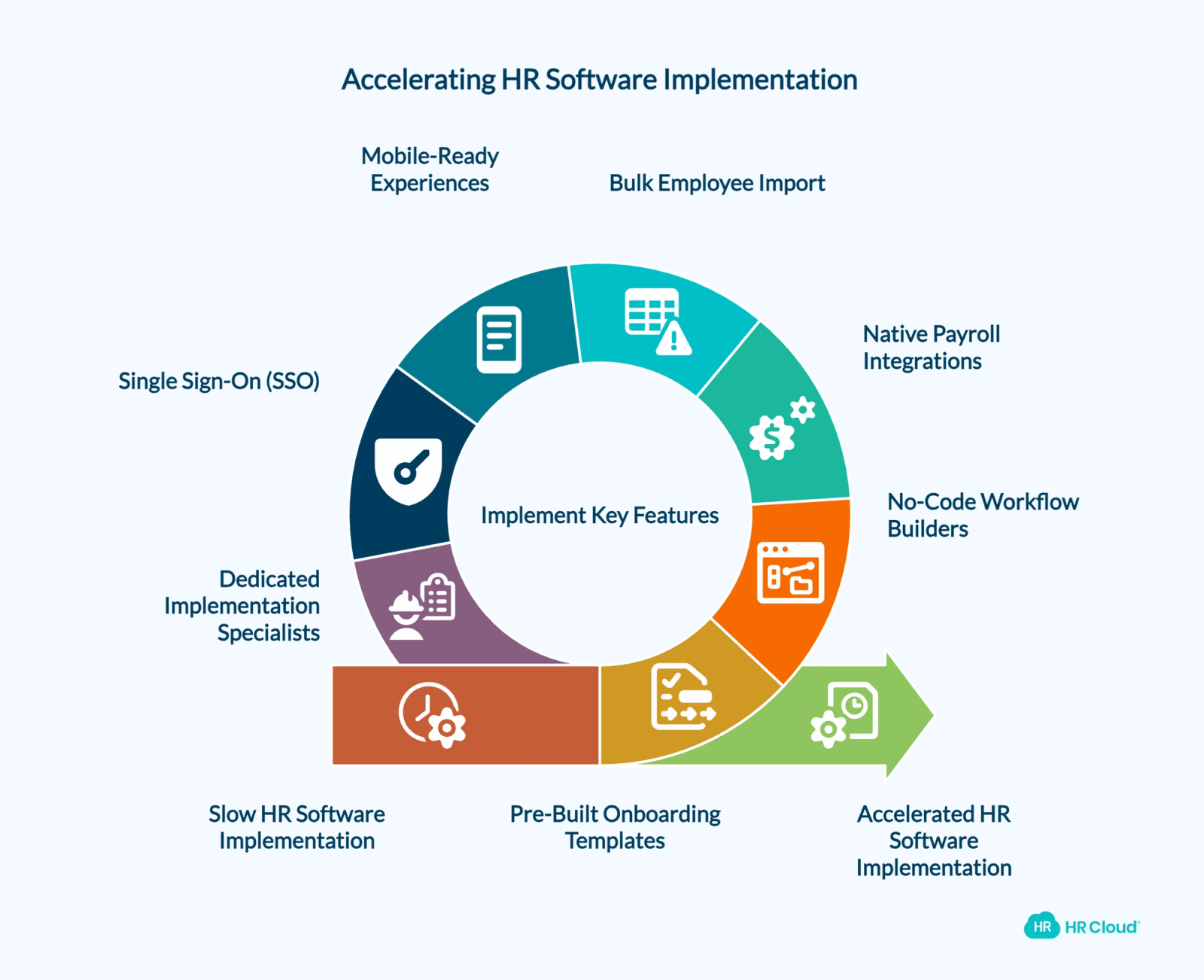
Some platform capabilities reduce implementation complexity in ways that compound — they don't just save hours, they eliminate entire testing cycles. These are worth asking about specifically, not just checking off a feature list.
Pre-Built Onboarding Workflow Templates
Starting from scratch on every workflow is a guaranteed timeline extender. Platforms with pre-built onboarding templates — broken down by role, location, or employment type — allow you to configure rather than build. The difference is significant: configuring a template takes hours; building a custom workflow from scratch takes days.
No-Code Workflow Builders
If updating a workflow requires an IT ticket, you will be updating workflows slowly. No-code builders allow HR to modify sequences, approvals, and reminders without developer involvement. This accelerates configuration during implementation and makes post-go-live adjustments possible without adding IT to the critical path.
Native Payroll Integrations
This is the single most important technical capability for reducing implementation risk. A native, pre-built connection to your existing payroll provider means tested data mapping, documented setup processes, and support from people who've run the integration dozens of times. A generic API connection means your team figures it out together for the first time. Platforms with tested integrations to ADP, UKG, Paylocity, and Paychex will go live faster than those relying on custom connectors — every time.
Why this matters for HR directors managing frontline teams: When payroll data flows automatically from your new HR platform, you eliminate the manual data entry that causes payroll errors and the reconciliation work that happens every pay period. The payroll integration isn't just an implementation concern — it's an ongoing operational concern.
Bulk Employee Import Tools
A well-designed bulk import tool with built-in validation catches errors before they become live data problems. Platforms that require manual employee setup or lack clear import error reporting add significant time to the data migration phase.
Mobile-Ready Employee Experiences
In organizations where a significant portion of the workforce is hourly, field-based, or doesn't regularly access a company laptop, adoption after go-live depends almost entirely on mobile usability. If employees can't complete their onboarding tasks, submit PTO, or access their documents from a phone, adoption stalls. Low adoption is the real cost of a poor implementation — not just for morale, but for your HR team, who ends up fielding calls about a system employees aren't using.
Single Sign-On (SSO) Support
SSO reduces employee friction at login and simplifies IT's account management during implementation. Platforms with native SSO connections to Okta, OneLogin, or Azure AD eliminate a common source of post-go-live IT support requests.
Dedicated Implementation Specialists
The most underrated factor in implementation speed: a named human being who knows your account, knows the platform, and shows up on every implementation call with context from the last one. Ticket-based support models have their place, but they are not implementation models. Ask vendors specifically: will we have a dedicated implementation manager for the duration of the project, or will we work with a general support team?
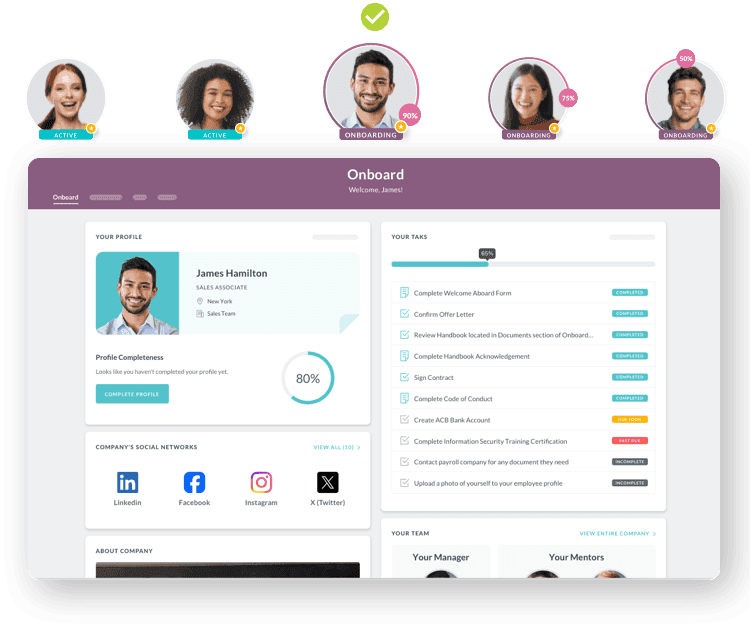
How HR Cloud addresses all seven of these factors: Pre-built onboarding workflow templates, ADP/UKG/Paylocity integrations, a no-code workflow builder, mobile-first design for frontline teams, bulk employee import with validation, SSO support for Okta and OneLogin, and a dedicated implementation specialist included in every deployment. See the HR Cloud implementation process
HR Software With Fast Implementation in 2026: Platform Comparison
The table below covers the six most commonly evaluated HR management software platforms at the mid-market level. "Typical implementation timeline" figures are based on vendor-stated averages and third-party review data for standard deployments. Complex deployments with multiple integrations, large data migrations, or custom requirements will extend any of these timelines.
| Platform | Typical Implementation | Best Fit | Core Strength |
|---|---|---|---|
| HR Cloud | 2–8 weeks (avg. 6 weeks per customer data) | Mid-market, frontline and distributed workforces (500–5,000 employees) | Pre-built payroll integrations, dedicated implementation specialists, mobile-first for hourly teams |
| BambooHR | 4–6 weeks | SMBs (under 500 employees) | Simplicity and ease of use; quick setup for small HR teams |
| Rippling | 1–3 weeks (small business); 4–8 weeks (mid-market/complex) | IT-forward organizations needing HR + IT automation | Unified HR/IT/Finance platform; strong workflow automation |
| HiBob | 6–8 weeks (marketing); 60–120 days per HiBob's implementation team for Core HR | Growing, modern-culture companies | Employee experience, analytics, compensation and workforce planning |
| Paylocity | Varies; longer runway for payroll configuration | Mid-market payroll-first organizations | Deep payroll accuracy and compliance infrastructure |
| UKG Ready | 6–9 months (typical) | Organizations with complex workforce management needs | Time, scheduling, and labor management at scale |
HR Cloud
Typical timeline: 2–8 weeks, averaging 6 weeks based on customer data; Onboard (onboarding module) averages 2–3 weeks for focused deployments.
HR Cloud is a modular HR platform built for mid-market and enterprise organizations with 500 to 5,000 employees, with particular depth for multi-location and frontline-heavy workforces. The implementation speed is driven by three specific design choices: pre-built, tested integrations with ADP, UKG, Paylocity, Okta, and OneLogin; a dedicated implementation specialist assigned to each account; and pre-built workflow templates for onboarding, document management, time-off, and compliance that are configured rather than built from scratch.
According to HR Cloud customer data, teams that implement the platform report saving 7 hours per week on onboarding-related tasks, and the platform sustains a 97% adoption rate — employees and managers who actually return to the system after go-live. For organizations with a significant hourly or distributed workforce, the mobile-first design is a material implementation consideration: 75%+ mobile completion rates for frontline teams means the system works where your employees are, not just where HR sits.
Customers describe the outcome directly. Travis French, CEO of a company using HR Cloud, put it this way in a published HR Cloud case study: "HR Cloud gave us back hours each week. Onboarding is now smooth, fast, and fully trackable." MCO, a portfolio management company, used HR Cloud's Onboard to bring 2,000 employees through onboarding in under five days after going live — meeting an aggressive deployment deadline that no other platform they evaluated could match.
On G2, Onboard by HR Cloud reviewers consistently highlight ease of setup and implementation support as standout strengths. One HR manager with 25 years of experience called it "the simplest integration I've ever had."
HR Cloud also includes Maya, an AI onboarding agent that guides new hires through Day 1 tasks conversationally — answering questions, delivering task prompts, and checking in at Day 7, Day 30, and Day 90 without HR intervention. For organizations where frontline employees don't check email regularly, Maya's mobile-first conversational interface removes a common adoption barrier that traditional onboarding portals create.
HR Cloud's modular approach also reduces implementation risk: many organizations start with the Employee Onboarding Software module, achieve a fast go-live, then expand to HRIS, time-off management, performance, and Workmates — HR Cloud's employee engagement, recognition, and communication platform — in planned phases.
Ideal for: HR Directors at mid-market companies with multi-location or frontline workforces who want a fast, structured path to go-live without sacrificing the payroll integrations and compliance features their business requires.
Watch for: If you're a small business under 200 employees, you may find that BambooHR's lighter feature set is a better fit at your current scale. HR Cloud is built for complexity — that's a strength for organizations that need it.
BambooHR
Typical timeline: 4–6 weeks.
BambooHR confirms on its FAQ page that most customers go from kickoff to go-live in four to six weeks, with a QuickStart self-service option for organizations with fewer than 25 employees. The platform's strength is its simplicity: the interface is intuitive enough that formal training is minimal, and customers consistently praise the experience during setup and initial adoption. Performance management, applicant tracking, and onboarding workflows are strong for SMBs.
BambooHR's native payroll module is built for US-based employees and handles federal, state, and local tax filing. For international payroll, BambooHR announced on December 4, 2025 localized payroll integrations with Xero for UK and Australian payroll (New Zealand integration was in waitlist status at time of writing), global payroll partners through the BambooHR Marketplace, and an Employer of Record (EOR) service powered by Remote for hiring in 90+ countries. Companies approaching 500+ employees, or with more complex multi-location and workflow needs, should evaluate whether BambooHR's customization depth matches their requirements.
Ideal for: Small and mid-sized businesses with a lean HR team that want a straightforward, intuitive platform for core HR, onboarding, and performance management.
Watch for: Implementation that goes to 6 weeks (the longer end) tends to involve payroll module setup. Evaluate BambooHR's specific payroll coverage for your region — US-based payroll is native and fully supported; international payroll runs through integration partners. Custom workflow requirements may also add configuration time beyond the standard setup.
Rippling
Typical timeline: According to Rippling's own website, most small businesses go live in 1–3 weeks. For mid-market organizations with more modules, data migration, or integrations, Rippling's HRIS review content notes that implementations typically complete in 2–4 weeks for straightforward needs, and 6–8 weeks for complex deployments involving multiple payroll systems, international employees, or custom integrations.
Rippling's differentiation is its unified approach to HR, IT, and finance. The "Employee Graph" architecture means that a single change — like updating an employee's location — can trigger automated updates across payroll, compliance training, and IT access simultaneously. For technology-forward companies where HR and IT operations are closely linked, this integration depth is genuinely compelling.
The implementation scope scales with the modules selected. Organizations adopting only core HR and payroll can go live quickly. Those implementing device management, global payroll, and custom automation workflows should plan for a longer runway. Rippling uses quote-based pricing, so implementation costs should be discussed directly with their team.
Ideal for: Technology companies and IT-forward organizations that want HR, IT, and finance managed from a single platform, particularly those with complex onboarding automation needs.
Watch for: Rippling's pricing is quote-based and scales with modules. For organizations that need core HR and employee experience functionality without IT management, it's worth evaluating which modules are actually needed before finalizing scope and budget.
HiBob
Typical timeline: 6–8 weeks per HiBob's marketing comparisons; HiBob's own implementation team notes Core HR deployments average 60–120 days depending on scope and company size.
HiBob positions itself as the modern HR platform for growing companies, with a user experience that emphasizes culture, engagement, and employee connection alongside core HR operations. The platform's analytics, compensation planning, and workforce planning tools have received strong reviews from mid-market HR teams. HiBob's professional services team works with each customer to customize the rollout timeline based on priorities.
HiBob's payroll capabilities expanded significantly in 2025–2026. The platform now offers native US payroll — powered by Gusto's Embedded Payroll engine and reaching general availability on January 1, 2026 — alongside native UK payroll (acquired through Pento). For US customers, this means HR data and payroll run from the same system, which removes a common integration step during implementation. The platform also offers a Payroll Hub for connecting existing payroll providers in markets where native payroll isn't yet available.
Ideal for: Growing companies with desk-based or hybrid workforces where modern employee experience, analytics, compensation planning, and an increasingly unified HR-payroll system are top priorities.
Watch for: Timeline estimates in HiBob's own content vary — marketing pages reference 6–8 weeks while their implementation team cites 60–120 days for Core HR. Clarify the expected timeline for your specific scope and headcount during the sales process. Native US payroll is newly launched (GA January 2026); organizations considering it as part of their implementation should factor in appropriate testing and validation time.
Paylocity
Typical timeline: Varies based on payroll configuration complexity. More extensive than HR Cloud's 6-week average, with timeline driven primarily by payroll setup, module count, and data migration volume.
Paylocity started as a payroll company and has expanded into a full HR platform. The platform's payroll accuracy is consistently rated highly by customers — it handles complex multi-state tax, shift differentials, and overtime rules with reliability. The Community and Recognition features are well-regarded for desk-based workforces.
Implementation is meaningful: Paylocity's strength (payroll depth and compliance) is also what makes its implementation more involved. Pay rules, EDI benefits feeds, and configuration of advanced compliance settings require time and close coordination. Organizations for whom payroll accuracy and compliance infrastructure are the top priority will find this trade-off worth it.
Ideal for: Mid-market organizations where payroll accuracy, compliance, and multi-state tax infrastructure are the primary HR software priority.
Watch for: Buyers who prioritize fast implementation, mobile-first frontline functionality, or onboarding as the primary use case should evaluate whether the longer payroll configuration timeline and cost structure match their immediate needs.
UKG Ready
Typical timeline: 6–9 months (typical per independent implementation consultants); enterprise UKG Pro implementations commonly run 12–18 months.
UKG Ready is built for organizations with complex workforce management requirements: intricate shift scheduling, biometric time tracking, advanced labor management, and large-scale compliance needs. The platform's depth in these areas is well-regarded, particularly for industries with complex hourly and shift-based workforces.
The implementation timeline for UKG Ready reflects that complexity. Per independent UKG implementation consultants at PredictiveHR, typical UKG Ready deployments run 6–9 months, and UKG Pro (enterprise) implementations commonly run 12–18 months. Organizations considering UKG Ready should factor this timeline into their planning and evaluate whether a phased rollout approach is possible to shorten time-to-value.
Ideal for: Organizations with 500+ employees that require sophisticated time, scheduling, and workforce management capabilities and have the internal resources and timeline to support a multi-month implementation.
Watch for: For organizations where speed of go-live is a primary buying criterion, the UKG Ready implementation timeline is significantly longer than most cloud-based mid-market alternatives. Evaluate timeline expectations during the sales process and ask specifically about phased implementation options.
Why Implementation Speed Matters More Than Most Buyers Factor In
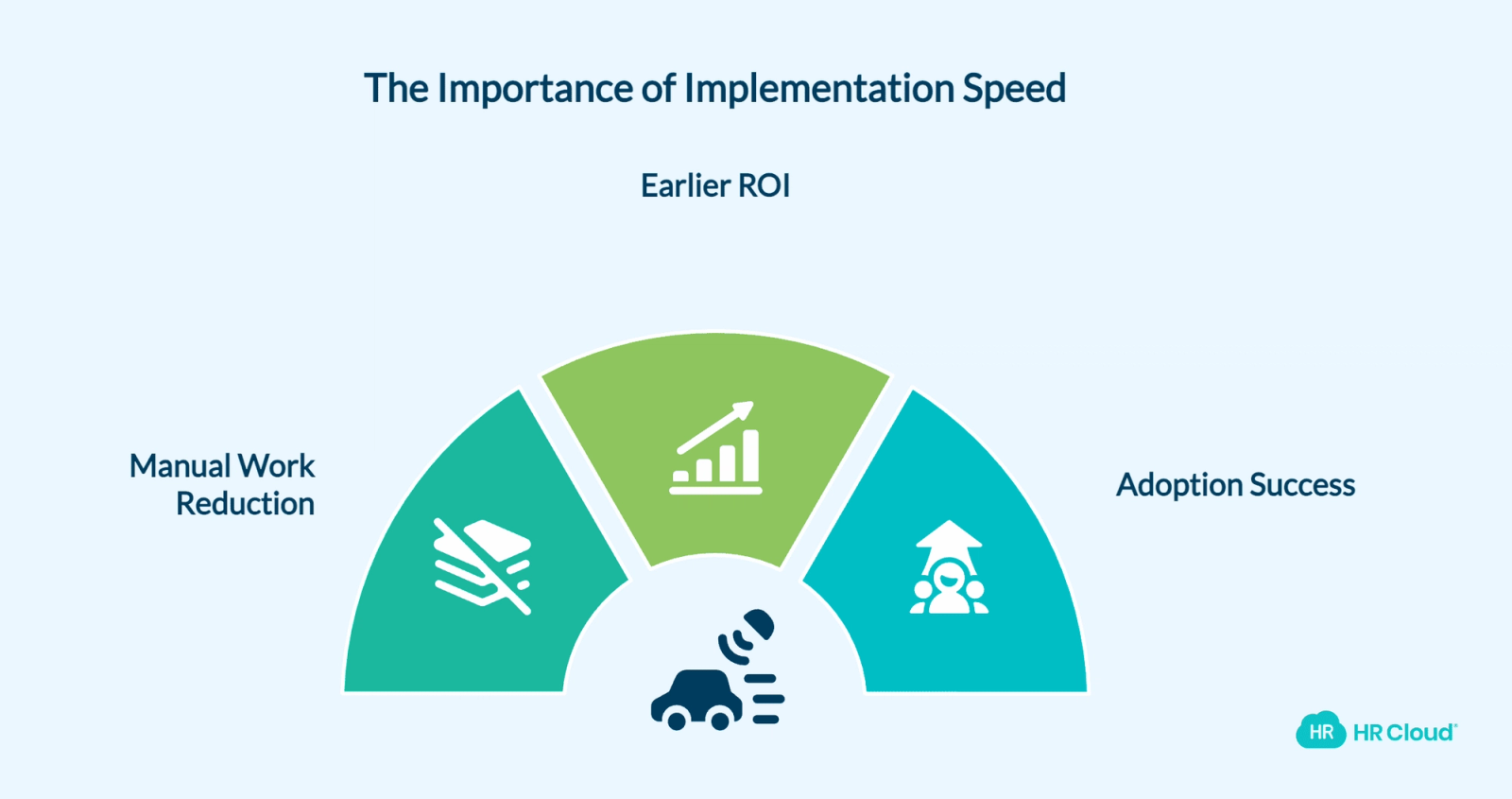
Implementation speed isn't just a project management preference. It has a direct, measurable financial impact.
Every Week of Delay Is a Week of Continued Manual Work
If your HR team is currently spending 15 hours per week on manual onboarding tasks — tracking down signatures, chasing documents, sending reminders by email — a two-month implementation delay costs approximately 120 hours of HR staff time that could have been redirected. That's time spent on work a system could handle, by people who were hired to do strategic work.
Faster Go-Live Means Earlier ROI
According to the Brandon Hall Group, organizations with strong onboarding programs improve new hire retention by 82% and productivity by over 70%. But those outcomes don't begin until your system is live and your onboarding workflows are running. Every week the implementation extends is a week where new hires are receiving an inconsistent, often paper-based experience — and the retention and productivity gains are deferred.
Low Adoption Is the Most Expensive Implementation Outcome
The most common and least discussed implementation failure isn't a missed deadline — it's an on-time go-live with low adoption. Only 12% of employees strongly agree their organization does a great job onboarding them, according to Gallup. That number gets worse, not better, when the onboarding system is confusing, not mobile-accessible, or deployed without adequate training. Poor adoption is the outcome of rushing implementation without adequate change management — and it's why the fastest go-live isn't always the best go-live.
What this means for HR directors: Speed matters, but speed with adoption matters more. The right question isn't "how fast can we go live?" — it's "how fast can we go live in a way that employees and managers actually use the system?"
Questions to Ask Every Vendor About Implementation — Before You Sign
The implementation section of a sales conversation is almost always underweighted. These six questions will surface the meaningful differences between vendors.
Who manages our implementation?
The right answer: a named, dedicated implementation specialist who stays with your account through go-live. The concerning answer: a shared support queue, a "pod" of rotating specialists, or "our team" without specifics.
What resources are required from our team, and for how many hours per week?
Realistic implementations at mid-market companies require roughly 3–5 hours per week of dedicated HR team time during the configuration and testing phases, more during data migration and training weeks. If a vendor tells you implementation requires "minimal time" from your team, be skeptical — configuration decisions require your people.
How long does data migration actually take, and who validates the data?
Ask for specifics: what's the validation process, how are errors surfaced, and who's responsible for resolving them? This question reveals whether the vendor has a structured methodology or a general promise.
Which integrations are included in the implementation timeline, and which are charged separately?
Native payroll integrations (to ADP, UKG, Paylocity) are often structured differently than custom API integrations. Understand which integrations are in scope and whether there are additional fees before you finalize your budget.
What are the most common reasons implementations with customers like us take longer than projected?
This is the most revealing question. A vendor who can answer it specifically — "data migration usually adds 1–2 weeks if employee records aren't audited beforehand" — has implemented for companies like you before. A vendor who deflects has not, or isn't being candid.
What does post-go-live support look like for the first 90 days?
The period immediately after go-live is when adoption either accelerates or stalls. Ask specifically whether your implementation manager stays engaged post-go-live or whether support transitions to a general queue at go-live.
Before these calls, download the HR Cloud HR Software Evaluation Checklist — it's built specifically for organizations at 200–2,000 employees and covers implementation methodology, integration scope, and post-go-live support criteria. Send it to every vendor alongside your six questions.
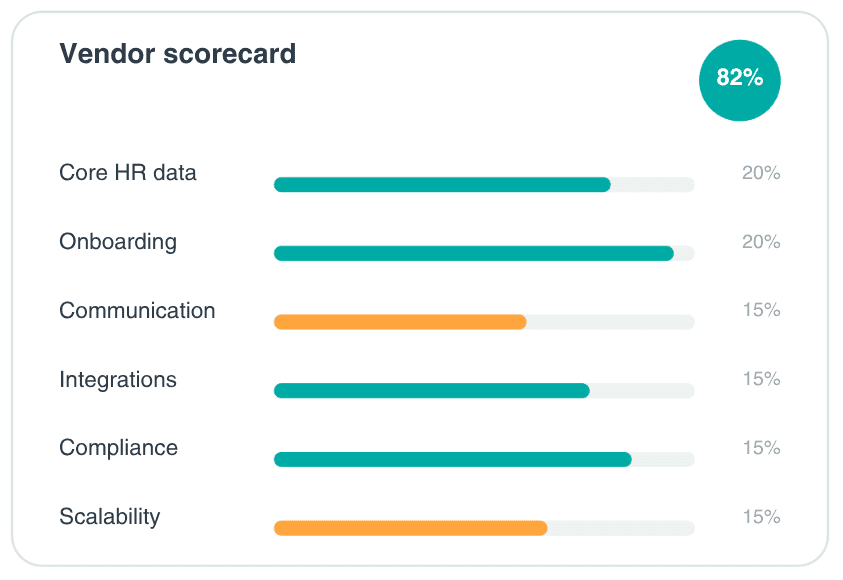
Ready to compare vendors without the guesswork? Score every platform the same way — onboarding, compliance, integrations, and more — before you sit through another demo. Get the vendor scorecard
Signs a Vendor Can Actually Deliver a Fast Rollout
Vendor claims about implementation speed are easy to make. These are the signals that separate vendors who deliver fast implementations from those who advertise them:
• A defined, documented onboarding methodology — not a general promise. Ask to see the actual implementation project plan they use for a company your size.
• Dedicated implementation manager, named at signing — not a shared support model that routes your questions to whoever's available.
• Pre-built integrations with your existing payroll provider — not a general API connection. Ask specifically whether the integration has been set up for customers using the same payroll provider you use.
• Customer references from companies your size and in your industry — and permission to ask those references specifically about implementation timeline and what caused any delays.
• Training resources designed for your workforce type — if your employees are hourly and field-based, ask how training is delivered to someone without a laptop or company email address.
• Clear post-go-live support commitment — a 90-day support period with a named contact, not a ticket queue that opens the day after launch.
How HR Cloud Helps Organizations Go Live in Under 8 Weeks
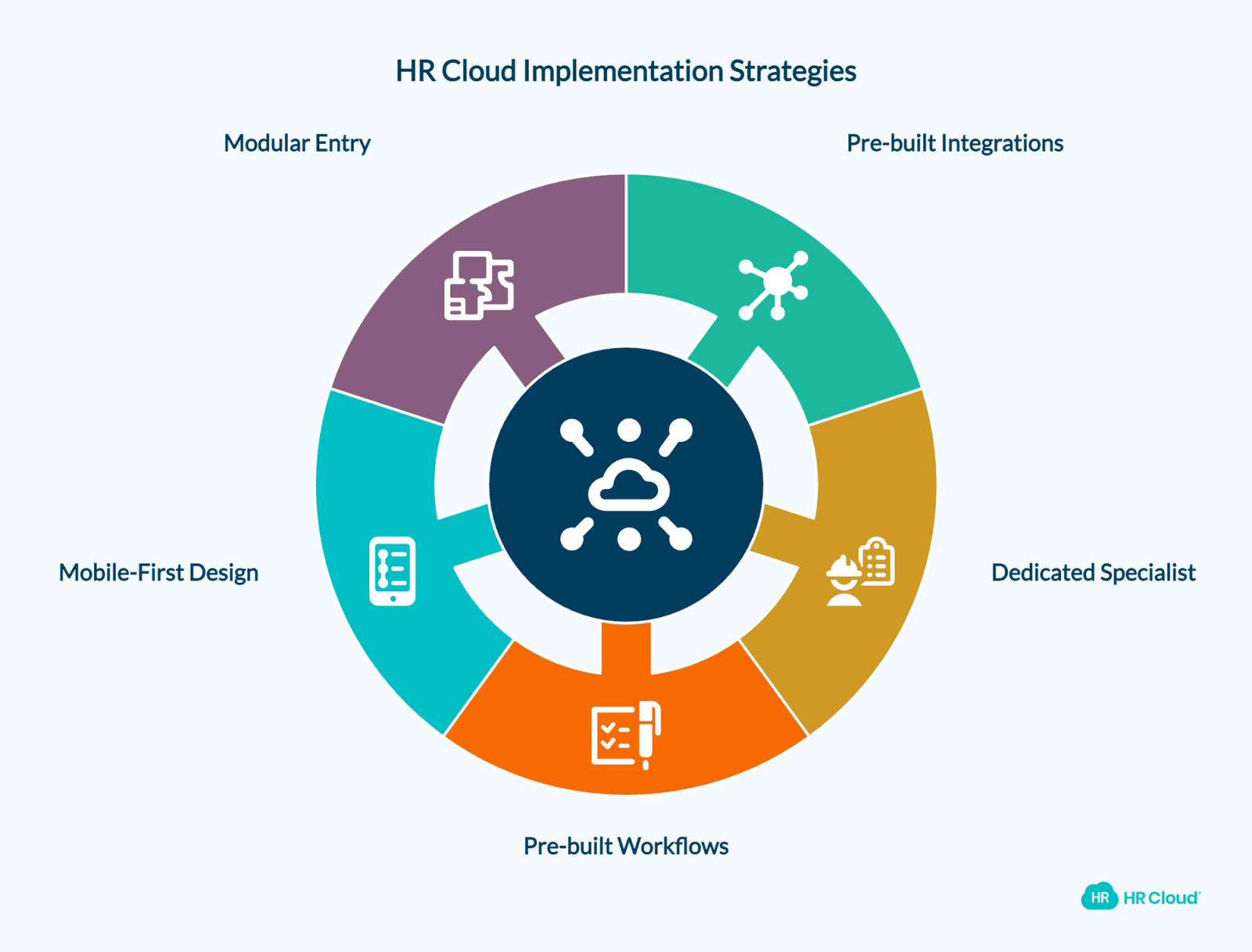
HR Cloud was built for the specific reality of mid-market organizations managing multi-location, frontline, or distributed workforces — environments where implementation speed matters because HR teams are lean and the cost of a slow rollout is measurable in manual hours and early retention losses.
Pre-built integrations that eliminate the most common implementation bottleneck. HR Cloud offers tested, native integrations with ADP Workforce Now, UKG, Paylocity, Okta, OneLogin, Slack, and Microsoft Teams. These integrations are configured, not built from scratch — which means the setup is faster, the data mapping is documented, and the testing has been done before your implementation begins.
A dedicated implementation specialist from kickoff through go-live. Every HR Cloud implementation is managed by a named specialist who knows your account, your scope, and your timeline. There is no handoff to a general support queue midway through the project.
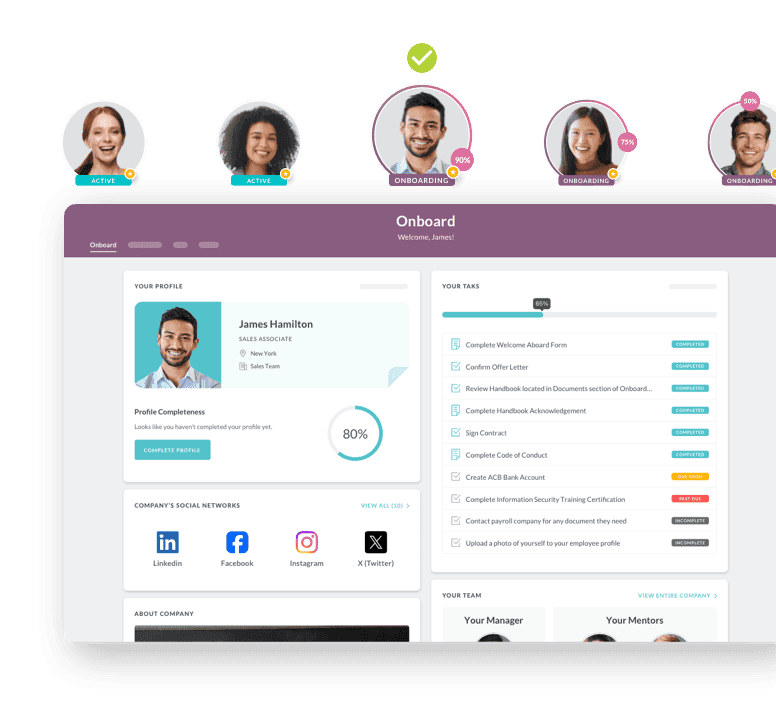
Pre-built onboarding workflows, configured for your company. The HR Cloud Onboard platform includes pre-built workflow templates for new hire onboarding, document collection, I-9 and E-Verify compliance, role-based task assignments, and e-signature collection. Your implementation specialist helps you configure these for your organization's structure — you're editing and adjusting, not building from a blank canvas.
Mobile-first design that drives adoption from day one. For organizations where a significant portion of employees don't regularly use a desktop computer, mobile adoption is the difference between a system that works and one that sits unused. HR Cloud achieves 75%+ mobile completion rates for distributed workforces — which matters most in manufacturing, healthcare, construction, and retail, where frontline employees need to complete onboarding tasks from a phone.
Modular entry point that keeps scope realistic. Many HR Cloud customers start with the onboarding module — achieving a 2–3 week go-live — then add HRIS, PTO management, time tracking, performance, and engagement tools in planned phases. This phased approach is one of the most reliable ways to hit a fast initial go-live without sacrificing long-term platform depth.
How to Turn This Into Action
Step 1: Audit your current data before you sign anything. Pull your employee records, check for duplicates, inconsistent fields, and missing data. The state of your data is the single biggest variable in how fast you can go live. Vendors can't tell you this on a sales call, but it's true: clean data is the foundation of a fast implementation.
Step 2: Define your launch scope in writing. Decide, before implementation begins, what goes live on day one and what is explicitly Phase 2. Document this, get vendor sign-off, and treat any additions to launch scope as formal change requests. This single governance decision prevents more timeline slippage than any other.
Step 3: Ask the six vendor questions above — in writing. Send them via email before your final vendor decision. The quality and specificity of the responses will tell you a great deal about who has actually implemented for companies like yours. If a vendor can't answer these questions in writing, that's your answer.
Ready to see what a structured 6-week implementation looks like for your organization? Book a demo with HR Cloud — tell them your current payroll provider and headcount, and they'll scope your implementation timeline in the first call.

Discover how our HR solutions streamline onboarding, boost employee engagement, and simplify HR management
Book Your Free DemoFrequently Asked Questions
How long does HR software implementation take?
Most HR software implementations for small and mid-sized organizations take between 4 and 12 weeks, depending on company size, integrations required, data migration complexity, and how much the platform needs to be customized. Focused deployments at companies under 500 employees can go live in as few as 2–4 weeks. Enterprise deployments with complex workforce management requirements typically take 3–12 months.
What is the fastest HR software to implement?
Cloud-based HR platforms with pre-built workflow templates, native payroll integrations, and dedicated implementation specialists typically offer the fastest go-live timelines. Among mid-market platforms, HR Cloud averages 6 weeks based on customer data; BambooHR averages 4–6 weeks for SMBs; Rippling states most small business deployments go live in 1–3 weeks, with mid-market timelines ranging from 4–8 weeks depending on modules and complexity. The fastest implementation for your specific situation depends on which integrations your existing payroll and identity management systems require.
Can HR software be implemented in under 8 weeks?
Yes — many small and mid-market organizations with a defined scope, clean data, and active internal project ownership can go live in 2 to 8 weeks. The two most important factors you control: auditing and cleaning your employee data before kickoff, and limiting your launch scope to core functionality with everything else designated as Phase 2.
What delays HR software implementation projects?
The four most common causes are: data quality issues that surface during migration and require cleanup before any records can go live; integration complexity, particularly when custom API connections are needed rather than native pre-built integrations; scope creep, when additional workflows and configurations are added to the launch scope after the project begins; and stakeholder availability, when approval cycles take longer than planned because no executive sponsor has been identified with decision-making authority.
How much internal effort does HR software implementation require?
Realistic mid-market implementations require roughly 3–5 hours per week of dedicated HR team time during configuration and testing phases, with additional time during data migration and training weeks. The project also requires participation from IT (integration setup and SSO), payroll (data validation and integration testing), and at least one executive sponsor empowered to make configuration decisions. Vendors who tell you implementation requires minimal internal involvement are not describing a complete picture.
What should companies ask before buying HR software?
Before signing, ask every vendor: Who is our dedicated implementation manager and when are they assigned? How does data migration work and who validates our data? Which integrations are included in the implementation timeline and which cost extra? What are the most common implementation delays for companies our size? And what does post-go-live support look like for the first 90 days? These six questions will reveal more about implementation reality than any feature demo.
How much does HR software implementation cost?
Implementation costs vary significantly by vendor and scope. Many cloud-based HR platforms — including HR Cloud — bundle implementation support into the annual contract with no separate fee for standard deployments. Others charge separately; mid-market implementation services can range from included to $5,000–$25,000+ for dedicated project management. Ask every vendor for a written statement of work that itemizes implementation costs before you sign, including any integration fees charged outside the base contract.
What should an HR software implementation plan include?
A complete implementation plan should cover: a defined launch scope with Phase 2 items documented in writing; a data migration timeline with validation checkpoints and a named person responsible for data cleanup; integration setup milestones for each payroll or identity management system; a training plan segmented by user type (HR admin, manager, frontline employee); and a named executive sponsor with authority to make configuration decisions without committee escalation.
About the author

Keep Reading


Like What You Hear?
We’d love to chat with you more about how HR Cloud® can support your business’s HR needs.
Book Your Free Demo