HR Cloud vs Paycor: Which HR Software Scales Better?

Direct Answer
If you are comparing HR software options and weighing Paycor against other platforms, HR Cloud is worth a look, particularly if predictable pricing and a strong onboarding experience matter more to you than an all in one payroll bundle. Here is the short version. HR Cloud tends to scale more predictably for companies that want to expand onboarding, HRIS, and engagement capabilities while keeping an existing payroll provider, since its pricing stays flat by employee band rather than climbing per employee. Paycor tends to scale more broadly for companies that want payroll and a wider HCM suite consolidated under a single vendor as headcount grows. HR Cloud prices in flat, package based tiers by employee band, while Paycor uses a base fee plus per employee model. HR Cloud does not process payroll natively. It runs alongside your existing payroll provider, including a direct integration with Paycor, so adding HR Cloud does not require changing your payroll setup. Paycor remains a strong, well established choice for companies that want payroll, HR, and recruiting bundled under a single vendor. The sections below walk through pricing, features, support, implementation, and how the two platforms can work together in practice.
Two questions tend to drive this comparison for most HR leaders. First, does the company want one vendor for everything, including payroll, or does it want to keep its current payroll system and add a specialized layer for onboarding and engagement. Second, how much does month to month cost predictability matter as the company adds headcount. Answering those two questions early makes the rest of the evaluation much faster, since most of the differences between HR Cloud and Paycor trace back to those two decisions.
At a Glance Comparison
Paycor is a payroll first HCM suite. HR Cloud is an onboarding and engagement first HR platform that connects with supported payroll systems, including Paycor. The table below pulls from each vendor's own published information and independent review platforms, each linked once in this article rather than repeated throughout.
| Feature | HR Cloud | Paycor |
|---|---|---|
| Starting price | $295/mo flat, 1 to 50 employees | Roughly $99/mo base plus roughly $6/employee/mo, third party estimate, since Paycor's current pricing page is quote based |
| Pricing model | Flat package by employee band | Base fee plus per employee (PEPM), custom quote for most accounts |
| Native payroll | No, connects with supported providers including ADP, Paylocity, QuickBooks Online, UKG, Paycor, and SAP SuccessFactors | Yes, payroll is the core product |
| Implementation | 2 to 4 weeks, free with 90 day prepay, or a $500 flat fee | Roughly 3 months, per aggregate G2 reviewer data, not a vendor published figure |
| Support hours | Live chat, email, and ticket support, Monday through Friday, 5 AM to 5 PM PST, plus an included Account Manager | Standard business hours support, with premium support available as an add on |
| G2 rating | Onboard by HR Cloud: 4.7/5, 102 reviews | 3.9/5, 1,363 reviews |
| Capterra rating | Not independently listed at product level | 4.3/5, 3,033 reviews |
| Best for | Onboarding, HRIS, and engagement for 1 to 250 employee teams, especially frontline and deskless workforces | Companies that want payroll and HR bundled under one vendor |
What Is HR Cloud
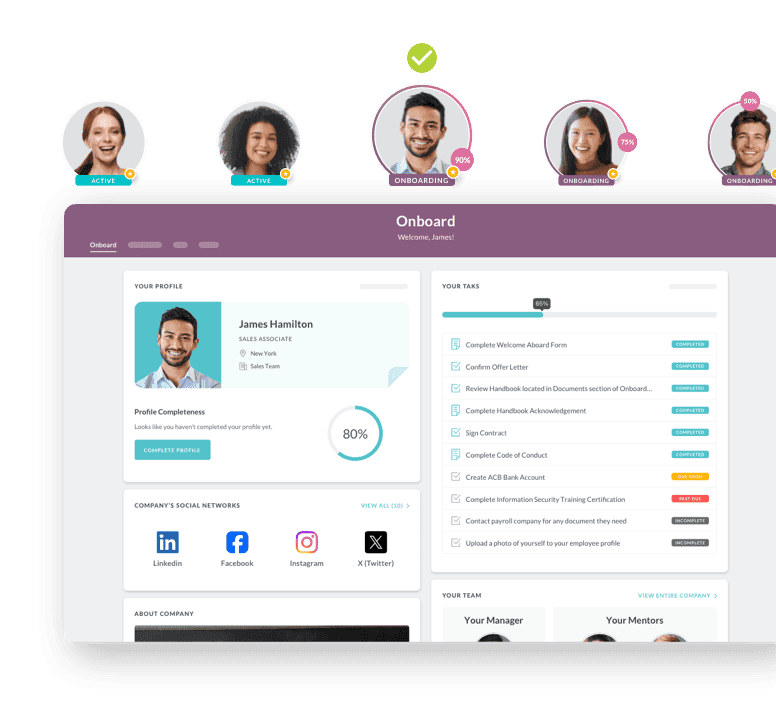
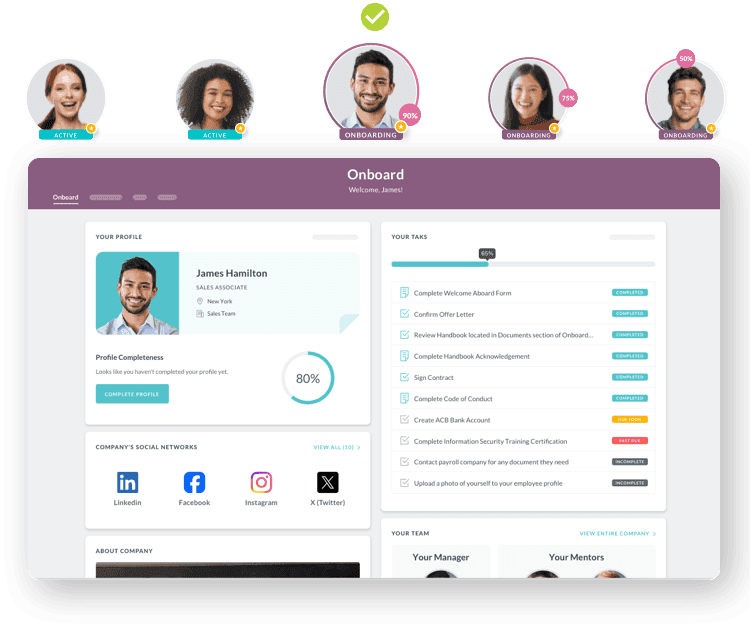
HR Cloud is an HR and employee experience platform organized around three connected products. Onboard handles new hire onboarding and workflow automation. People HRIS covers core HR record keeping, time off, and time tracking. Workmates covers engagement, recognition, and internal communication. The platform is built for small and mid sized companies, particularly those with frontline, deskless, or high turnover workforces, that need fast onboarding and strong day one adoption without heavy IT involvement to configure. HR Cloud does not process payroll itself. It connects with supported payroll providers, including ADP, Paylocity, QuickBooks Online, UKG, and Paycor, per HR Cloud's own FAQ.
The company positions itself around a simple idea. Many HR and payroll platforms are designed with the assumption that employees sit at a desk, check email regularly, and log into a system on their own. Frontline and deskless workforces, common in healthcare, manufacturing, construction, retail, and hospitality, often do not work that way. HR Cloud's products are built mobile first, so new hires and existing employees can complete onboarding tasks, check schedules, and receive company communication from a phone, without needing a company email address or a desktop login.
What Is Paycor
Paycor is a cloud based human capital management platform combining payroll, tax filing, HR, time and attendance, benefits administration, and a built in applicant tracking system. It is positioned primarily for United States mid market companies, with a scaled down tier available for smaller teams. As of April 14, 2025, Paycor is a wholly owned subsidiary of Paychex, in a deal valued at approximately $4.1 billion. At the time the acquisition was announced, Paycor served over 49,000 clients and supported roughly 2.7 million employees, headquartered in Cincinnati, Ohio. Paycor continues to operate as its own business unit within Paychex, and Paychex has described the acquisition publicly as a way to expand its upmarket capabilities and combine the two companies' HCM offerings.
Paycor's core strength is payroll. The platform handles tax filing, compliance updates across jurisdictions, and direct deposit as its primary function, with HR, time tracking, and recruiting built around that payroll core. For companies that want a single vendor managing the entire employee lifecycle from hire to paycheck, Paycor is designed specifically for that use case.
Pricing Breakdown
HR Cloud prices in flat monthly packages by employee band, not per seat. Per HR Cloud's published pricing:
| Plan | 1 to 50 employees | 51 to 100 employees | 101 to 250 employees |
|---|---|---|---|
| Essential HR | $295/mo | $495/mo | $795/mo |
| Professional HR | $595/mo | $995/mo | $1,495/mo |
| Culture HR | $895/mo | $1,395/mo | $1,995/mo |
Annual billing saves 20 percent. Implementation is free with 90 day prepayment, or a flat $500 fee otherwise, regardless of headcount. This flat structure means the price a company pays does not change based on how many employees it adds within a given band, which makes budgeting for the year ahead more straightforward.
Paycor's current pricing page is quote based rather than publicly listed, so exact rates are best confirmed directly with a Paycor representative for a company's specific situation. For general context, Pin.com's pricing analysis, which cites Business.com and OutSail estimates, suggests small business tiers have historically run in the range of $99 to $299 per month base plus $6 to $16 per employee, with mid market accounts of 50 or more employees typically moving to custom quotes. When getting a quote from Paycor, it is worth asking directly about a few things: what is included in the base implementation fee, whether benefits administration and premium support are bundled into the quoted price or billed separately, and how the per employee rate is structured as the company's headcount grows over time. Getting clear answers to those questions during the sales process avoids surprises later.
On the HR Cloud side, the main additional cost to plan for is Performance Management if a company starts on Essential HR and wants to add it later, since it is included at no extra charge in Professional and Culture HR. Custom integrations beyond the standard set are quoted separately based on complexity, and HR Cloud's sales team can walk through specific scenarios during a demo.
Feature by Feature Breakdown
Onboarding
HR Cloud's Onboard module is the product's core focus. It includes personalized onboarding journeys that can be built by role and by location, customizable checklists, I-9 and E-Verify support, electronic signatures, and automated workflows that assign tasks to new hires, managers, and HR without requiring manual follow up. Customer reported results, per HR Cloud's own published customer stories, include Behavioral Progression reporting a 60 percent reduction in onboarding related questions from new hires, onboarding time for new therapists dropping from 4 weeks to 2.5 weeks, and its administrative onboarding process finishing 3 times faster, and Osmose Utilities Services, a field based workforce that previously spent up to two hours per new hire on a paper based process, reporting improved data accuracy and reduced onboarding time after switching to HR Cloud.
Paycor's onboarding product is bundled starting at its Essential tier and is praised in reviews for automated data entry and mobile self service. Paycor's own Kansas Heart Hospital case study cites reduced manual work as a result of the platform's onboarding automation. The architectural difference between the two platforms is that onboarding is HR Cloud's primary product, built around getting a new hire ready before day one, while for Paycor it is one module within a broader payroll centered suite, built around getting a new hire correctly entered into payroll.
Core HRIS
Both platforms cover the basics of an HRIS: employee records, org charts, document storage, and custom fields for tracking company specific data. HR Cloud's People HRIS is included in every package starting at $295 per month, so there is no separate tier to unlock core record keeping. Paycor's core HR functionality beyond payroll is available starting at its Essential tier and expands with additional HR analytics at higher tiers. Companies that want a single system of record for basic employee data will find both platforms capable here, and the decision usually comes down to which platform's other modules matter more.
Time Off and Time Tracking
Time off requests, approvals, and balances are included in every HR Cloud package as part of the core HRIS, with time clock functionality available as part of the same suite. Paycor includes time off tracking starting at its Essential tier, and its entry level Basic tier has historically required time and attendance as a separate add on, according to third party buyer guides, since Paycor does not publish this detail on its own site.
Applicant Tracking
HR Cloud's Recruit ATS is included starting at Professional HR, and covers job posting, candidate pipelines, and a direct handoff into Onboard once a candidate is hired, so there is no gap between the recruiting and onboarding steps. Paycor also offers applicant tracking as part of its suite, and current job posting limits by tier are best confirmed directly with a Paycor representative, since exact plan details are not publicly published at this time. Neither platform is built primarily for sourcing passive candidates. Both are designed to manage inbound applicants once a job is posted.
Performance Management
HR Cloud's Performance Management module covers reviews, self evaluations, 360 degree feedback, and goal tracking. It is included in Professional and Culture HR, and available as a paid add on for companies starting on Essential HR. Historically, comparable talent development tools from Paycor have been bundled at its higher tiers, according to third party pricing guides, and companies interested in this functionality should confirm current availability directly with Paycor.
Employee Engagement
This is one of the clearer areas of difference between the two platforms. HR Cloud's Culture HR tier includes Workmates, which covers a branded mobile app, personalized onboarding journeys by role and location, pulse surveys, secure internal chat, and recognition tools that let employees and managers publicly acknowledge good work. Paycor's strength in this area leans more toward payroll adjacent analytics, such as recognition frequency reporting, promotion timing, and manager check in cadence, rather than a standalone communication and recognition suite built for daily employee use.


Payroll
Paycor processes payroll natively. This is its core strength, and it is the primary reason many mid market companies choose Paycor over a standalone HR platform. HR Cloud has no native payroll and connects with supported payroll providers, including Paycor, per HR Cloud's own FAQ. If payroll processing, tax filing, and compliance depth are the top evaluation priority, Paycor is built specifically around that need. If a company is satisfied with its current payroll provider, including Paycor, and wants to strengthen onboarding, HRIS, and engagement on top of it, HR Cloud is designed to work alongside that system rather than replace it, with the specific integration details confirmed during setup.
Mobile Experience
Both platforms offer native iOS and Android apps. Paycor's mobile app covers clock in and clock out, pay stub access, time off requests, and shift swapping, though some reviewers note fewer features are available on mobile compared to the desktop version. HR Cloud's mobile experience is central to its onboarding flow, with new hires at companies like MedLinks completing onboarding through an intuitive, mobile enabled workflow rather than a paper based process, according to HR Cloud's published customer story. This matters most for frontline and deskless teams who may not have regular access to a work computer or company email.
Reporting and Analytics
Paycor's HR analytics, available at its higher tiers, are frequently praised in reviews for real time dashboards and payroll adjacent reporting. Some reviewers on G2 note report customization as an area they would like to see continue improving. HR Cloud includes standard reporting and dashboards across every package tier as part of the core HRIS, covering onboarding progress, task completion, and employee records without an additional module to unlock.
Support Model
HR Cloud provides live chat, email, and ticket support Monday through Friday, 5 AM to 5 PM PST, plus an Account Manager included on every plan, who continues to be available after the initial implementation period rather than only during setup. On G2, Onboard by HR Cloud carries a 9.7 out of 10 quality of support score as of August 2026. Paycor's reviewers on G2 give strong marks for ease of use and payroll functionality, and Paycor actively responds to reviews on both G2 and Capterra, which is a good sign of vendor engagement with customer feedback. Support responsiveness is one of the more commonly discussed topics in Paycor's reviews and is worth asking about directly during evaluation, along with a clear understanding of what is included in standard support versus what falls under a paid premium support tier.
Implementation Process
HR Cloud's standard small business implementation takes 2 to 4 weeks, handled by a dedicated Account Manager who covers data migration, workflow configuration, and integration setup. Implementation is free with 90 day prepayment, or a flat $500 fee otherwise, and that fee does not increase with company size. The shorter timeline reflects the scope of what is being implemented, since HR Cloud is adding an onboarding, HRIS, and engagement layer rather than migrating an entire payroll system.
HR Cloud's published 2 to 4 week implementation window is vendor provided guidance for standard small business rollouts. Paycor's implementation timeline is not published by Paycor directly. The most commonly cited figure, roughly three months, comes from aggregate G2 reviewer data rather than a vendor published median, and it reflects the broader scope of a full payroll and HCM implementation compared to adding a focused HR layer on top of an existing system. A full payroll implementation involves migrating historical pay data, setting up tax jurisdictions, configuring benefits, and testing pay runs before go live, which naturally takes longer than configuring an onboarding workflow. It is a good question to raise directly with a Paycor representative during the sales process: what is included in the implementation timeline, which parts of the process require the company's own team, and what a realistic go live date looks like for a company of a specific size.
Proof: Ratings in Context
On G2, Onboard by HR Cloud averages 4.7 out of 5 across 102 reviews as of August 2026, with a 9.7 out of 10 quality of support rating. Paycor's G2 profile shows 3.9 out of 5 across 1,363 reviews, while its Capterra profile shows 4.3 out of 5 across 3,033 reviews. These are different platforms with different reviewer bases, and both are worth reading directly rather than relying on a single number, and review counts shift over time so it is worth checking current figures before a final decision. Paycor also holds multiple 2026 G2 Spring Awards across healthcare HR, learning, and recruitment marketing categories, which reflects genuine product strength in those specific areas and is worth acknowledging as part of a fair comparison.
Reading ratings across multiple platforms rather than a single source gives a more complete picture than any one number can provide on its own. A platform with a strong G2 score but a weaker showing elsewhere, or the reverse, usually points to a difference in who is leaving the reviews rather than a contradiction in the product itself. G2's reviewer base tends to skew toward software buyers and administrators evaluating the platform against competitors, while Capterra draws a broader mix of day to day users. Reading a handful of recent reviews on each platform, rather than relying only on the star rating, tends to surface the specific details that matter most for a company's own situation, such as how a platform handles a particular integration or how quickly a support ticket gets resolved during a busy payroll week. It is also worth checking whether recent reviews mention anything specific to a company's own size or industry, since a platform that works well for a five hundred employee organization does not always behave the same way for a fifty employee team, and the reverse is true as well.
Who Should Choose HR Cloud
HR Cloud tends to be the stronger fit for companies with 1 to 250 employees, especially those with frontline, deskless, or high turnover workforces where mobile access matters more than desktop logins. It is a good match for teams that want to keep their current payroll provider, including Paycor, and add a specialized, more mobile friendly layer for onboarding and engagement on top of it. Companies that prioritize fast onboarding, high mobile adoption, and day to day employee engagement, alongside predictable, flat monthly costs that do not shift as headcount grows within a band, will generally find HR Cloud aligned with what they are looking for. This includes companies that already have a payroll system they are happy with and simply want a dedicated layer for the parts of the employee experience that are not the primary focus of their current payroll platform.
Who Should Choose Paycor
Paycor tends to be the stronger fit for mid market companies that want payroll, HR, and recruiting managed under a single vendor relationship, with one point of contact for the full HCM stack. It is a good match for organizations that place payroll tax compliance depth as a top priority and want that built directly into the same system as core HR functions. Companies already using Paycor and looking to expand their usage of its recruiting or analytics modules, or that prefer consolidating vendors rather than adding a second platform, will generally find Paycor aligned with their goals. This also fits companies where a single, unified system for the entire employee record, from application to paycheck, matters more than having a more specialized tool for any one part of that process.
What Customers Are Saying
HR Cloud customers cited in the company's own published customer stories report measurable outcomes tied to onboarding automation. Behavioral Progression reports a 60 percent reduction in onboarding related questions from new hires, a drop in new therapist onboarding time from 4 weeks to 2.5 weeks, onboarding finishing 3 times faster for its administrative team, a 20 percent increase in employee engagement with Workmates, and a 10 percent improvement in therapist retention after 6 months. Osmose Utilities Services reports improved data accuracy and faster onboarding for its field based workforce after replacing a manual, paper based process. Medlinks reports a shift from a fully paper based recruiting and onboarding process to an automated, mobile enabled workflow, with its Auditing and Operations Administrator specifically praising HR Cloud's support response times. G2 reviewers of Onboard by HR Cloud consistently cite responsive support and configuration flexibility as standout strengths.
Paycor reviewers on G2 and Capterra frequently praise ease of use for payroll processing and the platform's Knowledge Center self help resources, along with the breadth of its HR analytics at higher tiers. Reporting flexibility and support responsiveness come up as areas some reviewers would like to see continue evolving, which is worth discussing directly with a Paycor representative as part of a normal evaluation process, the same way any software purchase should involve asking current customers about their experience.
Industry Considerations
The right choice between these platforms often depends on the makeup of a company's workforce as much as its size.
For healthcare organizations, credentialing, licensing documentation, and fast onboarding for clinical and support staff are often the priority. Depending on the role, employer, and jurisdiction, a new hire may need specific licenses, credentials, or training records verified before beginning certain patient facing responsibilities, and requirements vary enough that they should be confirmed against each organization's own policies rather than assumed. A mobile first onboarding flow that lets a new hire complete paperwork before their first shift can meaningfully shorten time to productivity in this setting.
“The flexibility of the HR Cloud system is invaluable in ensuring compliance. It helped us stay a step ahead of changing document collection requirements.”

— Jesse Rose, Provider recruitment, onboarding, and compliance manager

For manufacturing and construction companies, employees are frequently on the floor or on site rather than at a desk, and supervisors need visibility into which onboarding tasks are complete without chasing paperwork across multiple locations. A platform that gives managers a clear view of task status, even across several sites, tends to matter more here than deep payroll analytics.
For multi location retail and hospitality businesses, onboarding consistency across locations, combined with a way to reach employees who do not check corporate email regularly, becomes the central operational challenge. A mobile app that works the same way whether an employee is in one store or another helps standardize the new hire experience company wide.
For education and staffing organizations, seasonal hiring surges and high volume onboarding create their own pressure. A school district bringing on substitute teachers before the school year starts, or a staffing agency placing dozens of workers with different clients in a single week, both need an onboarding process that can scale up quickly without adding headcount to the HR team just to keep pace. Automated checklists and role based workflows tend to matter more in this setting than deep payroll customization, since the volume of new hires, not the complexity of any single hire, is the main operational challenge.
In each of these cases, the underlying question is the same. Does the company need a system built primarily around payroll accuracy and compliance, or does it need a system built primarily around getting employees ready to work and keeping them engaged once they are on the team. Many companies, including some Paycor customers, find that the honest answer involves both, which is why running HR Cloud alongside an existing payroll system is a common and practical setup rather than an either or decision.
Using HR Cloud Alongside Paycor
Since HR Cloud does not replace payroll, adding it does not require touching an existing Paycor relationship. HR Cloud's Paycor integration allows the two platforms to sync employee data, and per HR Cloud's own FAQ, the goal is to make it easier to keep employee data connected and streamline payroll related workflows. Setting up the connection involves generating API credentials through Paycor's own developer portal, so both HR Cloud's implementation team and the company's own Paycor administrator are typically involved in getting it configured correctly. For companies wanting to strengthen onboarding, HRIS, or engagement while keeping Paycor for payroll, the typical path looks like this.
First, scope the rollout with an HR Cloud Account Manager, which typically takes 2 to 4 weeks depending on employee count and how many existing workflows need to be configured. Second, bring over employee records and org structure, which move over during implementation with HR Cloud's team handling the data mapping. Third, set up the Paycor integration, which requires the company's Paycor administrator to generate API credentials and HR Cloud's implementation team to configure the connection on the HR Cloud side. Fourth, confirm exactly which fields and workflows are syncing, and in which direction, before retiring any older manual process, since the specific data flow should be verified for a company's own setup rather than assumed.
This approach lets a company keep the payroll relationship it already trusts while extending onboarding speed, mobile access, and employee engagement with a specialized layer alongside a payroll first platform. Any specific questions about which fields sync, how often, and in which direction are best confirmed directly with HR Cloud's implementation team during a demo, since exact integration behavior can vary by setup.
Questions to Ask Both Vendors
Since exact pricing, implementation scope, and support tiers vary by company size and are often finalized during a sales conversation rather than published in full, it helps to walk into evaluation calls with both vendors carrying the same list of questions. Asking both Paycor and HR Cloud the same set of questions makes the comparison fair and gives a company answers specific to its own situation rather than general figures pulled from a website.
On pricing, ask what is included in the base package versus what is billed as an add on, whether the quoted price changes as headcount grows within the current year, and whether there is a fee for adding a new module later. On implementation, ask what the realistic timeline looks like for a company of a specific size and industry, who handles data migration, and what the company's own team is expected to do during setup. On support, ask what the standard response time commitment is in writing, whether there is a dedicated point of contact or a general support queue, and whether premium support is available and what it costs. On integrations, ask which systems the platform connects to natively today, what data flows in each direction, and how a company's IT or HR team would be involved in setting that up.
Asking these questions of both vendors, rather than assuming based on general reputation or a single review, is the most reliable way to figure out which platform actually fits a specific company's size, industry, and existing technology setup.
How to Think About This Decision
Most companies land in one of three situations when comparing HR Cloud and Paycor. The first is a company without an established payroll system yet, which is deciding what to build its HR technology stack around from the start. For this group, the decision often comes down to whether payroll consolidation or onboarding and engagement is the more pressing priority, since starting with one vendor for everything is simpler than adding a second platform later.
The second is a company that already uses Paycor for payroll and is generally satisfied with it, but is running into friction with onboarding speed, mobile access for frontline employees, or day to day engagement. For this group, adding HR Cloud alongside the existing Paycor relationship is often the more direct path, since it solves the specific gap without requiring a payroll migration.
The third is a company that is unhappy with its current HR and payroll vendor broadly and is open to consolidating everything under a new provider. For this group, a fuller side by side evaluation of both platforms, including live demos and reference calls with current customers in a similar industry, is the more appropriate next step than relying on any single comparison article.
Identifying which of these three situations describes a company's actual position before scheduling demos tends to save time on both sides, since it narrows the conversation to the questions that matter most for that specific case.
Final Verdict
Paycor and HR Cloud serve different primary needs, and both are strong at what they are built to do. Choose Paycor when payroll consolidation and a wider HCM suite under one vendor are the central requirements, since it offers real compliance depth and now Paychex's scale following the 2025 acquisition. Choose HR Cloud when payroll is already working well and the larger problem is onboarding speed, employee readiness, mobile access, or frontline communication, since it is built to layer onto an existing payroll system, including Paycor, without requiring a switch. Evaluate the two together when Paycor should remain the payroll system of record but the surrounding employee workflows need a more specialized, mobile first operational layer. In terms of the original question, which platform scales better depends on what is actually growing: a company scaling its headcount while keeping the same payroll provider will find HR Cloud's flat, band based pricing and 2 to 4 week implementation more predictable, while a company scaling into a broader need for consolidated payroll, HR, and recruiting under one vendor will find Paycor's structure built for that path. A short list of demos with both HR Cloud and Paycor, using the same set of questions from earlier in this article, is usually the fastest way to get a clear answer specific to a company's own situation.

Discover how our HR solutions streamline onboarding, boost employee engagement, and simplify HR management
Book Your Free DemoFrequently Asked Questions
How does HR Cloud compare to Paycor
Paycor is a payroll first HCM suite. HR Cloud is an onboarding and engagement first platform that integrates with existing payroll systems, including Paycor. The right fit depends on whether a company is looking to consolidate payroll and HR under one vendor, or to strengthen onboarding and engagement on top of a payroll system it already uses.
Can I use HR Cloud if I already use Paycor
Yes. HR Cloud has a supported Paycor integration and does not process payroll itself, so the two platforms can be used together, with Paycor handling payroll and HR Cloud handling onboarding, HRIS, and engagement. Field mappings, data direction, and credentials should be confirmed with HR Cloud during implementation for a company's specific setup.
Is HR Cloud cheaper than Paycor
It depends on headcount and which modules a company needs. HR Cloud's flat pricing, from $295 to $1,995 per month, does not scale per employee. A direct cost comparison requires a current quote from Paycor, since its pricing is quote based rather than publicly listed.
What changed with Paycor's ownership
Paychex completed its acquisition of Paycor on April 14, 2025, for approximately $4.1 billion. Paycor continues operating as its own business unit within Paychex. Current customers with specific questions about their account should confirm details directly with their Paycor representative.
How long does implementation take with each platform
HR Cloud's standard implementation runs 2 to 4 weeks, per HR Cloud's own published guidance. Paycor does not publish an implementation timeline directly. The most commonly cited figure, roughly three months, comes from aggregate G2 reviewer data rather than a vendor published median, and reflects the broader scope of a full payroll implementation.
Does HR Cloud offer payroll like Paycor
No. HR Cloud integrates with a company's existing payroll provider, including Paycor, rather than replacing it. Companies that want payroll and HR from a single vendor should evaluate Paycor directly.
Which platform has better support
HR Cloud's Onboard product scores 9.7 out of 10 on quality of support on G2 as of August 2026. Paycor's reviews are generally positive on ease of use, with response times as a topic some reviewers raise, which is worth asking about directly when evaluating either vendor.
Does HR Cloud work well for companies planning to grow
HR Cloud's published pricing covers 1 to 250 employees, with custom quotes available above that range. Paycor's mid market and upper tiers are built to scale further within its own structure, and both vendors can typically accommodate a growing company's needs at their respective ends of the market.
Do I need to choose only one platform
Not necessarily. Since HR Cloud does not process payroll, a company can use Paycor for payroll and HR Cloud for onboarding, HRIS, and engagement at the same time. Many companies find this combination covers more ground than relying on either platform alone.
What industries is each platform best suited for
HR Cloud tends to see the strongest fit in healthcare, manufacturing, construction, retail, and hospitality, where a large share of employees work in the field or on a shift basis rather than at a desk. Paycor serves a broad range of mid market industries where payroll complexity and compliance depth are the primary technology need, alongside HR and recruiting functions layered on top.
About the author

Keep Reading


Like What You Hear?
We’d love to chat with you more about how HR Cloud® can support your business’s HR needs.
Book Your Free Demo