HR Cloud vs UKG: Enterprise HR Software Compared

HR Cloud vs UKG: A UKG Alternative for Enterprise HR Teams (2026)
HR Cloud is a strong UKG alternative if your priority is fast implementation, mobile-first onboarding, and employee engagement for a 500–5,000-employee organization, especially one with frontline, multi-location, or hourly workers. UKG (Ready or Pro) remains the better choice if your priority is deep, native payroll and workforce management, including complex scheduling, labor forecasting, and multi-state or global payroll compliance, and you have the budget and timeline for a longer rollout.
HR Cloud doesn't run native payroll. It's an HRIS, onboarding, and engagement platform that integrates with payroll providers, including UKG itself, so many organizations run both together rather than replacing one with the other. On price, HR Cloud uses custom, package-based pricing with no public per-employee rate; UKG doesn't publish pricing either, but third-party estimates put UKG Ready around $20–27 per employee per month and UKG Pro around $26–41. On implementation, HR Cloud averages 6 weeks; UKG's typical range, per independent implementation consultants, runs 6–9 months for Ready and 12–18 months for Pro. Full sourcing and links for every number below.
HR Cloud vs. UKG at a Glance
| Feature | HR Cloud | UKG Ready | UKG Pro |
|---|---|---|---|
| Starting price | Custom quote (package-based); SMB tier from $295/mo, <250 employees | ~$20–27 PEPM (third-party estimate; not published) | ~$26–41 PEPM (third-party estimate; not published) |
| Free trial | No self-serve trial; live demo | No published trial | No published trial |
| Native payroll | No, integrates with ADP, UKG, Paylocity, Intuit | Yes, US and Canada, plus multi-country via UKG Global Payroll | Yes, US, Canada, and 160+ countries via UKG Global Payroll |
| Core modules | Onboarding, People HRIS, Recruit ATS, Performance, Time Off, Time Clock, Workmates (engagement/comms/recognition), Maya AI onboarding agent | HR, payroll, time/scheduling, benefits, ACA compliance, recruiting, Bryte AI; more add-ons via Plus/Advanced tiers | Core HR, benefits, recruiting, talent marketplace, performance/coaching, learning, payroll, advanced WFM/scheduling/forecasting, UKG Talk |
| Mobile app | Yes, iOS and Android | Yes, iOS and Android | Yes, iOS and Android |
| Typical implementation | 2–8 weeks, avg. 6 weeks | Est. 6–9 months per PredictiveHR (UKG publishes no fixed timeline) | Est. 12–18 months per PredictiveHR (UKG publishes no fixed timeline) |
| Support hours | Live chat, email, ticket M–F 5 AM–5 PM PST; chat <30 sec; unlimited Account Manager | Not publicly detailed | Not publicly detailed |
| G2 rating | 4.7/5 (174 reviews) | 4.4/5 (2,614 reviews) | 4.3/5 (2,245 reviews) |
| G2 "Quality of Support" | Not scored in this G2 category | 8.8/10 | 8.1/10 |
| Best for | 500–5,000 employees, frontline/multi-location, fast go-live | ~10–1,500 employees (up to ~2,500), straightforward US/multi-country payroll | ~2,500–15,000+ employees, complex global payroll/WFM |
All pricing and implementation figures in this table are sourced and linked in the Pricing Breakdown and Implementation sections below.
Packaging accurate as of July 31, 2026. UKG has shifted feature tiers within the past year; verify current bundles before publish if this page is refreshed later.
What Is HR Cloud?
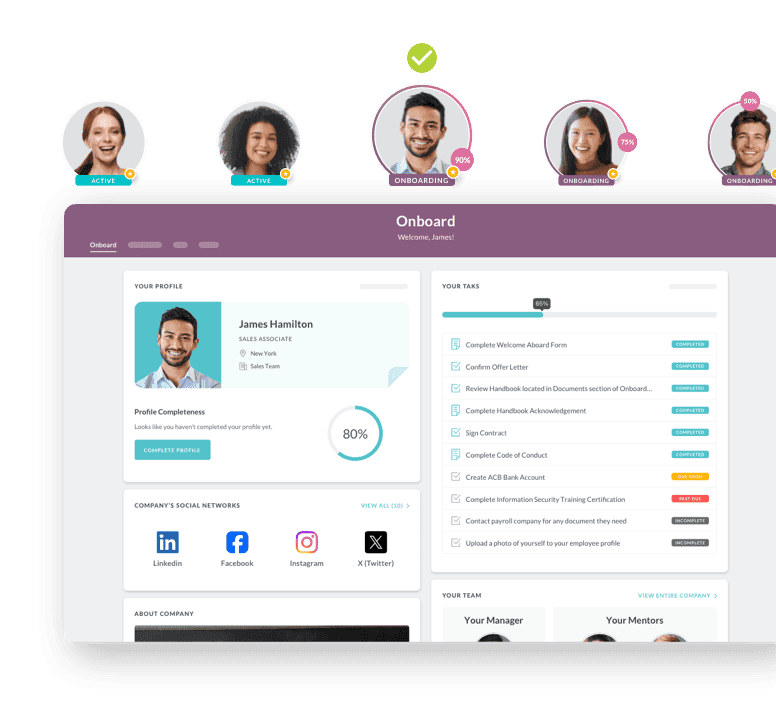
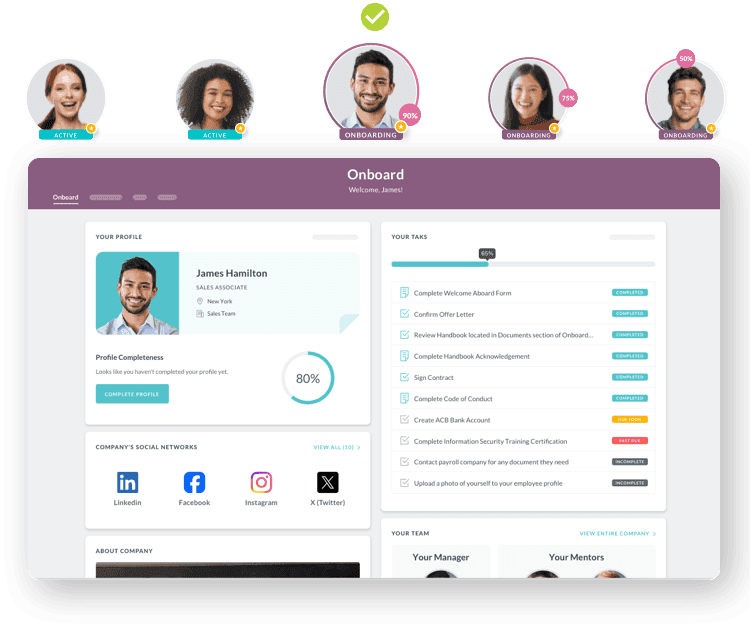
HR Cloud is a modular HR, onboarding, and employee-experience platform built for mid-market and enterprise organizations of 500 to 5,000 employees, with particular depth for multi-location, frontline, and hourly workforces. Rather than one monolithic system, it's structured as an Onboard Suite and a broader HR Suite, with add-ons like Workmates (engagement, recognition, internal communications) layered on top, so organizations can start with a focused deployment and expand in phases rather than committing to a full-platform rollout on day one.
The platform's core differentiators:
- Fast, structured implementation: 6-week average go-live, driven by pre-built integrations rather than custom API work
- Mobile-first design: built for employees who don't sit at a desk or check a company email address regularly
- Maya, an AI onboarding agent: a message-based conversational assistant that guides new hires through Day 1 tasks, then checks in at Day 7, Day 30, and Day 90
- Payroll-agnostic: pre-built, tested integrations with ADP, UKG, and Paylocity, rather than native payroll
- Dedicated implementation specialist on every account, named at signing
HR Cloud is best understood as the HRIS, onboarding, and employee-engagement layer that sits on top of whichever payroll system an organization already runs.
What Is UKG?
UKG (Ultimate Kronos Group), formed from the 2020 merger of Ultimate Software and Kronos, is one of the largest human capital management (HCM) vendors globally, with particular strength in payroll and workforce management for large, hourly, and shift-based workforces. UKG sells two distinct platforms under one brand:
- UKG Ready: per UKG's own current positioning, the primary fit for organizations of roughly 10–1,500 employees, scaling to about 2,500 employees depending on operational complexity. Sold in four tiers (Start, Core, Plus, Advanced), with Start built for organizations under 200 employees and including HR, payroll, time, benefits, recruiting, and performance from the entry tier.
- UKG Pro: targets organizations of roughly 2,500 to 15,000+ employees needing comprehensive HCM: advanced workforce management, ML-based labor forecasting, global payroll across 160+ countries, and deep compliance automation.
UKG is explicit that the choice between the two isn't headcount alone. It's operational complexity: multi-entity payroll structures, OFCCP recruiting compliance, position-based succession planning, and advanced forecasting needs are the signals UKG itself points to for moving from Ready to Pro. UKG doesn't publish pricing publicly for either product; every quote is custom.
Pricing Breakdown
HR Cloud pricing is package-based rather than strictly per-employee. There are two core plans: Onboard Suite (onboarding, offboarding, People HRIS) and HR Suite (adds Recruit ATS, Performance Management, Time Off tracking), both requiring a custom quote through sales, plus add-on modules (Engagement, Assets, Time Clock) that can be bundled in. HR Cloud publishes one concrete number: a $500 flat implementation fee for ADP Marketplace customers, and a fixed annual license model explicitly designed to avoid per-seat price surprises as headcount grows. A separate SMB-dedicated tier starts at $295/month for organizations under 250 employees, though that's below HR Cloud's core enterprise target range.
UKG pricing is also unpublished, but third-party procurement trackers, OutSail, PeopleOpsClub, and Vendr data aggregated by CheckThat.ai, put UKG Ready at roughly $20–27 PEPM for mid-market deployments and UKG Pro at $26–41 PEPM for enterprise deployments, with pricing compressing 20–30% at 5,000+ employees. The gap that matters most isn't the subscription line; it's implementation. For a 2,000-employee UKG Pro deployment, that math works out to roughly $768,000–$984,000/year in software costs, plus 40–70% of that figure again in first-year implementation fees, putting total year-one cost in the $1.075M–$1.673M range. UKG Ready implementations run smaller, 20–40% of annual subscription, or $20,000–$100,000 for standard mid-market scope, but that's still a materially larger upfront investment than HR Cloud's flat, low implementation fee.
Hidden costs are also worth flagging on the UKG side: published miscellaneous fees include $2.95 per W-2/1099 form printed, $55 per off-cycle payroll run, $137.50 per amended tax return, and $225/day for late year-end closings, costs that can add $10,000–$50,000+ annually for organizations with complex payroll operations.
The number that matters most for budget planning: a 2,000-employee UKG Pro deployment can cost over $1 million in year one before a single employee logs in. HR Cloud's comparable implementation runs a flat $500 fee (ADP customers) with no published PEPM markup.
| Plan tier | Price range | What's included |
|---|---|---|
| HR Cloud: SMB tier | From $295/mo (<250 employees) | Core onboarding, People HRIS |
| HR Cloud: Onboard Suite | Custom quote | New-hire onboarding, offboarding, People HRIS |
| HR Cloud: HR Suite | Custom quote | Everything in Onboard Suite, plus Recruit ATS, Performance Management, Time Off tracking |
| UKG Ready: Start | ~$20–27 PEPM (est.) | HR, payroll, SmartCheck, basic time/scheduling, benefits, recruiting, performance, for <200 employees |
| UKG Ready: Core/Plus/Advanced | ~$20–27 PEPM (est.), rising with add-ons | Core tier plus 3–6 selectable add-ons (learning, leave, compensation, document manager, etc.) |
| UKG Pro | ~$26–41 PEPM (est.) | Full HCM suite: core HR, benefits, recruiting, talent marketplace, learning, global payroll, advanced WFM |
Feature and Component Breakdown
Onboarding. HR Cloud's onboarding module is purpose-built: pre-built workflow templates by role, department, or location; digital I-9 and E-Verify; e-signature collection; and Maya, the AI onboarding agent, handling Day 1 through Day 90 check-ins conversationally. UKG Ready and UKG Pro both include onboarding as a bundled module, but it's built around the payroll/HCM data model first. Best for: HR Cloud, if onboarding experience and speed-to-productivity are the primary evaluation criteria.
Offboarding. HR Cloud's offboarding module handles customizable workflows for different exit types (resignation, termination, transfer), a branded exit portal for the departing employee, digital documents and e-forms, automated stakeholder notifications, and reporting on exit trends, sold as part of the Onboard Suite rather than a separate purchase. UKG's offboarding is workflow-based on both tiers: UKG Ready includes termination details, history, and checklist tracking as part of its core HR module, and UKG Pro supports exit interviews, automated access revocation, and knowledge-transfer workflows, including automation triggers that can kick off IT deprovisioning tickets on termination. Best for: even, both handle the compliance-critical parts of offboarding (access revocation, documentation, audit trail); HR Cloud's edge is a more consistent branded experience since it's the same platform and portal the employee used for onboarding.
Native payroll. UKG Ready and UKG Pro both run native payroll. Multi-country payroll isn't Pro-exclusive: UKG's own current guidance states Ready also offers multi-country payroll through UKG Global Payroll, with Pro extending that to 160+ countries and 120+ currencies for larger, more complex deployments. HR Cloud has no native payroll; it connects to ADP, UKG, Paylocity, and Intuit instead. Best for: UKG, at either tier, if payroll needs to live inside the same system as HR; HR Cloud, if you already have a payroll system you're happy with and just need the HRIS/onboarding layer replaced.
Workforce management and scheduling. This is UKG's core strength, particularly UKG Pro: ML-based labor forecasting, complex shift scheduling, biometric time tracking, and union/prevailing-wage compliance. HR Cloud offers time tracking and time-off management but not the same depth of forecasting or scheduling optimization. Best for: UKG Pro, for organizations with genuinely complex hourly scheduling.
Time clock. HR Cloud's Time Clock add-on covers timesheet management, project-level time tracking, approval workflows, automated reminders, custom policies, and reporting, sold separately from the core Onboard/HR Suite plans and aimed at hourly and salaried teams alike. UKG's time and attendance is deeper by design and comes with real hardware: UKG's InTouch DX time clocks (with optional biometric add-ons like TouchFree ID facial recognition and Touch ID Plus fingerprint scanning) run alongside the software, priced separately at roughly $1,000–$1,330 per device through third-party resellers, plus its own Equipment Support Services tier for hardware maintenance. Best for: UKG, for organizations that need physical time-clock hardware, biometric verification, or complex pay-rule automation tied directly to punches; HR Cloud, for organizations that just need reliable timesheet tracking without a hardware layer.
Employee engagement and internal communication. HR Cloud's Workmates module, recognition, company announcements, surveys, digital signage, customizable channels, is a dedicated engagement platform, not a bolt-on. UKG offers UKG Talk and Employee Voice surveys as part of Pro's "Culture" pillar, but engagement isn't the platform's center of gravity the way it is for HR Cloud. Best for: HR Cloud, for organizations prioritizing frontline connection and recognition.
AI capabilities. HR Cloud's Maya handles onboarding conversationally via message-based interaction. UKG's Bryte AI provides personalized insights and assistant functionality across both Ready and Pro, including payroll-anomaly detection. Both are real, current capabilities scoped differently: Maya to onboarding, Bryte more broadly across HR and payroll workflows. Best for: even, depending on scope of need.
Performance management. Both platforms offer performance management. HR Cloud's is a standalone add-on with 360-degree feedback and goal tracking; UKG Pro's is part of the Talent pillar alongside Learning and Talent Marketplace. Best for: UKG Pro, for organizations wanting performance tightly integrated with a broader talent-marketplace ecosystem.
Recruiting / ATS. HR Cloud's Recruit ATS is included in the HR Suite plan. On the UKG side, sourcing here matters: an older (September 2025) third-party summary placed recruiting as a UKG Ready Plus/Advanced add-on, but UKG's own current guide (June 2026) lists recruiting as included in the entry-level Start tier, meaning UKG appears to have repackaged its bundles since. UKG Pro includes recruiting as part of its broader Talent pillar. Best for: even, both are functional, neither is a best-in-class standalone ATS.

Ready to simplify hiring from job post to offer?
Track candidates, customize hiring stages, schedule interviews, and connect recruiting to onboarding in one easy-to-use ATS
Book Your Free Demo
Employee self-service portal. Both platforms give employees direct access to their own records, pay information, time-off requests, and document management without routing through HR. HR Cloud's self-service layer is built into the core HRIS and Onboard modules; employees update profiles, e-sign documents, and check task status from the same portal used during onboarding. UKG Ready and UKG Pro both offer employee self-service tied to the single-employee-record architecture, with UKG Ready specifically built for continuous background payroll processing so self-service changes reflect in pay calculations without a manual re-run. Best for: even, this is table-stakes functionality on both platforms, well executed on each.
Reporting and analytics. UKG Ready includes 500+ pre-built reports and real-time cross-platform dashboards, including fatigue analysis, flight-risk, and external benchmarking, a notably deep reporting library for its tier. UKG Pro extends this into predictive analytics through UKG Pro People Analytics, used for strategic workforce planning at scale. HR Cloud's reporting is scoped to HR and onboarding metrics (completion rates, time-to-productivity, workflow bottlenecks) rather than the labor-cost and predictive-forecasting depth UKG offers. Best for: UKG, for organizations that need workforce analytics as a strategic planning tool rather than an operational HR dashboard.
Mobile experience. Both platforms have native iOS and Android apps. HR Cloud reports 75%+ mobile completion rates specifically for frontline/distributed workforce onboarding tasks, a number UKG doesn't publish an equivalent for. Best for: HR Cloud, for organizations where a large share of employees are hourly and phone-first rather than desktop-first.
Compliance and global operations. UKG Pro's global payroll and multi-country compliance depth (160+ countries, 120+ currencies) has no HR Cloud equivalent; HR Cloud is US/Canada-focused via its integration partners. Best for: UKG Pro, for organizations with meaningful international payroll footprint.
Integrations. HR Cloud lists pre-built, tested integrations with ADP, UKG, Paylocity, Okta, OneLogin, Slack, and Microsoft Teams. UKG's approach splits by product: UKG Ready connects through an in-product Solutions Exchange with quick, self-service integrations to common SMB tools including Indeed, NetSuite, QuickBooks, Sage, Employee Navigator, and TurboTax; UKG Pro is built for enterprise system connectivity, SAP, Oracle, and Workday among them, via the broader UKG Marketplace, which has grown to more than 350 partners as of mid-2024 (up from 245+ at its 2023 relaunch). UKG doesn't publish integration pricing, and custom API work can run $15,000–$200,000+. Best for: HR Cloud, for lower integration cost and faster setup on common HR/payroll connections; UKG, for sheer breadth if a specific enterprise-system or niche connector is required.
Implementation and Onboarding Process
HR Cloud's implementation model centers on three things: pre-built, tested payroll integrations, a named implementation specialist assigned at signing who stays through go-live, and pre-built workflow templates that get configured rather than custom-built. Based on customer data, this produces an average 6-week go-live, with focused onboarding-only deployments going live in as little as 2–3 weeks, and one documented case, a 2,000-employee portfolio management company, completing full onboarding rollout in under five days post-launch.
UKG's implementation reality is different by design, not by failure: the depth that makes UKG Pro powerful for complex workforce management also makes it slower to configure. UKG itself doesn't commit to a public implementation timeline, stating only that it depends on modules, data migration, payroll complexity, integrations, and internal readiness. The most specific third-party figures come from PredictiveHR, independent UKG implementation consultants, who put typical UKG Ready deployments at 6–9 months and enterprise UKG Pro implementations at 12–18 months, with data migration alone representing roughly 40% of most UKG implementation budgets. Other third-party estimates run faster (some put UKG Pro as low as 4–12 months), so treat these figures as directional rather than a guarantee; ask any UKG rep for a written implementation timeline scoped to your specific size and complexity before signing. UKG Pro implementations for 1,000+ employee organizations also typically require internal stakeholders to budget 20–30% of their time during the implementation window, a resourcing cost separate from the invoice.
The practical takeaway: if your organization has the internal bandwidth for a longer, multi-stakeholder rollout and needs UKG's workforce-management depth, that investment pays off. If speed to value and a lean internal project team are the priority, HR Cloud's shorter, more contained implementation path is the material difference.
Support and Proof
HR Cloud publishes specific support commitments: live chat, email, and ticket support Monday–Friday, 5 AM–5 PM PST, with chat response times under 30 seconds and email/ticket responses within one hour, plus unlimited Account Manager support that continues after go-live. UKG doesn't publish equivalent support-hour specifics on its public pages; the best available proxy is G2's "Quality of Support" review category, where UKG Ready scores 8.8/10 and UKG Pro scores 8.1/10, both solid, though UKG Pro's larger, more complex enterprise deployments rate slightly lower on support responsiveness than Ready's leaner customer base.
On review-site credibility: HR Cloud holds a 4.7/5 rating on G2 across 174 verified reviews. UKG Ready holds 4.4/5 across 2,614 reviews, and UKG Pro holds 4.3/5 across 2,245 reviews. UKG's much larger review volume reflects its much larger installed base; HR Cloud's smaller review count comes with a higher average rating, though the sample-size gap is worth flagging for readers weighing statistical confidence.
Who Should Choose HR Cloud
- Organizations with 500–5,000 employees needing HR software for frontline, multi-location, or hourly workforces
- Teams that already have a payroll system in place (including UKG itself) and need a faster, more modern onboarding, HRIS, and engagement layer on top of it
- HR teams with limited internal bandwidth for a long implementation project
- Organizations where mobile-first employee experience is a hard requirement
- Companies prioritizing employee engagement, recognition, and internal communication alongside core HR
If your team needs to be live and productive within weeks rather than months, HR Cloud's 6-week average implementation is the deciding factor.
Who Should Choose UKG
- Organizations with complex, multi-state, or multi-country payroll and compliance requirements
- Companies with large hourly or shift-based workforces needing advanced scheduling, labor forecasting, and biometric time tracking (UKG Pro specifically)
- Organizations with a dedicated, well-resourced HRIS team able to manage a longer implementation and ongoing configuration
- Buyers for whom native payroll inside the same platform as HR is a non-negotiable requirement
If workforce-management complexity, not onboarding speed, is your primary cost driver, UKG Pro's depth justifies its longer timeline and higher price.
Real-World Proof
On G2, reviewer themes diverge in a telling way. HR Cloud reviewers consistently point to ease of setup and onboarding simplicity: one HR manager with 25 years of experience described HR Cloud's integration as the easiest of their career, and construction-industry reviewers specifically noted the platform stayed usable for less tech-comfortable teams. UKG Ready's reviewer themes lean similarly toward ease of use and quick access to information, though login and navigation friction show up as recurring complaints. UKG Pro reviewers cite helpfulness and straightforward setup as strengths, but flag a steeper learning curve and configuration challenges more often than Ready's reviewer base does, consistent with Pro's greater platform depth cutting both ways.
Beyond review-site sentiment, HR Cloud's documented case studies give more specific, attributed outcomes:
Interim Healthcare SLC, a franchise healthcare staffing organization, reports 97% monthly active usage of HR Cloud, a rollout completed in six weeks from kickoff to platform go-live, and a 60% improvement in HR efficiency. Franchise Owner Michael Hawkins credited the results to recruiting, onboarding, and engagement solutions working as a connected system rather than separate point tools.
Osmose Utilities Services, an infrastructure services company, improved data accuracy by 24% within three months of implementation and saved 7 hours per week on onboarding-related tasks, a 65% HR efficiency improvement overall, according to HR Analyst Kaylee Collins.
“ Our hiring managers now have a reliable system that is easy to navigate. Our HR team can actively monitor the process, and assist if needed, but Onboard has helped them save so much valuable time and effort while increasing data accuracy.”

— Kaylee Collins, HR Analyst, Osmose

Behavioral Progression, a healthcare organization, cut therapist onboarding time in half (from four weeks down to 2.5 weeks) while improving data accuracy by 30% within three months. CEO Nicole Minard described the change as completing onboarding three times faster than their prior process.
Separately, a 2,000-employee portfolio management company completed full employee onboarding through HR Cloud's Onboard platform in under five days after go-live. These are HR Cloud's own reported and case-study-documented outcomes; comparably specific UKG-side public case studies weren't located in this research pass, and none should be implied here.
Switching from UKG: What the Migration Actually Looks Like
If you're not fully replacing UKG but adding HR Cloud as your onboarding and HRIS layer, the most common path, since HR Cloud has a pre-built UKG payroll integration, the transition looks like this:
- Scope the launch, not the whole platform. Most HR Cloud customers start with the Onboard module specifically, a 2–3 week deployment.
- Audit your UKG employee data before kickoff. Data quality, not software complexity, is the single biggest variable in go-live speed.
- Connect the pre-built UKG payroll integration. Because this connection is tested and documented rather than custom-built, employee data flows between systems without manual re-entry from week one.
- Assign one internal owner with decision authority. Implementations with an empowered single point of contact avoid the committee-approval delays that most commonly extend timelines.
- Go live on the core scope, then phase in the rest. HRIS, time-off tracking, performance management, and Workmates engagement tools typically roll out in planned phases after the initial onboarding go-live.
If you're fully replacing UKG rather than layering HR Cloud on top of it, the payroll transition itself is a separate project outside HR Cloud's implementation scope and should be planned and timed independently.
Final Verdict: Is HR Cloud the Right UKG Alternative for You?
There's no single winner here. The honest answer depends on what's actually driving your evaluation. If payroll complexity, multi-country compliance, or advanced workforce scheduling is your core pain point, UKG Pro's depth is built for exactly that, and its longer implementation and higher cost reflect real capability, not just overhead. But if your pain point is onboarding speed, employee engagement, or an HRIS that a lean HR team can actually configure and launch in weeks rather than months, especially with a frontline or multi-location workforce, HR Cloud is built specifically around that problem, and its pre-built UKG integration means you don't have to choose one over the other for payroll. Whether you're evaluating HR Cloud as a UKG Ready alternative or a UKG Pro alternative, the real decision isn't replacing UKG outright. It's deciding whether the onboarding and HR layer sitting on top of your payroll system should take 6 weeks or several months to stand up.
Ready to see what a 6-week implementation looks like for your organization? Book a demo with HR Cloud and bring your current payroll provider and headcount, they'll scope a realistic timeline in the first call.

Discover how our HR solutions streamline onboarding, boost employee engagement, and simplify HR management
Book Your Free DemoFrequently Asked Questions
Is HR Cloud a full replacement for UKG payroll?
No. HR Cloud doesn't offer native payroll processing; it integrates with payroll providers including ADP, UKG, and Paylocity. HR Cloud is best understood as an alternative for the HRIS, onboarding, and employee-engagement layer, while payroll continues to run through UKG or another provider.
How much does UKG cost per employee per month?
UKG doesn't publish official pricing. Third-party procurement data estimates UKG Ready at roughly $20–27 PEPM and UKG Pro at $26–41 PEPM, not including implementation fees, which can add 20–70% of the first year's software cost depending on the product and deployment complexity.
How does UKG implementation time compare to HR Cloud's?
UKG doesn't publish a fixed timeline. Independent UKG implementation consultants at PredictiveHR estimate UKG Ready deployments typically run 6–9 months and UKG Pro implementations run 12–18 months, though other third-party estimates run faster. HR Cloud averages a 6-week implementation, based on customer data, with focused onboarding-only deployments completing in as little as 2–3 weeks.
Is HR Cloud a good enterprise HRIS alternative to UKG?
Yes, specifically for the HRIS, onboarding, and employee-experience layer. HR Cloud is built for 500–5,000-employee organizations and doesn't require replacing existing payroll. It's a strong enterprise HRIS alternative for teams that find UKG's HR/onboarding tools secondary to its payroll depth, rather than a payroll replacement in its own right.
Is UKG Ready or UKG Pro better for a mid-sized company?
Per UKG's own current guidance, UKG Ready is the primary fit for organizations of roughly 10–1,500 employees (scaling to about 2,500 depending on complexity), while UKG Pro targets organizations of roughly 2,500 to 15,000+ employees. The split is driven more by operational complexity, multi-entity payroll, OFCCP recruiting compliance, position-based succession planning, advanced forecasting, than by headcount alone, so a mid-sized company with complex scheduling needs could still be a better fit for Pro than a larger company with simpler operations.
What's the actual difference between UKG Ready and UKG Pro?
UKG Ready is built for speed and self-administration: bundled HR, payroll, time, and talent in four tiers (Start, Core, Plus, Advanced), with a lean implementation path aimed at leaner HR teams. UKG Pro is built for organizations with genuine operational complexity: multi-entity payroll structures, global payroll across 160+ countries, advanced workforce forecasting, and position-based succession planning, configured through direct enterprise conversations rather than fixed bundles. They're not a small-vs-large version of the same product; UKG itself warns against assuming one is just a scaled-down copy of the other.
What should I ask UKG during a demo before signing?
Based on what independent UKG implementation consultants flag as common blind spots: ask who your named implementation manager is and whether they stay engaged post-go-live; how data migration is validated and by whom; which integrations are included in the quoted timeline versus billed separately; what percentage of your team's time the implementation will actually require (PredictiveHR puts this at 20–30% of key stakeholders' time for UKG Pro); and for a written, itemized statement of work covering all implementation, hardware, and miscellaneous fees before you sign.
Does HR Cloud integrate with UKG?
Yes. HR Cloud offers a pre-built, tested integration with UKG that syncs employee data, job details, and records between the two platforms, allowing organizations to keep UKG for payroll while running HR Cloud's onboarding and HRIS layer on top.
What is a good alternative to UKG for onboarding specifically?
HR Cloud is built specifically around fast, mobile-first onboarding, including Maya, a message-based AI onboarding agent, with a 6-week average implementation, compared to UKG's onboarding module, which is available but built around UKG's broader HCM data model rather than as a standalone focus.
What size company should use UKG Pro?
UKG Pro is positioned for organizations of roughly 2,500 to 15,000+ employees with complex workforce management needs, multi-state or global payroll, advanced scheduling, and labor forecasting, and the internal resources to support a longer implementation.
Is there a free trial for HR Cloud or UKG?
Neither publishes a self-serve free trial. Both require a live demo and custom quote through sales.
Why do UKG implementations take so long?
Per PredictiveHR, data migration alone represents roughly 40% of most UKG implementation budgets, and organizations typically connect their HRIS to 15–25 other business systems, each requiring its own testing cycle. Enterprise UKG Pro deployments also typically require internal stakeholders to commit 20–30% of their time during implementation, a resourcing factor separate from vendor timelines.
About the author

Keep Reading


Like What You Hear?
We’d love to chat with you more about how HR Cloud® can support your business’s HR needs.
Book Your Free Demo