HR Cloud vs Rippling: Which HRIS Wins for Startups?

Direct Answer
If you're a growing startup outgrowing spreadsheets and looking for a Rippling alternative, HR Cloud is the stronger fit once your team is roughly 1–250 employees and you want core HR, onboarding, and engagement without paying for IT and finance modules you don't need. HR Cloud wins on pricing transparency and startup-sized packages: plans start at $295/month with published rates up to 250 employees, while Rippling wins on breadth if you specifically need unified HR, IT device management, and spend management in one system. Rippling's own published starting price is $8 per employee per month plus a $35 monthly platform fee for Core HR alone; real-world costs for companies buying Rippling landed at a median of $45,862 per year, according to an analysis of 280 verified purchases. For a startup that mainly needs onboarding, an HRIS, time off, performance reviews, and employee engagement rather than IT provisioning, HR Cloud is very likely the better-value HRIS.
At-a-Glance: HR Cloud vs Rippling for Startups
Startups comparing these two platforms are usually weighing three things: what it actually costs at their headcount, whether pricing is transparent enough to budget against, and whether they need Rippling's IT/device-management layer or just core HR. Here's how the two stack up on the specifics that matter most at the 1–250 employee stage.
| Feature | HR Cloud | Rippling |
|---|---|---|
| Starting price | $295/month (1–50 employees, Essential HR) | $8/employee/month + $35/month base platform fee (Core HR only) |
| Pricing model | Published, flat package pricing by employee band | Quote-based, modular per-employee-per-month add-ons |
| Free trial | No self-serve trial (guided demo instead); Workmates separately advertises a first-90-days-free offer | Demo only, no published free trial |
| Core HRIS | Included in every tier | Included in Core platform tier |
| Onboarding & offboarding | Included in every tier | Included, add-on modules extend it |
| Payroll | Not bundled, integrates with existing payroll provider | Native payroll module, separately priced |
| IT/device management | Not offered | Core differentiator; separate module |
| Applicant tracking | Included from Professional HR tier up | Available as a module |
| Performance management | Included from Professional HR tier up | Available as a module |
| Employee engagement app | Included in Culture HR tier | Not a core focus area |
| Implementation | Free with 90-day prepay, else $500 flat fee | $1,000–$20,000+ depending on scope |
| Support model | Live chat, email, ticket support + unlimited Account Manager | Tiered support; AI chatbot first, live agents for escalations |
| G2 rating | 4.7/5 (179 reviews) | 4.8/5 (13,101 reviews) |
| Best for | Startups needing HR, onboarding, and engagement without IT/finance bloat | Startups that specifically need unified HR + IT + spend management |
What Is HR Cloud?
HR Cloud is an HR software platform built around three connected products, People HRIS, Onboard, and Workmates, designed to take a growing company from its first structured hire through full employee lifecycle management. It's used most heavily by small and mid-sized organizations, with published pricing explicitly scoped to companies of 1–250 employees, which places it squarely inside the size range where most startups actually sit when they start shopping for an HRIS. HR Cloud offers a dedicated startup solutions page that frames the platform's role as removing manual HR administration so founders and early people-ops hires can focus on hiring and retaining talent rather than chasing paperwork.
The platform is organized into three package tiers (Essential HR, Professional HR, and Culture HR) that layer in more capability as a company grows, rather than charging per-employee fees that climb unpredictably with headcount. What distinguishes HR Cloud from many startup-stage competitors is that it doesn't require payroll to be bundled in: it runs independently and integrates with a company's existing payroll provider, so switching HR systems doesn't force a payroll migration at the same time.
- Runs on flat, package-based pricing rather than uncapped per-seat fees
- Onboarding, HRIS, document management, and time tracking included from the entry tier
- Does not require payroll to operate, integrates with existing providers instead of forcing a switch
- SOC 2 Type II certified and GDPR compliant
- Scales through defined employee bands (1–50, 51–100, 101–250) before moving to a custom enterprise quote past 250
What Is Rippling?
Rippling is a workforce management platform that unifies HR, IT, and finance functions (payroll, benefits, device management, software provisioning, and spend management) inside a single system built around one employee record. Its defining pitch is automation: hiring a new employee can simultaneously trigger payroll setup, laptop provisioning, software account creation, and benefits enrollment from one workflow. That breadth has made it popular with venture-funded, tech-forward startups that have (or plan to build) a dedicated IT function alongside HR.
Rippling's pricing follows a base-platform-plus-modules structure: a Core, Pro, or Enterprise platform tier determines which foundational features are available, and each additional product, payroll, benefits administration, time and attendance, device management, adds its own per-employee-per-month charge on top. This modularity is genuinely powerful for companies that want to consolidate many point solutions into one vendor, but it also means the advertised entry price understates what most companies end up paying once they add the modules a functioning HR + payroll setup actually requires.
- Unifies HR, IT, and finance in one employee record
- Automation engine can trigger cross-system workflows from a single action (e.g., new hire → payroll → IT provisioning)
- 500+ third-party integrations
- Pricing is modular and largely quote-based beyond the advertised Core HR starting rate
- Strongest fit for companies that specifically need IT device management alongside HR, not just core people operations
The Real Cost of Rippling for a Growing Startup
Rippling advertises a starting price of $8 per employee per month for its Core HR platform, plus a separate monthly base platform fee, commonly cited around $35/month. That figure is accurate as a floor, but it covers Core HR only, before payroll, benefits, time tracking, or any IT modules are added, and Rippling does not publish full module pricing; the rest requires a sales quote.
Third-party purchase data gives a clearer picture of what companies actually pay. An analysis of 280 verified Rippling purchases found a median annual contract value of $45,862, with a range spanning $5,894 to $190,647, and buyers negotiating an average 15% discount off list pricing. Separately, industry pricing guides commonly cite Rippling's payroll module adding roughly $15–$29 per employee per month on top of the Core HR rate, and implementation fees in the $1,000–$20,000+ range depending on company size and module count. One G2 reviewer, a co-founder at a bootstrapped, self-funded two-person startup, rated Rippling five stars for its product experience but specifically flagged cost as the drawback, writing that the platform is expensive for a small, self-funded team and wishing for deeper discounts at that size.
There's also a renewal pattern worth flagging for any startup budgeting multiple years out. At least one detailed third-party pricing analysis reports that Rippling contracts commonly include a 5–7% annual price escalator that applies at renewal, on top of whatever new modules a growing team adds along the way. Because year-one negotiated rates are what most finance teams budget against, the actual line item at renewal can arrive higher than expected even if headcount stayed flat, worth confirming directly in your own order form rather than assuming it applies. HR Cloud's published tier pricing doesn't eliminate the possibility of price changes over time, but because the rate for each employee band is public rather than individually negotiated, there's no comparable published escalator to account for, the number on the pricing page is the number to plan around, though buyers should still confirm renewal terms in their own contract.
HR Cloud's small-business pricing is published outright, with no quote required to see what a given headcount will pay, which gives buyers a clearer starting point for budgeting than Rippling's quote-only model: Essential HR starts at $295/month for up to 50 employees, scaling to $495/month at 51–100 employees and $795/month at 101–250. Even HR Cloud's most feature-complete small-business tier, Culture HR, tops out at $1,995/month for the 101–250 employee band, and annual billing removes another 20% from any tier. Two full years of HR Cloud's priciest small-business plan for a 1–50 person team ($895/month × 24 months = $21,480) still lands below the $45,862 median annual figure reported for Rippling, though it's worth noting that median spans companies of varying sizes, not exclusively sub-250-employee startups, so it isn't a precise like-for-like comparison. The clearer, apples-to-apples point is this: HR Cloud publishes its base rate by employee band, so that's the number to start planning around before implementation, add-ons, or custom scope. Rippling's number requires a phone call to find out, and multiple independent sources, Forbes Advisor among them, note that the lack of published module pricing makes it difficult to budget without first talking to sales.
Feature-by-Feature: HR Cloud vs Rippling for Startups
Onboarding
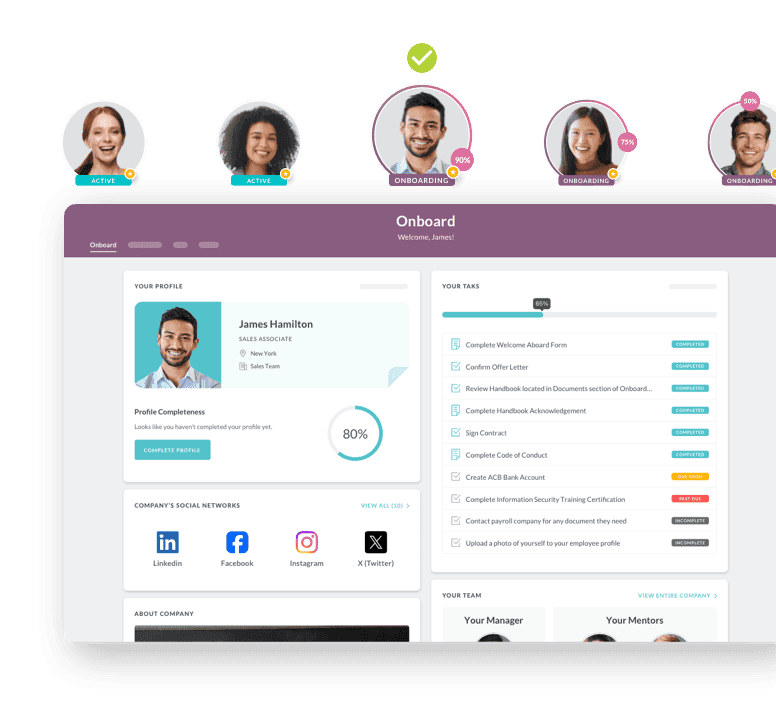
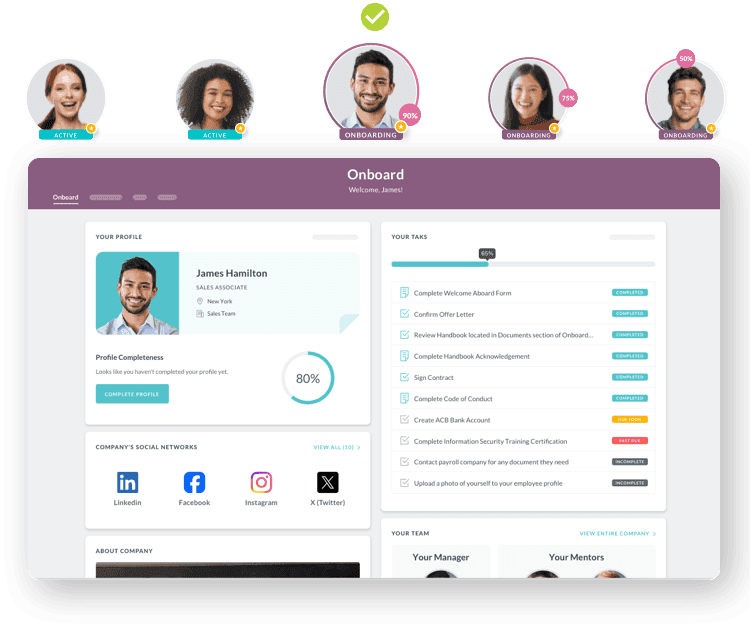
For a startup hiring quickly, onboarding speed and paperwork accuracy directly affect how fast a new employee becomes productive. HR Cloud's Onboard module is a customized, mobile-friendly portal that walks new hires through messaging, videos, documents, and pre-built I-9 and W-4 forms, with E-Verify integration and automated task workflows built in from the entry-level Essential HR tier. Rippling automates onboarding across systems simultaneously, a new hire's record can trigger contract signing, background checks, and account provisioning in the same motion, and it's genuinely fast once configured. The trade-off: several G2 reviewers describe Rippling's initial backend setup as dense, since it's touching HR, IT, and finance at once, which can be more configuration than a startup without a dedicated ops or IT hire needs. HR Cloud is purpose-built for HR-only onboarding out of the box; Rippling's onboarding automation is powerful specifically because it reaches into IT and finance systems a smaller startup may not yet have.
Core HRIS
Both platforms include a centralized employee record system as a baseline. HR Cloud's People HRIS centralizes employee data, document management with e-signature, org charts, and custom fields in every package tier, with no separate module fee. Rippling's Core platform likewise includes basic HR management, employee onboarding, org charts, and document storage at its $8/employee/month floor, but among Rippling's G2 reviews, a steep learning curve tied to the sheer number of available features is one of the more common complaints, since the HRIS sits inside a much larger HR/IT/finance system rather than functioning as a standalone module (alongside plenty of reviews praising the interface as intuitive once learned). For a startup team without a dedicated systems administrator, that added surface area is a real onboarding cost, not just a pricing one.
Payroll
This is the most structurally different area between the two platforms. Rippling bundles native payroll as a core product, with automated tax filing and payroll integrated directly into the same employee record as HR and IT: a genuine advantage if a startup wants one vendor for everything. HR Cloud does not offer native payroll; instead, it integrates with a company's existing payroll provider (ADP, UKG, Paylocity, and others), so switching to HR Cloud does not require also switching payroll providers. For startups that already have payroll sorted through a provider they're happy with, this avoids forced migration. For startups that want payroll and HR unified under one login from day one, Rippling's native approach is the more direct fit, at the cost of adding another per-employee module fee on top of the Core HR rate.
Time Off & Time Tracking
HR Cloud includes time-off management and time tracking in every package tier starting at Essential HR, with no add-on required. Rippling handles time and attendance as part of its broader HR product, and reviewers specifically praise how tightly it syncs with payroll: hours, PTO, and overtime flow through automatically once configured, eliminating manual CSV exports some teams dealt with on older systems. Both platforms perform well here; the difference is largely pricing structure rather than functionality, HR Cloud bundles it at no extra cost across all tiers, while it's one of several modules contributing to Rippling's total per-employee spend.
Applicant Tracking (ATS)
HR Cloud's Recruit ATS is included starting at the Professional HR tier ($595/month for up to 50 employees), covering job postings, candidate pipelines, and interview scheduling as part of the same monthly package, with no separate purchase needed once you're on Professional or Culture HR. Rippling offers recruiting as an add-on module priced separately from Core HR. For an early-stage startup that's hiring aggressively but doesn't want a standalone recruiting tool bill on top of its HRIS bill, HR Cloud's bundled approach is the more budget-predictable path.
Performance Management
HR Cloud's Perform module (reviews, self-evaluations, 360° feedback, and goal tracking) comes included in Professional HR and Culture HR, and can be added to Essential HR as a paid add-on for teams not yet ready to upgrade tiers. Rippling offers performance management as one of its many available modules, with reviewers noting the review templates are less flexible for companies that need different evaluation criteria across role types (client-facing versus support, for example). For a startup setting up its first formal review cycle, HR Cloud's bundling into a mid-tier package tends to be the simpler budget line to justify internally.
Employee Engagement & Culture
This is where HR Cloud diverges most from Rippling's positioning. HR Cloud's Workmates, included in the Culture HR tier, adds a custom-branded mobile app, personalized onboarding journeys by role and location, company announcements, eNPS and pulse surveys, secure chat, and digital signage. Rippling is not built around culture and engagement as a core focus; its strength is operational automation across HR, IT, and finance, not employee-facing community features. For an early-stage startup where founders care deeply about culture staying intact through fast headcount growth, HR Cloud's engagement layer is a genuinely different product category than anything in Rippling's stack.


IT & Device Management
This is Rippling's signature differentiator, and HR Cloud does not compete here at all. Rippling can provision software accounts, manage devices, and handle app access as part of the same automated workflow that runs HR and payroll. That's genuinely valuable for a startup that's also standing up its IT function for the first time and wants one system managing both people and hardware. If IT/device management is a real, current need rather than a someday need, Rippling's unified approach has no HR Cloud equivalent, and that alone may be reason enough to choose it.
Mobile Experience
For a startup with hybrid, remote, or field-based employees, mobile access to HR tasks isn't a nice-to-have; it's often how the majority of employees interact with the system day to day. HR Cloud includes mobile access across every package tier, and the Culture HR tier specifically adds a custom-branded mobile app that can be published under the company's own name in the App Store and Google Play, so employees experience it as an internal company tool rather than a generic third-party HR app. Rippling's mobile app covers the core employee self-service functions (payslips, PTO requests, time clock, org chart), and multiple G2 reviewers describe it as clean and reliable for those tasks, though a few note the mobile app is more limited than the desktop version for functions like adding timesheet comments, which occasionally pushes users back to a browser. For a startup where founders want the HR platform to feel like part of the company's own brand and daily rhythm rather than an outside tool employees log into once a month, HR Cloud's white-labeled mobile option is a meaningfully different offering than Rippling's functional-but-generic app.
Reporting & Scalability Past Startup Stage
Both platforms are built to scale, but they scale in different directions. Rippling's reporting tools are detailed and highly customizable. Several reviewers note real value in building dashboards that track completion rates, cost per hire, or workforce trends across HR, IT, and finance simultaneously, though the same reviewers describe a learning curve to build those custom reports from scratch. HR Cloud includes built-in reports and insights across every tier without requiring custom report-building, and its pricing bands are explicitly structured to carry a company from 1 employee through 250 without forcing an early jump into an enterprise contract, a detail HR Cloud calls out directly in its own pricing FAQ. The practical difference for a startup: if the plan is to keep the org chart flat and add IT complexity gradually, HR Cloud's banded pricing avoids a jarring cost cliff as headcount grows past the earliest tiers. If the plan involves standing up a full internal IT function alongside HR growth, Rippling's reporting depth across systems becomes more valuable the more those systems multiply.
Compliance & Security
HR Cloud is SOC 2 Type II certified and GDPR compliant across its platform, with I-9 verification and E-Verify integration included from the entry tier. Rippling likewise offers SOC 2 compliance and automated tax filing as part of its payroll and HR modules. Both platforms meet baseline compliance expectations for a growing startup; neither has a meaningful edge here for a company at the 1–250 employee stage, and startups evaluating either should confirm current certification status directly with each vendor's security documentation before finalizing a decision, since compliance posture can change between audits.
Support Model
HR Cloud provides live chat, email, and ticket support Monday–Friday, 5:00 AM–5:00 PM PST, with chat response times under 30 seconds and email/ticket responses within an hour on average, plus unlimited Account Manager support that continues after go-live, not just during implementation. Rippling's support draws mixed reviews: several G2 reviewers highlight fast, responsive account teams and an AI chat assistant that resolves routine questions instantly, while others describe slower response times on complex or payroll-critical issues, and note that regular employees can't open support tickets directly without routing through a company admin first. For a startup without a dedicated HR or IT staffer to serve as that admin gatekeeper, HR Cloud's more direct support access model may reduce day-to-day friction.
Getting Started: Implementation & Migration
HR Cloud's implementation process covers data migration, workflow setup, and integration configuration handled by an assigned Account Manager, and is included at no cost if a company prepays 90 days upfront; without prepayment, a flat $500 implementation fee applies regardless of company size. HR Cloud's own pricing FAQ references a 2–4 week timeline from kickoff to go-live for small-business customers.
Rippling's implementation is typically handled through a dedicated onboarding contact, and reviewers describe the process as detailed and well-supported, but multiple independent pricing guides report implementation fees ranging from roughly $1,000 up to $20,000 or more, scaled to company size and the number of modules being configured, a cost HR Cloud's flat-fee (or free-with-prepay) model avoids entirely. If a startup is migrating away from an existing HRIS or payroll system, both vendors assign implementation support, the material difference is what that support costs upfront and how predictable that cost is going in.
Proof: Reviews & Reputation
Both platforms carry strong review profiles, but from very different bases. HR Cloud holds a 4.7 out of 5 rating on G2 across 179 verified reviews, with 80% of reviewers giving it a full 5 stars and reviewers most often citing ease of use and configurability as strengths. Rippling holds a 4.8 out of 5 rating on G2 across 13,101 verified reviews, with an industry-leading Net Promoter Score, and was named a Leader in G2's Spring 2026 Core HR Grid report. Rippling's larger review volume reflects its larger overall customer base and broader product surface (HR, IT, payroll, spend, and more each generate separate reviews); HR Cloud's smaller, more concentrated review base skews toward companies closer to its actual target size band. Neither platform has a meaningful reputation disadvantage; the more useful signal for a startup is reading reviews specifically from companies your own size, since a five-star review from a 2,000-person enterprise using Rippling's IT stack says little about fit for a 40-person startup's core HR needs.
Who Should Choose HR Cloud
HR Cloud fits best for growing startups (roughly 50 to 500 employees, post-seed through Series B) that need a predictable, all-in-one HR system for onboarding, HRIS, time off, and increasingly performance and engagement, without paying for IT device management or native payroll they don't need yet.
- You want published pricing you can budget against without a sales call
- You already have a payroll provider you're happy with and don't want to switch it
- Culture and engagement matter as much as core HR administration
- You don't have (or don't yet need) a dedicated IT function to manage alongside HR
- You want a flat implementation cost, or none at all with prepayment
If that's your situation, HR Cloud is very likely the better-value HRIS for where your startup is today. Book a free HR Cloud demo to see current small-business pricing for your exact headcount.
Who Should Choose Rippling
Rippling fits best for venture-funded, tech-forward startups that specifically need HR, IT, and finance unified in one system. It is particularly strong for companies standing up an IT function for the first time and hiring across many software tools and devices simultaneously.
- You need device management and software provisioning alongside HR, not just HR alone
- You want native payroll under the same login as HR, even at a higher combined cost
- You're comfortable with quote-based, modular pricing and negotiating module-by-module
- You have (or plan to hire) someone technical enough to manage the platform's configuration depth
- Budget flexibility matters less than having every function under one vendor
If IT and finance unification is a genuine current need rather than a future one, Rippling's breadth is difficult for a pure-HR platform to match.
Real-World Results: What Switching to HR Cloud Looks Like
Companies that have moved onto HR Cloud from manual or fragmented HR processes report measurable results within months of go-live, not years, and one of HR Cloud's most detailed published case studies happens to be almost exactly startup-sized. Behavioral Progression, a 50-employee behavioral health company in Tampa, FL, was running onboarding entirely through Word documents and Google Drive uploads before switching to HR Cloud. After implementation, the company reported a 60% reduction in procedural questions from new hires, cut average new-therapist onboarding time from 4 weeks down to 2.5 weeks, and saw its administrative team complete the onboarding process 3 times faster thanks to automated task prompts. Beyond onboarding, Behavioral Progression also reported a 20% increase in employee engagement and a 65% participation rate after adding Workmates, along with a 10% improvement in therapist retention six months out, a meaningful number for any startup where early turnover is expensive to absorb.
Osmose Utilities Services, a field-based organization, faced a different problem before switching: onboarding new hires outside a central office took up to two hours each and frequently produced data entry errors, raising compliance concerns around I-9 and E-Verify deadlines. HR Cloud's Onboard solution automated that field-based process end to end; HR Analyst Kaylee Collins described the resulting system as reliable and easy for hiring managers to navigate, with meaningful time and effort saved and improved data accuracy feeding directly into better compliance outcomes. These aren't enterprise-scale deployments; they're the kind of measurable, fast-turnaround wins a growing startup team can expect from a platform built for the 1–250 employee range, not results borrowed from a much larger enterprise rollout.
“ Our hiring managers now have a reliable system that is easy to navigate. Our HR team can actively monitor the process, and assist if needed, but Onboard has helped them save so much valuable time and effort while increasing data accuracy.”

— Kaylee Collins, HR Analyst, Osmose

A separate HR Cloud customer, Medlinks Cost Containment, moved off a fully paper-based recruiting and onboarding process (one that gave the team no visibility into how many applicants sat in each stage of their pipeline) onto HR Cloud's Onboard and Recruit ATS. Auditing and Operations Administrator Shirley Garcia described the shift as giving her team an intuitive, mobile-friendly workflow with clear ownership at every step, plus the applicant-pipeline visibility her clients specifically ask for. None of these are billion-dollar, thousand-employee rollouts; they're the scale of result a 50-to-250-person startup team can realistically expect and measure within a single quarter of switching.
For a startup evaluating Rippling specifically because Rippling markets heavily to the startup and scale-up segment, the honest comparison point is this: Rippling's own case studies and reviews skew toward companies that need the full HR + IT + finance stack, while HR Cloud's results cluster around companies whose primary pain point was onboarding speed, data accuracy, and HR administrative load: the exact problems most startups are actually trying to solve before they need a unified IT layer.
How to Switch from Rippling to HR Cloud
If Rippling's cost or complexity has outgrown what your startup actually needs, moving to HR Cloud follows a defined path rather than a blind migration.
- Book a demo and get exact pricing for your headcount. HR Cloud's small-business pricing page shows published rates by employee band, so you'll know the real number before any sales conversation, not after.
- Export your employee data from Rippling. Core employee records, org structure, and historical time-off data are the priorities; HR Cloud's implementation team handles the import and validation.
- Keep your existing payroll provider in place. Since HR Cloud doesn't require bundled payroll, you don't need to migrate payroll and HR simultaneously, reducing the risk of a payroll disruption during the switch.
- Confirm your 90-day prepay window if you want implementation done at no cost; otherwise budget the flat $500 implementation fee.
- Go live on a 2–4 week timeline with your assigned Account Manager, based on HR Cloud's published small-business implementation timeframe.
- Cancel Rippling per your contract terms. Confirm your renewal date, notice period, and cancellation terms directly in your Rippling order form before scheduling the cutover, so nothing auto-renews unexpectedly mid-transition.
Final Verdict
For most startups in the 50–500 employee range, HR Cloud is the stronger Rippling alternative, not because Rippling is a weak product, but because Rippling is solving a broader problem (unified HR, IT, and finance) than most startups actually have at this stage. HR Cloud's published, flat-tier pricing starting at $295/month gives founders and early people-ops hires a number they can budget against immediately, without a sales call, and its feature set (onboarding, HRIS, time off, performance management, and employee engagement) maps directly onto what a growing startup needs to professionalize its HR function. Rippling remains the better choice specifically for startups that need device management and IT provisioning unified with HR from day one; for everyone else, that breadth is paying for capability that isn't yet being used.
The clearest way to know which side of that line your startup falls on: if your next hire after this HR decision is someone in IT, lean Rippling. If your next hire is in people ops, marketing, or engineering, HR Cloud is very likely the better-value platform for where you are right now. See current HR Cloud pricing for your team size to compare directly against your Rippling quote.

Discover how our HR solutions streamline onboarding, boost employee engagement, and simplify HR management
Book Your Free DemoFrequently Asked Questions
Is HR Cloud a good alternative to Rippling for startups?
Yes, for startups roughly 50–500 employees that need core HR, onboarding, time tracking, and increasingly performance and engagement, without IT device management or native payroll. HR Cloud's published pricing starts at $295/month for up to 50 employees, compared to Rippling's $8/employee/month-plus-fees starting rate for Core HR alone.
How much does Rippling actually cost compared to what it advertises?
Rippling advertises $8 per employee per month plus a roughly $35 monthly base platform fee for Core HR only. Real-world total costs run much higher once payroll and other modules are added: an analysis of 280 verified Rippling purchases found a median annual contract value of $45,862, with implementation fees adding $1,000 to $20,000 or more depending on company size.
Does HR Cloud include payroll like Rippling does?
No. HR Cloud does not bundle native payroll; it integrates with your existing payroll provider instead, so you keep your current payroll setup while switching your HR, onboarding, and engagement tools. Rippling bundles native payroll as a separately priced module within its platform.
What size company is HR Cloud actually built for?
HR Cloud's published small-business pricing explicitly covers 1–250 employees across three tiers (1–50, 51–100, 101–250), with a custom enterprise quote available past 250. That range covers most startups from early growth through Series B and beyond.
Is Rippling worth it for a very small, early-stage startup?
It can be powerful, but several small-business reviewers on G2 specifically flag cost as a drawback for small or bootstrapped teams, since the modular pricing model adds up quickly even before IT or finance modules are added. Startups without a near-term need for IT device management often find the added cost isn't matched by added value at that stage.
How long does it take to switch from Rippling to HR Cloud?
Based on HR Cloud's own published pricing FAQ, most small-business customers go live within 2–4 weeks of starting implementation, handled by an assigned Account Manager.
Does switching from Rippling to HR Cloud require switching payroll providers too?
No. Because HR Cloud integrates with existing payroll providers rather than requiring its own, you can move your HR, onboarding, and engagement functions to HR Cloud while keeping your current payroll provider unchanged.
Which platform has better customer support for a small team?
HR Cloud provides direct live chat, email, and ticket access plus an unlimited Account Manager for every customer. Rippling's support is generally well-reviewed but several users note that non-admin employees must route support requests through a company admin rather than contacting support directly, a structure that adds friction for startups without a dedicated HR or IT staffer.
Can HR Cloud replace Rippling if my startup only needs core HR, not IT?
For most startups, yes. HR Cloud covers the functions that make up the bulk of a typical Rippling bill at the startup stage (HRIS, onboarding, time off, applicant tracking, and performance management) without the IT device management and finance modules that push Rippling's total cost up. The one function HR Cloud does not replace is native payroll, which it instead connects to through integration with your existing provider rather than replacing it outright.
Does HR Cloud charge per employee like Rippling does?
No. HR Cloud uses flat, package-based pricing organized by employee band (1–50, 51–100, 101–250) rather than a per-seat fee that increases with every hire. A 40-person team and a 49-person team pay the same monthly rate on HR Cloud; on Rippling's per-employee-per-month model, every new hire adds directly to the bill across every active module.
About the author

Keep Reading


Like What You Hear?
We’d love to chat with you more about how HR Cloud® can support your business’s HR needs.
Book Your Free Demo