HR Cloud vs Gusto: Best Choice for Payroll + HR

Quick take:
Gusto is the stronger choice if payroll is your top priority. It's a full-service payroll platform with tax filing built in. HR Cloud is the stronger choice if onboarding, HR record-keeping, and employee engagement are what you're missing, and it's built to run alongside whatever payroll provider you already use rather than replace it.
These two products solve different problems, which is exactly why "Gusto alternative" searches so often lead people to the wrong comparison. Gusto is a payroll platform for small businesses (starting at $49/month + $6/employee) that added HR features, like onboarding checklists, benefits, and basic performance reviews, around that payroll core. HR Cloud is an HR and employee-experience platform (starting at $295/month, flat, not per employee) built around onboarding, HRIS, recruiting, and engagement, and it explicitly does not process payroll. It integrates with ADP, Paylocity, QuickBooks Online, UKG, Paycor, and SAP SuccessFactors instead (see the Payroll section below for the sourced link). If your team already has payroll sorted and needs deeper onboarding, compliance workflows, and engagement tools, HR Cloud is the better fit. If you need payroll running this week and want light HR bundled in, Gusto is the better fit.
HR Cloud vs Gusto: At a Glance
The comparison below reflects publicly listed pricing and features as of August 2026, verified directly from each vendor's site and live review platforms.
| Feature | HR Cloud | Gusto |
|---|---|---|
| Core product | Onboarding, HRIS, engagement platform | Full-service payroll platform with HR add-ons |
| Native payroll | No, integrates with ADP, Paylocity, UKG, QuickBooks Online, Paycor, SAP SuccessFactors | Yes: single-state (Simple) or multi-state (Plus/Premium), full tax filing |
| Starting price | $295/month flat (up to 50 employees), package-based | $49/month + $6/employee/month (Simple plan) |
| Pricing model | Fixed monthly license by employee band, not per-seat | Base fee plus per-employee fee, rises with headcount |
| Free trial | No. Personalized demo and custom quote instead | No, but month-to-month, cancel anytime |
| Onboarding | Dedicated product: workflows, I-9/E-Verify, branded portals, ADP Platinum-certified integration | Self-onboarding checklists, e-signature for W-4/I-9, offer letters |
| Applicant tracking (ATS) | Recruit ATS included in Professional/Culture HR: branded job boards, custom hiring stages, interview scheduling | Built-in, in-app ATS bundled with hiring flow; lighter than dedicated third-party ATS tools |
| Performance management | Included in Professional HR ($595/mo) and Culture HR ($895/mo); add-on on Essential | Add-on: $3/month per person (Simple plan) |
| Employee engagement | Culture HR tier: branded mobile app, pulse surveys, recognition, digital signage | Not a core focus. No dedicated engagement/recognition module |
| Support hours | Mon–Fri, 5 AM–5 PM PST, live chat/email/ticket, unlimited Account Manager | Basic Support included; Priority Support and dedicated advisor are paid add-ons on lower tiers |
| G2 rating | 4.6/5 (180 reviews) | 4.6/5 (12,310 reviews) |
| Capterra rating | 4.7/5 (84 reviews) | 4.6/5 (4,218 reviews) |
| Best for | 50–250 employees that already have payroll and need onboarding, HRIS, and engagement depth | 1–150 employees that need payroll running fast with light HR bundled in |
Full sourcing for every figure in this table is in the Link Audit at the bottom of this doc; see the relevant section below for the live citation on each specific claim.
What Is HR Cloud?
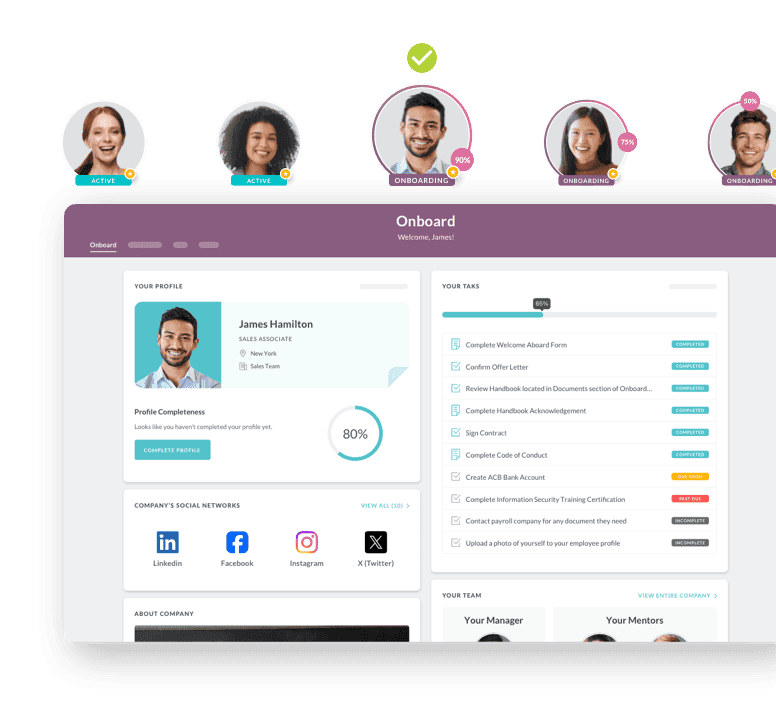
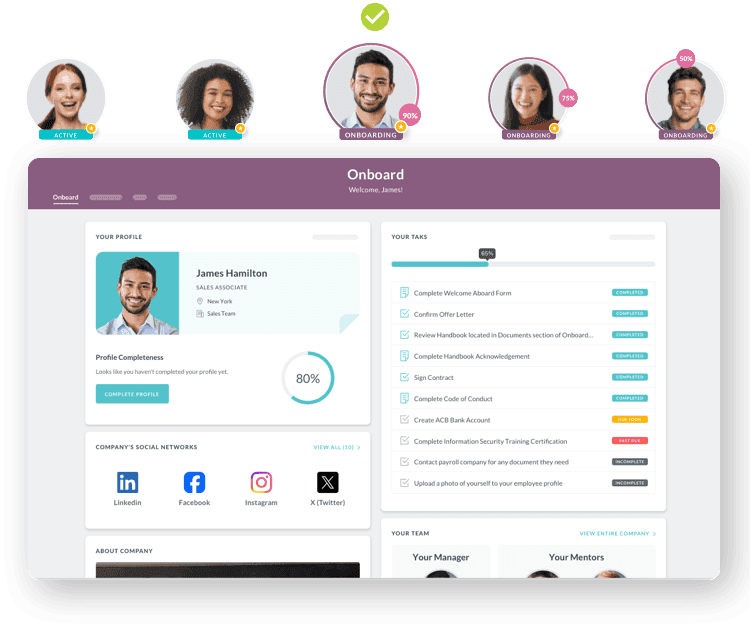
HR Cloud is an HR and employee-experience platform built around three connected products: Onboard (new-hire onboarding and offboarding), People (HRIS: employee records, time off, time clock), and Workmates (engagement: recognition, surveys, internal communications), with Recruit ATS and Perform (performance management) layered on top. It's priced in three package tiers, Essential HR, Professional HR, and Culture HR, that scale by employee band from 1 to 250 employees, with custom enterprise pricing above that.
HR Cloud's differentiator is depth on the onboarding and engagement side of HR, not payroll. The platform explicitly runs independently of payroll and connects to whatever provider a company already uses (ADP, UKG, Paylocity, QuickBooks Online, Paycor, or SAP SuccessFactors) rather than trying to replace it. That makes it a fit for companies that have payroll solved and are looking for the HR layer around it: structured onboarding, a real employee directory and org chart, compliance tracking (I-9, E-Verify), and a branded engagement app for frontline or distributed teams.
- Onboarding is the primary product, not a bolt-on to payroll
- Runs independently of any specific payroll provider, so no rip-and-replace required
- Culture HR tier adds a branded mobile engagement app, pulse surveys, and recognition tools
- ADP Platinum Marketplace Partner, with certified integrations to ADP Workforce Now, TotalSource, RUN, Vantage, and Lifion
What Is Gusto?
Gusto is a cloud-based, full-service payroll platform for small and mid-sized U.S. businesses, with HR and benefits tools built around that payroll core. It handles federal, state, and local tax filing automatically, supports unlimited payroll runs on every plan, and layers on benefits administration, time tracking, and basic HR, including onboarding checklists, an in-app applicant-tracking system, and performance reviews as an add-on on the entry-level plan.
Gusto's differentiator is that payroll is the product, not an integration. A business can sign up, add employees, and run its first payroll the same week, with tax forms (W-2, 1099, 940, 941) filed automatically. HR features exist to support that payroll core: onboarding gets new hires into the pay system quickly, and HR add-ons (certified HR experts, compliance alerts) become more robust at the Premium tier. On company fit, a G2 reviewer working in marketing research pegged Gusto's practical sweet spot at roughly 5 to 100 employees, calling it "a poor fit for businesses above 100-150 employees" given its Monday-through-Friday support hours and limited support for international full-time staff. That reviewer's assessment is the source for the company-size guidance referenced later in this piece; see the Link Audit for the full citation.
- Full-service payroll is the core product, not an add-on to something else
- Unlimited payroll runs, automatic tax filing, and next-day pay included on Plus and above (paid add-on on Simple)
- Onboarding, hiring, and performance tools exist to support the payroll relationship
- No long-term contract. Month-to-month, cancel anytime
HR Cloud vs Gusto: Pricing Breakdown
Gusto's pricing is per-employee, so the bill rises with headcount. Simple starts at $49/month + $6/employee/month and covers single-state payroll only. Hire someone in a second state and Gusto requires an upgrade to Plus ($80/month + $12/employee/month), which adds multi-state payroll, time tracking, and next-day pay. Premium ($180/month + $22/employee/month) adds a dedicated Service Advisor, certified HR expert access, and performance/compensation tools. A 10-person team on Simple runs about $109/month; the same team on Premium runs about $400/month. Gusto also has a Contractor Only plan ($35/month + $6/contractor) for businesses with no W-2 employees.
HR Cloud's pricing is a flat monthly license by employee band, not a per-seat fee, so headcount growth within a band doesn't move the price. Essential HR starts at $295/month for up to 50 employees and includes the Onboard Suite, time off and time-clock tracking, and basic HRIS. Professional HR ($595/month, 1–50 employees) adds Recruit ATS, Perform (performance management), Assets Management, and recognition. Culture HR ($895/month, 1–50 employees) adds Workmates, the branded engagement app, pulse surveys, and digital signage. Prices step up by employee band: Professional HR runs $995/month at 51–100 employees and $1,495/month at 101–250 employees. Implementation is included free with a 90-day prepayment; otherwise a one-time $500 fee applies. (Both vendors' full pricing pages are linked above, in Simple and Essential HR; every dollar figure below traces back to those two pages.)
The real pricing story is what each fee buys. Gusto's per-employee model is cheaper at very low headcounts if payroll is the only thing you need; a 10-person team on Simple pays roughly $1,308/year. HR Cloud's flat-license model gets cheaper per employee as a team grows within a band, and it never charges for payroll processing because it doesn't do payroll. You're paying for onboarding depth, HRIS, and (at Culture HR) engagement instead. A 50-person company comparing Gusto Premium (~$1,280/month) against HR Cloud Culture HR ($895/month) is comparing a payroll-inclusive platform to an HR-and-engagement platform that assumes payroll is handled elsewhere, not a like-for-like swap.
Hidden costs to watch for on each side: Gusto's add-ons, Priority Support ($30/month + $3/employee), HR Resources ($50/month + $5/employee), and Performance ($3/employee), stack on top of the base plan and can push a small team's effective cost well above the sticker price. On HR Cloud's side, custom integrations beyond the standard set (ADP, UKG, Paylocity, QuickBooks Online) carry an added fee scoped to complexity, and the free implementation only applies with 90 days prepaid.
HR Cloud vs Gusto: Feature-by-Feature Breakdown
Payroll
Gusto runs payroll natively: unlimited monthly runs, automatic federal/state/local tax calculation and filing, and direct deposit, with next-day pay included on Plus and above (a paid add-on on Simple) and same-day pay available on all plans for a per-payroll fee. This is Gusto's core competency and the reason most buyers land on it in the first place. HR Cloud does not process payroll at all; it integrates with ADP, Paylocity, QuickBooks Online, UKG, Paycor, and SAP SuccessFactors so that employee, time-off, and time-clock data syncs to whichever payroll system a company already runs. Teams that need payroll running this week should start with Gusto or keep their existing provider connected to HR Cloud, not expect HR Cloud to replace it.
Onboarding
Onboarding is HR Cloud's founding product: automated workflows, role-based checklists, I-9 and E-Verify compliance built in, branded new-hire portals, and ADP Platinum Marketplace-certified payroll sync, all designed to get a new hire ready before day one across distributed or frontline teams. Gusto's onboarding is a self-service checklist tied to payroll setup: new hires enter basic info, e-sign W-4s and I-9s, and (on higher tiers) sign custom documents like offer letters and handbooks. It's fast and simple for a small, single-location team, but it's built to get someone into the pay system, not to run a multi-step, compliance-heavy onboarding program across departments or locations.
HRIS and Employee Records
HR Cloud's People HRIS is a dedicated system of record: employee profiles, org charts, document storage with version tracking, custom fields, and role-based access controls, included starting at the Essential HR tier ($295/month). Gusto keeps an employee directory and basic org chart as part of its "one system of record" pitch, but it's built around what payroll needs (pay rate, tax status, banking info) rather than the broader HR data (performance history, custom compliance fields, department hierarchies) a dedicated HRIS tracks. The independent review cited above lists "fewer performance management features than other human resources solutions" among Gusto's limitations once a business wants deeper HR functionality alongside payroll.
Recruiting and Applicant Tracking
Both platforms include applicant tracking. Gusto's is built into the hiring flow: public job posts, an in-app ATS, and a direct sync into payroll once someone is hired, and the same independent review confirms this saves businesses from buying a separate ATS, though it's not as extensive as many third-party ATS options. HR Cloud's Recruit ATS (included in Professional HR and above) adds branded job boards, AI-generated job descriptions, custom hiring stages per role, built-in interview scheduling with Teams/Zoom links, and a direct handoff into the Onboard module, where a candidate record becomes an employee onboarding workflow automatically at the point of hire. For simple single-location hiring, Gusto's built-in ATS is enough. For multi-location or high-volume hiring with a formal stage-by-stage process, HR Cloud's Recruit is the deeper tool.
Performance Management
HR Cloud includes Perform, with reviews, self-evaluations, custom questions, 360° feedback, and goal tracking, in Professional HR ($595/month) and Culture HR ($895/month), and it's available as a paid add-on on Essential HR. Gusto offers performance reviews, real-time feedback, and goal tracking as a $3/month-per-person add-on, available on the Simple plan (included on Plus and Premium). The independent review cited above lists this as one of Gusto's main limitations, explicitly recommending against Gusto for businesses looking for extensive performance management features. If structured review cycles matter to your HR strategy, that's a meaningful gap to weigh.


Employee Engagement
This is where the two platforms diverge most. HR Cloud's Culture HR tier includes Workmates: a custom-branded mobile app, personalized onboarding journeys by role and location, eNPS and pulse surveys, secure internal chat, recognition and kudos, and digital signage, built specifically for connecting deskless, frontline, and distributed teams. Gusto's own product line has no comparable engagement or recognition module; its "people" focus is largely payroll- and benefits-adjacent (Gusto Wallet, financial wellness tools) rather than culture and communication. Companies where frontline engagement is a stated priority, like healthcare, manufacturing, construction, and retail, will find HR Cloud's engagement layer purpose-built for that use case in a way Gusto's product line doesn't attempt to match.
Time Off and Time Tracking
Both platforms track PTO and hours. HR Cloud includes Time Off and Time Clock as core modules across every package, with calendar integrations and automatic notifications. Gusto includes basic PTO policies and holiday pay on the Simple plan, with full time tracking (project tracking, scheduling, time kiosk) unlocked at the Plus tier ($80/month + $12/employee) as part of its "Time & Attendance" feature set. For a single-location team already on Gusto for payroll, its native time tools are convenient. For a multi-location or shift-based workforce, HR Cloud's time tracking is bundled into the same platform as onboarding, HRIS, and engagement rather than gated behind a payroll-tier upgrade.
Compliance
HR Cloud's compliance tooling centers on the onboarding process: built-in I-9 and E-Verify workflows, digital signature and storage for compliance-related documents, and SOC 2 Type II certification with GDPR compliance. Gusto's compliance strength is on the payroll and tax side: automatic federal, state, and local tax filing, compliance alerts, and (at Premium) access to certified HR experts. Neither platform's compliance coverage substitutes for the other. HR Cloud doesn't file payroll taxes, and Gusto's onboarding compliance tools don't extend into role-based, industry-specific document workflows the way HR Cloud's do.
Benefits Administration
Gusto's benefits administration is deep for a payroll-first platform: licensed brokers to build a medical/dental/vision package, pay-as-you-go workers' comp, HSAs and FSAs ($2.50–$4/month per participant), commuter benefits, and 401(k) plans that sync automatically with payroll deductions, all managed inside the same login used to run pay. HR Cloud doesn't administer benefits directly; benefits enrollment and deduction data flow through whichever payroll or benefits-broker system a company already has connected. For a team that wants one platform to shop, enroll, and deduct benefits without a separate broker relationship, Gusto's integrated approach is the more turnkey option. For a team that already has benefits and a broker in place, this isn't a gap HR Cloud needs to fill.
Mobile Access and Employee Self-Service
Both platforms give employees self-service access to their own information, but for different purposes. Gusto's mobile experience centers on pay: employees check pay stubs, tax forms, benefits elections, and PTO balances from a phone or the Gusto Wallet app. HR Cloud's mobile app is broader by design. At the Culture HR tier it's a custom-branded company app where employees complete onboarding tasks, browse an employee directory and org chart, receive company announcements, respond to pulse surveys, and give peer recognition, in addition to standard self-service functions like time-off requests. For a desk-based team that mainly needs pay-stub access, Gusto's mobile app covers it. For a frontline or deskless workforce that needs a single app for onboarding, communication, and culture, not just pay, HR Cloud's branded app is built for that job in a way Gusto's isn't.
Implementation and Support
HR Cloud's implementation includes setup, configuration, data import, and training handled by an in-house team, typically live within 2–4 weeks; it's free with 90 days prepaid, or a one-time $500 fee otherwise. Support runs Monday–Friday, 5 AM–5 PM PST via live chat (under 30 seconds, per internal averages), email, and ticket, plus an unlimited Account Manager who continues past go-live for configuration and adoption help. (Both details are on HR Cloud's pricing page, linked earlier in the Pricing Breakdown section.) Gusto is self-serve to start; most small businesses can add employees and run their first payroll within days, with Basic Support included on every plan. Priority Support and a dedicated Service Advisor are included only at the Premium tier ($180/month + $22/employee); on Simple and Plus, they're paid add-ons ($30/month + $3/employee, or bundled at $8/employee/month on Plus).
Proof: What Reviewers Say
On review platforms where buyers evaluate day-to-day product experience, both platforms score well: HR Cloud holds 4.6/5 on G2 (180 reviews) and 4.7/5 on Capterra (84 reviews); Gusto holds 4.6/5 on G2 (12,310 reviews) and 4.6/5 on Capterra (4,218 reviews). Gusto's reviews skew heavily toward payroll ease-of-use and tax-filing reliability; reviewers consistently cite fast setup and a clean interface for running pay. HR Cloud's reviews cluster around onboarding automation and implementation support; one Gartner Peer Insights reviewer specifically credited HR Cloud's team for customizations "other competitors would not do for us."
- HR Cloud customer Osmose Utilities Services, Inc., a field-services company whose onboarding had taken up to two hours per new hire, improved data accuracy by 24% within three months of implementing Onboard by HR Cloud, saving its HR team roughly seven hours a week, according to HR Cloud's published case study.
- HR Cloud customer Behavioral Progression, Inc., a behavioral health company that previously onboarded new therapists through unstructured Word documents and Google Drive uploads, cut new-therapist onboarding time from four weeks to two and a half weeks and saw a 60% drop in onboarding-related questions from new hires, according to HR Cloud's published case study.
- On the Gusto side, a Capterra reviewer described the automated payroll and self-service onboarding as effortless, but noted "it can feel somewhat limited for more complex HR needs" once a business grows past day-to-day payroll management.
“ Our hiring managers now have a reliable system that is easy to navigate. Our HR team can actively monitor the process, and assist if needed, but Onboard has helped them save so much valuable time and effort while increasing data accuracy.”

— Kaylee Collins, HR Analyst, Osmose

Who Should Choose Gusto?
Gusto is the right choice for a small business, typically under 50 employees, often under 20, that needs payroll running quickly, doesn't yet have a payroll provider in place, and wants basic HR (onboarding checklists, benefits enrollment, light performance tracking) bundled into the same monthly bill. It's especially strong for single-location teams, S-corp owners paying themselves, and businesses whose HR needs are simple enough that per-employee pricing stays manageable as they grow slowly.
- Businesses with no payroll system yet in place, or ones actively switching providers
- Single-state, single-location teams under roughly 50 employees
- Owners who want payroll, benefits, and light HR under one login without managing integrations
If payroll is the unsolved problem and HR needs are simple, Gusto is the faster and cheaper starting point.
Who Should Choose HR Cloud?
HR Cloud is the right choice for a company, typically 50 to 250 employees, that already has payroll handled (on ADP, UKG, Paylocity, or another provider) and needs a deeper onboarding, HRIS, and engagement layer than a payroll-first platform provides. It's a particularly strong fit for frontline-heavy industries like healthcare, manufacturing, construction, and retail, where compliance-heavy onboarding and a branded mobile engagement app for deskless workers matter more than bundling payroll into the same bill.
- Companies with payroll already solved that need dedicated onboarding, HRIS, and recruiting depth
- Frontline, multi-location, or deskless workforces that need a branded engagement app, not just payroll self-service
- Teams that have outgrown Gusto's HR layer specifically (recordkeeping, performance management, or engagement) without wanting to touch their payroll relationship
If payroll is already solved and the gap is onboarding, HRIS depth, or employee engagement, HR Cloud is the stronger fit.
Switching From Gusto to HR Cloud: What to Expect
Adding HR Cloud does not necessarily mean touching your payroll at all. That's the appeal of the integration model, since HR Cloud is built to layer HR and onboarding on top of whatever payroll system you run rather than replace it. The one thing to confirm before you plan around this: a native Gusto connector isn't among HR Cloud's standard listed payroll integrations (ADP, UKG, Paylocity, QuickBooks Online, Paycor, SAP SuccessFactors). If staying on Gusto for payroll is a hard requirement, get that confirmed by an HR Cloud Account Manager before you commit; don't assume it from the general "runs alongside your payroll" positioning. The typical path once that's confirmed:
- Confirm your payroll integration path. For the six providers on HR Cloud's standard list, standard integrations are included in every package. For Gusto or any provider not on that list, get written confirmation of what's possible (native sync, manual export/import, or a custom integration) before you sign.
- Export employee data from Gusto. HR Cloud's implementation team handles bulk data import as part of onboarding setup, so existing employee records, org structure, and documents transfer without manual re-entry.
- Configure onboarding workflows and the HRIS. Your HR Cloud Account Manager builds role-based checklists, I-9/E-Verify workflows, and custom fields during the 2–4 week implementation window.
- Connect the payroll integration. A one-time implementation fee (starting around $750 depending on complexity) applies to some third-party payroll connections; your Account Manager confirms feasibility and cost during setup.
- Go live with training included. Implementation, configuration, and training are bundled into every HR Cloud package, with unlimited Account Manager support continuing after launch.
Because HR Cloud doesn't require replacing payroll for the providers it does connect to, this is generally a lower-risk switch than moving payroll providers: you're adding an HR and onboarding layer on top of what's already working, not migrating tax filings and direct deposit mid-year, provided your specific payroll provider is confirmed compatible first.
The Bottom Line
Gusto and HR Cloud solve different halves of the same problem. If payroll is unsolved and HR needs are simple, Gusto gets a small business running fast at a low per-employee cost. If payroll is already handled and the gap is onboarding depth, HRIS structure, or employee engagement, especially for a growing or frontline-heavy team, HR Cloud is built for exactly that layer, running alongside your existing payroll provider rather than asking you to replace it.
The better question isn't "which one wins." It's whether your unsolved problem is payroll or everything HR does after payroll runs. Book a demo to see how HR Cloud's onboarding, HRIS, and engagement tools fit alongside your existing payroll setup.

Discover how our HR solutions streamline onboarding, boost employee engagement, and simplify HR management
Book Your Free DemoFrequently Asked Questions
Is Gusto good for HR, or just payroll?
Gusto handles payroll very well and includes HR tools, including onboarding checklists, a built-in ATS, benefits administration, and performance reviews as a paid add-on, but the independent review cited earlier still recommends against Gusto for companies wanting extensive performance-management features. Companies with more complex HR needs often find Gusto's HR layer thinner than a dedicated HRIS.
Does HR Cloud offer payroll?
No. HR Cloud does not offer native payroll processing (see the FAQ page linked in the opening section above). It integrates with leading payroll providers, including ADP, Paylocity, QuickBooks Online, UKG, Paycor, and SAP SuccessFactors, so employee and time data syncs automatically while payroll runs through your existing provider.
How much does Gusto cost per employee?
Gusto's Simple plan starts at $49/month plus $6 per employee per month for single-state payroll. Plus is $80/month plus $12/employee (multi-state payroll, time tracking), and Premium is $180/month plus $22/employee (dedicated support, certified HR experts). Full pricing is linked in the Pricing Breakdown section above.
How much does HR Cloud cost?
HR Cloud uses flat, package-based pricing rather than per-employee fees: Essential HR starts at $295/month for up to 50 employees, Professional HR at $595/month, and Culture HR at $895/month. Pricing steps up by employee band (51–100, then 101–250 employees) rather than rising with every new hire. Full pricing is linked in the Pricing Breakdown section above.
Can I use HR Cloud if I already run payroll through Gusto?
HR Cloud is built to run independently of any specific payroll provider and connects via standard integrations to ADP, Paylocity, QuickBooks Online, UKG, Paycor, and SAP SuccessFactors. A direct native Gusto integration isn't among HR Cloud's standard listed connections (see the switching section above for the full list), so confirm current Gusto compatibility with an HR Cloud Account Manager before switching if keeping Gusto payroll is a requirement.
What's the difference between an HRIS and a payroll platform?
A payroll platform like Gusto calculates pay, withholds and files taxes, and manages direct deposit. An HRIS like HR Cloud's People module (linked in the HRIS section above) centralizes employee records, documents, org structure, time off, and compliance tracking across the employee lifecycle. Many companies use both together: payroll handles pay, and the HRIS handles everything else about managing people.
Is Gusto only for small businesses?
Gusto is built primarily for small to mid-sized U.S. businesses. The independent review cited earlier recommends Gusto for businesses with 50 or fewer employees or contractors and explicitly does not recommend it for large organizations or enterprises.
Does Gusto have an applicant tracking system?
Yes. Gusto includes an in-app ATS bundled with its hiring workflow, so new hires sync directly into payroll. The independent review cited earlier confirms this saves businesses from buying a separate ATS, though it's not as extensive as dedicated third-party recruiting tools.
What are the disadvantages of Gusto for growing companies?
The independent review cited earlier lists thinner performance-management features as a specific limitation, and does not recommend Gusto for large organizations or businesses that want extensive performance-management capability. Per-employee pricing also rises with headcount, and add-ons like Priority Support stack additional monthly fees on top of the base plan.
Does HR Cloud work for frontline or deskless workforces?
Yes. HR Cloud's Culture HR tier is built specifically for this use case, with a custom-branded mobile app, role- and location-based onboarding journeys, and engagement tools designed for healthcare, manufacturing, construction, and retail teams that don't sit at a desk (see the industry page linked in the "Who Should Choose HR Cloud" section above).
About the author

Keep Reading


Like What You Hear?
We’d love to chat with you more about how HR Cloud® can support your business’s HR needs.
Book Your Free Demo