What's the Fastest Way to Onboard New Hires in a Healthcare Staffing Organization?

Healthcare staffing onboarding software cuts the time between an offer accepted and a clinician cleared to work by moving paperwork, credential collection, and compliance forms onto a phone instead of a desktop. For healthcare staffing organizations placing nurses and clinicians into shifts every week, fast onboarding in healthcare staffing is not a convenience feature. It is the difference between a filled shift and an empty one.
This capability gets searched for under a few different names: healthcare staffing onboarding software, fast employee onboarding healthcare, or SMS onboarding for nurses. The names differ, but the underlying need is the same, get a candidate from offer acceptance to a cleared first shift without losing them to a slower step along the way.
This guide covers healthcare staffing onboarding specifically: agencies and health systems placing nurses, allied health professionals, and per-diem or travel staff at speed. It doesn't cover physician credentialing or privileging, which run on a separate, slower verification track. For that side of the process, see our guide to healthcare credential tracking. What follows is built around a specific claim worth stating plainly up front: the biggest lever for onboarding speed in healthcare staffing isn't hiring more coordinators or writing shorter forms, it's meeting candidates on the device they already carry instead of the one a legacy process assumes they have.
The metric that actually matters for a staffing operation isn't time-to-hire, the span from application to accepted offer. It's offer-to-cleared-to-work time: the span from accepted offer to the moment a clinician is actually authorized to work the assignment. A candidate can accept an offer the same day it's extended and still take two weeks to clear paperwork, background checks, and facility requirements. That two-week gap is where placements get lost, and it's the gap this guide is actually about closing.
Why Onboarding Speed Is Business-Critical in Healthcare Staffing
Shift coverage and patient care impact
A healthcare staffing firm's product is coverage. A nurse who accepts an assignment but takes two weeks to clear onboarding paperwork is a filled shift that isn't actually filled yet, and every day that gap stays open is a day a unit runs short or a facility pulls in a more expensive last-minute contractor. A vacant RN position can cost an organization between $24,772 and $46,729 in starting costs alone, according to research on healthcare candidate drop-off, before factoring in the cost of covering that shift with overtime or agency staff in the meantime. A rough illustration: if a staffing firm's onboarding process averages two weeks instead of five business days, that's roughly a week and a half of extra exposure per placement, multiplied across every clinician moving through the pipeline at once, where each additional day is a day a facility is either short-staffed or paying a premium to fill the gap another way. Speed here isn't about efficiency for its own sake. It's the mechanism that turns a signed offer into an actual body on the floor.
Candidate drop-off during slow onboarding
Nurses and allied health professionals who work with staffing agencies typically have more than one offer in play at once. A slow onboarding process doesn't just delay a start date, it gives the candidate time to accept a faster-moving offer somewhere else. In a healthcare hiring survey, 27% of job seekers said they want to be contacted within 48 hours of applying, and 44% said they would likely stop responding to an employer entirely if that timeline isn't met, according to candidate ghosting research in healthcare hiring. A separate 2025 healthcare talent survey found that 62% of candidates expect a response within 72 hours, a timeline most systems miss, correlating with a 31% spike in candidate ghosting when it isn't met. Process speed isn't the only reason a candidate goes quiet, but both surveys point the same direction: faster response times track with fewer candidates disappearing mid-process. National RN turnover climbed to 17.6% in 2025, up 1.2 percentage points from the year before, according to the 2026 NSI National Health Care Retention & RN Staffing Report, and a workforce moving that much doesn't wait around for paperwork. A candidate who goes quiet mid-onboarding, commonly called ghosting in staffing circles, may have moved toward another opportunity, which makes unnecessary process delay particularly costly even when it isn't the only reason a candidate disappears.
What a Typical Slow Onboarding Process Looks Like
| Stage | Slow, paper-heavy process | Fast, mobile-first process |
|---|---|---|
| Form delivery | Printed packet or emailed PDF | SMS link, completable in minutes |
| Document collection | Mailed or dropped off in person | Photographed and uploaded from a phone |
| Task routing | Manually forwarded by one coordinator | Automatically routed to HR, payroll, IT in parallel |
| Status visibility | Checked candidate by candidate | One dashboard, all active onboardings |
| Candidate access required | Desktop, printer, email | A phone |
Paper forms and in-person orientation bottlenecks
The traditional healthcare onboarding sequence runs new hires through a stack of paper forms, an in-person orientation session scheduled around HR's calendar rather than the candidate's, and a credentialing process that often can't start until the paperwork is physically collected and reviewed. Each of those steps is a queue, and queues are where candidates wait, lose momentum, or take another offer. A candidate who has to print a form, sign it, scan it, and email it back has effectively been asked to complete four separate tasks to do what a phone camera and a text reply could do in one. Scheduling makes this worse: an in-person orientation session that only runs on certain days of the week means a candidate who's ready to start on a Tuesday might not actually begin working until the following Monday, purely because the orientation calendar doesn't move as fast as the candidate does. None of that delay reflects anything about the candidate's readiness to work. It's entirely a function of how the process is built.
Email-dependent processes for candidates without corporate email
A large share of the healthcare workforce doesn't have a company email address to onboard into, because they haven't started the job yet, and per-diem or travel staff may never get one at all. An onboarding process built around emailing PDF forms back and forth assumes a level of desktop access and inbox-checking behavior that doesn't match how most clinical staff actually work. Roughly 80% of the workforce globally are deskless workers who don't sit at a desk or use a computer for their job, according to a workforce communication primer, and healthcare's shift-based, floor-based clinical roles sit squarely in that population. An email-first onboarding process is built for the minority of the workforce, not the majority, and every step that only works by email is a step that quietly excludes most of the people going through it. The candidates most affected tend to be exactly the ones a staffing firm can least afford to lose: per-diem and travel nurses who have other options and no particular loyalty yet to a firm they haven't worked a single shift for.
What a Modern, Fast Onboarding Workflow Includes
SMS-based document collection
The fastest onboarding workflows meet candidates on the channel they actually check: text messages. SMS-based document collection means a candidate can photograph a license, submit a form, or sign a document from their phone within minutes of receiving a request, rather than waiting until they're off shift and back in front of a computer. That's the actual problem SMS onboarding for nurses solves. It has nothing to do with texting being a nicer experience than email, and everything to do with a phone being the one device almost every candidate reliably has, while a working email habit and a computer are not guaranteed.
E-signature and compliance forms on any device
Compliance and consent forms need to be completable on whatever device the candidate has in hand, phone included, without a downloaded app or a desktop-only portal standing in the way. A form that only renders properly on desktop is a form that sits unsigned until the candidate happens to be near one, and for a candidate juggling shifts at a current job while onboarding for a new one, "happens to be near a desktop" can mean days of delay. Real e-signature capability, the kind that lets a form go from sent to signed in the same phone conversation, is what closes that gap, rather than sent, printed, signed, scanned, and returned across a span of days.
Pre-boarding before day one
Fast onboarding workflows front-load as much as legally possible before the candidate's first shift: background check initiation, license verification, tax forms, and orientation materials all start the moment an offer is accepted rather than waiting for a first day that hasn't happened yet. Completing that administrative work before day one leaves more of the first shift for the orientation, facility-specific training, and clinical readiness steps that still need to happen regardless of how fast the paperwork moved. Pre-boarding also shortens the exposed window where a candidate has accepted an offer but hasn't formally started, which is exactly the window where a competing offer is most likely to pull them away. The firms doing this well treat the gap between offer acceptance and day one as active onboarding time, not dead time to be filled later, since every day in that window is a day the candidate is still technically available to someone else.
Automated task routing to HR, payroll, and IT
A fast process doesn't route every completed form back through a single HR inbox for manual forwarding. Automated task routing sends a completed I-9 to whoever handles compliance, a signed direct deposit form to payroll, and an access request to IT, in parallel rather than in sequence, so no single person becomes the bottleneck for three different departments' worth of work. Sequential handoffs are where speed quietly leaks out of an otherwise fast process: a form that's digitized and submitted instantly can still sit for two days if it's waiting in a queue behind someone's other work before it gets forwarded to the next department. Parallel routing removes that specific failure mode without requiring any department to change how it actually does its own work, only how it receives the request to start.
How Healthcare Staffing Firms Are Cutting Onboarding Time
Case pattern: managing 70+ onboarding workflows simultaneously
Staffing firms placing clinicians across multiple facilities are frequently running dozens of onboarding workflows in parallel, sometimes 70 or more at a time, each with its own start date, facility-specific requirements, and credential deadlines. The firms handling this well have moved away from tracking each one manually and toward a system that shows every candidate's status on one dashboard, so a coordinator can see at a glance which onboardings are stuck and why, instead of checking each one individually. At that volume, a system built for the caseload is what separates a coordinator who can actually keep up from one who's perpetually behind. A spreadsheet-based version of the same caseload tends to fail quietly: nothing breaks visibly, but a handful of candidates fall a few days behind each week, and by the time anyone notices the pattern, several placements have already slipped past their intended start dates.
Reducing time-to-productivity for per-diem and travel staff
Per-diem and travel nurses are onboarded more frequently than permanent staff, sometimes for multiple facilities within the same health system, which means any friction in the process gets multiplied by how often it repeats. Staffing firms cutting onboarding time for this population typically standardize the parts of the process that don't change assignment to assignment, background checks, base compliance forms, so only the facility-specific requirements need to be handled fresh each time. A travel nurse who has to redo an entire onboarding packet from scratch for every new assignment experiences the friction of a first-time hire every few months, even though most of what's being collected hasn't actually changed since the last placement.
| Reusable across placements | Facility-specific per assignment |
|---|---|
| Core employee and tax information | Facility-specific policy acknowledgments |
| Current license and certification documents | Site orientation and training |
| Prior screening information, where accepted by the client and applicable requirements | Client-specific documentation requirements |
| Existing candidate profile and history | Unit- or department-specific credentialing |
Separating the reusable core of onboarding from the facility-specific layer on top of it is what lets a returning or frequently-placed clinician move through onboarding in a fraction of the time a genuinely new hire needs, without cutting any actual compliance step out of the process.
Step-by-Step: Building a Fast Onboarding Process
Step 1: Digitize every onboarding form
Start by converting every paper form in the current process into a digital, mobile-completable version. This step alone removes the slowest bottleneck in most legacy processes: forms that can't be started until someone is physically in an office. Audit the full stack of forms currently in use, tax documents, direct deposit authorization, facility-specific compliance acknowledgments, background check consent, before digitizing, since a process built around forms that are outdated or duplicated just digitizes the inefficiency along with the paperwork. Firms that skip this audit step often end up with a faster version of a process that had unnecessary steps built in from the start, rather than an actually optimized one.
Step 2: Move to mobile/SMS-first delivery
Once forms are digital, deliver them the way candidates will actually engage with them, by text rather than email, with links that open cleanly on a phone. This is the step that turns "digitized" into "actually fast," since a digital form nobody opens is no faster than a paper one. A PDF attached to an email a candidate never checks accomplishes nothing that a paper form in a drawer doesn't. The test worth applying to every step in the process is simple: would a candidate reasonably encounter and act on this within a day, given the devices and habits they actually have, or does it depend on them happening to be somewhere they usually aren't.
Step 3: Automate compliance document collection
License uploads, certification documents, and background check consent should route automatically to the right compliance step without a human manually forwarding each one. Automating this collection step removes the delay between when a candidate submits a document and when someone actually reviews it, which in a manual process can be the single largest chunk of unexplained time in the whole onboarding window. It also reduces the chance a document gets misfiled or overlooked entirely, since an automated route doesn't forget a step the way an overloaded coordinator occasionally will.
Step 4: Set up automated task assignment
Once documents come in, the right person, a payroll contact, an IT admin, a facility compliance officer, should be notified automatically rather than waiting for a coordinator to manually triage and forward. This is what keeps a large caseload from requiring a manual handoff for every single document, and it's the step most manual processes skip because it requires rethinking who's responsible for what, not just digitizing a form. Firms that automate document collection but skip this step often find the bottleneck simply moves one step downstream, from "waiting for the form" to "waiting for someone to notice the form arrived."
Step 5: Track completion in real time
A single dashboard showing every candidate's onboarding status, what's complete, what's outstanding, and what's overdue, replaces the need to individually check in on each active onboarding. This is also what catches a stalled onboarding early enough to intervene, rather than discovering the gap only when the candidate's start date arrives and they aren't actually ready. Real-time visibility turns "we'll find out on day one" into "we found out three days ago and already followed up," which is the difference between a missed start date and a recovered one. This step is also what makes the other four sustainable at scale: automation handles the routine cases, and visibility is what tells a coordinator where to spend their limited attention on the exceptions.
How HR Cloud Speeds Up Healthcare Onboarding
Mobile-first onboarding via SMS
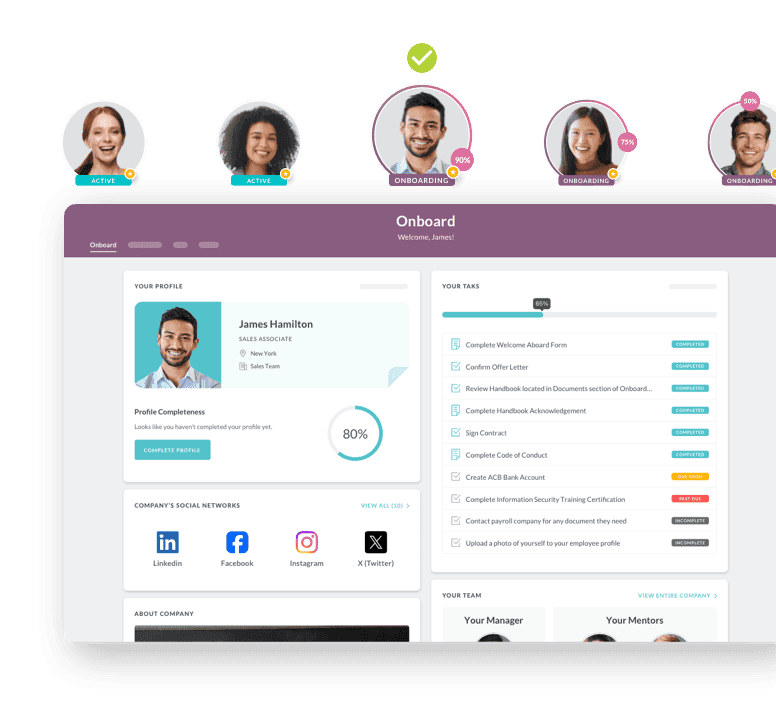
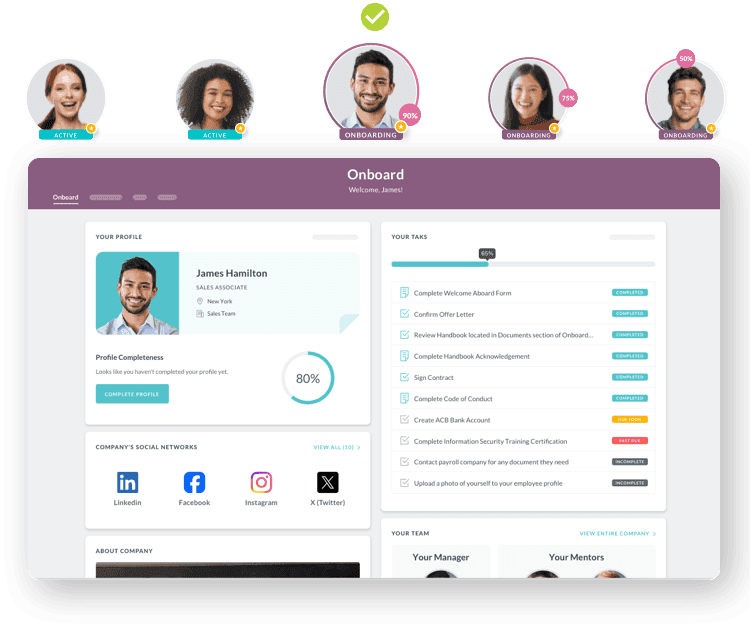
HR Cloud's Onboard platform supports SMS-based document collection for candidates who don't have a corporate email address to onboard into. Maya, HR Cloud's AI onboarding agent, is built specifically for this kind of frontline, deskless onboarding, reaching candidates by text rather than routing everything through an inbox they may not check between shifts or before their first day. For a staffing coordinator, that means a document request lands somewhere the candidate can open and act on immediately, from the phone they already carry, instead of sitting unopened in an inbox they don't have a habit of checking yet.
Automated workflows across HR, payroll, IT
Document request tasks in Onboard can route to HR, payroll, and IT in parallel once a candidate submits the required forms, rather than depending on one coordinator to manually forward each completed document to the right department. I-9 and E-Verify processing runs inside the same platform as document collection, and Checkr background screening can be incorporated into the same Onboard task workflow alongside other onboarding requirements, so a staffing coordinator isn't managing compliance across three disconnected systems for a single new hire. That matters most at volume: a coordinator handling a handful of onboardings can absorb some manual forwarding, but one handling dozens at once needs the routing to happen without their direct involvement in every single handoff.
Real-time completion tracking
A coordinator managing dozens of active onboardings can see completion status across every candidate from one dashboard, rather than opening each candidate's file individually to check what's outstanding. That visibility is what makes a large, simultaneous caseload, the case pattern common among healthcare staffing firms, workable for a small coordination team. It also turns a stalled onboarding from something discovered on day one into something caught and fixed while there's still time to recover the start date, which is the difference between a scramble and a non-event.
Common Onboarding Mistakes Healthcare Staffing Firms Make
Assuming every candidate has reliable email/computer access
The single most common mistake in healthcare staffing onboarding is designing the process around the coordinator's own daily tools, email, a desktop portal, rather than the candidate's. A process that assumes reliable email and computer access will work fine for some candidates and quietly stall out for the deskless majority, without anyone noticing until a start date is missed. This mistake is easy to make precisely because it doesn't look like a mistake from the coordinator's side of the process. Their own forms are getting filled out fine; they just don't see the candidates who quietly stopped responding because the process assumed tools they didn't have. The fix isn't complicated, it's checking every step in the process against the question of whether a candidate could complete it from a phone with no email habit, but it does require someone to actually walk through the process as a candidate would, rather than trusting that it works because it works for the person who built it.
No automated reminders for incomplete paperwork
An onboarding step that goes untouched for three days needs something to nudge it forward, whether that's an automated text reminder or an alert to a coordinator. Without automated reminders, incomplete paperwork just sits until someone happens to notice, and by the time someone notices, the candidate may already be considering another offer. Manual follow-up also doesn't scale: a coordinator can remember to chase five outstanding forms, but across a large simultaneous caseload, something is always going to slip through without a system doing that chasing automatically. The firms that get this right treat the reminder cadence itself as part of the process design, not an afterthought bolted on once something's already gone quiet.
Disconnected onboarding and credentialing processes
Onboarding and credentialing are often run as two separate processes on two separate timelines, which means a candidate can finish onboarding paperwork and still not be cleared to work because credential verification is stuck in a different queue nobody is watching in relation to the start date. Connecting the two, so onboarding status and credential status are visible in the same place, closes that gap. Otherwise it's possible for a coordinator to mark a candidate "onboarded" while a license verification quietly sits unresolved, and nobody discovers the mismatch until the candidate shows up for a shift they aren't actually cleared to work. This is a coordination failure more than a technology failure, but the technology fix is straightforward: put both processes in view of the same person at the same time, rather than requiring someone to manually cross-reference two separate systems to catch the gap.
Results: What Faster Onboarding Delivers
Reduced time-to-start and lower candidate drop-off
The measurable outcome of a faster process is a shorter offer-to-cleared-to-work time, fewer days between an accepted offer and a clinician actually authorized to work the assignment, and fewer candidates who go quiet partway through. Fewer days in the pipeline means fewer opportunities for a candidate to take a competing offer, and a shorter, mobile-friendly process is simply easier for a busy candidate to actually finish. Retention starts before day one too: a frustrating, slow onboarding experience is one of several factors that can leave a clinician less invested from the first shift onward, alongside burnout and scheduling strain that firms don't control directly. What a staffing operation can control is what it measures. Rather than folding onboarding performance into a broader retention number that won't show a problem until months later, the more useful leading indicators are specific to the onboarding window itself:
- Median offer-to-cleared-to-work time
- Percentage of candidates cleared before their scheduled start date
- Onboarding abandonment rate (candidates who accept an offer but never complete onboarding)
- Average number of manual follow-ups per placement
- Average time a completed task spends waiting for internal action before someone picks it up
These give an operations team something concrete to review, rather than waiting for a missed start date to reveal that something in the pipeline was already stuck.
“The flexibility of the HR Cloud system is invaluable in ensuring compliance. It helped us stay a step ahead of changing document collection requirements.”

— Jesse Rose, Provider recruitment, onboarding, and compliance manager

What's the Best Healthcare Staffing Onboarding Software for Agencies Placing Clinicians at Scale?
The right software depends on caseload and candidate type, but the underlying requirement doesn't change with volume: meeting candidates on their phone instead of their inbox. What changes with volume is how much manual tracking a coordinator can realistically sustain before something starts slipping, which is usually the point where firms move from spreadsheets to dedicated software. These are the questions worth asking a vendor directly, and what the answer should sound like either way:
| Ask the vendor | Strong answer | Warning sign |
|---|---|---|
| Can a clinician start onboarding without a corporate email address? | Yes, via SMS or a mobile link before day one | Requires a company account to log in |
| Can workflows vary by facility or client? | Yes, role- and location-specific requirements | One universal checklist for everyone |
| Can HR see which placements are stalled, and why? | Exceptions and overdue tasks visible centrally | Has to open each candidate's file to check |
| Does reused clinician data carry forward on repeat placements? | Yes, core information persists across assignments | Every placement starts from a blank form |
| Does it work alongside our existing ATS, payroll, and HRIS? | Integrates alongside what we already run | Requires replacing existing systems |
How Long Should Healthcare Onboarding Take?
There's no single universal benchmark, since it depends on the role, the facility's credentialing requirements, and how much can legally be completed before day one. It's also worth separating two metrics that get conflated: time to hire, the span from application to accepted offer, and onboarding time, the span from accepted offer to first shift. SmartRecruiters' 2025 Recruiting Benchmarks Report, drawn from nearly 90 million applications, puts the median time to hire in healthcare at 41 days, which is a hiring-funnel metric, not an onboarding one, but it sets useful context: a candidate who's already spent over a month getting to an accepted offer has limited patience left for a slow onboarding process on top of it. What's consistent across faster onboarding processes specifically is that most of the administrative work, forms, background check initiation, tax documents, happens before the first shift rather than on it, so day one is spent on orientation and floor-specific training rather than paperwork. A useful internal benchmark isn't a fixed number of days, it's the ratio of time spent on paperwork versus time spent actually preparing the candidate for the floor. A process that's mostly paperwork on day one is a process with room to move faster.
Can Onboarding Be Completed Entirely on a Phone?
Most of it, yes. Document uploads, e-signatures, and compliance forms can generally be completed on a phone with the right software. Form I-9 has specific rules of its own: since August 2023, qualifying E-Verify employers may use DHS's optional alternative procedure for remote document examination when its requirements are met, so this isn't the blanket in-person rule it used to be. Employers who don't meet those requirements, along with facility-specific orientation, occupational health steps, and other clinical or role-specific requirements, may still need live or in-person completion. A well-designed process minimizes what's left for those steps rather than assuming everything defaults to physical presence, but what's actually required depends on the employer's specific setup, not a single universal rule. In practice, that usually means a candidate arrives for whatever in-person step remains already fully onboarded on paper, so that step is short and purely procedural rather than the moment everything else gets sorted out.
How Does Onboarding Connect to Credential Verification?
Onboarding and credential verification are related but distinct processes: onboarding covers the administrative steps to get someone employed (forms, tax documents, direct deposit), while credential verification confirms a clinician's license and certifications are current and valid for the role. They should be visible in the same system even though they're different processes, because a candidate can finish onboarding and still not be cleared to work if credential verification hasn't caught up, and that gap is easy to miss when the two run in separate tools. A coordinator who only checks onboarding status has no way of knowing a credential is still pending unless the two are visible side by side.
What's the Difference Between Onboarding and Orientation?
Onboarding is the administrative and compliance process that gets someone legally employable, forms, background checks, credential collection, tax documents. Orientation is what happens once that's done: introducing a new hire to their unit, their equipment, their team, and facility-specific procedures. Fast healthcare staffing onboarding software exists to compress the first category so more time and attention can go to the second, rather than having orientation day double as a paperwork-catchup session. Firms that blur the two often end up with orientation days that are mostly administrative, which is the exact opposite of what orientation is supposed to accomplish, and it leaves a new clinician's first real impression of the unit as a day spent on forms instead of a day spent meeting the team they'll actually be working alongside.
What Should a Healthcare Staffing Firm Look for in Onboarding Software?
When you evaluate onboarding software for healthcare staffing, pressure-test these five areas. A tool missing any one of them tends to reintroduce the exact bottleneck it was supposed to remove, just in a different part of the process.
| Capability | Why it matters |
|---|---|
| Mobile-first delivery | Works without a corporate email address most candidates don't have yet |
| SMS as a primary channel | Reaches candidates on the device they actually check |
| Parallel task routing | Sends forms to HR, payroll, and IT at once, not in sequence |
| Real-time status visibility | Surfaces a stalled onboarding while there's still time to fix it |
| Credential-tracking handoff | Prevents "onboarded" and "cleared to work" from becoming two separate unknowns |
Firms evaluating options often focus first on the price and the form builder, since those are the easiest features to compare side by side in a demo. The five capabilities above are harder to see in a short demo but matter more once a firm is actually running dozens of onboardings a week, since that's when a missing capability turns into a candidate lost to a competing offer rather than just a minor inconvenience.
Does Fast Onboarding Work Differently for a Staffing Agency Than for a Health System's Internal HR Team?
The core mechanics are the same, mobile-first delivery, automated routing, real-time visibility, but the volume and repetition patterns differ. A staffing agency is running many onboardings in parallel across different facilities and clients, often for the same clinicians repeatedly over time, which makes standardizing the reusable core of the process especially valuable. A health system's internal HR team is typically onboarding for a smaller, more consistent set of internal roles, where facility-specific requirements matter more than reuse across placements. Both benefit from the same underlying speed principles; the emphasis just shifts depending on whether the bigger challenge is volume across many clients or consistency across many departments in one organization. A staffing agency evaluating software should weigh reuse and scale heavily; a health system's internal team should weigh consistency across departments and facilities more heavily, even though both are ultimately buying the same category of tool.
What Happens When Onboarding Speed and Compliance Requirements Conflict?
Speed and compliance aren't actually opposed, even though a rushed process can feel like it's cutting corners. Required steps, Form I-9 verification for every hire, and depending on the role, employer, client, and applicable law, background screening and license verification, don't go away with a faster process; they just stop being manually chased one at a time. What speeds up is the administrative overhead around those steps: the time a form sits waiting to be forwarded, the days a candidate waits for someone to notice a document arrived, the delay between a background check clearing and someone actually seeing that it cleared. None of that overhead is a compliance requirement. It's friction that accumulated around the requirements, and it's the part that automation actually removes, leaving the compliance steps themselves exactly as rigorous as they were before, just faster to complete and easier to prove after the fact.
What Faster Onboarding Software Can't Fix
Software removes administrative waiting time, not every dependency in the process. It can't shorten a third-party background check provider's actual turnaround time, waive a facility's specific requirements, or make an unresolved license or certification issue disappear. What it does remove is the time a completed step sits waiting for someone to notice it, forward it, or act on it, which in most manual processes is a larger share of the total delay than the underlying checks themselves. A firm evaluating onboarding software should expect it to close the gaps around compliance requirements, not to shrink the requirements.

Discover how our HR solutions streamline onboarding, boost employee engagement, and simplify HR management
Book a DemoConclusion
Most healthcare staffing firms don't need to rebuild their entire onboarding process to see a difference. Start with the single biggest bottleneck, usually the step that assumes desktop or email access from candidates who don't reliably have either, and move that one step to mobile-first, SMS-based delivery. That single change is often what turns a generic onboarding process into fast employee onboarding healthcare staffing actually depends on. The rest of the process can follow once that foundation is in place, and the sequencing matters less than actually starting: a firm that fixes the worst bottleneck this quarter and the next-worst one after that will outpace a firm still waiting for the budget and time to redesign everything at once.
What makes healthcare staffing onboarding fast isn't a shorter checklist for its own sake. It's recognizing that a nurse or clinician evaluating a staffing agency is often evaluating several at once, and the agency whose onboarding process respects their time, meets them on their phone, and gets them to their first shift without friction is the one that keeps its coverage filled. Slow, paper-heavy, email-dependent onboarding doesn't just delay a start date. It quietly tells a candidate what the rest of the working relationship might feel like, before they've worked a single shift, and in a labor market where nurses and allied health professionals have options, that first impression carries more weight than most staffing firms give it credit for.
If your onboarding process still depends on candidates finding a computer to fill out forms, see how HR Cloud's Onboard platform handles mobile-first onboarding for healthcare staffing teams. See how HR Cloud supports healthcare teams with fast, mobile-first onboarding built for frontline and deskless clinical staff.
About the author

Keep Reading


Like What You Hear?
We’d love to chat with you more about how HR Cloud® can support your business’s HR needs.
Book Your Free Demo