HR Cloud vs ADP Workforce Now: A Side-by-Side Breakdown

Direct Answer
If you're searching for an ADP Workforce Now alternative, the honest answer is that ADP Workforce Now and HR Cloud usually solve different problems, so the right move is often "both, together" rather than a straight swap. ADP Workforce Now is a payroll, tax filing, and benefits administration platform built for companies with 50 or more employees, and it remains one of the most widely used systems in that category for good reason: only 12% of employees strongly agree their organization does a great job onboarding new hires according to Gallup, and payroll accuracy is not the part of that statistic ADP is responsible for fixing. HR Cloud is an onboarding and employee experience platform that runs on top of ADP Workforce Now rather than competing with its payroll core. If your ADP frustration is with paperwork, mobile access for frontline workers, or engagement, HR Cloud is built to close that gap without a payroll migration. If your frustration is with ADP's payroll pricing, support, or platform fit itself, that is a different decision, and this guide covers both paths.
Quick take: Approximately 500 ADP Workforce Now customers already run HR Cloud as their onboarding and engagement layer, keeping ADP for payroll. HR Cloud's ADP Marketplace implementation is a flat $500 fee for any company size, live in 2 to 3 weeks. Full payroll migrations away from ADP are a separate, larger project this article addresses in the "add vs switch" section below.
At a Glance: Is HR Cloud an ADP Workforce Now Alternative?
Both platforms serve HR teams, but they are not solving the same job. The table below compares them on the dimensions buyers actually ask about, not a feature-for-feature checklist that assumes they're interchangeable.
| Category | HR Cloud | ADP Workforce Now |
|---|---|---|
| Core function | Onboarding, HRIS, employee engagement, and offboarding | Payroll, tax filing, benefits administration, HR |
| Starting price | Fixed annual license, custom quote (no per-seat fee); mid-market onboarding platforms typically run $6 to $12 PEPM as a category | Quote-based; third-party estimates place it at $23 to $30 PEPM for the software before add-on modules |
| Free trial | No self-serve trial; personalized demo and quote | No self-serve trial; consultation and quote |
| Runs alongside existing payroll | Yes, ADP two-way sync included | N/A, ADP is the payroll system of record |
| Mobile access for frontline workers | Text-based onboarding via Maya, no app download required | Mobile app included, requires login and portal navigation |
| Typical implementation time | 2 to 3 weeks for ADP Marketplace customers | Weeks to months depending on modules and company size |
| G2 rating | 4.6 | 4.2 (4,231 reviews) |
| Capterra rating | 4.7 (399 reviews) | 4.4 (7,228 reviews) |
| Best for | HR teams that want a modern onboarding and engagement layer, especially for deskless and multi-location workforces | Mid-market to enterprise companies that need payroll, tax compliance, and benefits administration in one system |
What Is ADP Workforce Now?
ADP Workforce Now is a cloud-based human capital management (HCM) platform built by ADP, one of the largest payroll processors in the United States. It is designed for companies with roughly 50 to 1,000+ employees and bundles payroll, tax filing, benefits administration, time and attendance, and talent management into a single system with three main tiers: Select, Plus, and Premium, each adding more modules on top of the last.
ADP's scale is part of its pitch. The platform draws on a benchmarking data pool of more than 42 million employee records to help HR teams compare their pay and turnover against companies of similar size and industry, and it has recently layered in ADP Assist, a generative AI tool built into the platform that validates payroll information, flags anomalies, and checks for missing tax registrations. That combination of scale, compliance depth, and decades of payroll infrastructure is why so many mid-market and enterprise companies default to ADP for their core HCM system.
Key characteristics:
- Payroll and tax filing engine trusted by companies with complex, multi-state compliance needs
- Compensation benchmarking against a large, real-time workforce dataset
- Native mobile app for employee self-service (pay stubs, time off, benefits enrollment)
- Modular tiers (Select, Plus, Premium) so companies pay only for the modules they use
- Marketplace ecosystem that lets specialized tools like HR Cloud connect via API without disrupting the payroll core
ADP Workforce Now is not primarily an employee experience or onboarding platform. Its onboarding module handles the compliance essentials, I-9 collection, W-4 processing, and direct deposit setup, but was not built around the pre-boarding, mobile-first, or culture-building experience that distributed and frontline workforces increasingly expect.
ADP Workforce Now gives organizations a strong foundation for payroll, tax compliance, and core HR administration, and it built that reputation over decades by staying focused on getting those functions right at scale. What it was not built to be the center of gravity for is the employee-readiness layer around that core: the pre-boarding, mobile-first, and culture-building work that happens before and around a paycheck rather than inside one. That is a deliberate scope choice on ADP's part, not a shortfall, and it is exactly the space HR Cloud is purpose-built to operate in alongside it. A company whose priority is accurate, compliant payroll at scale gets real value from ADP's depth there. A company whose priority is the onboarding or employee-experience layer specifically tends to look for a tool built around that one job, which is a different kind of depth than a payroll platform is optimized to provide.
What Is HR Cloud?
HR Cloud is a modular HR software platform built around onboarding, HRIS, employee engagement, and offboarding for organizations with 250 to 10,000+ employees, with particular depth in industries with compliance-heavy or distributed workforces: healthcare, construction, utilities, retail, hospitality, food service, and education. Rather than competing with payroll providers, HR Cloud is designed to sit alongside an existing payroll system like ADP, UKG, or Paylocity and handle the parts of the employee lifecycle those systems weren't built for.
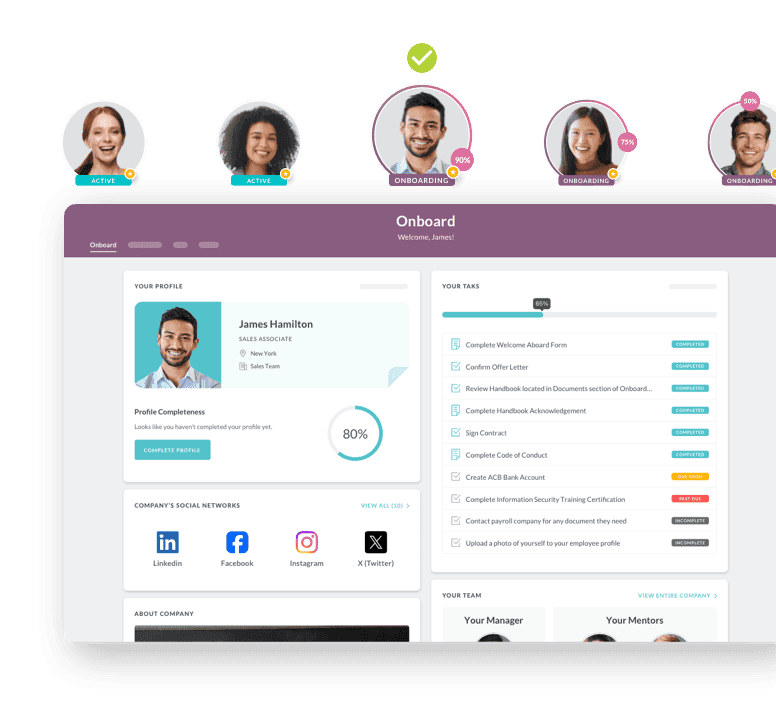
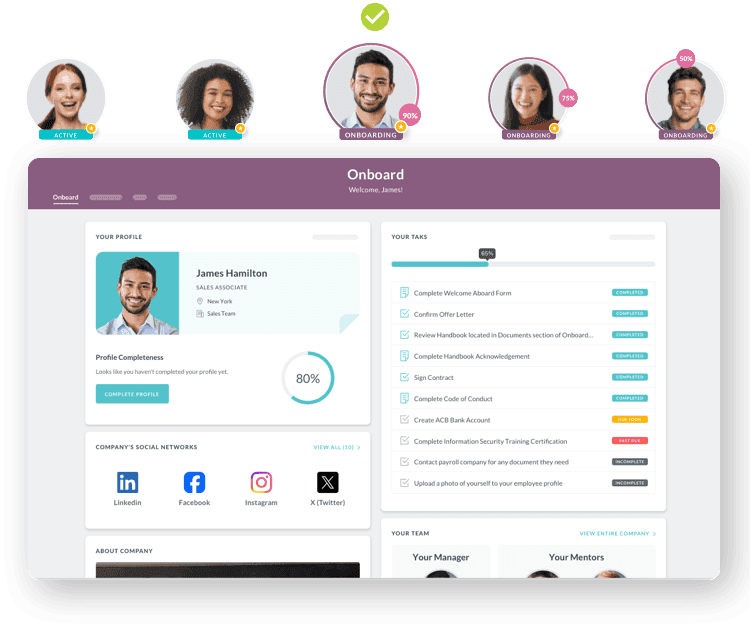
The platform is organized around two core suites: the Onboard Suite (new-hire onboarding, offboarding, People HRIS) and the full HR Suite (adds Recruit ATS, performance management, and time-off tracking), with add-on modules for Employee Engagement, Assets, and Time Clock. HR Cloud holds Platinum ADP Marketplace Partner status, its highest partnership tier, and reports that approximately 500 ADP Workforce Now customers already run HR Cloud on top of their existing ADP environment.
Key characteristics:
- I-9 and E-Verify compliance built into the onboarding workflow, with automated credential and license expiration tracking
- Maya, a text-based AI onboarding agent for frontline and high-volume hiring, reaching new hires on any phone without an app download
- Workmates by HR Cloud, the engagement layer for recognition, internal communications, and pulse surveys
- Native two-way sync with ADP Workforce Now: new-hire data flows in, and updates in ADP sync back automatically
- Fixed annual license pricing rather than a per-seat model, so headcount growth during the year does not trigger a surprise bill
HR Cloud does not process payroll, file payroll taxes, or administer benefits, those functions stay with ADP in the roughly 500 accounts running both platforms together.
That scope is deliberate rather than a limitation the company is working around. HR Cloud markets itself as a modular HR suite rather than an all-in-one platform, meaning a company can start with the single product that solves its most urgent problem, most often onboarding or engagement, and expand into HRIS, recruiting, time off, time tracking, performance management, or offboarding later, without a second implementation project or a second vendor relationship to manage. For a company already invested in ADP for payroll, that modularity is the point: it lets HR pick up the onboarding, engagement, and readiness workflows ADP was never scoped to specialize in, on a timeline set by their own priorities rather than a vendor's product roadmap.
Pricing: What Each Platform Actually Costs
Neither company publishes a public price list, which is standard for HCM software sold to companies above a certain headcount, but the pricing models work differently enough that they deserve a direct comparison.
ADP Workforce Now is priced per employee per month (PEPM) with three tiers. According to OutSail, an independent HRIS advisory firm, most organizations pay between $23 and $30 PEPM for the software itself, with Select covering payroll, tax filing, onboarding, and basic HR recordkeeping; Plus adding benefits administration; and Premium adding automated time and attendance. Organizations that add ADP's Comprehensive Services (outsourced payroll and HR administration) should expect a combined total closer to $30 to $50 PEPM. ADP also typically charges a one-time implementation fee on top of the monthly rate, and the company does not publish that figure. Because pricing is fully custom and quote-based, ADP's own product page directs prospective buyers to "get pricing" rather than listing a rate card.
HR Cloud uses a fixed annual license model instead of a per-seat meter. Pricing depends on three factors: headcount band, which suite you choose (Onboard Suite or the full HR Suite), and any add-on modules (Employee Engagement, Assets, Time Clock). Because the license is fixed rather than per-seat, adding employees during the year does not automatically increase the bill the way a PEPM model does. For companies specifically evaluating onboarding software as a category (the $6 to $12 PEPM benchmark cited in the table above), that gives useful context against ADP's broader HCM pricing. For the roughly 500 companies running HR Cloud on top of an existing ADP Workforce Now account, implementation through the ADP Marketplace is a flat $500 fee regardless of company size, substantially below the $5,000 to $50,000 range typical implementation for comparable integrations costs according to HR Cloud.
For scale, a 500-employee organization paying $23 to $30 PEPM for ADP Workforce Now software alone (the OutSail range cited above) works out to roughly $138,000 to $180,000 a year before implementation, add-on modules, or Comprehensive Services. That figure covers running payroll, tax, and core HR for the company, and it is not an apples-to-apples comparison to HR Cloud, since HR Cloud does not perform those functions. The more useful comparison is the incremental cost of adding an onboarding and engagement layer on top of that existing ADP spend, which is what the $500 flat implementation fee and the $6 to $12 PEPM onboarding-category benchmark above are meant to illustrate.
Hidden costs to watch on both sides:
- ADP: implementation fees, per-module add-on pricing (recruiting, for example, runs an additional $3 PEPM plus a $2,000 setup fee at the midsize tier according to ADP Marketplace listing data), and rate increases at renewal that are common with annual HCM contracts industry-wide.
- HR Cloud: some third-party integrations, ADP included, may carry a one-time setup fee starting at $750 outside the ADP Marketplace's own $500 flat-fee path, so which path applies depends on how the account is set up.
Feature-by-Feature Breakdown
Payroll and Tax Filing
ADP Workforce Now's payroll engine is the core of the product and the reason most companies choose it in the first place. It handles automated tax filing and reporting across federal, state, and local jurisdictions, and independent analysts scoring HR management software have rated ADP's payroll and tax management at the top of the category. HR Cloud does not process payroll or file payroll taxes. If payroll accuracy, multi-state tax compliance, or benefits administration is your primary pain point, ADP (or a similar payroll-first platform) is the right tool for that job, and HR Cloud is designed to work alongside it rather than replace it.
Core HRIS and Employee Records
Both platforms maintain a system of record for employee data, but for different purposes. ADP's HRIS module is built around the data payroll and compliance need: tax status, deductions, benefits elections. HR Cloud's People HRIS is built around the data HR teams use day to day: employee profiles, org charts, department hierarchies, custom fields, and document storage, with the same data syncing bidirectionally to ADP so nothing has to be entered twice.
New-Hire Onboarding Experience
This is where the two platforms diverge most. ADP Workforce Now's onboarding module is available as a separately licensed add-on for Payroll and Enhanced HR clients and covers the compliance baseline well: I-9 Section 1, tax withholding forms, direct deposit, and policy acknowledgment. It supports welcome message customization, buddy assignment, and task tracking through an Onboarding Administrative Dashboard. What it does not provide, according to HR Cloud's own gap analysis of the ADP onboarding checklist, is a full pre-boarding layer built around self-service profile completion, team introductions, and role-specific preparation before Day 1. HR Cloud's Onboard module is built specifically to close that gap: role-based workflows built once and reused for every hire, automated pre-boarding portals that fire the moment an offer is accepted, and mobile document capture so new hires never need a scanner.
Compliance: I-9 and E-Verify
Both platforms support I-9 and E-Verify, but the depth differs. HR Cloud's compliance tracking includes automated credential and license expiration alerts, which matter most for healthcare and construction employers managing licensed or certified staff, plus a searchable, timestamped audit trail designed for the kind of scrutiny a Joint Commission review or DOL audit would apply. ADP's onboarding add-on handles I-9 collection and W-4 processing as part of the broader compliance suite that comes with its payroll and HR tiers.
Time and Attendance
ADP Workforce Now's Premium tier includes automated time and attendance tracking directly integrated with payroll, which is a meaningful advantage for companies that want time data to flow straight into a paycheck without a separate system. HR Cloud offers a standalone Time Clock add-on module for timesheet management, project tracking, and approvals, designed to complement (not replace) whatever time and attendance capability a company's payroll platform already provides.
Employee Engagement and Recognition
ADP Workforce Now includes some engagement-adjacent reporting through its analytics, but it is not built as an engagement platform. HR Cloud's answer here is Workmates by HR Cloud, a centralized engagement hub for peer recognition, targeted internal communications, pulse surveys, and custom employee profiles that highlight skills and achievements. For companies whose ADP frustration is specifically "we have no way to build culture or recognize people across multiple locations," this is the module built for that problem, and it connects to the same ADP single sign-on so employees are not managing yet another login.


Mobile Access for Frontline and Deskless Workers
Mobile access for frontline and deskless workers is where the day-to-day experience of the two platforms diverges most. ADP provides a native mobile app, ADP Mobile Solutions, for pay stubs, time off, benefits enrollment, and direct deposit management, but it still requires a login and portal navigation. HR Cloud's Maya reaches new hires through text-based conversation on any phone, with no app download and no portal login required, which matters most for retail, hospitality, and field-based workforces where completion rates drop sharply the moment a task requires a desktop or an app install.
AI Capabilities
Both platforms have invested in AI, aimed at different problems. ADP Assist, embedded directly in Workforce Now, validates payroll data, checks for missing tax registrations, and flags anomalies, essentially an AI layer focused on payroll accuracy and compliance. Maya, HR Cloud's AI onboarding agent, is focused on the new-hire experience: guiding hires through tasks in the right sequence, answering common questions without HR involvement, and sending automated check-ins at Day 7, Day 14, and Day 30 to flag anyone who has gone quiet before that silence turns into a resignation.
Reporting and Benchmarking
ADP's standout here is ADP DataCloud, which benchmarks pay, turnover, and other workforce metrics against a dataset of more than 42 million employee records, a scale advantage no onboarding-focused platform can match. HR Cloud's reporting is scoped to what it manages: onboarding completion by location, role, and hire date, overdue task flags before they become compliance problems, and scheduled reports delivered automatically to the inbox of whoever needs them.
Integration Depth With Each Other
Because HR Cloud is built as an ADP Marketplace partner rather than a competitor, the two systems connect through ADP SSO, automatic new-hire data sync, and one-click document push to ADP Document Cloud. The integration supports every major ADP platform variant, RUN, Workforce Now, Vantage, Lyric, and TotalSource, with a production-grade, secure API rather than CSV file imports.
Here is what that connection actually does day to day: a hire is triggered in an applicant tracking system, HR Cloud opens the onboarding flow, the new hire completes I-9s, W-4s, and role-specific checklists from their phone or a desktop, and that completed data pushes into ADP Workforce Now with one click, with no manual re-entry at any step. From that point forward, changes made inside ADP, a title update, a pay change, a termination, sync back into HR Cloud automatically, so the two systems stay in agreement without anyone reconciling records by hand. That two-way sync is the specific technical detail behind "add HR Cloud without disrupting ADP": the payroll system of record does not move, and HR Cloud does not become a second, conflicting source of truth for the data ADP still owns.
Custom Forms, Workflows, and Reporting
Beyond onboarding itself, HR Cloud includes a broader workflow layer: if-then logic that triggers tasks by role, location, or hire date, custom PDF form mapping with e-signatures, and a real-time dashboard that flags overdue tasks by location before they become a Day 1 problem. ADP Workforce Now covers a version of this through its own reporting and dashboard tools, scoped primarily around payroll, compliance, and HR administrative reporting rather than the onboarding-specific completion tracking HR Cloud is purpose-built to surface.
Implementation and Migration
For the roughly 500 companies running both platforms together, implementation is not a migration at all. HR Cloud's typical go-live for ADP Marketplace customers is 2 to 3 weeks: week one is the kickoff call and form building, week two is training and checklist configuration, week three is go-live, all while ADP continues running payroll uninterrupted. Data flows from the existing ADP account into HR Cloud automatically, so there is no re-entry and no new system of record for payroll data.
ADP Workforce Now implementations, by contrast, vary considerably by company size and module count. Because Workforce Now is the payroll system of record, implementing it (or migrating to it from another payroll provider) is a heavier project involving historical payroll data transfer, parallel testing, and tax jurisdiction setup, timelines that third-party sources describe as running from several weeks to a few months depending on complexity, compared to the one-to-two-week implementations some lighter payroll-only competitors offer.
Support and Credibility
Support quality is one of the more consistent points of friction voiced in ADP Workforce Now's own review data. On G2, common review themes include "Customer Support" alongside "Poor Customer Support" as two of the most frequently mentioned tags, reflecting the mixed experience larger enterprise support organizations often produce at scale. ADP's own site is candid about this trade-off and leans into its scale as the answer: in-house implementation, rapid-response support, and a stated 9 out of 10 clients who say switching to ADP was worth it, with an average client tenure over 10 years, a genuinely strong retention signal for a company processing payroll for millions of workers.
HR Cloud's support model is smaller by design: an in-house customer support team included in every plan, with onboarding setup, training, and configuration bundled in rather than billed separately. On third-party review platforms, HR Cloud currently holds 4.6 on G2 and 4.7 on Capterra from 399 reviews, against ADP Workforce Now's 4.2 on G2 from 4,231 reviews and 4.4 on Capterra from 7,228 reviews. The review volume gap reflects ADP's much larger install base rather than a quality gap alone, and both platforms carry meaningfully strong scores for their category.
Who Should Stick With (or Add) ADP Workforce Now as the Core
ADP Workforce Now is the right foundation if:
- Payroll accuracy and multi-state or multi-jurisdiction tax compliance is the priority, not a nice-to-have
- The organization needs benefits administration and payroll in the same system as HR
- Compensation benchmarking against a large, real-time dataset matters for pay equity or retention strategy
- The company is large enough (typically 50+ employees, often well beyond that) that ADP's enterprise support infrastructure and long track record outweigh a smaller vendor's more personal support model
Bottom line for this side: if payroll is working and the pain is somewhere else, keep ADP and solve that other problem separately rather than replacing a system that is doing its job well.
Who Should Add or Choose HR Cloud
HR Cloud is worth adding on top of ADP, or choosing outright for the HR/engagement layer, if:
- New-hire onboarding still relies on email threads, paper packets, or a spreadsheet one person maintains
- A meaningful share of the workforce is deskless, hourly, or field-based and needs onboarding that works on a phone without an app download
- Engagement, internal communications, and recognition are effectively nonexistent across multiple locations
- Compliance tracking for credentials and licenses (healthcare, construction, utilities) needs automated expiration alerts rather than manual spreadsheet monitoring
- The goal is to close these gaps without touching payroll, in weeks rather than months
The direct answer: if the pain is onboarding, mobile access, or culture rather than payroll itself, HR Cloud is built to solve exactly that, without asking the organization to rebuild its payroll infrastructure to get there.
Real-World Proof: How Companies Use HR Cloud Alongside ADP
The pattern across HR Cloud's customer base is consistent: companies keep ADP for payroll and add HR Cloud specifically to close the onboarding and engagement gap. Osmose Utilities Services, a construction and utilities employer with field crews across multiple sites, reported a 24% improvement in data accuracy within three months of implementing HR Cloud, along with 7 hours saved per week on onboarding administration, without changing payroll providers.
Behavioral Progression, a behavioral health (ABA therapy) provider, cut its onboarding process to three times faster after implementing HR Cloud, with a 66% overall HR efficiency improvement. And Interim HealthCare of Salt Lake City, a healthcare franchise managing recruiting, onboarding, and engagement across a distributed workforce, went from kickoff to full platform rollout in six weeks and reported a 60% HR efficiency improvement.
On the larger end, Rehmann, a financial services firm managing onboarding and recruiting across 1,200 employees on behalf of multiple clients, uses HR Cloud to standardize a process that previously varied by client and location. None of these organizations report replacing their payroll system to get these results, the pattern across HR Cloud's published case studies is consistently additive rather than a full platform rip-and-replace.
What these examples have in common is the shape of the problem, not the industry. A construction employer with field crews, a behavioral health provider onboarding clinical staff, a healthcare franchise with licensed staff, and a financial services firm managing onboarding for multiple client companies at once are structurally different businesses, but each one described the same underlying gap before implementing HR Cloud: a payroll system doing payroll well, and an onboarding process still running on email, spreadsheets, or paper that could not keep pace with growth or compliance requirements. That consistency across industries is a reasonable signal for any HR leader evaluating whether the same pattern applies to their own organization: if the payroll relationship itself is not the complaint, the fix others have found is rarely a payroll switch.
“ Our hiring managers now have a reliable system that is easy to navigate. Our HR team can actively monitor the process, and assist if needed, but Onboard has helped them save so much valuable time and effort while increasing data accuracy.”

— Kaylee Collins, HR Analyst, Osmose

How to Decide: Add HR Cloud on Top of ADP, or Consider a Full Switch
This decision is really two separate questions, and it is worth answering them separately rather than treating "ADP Workforce Now alternative" as a single yes-or-no choice.
Question 1: Is ADP's payroll, tax filing, and benefits administration working for you?
If yes, and most of the frustration ADP customers describe is about onboarding, mobile access, or engagement rather than payroll accuracy, the answer is to add a layer, not switch platforms. This is the path roughly 500 ADP Workforce Now customers have already taken with HR Cloud: keep payroll exactly where it is, connect HR Cloud through the ADP Marketplace, and go live in 2 to 3 weeks with a flat $500 implementation fee. Nothing about the payroll relationship changes, and there is no tax jurisdiction migration, no historical payroll data transfer, and no interruption risk during a pay cycle.
Question 2: Is the payroll and tax core itself the problem?
If the frustration is with ADP's pricing, its support experience for payroll issues specifically, or platform fit at your company's size, that is a genuinely different, larger decision involving a full HCM migration, which is a separate project from anything HR Cloud addresses. That kind of switch typically involves evaluating payroll-first alternatives (the category ADP itself competes in against providers like Paycor, Paylocity, or UKG), parallel payroll testing, and a multi-month transition. It is a real option for some organizations, but it should be evaluated on its own terms, with its own vendor comparison, rather than folded into an onboarding or engagement software decision.
In practice: the two questions are not mutually exclusive, and they don't have to happen at once. Many organizations solve the onboarding and engagement gap first, since it is the faster, lower-risk change, and revisit the payroll question separately and on its own timeline if it still needs solving.
There is also a sequencing argument worth naming directly. Payroll migrations carry real risk: a missed tax filing deadline or a payroll run that goes wrong during a transition has immediate, visible consequences for every employee at the company, which is part of why ADP's client tenure runs so long (noted in the Support and Credibility section above) and why so many HR leaders are cautious about touching payroll once it is stable. Onboarding and engagement gaps, by contrast, tend to compound quietly. A new hire who gets a confusing first week does not usually cause an incident report, but the Gallup research cited earlier suggests the cumulative cost, in early turnover, disengagement, and lost productivity, is often larger than the visible cost of a payroll error, just harder to see on a single day's dashboard. That asymmetry is a reasonable part of the decision: fixing the quieter, lower-risk problem first while leaving a well-functioning payroll system untouched is not a compromise position, it is frequently the right sequencing on its own merits.
For organizations choosing the "add HR Cloud" path, next steps are straightforward: book a demo to confirm your specific ADP platform variant (RUN, Workforce Now, Vantage, Lyric, or TotalSource) is supported, request a quote scoped to your headcount and the Onboard Suite or full HR Suite, and expect a kickoff call within days of signing rather than weeks.
Final Verdict
ADP Workforce Now and HR Cloud are not really competing for the same budget line, and treating "ADP Workforce Now alternative" as a single question misses that. ADP remains a strong, well-supported choice for payroll, tax filing, and benefits administration, backed by decades of infrastructure and a client base that, by ADP's own reporting, largely says the platform was worth choosing. Where ADP customers consistently report friction is onboarding, frontline mobile access, and engagement, exactly the gap HR Cloud was built to close, without requiring a payroll migration to do it. For most of the roughly 500 companies already running both, the answer wasn't "replace ADP," it was "add the onboarding and engagement layer ADP was never scoped to specialize in." If payroll itself is the actual pain point, that is a separate, bigger decision worth evaluating on its own terms rather than folding into an onboarding software search.

Discover how our HR solutions streamline onboarding, boost employee engagement, and simplify HR management
Book Your Free DemoFrequently Asked Questions
What is the best alternative to ADP Workforce Now for onboarding?
HR Cloud is built specifically to close ADP Workforce Now's onboarding gaps, pre-boarding, mobile access for frontline workers, and role-based workflows, while running alongside ADP's existing payroll rather than replacing it. It connects through ADP SSO and automatic data sync, so no payroll migration is required.
Is there a free alternative to ADP Workforce Now?
Neither ADP Workforce Now nor HR Cloud offers a self-serve free plan. Both are quote-based enterprise software requiring a personalized demo before pricing is provided, which is standard for HCM platforms serving companies with 50 or more employees.
How much does ADP Workforce Now cost per employee?
ADP does not publish official pricing, but third-party HRIS advisory estimates place Workforce Now at $23 to $30 per employee per month for the software alone, with Comprehensive Services (outsourced payroll and HR) pushing the total to $30 to $50 PEPM. Implementation fees are typically charged separately.
What does ADP Workforce Now not do well?
Independent review data on G2 shows customer support as a recurring point of friction, with both "Customer Support" and "Poor Customer Support" among the most common review tags. On the product side, ADP's native onboarding module covers compliance essentials (I-9, W-4, direct deposit) but was not built for pre-boarding, mobile-first frontline access, or engagement.
Can I use HR software alongside ADP without switching payroll?
Yes. HR Cloud is built as an ADP Marketplace partner specifically for this scenario. Approximately 500 companies currently run HR Cloud on top of an existing ADP Workforce Now account, with two-way data sync and no changes to how payroll is processed.
How long does it take to add onboarding software on top of ADP?
For HR Cloud specifically, ADP Marketplace customers typically go live in 2 to 3 weeks: one week for kickoff and form building, one week for training and configuration, and one week to launch.
Does HR Cloud replace ADP Workforce Now?
No. HR Cloud does not process payroll, file payroll taxes, or administer benefits. It is designed to run alongside ADP Workforce Now (or UKG, Paylocity, and other payroll systems) as the onboarding, HRIS, and engagement layer, not as a payroll replacement.
What is the main difference between ADP Workforce Now and HR Cloud?
ADP Workforce Now is a payroll, tax, and benefits administration platform with HR features layered on top. HR Cloud is an onboarding, HRIS, and employee engagement platform designed to connect to a company's existing payroll system rather than including payroll itself.
Is ADP Workforce Now good for small businesses?
ADP Workforce Now is generally positioned for companies with 50 or more employees; ADP's RUN product is built for smaller businesses below that threshold. HR Cloud also offers dedicated SMB pricing for companies under 250 employees for organizations evaluating onboarding and engagement software at a smaller scale.
About the author

Keep Reading


Like What You Hear?
We’d love to chat with you more about how HR Cloud® can support your business’s HR needs.
Book Your Free Demo