HR Cloud for Franchises: Managing Multi-Unit Employees

HR Cloud for Franchises means running onboarding, employee records, scheduling, time tracking, hiring, and team communication for several franchise locations from one HR system. For a franchise operator with 1 to 250 employees, HR Cloud publishes package pricing that starts at $295 per month for up to 50 employees. HR Cloud is not a payroll system, it does not publish a franchise-specific price list, and its customer evidence for franchises comes from two Interim HealthCare franchise stories. This guide uses the phrase for HR Cloud's standard modules applied to multi-unit operators, and the HR Cloud pages reviewed show no separate franchise edition. HR Cloud's onboarding page says new hires can receive documents before day one with no company email required.
An owner of several units often cannot see which new hire at which unit is ready to work and which file is incomplete. Each location hires its own people, but the paperwork, approvals, and policies repeat at each site, and when those steps live in filing cabinets, email threads, and spreadsheets, nobody sees the whole picture. HR Cloud's role is to give those steps one home, alongside the payroll provider you already use.
Key takeaways
- Price structure: HR Cloud charges a flat package price by employee band, not per seat. Published small-business plans run from $295 to $1,995 per month. Above 250 employees, HR Cloud quotes a fixed annual license.
- Franchise evidence: HR Cloud publishes two case studies from independently owned Interim HealthCare franchises, one of which spans three offices, plus one Interim network story. Its retail stories, Public Group and Konzum, do not state that the customer is a franchise.
- Multi-unit controls documented in the help center: Checklists that start on job changes such as a new location, assignment rules by location, manager, and position, employee groups, and role-based visibility that can be limited by location, department, or division.
- Real limits: No payroll, no published franchise discount, no franchisor-wide rollout program described on the pricing pages, and no location-level reporting found in the documentation reviewed.
- Next step: Ask for a quote that names your employee band, how your units and legal entities are counted, the modules you need, and the payroll provider you plan to keep.
What is HR Cloud for Franchises, and who is it built for?
HR Cloud combines onboarding, employee records, time tracking, scheduling, hiring, and workforce communication modules for organizations that want to improve HR operations without replacing their payroll platform. Modules named on HR Cloud's site include Onboard, People HRIS, Workmates for engagement and recognition, Recruit ATS, Perform for performance management, Time Off, Time Clock, Shift Planner, Assets, and Offboard. HR Cloud is an ADP Platinum Marketplace Partner.
Two different buyers search for franchise HR software, and they need different answers.
The franchisee or multi-unit operator owns one or more locations and employs the people who work in them. This is the buyer HR Cloud's published evidence supports. The two franchise case studies on HR Cloud's site both come from franchise owners and their staff.
The franchisor owns the brand and sets standards for franchisees. HR Cloud's pricing pages describe pricing for an organization's own employees. They do not describe a program in which a brand buys HR software and extends it to independently owned franchisees, and they do not describe separate billing or data separation between franchisees. If you are a franchisor, treat that as an open question for your demo rather than an assumption.
HR Cloud describes its platform as built for "frontline-heavy enterprises," and its frontline HR software page speaks to employees who work without a desk, corporate laptop, or company email. That page also says HR Cloud can manage workers across multiple locations from a single system. Many franchise staff fit that description: servers, technicians, caregivers, stylists, and trainers who work a shift and go home.
HR Cloud sits alongside payroll rather than replacing it. Its onboarding page describes HR Cloud as working above your HR and payroll stack, with your payroll remaining the system of record.
How much does HR Cloud for Franchises cost?
HR Cloud prices as a flat package rather than per seat. For teams of 1 to 250 employees, HR Cloud's small-business pricing page lists three plans: Essential HR at $295 per month, Professional HR at $595 per month, and Culture HR at $895 per month, each for up to 50 employees. Prices step up at 51 to 100 employees and again at 101 to 250. The page states that annual billing saves 20 percent.
HR Cloud small-business pricing by plan and employee band (monthly billing)
| Plan | Up to 50 employees | 51 to 100 employees | 101 to 250 employees | What the plan includes |
|---|---|---|---|---|
| Essential HR | $295 | $495 | $795 | Onboard Suite (Core), time off management and time tracking, basic HRIS functionality, standard integrations, email and chat support |
| Professional HR | $595 | $995 | $1,495 | Everything in Essential HR, plus performance management, applicant tracking, assets management, and Kudos recognition |
| Culture HR | $895 | $1,395 | $1,995 | Everything in Professional HR, plus a custom branded mobile app, task management, personalized journeys by role and location, company announcements, eNPS and pulse surveys, employee engagement tools, secure chat, and digital signage |
Prices come from HR Cloud's small-business pricing page, checked in October 2026. Confirm current figures in your quote.
How are employees counted across several units?
The price bands are based on employee count. The pricing pages reviewed do not say how a multi-unit operator with several locations, or several legal entities under common ownership, is counted. That matters, because a group of ten small units can sit in a higher band than any single unit. Ask your specialist to state in writing which employees count toward your band and whether each entity is quoted separately.
What changes above 250 employees?
Above 250 employees, HR Cloud's standard pricing page describes a fixed annual license quoted to your organization. Price depends on three things: team size, whether you choose the Onboard Suite or the HR Suite, and any add-ons. The add-ons are Employee Engagement, Assets, and Time Clock. Ask your specialist to list the exact modules in each suite on your quote.
The same page states a 12-month minimum term, says smaller businesses may qualify for special monthly contracts, and says multi-year agreements are available. HR Cloud does not offer a self-serve trial. Instead, a specialist gives a personalized demo and prepares a custom quote.
What does implementation cost?
On the small-business page, standard implementation is included at no cost when you prepay 90 days upfront. Without prepayment, a one-time $500 implementation fee applies to standard packages. That page says implementation covers data migration, workflow setup, and integration configuration by your Account Manager.
On the standard pricing page, setup, configuration, data import, and training are included. The two pages describe different pricing tracks, so read each figure against the track your quote uses and ask your specialist to confirm implementation terms in writing.
Why do band thresholds matter more than cost per employee?
The step at each threshold can matter more than the average cost per employee. Moving from 50 to 51 employees raises the Essential HR list price from $295 to $495 per month, a $200 monthly increase, or $2,400 over twelve months at monthly list price. On Professional HR the same move goes from $595 to $995, a $400 monthly increase. Moving from 100 to 101 employees on Essential HR adds $300 per month. A franchisee who plans to open a fourth or fifth unit should model the next band before signing, because each new unit adds employees all at once.
Why is HR different in a multi-unit franchise?
A multi-unit franchise operator may manage several locations under one or more legal entities. Each unit can have different managers, hiring needs, and schedules, even when the organization uses the same policies and onboarding requirements. The challenge is keeping those processes consistent while giving the owner visibility into what each location has completed. One failure point is easy to picture: separate location managers run the same onboarding process differently, and the owner finds out only when a file is missing.
Franchising employs millions of people. The International Franchise Association's 2026 Franchising Economic Outlook, produced with the research firm FRANdata, projects franchise establishments growing from 832,521 to 845,000 units in 2026 and franchise employment rising by more than 150,000 jobs to nearly 8.9 million (IFA, February 2026). These are the association's projections. They show how many employers and employees sit in the franchise model, so the same HR steps repeat across a very large number of small employers.
Brand standards meet local hiring. A franchise brand sets how a guest, patient, or client should be served. The franchisee hires, schedules, and manages the people who deliver that service. The HR system a franchisee chooses has to support local hiring decisions while keeping the same required forms and training steps at each unit.
Employer status depends on facts. Whether a franchisor counts as a joint employer of a franchisee's workers depends on the facts and on the rule in force, and agencies and courts have changed that standard over the years. A law firm alert dated April 24, 2026 reports that the Department of Labor's Wage and Hour Division released proposed joint employment rules, with comments due June 22, 2026 (Parker Poe alert). Rulemaking can change after a comment period, so check the current status before relying on it. This is general information, not legal advice. Franchisors in particular should ask counsel whether they should have visibility into a franchisee's employee records at all, before choosing any shared system.
Turnover multiplies paperwork. Roles that turn over often create onboarding work at each unit, again and again. HR Cloud's pages do not quantify that for franchises, so this guide does not either. As units are added, an owner can no longer check each hire in person, so visibility into which tasks are finished at which unit has to come from the system.
How does HR Cloud for Franchises handle onboarding across units?
HR Cloud for Franchises uses the same modules that all HR Cloud customers use, so the useful question is how each module maps to a workflow at your units.
How do onboarding checklists work across locations?
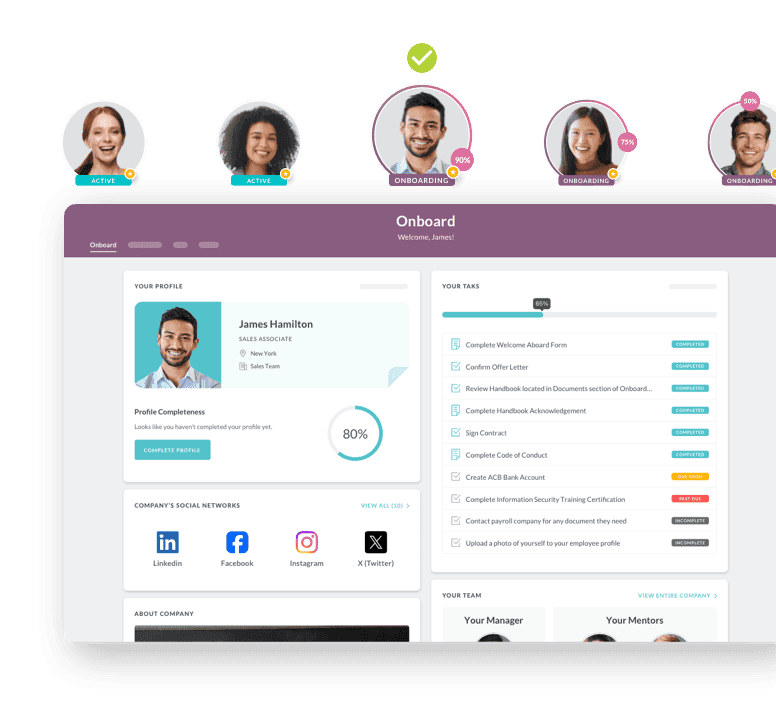
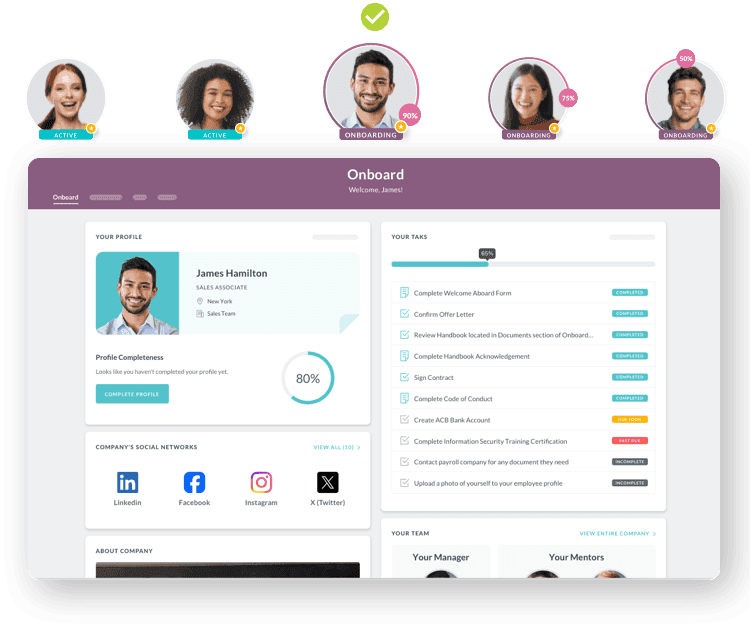
Onboard is HR Cloud's onboarding module. Its published feature list includes personalized onboarding plans, customizable portals, employee profiles, I-9 verification, welcome emails, workflows and checklists, approval workflows, automatic notifications, bulk data import, a mobile app, and access and security profiles.
HR Cloud's help center documents how checklists start and who receives them in its checklist article. A checklist starts from a trigger, which is the action that initiates task assignment. Triggers include employment status changes such as pre-hiring, hiring, rehiring, and terminating, and job detail updates such as a change of manager, position, department, location, division, salary, or employment type. Checklists can also start on a fixed date or be assigned manually.
The same article says you can assign a checklist to all employees or to a selected group using criteria that include Department, Division, Employment Status, Employment Type, Location, Manager, Pay Rate, Position, Security Role, and Specific Employee. Its example activates a checklist for all hired translators. The practical reading for a franchise operator is that a transfer to a new location can start a new checklist, and a new general manager can receive a different checklist than a new hourly employee. The article does not use a franchise example, so test your own rules in the demo.
HR Cloud's onboarding page says new hires can receive documents before day one and that no company email is required. That matters for staff who never had a work inbox.
How do employee groups help a multi-unit operator?
The help center's employee groups article says employee groups are logical sets of employees, useful when assigning tasks or generating reports that need to be handled by multiple users. Admins can build a group from eligibility criteria such as Department, Division, or Location, or add members by hand. The article also describes chat and directory segmentation, which controls which members can contact whom through Chat and which people members can see in the Directory. Under group details, admins can see which checklists and workflows use the group. For an operator whose units share one HR person, that means a single group such as all hourly staff at one location can receive the same checklist and the same chat limits, and the HR person can see where the group is used before changing it.
How are locations set up in HR Cloud?
HR Cloud's help center has an article on editing positions, locations, departments, divisions, and employment types. It says you can edit the name, code, and description of a location and inactivate records, and that its instructions do not apply to clients that use an ADP integration. If you use an ADP product for payroll, ask how your locations are created and maintained.
Does HR Cloud support I-9, E-Verify, and background checks?
HR Cloud's I-9 and E-Verify page describes a four-step flow. The new hire completes Section 1 electronically from any device. HR reviews documents in person or remotely, completes Section 2, and captures signatures. HR then submits E-Verify cases from the dashboard, and forms move to secure storage with audit trails and automated alerts for expiring documents.
Software supports those steps, and verification remains the employer's responsibility. Rules for remote document review are set by federal agencies and carry eligibility conditions, so confirm that your organization qualifies before you rely on a remote process. Decide who completes Section 2 at each unit, and train that person. At a multi-unit operator, that task sits at each site.
For background screening, the help center lists integrations with Checkr and Verified First. If your brand requires screening, confirm that your provider appears on the integration list or ask HR Cloud how a different provider would connect.
How do you control who sees what across locations?
A franchise owner may want a general manager to see their own team and nothing else. The help center's security roles article says Employees can see only themselves, and Managers can see themselves and everyone below them in the hierarchy. It says neither can be changed, role names cannot be changed, and new roles cannot be added.
For limits by site, the article says an admin can turn off the option that automatically includes current and new locations, departments, and divisions, then choose which of them a specific user can reach. Field and form permissions, such as who can read pay rate, are set by the Account Manager or support team, not by admins. The article does not describe a franchisor role or a cross-entity view, so ask about it directly if you need one.
Can HR Cloud schedule and track time across franchise units?
Shift Planner is HR Cloud's scheduling module. Its page describes smart and recurring scheduling, bulk actions to plan, assign, copy, publish, or unassign shifts, conflict detection, real-time alerts, role-based access, and mobile access so employees can check schedules and confirm assignments from a phone.
HR Cloud's retail HR software guide states the limit plainly. Shift Planner builds and manages schedules, and it is not the same as POS-driven demand forecasting. If your schedules must adjust to point-of-sale traffic or predictive labor forecasting, the guide says to confirm with HR Cloud whether that is supported. A franchise that schedules from appointment books should ask the same question.
For time tracking, HR Cloud's frontline page lists mobile punch in and out with geo-verification and describes time clock and leave requests in one place. Time Clock is an add-on on the standard pricing track. On the small-business track, Essential HR includes time off management and time tracking.
How does HR Cloud support hiring for several locations?
Recruit is HR Cloud's applicant tracking module. Recruit is included in Professional HR, Culture HR, and the HR Suite. The help center lists job board and applicant tracking integrations, including Indeed and JobTarget.
The published evidence for hiring comes from Interim HealthCare SLC, a franchise that used Recruit with Onboard and Workmates. Its case study describes manual, paper-based recruiting, onboarding, and engagement before HR Cloud. For a multi-unit operator, the recruiting problem is applicants and new-hire paperwork scattered across units, with no single place to see who is in the pipeline. The page does not give a hiring result number, so this guide does not either.
How does HR Cloud keep staff at different locations connected?
Workmates handles communication and recognition, and it has its own pricing page with Recognition, Essential, and Premium plans. Premium is a custom quote, and reward funding such as gift cards is separate from the subscription. The Workmates pricing page lists peer recognition, announcements, channels, surveys and polls, and mobile apps for iOS and Android. HR Cloud describes Workmates as connecting deskless, remote, and hybrid teams in one tool.
Culture HR bundles engagement tools with the HR modules. Workmates can also be bought alone. Buy Workmates alone when onboarding, records, and time off already run in another system and the gap is communication and recognition. Choose Culture HR when you want the engagement tools sold together with the HR modules in one package.
For a franchise, announcements and channels are the features to test. Ask whether a message can go to one unit, to all units, or to a selected set of managers, and combine that with the employee group and directory settings described above.

Want to learn how Workmates can transform your organization today?
Want to learn how Workmates can transform your organization today?
Book Your Free Demo
Does HR Cloud connect to payroll and accounting tools?
HR Cloud does not run payroll. The small-business FAQ says HR Cloud operates independently of payroll systems, that payroll is not required to use core features, and that no payroll is bundled into the package price. Payroll integrations listed in the help center include UKG, Paycor, Paylocity, Dayforce, SAP, and several ADP products, including ADP Workforce Now and ADP RUN.
A multi-unit operator may run payroll through one provider for all units or through different providers by entity. The pages reviewed do not say how HR Cloud handles several payroll connections at once. State your payroll setup in the demo and ask which employee fields sync, in which direction, and how often.
For accounting, the help center documents a QuickBooks Online integration that exports employee data to QuickBooks Online and imports employees into HR Cloud. The article cautions that employee status data from QuickBooks accounts with payroll can be incorrect, so test status sync before relying on it.
How secure is HR Cloud?
HR Cloud's SOC 2 page describes SOC 2 Type 2 compliant software. Separately, its FAQ page names GDPR among the data protection standards it complies with. Both are vendor statements, so treat the SOC 2 report and your contract terms as the evidence. HR Cloud's security FAQ states that data is encrypted at rest using AES256 at the device level and in transit using TLS/1.2. It also says HR Cloud conducted a pen test of all products using Praetorian and that the report can be provided under NDA.
Ask for the SOC 2 report and the penetration test summary under NDA during diligence. For a franchisor, also ask who owns employee data when a franchisee leaves the brand or sells a unit. The pages reviewed do not address it.
What do franchise customers report?
HR Cloud's customer stories page lists 26 stories. Two are from independently owned Interim HealthCare franchises, and a third describes the Interim HealthCare network. The page does not label any restaurant, retail, or fitness customer as a franchise, so this guide does not claim franchise results in those categories. It does cover two retail customers with many stores, labeled as parallels.
Interim HealthCare Sioux Falls: three offices, no paper files
HR Cloud's Interim HealthCare Sioux Falls case study describes an independently owned franchise of Interim HealthCare Inc. The challenge was manual onboarding across three offices, with employee records kept in a physical filing cabinet. State audits required pulling paper files, and rehired or cycling staff had their histories rebuilt from scratch.
The team implemented Onboard to replace paper-based onboarding and moved contract signing into HR Cloud, replacing a separate e-signature tool. The page's results section reports no paper employee files, easier audits, and faster access to employee documents. Ali, Staffing Manager at Interim HealthCare Sioux Falls, says, "Anytime we hire someone, they come through HR Cloud. This is our giant file cabinet, essentially." The page also cites an 85 percent employee satisfaction rating from a 2025 employee survey. These are customer-reported results from one three-office franchise operator, not a forecast for yours.
Interim HealthCare SLC: recruiting, onboarding, and engagement
HR Cloud's Interim HealthCare SLC case study describes a franchise owned by Michael Hawkins that managed recruiting, onboarding, and employee engagement through manual, paper-based systems. The solution used Recruit ATS, Onboard, and Workmates. Hawkins says that once a new hire completes the detailed onboarding checklist, he is fully confident he can put them in the field right away, without any compliance concerns. He adds that with HR Cloud, "we have less to worry about, so we can focus on delivering the best patient care possible."
The case study does not give the number of locations or employees, and its body text does not report a rollout time. Figures for Interim that appear in tiles on other pages are left out of this guide.
Interim HealthCare SLC-Manassas: onboarding that candidates could follow
HR Cloud's Interim HealthCare SLC-Manassas case study describes the Interim HealthCare network as independently owned franchisees, though it does not label the Manassas office itself as a franchisee. Onboarding there was disorganized, with missing documents and candidates asked for more paperwork after believing they had finished. The page says the team used Onboard, where candidates submit documents and recruiters review them, and reports that candidates can track their progress and that HR staff workload fell. It gives no percentage results.
What can a franchise learn from retail customers with many stores?
HR Cloud's customer stories include two retail customers with large store counts. Neither page says the customer is a franchise, and both are far larger than a typical franchisee, so read them as parallels for frontline staff across many sites, not as franchise proof.
Public Group. HR Cloud's Public Group case study describes a Greek retailer with 64 stores across Greece and Cyprus and more than 2,000 employees, mostly frontline. Onboarding feedback, exit interviews, performance management, communication, and recognition ran on separate systems, and most frontline employees had no corporate email. The page reports 2,000+ employees on one platform and five HR tools unified into one, with a direct API integration with Softone that syncs records between payroll and HR. Elektra Diamanti, HR Director at Public Group, says, "HR Cloud has become much more than a survey platform. It enables us to manage multiple HR processes."
Konzum. HR Cloud's Konzum case study describes a retailer within Fortenova Group with more than 600 stores and over 10,000 employees, where staff relied on bulletin boards, printed newsletters, and memos. Konzum used Workmates, and the page reports that employees in all 600+ stores receive updates at the same time. This is a communication story, not an onboarding story.
What should a restaurant or fitness franchise take from these stories?
Both franchise stories come from healthcare, where documentation drives the HR workload. A food service or fitness franchise should ask HR Cloud for references in its own category.
What do implementation and support look like?
HR Cloud's customer support page lists a six-step implementation for Onboard: kick-off call, building forms and importing employees, training for HR admins, managers, and employees, configuring checklists and portals, system testing, and go-live. Workmates follows its own six steps: kick-off call, importing employees, system training, configuring channels and pages, customizing kudos and rewards, and go-live.
Rollout effort depends on how many employee records you import, how many forms and checklists you build, how many sites need training, and how many integrations you connect. Ask for a written timeline that names each of those factors, and who on your side owns forms, data import, and testing.
Ask HR Cloud which support channels and hours apply to your plan, especially if your units run evenings, weekends, or overnight, and get the answer in writing before you sign.
Who should choose HR Cloud, and who should look elsewhere?
HR Cloud for Franchises fits some operators better than others. Use this table as a screening step before a demo.
| Your situation | HR Cloud is likely a fit when | Look elsewhere or add tools when |
|---|---|---|
| Role | You are a franchisee or multi-unit operator who employs your own staff | You are a franchisor who needs one contract covering many independent franchisees |
| Size | You have 1 to 250 employees, or more with a custom quote | Your units are so small that one location cannot justify a package |
| Workforce | Staff are deskless, hourly, or spread across sites | Your whole team works at desks and needs mainly payroll |
| Onboarding | Paper or folders slow new hires at each unit | Hiring is rare and paperwork is light |
| Payroll | You keep your payroll provider and want HR alongside it | You want HR and payroll bundled in one product |
| Reporting | You need records and checklists per unit | You need a franchisor dashboard comparing all franchisees |
| Scheduling | You build schedules by hand or from fixed patterns | Schedules must follow live sales or appointment data |
How should a franchise operator evaluate HR software?
Franchise buyers carry risks that general software checklists miss: several locations with one owner, managers who are not HR professionals, brand-required forms, and units that open, close, and change hands. Use this checklist on any vendor, including HR Cloud.
- Define who is the employer. List each legal entity that employs staff and ask how the vendor treats several entities under one owner.
- Count employees the way the vendor counts them. Price your real headcount and the headcount you will reach after the next two openings.
- Test a location-based checklist. Ask the vendor to trigger a checklist when an employee transfers to another unit and to show who completes each task.
- Test visibility limits. Ask for a demo in which a general manager sees only their own unit.
- Define the payroll relationship. Name your payroll provider or providers and ask which employee fields sync, in which direction, and how often.
- Plan the exit. Ask how employee records are exported if you sell or close a unit, and what happens to your data at the end of the term.
- Ask for matched references. Request a franchise customer of your size and category, and ask how long go-live took.
HR Cloud's onboarding ROI calculator asks for industry, number of employees, new hires per year, manual hours per hire, and HR hourly rate, and applies a fixed 70 percent reduction in manual onboarding hours. The 70 percent is the calculator's modeling assumption, not a customer result, so test it against your own numbers before you rely on the output.
The bottom line on HR Cloud for Franchises
HR Cloud for Franchises is a reasonable fit for franchisees and multi-unit operators with 1 to 250 employees that want onboarding, records, scheduling, time off, hiring, and time tracking in one system alongside their existing payroll. Price is the lesser question: list prices step up by employee band, so model your next opening before you sign.
The evidence base is real but narrow. HR Cloud publishes two case studies from independently owned Interim HealthCare franchises, one across three offices, and none that label a restaurant, retail, or fitness customer as a franchise. The documentation does not show a franchisor-wide program, a franchise discount, location-level reporting, or payroll. Treat payroll as an adjacent-tool need and pair HR Cloud with your payroll provider. Treat the franchisor-wide program as the one that can be a blocker: if your brand needs to roll one system out to many independent franchisees, test that arrangement before anything else. A missing franchise discount is a pricing question, not a fit question.
Test the modules in your proposed package against your real workflows at each unit: a sample new hire, a transfer between locations, a general manager view, and your payroll requirements. Do this before you buy.
To test fit, book a demo of HR Cloud Onboard and bring your current onboarding checklist, your payroll provider, and a list of your locations. A specialist walks through the Onboard Suite or HR Suite against your process and prepares a custom quote. You can also review the pricing page first.

Discover how our HR solutions streamline onboarding, boost employee engagement, and simplify HR management
Book Your Free DemoFrequently asked questions about HR Cloud for Franchises
Is HR Cloud for Franchises priced per location?
No. HR Cloud prices by package and employee band, not per location or per seat. Small-business plans cover 1 to 50, 51 to 100, and 101 to 250 employees, and organizations above 250 employees receive a fixed annual license quote. Ask how your units and entities are counted toward the band.
How much does HR Cloud cost for a 50-employee franchise operator?
On HR Cloud's small-business pricing page, a 50-employee organization pays $295 per month for Essential HR, $595 for Professional HR, or $895 for Culture HR with monthly billing. Annual billing saves 20 percent. Implementation is a one-time $500 for standard packages unless you prepay 90 days upfront.
Does HR Cloud offer a franchise discount?
HR Cloud's small-business and standard pricing pages do not list a franchise discount. Ask HR Cloud during your demo whether any franchise or multi-location pricing applies, and get the answer written into your quote before you sign. Pricing is by employee band, so also confirm how your units are counted.
Does HR Cloud include payroll?
No. HR Cloud operates independently of payroll, requires no payroll provider to run core features, and bundles no payroll in its package price. It integrates with payroll providers including UKG, Paycor, Paylocity, Dayforce, SAP, and several ADP products, so you keep your existing payroll system.
Is there a free trial of HR Cloud?
HR Cloud does not offer a self-serve trial. Buyers get a personalized demo from a specialist, who then prepares a custom quote for the team size and modules. Bring your own onboarding checklist and a list of your locations to the demo so you can judge the fit with real material.
Can HR Cloud start a different onboarding checklist for each location?
HR Cloud's help center says checklists can start on triggers such as hiring or a change of location, and can be assigned using criteria that include Location, Manager, Position, and Employment Type. Ask for a demo using your own units and roles, because the article does not use a franchise example.
Can a general manager see only their own location's employees?
HR Cloud's help center says managers see themselves and everyone below them in the hierarchy, and an admin can limit a user's access to chosen locations, departments, or divisions. Field-level permissions are set by the Account Manager or support team. Confirm the exact view you need during your demo.
Can a franchisor use HR Cloud for all of its franchisees?
HR Cloud's pricing pages describe pricing for an organization's own employees and do not describe a brand-wide program for independent franchisees. A franchisor should ask HR Cloud how billing, data separation, and employee ownership would work, and should ask counsel about employer status before sharing records.
Is HR Cloud secure enough for sensitive HR data?
HR Cloud publishes several security assurances and controls, but suitability for sensitive HR data depends on your organization's requirements. HR Cloud states that it encrypts data at rest with AES256 and in transit with TLS 1.2, and that a penetration test report is available under NDA. Request the SOC 2 report before signing.
Which franchise customers does HR Cloud have?
HR Cloud's customer stories include two independently owned Interim HealthCare franchises, Sioux Falls with three offices and Salt Lake City. Both are healthcare franchises. HR Cloud publishes no restaurant, retail, or fitness franchise story, so ask for references that match your size and category.
About the author

Keep Reading


Like What You Hear?
We’d love to chat with you more about how HR Cloud® can support your business’s HR needs.
Book Your Free Demo