How AI Can Improve Manufacturing Employee Onboarding in 2026

If you're an HR leader or operations head in manufacturing, you've probably heard plenty of AI hype. This article isn't to add to the hype.
Here I take a practical look at how AI can actually improve employee onboarding in manufacturing, solving real problems you're dealing with right now.
Let me give you two scenarios and choose for yourself what you would want for your employees.
Scenario A: New hire arrives at 6 AM. Spends two hours filling out paper forms in a break room. Gets a 45-minute safety video—the same one everyone watches, regardless of their role. Shadows an experienced operator, who's too busy to explain much, for 2 days. Takes two weeks to start working independently, and leaves before 90 days are up citing "nobody really trained me."
Scenario B: New hire completed all paperwork on her phone before day one. Her safety training focused specifically on the equipment she'll operate—she already passed the lockout/tagout module. An AI assistant answered her questions about shift schedules at 11 PM the night before. Her supervisor received an alert that she learns best through hands-on practice. She's productive in half the time.
Those are two diametrically opposite onboarding experiences at the manufacturing company with completely different outcomes.
Why? Because AI-powered onboarding has the capability to achieve outcome B for all your new hires in 2026.
The real question is how AI can help improve manufacturing onboarding in 2026.
5 Practical Ways AI Can Improve Manufacturing Employee Onboarding
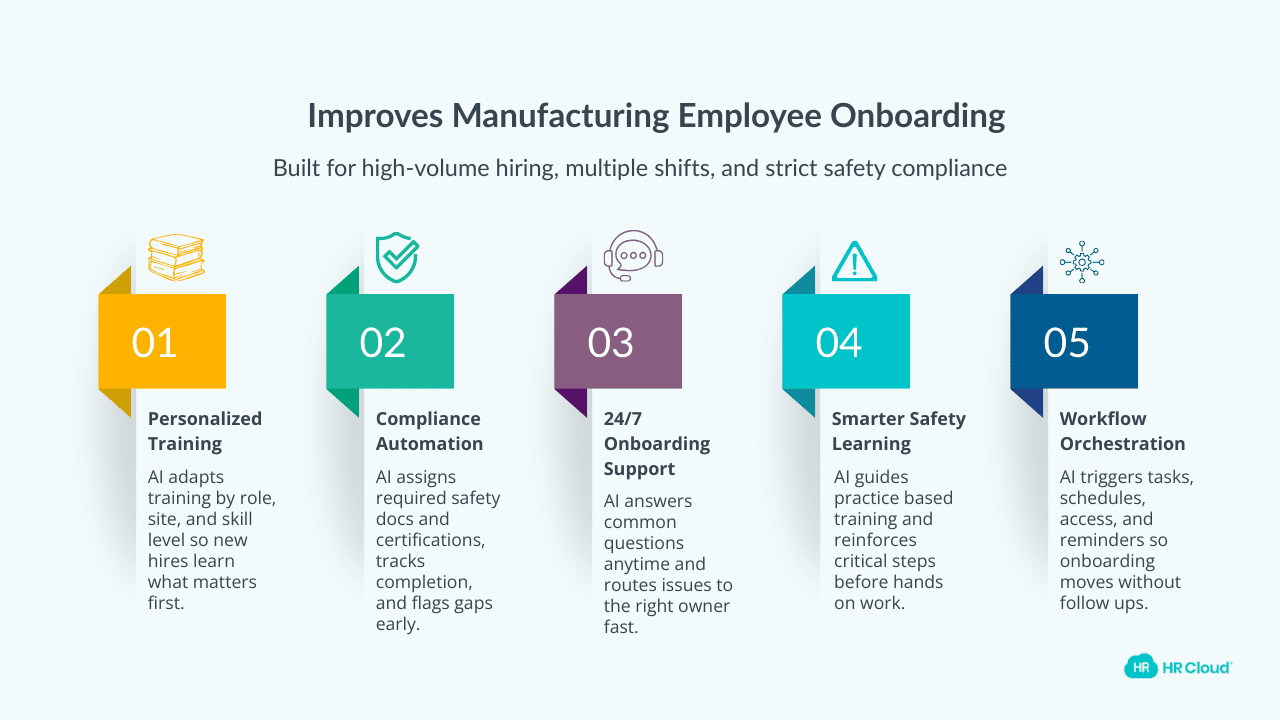
Here's how AI actually improves manufacturing employee onboarding, with specific examples you can implement.
1. Personalized Training Paths for Every Role on the Floor
Traditional onboarding treats everyone the same. A 20-year machinist switching companies gets the same basic training as someone who's never worked in manufacturing. That's inefficient for you as an employer and probably the new hire finds it insulting.
An AI learning management system for manufacturing can assess each new hire's existing skills through a brief assessment, then automatically create customized training plans.
Example: An experienced forklift operator transferring from a competitor gets a fast-track module on your specific equipment and facility layout, just revising the basics they already know. Meanwhile, a new-to-manufacturing hire gets foundational safety training before any equipment-specific content.
This means your experienced hires reach productivity faster. New hires get the foundation they actually need. Everyone gets the training they need.
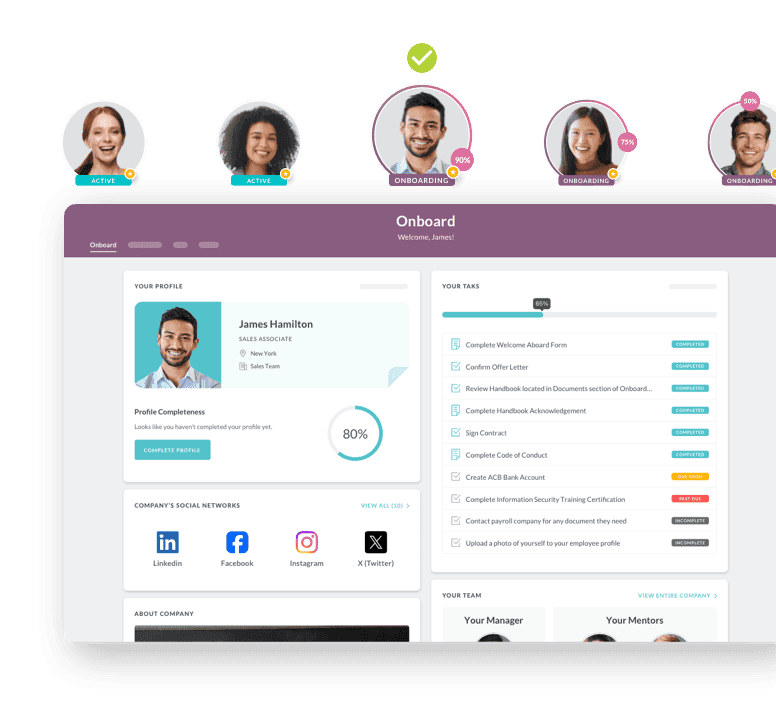
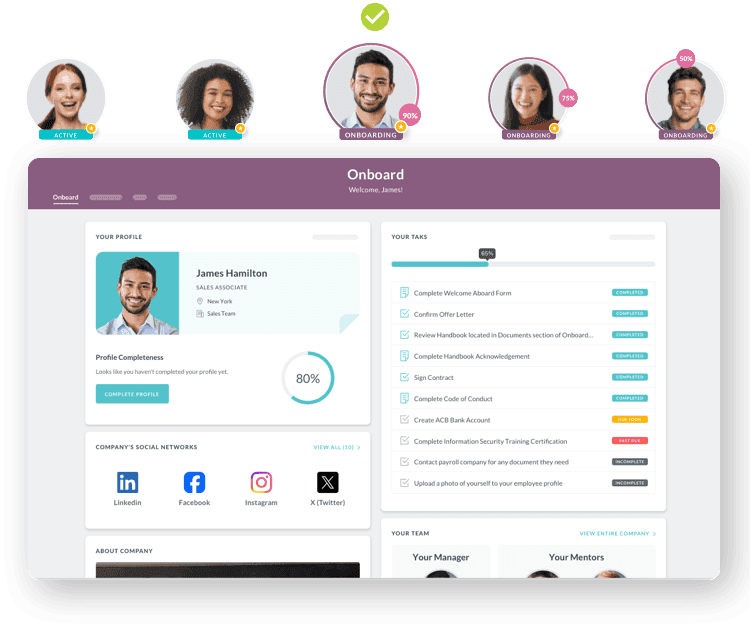
2. Automating Compliance and Documentation for a Safer Workplace
Compliance paperwork is tedious but critical. Missed safety acknowledgments, incomplete certifications, or undocumented training create real legal exposure as well as real safety risks.
AI onboarding software automates the entire compliance onboarding workflow:
- Automatically assigning required training based on role and work area
- Tracking completion with timestamps
- Flagging gaps before they become problems
- Creating audit-ready documentation without manual effort
Example: An AI system flags that a new hire hasn't completed their forklift certification acknowledgment before their scheduled first shift operating equipment. Automated reminders go to both the employee and supervisor, with escalation built-in if the deadline approaches without completion. When it’s time for auditors, every document is timestamped and accessible.
Using AI ensures that nothing falls through the cracks when you're onboarding dozens of workers across multiple shifts.
Download Your Free Manufacturing Onboarding Checklist
Ensure your new hires are ready for success right from day one. This checklist covers all the essentials—safety compliance, training, and seamless integration for your frontline workers.
Download Now
3. Providing 24/7 Support with AI-Powered Onboarding Assistants
Say your new hires have questions late at night before they join the next day. Your HR team isn't available then or at the start of morning shift when the new hire works into the building with questions nagging at them. That is a less than ideal situation for new hire retention.
AI chatbots trained on your company-specific information—shift schedules, PPE requirements, facility layouts, parking, break room locations— can provide instant answers whenever workers need them. Even if they do not get all their answers at that point, but the bot escalates it to the right person and communicates as much, the new hires feel you have their back, and that is all that matters.
Example: A new hire on night shift wonders where to find the safety data sheets for cleaning chemicals she'll be using. Instead of waiting until morning to track down a supervisor, she asks the AI assistant and gets an immediate, accurate answer with a direct link to the documents.
Digital onboarding for manufacturing workers means support that matches their schedules and is independent of HR's business hours.
4. Enhancing Safety Training with AI and Immersive Simulations
Watching a 45-minute safety video doesn't create behavior change because that takes time. You can start with that behaviour change with interactive, role-specific training.
AI can power realistic simulations for hazardous tasks, allowing new hires to practice correct procedures in safe environments before touching actual equipment. The AI provides real-time feedback on mistakes, something a static video can never do.
Example: New hires practice lockout/tagout procedures on a virtual machine. The AI system tracks their actions, identifies errors, and provides immediate correction. By the time they approach real equipment, the correct procedure is already practiced and reinforced.
Smart factory training and onboarding makes safety training engaging and effective, while also meeting compliance criteria.
5. Reducing Onboarding Time with AI-Driven Workflows
AI doesn't just help individual tasks; it orchestrates the entire onboarding journey, coordinating activities that currently require manual scheduling and follow-up.
- Schedule training sessions based on new hire role and supervisor availability
- Automatically provision system access the moment an offer is accepted
- Assign buddies or mentors based on shift alignment and experience
- Trigger notifications when milestones are complete or overdue.
Example: A candidate accepts an offer on Friday. By Monday morning—without needing any manual HR intervention—their training schedule is set, their supervisor has received onboarding checklists, their buddy has been notified, and uniform ordering is triggered.
Reducing onboarding time with AI means new hires are productive faster.
Benefits of Using AI in Manufacturing Onboarding
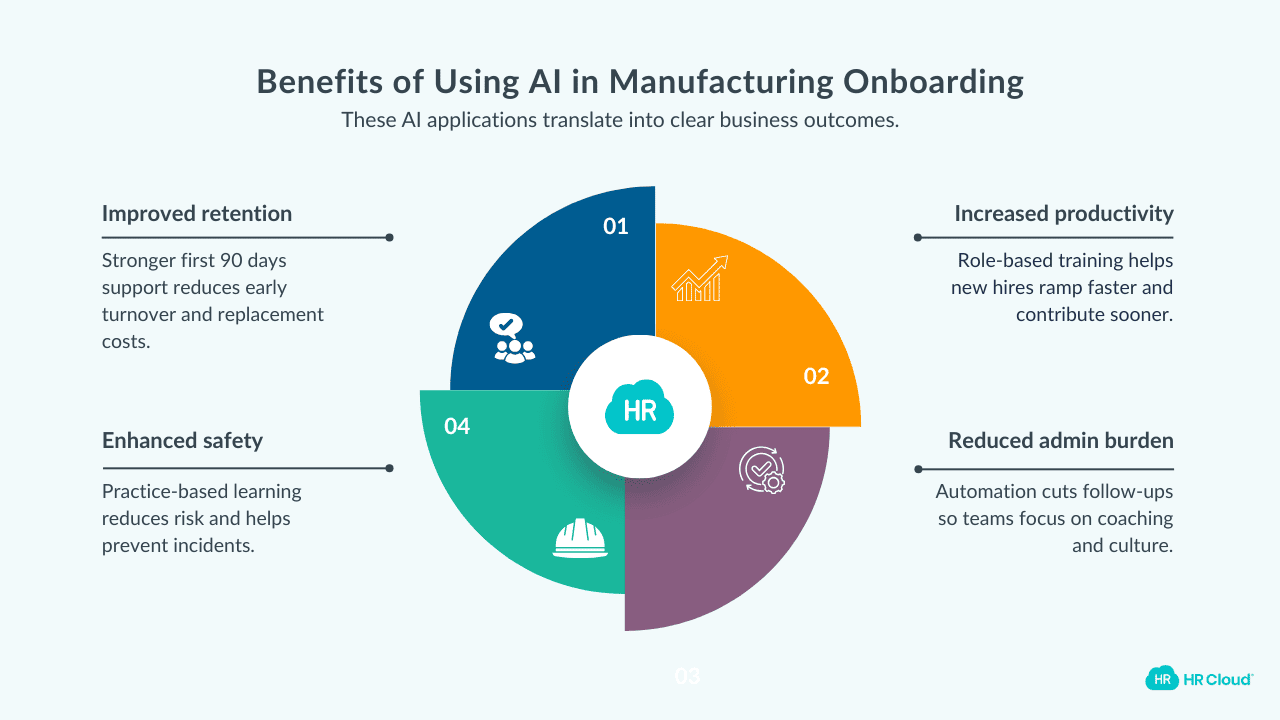
These AI applications translate directly into business outcomes:
- Improved retention: Better training and support during the first 90 days directly reduces turnover. Given that replacing a frontline worker costs thousands of dollars, even modest retention improvements pay for the technology investment.
- Increased productivity: Personalized training paths and reduced administrative delays mean new hires reach full productivity faster. That's more output from your workforce investment.
- Enhanced safety: Interactive training reduces the incidents that can occur when new workers encounter hazards. Research shows comprehensive safety training reduces workplace injuries by 50%.
- Reduced administrative burden: Using AI for HR automation frees HR and operations managers to focus on the human elements of onboarding—relationship building, mentoring, culture integration—that AI can't replace.
How to Get Started with AI in Your Manufacturing Onboarding Process
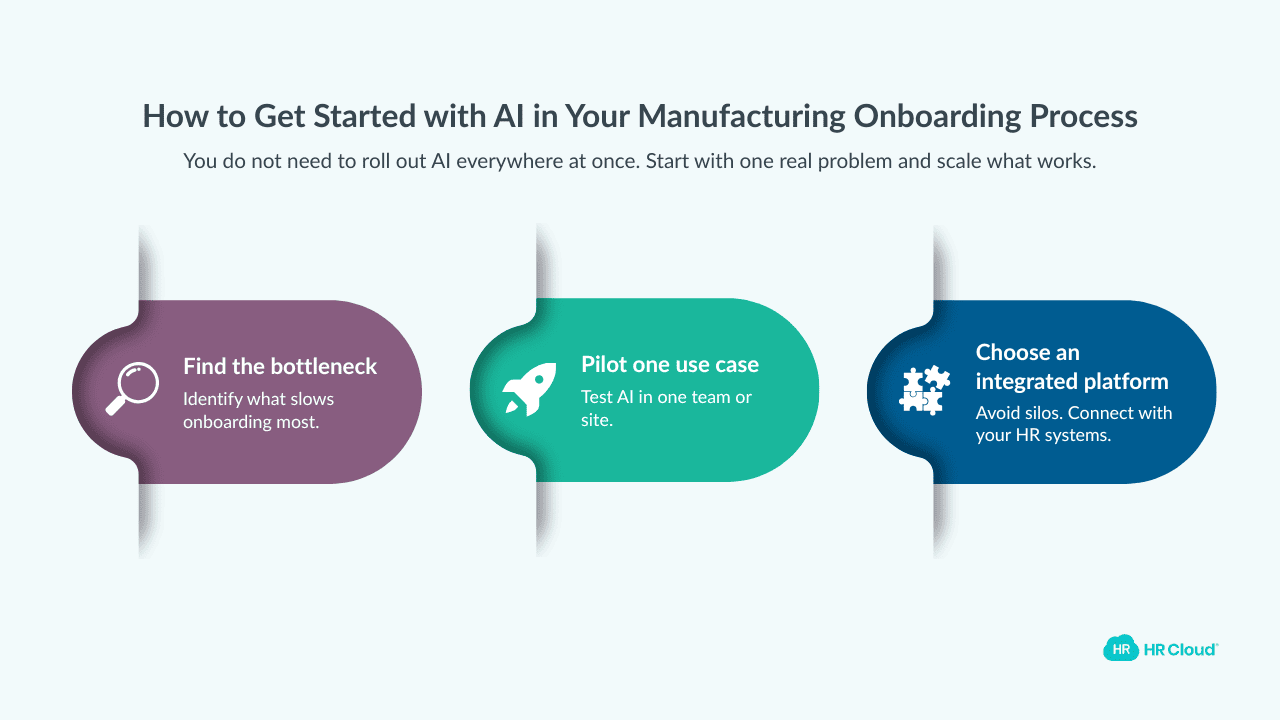
You don't need to introduce AI into all the processes and workflows at once. Here's a practical path forward:
Step 1: Identify your biggest bottleneck.
Where does your current onboarding process create the most friction? Paperwork completion? Safety training consistency? New hire questions that nobody answers? Start there.
Step 2: Start small with a pilot program.
Implement an AI solution for one pain point. Maybe an onboarding chatbot for a single facility, or automated compliance tracking for one department. Learn what works before scaling.
Step 3: Look for integrated solutions.
Standalone AI tools create new silos. AI HR tools for manufacturing work best when they're part of a larger platform that connects onboarding to your existing HR systems.
The goal isn't to adopt AI for its own sake. It's to solve real problems your manufacturing onboarding process faces today.
The Future Is Here: Embrace AI for a Smarter Onboarding Experience
AI in manufacturing HR isn't a futuristic concept anymore. You can start using it as a practical tool solving real problems right now. Personalized training, automated compliance, 24/7 support, and intelligent workflow orchestration are available today.
And know this: AI employee onboarding does not mean that you are replacing human connection. You are, in fact, working towards freeing up human capacity for the things that actually need humans, such as building relationships, providing mentorship, creating culture.
Your frontline workers deserve onboarding that's personalized to their role, available when they need it, and designed to set them up for success. AI makes that possible at scale.

Discover how our HR solutions streamline onboarding, boost employee engagement, and simplify HR management
Book Your Free DemoFAQs
What is AI employee onboarding in a manufacturing context?
AI employee onboarding in manufacturing uses artificial intelligence to automate, personalize, and streamline new hire integration. This includes AI-driven training modules customized for specific equipment and roles, automated compliance tracking for safety certifications, and 24/7 chatbots answering questions about shifts, procedures, and facility information.
How can AI improve safety training for new manufacturing workers?
AI enhances safety by enabling personalized training paths focused on each worker's specific role and risk exposure. It powers realistic simulations for practicing hazardous procedures safely, automates certification tracking to ensure no one starts without required training, and provides real-time feedback during interactive training modules.
Will AI replace HR managers in the manufacturing onboarding process?
No. AI augments HR managers by handling repetitive administrative tasks—paperwork processing, scheduling, basic questions—freeing HR professionals to focus on human elements. Elements such as building relationships, mentoring new hires, fostering culture, and addressing complex situations that require human judgment and empathy.
Is AI onboarding software difficult to implement in a manufacturing facility?
Modern AI onboarding software is typically cloud-based and designed for straightforward implementation. The best solutions integrate with existing HR systems rather than requiring separate infrastructure. Starting with a specific pain point—like automating document collection or implementing a chatbot—makes adoption manageable and demonstrates value quickly.
About the author

Keep Reading


Like What You Hear?
We’d love to chat with you more about how HR Cloud® can support your business’s HR needs.
Book Your Free Demo