What's the Best Way to Onboard Frontline Manufacturing Workers Who Don't Have Email?

The best way to onboard frontline manufacturing workers who don't have email is mobile-first, SMS-based onboarding software that collects I-9s, W-4s, and safety sign-offs from a personal phone or a shared plant kiosk, with no company email address or login required anywhere in the process. In practice, this means choosing frontline employee onboarding software built around a phone number instead of an inbox: it replaces paper packets and email-dependent portals with text-message links, works in the languages your workforce actually speaks, and routes safety and compliance forms automatically so nothing gets missed between shifts, supervisors, or plants.
This piece covers what it actually takes to build that, why the paper-and-email approach keeps failing on the factory floor, what mobile-first onboarding solves that email-based systems can't, and what measurably changes on the production line once it's fixed.
Why Traditional Onboarding Fails on the Factory Floor
Most onboarding software, even software marketed as modern, is still built around a corporate email address as the front door. That single design assumption breaks the moment it reaches a production floor, and it's the reason so many plants are still running onboarding on paper, clipboards, and whatever the shift supervisor remembers to hand out on a given morning.
No corporate email or desk access
A recent analysis of frontline digital access found that roughly 80% of the global workforce has no desk, no company laptop, and no corporate email address at all. Among frontline workers specifically, the same reporting put the number without a corporate email login at 83%. Manufacturing sits squarely inside that group: machine operators, assemblers, line workers, warehouse staff, and production technicians who spend eight to twelve hours a shift on their feet, not at a keyboard.
When onboarding software assumes an email inbox as the starting point, it locks out the majority of the people it's supposed to be onboarding. HR teams end up improvising around the gap: collecting a personal Gmail address just to send a form, texting a PDF link and hoping it opens correctly on a small screen, or falling back to paper because at least paper doesn't require an account. Each workaround creates its own failure mode. Personal email addresses go unchecked for days. PDFs formatted for a desktop screen render as unreadable on a phone, forcing a worker to zoom, scroll sideways, and often give up before finishing a form they'd have completed in minutes on a properly built mobile flow. And paper, the oldest workaround, still has to be scanned, filed, and manually keyed into whatever system HR uses to track it, which reintroduces the exact administrative burden mobile onboarding is supposed to remove in the first place.
The deeper issue is that none of these are edge cases confined to a handful of unusual hires. When 83% of frontline workers have no corporate email address, an onboarding process that requires one isn't accommodating an exception, it's failing the majority of the people going through it by design, and every workaround HR builds around that failure is a patch on a foundation that was never built for the workforce actually using it.
High-volume hiring with tight start-date windows
Manufacturing onboarding rarely happens one hire at a time. Seasonal production ramps, new line launches, and constant backfill against turnover mean plants frequently need to onboard 20, 50, or more workers in a single week, each tied to a hard start date that lines up with a specific shift schedule, not a flexible office start date that can slip by a few days without consequence.
Bureau of Labor Statistics data analyzed through 2026 put estimated annual manufacturing turnover at roughly 30% to 35%. For a facility with 500 employees, a 30% turnover rate means replacing approximately 150 workers every year, which works out to close to three new hires a week, every week, indefinitely, not as a one-time seasonal spike. Onboarding systems designed around a trickle of eight to ten office hires a month were never built to absorb that kind of continuous volume, and they buckle at exactly the moment a plant needs them to hold. Every hour an onboarding system spends on manual data entry or paper-chasing during a hiring surge is an hour it isn't spending getting a worker cleared for their first shift, and at 150 hires a year, those hours compound fast.
Seasonal spikes make the problem worse, not just steadier. A plant that ramps production ahead of a peak season, or opens a new line with a hard go-live date, doesn't get to onboard those workers gradually over a quarter; it needs all of them cleared, trained, and certified inside a window measured in days. A paper-based process that works, barely, at a rate of five new hires a week falls apart completely at fifty, because the bottleneck isn't the forms themselves, it's the number of human hours available to chase signatures, scan documents, and manually verify that nothing was missed.
What Does "Frontline Onboarding" Actually Require?
Frontline manufacturing onboarding has to clear two very different bars at the same time: the standard administrative paperwork every employee in the country completes, and a second, heavier layer of safety and compliance work that carries real legal exposure and real physical risk if any part of it gets skipped. The general framework for what strong onboarding covers, sometimes summarized as the 4 Cs of onboarding, still applies here; manufacturing just adds a compliance layer most other industries don't carry.
Safety training, equipment certification, compliance forms
Every new hire, regardless of industry, still needs the basics handled: I-9 identity and work-eligibility verification, W-4 tax withholding forms, direct deposit setup, and signed acknowledgment of company policies. On a production floor, that baseline gets layered with a second tier of requirements that don't exist in most office jobs: equipment-specific certifications such as forklift operation, lockout/tagout procedures for machinery maintenance, and overhead crane qualifications, plus PPE requirements that vary by department and role-specific OSHA training obligations that, depending on the equipment and hazard involved, often have to be satisfied before a worker is authorized to operate it, not sometime after.
None of this is optional paperwork that can wait until week two. Under the General Duty Clause, Section 5(a)(1) of the Occupational Safety and Health Act, employers are required to provide a workplace "free from recognized hazards that are causing or likely to cause death or serious harm to employees," and OSHA's Personal Protective Equipment standard separately requires every general-industry employer to conduct a documented hazard assessment before assigning PPE. Multi-state manufacturers carry an added layer of complexity on top of that baseline: of OSHA's approved State Plans, 22 cover private-sector workers (the other 7 apply only to state and local government employees), and those private-sector State Plans are permitted to set standards more stringent than the federal requirement, which means a single national onboarding checklist can genuinely undercount what a specific plant needs to collect depending on which state it sits in.
BLS data shows manufacturing recorded 355,800 total recordable injury and illness cases in 2023, a rate of 2.8 cases per 100 full-time workers, down from the year before. New hires carry more of that risk than tenured workers do. Peer-reviewed research from the Institute for Work & Health, published in Occupational and Environmental Medicine, found that workers in their first month on a job face roughly three times the risk of a lost-time injury compared with workers who have more than a year of tenure, a finding that has held across a decade of follow-up data and is now standard guidance among occupational safety agencies. Treating required safety steps as paperwork to clear rather than a readiness gate a worker has to pass increases the odds that a documentation or training gap reaches the production floor. For a broader look at sequencing this correctly across a new hire's first weeks, not just the software layer, see HR Cloud's guide to manufacturing onboarding best practices.
Core Challenges of Onboarding Deskless Manufacturing Workers
Once onboarding assumes an inbox that doesn't exist, the failure shows up downstream in four distinct, recurring ways, and plants running paper-and-email onboarding today are usually dealing with some combination of all four at once, not just one in isolation, each compounding the others.
Paperwork bottlenecks before day one
When onboarding forms have to be printed, filled out by hand, scanned, and emailed back, the entire process depends on the new hire having access to a printer, a scanner, and a personal email address, none of which is a safe assumption for someone who just accepted a production job. In practice, this means paperwork gets pushed to the first shift itself: the new hire spends their first hours in a break room filling out forms instead of meeting their supervisor or starting hands-on training, and HR spends that same time chasing signatures instead of processing the next hire in the pipeline.
Inconsistent onboarding across shifts and plants
A worker who starts on first shift under one supervisor frequently gets a meaningfully different onboarding experience than someone who starts on third shift under another, or someone hired at a different facility entirely. Without a system that enforces one sequence of steps regardless of who's supervising, safety training quality becomes dependent on which individual happens to be on the floor that day and how thorough they personally choose to be, which is precisely the kind of unmanaged variability that produces training gaps nobody notices until an audit or an incident surfaces them.
Language barriers
Manufacturing workforces are frequently linguistically diverse, and standard onboarding forms and portals built exclusively in English create a genuine comprehension gap for workers whose first language is something else. A worker who signs a safety acknowledgment or a policy form they can't fully read may not actually understand what they're agreeing to, which turns a language gap into a compliance risk and a fairness problem at the same time, not just an inconvenience.
In practice, plants without multilingual onboarding tend to solve this informally: a bilingual coworker translates on the fly, a supervisor summarizes the key points verbally, or the worker signs and hopes the details don't matter later. None of those informal fixes produce a documented record that the worker actually understood what they signed, which is precisely the kind of gap that turns into a problem the first time a safety incident or a wage dispute puts that understanding in question.
Low engagement with digital HR portals
Even plants that have already moved onboarding online frequently see poor completion rates from frontline workers on generic HR portals built with an office login in mind. That's usually a sign the plant adopted general-purpose deskless workforce HR tools that weren't actually built around a five-minute, on-the-floor completion window. Those portals typically assume a user is sitting at a desk with time to spare, when in reality a frontline worker is more likely completing the process during a short break between tasks, on a phone, with limited patience for a slow-loading, desktop-oriented interface. The result is stalled progress, missed deadlines, and workers who eventually give up on the digital process and fall back to asking HR for a paper copy instead, which means the plant ends up maintaining both a digital system and a paper fallback in parallel, the worst of both approaches rather than the benefit of either one.
What Mobile-First Onboarding Solves
Mobile-first onboarding software is built around the device frontline workers already carry and the identifier they actually have, an employee ID or a phone number, instead of the company laptop and email address they don't. This is a subset of a broader shift already underway across deskless onboarding software generally, applied here specifically to the compliance load manufacturing carries; mobile onboarding for manufacturing has to clear the same safety and certification bar described above, not just collect a signature. Solving the email problem alone without also solving the shared-device problem, for instance, just leaves out the workers who don't own a personal phone; the fixes below are meant to work together, not as a menu to pick one from.
SMS document collection from a personal phone
Instead of an email containing a login link, new hires receive a text message with a direct, secure link to their onboarding forms the moment they're added to the system. There's no account to create and no company email required at any step. From that single text, a worker can complete I-9 verification, W-4 forms, direct deposit setup, and policy acknowledgments on their own phone, on their own schedule, ahead of their first shift rather than during it.
Kiosk mode for shared devices
Not every plant can assume every worker owns a personal smartphone with a reliable data plan, particularly in facilities with a large seasonal or entry-level workforce. Kiosk mode closes that gap directly: a shared tablet or terminal placed in the break room, at the HR desk, or near the timeclock runs the identical mobile onboarding flow used on personal phones, except each worker logs into their own individual session on the shared hardware and logs out when finished, so the same device can be used by dozens of different new hires in a single day while keeping each worker's forms and signatures in their own separate session. It's the same underlying workflow and the same safety and compliance sequencing as the personal-phone experience, just running on hardware the plant supplies rather than hardware the worker has to bring.
Multilingual form support
Multi-language support is what closes the comprehension gap described earlier: workers complete paperwork and safety content in a language they're actually comfortable reading, not just English with translation treated as an afterthought. HR Cloud lists multi-language support as a standard part of its manufacturing offering rather than a custom add-on, which is the level of support worth confirming before signing with any vendor.
Automated task routing to safety/compliance teams
When configured, a completed form or an uploaded certification document routes automatically to whoever needs to review it, whether that's a plant safety manager confirming a forklift certification, an HR administrator verifying I-9 documentation, or a department lead approving a role-specific waiver. Nobody has to remember to forward an email, walk a paper file down the hall, or manually flag a completed form for review, and the review activity creates a trackable, timestamped history, the kind of record a compliance inspection or an incident investigation will eventually ask for.
How Manufacturers Are Solving This Today
There's no single vendor or product that manufacturing HR teams have standardized on, and the specific manufacturing onboarding software varies plant to plant. What's consistent, wherever it's actually working, is the sequence: push everything that doesn't require standing on the production floor into pre-boarding, deliver it by text instead of email, and reserve the actual first shift for orientation, introductions, and hands-on training rather than administrative catch-up.
Case pattern: reducing paperwork time before first shift
HR Cloud customer Duro-Last, a manufacturer with 823 employees, has run its onboarding through the platform for more than five years as an ADP Marketplace customer, one of the more established manufacturing relationships in HR Cloud's customer base. The clearest published proof of this pattern working at scale comes from outside manufacturing specifically: Veolia North America, an environmental services operator with a largely field-based workforce that often lacked email or desktop access, rolled the same onboarding approach out to more than 10,000 employees and reports a 75%+ mobile onboarding completion rate, with 80%+ of onboarding workflows now run directly by HR rather than routed through IT. Manufacturers adopting this approach are following the same underlying logic already proven at that scale in another deskless, shift-based industry: move the paperwork earlier, make it phone-completable, and let the first physical shift be about the job itself. [VERIFY: a manufacturing-specific published case study with a named percentage result does not yet exist in HR Cloud's customer story library at hrcloud.com/customer-area-listing as of this writing; treat the direction of this result as established in deskless industries generally, evidenced by Veolia, not yet as a manufacturing-specific published metric, until such a case study is published.]
A new hire's first shift starts with a supervisor introduction, a tour of the work area, and hands-on training, not a stack of forms and a pen.
Industry estimates built on BLS data put the typical cost of hiring an entry-level production operator at roughly $3,000 to $6,000 once recruiting, screening, and onboarding administration are all counted, and that figure applies to every single one of the 150 or so hires a 500-person, 30%-turnover plant makes in a year. A paperwork process that adds friction, delay, or errors at that volume isn't a minor administrative annoyance; it's a cost that compounds by the hundreds across a single year, and it compounds again every year turnover stays where it currently sits.
Step-by-Step: Building Mobile-First Onboarding
None of this requires replacing an existing payroll system or rebuilding HR infrastructure from scratch. It requires digitizing the specific parts of onboarding currently trapped on paper, roughly in the order below.
Step 1: Digitize every onboarding form
Start with a complete inventory of every document a new hire currently signs on paper: I-9, W-4, direct deposit authorization, employee handbook acknowledgment, PPE agreements, and any equipment-specific waivers particular to your plant. Each one needs to become a genuinely mobile-completable e-form with a legally valid e-signature attached, not a scanned PDF that still has to be printed, signed by hand, and re-scanned, which is a common half-measure that looks digital but preserves the same bottleneck.
Step 2: Set up SMS-based delivery
Once forms exist in digital form, the delivery channel matters just as much as the form itself. Configure the system to text new hires a secure onboarding link the moment they're added to it, rather than emailing that link to an address they may not have, may not check, or may not trust with sensitive personal information. This is the step that actually solves the no-email problem directly; digitizing the forms without also changing the delivery channel just moves the exact same email bottleneck online instead of removing it.
Step 3: Add kiosk access for shared devices
For plants where not every worker owns a reliable personal smartphone or has consistent mobile data, set up kiosk mode on a shared tablet placed in the break room, at the HR desk, or on the floor near the timeclock where new hires naturally pass through. Each worker logs into their own individual session on the shared device, completes their forms and safety sign-offs, and logs out when finished, which means a single kiosk can serve many workers across a shift while keeping each person's records in a separate session.
Step 4: Automate safety training sign-off
Map every role in the plant to the specific safety training and equipment certifications it legally requires, then configure the system to assign that training automatically the moment someone is hired into that role, rather than relying on a supervisor to remember which modules apply. As a design principle, a newly hired forklift operator should have forklift certification training assigned without anyone having to add it manually, with completion timestamped, which is what turns a training requirement into an auditable record rather than a verbal assurance. The system tracks and assigns the requirement; the actual certification training itself is typically delivered through the plant's existing training program, not the onboarding software.
Step 5: Track completion by plant/shift
Set up a real-time dashboard that breaks onboarding completion status out by individual plant, shift, and supervisor, rather than reporting a single company-wide percentage that hides where the actual gaps are. This is what makes it possible to catch the exact problem described in the "inconsistent onboarding" challenge above, the specific supervisor or shift where new hires are consistently falling behind on safety sign-off, while it's still a data point on a dashboard and before it becomes a compliance finding or an incident report.
The tracking itself should answer three questions at a glance for anyone managing onboarding across more than one shift: who has started but not finished, who is overdue against the timeline their role requires, and whether any one shift or supervisor shows a pattern that the others don't. A dashboard that only reports a single completion percentage for the whole plant hides all three of those answers behind one number, which defeats the purpose of tracking completion in the first place.
How HR Cloud's Onboard Product Works for Plant Workers
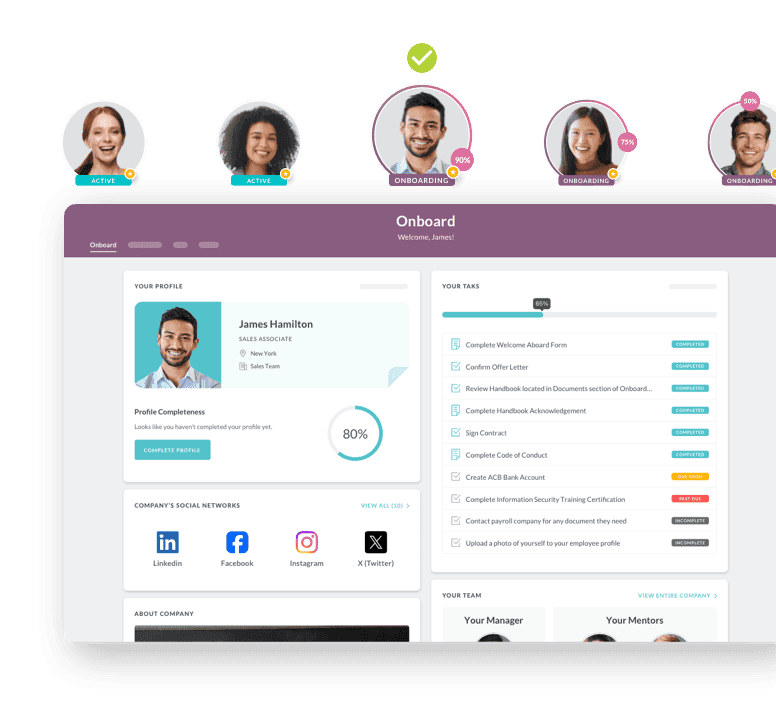
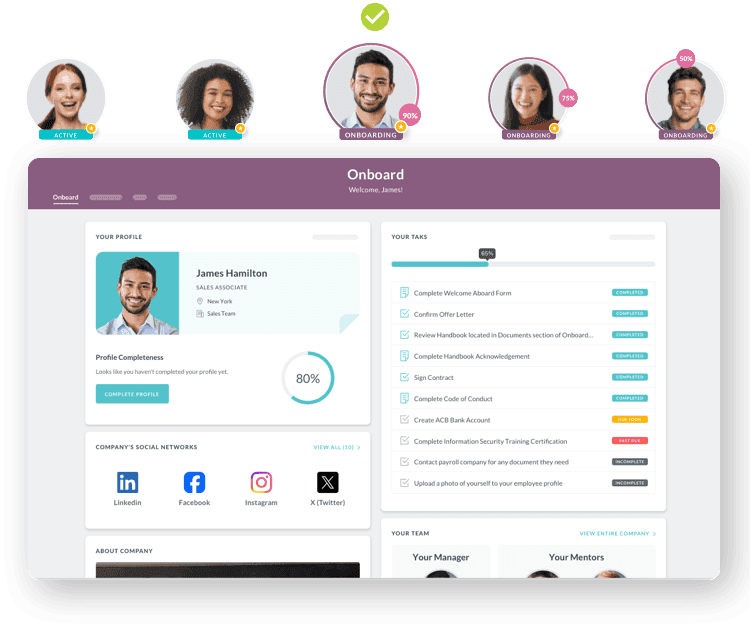
HR Cloud's Onboard product is built around the mobile-first, no-email model described throughout this guide, applied specifically to the compliance load that manufacturing carries on top of standard HR paperwork. As manufacturing onboarding software goes, the differentiator isn't a longer feature list, it's whether the product was actually designed around a workforce that mostly doesn't have a company email address. HR Cloud also maintains a dedicated frontline HR page and a manufacturing industry page covering the full suite beyond onboarding, including time tracking with geolocation, multi-language support, and OSHA credential tracking for plant floor teams.
SMS onboarding without requiring email
New hires receive a secure SMS invitation the moment they're added to the system, sent through Twilio, and complete I-9 verification, W-4 forms, direct deposit setup, and policy acknowledgments directly from their phone, with no company email address, account creation, or app download required at any step. The I-9 form carries its own deadline logic: Section 1 locks if the employee hasn't completed it by their start date, and Section 2 locks if it isn't finished by Day 3, which keeps the process audit-ready without HR having to track the deadline by hand. HR Cloud reports a 96% mobile completion rate across its customer base; its own savings calculator estimates $30 to $48 per employee from skipping a corporate email license, though that figure is a marketing-tool estimate rather than an audited average and is worth treating as directional, not a guaranteed number for any specific plant.
Automated compliance form routing
Safety certifications, equipment-specific waivers, and I-9 documentation can be configured to route automatically to whichever reviewer needs to see them, whether that's a plant safety manager confirming a forklift certification or an HR administrator verifying identity documents, with a trackable review history behind each one. That history is what an HR team actually needs to produce during an OSHA inspection or an internal compliance review, rather than reconstructing who reviewed what from memory or a paper filing cabinet after the fact.
The routing itself is role-based rather than one-size-fits-all, which matters because a safety manager and an HR administrator are usually looking for different things in the same stack of new-hire paperwork. A safety manager needs to confirm that a forklift certification is current and that the right training module was actually completed, not just uploaded. An HR administrator is verifying identity documents against I-9 requirements and confirming tax forms are filled out correctly. Routing each document type to the person actually responsible for reviewing it, instead of dropping everything into one shared inbox for whoever gets to it first, is what keeps the review step from becoming its own bottleneck once hiring volume picks up.
Multi-plant visibility for HR teams
For manufacturers running more than one facility, a dashboard shows onboarding status across every plant, broken out by location and role and, when configured for it, by shift, rather than requiring a separate check-in with each site's HR contact. That centralized view is what lets a corporate HR team manage onboarding consistency across a dozen locations simultaneously, and it's the same underlying visibility that made it possible for a deployment the scale of Veolia's, more than 10,000 field employees onboarded through one system, to stay manageable from a single team rather than requiring a parallel HR process at every site.
For a corporate HR function overseeing several plants, that visibility changes the nature of the job itself. Instead of calling each site's HR contact to ask how onboarding is going this week, a director can open one dashboard and see, at a glance, which plant is behind on safety sign-off and, where shift-level tracking is configured, which shift within that plant is the actual source of the gap, and whether the issue is a training bottleneck, a staffing gap in HR, or a supervisor who needs a reminder about the process. That's the difference between managing onboarding reactively, after a problem has already surfaced, and managing it as a number that's visible before it becomes one.
Common Onboarding Mistakes in Manufacturing
Even plants that invest in genuinely better onboarding software can undercut that investment with two mistakes that show up repeatedly across implementations. Both are less about the software itself and more about an assumption baked into how it gets rolled out, which is exactly why they're easy to miss during a vendor evaluation and expensive to discover afterward.
Assuming all workers have reliable internet/email
Kiosk mode exists specifically because not every worker has a personal smartphone with dependable mobile data, and a mobile-first onboarding system with no shared-device fallback quietly excludes exactly the workers who most need the alternative to paper. Rolling out a phone-only solution and assuming adoption will follow is a common and avoidable failure mode; it recreates the original access problem in a new digital form instead of solving it. The plants that get this right typically ask a simple question before rollout, not after: what share of this specific workforce owns a personal smartphone with reliable data, and where is the shared-device kiosk actually going to sit so it's convenient enough that workers use it instead of defaulting back to paper.
No tracking of incomplete safety documentation
A system that collects safety sign-offs without clearly surfacing which ones remain incomplete is only solving half the problem. Without a real-time, shift-by-shift view of exactly who hasn't finished required training, a gap in coverage can sit unnoticed for weeks, discovered only when an OSHA auditor asks for documentation that doesn't exist, or worse, after an incident makes the missing training impossible to ignore.
Results: What Faster Onboarding Delivers
The gap between the two approaches is which workers the system can actually reach, and how much of the process happens before a new hire ever sets foot on the floor for their first paid shift.
| Metric | Paper-and-email onboarding | Mobile-first onboarding |
|---|---|---|
| Where paperwork happens | First shift, in person, on the clock | Before day one, from a personal phone or shared kiosk |
| Safety training consistency | Varies by individual supervisor and shift | Same required sequence, applied to every hire, every shift |
| Completion visibility | Manual, discovered after the fact | Real-time, broken out by plant and shift |
| Primary access requirement | Corporate email address or desk access | Personal phone or shared kiosk; no company email needed |
| Multilingual support | Typically none, or handled ad hoc | Built into forms, SMS, and training content |
Reduced time-to-productivity on the floor
Moving paperwork and safety sign-off ahead of the first shift means a new hire's actual first day on the floor is spent on supervisor introductions, a tour of the work area, and hands-on training, rather than filling out forms that could have been finished days earlier. Given that BLS-based industry estimates put full productivity for a new production operator at roughly one to three months even under ordinary conditions, and that a mid-sized plant running 30% annual turnover is effectively hiring at a rate of close to three people a week year-round, removing paperwork delay from the front of that ramp-up window is one of the few onboarding changes with a direct, compounding effect on how quickly new hires become useful on the line, multiplied across every hire the plant makes that year.
Conclusion
Frontline manufacturing workers don't need a smaller, mobile-shaped version of office onboarding software. They need onboarding built from the ground up around the phone they carry, the shift they work, and the safety requirements the job legally demands, with no corporate email address required anywhere in the sequence. Mobile-first, SMS-based onboarding, paired with kiosk access for the workers who don't have a personal smartphone, closes that gap without asking a manufacturer to switch payroll providers or rebuild its HR technology stack from the ground up.
If a plant's current onboarding process still quietly assumes every new hire has a company email address and a few uninterrupted hours at a desk to use it, that single assumption is very likely the largest blocker standing between where onboarding is today and where it needs to be to keep up with the hiring volume manufacturing actually runs on.
Fixing it doesn't require a wholesale technology overhaul or a change of payroll provider. It requires digitizing the forms, changing the delivery channel from email to SMS, adding a kiosk option for the workers without a personal smartphone, and building visibility into completion status by plant and shift instead of a single company-wide number. Each of those steps is small on its own. Together, applied consistently across every new hire a plant brings on, they're the difference between an onboarding process that quietly excludes the majority of the workforce it's meant to serve and one that was actually built for the people doing the work.
This is the kind of shift worth seeing on a live plant setup rather than reading about secondhand: book a demo of Onboard and walk through your own hiring volume and shift structure directly. If you'd rather run the numbers first, HR Cloud's onboarding ROI calculator takes your actual headcount and turnover rate and estimates the difference before you bring it to a budget conversation.

Discover how our HR solutions streamline onboarding, boost employee engagement, and simplify HR management
Book Your Free DemoFAQs
Can onboarding be completed without a personal email address?
Yes. Mobile-first onboarding platforms deliver forms by SMS text message to a personal phone number rather than by email, so new hires complete I-9s, W-4s, direct deposit setup, and policy acknowledgments without ever needing a corporate or personal email account at any step.
How do kiosks work for shared-device onboarding?
A shared tablet or terminal placed in a break room or near the timeclock runs the same mobile onboarding flow used on personal phones. Each worker logs into an individual session, completes their own forms and safety sign-offs, and logs out, so one shared device can onboard dozens of workers across a shift while keeping each person's records in a separate session.
What multilingual support should manufacturers look for in onboarding software?
Look for multi-language support built into the platform itself, not bolted on as a manual translation step. HR Cloud lists multi-language support as a standard part of its manufacturing offering, alongside OSHA credential tracking, so workers can complete paperwork and safety training in a language they're comfortable reading rather than in English only. Confirm with the vendor exactly which pieces (forms, SMS, training content) are covered before assuming full coverage.
How long should manufacturing onboarding take?
Core paperwork and I-9 verification can be fully completed before day one when it's handled through pre-boarding rather than on the first shift. Full productivity for a new production operator typically still takes one to three months according to BLS-based industry estimates, but a faster, mobile-first paperwork process removes delay from the front of that timeline instead of adding to it.
Does mobile-first onboarding replace an existing payroll system?
No. Mobile-first onboarding software is typically layered on top of an existing payroll and HRIS setup rather than replacing it, syncing new-hire data into payroll once onboarding is complete instead of requiring a manufacturer to switch payroll providers to get mobile, no-email onboarding.
What happens if a worker doesn't have a smartphone at all?
Kiosk mode is built for exactly that situation. A worker without a personal smartphone completes the identical onboarding flow on a shared plant tablet or terminal, logging into their own individual session so their forms and signatures stay separate from every other worker who uses the same device.
Who reviews safety certifications once they're submitted?
Completed certifications and safety sign-offs route automatically to whoever is responsible for reviewing them, typically a plant safety manager for equipment-specific certifications and an HR administrator for I-9 and general compliance documents, with a timestamp attached to each review for audit purposes.
Can this work across multiple plants with different supervisors?
Yes. A shared dashboard is designed to show onboarding completion status by location and role, and, when configured for it, by shift and supervisor, which is what lets a corporate HR team enforce the same onboarding sequence everywhere rather than leaving consistency up to whichever supervisor happens to be on the floor at a given site.
About the author

Keep Reading


Like What You Hear?
We’d love to chat with you more about how HR Cloud® can support your business’s HR needs.
Book Your Free Demo