The Complete Guide to Manufacturing Onboarding: Best Practices That Transform New Hire Success

Manufacturing onboarding best practices differ fundamentally from office-based programs because new hires must immediately navigate OSHA compliance, equipment operation, shift-based schedules, and safety protocols where mistakes carry real consequences. The National Association of Manufacturers reports 65% of manufacturing companies struggle with workforce development, and 40% of new employees typically leave within 90 days without structured onboarding. Effective programs combine digital pre-boarding, interactive safety training, structured mentorship, mobile-first platforms for deskless workers, and automated workflows that deliver consistent experiences across every shift and facility.
Why do manufacturers keep losing new hires in the first 90 days?
Manufacturing onboarding best practices exist because the standard office playbook fails on the production floor — new hires face safety protocols, unfamiliar equipment, and shift-based schedules from day one, and without structured support that matches those realities, 40% walk out before the quarter ends.
Is safety training alone enough to fix it?
Not by itself — the most common failure in manufacturing onboarding is information overload on day one, which leaves people overwhelmed rather than equipped, and generic content that ignores role-specific needs only makes it worse.
So what does an effective manufacturing onboarding program actually require?
It needs to start before the first shift with digital pre-boarding, build safety knowledge progressively, pair new hires with the right mentors, and use mobile-first workflows that reach deskless workers on every shift — which is exactly what this guide maps out, phase by phase.
"We lost three new hires in their first week. All of them said the same thing – they felt completely lost and unprepared for the reality of our manufacturing floor."
Sarah Martinez had been the HR director at a leading industrial manufacturing company for eight years, but this conversation with her CEO still haunts her. Like many manufacturing employers implementing traditional onboarding processes, they were struggling with new hire retention challenges. The statistics were stark: 40% of their new employees left within the first 90 days, and exit interviews revealed a consistent theme – inadequate manufacturing onboarding experiences that failed to address industry-specific needs.
Manufacturing presents unique employee onboarding challenges that office-based industries simply don't face. New hires must navigate complex safety protocols, understand specialized equipment operation, and integrate into tight-knit production teams where mistakes can be costly and dangerous. Yet many manufacturers still rely on outdated new hire orientation approaches that leave employees feeling overwhelmed and underprepared for manufacturing work environments.
Effective manufacturing onboarding programs require systematic pre-boarding automation, comprehensive safety training protocols, structured mentorship systems, and integrated technology solutions. Manufacturing companies implementing these best practices achieve 60% higher retention rates and accelerated time-to-productivity for new manufacturing employees. Essential elements include automated compliance documentation workflows, mobile-accessible training modules for deskless workers, and measurable success metrics that track both employee engagement and operational performance outcomes.
Key Takeaways
- Manufacturing onboarding software should begin 1-2 weeks before the employee's start date with digital pre-boarding processes that include I-9 verification, safety orientation videos, and equipment training modules
- Safety training programs must be comprehensive, interactive, and verified through digital tracking systems with automated compliance reporting and real-time progress monitoring
- Buddy/mentor programs accelerate manufacturing employee integration and reduce early turnover by up to 45% when supported by structured workflow automation
- Digital signage and mobile-friendly platforms improve communication on manufacturing floors while supporting deskless worker engagement
- Automated workflow systems ensure consistent onboarding experiences across shifts and locations while reducing administrative burden on manufacturing supervisors
- Cloud-based HRIS integration enables seamless data flow between onboarding platforms, payroll systems, and manufacturing execution software
- Regular feedback collection through employee engagement surveys and process optimization are essential for continuous improvement in manufacturing onboarding programs
- Mobile accessibility features support 24/7 shift operations and enable manufacturing workers to complete training during optimal hours
The Manufacturing Onboarding Challenge
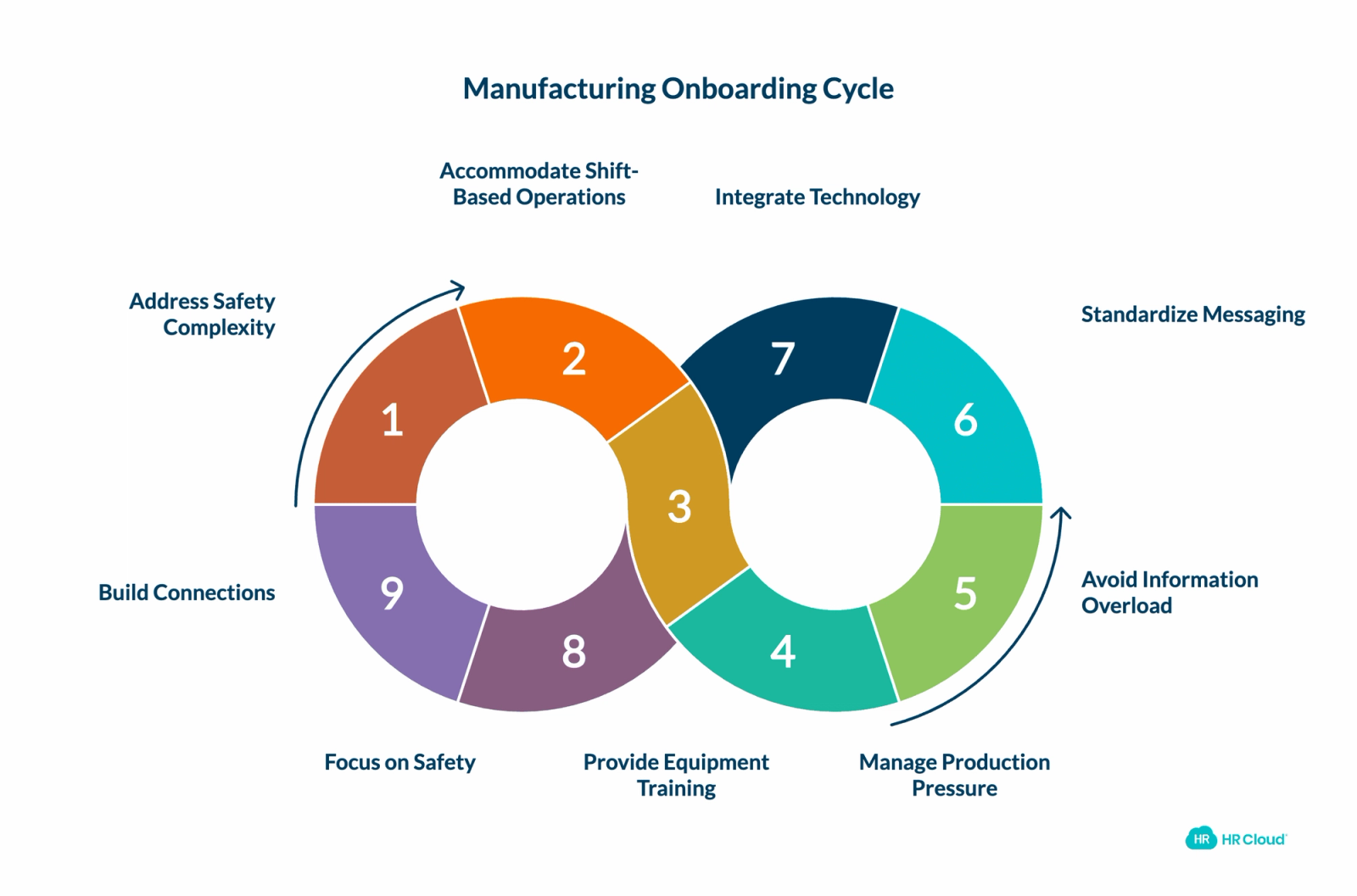
Manufacturing work environments create distinctive employee onboarding obstacles that require specialized approaches tailored to industrial operations. Unlike office workers who can gradually ease into their roles, manufacturing employees often need immediate competency in workplace safety protocols, equipment operation procedures, and quality control standards.
The National Association of Manufacturers reports that 65% of manufacturing companies struggle with workforce development, with inadequate onboarding processes cited as a primary factor in early employee turnover. When manufacturing workers leave quickly, companies lose not just recruitment investments but also training costs, overtime expenses for existing staff, and production efficiency.
Industry-Specific Onboarding Barriers
Safety Complexity: Manufacturing onboarding must address OSHA compliance requirements, hazardous materials handling, emergency evacuation procedures, and equipment-specific safety protocols that vary by department and production line.
Shift-Based Operations: Traditional onboarding programs designed for standard business hours fail to accommodate second and third shift manufacturing workers, creating inconsistent training experiences and knowledge gaps.
Equipment Training Requirements: Manufacturing new hires need hands-on training with specialized machinery, quality control instruments, and production software that cannot be effectively learned through standard orientation sessions.
Production Pressure: Manufacturing supervisors face constant pressure to maintain production quotas, making it challenging to dedicate adequate time and attention to comprehensive new employee development.
Research from Deloitte and The Manufacturing Institute indicates that manufacturing organizations need 3.8 million new workers through 2033, with 1.9 million positions potentially remaining unfilled due to inadequate talent development and retention strategies.
Ready to transform your manufacturing onboarding process? See how HR Cloud's integrated platform automates every step from pre-boarding to full integration.
Common Manufacturing Onboarding Pitfalls
Information Overload on Day One: Traditional approaches dump extensive safety manuals, company policies, and job procedures on new employees immediately. This creates cognitive overload when people are already nervous about starting a new job.
Inconsistent Messaging Across Shifts: Manufacturing operations often run multiple shifts with different supervisors. Without standardized onboarding processes, new hires receive conflicting information depending on when they start or which team they join.
Limited Technology Integration: Many manufacturers still rely on paper-based processes and in-person briefings. This approach struggles to reach distributed teams, track completion of required training, or provide consistent information access.
Insufficient Safety Focus: While most manufacturers include safety training, it's often generic and fails to address specific hazards of the new employee's actual work environment and role.
Weak Connection Building: Manufacturing culture is often relationship-driven, but traditional onboarding fails to systematically introduce new hires to key colleagues and help them understand informal communication patterns.
Pre-Boarding: Setting the Foundation for Success
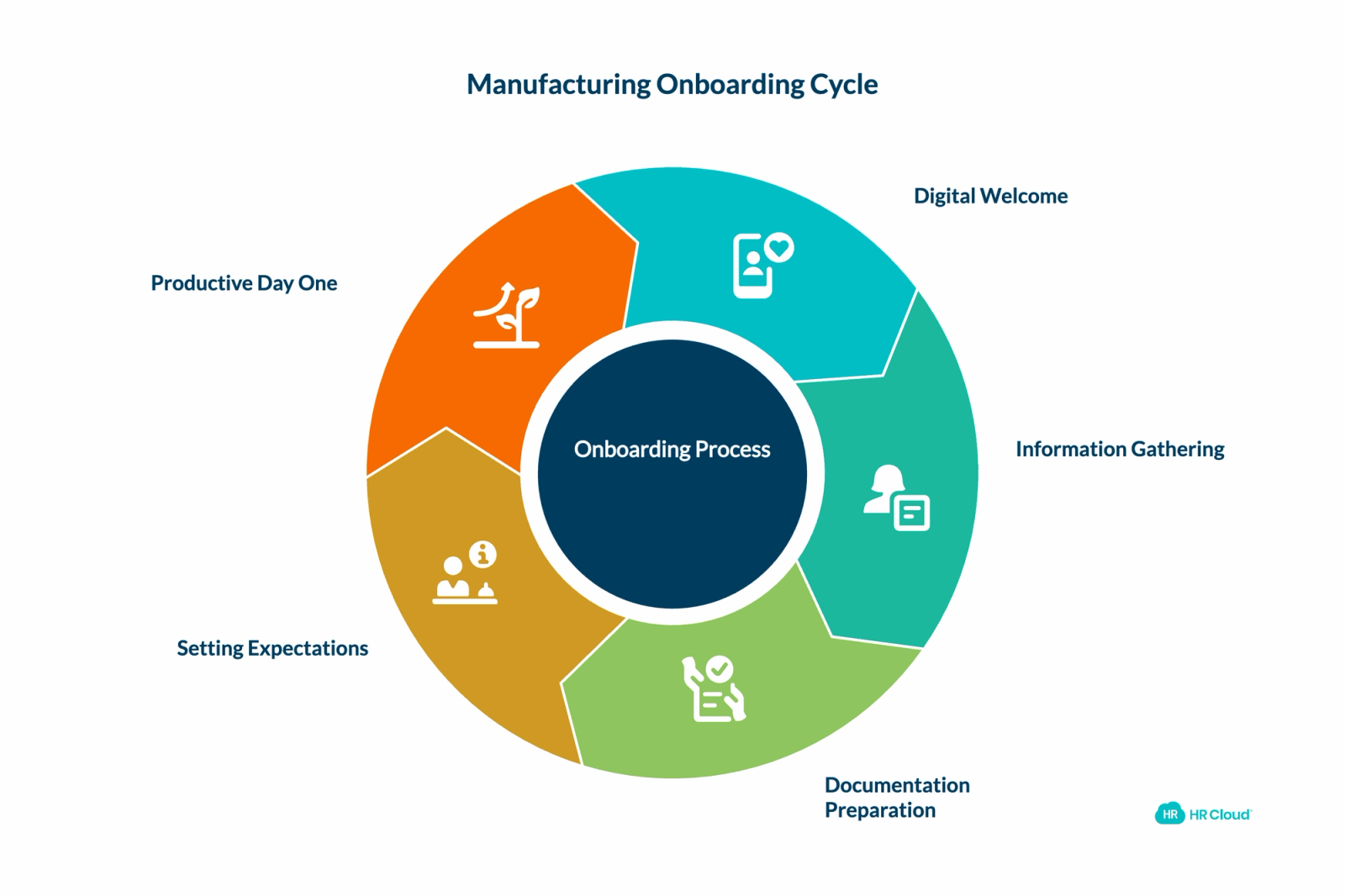
The most effective manufacturing onboarding begins before the employee sets foot in your facility. Pre-boarding creates momentum, reduces first-day anxiety, and enables productive Day One experiences.
Digital Welcome and Information Gathering
Modern manufacturing pre-boarding leverages comprehensive technology platforms to collect essential information and begin the employee engagement process. Digital onboarding platforms allow new manufacturing hires to complete paperwork, watch safety orientation videos, and begin learning about company culture and manufacturing processes from their homes.
The optimal approach involves sending pre-boarding materials 1-2 weeks before the manufacturing start date. This timeline gives people adequate preparation time for manufacturing role expectations without the information becoming stale. Include company history videos, virtual facility tours highlighting production areas, safety equipment demonstrations, and introductions to their immediate team members and production supervisors.
Advanced digital pre-boarding features include:
- Interactive facility tours showing specific production lines and safety zones where new hires will work
- Role-specific safety videos covering equipment operation and hazard identification relevant to their manufacturing position
- Team introduction modules with photos and roles of key personnel including supervisors, safety coordinators, and quality control staff
- Company culture content highlighting manufacturing excellence, continuous improvement initiatives, and employee recognition programs
- Equipment familiarization with virtual demonstrations of machinery and tools they'll be using
Experience comprehensive digital pre-boarding with HR Cloud's manufacturing-focused platform that combines safety orientation, cultural integration, and compliance automation in one streamlined solution.
Documentation and Compliance Preparation
Manufacturing employees typically need extensive documentation including I-9 verification, safety certifications, and sometimes background checks. Digital pre-boarding platforms streamline this process by sending forms electronically and allowing secure document upload.
Transform your pre-boarding process with HR Cloud's automated workflows that trigger customized checklists based on role, location, and compliance requirements.
E-Verify integration is particularly valuable for manufacturing companies, as it allows immediate verification of work authorization without delays. When combined with digital I-9 processing, this creates a smooth transition from hiring to active employment.
| Traditional Pre-boarding | Modern Digital Pre-boarding |
|---|---|
| Mail paper packets 1-2 weeks before | Automated digital delivery with tracking |
| Generic welcome letter | Personalized video messages from team |
| Static PDF forms | Interactive mobile-friendly forms |
| No completion tracking | Real-time progress monitoring |
| Manual follow-up calls | Automated reminders with escalation |
| One-size-fits-all approach | Role-specific content and checklists |
| Paper document collection | Secure digital document upload |
| Limited accessibility | 24/7 mobile access from anywhere |
Why This Transformation Matters: Digital pre-boarding isn't just about convenience – it's about setting professional expectations from day one. When new hires experience a seamless, technology-enabled process, they form positive impressions about your company's operational sophistication. More importantly, the data shows that employees who complete comprehensive digital pre-boarding are 73% more likely to complete their first 90 days successfully. The tracking capabilities also help HR teams identify potential issues before they become retention problems.
Setting Realistic Expectations
Pre-boarding communications should paint an accurate picture of the manufacturing environment. Include information about physical requirements, typical noise levels, safety equipment requirements, and work pace expectations.
This transparency helps new hires prepare mentally and physically for their roles. It also reduces turnover from people who might not be suited for manufacturing environments but weren't adequately informed during the hiring process.
Day One: Making Powerful First Impressions
First impressions in manufacturing settings are critical because the environment can feel intimidating to newcomers. A structured Day One experience helps new hires feel welcomed while ensuring they receive essential safety information.
Structured Welcome and Orientation
Begin with a dedicated welcome session away from the production floor. This should include personal introductions to their immediate supervisor, HR representative, and assigned buddy/mentor. Provide a detailed schedule for their first week so they understand what to expect.
Use this time to review company values, explain the role of their specific department in the broader operation, and discuss career development opportunities. Manufacturing employees often worry about being "stuck" in entry-level roles, so early career pathing discussions improve engagement.
Comprehensive Safety Introduction
Safety orientation must go beyond policy reviews. Include facility tours that highlight specific hazards, emergency procedures, and location of safety equipment. Make this interactive by having new hires practice emergency responses and demonstrate proper use of personal protective equipment.
Digital signage systems can reinforce safety messages throughout the facility, providing ongoing reminders as new employees navigate their environment. These systems are particularly effective in noisy manufacturing environments where verbal communication can be challenging.
| Traditional Safety Training | Modern Interactive Safety Training |
|---|---|
| Read safety manual | Interactive facility tours with hazard identification |
| Watch safety videos | Hands-on PPE demonstration and practice |
| Sign acknowledgment forms | Digital tracking of safety competency assessments |
| Generic safety briefing | Role-specific safety protocols and scenarios |
| One-time orientation | Ongoing safety reinforcement through digital signage |
Breaking Down the Safety Impact: The shift from passive to interactive safety training isn't just about engagement – it's about preventing accidents that can cost companies hundreds of thousands of dollars. OSHA data shows that new employees are 5 times more likely to be injured in their first month compared to experienced workers. Interactive training that includes hands-on practice with emergency shutoffs, proper lifting techniques, and hazard recognition creates muscle memory that automatic responses can't achieve. When new hires actually practice putting on respirators rather than just watching a video, they're prepared for real-world situations where seconds matter.
According to the Bureau of Labor Statistics, OSHA data shows manufacturing has significantly higher workplace injury rates than other industries, making comprehensive safety training critical for manufacturing onboarding programs.
Technology and Systems Access
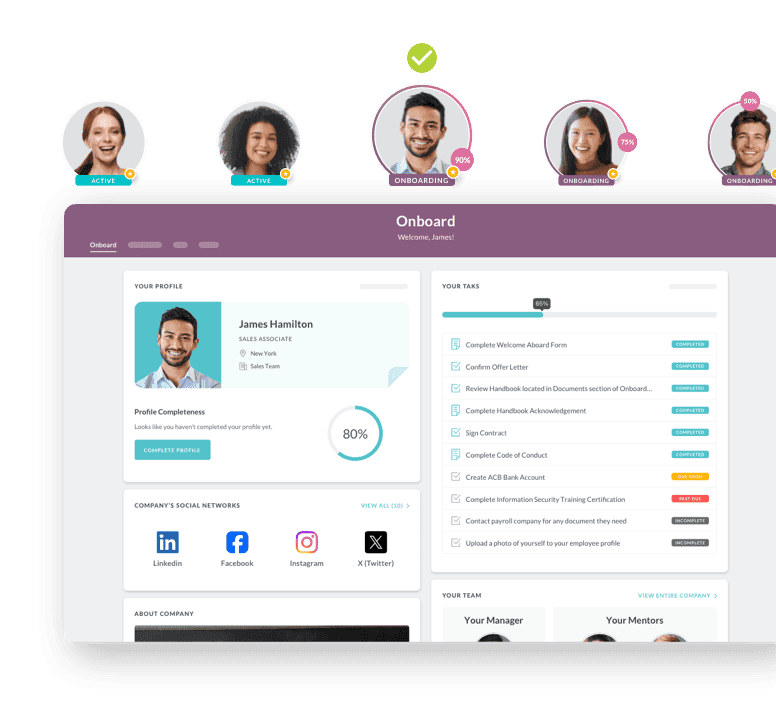
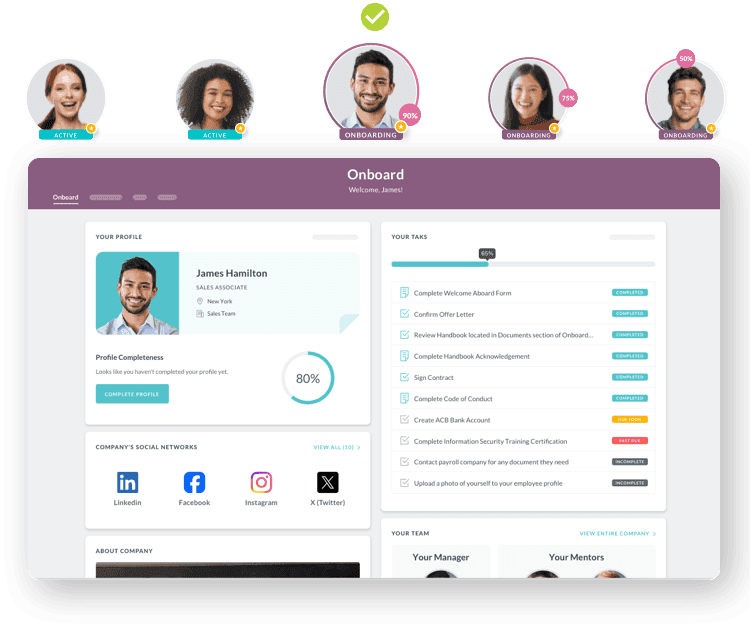
Provide necessary technology access early in the day, including computer login credentials, mobile app installations, and communication platform access. Many manufacturing employees now use tablets or smartphones for work-related activities, so ensuring they're comfortable with these tools is essential.
Streamline technology adoption with HR Cloud's Workmates platform, which provides mobile-friendly access to company communications, training materials, and peer recognition systems.
Meeting Key Personnel
Introduce new hires to essential personnel beyond their immediate team. This includes maintenance staff they'll interact with, quality control personnel, safety coordinators, and administrative staff who support their role.
Understanding these relationships helps new employees navigate the organization more effectively and reduces confusion about who to contact for different issues.
Week One: Intensive Learning and Integration
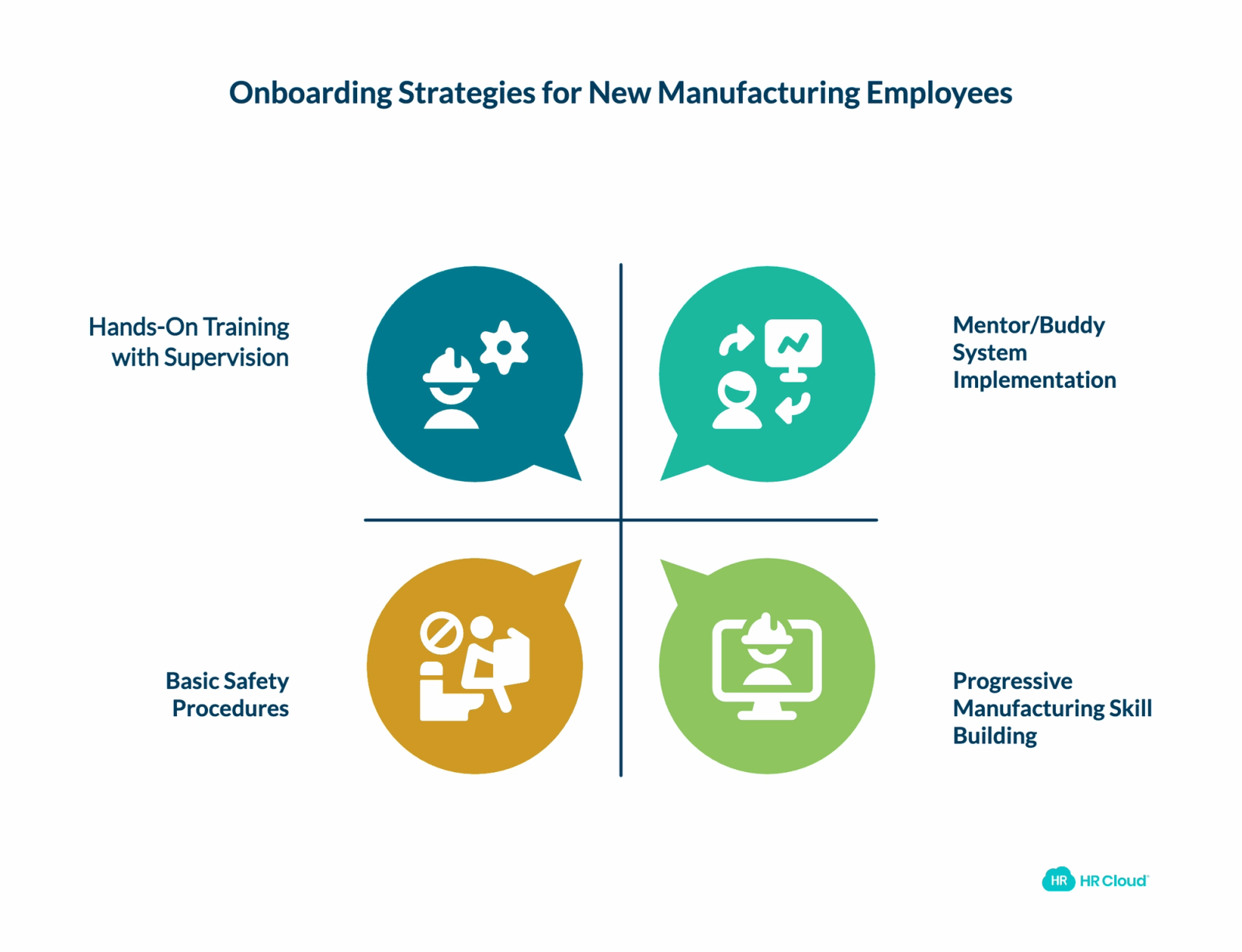
The first week establishes patterns and relationships that will define the new manufacturing employee's experience. Structure this critical period carefully to balance information transfer with hands-on learning opportunities specific to manufacturing operations.
Progressive Manufacturing Skill Building
Rather than overwhelming new manufacturing hires with all job responsibilities immediately, introduce tasks progressively through structured learning pathways. Start with basic safety procedures and foundational skills, then gradually add complexity as competence develops in manufacturing environments.
Create daily manufacturing onboarding checklists that outline learning objectives, hands-on tasks to complete, and key personnel to meet. This provides structure while giving new manufacturing employees a sense of accomplishment as they complete each milestone.
Mentor/Buddy System Implementation
Assign experienced manufacturing employees as mentors or buddies for new hires. Choose mentors carefully – they should be technically competent in manufacturing processes, patient teachers, and positive representatives of company culture within the manufacturing environment.
Provide mentors with specific guidance about their responsibilities, including daily check-ins, answering equipment operation questions, and escalating safety concerns when appropriate. Many manufacturing companies underestimate the importance of mentor training, which leads to inconsistent experiences for new manufacturing workers.
The Mentor Selection Reality Check: Not every experienced worker makes a good mentor. The best technical performers might lack patience or teaching skills, while others might inadvertently pass on outdated practices or negative attitudes. Successful manufacturing companies look for mentors who demonstrate safety consciousness, positive attitudes, and natural teaching abilities – even if they're not the highest producers. The investment in proper mentor training typically pays off within the first month, as well-supported new hires reach independence faster and with fewer mistakes.
Hands-On Training with Supervision
Begin practical work under close supervision. This allows new employees to apply what they've learned while having immediate access to guidance and correction. Document training progress to ensure all essential skills are mastered before independent work begins.
Use structured observation periods where experienced workers demonstrate proper techniques while explaining their decision-making process. This helps new hires understand not just what to do, but why specific approaches are used.
Automate training tracking and compliance verification with HR Cloud's checklist automation that ensures consistent skill development across all new hires.
Month One: Building Competence and Confidence
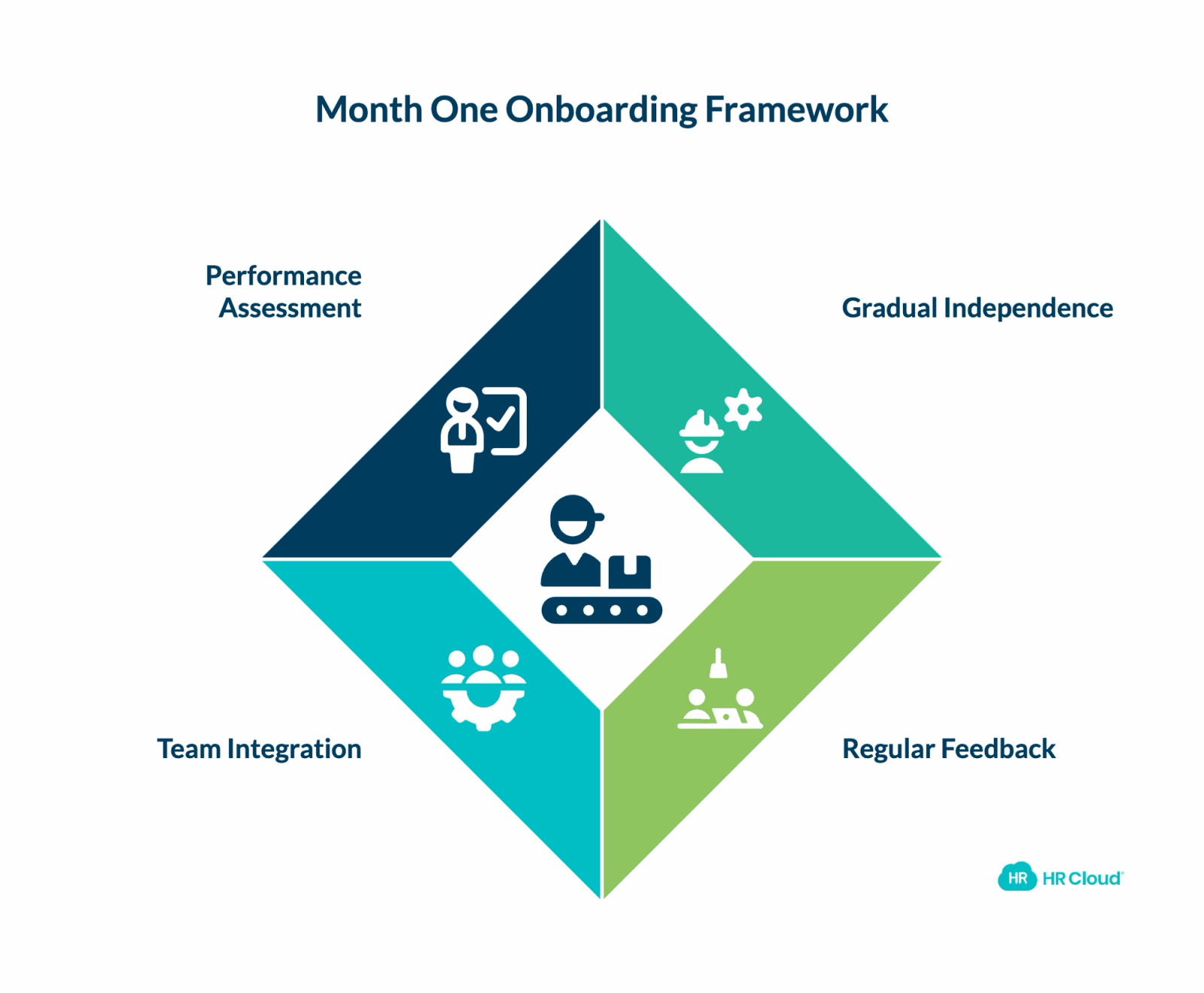
The first month is crucial for developing job competence and workplace relationships. Focus on moving from supervised to independent work while maintaining regular feedback cycles.
Gradual Independence
Systematically reduce supervision as new hires demonstrate competence. This requires careful assessment of their technical skills, safety awareness, and decision-making abilities.
Create clear criteria for independence in different tasks. Some activities might be appropriate for unsupervised work after a few days, while others require weeks of observation and practice.
Regular Feedback and Course Correction
Schedule formal check-ins at the end of each week during the first month. These sessions should review accomplishments, address concerns, and adjust training plans based on individual progress.
Encourage open communication about challenges and confusion. Manufacturing environments can be intimidating, and new employees may hesitate to ask questions if they feel it reflects poorly on their competence.
Integration into Team Dynamics
Help new hires understand informal communication patterns, unwritten rules, and team dynamics. Manufacturing teams often develop strong cultures that aren't immediately obvious to outsiders.
Facilitate informal interactions through lunch meetings, team projects, or collaborative problem-solving activities. These interactions help new employees feel like genuine team members rather than temporary additions.
Performance Assessment and Planning
Conduct a formal performance review at the 30-day mark. This should assess technical competence, safety awareness, team integration, and overall adjustment to the role.
Use this review to identify areas needing additional development and create plans for continued growth. Many manufacturing employees value clear paths for advancement, so discussing future opportunities during this review improves retention.
Technology Integration for Modern Manufacturing Onboarding
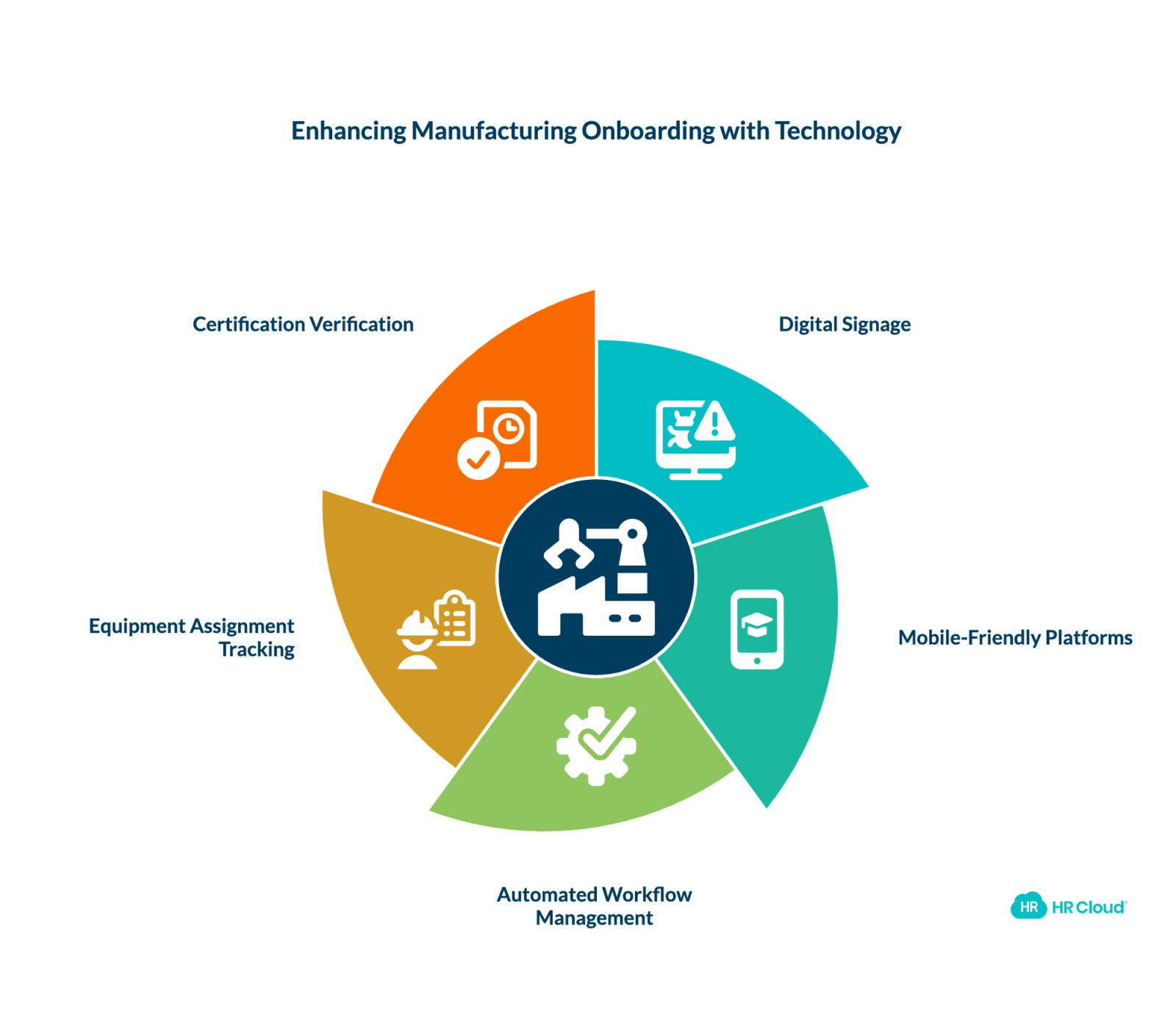
Manufacturing companies increasingly recognize that technology can solve many traditional onboarding challenges. The key is selecting tools that work well in industrial environments and integrate with existing systems.
Digital Signage for Real-Time Communication
Digital signage systems display important information throughout manufacturing facilities, including safety reminders, production metrics, and company announcements. For new hires, these systems provide ongoing access to essential information without requiring supervisor interruption.
Position signs strategically in break areas, entrance points, and workstations where people naturally pause during their day. Update content regularly to maintain engagement and ensure information stays current.
Mobile-Friendly Platforms for Accessibility
Many manufacturing employees don't have desktop computer access during work hours. Mobile-friendly onboarding platforms allow people to access training materials, company communications, and policy updates from their smartphones or tablets.
This accessibility is particularly important for shift workers who may need to complete training modules outside regular office hours.
Enable seamless mobile access with HR Cloud's responsive platform design that works effectively on any device, from desktop computers to smartphones.
Automated Workflow Management
Workflow automation ensures consistent onboarding experiences regardless of which HR representative, supervisor, or shift manages the process. Automated systems trigger appropriate checklists based on role, location, department, and other relevant factors while integrating with payroll, timekeeping, and manufacturing execution systems.
These comprehensive platforms also track completion of required activities, send automated reminders for overdue tasks, and escalate issues when progress stalls. Advanced workflow capabilities include conditional logic for different manufacturing roles, integration with time and attendance systems, and automated payroll system synchronization for seamless employee setup.
Manufacturing-specific workflow features include:
- Equipment assignment tracking with automated IT notifications for computer setup and safety equipment distribution
- Certification verification with automated alerts for expiring safety licenses and training requirements
- Multi-location coordination enabling consistent onboarding across different manufacturing facilities and distribution centers
- Shift-based task routing ensuring appropriate personnel receive onboarding responsibilities based on work schedules
- Compliance automation with built-in OSHA reporting and I-9 documentation management
Streamline manufacturing onboarding with HR Cloud's advanced workflow automation that coordinates complex multi-step processes across shifts, departments, and locations.
| Manual Onboarding Systems | Automated Workflow Systems |
|---|---|
| Paper checklists and clipboards | Digital checklists with automatic progression |
| Phone calls and emails for updates | Real-time dashboard visibility |
| Manual tracking in spreadsheets | Integrated analytics and reporting |
| Inconsistent messaging across shifts | Standardized communications for all shifts |
| HR bottlenecks for routine tasks | Self-service capabilities with HR oversight |
| Lost paperwork and missing steps | Complete audit trails and compliance tracking |
| Reactive problem identification | Proactive alerts and intervention triggers |
| Limited scalability | Easy expansion across locations and roles |
The Operational Reality: Manufacturing companies using manual systems typically spend 8-12 hours of administrative time per new hire, with HR representatives constantly chasing down completed forms and following up on missed deadlines. Automated systems reduce this to 2-3 hours while actually improving compliance rates. The real game-changer is shift coverage – when your night shift supervisor can see exactly where each new hire stands in their onboarding journey without calling HR, you've eliminated a major friction point that often leads to inconsistent experiences.
Integration with Existing HRIS Systems
Effective onboarding technology integrat es with existing payroll, benefits, and HR information systems. This integration eliminates duplicate data entry, reduces errors, and ensures consistent information across all platforms.
Consider systems that connect with your existing HRIS platforms. HR Cloud integrates with ADP Workforce Now and offers API connectivity for additional system integration commonly used in manufacturing environments.
Measuring Onboarding Success in Manufacturing
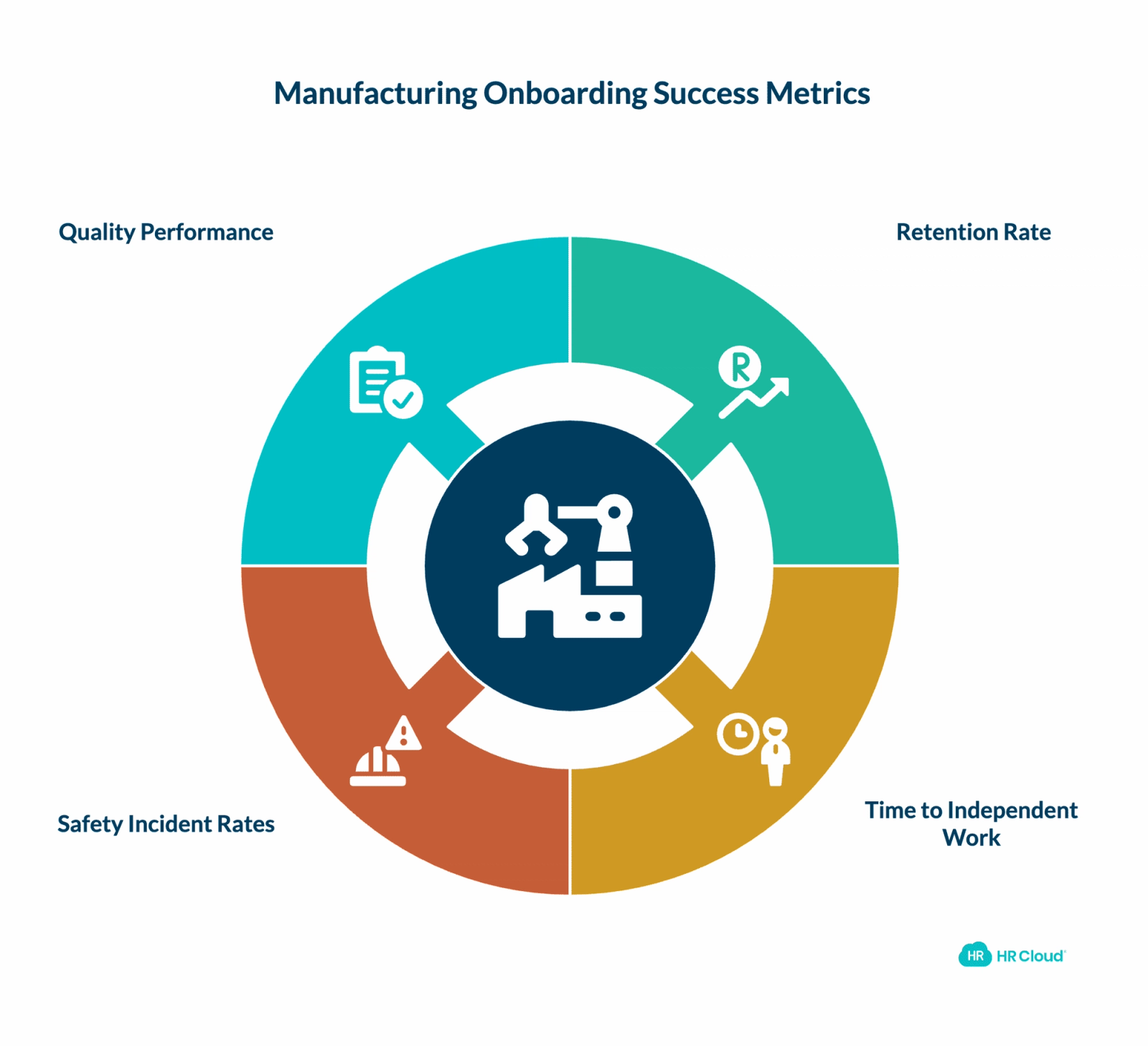
Success metrics for manufacturing onboarding should reflect the unique challenges and goals of industrial environments. Track both quantitative outcomes and qualitative feedback to build a complete picture of program effectiveness.
Retention and Time-to-Productivity Metrics
90-Day Retention Rate: This is the most critical metric for manufacturing onboarding. Companies with effective programs typically see 85%+ retention rates compared to 60-70% for those with poor onboarding.
Time to Independent Work: Track how long it takes new hires to work independently in their roles. Effective onboarding should reduce this timeframe while maintaining quality and safety standards.
Safety Incident Rates: Monitor safety incidents involving new hires during their first six months. Well-onboarded employees should have incident rates similar to or lower than experienced workers. According to OSHA data, the manufacturing industry reported 2.8 recordable injury cases per 100 full-time workers in 2023.
Quality Performance: Measure quality metrics for new hires including defect rates, rework requirements, and customer complaints. Strong onboarding should result in quality performance approaching experienced worker levels within 30-60 days.
| Traditional Onboarding Metrics | Modern Comprehensive Metrics |
|---|---|
| Basic retention tracking | 90-day retention + predictive analytics |
| Subjective manager feedback | Data-driven performance measurements |
| Annual satisfaction surveys | Real-time feedback at 30, 60, 90 days |
| Training completion checkboxes | Competency verification and skill assessments |
| Cost per hire | ROI including productivity and quality gains |
| Generic safety statistics | New hire-specific safety incident tracking |
Making Metrics Meaningful: The difference between tracking "training completed" versus "competency verified" is enormous in manufacturing settings. A checkbox tells you someone sat through a session; competency verification tells you they can safely operate equipment independently. This distinction becomes critical when you consider that the average manufacturing company spends $15,000 per safety incident, and most incidents involving new hires stem from inadequate skill verification rather than missing training. Predictive analytics take this further by identifying patterns – like new hires who complete training quickly but struggle with hands-on assessments often need additional mentoring support.
Employee Experience and Engagement Metrics
Onboarding Satisfaction Surveys: Collect feedback about the onboarding experience itself, including information clarity, support adequacy, and overall satisfaction. Employee survey platforms make it easy to survey at 30, 60, and 90 days to capture evolving perspectives.
Manager Effectiveness Ratings: Ask new hires to evaluate their supervisors' effectiveness in supporting their transition. This helps identify managers who need additional coaching in onboarding skills.
Buddy/Mentor Program Feedback: Gather input from both new hires and their assigned mentors about program effectiveness. This feedback helps refine mentor selection and training processes.
Track onboarding effectiveness with HR Cloud's comprehensive analytics that provide real-time visibility into retention rates, training completion, and employee satisfaction scores.


Process Efficiency and Cost Metrics
Administrative Time Requirements: Measure how much HR and management time the onboarding process requires. Efficient programs should reduce administrative burden while improving outcomes.
Training Cost per Employee: Calculate total onboarding costs including materials, trainer time, lost productivity, and technology expenses. Compare these costs to retention and performance benefits.
Compliance Achievement Rates: Track completion of required training, certifications, and documentation. Manufacturing environments often have regulatory requirements that must be met within specific timeframes.
Performance management systems can help track these metrics systematically and provide actionable insights for program improvement.
Industry-Specific Considerations for Manufacturing Onboarding
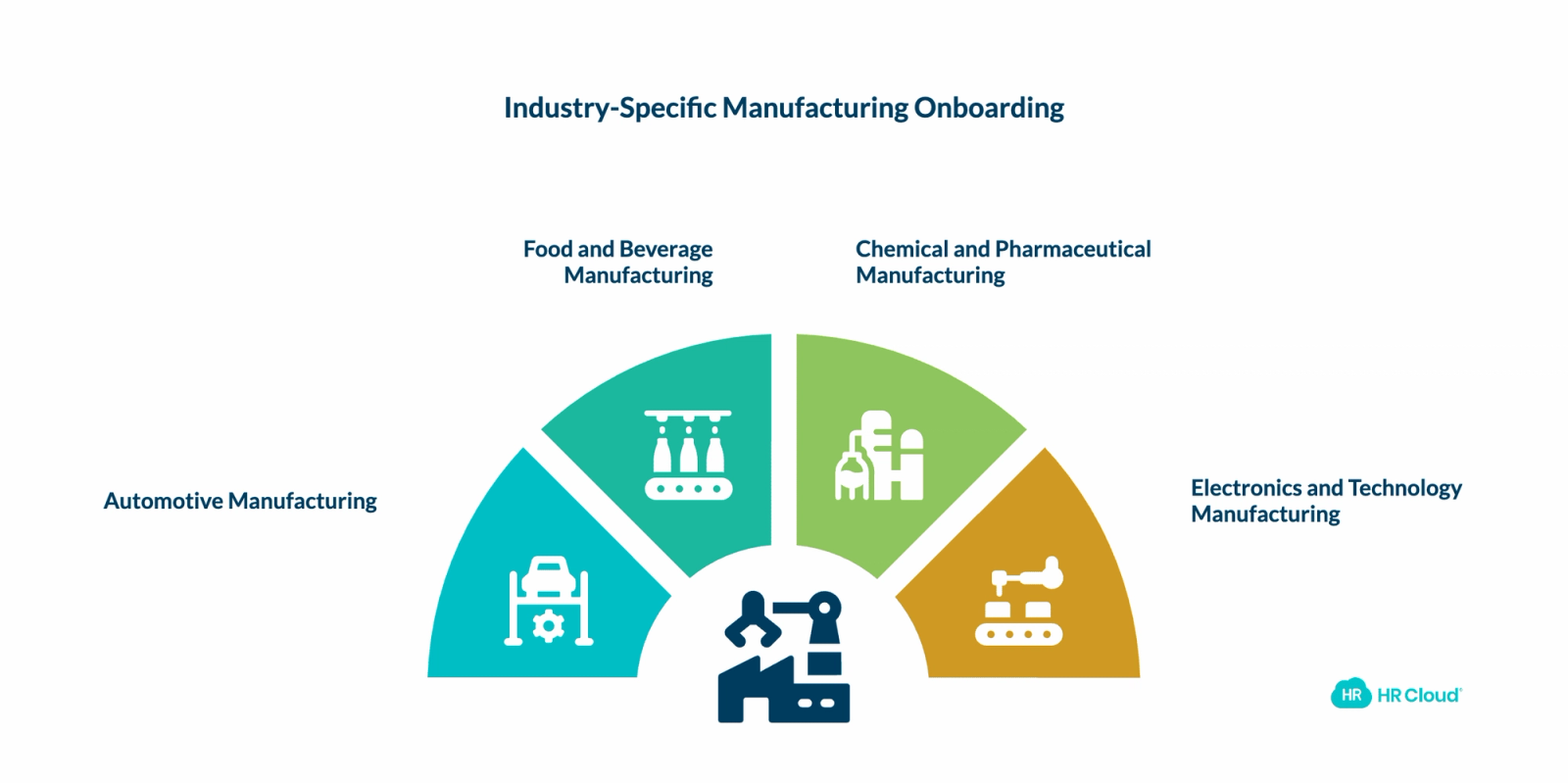
Different manufacturing sectors have unique onboarding requirements based on their products, processes, and regulatory environments. Customize your approach based on these industry-specific factors.
Automotive Manufacturing
Automotive plants typically require extensive quality training, lean manufacturing principles, and complex safety protocols. New hires need to understand just-in-time inventory concepts, quality control systems, and continuous improvement methodologies.
Consider incorporating supplier relationship training, as automotive manufacturing often involves complex supply chain interactions. Workers may need to understand how their specific roles impact upstream and downstream processes.
Food and Beverage Manufacturing
Food manufacturing requires comprehensive food safety training including HACCP principles, allergen management, and sanitation procedures. New hires must understand both regulatory requirements and company-specific safety protocols.
Temperature control awareness, contamination prevention, and proper documentation practices are essential skills that require hands-on training and regular assessment.
Chemical and Pharmaceutical Manufacturing
Chemical manufacturing involves complex safety protocols, regulatory compliance requirements, and specialized equipment operation. New hires need extensive training in hazardous material handling, emergency response procedures, and documentation requirements.
Consider incorporating Good Manufacturing Practices (GMP) training for pharmaceutical environments, as these standards affect every aspect of production work.
Electronics and Technology Manufacturing
Electronics manufacturing often involves clean room environments, static electricity control, and precision assembly techniques. New hires need training in contamination control, quality standards, and specialized tools and equipment.
Anti-static procedures, microscope use, and quality inspection techniques are often essential skills that require significant practice to master.
Customize onboarding checklists for industry-specific requirements with HR Cloud's flexible checklist builder that adapts to any manufacturing sector's unique needs.
Download your free employee onboarding checklist
Using this checklist ensures that you are not scrambling to make the new employees feel welcomed, prepared, and set up for long-term success.
Download Now
Building a Culture of Continuous Learning in Manufacturing
Manufacturing work environments change constantly due to new technologies, process improvements, automation advances, and evolving market demands. Effective manufacturing onboarding establishes patterns of continuous learning that serve employees throughout their careers while supporting organizational competitiveness.
The Manufacturing Institute and Deloitte project that as many as 3.8 million additional employees could be needed in manufacturing between 2024 and 2033, with workforce development challenges remaining among the top concerns for U.S. manufacturers since 2017.
Cross-Training and Skill Development Programs
Introduce concepts of cross-training and skill development during manufacturing onboarding orientation. Help new manufacturing employees understand that learning doesn't stop after the initial orientation period but continues throughout their manufacturing careers.
Explain available employee training programs, tuition reimbursement policies, and career advancement pathways specific to manufacturing roles. Many manufacturing workers are interested in developing technical skills in areas such as:
- Advanced machinery operation and maintenance certifications
- Quality management systems including Six Sigma and Lean Manufacturing principles
- Safety leadership training and OSHA instructor certifications
- Supervisory development programs preparing for manufacturing leadership roles
- Technical education partnerships with local community colleges and trade schools
Support continuous learning initiatives with HR Cloud's training management system that tracks certifications, schedules training sessions, and measures learning outcomes across manufacturing teams.
Innovation and Process Improvement Culture
Teach new manufacturing hires about continuous improvement processes and encourage them to contribute ideas for enhancing efficiency, quality, or safety in manufacturing operations. This engagement helps them feel valued while contributing to organizational success and operational excellence.
Explain formal suggestion systems, improvement team participation opportunities, and recognition programs for employee contributions. Manufacturing employees often have valuable insights about process optimization, equipment efficiency, and quality improvements based on their direct production experience.
Key elements of manufacturing innovation culture include:
- Employee suggestion platforms with systematic review and implementation processes
- Cross-functional improvement teams addressing production challenges and opportunities
- Innovation recognition programs celebrating contributions to efficiency and quality
- Best practice sharing across shifts, departments, and manufacturing facilities
Mentorship Program Evolution
Develop systems where today's new hires become tomorrow's mentors. This creates a culture of knowledge sharing and helps experienced employees develop leadership skills.
Provide ongoing training for mentors and recognize their contributions to successful onboarding outcomes.
Technology Solutions for Manufacturing Onboarding
Modern manufacturing onboarding requires technology platforms that address the unique challenges of industrial environments. The right technology stack can dramatically improve onboarding efficiency while ensuring consistent experiences.
McKinsey research shows that each frontline employee departure could cost about $52,000 annually in recruiting, training, and onboarding productivity losses, making retention improvements critical for manufacturing competitiveness.
Enterprise-Grade Cloud Infrastructure
HR Cloud's manufacturing onboarding platform operates on enterprise-grade cloud infrastructure designed for industrial environments and distributed manufacturing operations. The platform utilizes redundant, geographically distributed data centers with robust backup systems for enhanced data protection and accessibility.
This cloud architecture ensures manufacturing companies can access onboarding systems across multiple facilities, shifts, and geographic locations without performance issues. All data transmissions use enterprise-grade encryption, while regular third-party security testing validates security standards required for industrial compliance frameworks.
The cloud-based approach particularly benefits manufacturing organizations with:
- Multi-site coordination across manufacturing facilities and distribution centers
- 24/7 accessibility for shift workers and global operations
- Scalable storage for safety training videos, equipment manuals, and compliance documentation
- Integrated API access for connection with manufacturing execution systems (MES) and enterprise resource planning (ERP) platforms
- Automated backup systems ensuring business continuity during equipment failures
Experience HR Cloud's secure cloud infrastructure designed specifically for manufacturing operations. Explore enterprise features and schedule a platform demo today.
Comprehensive HRIS Integration
Select onboarding platforms that integrate seamlessly with existing HR information systems, payroll platforms, and manufacturing software. This integration eliminates duplicate data entry and ensures accurate information across all systems.
Look for platforms that connect with popular manufacturing solutions including ADP, Workday, Dayforce, and industry-specific software commonly used in your sector.
Mobile-First Platform Design
Manufacturing workers often lack desktop computer access during work hours. Choose platforms designed for mobile use that provide full functionality on smartphones and tablets.
Mobile-friendly design is particularly important for shift workers who may need to access training materials, company communications, or complete onboarding tasks outside regular business hours.
Automated Workflow Capabilities
Workflow automation ensures consistent onboarding experiences regardless of which manager or HR representative handles the process. Look for systems that can trigger role-specific checklists, send automated reminders, and escalate overdue items.
These capabilities are essential for multi-shift operations where different supervisors may be responsible for onboarding activities at various times.
Analytics and Reporting Features
Choose platforms that provide comprehensive analytics about onboarding effectiveness. Track metrics including completion rates, time-to-productivity, retention rates, and employee satisfaction scores.
Real-time reporting capabilities help identify problems early and enable proactive intervention when onboarding activities fall behind schedule. Advanced analytics dashboards can reveal patterns that indicate which onboarding elements contribute most to successful outcomes.
Experience the power of integrated manufacturing onboarding with HR Cloud's comprehensive platform that combines HRIS functionality, workflow automation, and mobile accessibility in one solution.
Real-World Case Study: Industrial Equipment Manufacturer
A mid-sized industrial equipment manufacturer with 850+ employees across three facilities faced significant onboarding challenges that were impacting their operational efficiency and bottom line. Prior to implementing HR Cloud's manufacturing onboarding solution, the company experienced:
- 45% turnover rate within the first 90 days
- 14-day average time to independent productivity for new hires
- Inconsistent safety training across different shifts and locations
- Manual paperwork processing requiring 8+ hours per new hire
- Limited visibility into onboarding progress and completion rates
Implementation Strategy
Working with HR Cloud's implementation team, the manufacturer deployed a comprehensive onboarding platform that included:
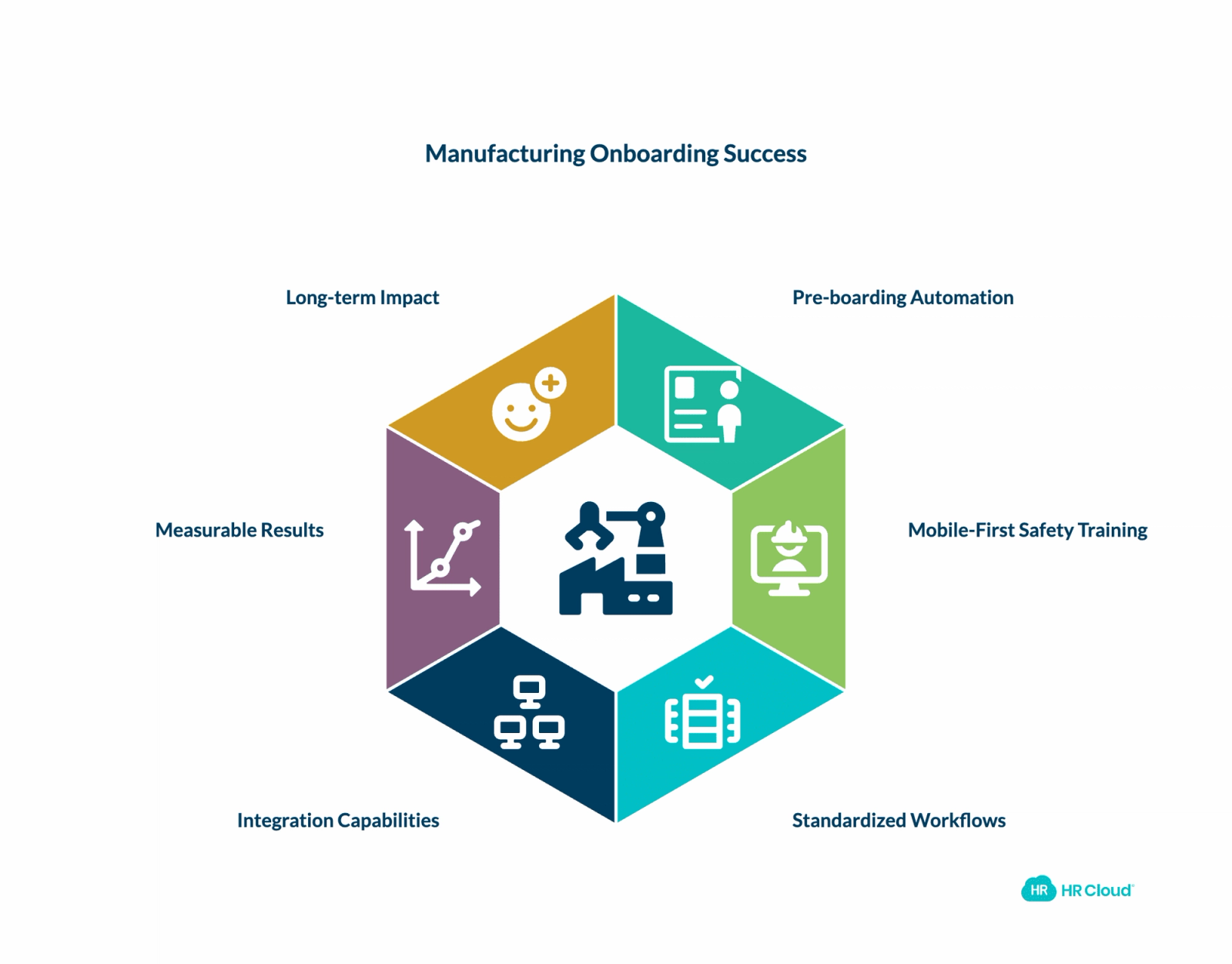
Pre-boarding Automation: Digital workflows triggered upon offer acceptance, enabling new hires to complete I-9 verification, safety orientation videos, and equipment training modules before their first day.
Mobile-First Safety Training: Interactive safety protocols accessible on tablets and smartphones, allowing shift workers to complete required training during optimal hours rather than disrupting production schedules.
Standardized Workflows: Role-specific checklists for machine operators, quality control technicians, and maintenance staff that ensured consistent training regardless of hiring manager or location.
Integration Capabilities: Seamless connection with their existing ERP system and time tracking software, eliminating duplicate data entry and ensuring accurate employee records.
Measurable Results After 12 Months
The implementation delivered significant improvements across all key metrics:
- Reduced 90-day turnover to 18% (60% improvement from baseline)
- Accelerated time-to-productivity to 6 days (57% faster than previous average)
- Achieved 98% safety training completion rates across all shifts
- Decreased onboarding administrative time to 2.5 hours per new hire
- Improved manager satisfaction scores from 6.2 to 8.7 out of 10
The company's HR director noted: "The transformation has been remarkable. Our new hires arrive confident and prepared, our managers spend less time on paperwork and more time on coaching, and our safety incidents have dropped significantly. The cloud-based platform means our night shift supervisors have the same onboarding tools as day shift managers."
Long-term Impact
Beyond immediate metrics, the manufacturer reported sustained benefits including enhanced employer branding, reduced recruitment costs, and improved employee engagement scores. The standardized approach also enabled faster expansion into new facilities with consistent onboarding experiences.
Transform your manufacturing onboarding outcomes with HR Cloud's proven platform. Join hundreds of manufacturing companies achieving similar results.
Overcoming Common Implementation Challenges
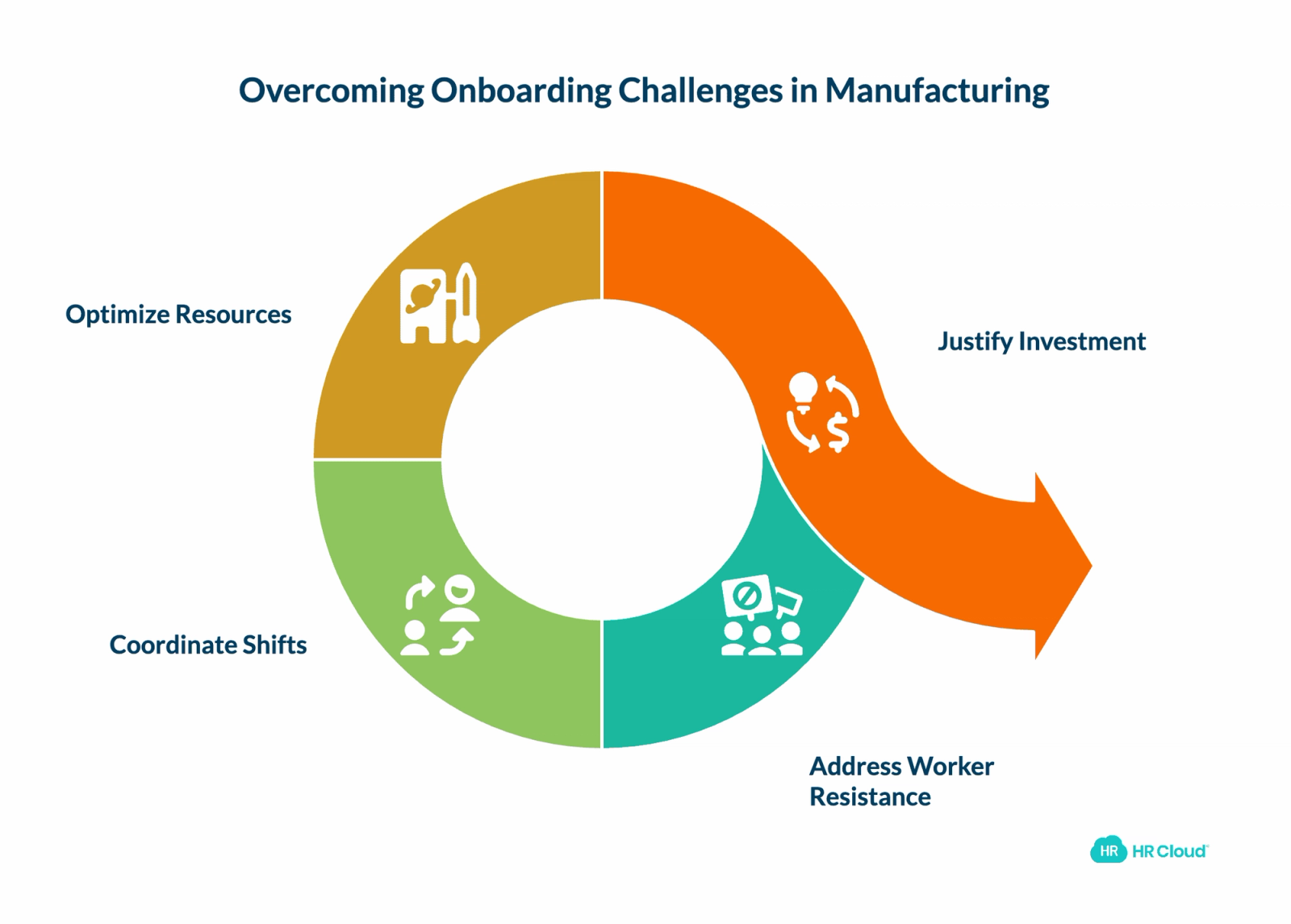
Manufacturing companies often face specific obstacles when implementing improved onboarding processes. Understanding these challenges helps develop strategies for successful program launches.
Resistance from Experienced Workers
Long-term employees may resist formal onboarding processes, viewing them as unnecessary bureaucracy. Address this by involving experienced workers in program design and emphasizing their expertise in mentoring roles.
Explain how structured onboarding reduces the burden on experienced workers by ensuring new hires arrive with better preparation and clear expectations.
Multi-Shift Coordination Challenges
Manufacturing operations often run continuous shifts with different supervisors responsible for onboarding activities. Develop clear protocols that ensure consistent experiences regardless of timing.
Use technology platforms to provide standardized content and track completion across all shifts. Consider appointing onboarding coordinators for each shift to maintain consistency.
Limited Training Space and Resources
Manufacturing facilities may have limited classroom space or quiet areas suitable for training activities. Design flexible programs that can adapt to available space and utilize technology to supplement in-person activities.
Consider mobile training carts, outdoor spaces during good weather, or off-site locations for initial orientation activities.
Budget Constraints and ROI Justification
Manufacturing companies often operate with tight margins and may resist onboarding investment. Build business cases that quantify the costs of poor onboarding including turnover, training, overtime, and reduced productivity.
Calculate return on investment based on retention improvements, reduced training time, and faster productivity achievement.
The Hidden Costs Reality: Most manufacturing executives focus on the upfront costs of onboarding systems without calculating the hidden expenses of poor onboarding. Consider this: if you lose a new hire after two weeks, you've not only lost your recruitment and initial training investment, but you're also paying overtime to existing workers who cover the gap, potentially rushing to hire a replacement, and dealing with the productivity loss from disrupted team dynamics.
Research from Deloitte and The Manufacturing Institute shows that manufacturing could need as many as 3.8 million new employees by 2033, with 1.9 million jobs potentially remaining unfilled if workforce challenges aren't addressed. One mid-sized manufacturer discovered they were spending $127,000 annually just on overtime costs related to new hire turnover. Their onboarding technology investment of $45,000 eliminated 80% of those costs within the first year.
Creating Your Manufacturing Onboarding Action Plan
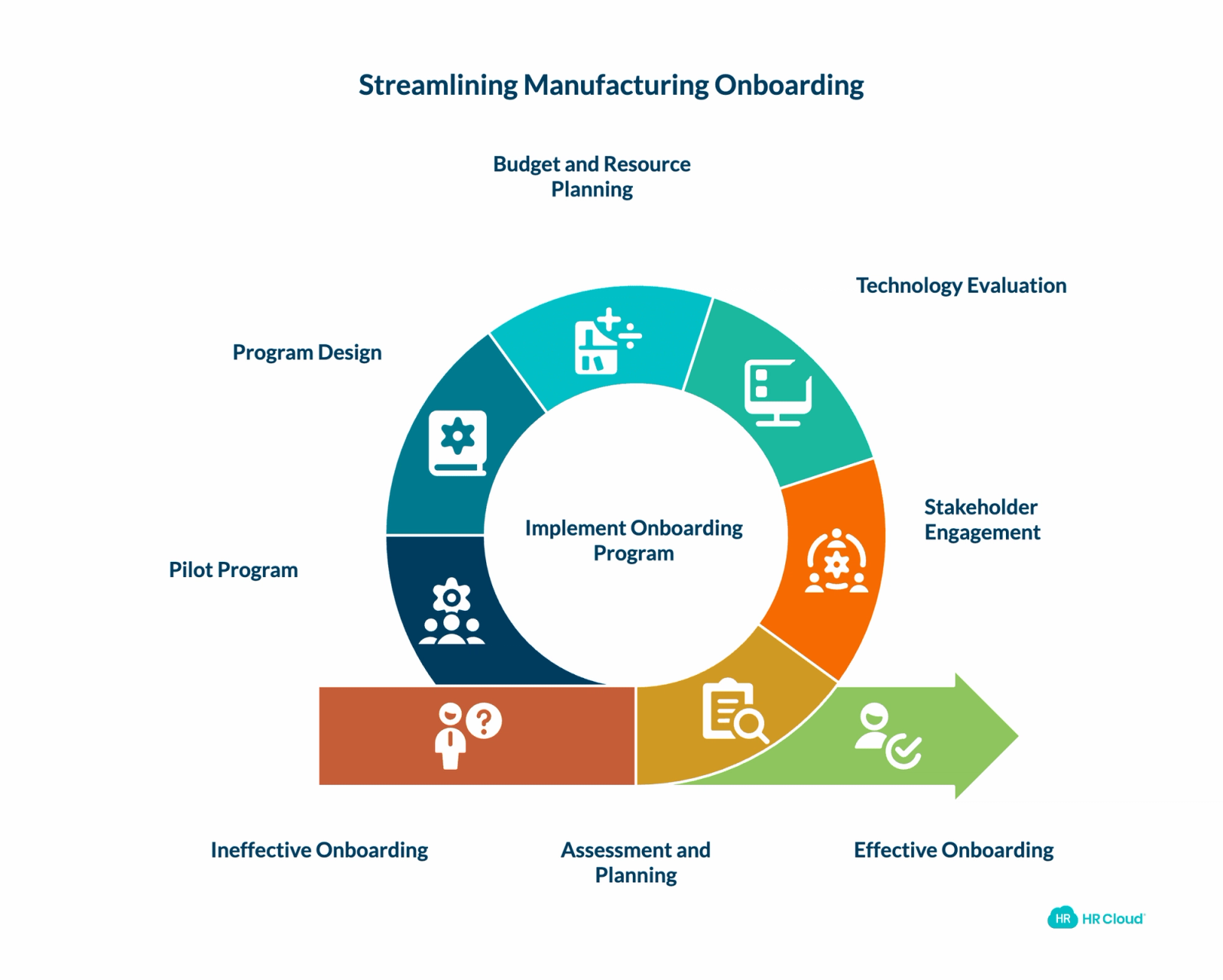
Developing an effective manufacturing onboarding program requires systematic planning and phased implementation. Use this framework to create a comprehensive program that works for your specific manufacturing environment and business needs.
Assessment and Planning Phase
Current State Analysis: Document your existing manufacturing onboarding process including timeline, activities, responsible parties, and success metrics. Identify gaps and improvement opportunities specific to manufacturing operations, safety compliance, and shift coordination challenges.
Stakeholder Engagement: Involve key stakeholders including HR leaders, operations managers, safety coordinators, production supervisors, and experienced manufacturing workers in program design. Their input ensures practical, implementable solutions that address real-world manufacturing challenges.
Technology Evaluation: Assess current HR technology stack and identify integration requirements with existing systems including payroll platforms, timekeeping software, and manufacturing execution systems. Consider comprehensive HRIS platforms that can streamline multiple HR functions.
Budget and Resource Planning: Determine budget requirements, technology needs, and staff time commitments for manufacturing onboarding implementation. Consider both implementation costs and ongoing operational expenses, including:
- Software licensing costs for onboarding platforms and mobile applications
- Implementation services including setup, training, and customization for manufacturing processes
- Content development for safety training videos, equipment operation guides, and compliance materials
- Staff training expenses for HR teams and manufacturing supervisors using new systems
- Hardware costs for tablets, digital signage, and mobile devices supporting deskless workers
Streamline your planning process with HR Cloud's implementation consulting that includes needs assessment, system design, and change management support specifically for manufacturing environments.
Program Design and Development
Manufacturing-Specific Curriculum Development: Create comprehensive onboarding content addressing industry-specific needs including OSHA safety training, equipment operation procedures, quality control standards, and emergency response protocols. Ensure content accommodates different learning styles and literacy levels common in manufacturing workforces.
Technology Platform Selection: Choose onboarding software solutions designed for manufacturing environments with features including:
- Mobile-first design supporting smartphones and tablets for deskless worker access
- Offline capabilities ensuring training continuity during network disruptions
- Multi-language support accommodating diverse manufacturing workforces
- Integration capabilities with existing HR, payroll, and manufacturing systems
- Compliance tracking for OSHA requirements, safety certifications, and training documentation
Program Design and Development
Content Creation: Develop standardized content including welcome materials, safety training modules, role-specific checklists, and assessment tools. Ensure content reflects your company culture and values.
Technology Selection: Choose platforms that support your onboarding requirements while integrating with existing systems. Consider scalability, ease of use, and mobile accessibility.
Process Documentation: Create detailed process documentation including timelines, responsibilities, and escalation procedures. This ensures consistent implementation across all departments and shifts.
Pilot Program Implementation
Limited Rollout: Begin with a pilot program for one department or shift. This allows testing and refinement before full implementation.
Feedback Collection: Gather extensive feedback from new hires, managers, and HR staff during the pilot phase. Use this input to refine processes and content.
Performance Measurement: Track key metrics during the pilot to establish baseline performance and identify areas needing adjustment.
Full Program Launch and Optimization
Phased Rollout: Implement the refined program across all departments and shifts using a phased approach that allows for ongoing adjustment.
Training and Support: Provide comprehensive training for managers, mentors, and HR staff on their roles in the onboarding process.
Continuous Improvement: Establish regular review cycles to assess program effectiveness and make necessary adjustments based on changing needs and feedback from manufacturing supervisors and new hire experiences.
Get started with your manufacturing onboarding transformation by scheduling a demo to see how HR Cloud's integrated platform can streamline every aspect of your program.
Why HR Cloud Leads Manufacturing Onboarding Solutions
HR Cloud's platform addresses unique manufacturing challenges that generic onboarding systems cannot handle effectively. Purpose-built for industrial environments, the platform combines essential HR functions with manufacturing-specific capabilities that drive measurable results.
Manufacturing-Optimized Features
Shift-Based Coordination: Unlike standard onboarding platforms designed for office workers, HR Cloud accommodates 24/7 manufacturing operations with automated workflows that coordinate activities across multiple shifts, time zones, and production schedules without requiring constant HR oversight.
Deskless Worker Support: The platform's mobile-first design ensures manufacturing employees can access training materials, complete safety documentation, and receive critical communications without requiring desktop computer access during production hours.
Safety Compliance Integration: Built-in OSHA compliance tracking, automated safety training assignments, and certification management eliminate manual processes while ensuring regulatory compliance across manufacturing facilities and production lines.
Multi-Facility Coordination: Cloud-based architecture enables consistent onboarding experiences across manufacturing locations while accommodating local variations in procedures, equipment, and compliance requirements.
Integration Ecosystem for Manufacturing
HR Cloud's comprehensive integration capabilities connect seamlessly with essential manufacturing systems including:
- Payroll platforms including ADP, Workday, and Dayforce for automatic employee setup and benefits enrollment
- Time and attendance systems enabling immediate clock-in capabilities and scheduling integration for new manufacturing workers
- Benefits administration platforms with automated enrollment processes designed for manufacturing employee populations and shift-based coverage options
- Learning management systems supporting ongoing safety training, equipment certifications, and skill development programs specific to manufacturing roles
Proven Manufacturing Results
Manufacturing companies using HR Cloud's onboarding platform consistently report significant operational improvements including:
- 60% reduction in new hire turnover during first 90 days compared to manual processes
- 75% decrease in onboarding administrative time for HR teams and production supervisors
- 90% improvement in safety training completion rates across all shifts and manufacturing facilities
- 50% faster time-to-independent productivity for new manufacturing employees
Experience the difference comprehensive manufacturing onboarding makes for your operations. Schedule your HR Cloud demonstration and discover how industry-leading companies are transforming their workforce development.

Discover how our HR solutions streamline onboarding, boost employee engagement, and simplify HR management
Book Your Free DemoFrequently Asked Questions About Manufacturing Onboarding
How long should manufacturing onboarding take?
Effective manufacturing onboarding typically spans 90 days, with intensive activities in the first 30 days. The timeline includes 1-2 weeks of pre-boarding, structured first-week orientation, progressive skill building through month one, and ongoing check-ins through the first quarter. However, specific timing should be adjusted based on role complexity, safety requirements, and individual learning needs.
What's the most important element of manufacturing onboarding?
Safety training is the most critical component of manufacturing onboarding. New hires must understand safety protocols, emergency procedures, and hazard recognition before beginning independent work. However, comprehensive programs balance safety training with relationship building, skill development, and cultural integration for optimal results.
How can small manufacturers implement effective onboarding without large HR departments?
Small manufacturers can leverage technology platforms to automate routine onboarding tasks, create standardized checklists, and track progress. Focus on essential elements including safety training, basic job skills, and mentor assignment. Consider partnering with local training organizations or industry associations for specialized content development.
Should manufacturing onboarding be different for temporary vs. permanent employees?
Yes, onboarding should be scaled based on employment duration and role complexity. Temporary workers still need comprehensive safety training and basic job skills, but may not require extensive cultural integration activities. However, companies that treat temporary workers well often convert them to permanent employees, so maintaining quality experiences is important.
How do you measure ROI of manufacturing onboarding investments?
Calculate manufacturing onboarding ROI by comparing onboarding program costs to savings from improved retention, reduced training time, faster productivity achievement, and lower safety incident rates. Most manufacturing companies see positive ROI within 6-12 months of implementing comprehensive onboarding software programs. Track key metrics including 90-day retention rates for manufacturing workers, time to independent work, safety incident reduction, and quality performance of new manufacturing hires.
What technology features are most important for manufacturing onboarding software?
Essential manufacturing onboarding technology features include mobile accessibility for deskless workers, workflow automation for consistent processes, integration with existing HRIS systems, digital document management for compliance, and comprehensive analytics dashboards. Mobile access is particularly important since many manufacturing workers don't have desktop computer access during production hours. Look for platforms with offline capabilities, multi-language support, and manufacturing-specific compliance tracking.
How do you handle manufacturing onboarding across multiple shifts?
Use comprehensive onboarding technology platforms to ensure consistent content delivery across all manufacturing shifts. Assign dedicated onboarding coordinators for each shift, create detailed process documentation for manufacturing procedures, and use automated workflows to track completion across different shift schedules. Consider recording key safety training sessions so they can be delivered consistently regardless of shift timing or supervisor availability.
What's the biggest mistake manufacturing companies make in employee onboarding?
The most common manufacturing onboarding mistake is information overload on the first day. Trying to cover all safety protocols, equipment operation procedures, and company policies immediately overwhelms new manufacturing hires and reduces retention of critical safety information. Instead, use progressive disclosure that introduces manufacturing-specific information when it's most relevant and useful for production work.
Manufacturing onboarding success requires systematic planning, technology integration, and continuous refinement based on feedback and performance metrics. Manufacturing companies that invest in comprehensive onboarding programs see significant improvements in retention, productivity, and employee satisfaction while reducing safety incidents and quality problems on production floors.
The key is recognizing that effective manufacturing onboarding extends far beyond orientation day. It's a strategic process that shapes employee experiences, builds organizational culture, and drives long-term business results in manufacturing environments. With proper planning and implementation, manufacturing onboarding becomes a competitive advantage that attracts better manufacturing talent and improves operational performance.
About the author

Keep Reading


Like What You Hear?
We’d love to chat with you more about how HR Cloud® can support your business’s HR needs.
Book Your Free Demo