How Do You Manage Payroll and Compliance for Union and Non-Union Construction Workers?

Construction firms manage payroll and compliance for union and non-union workers by getting three things right for every hour worked: the worker's classification (employee or subcontractor, union local or open shop), the applicable wage rate (a collective bargaining agreement rate or a government-set prevailing wage), and the documentation proving both are correct. On federally funded projects over $2,000, the Davis-Bacon Act requires contractors to pay the locally prevailing wage and file a weekly certified payroll report, according to the U.S. Department of Labor. Union crews add a second layer: wage rates, dues, and fringe benefit contributions set by a collective bargaining agreement rather than the employer. Firms that manage this well don't run it out of spreadsheets. They keep worker classification, job-site assignment, and time data in one system that feeds accurate numbers to whichever payroll platform actually cuts the check and files the report.
What Makes Construction Payroll Compliance Complex
Office-based payroll is largely a solved problem: one employer, one set of state rules, one pay scale. Construction payroll rarely looks like that, because the same company can be running several different sets of rules for the same workforce depending on which project a crew happens to be assigned to this week.
Union rules, prevailing wage, multi-state work
Three sources of complexity stack on top of each other in construction payroll, and each one multiplies the others.
Union rules set wage rates by trade, local, and region through a collective bargaining agreement, not through the employer's own pay scale. A journeyman electrician and an apprentice electrician on the same crew are paid differently, and that rate can also include dues withholding and contributions to health, pension, and training trust funds that have to be reported separately from regular payroll.
Prevailing wage adds a government-set wage floor on top of that. The Davis-Bacon Act requires contractors on federal construction contracts over $2,000 to pay the locally prevailing wage and fringe benefit rate, as the Department of Labor's Wage and Hour Division explains. Beyond the original act, Congress has extended Davis-Bacon prevailing wage requirements to approximately 60 additional federal statutes covering transportation, housing, and water projects, and most states run their own "little Davis-Bacon" laws that apply the same idea to state-funded work. The wage determination that applies depends on the county, the trade classification, and the project type, and it's generally locked in when the contract is awarded. It doesn't drift on its own mid-project; it changes only if the contract itself is modified, extended, or a new option period is exercised, which is exactly the moment firms most often lose track of which determination now governs the work.
Multi-state work means a single company can be running union payroll in one state and open-shop payroll in another for the same pay period, each with different prevailing wage determinations, different state unemployment insurance rates, and different tax withholding rules. A crew that moves from a state job in one state to a federally funded job in a neighboring state mid-project can trigger a different wage determination without anyone flagging it.
State-level prevailing wage laws add their own variations on top of the federal rules, and they don't always mirror Davis-Bacon exactly. Delaware, for example, requires certified sworn payroll reports on covered public works contracts, retained for two years, under Delaware Code Title 29, Chapter 69, § 6960. Delaware's law also ties its prevailing wage directly to the collective bargaining rate for a given trade and county when that rate has prevailed for four consecutive years, which is a different determination method than the federal Davis-Bacon survey process the DOL uses. A contractor working federal, Delaware-state, and private jobs in the same quarter is effectively running three different compliance regimes on the same payroll.
None of these three sources of complexity is unusual on its own. What makes construction payroll compliance hard is that a mid-sized contractor is often managing all three at once, for the same workforce, in the same pay period. Consider a single crew: an apprentice electrician working under a union collective bargaining agreement on a state highway project one week, then reassigned to a federally funded school renovation the next. The apprentice's base rate is set by the CBA, but the school project's Davis-Bacon wage determination may specify a different apprentice-to-journeyman ratio or a different fringe benefit rate for that trade in that county. Both the union hall and the certified payroll report need the correct number, and they aren't always the same calculation.
Union payroll also isn't just a different hourly rate. Collective bargaining agreements typically require the employer to report and remit contributions to separate trust funds, often monthly or quarterly, covering health and welfare, pension, and apprenticeship training, on top of whatever the union local withholds in dues. Those trust fund administrators are a separate audience from the certified payroll report's audience (the contracting agency), and they expect their own reporting format. A payroll process built only around Davis-Bacon compliance can miss union trust fund reporting entirely, and a process built only around union reporting can miss the certified payroll requirement on a federally funded job.
The table below summarizes how the three payroll tracks actually differ in practice:
| Standard non-union payroll | Union payroll | Prevailing wage (Davis-Bacon) payroll | |
|---|---|---|---|
| Wage source | Employer-set rate | Collective bargaining agreement | DOL or state wage determination |
| Reporting frequency | Standard pay period | Standard pay period, plus trust fund reports (often monthly/quarterly) | Weekly, including weeks with no work |
| Required form | None specific | Union hall/trust fund forms | Form WH-347 or state equivalent |
| Extra deductions | None beyond standard | Dues, health/pension/training fund contributions | None inherent, but fringe benefits must equal or exceed the determination |
| Who sets the rate | Employer | Union and employer, via CBA | Government agency |
| Applies to | Any private work | Any unionized job, public or private | Federally funded work over $2,000, or state-funded work under an equivalent state law |
A union job on a federally funded project sits in two rows of this table at once, which is exactly where reporting gaps tend to open up.
Common Compliance Risks in Construction Payroll
Most construction payroll compliance failures fall into one of two categories: the report itself is wrong (certified payroll reporting errors), or the underlying classification feeding that report is wrong (misclassification). The two compound each other, since an accurate report built on a wrong classification is still wrong, just wrong in a way that's harder to catch until an investigator pulls the underlying time and assignment records.
Certified payroll reporting errors
Certified payroll is the weekly report contractors file on Form WH-347 (or a state equivalent) proving that Davis-Bacon prevailing wages were paid. It has to be filed every week a covered project is active, including weeks with no work performed, and it requires accurate job classification per worker, per week, plus a signed statement of compliance. The most common errors are not exotic. They're the same few mistakes repeated across projects: paying a laborer rate for work that should be classified as a higher-paid trade (or the reverse, over-classifying to inflate the reported rate); missing a weekly filing because no work happened that week and someone assumed a report wasn't required; applying the original wage determination after a contract modification or extension has incorporated a new one, without anyone flagging that the governing rate changed; and splitting a worker's hours across multiple classifications on the same day without documenting the split, which makes the reported average rate impossible to verify against actual time worked. Each of these is a paperwork error with a real financial consequence, because certified payroll reports are signed under penalty of federal law, and a pattern of errors reads to an investigator the same way a single large discrepancy does. For a full breakdown of what a certified payroll report covers and how Form WH-347 is structured, see HR Cloud's certified payroll glossary entry.
Misclassification of union vs. non-union labor
Misclassifying a worker as an independent contractor instead of an employee, or applying the wrong union classification within a trade, denies workers overtime and benefits they're owed and denies the government payroll tax revenue it's due. The Department of Labor has identified construction as one of the industries where misclassification is most common, in part because crews are project-based, turnover is high, and the line between a legitimate subcontractor and a misclassified employee depends on the degree of control the general contractor exercises, not just on what a contract calls the worker.
The penalties are not hypothetical. In 2016, Hawaii's Department of Labor and Industrial Relations fined a Texas-based contractor $767,095 for allegedly misclassifying 65 workers as independent contractors on a Waikiki hotel project, because doing so let the contractor avoid paying unemployment insurance, workers' compensation, and disability premiums required for direct employees. In a separate case, the U.S. Department of Labor recovered more than $1.6 million in back wages and liquidated damages for 188 North Carolina construction workers misclassified as independent contractors, after a Wage and Hour Division investigation found the misclassification had denied those workers required overtime pay under the Fair Labor Standards Act. Both cases involved workers performing ordinary construction trade work under enough employer control that the independent contractor label didn't hold up to a DOL investigation. Within a union workforce, the equivalent risk is classifying a worker at a lower trade tier than the work performed actually calls for under the CBA, which shortchanges the worker's wage and the required trust fund contribution at the same time.
What HR Software Should Handle
No HR platform, HR Cloud included, calculates a prevailing wage, negotiates a collective bargaining rate, or files a certified payroll report on a contractor's behalf. What good HR software should handle is the classification and documentation layer that everything else depends on: making sure the right worker is recorded under the right classification, on the right project, with the supporting documents to prove it, before any of that data reaches a payroll run.
Automated compliance documentation
HR software's job in this picture isn't to calculate wages. It's to make sure the underlying data (who worked where, under what classification, for how long) is accurate and audit-ready before it ever reaches a payroll or certified-payroll system. In practice, "automated" here means a few specific things: new-hire I-9 and E-Verify tasks that trigger automatically when someone is added to a project rather than waiting on a manual checklist; document expiration tracking for anything with a renewal date, like a union apprenticeship certification, a safety credential, or a state contractor license, so the person who needs to renew it is flagged before it lapses rather than after; and a permanent, timestamped record of every change to a worker's classification, position, or project assignment, so that if a classification is questioned six months later, there's a paper trail showing exactly who changed what, when, and, ideally, in response to what (a new project assignment, an updated wage determination, a promotion within a trade). None of that data storage substitutes for a certified payroll report or a payroll run. What it does is make sure the numbers going into those processes are the numbers that were actually decided, not whatever survived being re-typed across three spreadsheets.
Prevailing wage rate tracking
Software can't set a prevailing wage rate; only the Department of Labor or a state agency can do that. What it can do is make classification changes visible and trackable, so that when a contract modification changes the governing wage determination, or a worker moves from one job classification to another, that change is recorded against the right worker and the right project rather than getting lost in an email chain. In practical terms, that looks like tying each worker's project assignment to a record of which wage determination or CBA rate applies to that assignment, then flagging that record for review whenever the worker's project changes or the underlying contract is modified or extended, since those are the events that can actually trigger a different rate. That recorded history is what a payroll team or a specialized certified-payroll tool needs to defend a classification during an audit; without it, defending a rate months after the fact comes down to memory and whatever paperwork happened to survive.
How Construction Firms Manage This Today
Integrating HR data directly with payroll compliance tools
Most construction firms don't run payroll compliance inside one all-in-one system. They run a project management or field platform (commonly Procore), an HRIS that tracks who's employed and where they're assigned, a time-tracking system that logs hours by job and project, and a payroll or certified-payroll system that actually calculates wages and generates the WH-347. Larger public-works specialists sometimes add a dedicated certified-payroll reporting tool on top of general payroll software, specifically to handle the WH-347 formatting and state-by-state variations. That's typically four separate systems touching the same worker record over the course of a pay period.
The risk point is the handoff between these systems. If the field platform says a worker is assigned to Job A and the HRIS still shows Job B from a prior assignment, the time-tracking entries and the certified payroll report inherit whichever number happened to be entered last, or worse, the two systems disagree and nobody notices until an audit. This is the exact failure mode that shows up in DOL misclassification cases as often as a deliberate attempt to underpay: not fraud, but a data gap between the system where a foreman assigns crews and the system where payroll gets run. Firms that manage this well standardize which system is the source of truth for classification and job assignment (usually the HRIS, since it's the system that persists across projects rather than resetting per job), and connect the field platform and payroll system to it through integrations rather than re-entering the same data three times by hand. That's less about any single piece of software and more about deciding, in advance, which record wins when two systems disagree.


Step-by-Step: Managing Union and Non-Union Payroll Compliance
These five steps run roughly in the order a worker moves through a project: mapping the project's requirements before anyone is assigned, classifying the worker correctly at assignment, tracking their hours accurately while they work, re-checking that classification whenever their assignment changes, and keeping the resulting records centralized for whenever they're needed. Skipping any one step doesn't necessarily cause an immediate problem; it just means the gap sits undetected until an audit, a wage dispute, or a bid for new public work forces someone to go looking for records that were never properly kept.
Step 1: Map compliance requirements by project/state
Before a crew shows up on site, identify whether the project is federally funded (Davis-Bacon applies), state-funded under a state prevailing wage law like Delaware's, or private with no prevailing wage requirement at all. Note which state's unemployment insurance and withholding rules apply, whether the project falls under a union collective bargaining agreement or a project labor agreement, and which specific Davis-Bacon wage determination (or state equivalent) is attached to the bid, since determinations are published by county and trade, not as a single blanket rate. This mapping should happen at the bid stage, not after the crew is already on site: the wage determination attached to a public bid is generally set at that point, and discovering the requirement after work has started means retroactively correcting pay, which is far more disruptive than budgeting for it up front. Whoever owns the bid process should hand this mapping to HR and payroll before the first hour is worked, not after the first invoice is due.
Step 2: Classify workers correctly in the system
Record each worker's classification (employee vs. subcontractor, union trade classification, apprentice level) in the HRIS at the point of hire or project assignment, not after the fact. HR Cloud's People HRIS tracks position, location, department, and division at the employee level, and changes to that record can be tracked through HR Cloud's audit history, which is what lets a classification decision be traced back to who made it and when, which matters if that classification is ever questioned. For subcontracted or vendor-supplied crews, this step also means recording which entity actually employs the worker: HR Cloud's Procore integration syncs vendor assignment (which subcontractor a worker belongs to) into the People module automatically when a company connects the two systems, so a vendor's crew doesn't get silently treated as a direct employee, or vice versa, just because they're working the same site.
Step 3: Automate certified payroll reporting
Certified payroll reporting is generated by a payroll system or a dedicated certified-payroll tool, not by an HRIS; no HR software, HR Cloud included, files Form WH-347 on a firm's behalf. What HR software contributes is clean input: accurate hours by project, logged through a system like HR Cloud's Time Clock, which lets employees track time against specific named projects rather than a single generic timesheet. Projects in Time Clock are created by an admin, assigned to specific employees, and logged either through manual time entry or start/stop automatic tracking, with total hours per project visible on the employee's pay-period timesheet. An employee can only select a project they've been assigned to, which keeps a worker from logging hours against a job they weren't actually staffed on. That per-project hour data, tied to an accurate job classification recorded in Step 2, is the raw input a certified payroll report or a payroll provider's compliance module is built from. The cleaner that input, the less reconciliation work falls on whoever prepares the actual WH-347.
Step 4: Audit classification before each project
Before crews move to a new project, especially one that crosses a state line or switches from private to publicly funded work, re-verify each worker's classification against that specific project's requirements. A classification that was correct on the last job isn't automatically correct on this one if the wage determination, the funding source, or the union jurisdiction is different, and treating classification as a one-time setup step rather than a per-project check is one of the most common patterns behind the misclassification cases cited earlier in this guide. HR Cloud's People module supports custom views and reports, which is what lets an HR or payroll administrator pull a current classification list before crews are reassigned, rather than relying on memory or a foreman's verbal confirmation. Building this audit into the reassignment workflow itself (rather than as a periodic cleanup task) is what keeps it from being skipped when a project deadline is tight.
Step 5: Keep documentation centralized for review
Store I-9s, wage determination records, union agreements, and classification-change history in one system with role-based access, so that when a Department of Labor investigator, a bonding company, or an internal auditor asks for records, they can be pulled in minutes rather than requested from three different people across two offices. HR Cloud's People module stores employee documents with configurable privacy settings per document, so sensitive records like wage garnishment notices stay restricted while a certified copy of a signed union agreement can be shared with the payroll team that needs it, and it includes a global folder tree for organizing records consistently across the company rather than per employee ad hoc. The two-year Delaware retention requirement cited earlier, and similar retention windows in other states, only matter if the records are still findable when someone asks for them.
How HR Cloud Integrates with Payroll for Construction Compliance
This section is specifically about HR Cloud's role in the compliance stack described above. HR Cloud is the classification, documentation, and time-tracking layer here, not the payroll engine, and its value in a construction compliance workflow comes entirely from how accurately it feeds the systems that do calculate and report wages.
Payroll integrations
HR Cloud does not process payroll itself, and nothing in this guide should be read to suggest otherwise. It integrates with the payroll and tax-management systems that do, including ADP (HR Cloud is an ADP Platinum Marketplace Partner), UKG, Paylocity, Paycor, Dayforce, SAP, and QuickBooks Online, per HR Cloud's own integration documentation. Those integrations are what carry a worker's classification and assignment data from HR Cloud into the system that actually calculates the paycheck and, where applicable, the certified payroll figures.
For construction specifically, HR Cloud also integrates directly with Procore, the project management platform many contractors already use to run job sites. Once an account manager sets up the connection, new employees added in HR Cloud are exported to Procore automatically. In the other direction, Procore syncs each worker's job title, vendor or sub-company assignment (mapped to HR Cloud's location field), first and last name, and active employment status back into HR Cloud, either automatically on an ongoing basis or through a manual import an admin can trigger. This integration syncs identity and assignment fields only, not wage rates or certified payroll data itself, so it keeps a worker's project and vendor assignment consistent between the field-management platform crews actually use and the HR system that feeds payroll, without someone re-typing the same assignment twice. The wage calculation still happens downstream, in the payroll system.
Compliance documentation storage
Every employee record in HR Cloud's People module can hold uploaded documents, including I-9s, certifications, and signed union agreements, with per-document privacy settings that control who can view a given file. Every change to an employee's core employment fields, including position, location, and department, is logged in an auditable change history, and HR Cloud's I-9 and E-Verify tools build employment eligibility verification directly into the onboarding workflow, with records retained to meet the federal three-year (or one-year-post-termination, whichever is later) retention requirement. Combined with the project-level time tracking in Time Clock, this gives a payroll or compliance team one place to pull classification history, hours by project, and supporting documents when a certified payroll report or a wage-and-hour audit needs to be backed up with records rather than recollection. None of this replaces a payroll system's own recordkeeping requirements; it's the layer that keeps the data feeding that system accurate in the first place.
Common Mistakes in Union/Non-Union Payroll Management
The two mistakes below aren't the only ways construction payroll compliance goes wrong, but they're the ones that show up most often behind the DOL enforcement actions and audit findings cited throughout this guide, and both trace back to the same root cause: a worker's classification or a project's compliance record not being updated when circumstances change, even though the system holding that data was technically working correctly the whole time.
Misclassifying workers across projects
A classification that was correct on a private, non-union job doesn't automatically carry over when the same worker moves to a federally funded or union job the following month, and it doesn't automatically carry over the other direction either: a worker correctly classified at a journeyman rate on a public works job isn't necessarily entitled to that same rate on a private job where no wage determination applies. Firms that treat classification as a one-time setup step, rather than something to re-verify per project, are the ones most likely to show up in a Department of Labor case like the $767,095 Hawaii fine or the $1.6 million North Carolina case cited earlier in this guide. The mistake is rarely a single dramatic misclassification. It's usually a worker's classification staying frozen in the system from their first assignment while the projects they actually work on change underneath it.
Inconsistent recordkeeping across states
When each project or each site keeps its own records, often in whatever spreadsheet or paper file the site supervisor happens to use, there's no single version of a worker's classification, wage determination, or union status that the payroll team can trust. Two sites might record the same worker's trade classification differently, or one site's records might reflect a wage determination update the other site never received. This is where the gap between the field platform, the HRIS, and the payroll system does the most damage: without one designated system of record, an auditor asking for three years of I-9 and wage-classification history across five states, several of which may have their own retention requirements like Delaware's two-year minimum, can turn into a weeks-long scavenger hunt across site offices instead of a single export. That delay itself is a compliance risk, since most state and federal record requests come with a response deadline, not an open-ended one.
What Better Compliance Management Delivers
The payoff for doing all of the above isn't abstract. It shows up as fewer hours spent reconstructing records under deadline pressure, fewer disputes with workers or union locals over what rate applied to a given week, and a materially lower chance of becoming the next case study in a Department of Labor enforcement bulletin.
Reduced audit risk and payroll disputes
Centralizing classification, time, and documentation data doesn't eliminate the need to pay workers correctly, but it removes the most common cause of a compliance failure: a data handoff that nobody owned. When classification history, hours by project, and supporting documents live in one auditable system, a Department of Labor wage-and-hour review, a bonding company's compliance check, or an internal audit ahead of bidding on a new public contract becomes a matter of pulling a report rather than reconstructing months of records from memory and scattered files. That same centralization reduces payroll disputes with workers themselves: when a union member or a worker on a prevailing wage job questions their rate, having a timestamped record of which classification and wage determination applied to their specific hours settles the question with data instead of an argument.
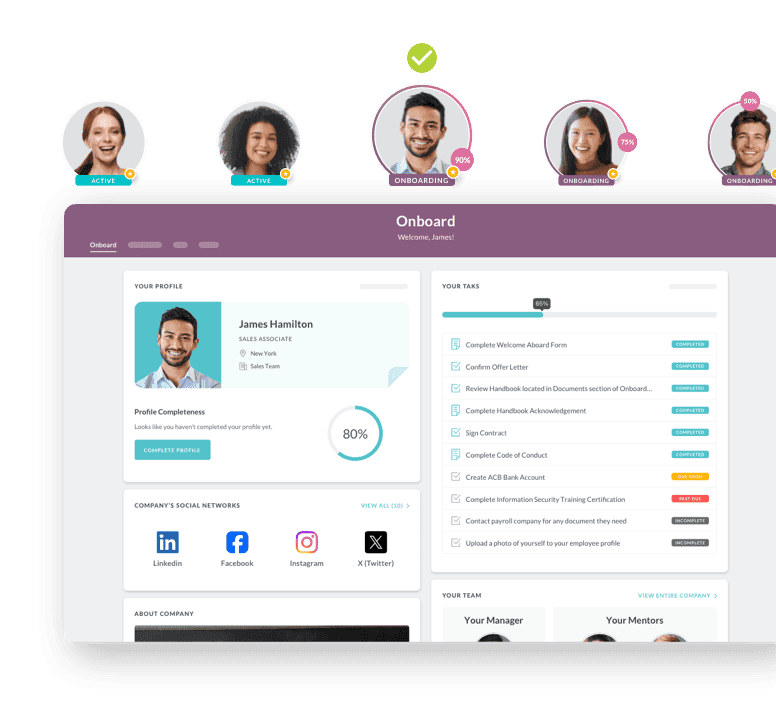
Osmose Utilities Services, a construction and utilities company that uses HR Cloud's Onboard solution for its field-based crews, previously spent up to two hours per new hire on manual onboarding paperwork, with data entry errors adding further delay, and had ongoing concerns about consistently meeting I-9, E-Verify, and industry-specific compliance deadlines across a workforce with no central office to process hires from. According to Kaylee Collins, HR Analyst at Osmose Utilities Services, automating that onboarding process gave the company's hiring managers "a reliable system that is easy to navigate," and "helped us improve compliance and gives us a powerful tool to achieve even more results in the future." It's worth being direct about what that case does and doesn't demonstrate: it's specifically about onboarding compliance (I-9 and E-Verify accuracy at the point of hire), not certified payroll or union wage reporting. But it illustrates the underlying pattern this guide has been making throughout: the same worker-classification and documentation gaps that create onboarding compliance risk for a field-based construction workforce are the ones that create payroll and certified-payroll compliance risk further downstream, because they're the same underlying data.
“Our hiring managers now have a reliable system that is easy to navigate. Our HR team can actively monitor the process, and assist if needed, but Onboard has helped them save so much valuable time and effort while increasing data accuracy.”

— Kaylee Collins, HR Analyst, Osmose

Conclusion
Union and non-union construction payroll compliance isn't one problem. It's three (union rules, prevailing wage, and multi-state variation) that compound each other, and most compliance failures trace back to a data handoff between systems rather than a single bad calculation or a deliberate attempt to underpay. The $767,095 Hawaii case and the $1.6 million North Carolina case cited in this guide didn't start as fraud investigations; they started as classification decisions that were never re-checked as projects changed.
Getting worker classification right at the point of assignment, keeping it current per project, and centralizing the documentation that proves it are the parts an HRIS and time-tracking platform can actually own. None of that replaces a payroll provider or a dedicated certified-payroll tool, and no HR software, HR Cloud included, files a WH-347 on a contractor's behalf. What it does is make sure the classification, hours, and documentation feeding that payroll system are accurate and defensible, which is what separates a contractor who can produce an audit trail in an afternoon from one who's reconstructing it under deadline pressure with an investigator on the other end of the phone. See how HR Cloud supports construction workforces, or book a demo of HR Cloud's onboarding and HRIS tools to see how classification, time tracking, and documentation come together for field-based crews.

Discover how our HR solutions streamline onboarding, boost employee engagement, and simplify HR management
Book a DemoFAQs
What is certified payroll reporting?
Certified payroll is a weekly wage report, filed on federal Form WH-347 or a state equivalent, that contractors on federally funded construction projects over $2,000 submit to prove they paid the Davis-Bacon prevailing wage. It lists each worker's name, hours, job classification, and pay rate for that week, along with a signed statement certifying the payroll is accurate and complete, and it's required for every week a covered project is active, including weeks when no work occurred on site.
How does HR software handle prevailing wage calculations?
HR software does not set or calculate the prevailing wage rate itself; that determination comes from the Department of Labor's Wage and Hour Division or a state labor agency under a state-level equivalent law. What HR software can do is track and timestamp classification and rate changes at the worker and project level, so that when a wage determination updates or a worker's classification changes, there's an auditable record showing what applied and when. The payroll system or a dedicated certified-payroll tool then uses that record, along with the worker's actual logged hours, to calculate the payment and generate the compliance report.
Can one system manage both union and non-union crews?
Yes, as long as the system tracks classification, project assignment, and applicable wage rules (collective bargaining agreement vs. prevailing wage vs. neither) at the individual worker level rather than applying one rule company-wide. HR Cloud's People module supports custom fields and views by position, location, and department, which is what lets a single HRIS represent a workforce that's part union and part open shop, spread across multiple states and wage determinations, without merging the two into one incorrect rule set or forcing every worker through the same classification template.
What are the penalties for payroll misclassification?
Penalties vary by case and jurisdiction, but real enforcement actions show the range. Hawaii's Department of Labor and Industrial Relations fined a contractor $767,095 for allegedly misclassifying 65 workers as independent contractors on a single hotel project, driven largely by the unemployment insurance, workers' compensation, and disability premiums the contractor avoided paying. The U.S. Department of Labor separately recovered over $1.6 million in back wages and liquidated damages for 188 misclassified construction workers at a North Carolina firm, after finding the workers had been denied required overtime pay. Beyond direct fines and back-wage awards, misclassification can trigger back taxes, denial of future federal contract eligibility, and civil or criminal liability for knowing violations of the Davis-Bacon Act, according to the Department of Labor.
About the author

Keep Reading


Like What You Hear?
We’d love to chat with you more about how HR Cloud® can support your business’s HR needs.
Book Your Free Demo