What's the Fastest Way to Onboard Seasonal and Project-Based Construction Workers?

The fastest way to onboard seasonal and project-based construction workers is to move every step off paper and off-site: send I-9s, tax forms, and safety orientation to a worker's phone before their first day, gate site access behind a completed digital checklist, and route manager sign-off automatically instead of by email. Done this way, a worker's first morning on an actual job site is reduced to identity verification and a site-specific safety walkthrough, rather than a full day of paperwork, and none of it requires a trip to a central office.
Construction hiring does not run on a normal calendar. A framing crew hired for a six-week job, a utility crew brought on for storm restoration, or a subcontractor's laborers added for one phase of a build all need to be compliant and productive almost immediately, often before anyone in HR has met them in person. Below is exactly how fast-moving construction and field-service employers are rebuilding onboarding around that reality, and where HR Cloud's Onboard platform fits into it.
Why Construction Onboarding Needs to Move Fast
Construction onboarding carries a structural time pressure that most other industries do not deal with in the same way. A retail chain hiring a holiday associate still expects that associate to be around for months. A general contractor bringing on a crew for the foundation phase of a build may only need that crew for a matter of weeks before the project moves to framing and a different trade takes over. Every day spent getting that crew compliant and productive is a day subtracted directly from a fixed, often contractually penalized, project timeline. Construction employment does not sit still the way office headcount does, either. The U.S. Bureau of Labor Statistics puts total construction employment at roughly 8.3 million as of April 2026, and that number swings hard by season and region because the work itself is weather-dependent and project-bound. The Federal Reserve Bank of St. Louis has tracked this directly: construction employment in cold-weather states drops sharply every winter and rebuilds every spring, a pattern the BLS strips out with seasonal adjustment but employers live through every year. A contractor cannot spread hiring evenly across twelve months when half the calendar is a bidding season and the other half is a building season.
Short project timelines and tight labor markets
Layer a tight labor market on top of that seasonality and slow onboarding becomes a direct cost, not just an inconvenience. BLS JOLTS data put the construction hiring rate at 3.3% in February 2026, the lowest reading since the JOLTS series began in 2000, while job openings ran between roughly 212,000 and 240,000 in the same stretch. That means every qualified worker a contractor identifies is also being chased by someone else, and a five-day onboarding cycle is five days for that worker to accept a different offer or simply not show up. A six-week roofing job does not have five slow days to give up front. If a crew is only on-site for the life of one project, every day spent on paperwork instead of the project is a day that project falls behind, and a day that worker is being paid without producing anything on the job.
The labor pool itself is also narrower than it used to be. An analysis of BLS, AGC, and Deloitte data by Amtec Staffing found immigration enforcement activity has directly or indirectly affected roughly a third of construction firms, at a time when foreign-born workers make up close to a quarter of construction payroll employment and about a third of craft workers specifically. The same analysis found data-center construction is pulling the highest-skilled trades toward better-paying projects, with those contractors carrying meaningfully longer project backlogs than the rest of the industry. None of that is a reason to slow down hiring. It is a reason a contractor cannot afford to lose a worker they already found to a competitor's faster onboarding process. Project-based hiring compounds this further: a general contractor staffing up for one phase of a build, then releasing that crew and staffing a different trade for the next phase, is effectively running the seasonal-hiring problem multiple times per project instead of once per year.
What Slows Down Traditional Construction Onboarding
Most onboarding delays in construction come from a mismatch: the process was built for an office worker who has a laptop, a company email address, and a full day free before starting work. Field and seasonal hires usually have none of those three things, and a process that assumes otherwise does not just run slower, it actively works against the way construction hiring actually happens, where a foreman needs three more laborers on-site by Thursday and cannot wait for a Monday-through-Friday HR orientation cycle to catch up.
Paper forms and in-office orientation requirements
A traditional construction onboarding process typically requires a new hire to show up at a central office or trailer, sit down with an HR staffer, and fill out a stack of paper: W-4, I-9, direct deposit forms, an employee handbook acknowledgment, and a safety orientation packet, often all on the morning of day one. HR Cloud's own case work with Osmose Utilities Services, a utility-structure inspection company with a largely field-based workforce, found that a typical manual onboarding took up to two hours per new hire and sometimes produced data-entry errors that took even longer to correct, all while raising real questions about whether the company could consistently meet I-9 and E-Verify deadlines.
Run that reported maximum against a realistic seasonal ramp, purely as an illustrative scenario based on Osmose's own reported numbers rather than an industry-wide benchmark, and the scale of the problem becomes obvious. Thirty seasonal or project-based hires at up to two manual hours apiece is as much as sixty HR hours, roughly a week and a half of a single HR staffer's time, spent on data entry before any of those thirty people has picked up a tool. On a project with a hard start date, that time either comes out of the project schedule or comes out of HR's ability to do anything else that week, including the recruiting needed to fill the next round of seasonal openings.
Paper also has no audit trail. If an OSHA inspector or a state labor auditor asks for proof that a specific worker completed safety orientation before starting, a signed paper form sitting in a site trailer is slow to produce and easy to lose, and it proves the form was signed, not that the training was actually delivered or understood. That gap gets worse, not better, when a project runs multiple subcontractors on the same site, since each one may be keeping its own paper records in its own format, and under OSHA's multi-employer worksite policy, a controlling employer can carry responsibility for site-specific hazard orientation depending on its role and degree of control on that site. A filing cabinet split across five subcontractors is not a system anyone can produce an answer from quickly.
What Mobile Onboarding Looks Like for Field Crews
Mobile-first onboarding flips the traditional model: instead of asking a worker to come to HR before they can start, HR sends the paperwork to the worker, wherever they are, before their start date. That shift also changes how HR handles volume. When a seasonal ramp brings on dozens of workers in the same week, a system built for one-at-a-time, in-person onboarding cannot keep pace no matter how many extra hours HR puts in, because the bottleneck is the format of the process itself, not the number of people running it.
SMS-based paperwork completion before day one
For a frontline or field workforce, email is not a reliable channel. Many construction workers do not have a company email address on their first day, and some do not check personal email often even when they have one. Text messages get opened. HR Cloud's platform reflects that reality directly: its SMS module can send time-sensitive onboarding messages, reminders, and short task links straight to a new hire's phone, and it is available once an account has Twilio integration enabled in the backend. A worker gets a text with a link, taps it, and completes a form built for a phone screen rather than a desktop browser resized down. No app download, no portal password to remember before they even have one.
Mobile onboarding is not limited to a single channel, either. Alongside SMS, HR Cloud's automation supports an Email module for anything that benefits from richer formatting, such as a welcome packet or a benefits summary, a Chat module for quick informal updates delivered through the platform's built-in messaging, and a Meeting module that can schedule a supervisor introduction call or an in-person orientation slot directly onto a calendar with automatic attendee tracking. For a project-based hire, that flexibility matters: a text can confirm the start time and site address the night before, while a scheduled meeting module locks in a specific supervisor to meet them at the gate on day one, so nobody is standing around a job site wondering who is supposed to be there.
Digital safety orientation and sign-off
Safety orientation is the one onboarding step a construction employer cannot afford to shortcut, and it is also the one most exposed by a manual process. Federal OSHA's construction standard, 29 CFR 1926.21(b)(2), requires employers to instruct each employee in recognizing and avoiding the unsafe conditions specific to their work environment before they are exposed to it, and topic-specific standards layer on top of that general requirement, including fall protection training under 29 CFR 1926.503 for anyone exposed to fall hazards. Digitizing that step does two things a paper sign-off sheet cannot: it forces sequence, so a worker cannot skip ahead to a task without acknowledging the hazard briefing that comes before it, and it creates a timestamped completion record HR or a safety manager can pull up in seconds rather than digging through a site binder.
This matters even more for a crew that rotates across job sites rather than staying at one location, which describes most project-based construction work by definition. A general hazard orientation covers company policy, but the specific hazards at a highway overpass job are not the same as the specific hazards at a warehouse build, and HR Cloud's checklist triggers, which can fire on a job-detail change such as a new location or position, make it possible to configure a fresh, site-specific safety module each time a worker moves to a different site, rather than assuming one orientation on day one of employment covers every site that worker ever sets foot on. A timestamped completion record also does work beyond OSHA compliance itself: workers' compensation insurers and project owners running their own safety audits routinely ask contractors to produce proof of orientation for every worker on a claim or on a bonded project, and a digital record that can be pulled up by name in seconds is a materially better position to be in than promising to go find the paperwork in a site trailer.
How Construction Firms Are Speeding Up Onboarding Today
The contractors and field-service employers moving fastest are not adding HR headcount to keep pace with seasonal hiring swings. They are restructuring when onboarding happens relative to a worker's actual start date, and how many workers can move through the process at once. Batch hiring is a normal part of construction: a general contractor might bring on twenty framers for one phase, then release most of them and bring on a different trade for the next. HR Cloud's onboarding tools include a bulk-start action built for exactly this pattern, where an HR admin can select a batch of newly added employee records from the People tab and trigger onboarding for the entire group in a few clicks, rather than opening each individual profile one at a time, with the process designed to be repeated in batches of up to roughly a hundred records at once for larger cohorts.
Pre-boarding workers before their first day on site
Pre-boarding means every form, acknowledgment, and safety module that does not require a supervisor standing next to the worker gets completed before day one, not on it. That includes I-9 Section 1, tax withholding forms, direct deposit setup, handbook acknowledgment, and the general safety orientation module. When those items are already done, a worker's actual first morning on-site is reduced to I-9 Section 2 verification, a site-specific hazard walkthrough with their supervisor, and getting to work.
This is the single most effective change a construction employer can make to onboarding speed, because it does not require new headcount or new hardware. It only requires sending the paperwork earlier and giving the worker a way to complete it from a phone they already own. Pre-boarding also changes what a worker's first impression of the company looks like. A crew member whose first morning is spent standing around while paperwork gets sorted out forms a different opinion of the job than one who shows up already cleared, already assigned to a supervisor, and ready to start working within minutes. For seasonal and short-tenure hires especially, that first-morning experience is most of what they will remember about the company, since there may not be a second or third week to change the impression.
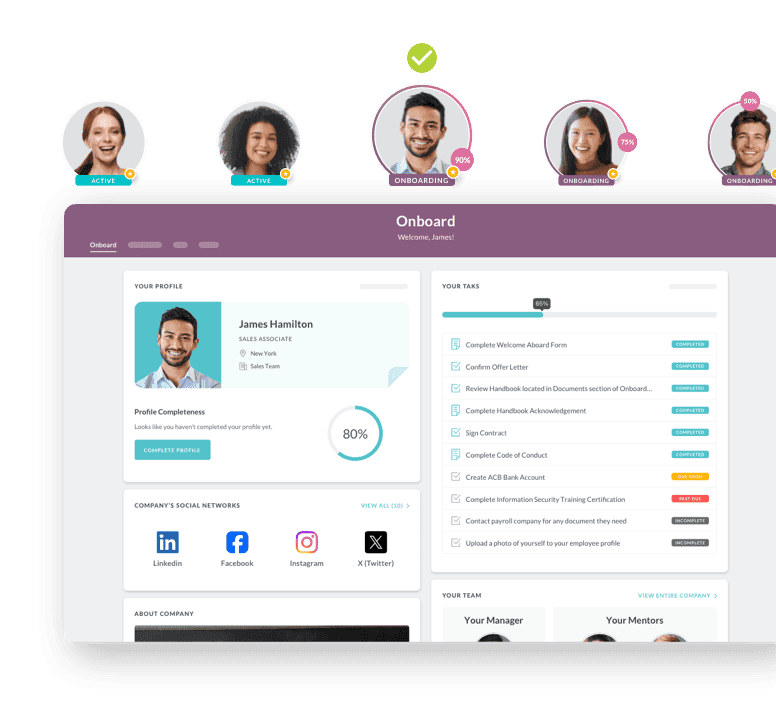
Step-by-Step: Building Fast Onboarding for Field Crews
Here is the sequence construction and field-service HR teams are using to compress onboarding from days to hours, in the order it should be built. Each step assumes the one before it is already in place, so skipping ahead, for example automating task routing before the underlying paperwork is even digital, tends to just automate a broken process rather than fix it.
Step 1: Digitize all onboarding paperwork
Start by moving every required document into a digital, e-signature-ready format: W-4, state withholding, I-9 Section 1, direct deposit authorization, confidentiality or equipment agreements, and any company-specific policy acknowledgments. HR Cloud's Onboard platform supports e-signature for these common onboarding documents, so a new hire can review and sign each one from any device before their start date, with no printing, scanning, or in-person witnessing required. This step alone removes the paper stack that historically anchored construction onboarding to a physical office. It is also the step that determines whether every later step works, since automated reminders, mandatory gates, and dashboard tracking all depend on the underlying documents already existing as trackable, digital tasks rather than loose paper.
Step 2: Move delivery to SMS/mobile
Once the forms exist digitally, the delivery channel matters as much as the format. Build the onboarding checklist inside a portal that works cleanly on a phone browser, and add SMS delivery for anything time-sensitive, using a system with native SMS support like HR Cloud's SMS module rather than hoping a worker checks an email account tied to a job they have not started yet. If part of a checklist still needs to happen on the actual job site, such as a worker who was hired same-day for an urgent staffing gap, kiosk-style, on-site completion should be the fallback, not the default. Every task that can be finished before day one and is not should be treated as a design gap in the workflow, not an acceptable exception.
Step 3: Automate safety orientation sign-off
Configure the safety orientation checklist as a mandatory gate rather than an optional item on a longer list. HR Cloud's Mandatory Checklist setting locks a new hire out of the rest of the system, and by extension out of any subsequent onboarding tasks, until every task in that checklist is complete, and it gives HR admins, managers, and other authorized users a live view of exactly where each worker stands in that sequence. That structure directly answers a safety manager's real question on a busy Monday: not "did everyone sign something," but "has every single person scheduled for this site actually completed and acknowledged the hazard briefing." Because the gate can be triggered automatically by a job detail change rather than only at initial hire, it also covers a returning seasonal worker moved to a new site or a different type of work, where the earlier orientation no longer applies.
Step 4: Set up automated task routing to project managers
Onboarding is not only an HR function on a construction project. Superintendents need to confirm crew assignments, project managers need to sign off on start dates tied to specific jobs, and safety leads need to confirm site-specific briefings for each location a crew rotates through. HR Cloud's Smartflow automation assigns onboarding modules, whether that is a task, an email, an SMS message, or a scheduled meeting, based on rules like Manager, Location, Position, Department, or Employment Status, so a task can route automatically to the specific project manager or superintendent responsible for that worker's job site rather than sitting in a shared inbox waiting for someone to notice it. Set the trigger to fire when an employee's status changes to hired or when a job detail like project or location is updated, and the routing happens without HR manually reassigning anything for every new start. For a general contractor that already tracks vendor and project assignments in Procore, this pairs directly with HR Cloud's Procore integration, which keeps a worker's job title, vendor/location detail, and employment status synced between the two systems automatically, rather than requiring the same information to be re-entered by hand.
Step 5: Track completion before site arrival
The last step is visibility. A dashboard view of every active onboarding, sorted by who is starting within the next seven days and who has an overdue task, lets HR catch a missing I-9 or an unsigned safety acknowledgment while there is still time to fix it, rather than discovering the gap when the worker is already standing at the gate. HR Cloud's onboarding dashboard breaks this down by total active onboardings, onboardings starting within seven days, onboardings with overdue tasks, and unassigned onboardings, and it can be filtered by department or location, which matters directly for a contractor running several job sites at once with different start dates on each. A separate view of overdue tasks by assignee also surfaces which manager or superintendent is the actual bottleneck, rather than leaving HR to guess which site is behind.
| Onboarding step | Manual, paper-based process | Mobile, automated process |
|---|---|---|
| Where paperwork happens | Central office or site trailer, day one | Worker's own phone, before start date |
| Typical time per new hire | Up to two hours (HR Cloud/Osmose case data) | Minutes, spread out before the start date |
| Safety sign-off proof | Paper form, filed on-site | Timestamped digital completion record |
| Task ownership for managers | Email, easily missed | Auto-routed by role, location, or manager |
| Visibility into gaps | Discovered on arrival, or after | Flagged days ahead on a live dashboard |
How HR Cloud Gets Workers Job-Site Ready Faster
HR Cloud's Onboard platform was built around exactly this frontline reality rather than retrofitted from an office-first HRIS, which shows up in three specific places for construction employers: how workers receive tasks, how safety compliance gets enforced and proven, and how the employee onboarding platform ties into a project management system contractors are likely already running.
Mobile-first onboarding via SMS
HR Cloud's Maya AI onboarding agent is available as an SMS-linked chat experience that guides new hires through their onboarding portal on any phone, with no app download required, which the company positions specifically for construction and utilities crews who need to complete tasks from the field rather than a desk. Once a new hire opens Maya for the first time, it introduces their manager and any assigned onboarding buddy, then presents onboarding tasks one at a time, starting with the most time-sensitive, and automatically advances to the next task as each one is completed or explicitly skipped. Combined with kiosk mode, which lets a worker complete required onboarding paperwork directly at the job site if some of it could not be finished in advance, this covers both the pre-boarding scenario and the reality that some construction hiring genuinely happens the same morning a crew shows up short-handed.
Automated safety and compliance sign-off
Beyond the Mandatory Checklist gate described above, HR Cloud's reminder system lets HR configure upcoming alerts before a task's due date and overdue alerts after it, including repeating overdue alerts on a daily, weekly, or monthly cadence until a task is finally completed. For a construction employer running a rotating roster of seasonal and project-based hires, that closes the gap between sending a safety module and being able to prove every current worker on a site actually finished it.
On the project-management side specifically, HR Cloud maintains a direct Procore integration. Once an account manager sets up the connection, an admin selects the relevant Procore company, and optionally a specific vendor sub-company, then imports users directly into HR Cloud. From there, employee records sync from Procore into HR Cloud, including email address, job title, vendor or location detail, first and last name, and active employment status, while any new hire added in HR Cloud is exported out to Procore automatically, and later updates sync in both directions. For a general contractor already running project assignments through Procore, that removes a second, manual data-entry step every time a worker is added to or moved between projects, which is exactly the churn that project-based and seasonal hiring produces constantly. Combined with existing payroll integrations for ADP, UKG, and Paylocity, a worker's information can move from Procore, into onboarding, and out to payroll without HR retyping the same name and job title three separate times.

Ready to pass your next audit—without the stress?
See how you can simplify compliance and eliminate gaps before they become problems.
Book Your Free DemoCommon Onboarding Mistakes in Construction
Two recurring mistakes create avoidable delay for construction employers, and both are structural rather than a matter of anyone working harder. They also tend to reinforce each other: a paper-first process is exactly the kind of process that produces no reliable tracking, because nobody is entering completion status anywhere central until someone manually does the data entry after the fact.
Requiring in-person paperwork before start date
Treating a worker's first morning on-site as the moment paperwork begins guarantees that morning is lost to administration instead of production. This is worse, not better, for seasonal and project-based hires specifically, because their entire tenure on a job might be measured in weeks. Losing a half-day to paperwork on a six-week job is a materially larger share of that worker's productive time than the same half-day would be for a permanent employee. This is a different problem from the one most general-purpose guides to high-volume employee onboarding address: those cover scaling a standardized process across a large office-based or retail cohort, while a rotating field crew adds the extra complications of no fixed jobsite, no shared email domain, and a safety orientation requirement that changes with every location. It also creates an unnecessary point of failure: if the one HR staffer who runs in-person onboarding is out sick or double-booked across two job sites on the same morning, new hires either wait or start work without having completed required documentation, and neither outcome is acceptable.
No tracking of incomplete onboarding tasks
The second common failure is having no single, current view of who has and has not finished onboarding. When that tracking lives in a site supervisor's memory, a spreadsheet nobody updates consistently, or a stack of paper in a trailer, gaps do not surface until an audit, an incident, or a worker showing up to a site they are not actually cleared to enter. A live dashboard view removes the guessing, and it is the difference between finding a missing I-9 on a Tuesday afternoon with time to fix it and finding it during a compliance audit six months later. This failure compounds specifically for seasonal employers, because the same roster of returning workers often needs to be re-onboarded or re-verified each season, and a process with no persistent tracking effectively starts from zero every single year instead of building on what was already confirmed the last time those workers came back.
What Faster Onboarding Delivers
The payoff for compressing onboarding into hours instead of days is not abstract. It shows up directly in how fast a crew starts producing, how much administrative time HR gets back, and how defensible the company's compliance position is if a regulator or an insurer ever asks for records. For seasonal employers specifically, it also shows up the following year, when a returning worker's information is already on file and a fresh season of onboarding starts from a running head start instead of from zero.
Reduced project delays and faster crew ramp-up
Osmose Utilities Services automated its field onboarding approach with HR Cloud specifically to cut the time and error rate tied to its manual process, after finding that its prior approach raised real concerns about consistently meeting I-9 and E-Verify compliance deadlines for a largely field-based workforce. Its HR analyst, Kaylee Collins, has described the result as taking onboarding "from chaos to clarity," and reports that hiring managers now have a reliable system to navigate while HR spends less time on manual data entry and more time on higher-value work. The same case notes that HR retained active oversight of the process throughout, rather than losing visibility once onboarding moved off paper, which is the outcome a field-heavy employer actually needs: less manual work, not less control over compliance.
That kind of change matters most exactly where seasonal and project-based hiring concentrates the pain. Going back to that illustrative math, cutting up to sixty hours of manual onboarding work for thirty seasonal hires down to a fraction of that time, because most of the process now runs through pre-boarding, automated routing, and e-signature rather than manual data entry, frees an HR team to spend that week on recruiting the next round of seasonal openings instead of re-typing the current one. On the project side, a crew that is fully compliant and working by their second morning instead of their fourth is a crew that is not costing a project two extra days of payroll for zero output, and it is a crew whose first real impression of the company is a smooth start rather than a paperwork bottleneck.
The returning-worker piece is worth calling out specifically, because seasonal construction hiring is rarely a one-time event with entirely new people every year. HR Cloud supports a dedicated rehire checklist that triggers automatically when a previously terminated worker is marked as rehired rather than treating them as a brand-new employee. Their prior tasks and forms are archived rather than deleted, visible to HR but not cluttering the returning worker's own view, and only the checklist items relevant to a rehire, rather than every document a first-time hire would need, get reassigned. For a contractor who brings back a meaningful share of last season's crew every spring, that difference is the gap between fully re-running onboarding from scratch and simply confirming what has changed since the worker last left.
Conclusion
The fastest path to onboarding seasonal and project-based construction workers is not adding people to HR. It is removing the assumption that onboarding requires a desk, a company email address, and a full day in an office before someone can pick up a tool. Digitize the paperwork, deliver it by text to a phone workers already carry, make safety orientation a gate rather than a checkbox, route manager and project-manager tasks automatically instead of by email, and track completion on a live dashboard before anyone arrives on-site.
None of this requires replacing a project management system a contractor already relies on. A direct sync with Procore means job title, vendor/location detail, and employment status do not have to be re-keyed by hand, and existing payroll integrations with ADP, UKG, or Paylocity mean the same is true once a worker moves from onboarding into active pay status. The goal is not to add another disconnected tool to a construction company's stack. It is to remove the manual handoffs between hiring, onboarding, project assignment, and payroll that are the actual source of onboarding delay. Construction and field-service employers running this model, including HR Cloud customers like Osmose Utilities, have moved onboarding out of the office and into the field, cutting the manual data-entry time and error rate that a paper process could not catch.
See how HR Cloud's Onboard platform for construction teams handles seasonal and project-based hiring. Request a demo to walk through mobile onboarding, Smartflow task routing, and the onboarding dashboard with your own workforce numbers.
Discover how our HR solutions streamline onboarding, boost employee engagement, and simplify HR management
Book a DemoFAQs
Can onboarding be completed before a worker arrives on site?
Yes. Most of a construction new hire's paperwork, including I-9 Section 1, tax withholding forms, direct deposit setup, and general safety orientation, can be completed from a phone before the worker's first day, using an e-signature-enabled onboarding portal rather than an in-person session. This leaves only I-9 Section 2 verification, which requires the employer to examine identity and work-authorization documents in person or through an authorized alternative procedure under current USCIS rules, and any site-specific hazard walkthrough for the actual arrival. That is the entire model behind pre-boarding: front-load everything that does not require an in-person step, and leave day one for the small handful of things that do.
How do you onboard workers without company email addresses?
Use SMS instead of email as the primary onboarding channel. Platforms with native SMS support, such as HR Cloud's SMS module and Maya AI onboarding agent, send task links directly to a worker's personal phone number and let them complete onboarding through a mobile browser, with no company email account or app download required before their first day. This matters specifically for seasonal and project-based construction hires, who often do not receive a company email address until well after their actual start date, if they ever receive one at all for a short-term role.
Does onboarding software track safety orientation completion?
Good onboarding software tracks safety orientation as a mandatory, timestamped step rather than a form filed away after the fact. HR Cloud's Mandatory Checklist setting blocks further access until a safety module is finished, and its onboarding dashboard shows exactly which current workers have an overdue or incomplete safety task, so gaps surface before an audit or incident rather than after one. That timestamped record is also what an employer would want on hand if a state labor department or OSHA ever asked for evidence that a specific worker completed orientation before starting work on a given site.
How does this work for short-term project hires?
The same digital, mobile-first workflow applies regardless of how long a hire is expected to stay on the roster, and it matters more for short-term hires, not less, because a delay of even a day or two eats a much larger share of a six-week project than it would for a permanent employee. Automated task routing by project or location also makes it practical to onboard and offboard project-based crews repeatedly without rebuilding the process each time, since role-based templates and Smartflow triggers can be reused every time a new phase of work starts rather than configured from scratch. For contractors who track vendor and project assignments in Procore, that reuse extends into the project system itself, since a worker's job title and location detail stay synced between HR Cloud and Procore rather than needing manual re-entry each time.
About the author

Keep Reading


Like What You Hear?
We’d love to chat with you more about how HR Cloud® can support your business’s HR needs.
Book Your Free Demo