What's the Best Way to Onboard New Government Employees Remotely or Across Departments?

The best way to onboard new government employees, whether they work remotely or across several departments, is to run every department's tasks at the same time instead of passing the new hire from office to office. Government employee onboarding software makes that possible. It routes each task to its owner the moment an offer is accepted, shows everyone the same status, and holds back only the steps that truly depend on another step. That order of operations removes waiting time without removing a single approval.
The workflow principles below apply to any government employer. The regulatory examples come from U.S. federal employment (OPM, 5 CFR Part 731, and federal clearance data), so state, local, and school district agencies should substitute their own civil service, background check, credentialing, and security rules.
Why Government Onboarding Spans Multiple Departments and Approvals
A new hire at a small private company might deal with one HR generalist and one IT ticket. A new government employee can touch far more offices than that. Public agencies keep separate owners for personnel records, technology access, physical security, and the daily work itself. Each owner has its own rules, its own forms, and its own definition of done.
That structure exists for good reasons. Public money, public data, and public trust sit behind every position, and agencies answer for who gets access to what. Public sector onboarding is therefore a coordination problem before it is a paperwork problem. The paperwork is manageable. Getting five or six offices to finish their piece in the right order, while seeing each other's progress, is the hard part.
Three forces widen the coordination gap. First, positions carry different risk levels. The U.S. Office of Personnel Management (OPM) describes a position designation system that assesses each position's duties to set its risk and sensitivity level, and that result determines the level of investigation the position requires (OPM Position Designation Tool). Two employees who start the same week can need very different checks.
Second, some checks carry timing rules. For covered federal positions, OPM's suitability regulation says a background investigation should be initiated before the individual is appointed, and where an agency does not start on time, it must start as soon as possible even after the appointment (5 CFR Part 731). Third, remote and field-based employees are not standing in the building when the badge, laptop, and login get sorted. Every handoff has to work without a hallway conversation.
Multi-department onboarding software is built to manage those three forces in one place. The rest of this guide explains how to use it, starting with who is actually involved.
HR, IT, security clearance, department heads
Four groups anchor a government onboarding, and each one holds a different piece of the same new hire.
HR owns the employment record. That includes the accepted offer, the personnel action, benefits enrollment, and Form I-9. The I-9 has its own clock. The employee completes Section 1 no later than the first day of employment (USCIS Form I-9 instructions), and the employer or an authorized representative completes Section 2 within three business days of the date of hire (USCIS). A missed I-9 deadline is an HR problem that starts as a coordination problem.
IT owns accounts, equipment, and access. IT cannot finish its work until it knows the role, the start date, and the access level, and the access level may depend on what security decides. For a remote hire, IT also owns getting hardware to a home address before day one.
Security owns the vetting path. That path starts with the position designation and, for many roles, a questionnaire, an investigation, and a determination. Not every role involves a clearance. Many need only a suitability or fitness check tied to a public trust designation, while national security positions add a sensitivity level on top. OPM's tool looks at both, and its guidance notes that, for covered positions, a critical-sensitive or special-sensitive designation automatically carries a high-risk public trust designation (OPM).
Department heads own the job itself. They confirm the workspace or remote setup, plan the first week, assign a supervisor or buddy, and decide when the new hire starts real work. They can be left out of the status loop, because they sit outside HR and IT.
Payroll, facilities, training, and labor relations can sit alongside these four. The point is not the exact list, which varies by agency. The point is that each group can only see its own queue unless the process gives them a shared view. Government employee onboarding software gives all of them that shared view.
What Slows Down Government Onboarding Today
Waiting starts before day one. OPM data reported by Federal News Network shows the federal governmentwide average time to hire was 101 days in fiscal 2024 (Federal News Network). OPM's Merit Hiring Plan sets a goal of reducing time to hire to under 80 days (OPM Merit Hiring Plan). Time to hire measures the hiring process, not onboarding, but the two run back to back. Every idle week after the offer adds to a wait the new hire has already sat through.
The employee's experience of that wait matters. Gallup reports that only 12% of employees strongly agree their organization does a great job onboarding new employees (Gallup). That figure covers workers across sectors, not only government, but it sets the baseline every agency is measured against by the people it hires.
Inside the agency, a common way this stalls is that the process was built around offices instead of around the new hire. Each office does its part, and none of them owns the whole. Public sector onboarding needs one shared record that follows the hire, and agencies have to build that record on purpose.
Sequential, siloed department approvals
The standard pattern is a relay race. HR finishes the personnel action and emails IT. IT waits for the security office to confirm the access level. Security waits for a completed questionnaire. The department head waits for IT to say the laptop is ready. Each office sees only its own queue, so nobody can tell whether a delay is one day or three weeks until someone sends a chasing email.
Sequential handoffs feel safe because they mirror how paper travelled between desks. But some of those dependencies are habits, not rules. The table below separates real dependencies from habits for a typical position. It is an illustration of the method, not agency policy, so confirm sequencing against your own regulations and counsel.
| Workstream | Usual owner | Can start when | Truly waits on |
|---|---|---|---|
| Personnel record and benefits | HR | Offer is accepted | Accepted offer |
| Form I-9, Section 1 | New hire | After offer acceptance, no later than first day of employment | Accepted offer |
| Form I-9, Section 2 | HR or authorized representative | Once the employee presents documents, within three business days of hire | Section 1 and documents |
| Position designation | HR with security office | Once duties are defined | Position description |
| Investigation initiation | Security office | Before appointment for covered federal positions | Designation and completed questionnaire |
| Accounts and equipment | IT | Once role, start date, and location are confirmed | Role and start date; access level may wait on security |
| Workspace or remote setup and first-week plan | Department head | Once start date is confirmed | Start date |
| Access to classified material | Security office | Per agency access rules and eligibility decisions | Eligibility decision |
Agency security rules, eligibility decisions, and any preliminary or interim determination process control actual access. The table illustrates workflow design. It does not set those rules.
Read down the last column. Only a few rows wait on another row. The sequential relay treats all of them as if they did. A workflow that respects only the true dependencies lets the department head plan the first week on the day the offer is accepted, not after IT and security have both reported back.
Silos also hide risk. If the I-9 clock, the badge request, and the questionnaire each live in a different inbox, no one sees the employee whose three deadlines all land in the same week. That is how a fixable delay turns into a first day with no login and an open compliance item.
What Streamlined Onboarding Workflows Solve
A well-built workflow solves two problems that manual processes create. The first is routing: making sure each task reaches the right owner without someone forwarding an email. The second is sequencing: making sure tasks run side by side wherever the rules allow. Both problems are visible in government employee onboarding software evaluations, because comparing vendors forces an agency to describe its current sequence on one page. Writing it down is the first useful result, before any software is switched on.
Automated routing between departments
Automated routing means a defined event creates the work and assigns it. When a candidate accepts an offer, the workflow generates the full checklist for that position type and sends each task to a named owner or role, with a due date. HR does not forward anything. IT does not wait to be told. The department head receives the first-week tasks the same day the security office receives the vetting tasks.
Good routing has four properties. It assigns by role instead of by person, so a vacation or a reorganization does not stall the hire. It attaches a due date to every task, measured back from the start date. It sends reminders before the due date and escalations after it. And it records who completed each task and when, which gives the agency an audit trail without anyone building one by hand.
For public sector onboarding, routing also means variants. A groundskeeper, a payroll analyst, and a position with national security duties should not receive the same checklist. Job, department, and work location are the natural inputs for deciding which checklist a new hire receives. Build the variants once so that no office has to remember the exceptions.
Parallel processing instead of sequential handoffs
Parallel processing means every task whose true prerequisites are met starts now. It does not mean skipping steps or granting access early. It means the department head does not wait for IT, and IT does not wait for security, when the work itself does not require it.
Security timelines show why this matters. A ClearedJobs analysis of published government data reports that the federal government-wide total processing time for an initial Top Secret clearance was 205 days in the first quarter of fiscal 2026, and 92 days for a Secret. The same source notes that preliminary determinations, which the source describes as letting most people begin work, averaged 23 days for high-risk positions and 8 for moderate-risk positions in the second quarter of fiscal 2026, and it cautions that the 8-day figure is the low point of a volatile, restated series (ClearedJobs). The source also reports that the basis for these figures is being revised and that the change is expected to lower reported timeliness, so treat every number here as a moving target.
Now consider what a sequential process does with those numbers. If IT and the department head wait for a final determination before preparing anything, the new employee's first day depends on the longest task in the entire process. In a parallel process, the longest task is still the longest task, but it only gates the things it actually gates. Access to classified material stays behind the agency's decision. Everything else moves.
That is the core idea of multi-department onboarding software: separate the gate from the queue. Put the true gates in a small number of chained tasks. Run everything else in parallel, and make progress visible to every stakeholder.
How Agencies Are Streamlining Onboarding Today
Improving public sector onboarding starts with a list, not a purchase. Agencies collect every form, system, approval, and owner touched by a new hire. They mark the true dependencies. Then they move the process into multi-department onboarding software that enforces order only where order is real. The shift is small in concept and large in effect, because it replaces a relay with a shared checklist.
Three practices are worth building in. Agencies build separate checklists by position type so that low-risk, moderate-risk, and sensitive roles each follow their own path. They give each department a role in the workflow instead of a seat in an email chain. And they move employee-facing tasks onto devices new hires already own, which matters for remote staff and for field employees who do not sit at a desk.
That last practice is worth attention. A public works crew member, a park ranger, or a seasonal employee may not have a government email address on the day the offer is accepted. Onboarding that depends on a desktop portal and a work inbox leaves those hires waiting. Tools built for frontline and deskless workforces avoid that by delivering tasks through a phone.
Building cross-department automated workflows
A cross-department workflow has five building blocks. The trigger is the event that starts it, such as an accepted offer or a confirmed start date. The checklist is the set of tasks for that position type. The assignee is the role responsible for each task. The rule is the condition that controls order, such as "do not release equipment until the start date is confirmed." The view is the shared status screen that HR, IT, security, and department heads all see.
Build the first version around one high-volume position type, not the whole agency. Pick the role hired most often, map its dependencies, and configure a workflow for it. Run a small pilot with one department head who is willing to give blunt feedback. Adjust the rules after the first few hires. Then copy the structure to the next position type and change only what differs.
The record of who did what is a further benefit. When every task has an owner, a due date, and a completion stamp, an internal review or an audit begins with a report instead of a search through inboxes. For agencies weighing platforms, this comparison of HR platforms for government agencies covers the evaluation criteria for the wider HR system, including procurement, security certifications, and implementation risk.
Step-by-Step: Streamlining Multi-Department Onboarding
The five steps below take an agency from a set of disconnected checklists to a working cross-department process. Each step produces something concrete that the next step uses, so do them in order.
Step 1 Map every department involved in onboarding
Public sector onboarding involves more owners than any single office can see, so begin by putting them in one room. Start with a working session that includes a representative from every office that touches a new hire. HR, IT, the security office, payroll, facilities, training, and a department head should all attend. If a bargaining unit or an ethics office applies to certain positions, include them too.
Ask each office to list what they do for a new hire, what they need in order to start, what they hand off, and how they know they are finished. Capture forms, systems, and approvals in that list, not only tasks. Then ask the question that produces the real insight: what do you wait for, and is that wait required by a rule or by habit?
The output is a dependency map. It should fit on one page. If it does not, the process has more steps than anyone realized, and that is worth knowing before automation begins. Include remote and field scenarios as a separate row group, because equipment shipping, home network access, and first-day contact all work differently for someone who is not coming to an office. Keep the map, because Step 2 builds directly on it.
Step 2 Identify steps that can run in parallel
Take the dependency map and apply one test to every step: what has to be true before this step can start? If the honest answer is "the offer is accepted" or "the start date is confirmed," the step can run in parallel with every other step that has the same answer.
Mark the genuine gates. Some are set by regulation. Form I-9 Section 2 follows Section 1 and the employee's documents, and it has a three-business-day deadline from the date of hire (USCIS). Investigation initiation follows the position designation and the completed questionnaire. Access to classified information follows the agency's eligibility decision. Other gates are local policy, and those deserve a second look. If a policy says IT cannot create an account until security completes an investigation, ask whether an account with limited access could be created earlier without breaking the rule.
Then group the position types. Low-risk positions may need few gates. Moderate-risk and high-risk public trust positions add vetting steps. National security positions add more. For covered federal positions, the position designation described in OPM's system gives you a principled way to decide which variant each hire receives. State and local agencies can use their own risk and background-check tiers the same way (OPM). The output of this step is a short list of true gates per position type and a longer list of tasks that can start immediately.
Step 3 Automate routing and approvals
Now translate the map into a workflow in your government employee onboarding software. Create one checklist per position type. Assign each task to a role, set a due date relative to the start date, and turn on reminders. Use ordered chains only for the true gates identified in Step 2, and leave everything else unchained.
Approvals deserve their own attention. Many onboarding forms need input from more than one person: HR fills in employment details, the department head confirms the supervisor, and the employee signs. A workflow should support multi-party forms where each participant sees only their part when it is their turn. HR Cloud's support documentation describes this as a multi-contributor form task, and gives the offer letter as the common example: the employee cannot sign until HR has completed the employment details on the same form (HR Cloud Help Center).
Set alerts on both sides of every due date. A reminder ahead of the deadline prompts the task owner. An overdue alert after the deadline tells whoever needs to intervene. Decide in advance who receives escalations, and decide it by role, so the answer does not depend on who happens to be working that week. Test the workflow with a dummy hire before a real one arrives, and read every notification the way the recipient will.
Step 4 Set up status visibility for all stakeholders
A workflow nobody can see is only a slightly better email chain. The point of status visibility is to end the question "where are we on Jordan's onboarding?" before anyone has to ask it.
In multi-department onboarding software, the shared view is the feature that ends the relay. Give every stakeholder a view that matches their role. HR needs the full board across all active hires. IT needs the queue of tasks assigned to IT, sorted by start date. The security office needs the list of hires awaiting vetting steps. The department head needs the status of their own new hire, with each task labeled by owner. Nobody should need a separate report.
Define what each status means before launch. "Pending" should mean the task is waiting on another task in a chain, not that someone forgot it. "Overdue" should trigger a specific action by a specific role. Agree on a daily or weekly review of overdue items, because a dashboard that nobody reviews is decoration. Add a comment channel on tasks, so a new hire who is stuck can ask for help inside the task instead of calling someone.
Remote employees deserve a specific check. Confirm that a new hire can see and complete their tasks on the device they own, before their government email exists. If the answer is no, the workflow has a hole exactly where remote onboarding can break.
Step 5 Track time-to-productivity by department
Time-to-productivity is a measure your agency has to define, because no software can define it for you. Pick a small number of milestones that mean something in the job. Examples include the date the employee has working access to required systems, the date of their first assigned work, and the date their supervisor confirms they are working independently.
Measure by department, not only agency-wide. A single average hides the fact that one department may reach the milestone in half the time of another. Once you can see the difference, you can ask what the faster department does. Sometimes the answer is a specific task, such as equipment staged before the start date, that can be copied.
Use workflow data as one input. Completion counts and overdue tasks by role show where the process stalls. Use surveys and check-ins for the rest. Gallup's finding that only 12% of employees strongly agree their organization does a great job of onboarding is a reminder that the new hire's own view belongs in the measurement (Gallup). Review the numbers monthly, adjust one variable at a time, and record what changed.
How HR Cloud Coordinates Multi-Department Onboarding
Agencies shortlisting government employee onboarding software can look at HR Cloud Onboard, which describes itself as an onboarding layer that sits above an organization's HR and payroll stack and coordinates forms, compliance, tasks, and cross-functional employee journeys. As multi-department onboarding software, it is designed to work alongside the payroll or HRIS system an agency already runs, with new-hire data syncing to that system of record. The product page shows integrations with ADP, UKG, Workday, and Paylocity, and the integrations directory lists the wider set.
Rollout follows a guided plan. HR Cloud's site describes a six-week launch in three stages: connect payroll and data in weeks one and two, configure workflows in weeks three and four, and pilot and launch in weeks five and six. Scope changes the timeline, so agencies should ask for a plan built around their own position types and approval rules.
Two boundaries matter for public sector onboarding, and they are worth stating plainly. HR Cloud tracks and routes onboarding tasks. It does not investigate, adjudicate, or grant clearances, which stay with the agency and its investigative service providers. And HR Cloud's site lists SOC 2 Type II certification for its security controls (HR Cloud). Agencies that require a specific cloud authorization for procurement, such as FedRAMP, should ask any vendor for its authorization status early in the process.
Automated cross-department routing
HR Cloud Onboard is built around checklists made of tasks. According to the Onboard section of the HR Cloud Help Center, admins create checklists, add tasks, order them, set optional tasks, and configure reminders and overdue alerts. Tasks come in individual and multi-contributor types. Individual types include plain tasks, video tasks, form tasks, and document request tasks. Multi-contributor types include multi-party forms and complex tasks that chain steps together in a set order (task types).
That design maps directly to the two ideas in this guide. Chained tasks are the tool for true gates. The support documentation describes chains as tasks stacked in an order the creator defines, used when steps depend on the completion of other tasks. A later step shows as Pending until the step before it is done, and chains can involve one assignee or several assignees working on the same employee (chained tasks). Use them where order is real, such as an offer letter that HR must complete before the employee signs. Leave the rest of the checklist unchained so owners can work at the same time.
Alerts and reminders attach to each task. An admin sets how many days before the due date an upcoming alert goes out, and how many days after it an overdue alert goes out. Overdue alerts can repeat daily, weekly, or monthly (alerts).
For remote and field employees, the remote onboarding page describes digital forms, e-signatures, branded portals, and workflows that send emails, Slack or Teams messages, and reminders. The Onboard product page adds that new hires can complete onboarding without a company email address, and that I-9 and E-Verify steps are automated inside the flow. For teams onboarding high volumes of hires without desks, Maya, HR Cloud's AI onboarding agent, delivers onboarding steps by text message to a new hire's own phone, with no app download or portal login.
Customer results give a sense of scale, though none of the customers below are government agencies. According to HR Cloud's remote onboarding page, Veolia has onboarded more than 10,000 employees through the platform with a mobile completion rate above 75%, and its HR team manages more than 80 workflows without IT (Veolia story). HR Cloud's customer listing also features MCO, whose story is headlined as onboarding 2,000 employees in five days or less (MCO story). Those are private-sector deployments, so treat them as evidence of volume handling, not of government outcomes. More stories are on the customer success page.
Status tracking and visibility
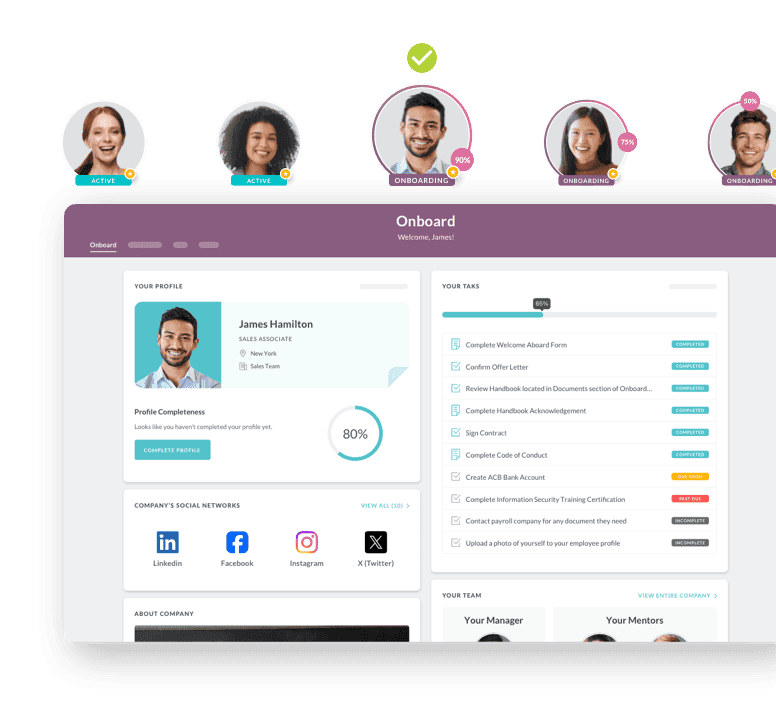
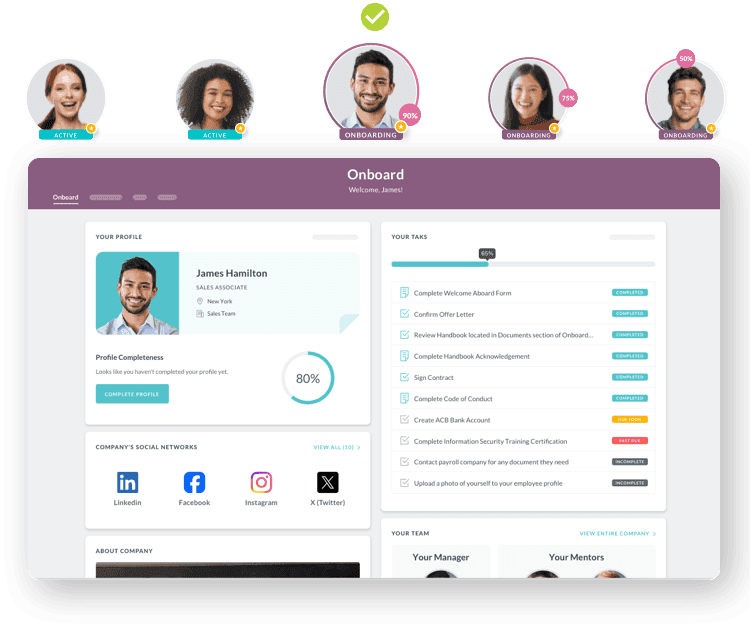
The Onboard module includes a dashboard for exactly the visibility problem described in Step 4. According to the dashboard overview in the Help Center, the dashboard shows summary cards for total onboardings, onboardings starting in seven days, onboardings with overdue tasks, and onboardings not yet assigned. Each card opens a full list that can be exported.
An overdue tasks panel switches between a view by task and a view by assignee. That second view answers a question department heads have: which office is holding this up? A role responsibility widget tracks task completion by responsible role, which the documentation says helps teams identify which departments or users need follow-up. Filters narrow the dashboard by department or location, and each user can add a "My tasks" widget that shows only the tasks assigned to them.
Visibility also includes help. HR Cloud task watchers are people who receive an email when someone comments on a task, and HR admins are watchers on all tasks by default. A new hire stuck on a task can comment on it, and the watchers are notified (watchers). That keeps questions inside the workflow instead of scattered across inboxes and phone calls.
The support articles cited here describe how the product is documented. Before any agency-specific configuration, a live walkthrough of the exact routing and dashboard behavior against your own position types is worth doing.
Common Mistakes in Government Onboarding
Sequential approvals get their own section below, but they are not the only mistake. Four others are worth planning around.
Automating before mapping is the first. Government employee onboarding software applied to a process nobody has drawn simply moves the confusion online. Do Step 1 and Step 2 first, even if the work feels slow.
Using one checklist for every role is the second. A single workflow forces low-risk hires through vetting steps they do not need, or lets sensitive hires skip steps they do not have. Build variants by position type.
Designing for the office is the third. A workflow that assumes a desk, a government email address, and a printer fails remote and field employees on day one. Test with a hire who has none of those things.
Treating status as HR's job is the fourth. If department heads and IT need to ask HR for updates, the process still runs through one bottleneck. Give every stakeholder a live view.
Sequential approvals that could run in parallel
The mistake deserves its own section because it is easy to miss. Sequential approvals can survive for years without anyone deciding they should. They were the right design when a paper folder moved from one desk to the next. They stay because nobody has asked which steps truly depend on the previous one.
The way to find them is to look at every handoff and ask what the receiving office needs from the sending office. Sometimes the answer is a piece of information, such as a start date or a role code. Sometimes it is a decision, such as a favorable determination. Sometimes the answer is "nothing, we just get notified." When the answer is nothing, the handoff is a candidate for parallel processing. The receiving office can start the moment the offer is accepted.
Be careful in the other direction as well. Some sequences are protective, and removing them creates risk. If a rule requires a determination before access to a system, that gate stays. The goal is to keep every real gate and remove every imaginary one. A short review with the security office and legal counsel before changing any sequence is time well spent.
Finally, watch for approvals that were added after an incident and never revisited. A control that exists to prevent a specific problem may be worth keeping, but it may also be satisfied by a check that runs in parallel. Ask what the control protects against, and whether it can run beside the other work.
What Streamlined Onboarding Delivers
Well-configured multi-department onboarding software changes what each person in the process experiences. The new hire receives a clear list of what to do and when, on a device they own. HR sees which hires are on track and which are stalled without sending a single status email. IT and security receive their tasks at the moment they become actionable. Department heads know the start date is real, because the tasks that feed it are visible.
For the agency, the record is the other deliverable. Every task has an owner, a due date, and a completion time. An audit or internal review starts from that record. The I-9 deadline, which USCIS sets at three business days from the date of hire for Section 2, becomes a tracked task with an alert instead of a memory (USCIS).
Faster time-to-productivity for new government employees
Faster time-to-productivity is the natural goal of a workflow project, and it follows from removing idle time between steps. When accounts, equipment, and first-week planning start at offer acceptance instead of after each office reports back, the new employee has more of what they need on the first day.
The evidence from HR Cloud customers points the same direction, with the caveat that these are private-sector organizations and results vary. Interim HealthCare reports a six-week path from kickoff to platform rollout and a 60% improvement in HR efficiency, and Behavioral Progression reports that HR saves eight hours a week onboarding new hires, both as published on HR Cloud's remote onboarding page. Those figures describe HR effort, not time-to-productivity, so agencies should set their own baseline and measure their own change.
Time-to-productivity has an employee side as well. Gallup's 12% figure suggests that most employees do not rate their onboarding at the top of the scale (Gallup). An agency that measures the new hire's experience at 30, 60, and 90 days, which HR Cloud's remote onboarding page describes as automated check-ins, will see problems in the process before they show up as early departures.
Conclusion
The best way to onboard new government employees, remotely or across departments, is to stop treating onboarding as a relay and start treating it as a shared checklist. Public sector onboarding improves fastest when the structure changes first and the tool follows. Map every office involved. Separate the true dependencies from the habits. Run everything that can run in parallel. Chain only the gates that the rules require. Give every stakeholder the same live view, and measure time-to-productivity by department so the process keeps improving.
Government employee onboarding software is the tool that holds that structure together. It routes tasks to owners, sends reminders, records completion, and shows status to HR, IT, security, and department heads at once. The tool does not replace the agency's judgment about which steps are required. It removes the waiting that comes from not being able to see the work.
If you want to see how this would look for your position types, book a free HR Cloud Onboard demo and bring your current department-by-department checklist. The team can walk through how it maps to parallel tasks, chained gates, and a shared dashboard.

Discover how our HR solutions streamline onboarding, boost employee engagement, and simplify HR management
Book a DemoFAQs
How long does government onboarding typically take?
There is no single figure. OPM data reported by Federal News Network shows the federal governmentwide average time to hire was 101 days in fiscal 2024, and vetting for cleared roles adds more time on top. After the offer, public sector onboarding length depends on position risk level, the number of offices involved, and whether tasks run in parallel or in sequence.
Can onboarding workflows include security clearance steps?
Yes, as coordination steps. A workflow can assign the questionnaire task, send reminders, notify the security office, and hold system access until a determination arrives. Investigations and determinations stay with the agency and its investigative providers. Government employee onboarding software tracks tasks and status. It does not grant clearances or replace the agency's vetting process.
How do you coordinate onboarding across HR, IT, and department heads?
Give each group its own tasks, assigned by role, with due dates measured from the start date. Run independent tasks in parallel and chain only true dependencies. Then give all three groups one shared dashboard in your multi-department onboarding software, so HR, IT, and department heads see the same status without asking each other for updates.
Does this work for both classified and non-classified roles?
Yes. Build a separate checklist for each position type. Non-classified roles follow a shorter path, while positions with national security sensitivity add vetting and access steps. For covered federal positions, OPM's position designation framework sets risk and sensitivity. State and local agencies should map their own civil service, background check, and security rules into the same workflow.
Reviewed by the HR Cloud Content Team. Last updated September 29, 2026.
About the author

Keep Reading


Like What You Hear?
We’d love to chat with you more about how HR Cloud® can support your business’s HR needs.
Book Your Free Demo