What Is HR Cloud Software? A Complete Guide for 2026

If you are Googling "HR cloud software" at 11 p.m. with three browser tabs open and a spreadsheet that will not survive one more new hire, here is the short version: it is HR software that lives on the internet instead of on a server in your office, and it is now how most companies run HR. Hosted, cloud-based HR software now accounts for roughly 64% of the global HR software market, according to Fortune Business Insights, and that share keeps climbing every year. This guide breaks down what HR cloud software actually is, how it works, what it costs, and how to evaluate it without getting lost in acronyms like HRIS, HRMS, and HCM.
Key Takeaways
- HR cloud software is any HR system hosted on the vendor's servers and accessed through a browser or app, rather than installed on your own company hardware. It is not a single product category. It is a delivery method that HRIS, HRMS, and HCM platforms all now use.
- The global HR software market was valued at $23.32 billion in 2025 and is projected to reach $66.70 billion by 2034, with cloud deployments driving most of that growth (Fortune Business Insights).
- Replacing one employee costs between 50% and 200% of their annual salary, according to a Gallup analysis (2019, still the standard industry reference point), which is why most HR cloud platforms lead with onboarding and retention tools rather than pure data storage.
- What a company needs from HR cloud software changes by stage. A 15-person startup and a 1,500-person healthcare system are not shopping for the same thing, even if both call it "HR software."
- Security is not optional. Look for SOC 2 Type II certification, GDPR compliance, and role-based access controls before comparing features, not after. HR Cloud, for example, is directly SOC 2 Type II certified and GDPR compliant, confirmed on its own security documentation rather than left as an unverified marketing claim.
- Use the turnover cost calculator referenced later in this guide to see what your current manual processes are actually costing you before you shop for a replacement.
What HR Cloud Software Actually Means (and Why the Standard Definition Falls Short)
Most explanations of HR cloud software stop at "HR software hosted on the internet." That is technically correct and mostly useless, because it does not tell you what the software does or why the hosting model matters to the person who has to use it every day.
Here is the fuller picture. HR cloud software is a system that manages some or all of the employee lifecycle, hiring, onboarding, records, time off, performance, and engagement, and is delivered as software-as-a-service (SaaS) rather than installed locally. The vendor hosts the servers, manages the updates, and handles the infrastructure. Your team logs in through a browser or mobile app and never touches a server room.
That distinction matters more than it sounds. On-premise HR software required an IT team to install it, patch it, back it up, and eventually replace the hardware it ran on. Cloud HR software shifts all of that work to the vendor. Your HR team gets the software; the vendor keeps the lights on.
Why this matters: The hosting model is not a technical footnote. It determines who is responsible when something breaks, how fast you get new features, and whether a five-person HR team can realistically run the system without a dedicated IT hire.
HRIS, HRMS, HCM, and "HR Cloud Software": How the Terms Actually Relate
People use these terms interchangeably, and that causes real confusion when you are evaluating vendors. Here is how they actually break down:
| Term | What It Primarily Does | Typical Buyer |
|---|---|---|
| HRIS (Human Resource Information System) | Core data management: employee records, org charts, basic reporting | Small companies that need a reliable system of record |
| HRMS (Human Resource Management System) | HRIS functions plus operational workflows: onboarding, time off, self-service | Growing companies automating manual HR processes |
| HCM (Human Capital Management) | HRMS functions plus strategic layers: performance, talent analytics, workforce planning | Mid-market and enterprise companies aligning HR with business strategy |
| HR cloud software | Not a fourth category. It is the delivery model (SaaS, browser-based) that most modern HRIS, HRMS, and HCM platforms now use | Anyone evaluating HR technology in 2026 |
"HR cloud software" is the search term buyers actually use, but it describes how the software is delivered, not which functions it includes. A vendor can call itself an HRIS, an HRMS, or an HCM platform and still be cloud-based. This guide covers cloud-delivered platforms across all three categories, since that is what "HR cloud software" means in practice for anyone typing it into a search bar. For a deeper breakdown of how HRIS, HRMS, and HCM differ feature by feature, see HRIS vs. HRMS vs. HCM: What's the Difference?
How Cloud HR Software Actually Works Under the Hood
Understanding the mechanics helps you ask better questions during a vendor demo. Cloud HR platforms are built on a few consistent architectural principles, even though the interfaces look different from vendor to vendor.
Multi-tenant hosting. Most HR cloud platforms use a multi-tenant architecture, meaning many customers share the same underlying software infrastructure while their data stays logically separated and private. This architecture generally supports subscription-based pricing, since the vendor is not standing up dedicated infrastructure for every customer, though it is not the only technical model that can support a subscription.
Vendor-managed updates. When the vendor ships a new feature or a security patch, customers typically receive it without needing to run their own IT upgrade project. Release cadence and rollout approach still vary by vendor, some use phased releases or scheduled maintenance windows, so ask any vendor directly how and how often updates reach your account. This is still a meaningful advantage over legacy on-premise systems, which often ran years-old versions because upgrades were expensive and disruptive.
Browser and mobile access. Employees and HR administrators log in through a web browser or a mobile app, from any device with an internet connection. For a distributed or frontline workforce, this matters enormously. A retail associate or a home health aide is far more likely to complete onboarding tasks on a phone than to sit down at a company laptop.
Integration layer. Modern HR cloud software connects to payroll providers, applicant tracking systems, background check vendors, and communication tools through APIs, rather than requiring manual data exports and re-entry. This is where a lot of the real time savings happen, since duplicate data entry is one of the most common sources of HR administrative overhead.
Data security and compliance controls. Reputable HR cloud vendors maintain SOC 2 Type II certification, encrypt data at rest and in transit, and support region-specific compliance requirements like GDPR. HR Cloud, for example, is SOC 2 Type II certified and GDPR compliant, confirmed directly on its own security documentation, not just claimed in marketing copy.
Single sign-on and identity management. Most established cloud HR platforms support single sign-on (SSO) through common enterprise identity providers, letting employees log in with existing company credentials instead of managing yet another password. For IT teams, this also means access can be revoked instantly the moment someone leaves the company, closing a common security gap left open by manual offboarding. Confirm which specific identity providers a vendor supports if your company already standardizes on one.
Role-based permissions. A frontline manager should be able to approve their own team's time-off requests without seeing companywide salary data. Cloud platforms handle this through role-based access controls, which assign visibility and editing rights based on job function rather than giving every logged-in user the same level of access. This becomes critical the moment a company operates across more than one location or department.
Why this matters: If a vendor cannot clearly explain their hosting architecture, update cadence, and integration approach in the first demo, that is a signal worth noting. A platform built on modern cloud infrastructure should be able to answer these questions without hesitation.
The Core Modules Inside a Cloud HR Platform
"HR cloud software" is often sold as a single product, but it is really a bundle of modules that a company can adopt all at once or roll out in phases. Understanding the modules helps you figure out what you actually need versus what a sales deck is trying to upsell you on.
| Module | What It Automates | Who Needs It Most |
|---|---|---|
| HRIS / core HR | Employee records, org charts, document storage, compliance forms | Every company, regardless of size |
| Onboarding | New hire paperwork, task checklists, I-9 and E-Verify, welcome sequences | Companies with regular hiring or high turnover roles |
| Applicant tracking (ATS) | Job postings, resume screening, interview scheduling, candidate pipelines | Companies hiring more than a handful of roles per year |
| Time off and time tracking | PTO requests, accrual rules, shift scheduling, attendance | Companies with hourly, shift-based, or distributed teams |
| Performance management | Reviews, goal tracking, feedback cycles | Companies formalizing growth conversations beyond an annual spreadsheet |
| Employee engagement and communication | Recognition, surveys, internal announcements, company directory | Companies with frontline, remote, or multi-location workforces |
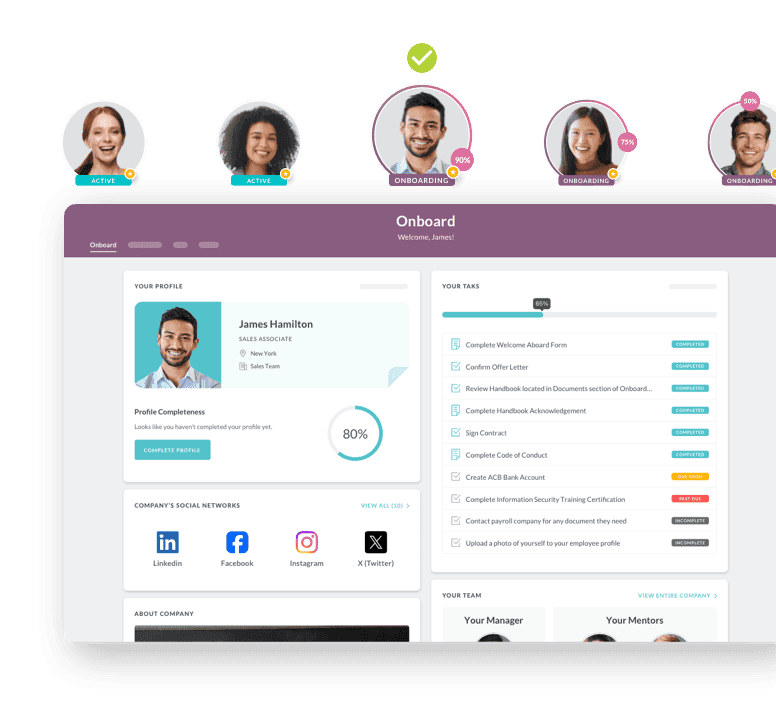
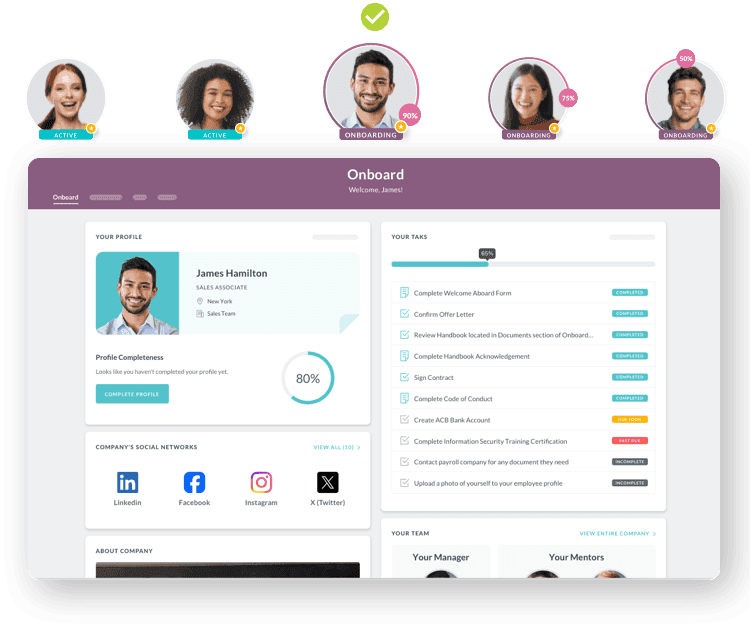
| AI-assisted HR | Conversational onboarding guidance, workflow automation, proactive check-ins | Companies with deskless or fast-scaling teams whose HR staff cannot personally follow up on every new hire |
A company evaluating HR cloud software does not need to buy every module on day one. Most vendors, including HR Cloud, let organizations start with core HR and onboarding and add engagement or performance modules later as needs grow. That modular approach matters more for a 40-person company than a 4,000-person one, since a smaller team cannot absorb the cost or the change-management burden of implementing everything at once.
AI-assisted HR deserves a specific callout here, since it is the fastest-moving part of the category. SHRM's State of AI in HR 2026 report, based on a survey of 1,908 HR professionals, found that 73% of HR professionals at the director level and above had adopted AI in their work by 2025. In practice, that usually shows up first in onboarding, where a conversational AI agent can guide a new hire through Day 1 tasks and check in at Day 7, Day 14, and Day 30 without HR staff manually chasing down every unfinished form. HR Cloud's own AI layer, available across the platform, follows this pattern.
Pro tip: Ask any vendor to show you exactly which modules are included at your quoted price and which ones require an upsell. Bundled pricing structures vary widely, and a platform that looks affordable in a demo can get expensive fast once you add the modules you actually need.
Why the Shift to Cloud HR Software Has Accelerated
The move to cloud HR software is not a trend that peaked a few years ago. It is still accelerating, and the numbers explain why.
The global HR software market was valued at $23.32 billion in 2025 and is projected to grow to $66.70 billion by 2034, a compound annual growth rate of 12.38%, according to Fortune Business Insights. Within that same report, hosted (cloud-based) HR software solutions dominate with approximately 64% market share, ahead of on-premise deployment, and cloud adoption is expected to keep growing as more organizations shift away from legacy on-premise systems.
Three forces are driving that shift.
The cost of doing HR manually keeps rising. A Gallup analysis, still the most-cited figure in the industry since it was published in 2019, found that replacing a single employee can cost between 50% and 200% of their annual salary once recruiting, onboarding, and lost productivity are factored in. For a 100-person organization with an average salary of $50,000, Gallup put that at roughly $660,000 to $2.6 million a year in turnover and replacement cost. Manual, paper-based onboarding does not cause turnover by itself, but a slow, confusing first 90 days is a well-documented contributor to early attrition, and cloud HR software directly targets that window.
Distributed and frontline workforces need mobile-first tools. A workforce spread across shifts, locations, or job sites cannot rely on a desktop HR portal that only works from a company laptop. Cloud HR software, particularly the mobile and conversational AI layers, meets employees where they already are.
AI has moved from experimental to expected. Industry tracking of SHRM's 2026 research puts roughly 39% of HR organizations as currently having AI adopted in HR functions, with another 7% planning to launch AI initiatives within the year. Cloud-based platforms generally make it easier for vendors to roll out AI features centrally and iterate quickly, compared with on-premise systems, where deployment tends to be slower and more customer-specific.
Why this matters: These are not abstract industry trends. They translate directly into a competitive gap. A company still running HR out of spreadsheets and email in 2026 is not just less efficient than a competitor on cloud HR software. It is also slower to onboard, slower to respond to compliance changes, and less able to give employees the mobile-first experience they now expect from every other part of their working life.
HR Cloud Software by Company Stage: Startup, Growth, and Enterprise
Most guides to HR cloud software describe features as if every buyer needs the same thing. They do not. What a 12-person startup needs from HR cloud software is meaningfully different from what a 1,500-employee healthcare system needs, and buying the wrong tier of complexity in either direction wastes money and time.
Startups (Under 50 Employees)
At this stage, the priority is a reliable system of record and basic onboarding automation, not deep analytics or succession planning. A startup usually has one or two people wearing the HR hat alongside other responsibilities, so the software needs to be usable without dedicated HR training.
What to prioritize: core HRIS, digital onboarding with e-signatures, PTO tracking, and straightforward payroll integration. Skip anything marketed as "enterprise workforce planning."
Growth-Stage Companies (50 to 500 Employees)
This is where manual processes start breaking. Hiring accelerates, compliance requirements multiply across states or countries, and the founder or office manager who used to handle HR informally can no longer keep up. Growth-stage companies typically need to add applicant tracking, structured onboarding workflows, and performance management on top of core HR.
What to prioritize: modular platforms that let you add capability without a full re-implementation, strong integration with payroll and background check vendors, and reporting that shows leadership real workforce trends instead of static headcount numbers.

Ready to simplify hiring from job post to offer?
Track candidates, customize hiring stages, schedule interviews, and connect recruiting to onboarding in one easy-to-use ATS.
Book Your Free Demo
Enterprise and Frontline-Heavy Organizations (500+ Employees)
At this scale, the challenges shift toward consistency and compliance across locations, departments, and sometimes countries. A construction company running crews across a dozen job sites, or a healthcare system managing credential compliance across multiple facilities, needs HR cloud software built for distributed, often deskless, workforces.
What to prioritize: mobile-first employee experience, role-based access controls for multi-location HR teams, detailed compliance and audit trails, and engagement tools that reach frontline employees who do not sit at a desk.
Here is what that looks like in practice. Rehmann, a financial services and consulting firm, needed to manage onboarding and recruiting for 1,200 employees across multiple client accounts, each with its own workflow requirements. A generic, one-size-fits-all HR platform could not handle that level of per-client customization without heavy manual workarounds. Rehmann moved to a cloud HR platform built for multi-client complexity, using it to standardize the parts of onboarding that could be standardized while still customizing workflows per client. See the full story.
Why this matters: If a vendor's sales pitch does not change depending on your company size, that is a sign their platform was not really built with company-stage differences in mind. The right question in a demo is not "what does your software do," but "what does your software do for a company at my exact stage."
HR Cloud Software Across Industries
The core functions of HR cloud software stay consistent across industries, but which functions matter most shifts depending on how and where a company's employees actually work.
Healthcare. Credential tracking, license expiration alerts, and strong visibility into missing or expiring compliance documents are non-negotiable. A hospital or home health agency cannot afford a system that treats an expired nursing license the same way it treats a missed lunch survey. Staffing is also often 24/7 and shift-based, which makes mobile access essential rather than a nice-to-have. Any healthcare-specific regulatory requirement, including HIPAA, should be reviewed directly with the organization's legal and compliance team rather than assumed from a vendor's marketing language.
Construction and field services. Employees rarely sit at a desk, and crews frequently move between job sites. HR cloud software here needs to work reliably on a phone with an inconsistent signal, support digital I-9 and E-Verify completion in the field, and handle multi-location compliance without requiring a corporate office visit. Osmose Utilities Services, a construction and utilities customer, adopted a cloud HR platform specifically to improve field-based onboarding and compliance tracking for crews working across dispersed job sites, rather than routing every new hire through a central office.
“ Our hiring managers now have a reliable system that is easy to navigate. Our HR team can actively monitor the process, and assist if needed, but Onboard has helped them save so much valuable time and effort while increasing data accuracy.”

— Kaylee Collins, HR Analyst, Osmose

Retail and food and beverage. High seasonal hiring volume and frequent shift changes are the defining challenge. Cloud platforms that support high-volume, templated onboarding and mobile-first scheduling reduce the administrative burden of a workforce that turns over faster than a typical corporate office. Konzum, a retail customer, used a cloud communication and engagement platform to unify internal communication for more than 10,000 employees across 600-plus locations, a scale that would be unmanageable through email chains or physical bulletin boards.
Manufacturing. Compliance documentation, safety training records, and shift-based time tracking tend to matter most, alongside engagement tools that reach employees on the production floor rather than only those with a company email address they check daily.
Why this matters: A platform that excels for a healthcare compliance team may be entirely wrong for a retail chain's seasonal hiring surge. When a vendor cannot speak specifically to your industry's actual day-to-day workflow, that is worth treating as a gap, not a minor detail.
What to Look for When Evaluating HR Cloud Software
Once you understand the category and your own stage, evaluation comes down to a short list of criteria that matter more than a feature checklist.
Security and compliance credentials. Ask directly whether the vendor is SOC 2 Type II certified and whether they support GDPR or other regional data protection requirements relevant to your workforce. Do not accept "our data is in the cloud, so it's secure" as an answer. That is not a compliance credential.
Implementation timeline. A cloud HR platform that takes nine months to implement defeats much of the point of choosing cloud software in the first place. Ask for a realistic go-live timeline based on a company your size, not the vendor's best-case example.
Mobile and deskless-worker experience. If any portion of your workforce does not sit at a desk, test the mobile experience yourself during the demo. Do not take the sales team's word for it.
Pricing transparency. Understand whether pricing is per-seat, tiered by employee band, or a flat annual license, and ask what happens to your cost as you grow. Per-seat pricing that looks cheap at 20 employees can become expensive fast at 200. Some vendors, including HR Cloud, use published employee-band tiers instead, so a company moving from 90 to 110 employees can see its exact next-tier cost in advance rather than negotiating a new quote every time headcount changes.
Integration depth, not just integration count. A vendor listing 50 integrations is less useful than confirming the two or three integrations you actually need, like your existing payroll provider, work correctly and reliably.
Real customer proof, not just logos. Ask for a reference customer close to your size and industry, and actually talk to them. A logo wall tells you who signed a contract. A reference call tells you whether the platform delivered.
Support model and response time. Ask what happens when something breaks on a Friday afternoon during a hiring push. Some vendors offer live chat with sub-minute response times; others route every request through a ticketing queue with a multi-day turnaround. That difference rarely shows up in a feature comparison chart, but it matters enormously the first time payroll data will not sync correctly the day before a pay run.
Contract flexibility. Understand the cancellation terms, the renewal structure, and whether pricing is locked for the contract term or subject to change at renewal. A platform that requires a multi-year commitment before you have confirmed it fits your workflow shifts a meaningful amount of risk onto the buyer.
Why these matter: Feature comparisons are the easy part of evaluating HR cloud software. Support quality, contract terms, and reference calls are the parts that actually predict whether the relationship works two years in, and they are also the parts most buyers skip because they take more effort to check.
Common Mistakes Companies Make When Adopting Cloud HR Software
Even companies that do their evaluation carefully tend to make a few predictable mistakes during and after implementation.
Buying for the company you'll be in three years, not the one you are today. Enterprise-tier complexity is wasted on a 30-person team, and it usually means paying for modules nobody uses and training employees on workflows built for a much bigger organization.
Underestimating the change management effort. Even a well-designed platform requires employees to build new habits. Companies that treat rollout as "flip the switch and send an email" see lower adoption than companies that budget time for training and internal communication.
Ignoring the mobile experience for frontline staff. A platform can look excellent on a laptop in a sales demo and still fail for the employees who will actually use it from a phone on a job site or a hospital floor.
Skipping the security conversation until legal asks. Waiting until a compliance review flags a gap is the most expensive time to discover a vendor cannot meet your data protection requirements. Ask upfront.
Choosing based on the lowest sticker price alone. The cheapest platform is not a bargain if it lacks the integrations, security certifications, or mobile experience your workforce actually needs. Factor in the true cost of a bad onboarding experience before comparing quotes.
Treating implementation as a one-time project instead of an ongoing relationship. The vendors who perform best long-term are the ones who stay engaged after go-live, through regular check-ins, proactive feature training, and responsive support. A platform that disappears after the contract is signed will leave gaps that surface months later, usually during a compliance audit or a busy hiring season, which is the worst possible time to discover them.
Here's what this looks like in practice, drawn from a composite of common vendor-switch stories. A mid-size logistics company switched HR platforms purely because the new vendor quoted a lower per-seat price. Within six months, the company discovered the new platform lacked a working integration with their existing background check vendor, forcing HR staff back into manual data entry they thought they had eliminated. The switch ultimately cost more in lost productivity than the original platform's higher subscription fee would have, a reminder that the sticker price and the total cost of ownership are rarely the same number.
Measuring ROI: The Metrics That Actually Matter
Justifying the investment in HR cloud software to a CFO requires more than "it will save time." Here are the metrics that translate software adoption into numbers a finance leader will actually trust.
Time to productivity. Track how many days it takes a new hire to complete onboarding and reach full productivity before and after implementation. A shorter ramp-up period has a direct, calculable revenue impact, especially for revenue-generating roles.
Cost per hire. Compare recruiting and onboarding administrative costs before and after automation. Manual processes hide labor costs across multiple people's time; cloud HR software makes that cost visible and reducible.
Turnover in the first 90 days. Early turnover is disproportionately expensive because the company absorbs onboarding and training costs without getting sustained productivity in return. If cloud HR software improves the early employee experience, this number should move.
HR administrative hours reclaimed. Track how many hours per week HR staff spend on manual data entry, paper forms, or answering repetitive employee questions before and after implementation. Those reclaimed hours can be redirected toward the strategic work HR teams are usually too buried to get to.
Compliance incident rate. Missed I-9 deadlines, expired certifications, or incomplete required training all carry real financial and legal risk. A drop in compliance incidents after implementation is a concrete, defensible ROI metric.
Here's what this looks like as a modeling exercise, not a promise. Take a mid-sized organization of 300 employees with a 15% annual turnover rate, roughly 45 departures a year. Using Gallup's conservative low end of 50% of salary per replacement and an average salary of $55,000, that is about $27,500 per departure, or close to $1.24 million a year in turnover-related cost. Cloud HR software does not automatically produce a specific reduction in that number, the size of any improvement depends on your current process, your industry, and how well the rollout goes. What you can do is model a range: estimate what a 5%, 10%, or 15% reduction in first-year turnover would be worth at your own headcount and salary levels, then treat those figures as scenarios to test against your own post-implementation data, not as a guaranteed outcome.
Why this matters: Software budgets get approved when the numbers speak in the language finance already trusts. "It will save time" rarely survives a budget review. A modeled range built from your own headcount, turnover rate, and salary data, with the assumption stated plainly as an assumption, holds up much better under scrutiny than a single confident number.
How to Turn This Into Action
Reading about HR cloud software does not fix a broken onboarding process. Here is what to do in the next 48 hours to move from research to a real decision.
- Audit your current process cost. Use a turnover and onboarding cost calculator to put a real dollar figure on what your current manual or fragmented process is costing you. Bring that number, not a vague sense that "things feel slow," into any internal budget conversation.
- Map your must-have modules by stage. Using the startup, growth, and enterprise breakdown above, write down the three to five modules your company actually needs right now, separate from what a sales rep will try to bundle in.
- Book two demos, not one. Compare a platform against at least one alternative, and ask both vendors the same specific questions about SOC 2 certification, implementation timeline, and mobile experience for frontline staff. The differences in how confidently they answer will tell you as much as the feature comparison itself.
Choosing HR cloud software is not just a technology decision. It is a decision about how much time your HR team gets back and how good your employees' first 90 days actually feel. See how HR Cloud's platform handles onboarding, engagement, and AI-assisted workflows for companies at every stage.

Discover how our HR solutions streamline onboarding, boost employee engagement, and simplify HR management
Book Your Free DemoFrequently Asked Questions
What is HR cloud software?
HR cloud software is HR management software hosted on a vendor's servers and accessed through a web browser or mobile app, rather than installed on a company's own hardware. It typically covers some combination of employee records, onboarding, time off, performance management, and engagement tools, delivered on a subscription basis.
Is HR cloud software the same as an HRIS?
Not exactly. HRIS refers to the function, core employee data management, while "HR cloud software" refers to the delivery model, hosted and accessed online. Most modern HRIS platforms are cloud-based, but HRIS is one category of software that can be delivered through the cloud, not a synonym for it.
How much does HR cloud software cost?
Pricing varies by vendor, but package-based tiers organized by employee count are common. HR Cloud, for example, publishes three tiers, Essential HR, Professional HR, and Culture HR, priced by employee band rather than per seat: Essential starts at $295/month for up to 50 employees and scales to $795/month at 101-250 employees, while Culture HR (the full engagement and AI tier) ranges from $895 to $1,995/month across those same bands. Annual billing typically discounts the monthly rate. Always request a quote based on your specific employee count and required modules rather than relying on a generic industry average.
Is HR cloud software secure?
Reputable HR cloud vendors maintain SOC 2 Type II certification, encrypt employee data both at rest and in transit, and support compliance frameworks like GDPR. Security should never be assumed. Ask any vendor directly for their compliance certifications before signing a contract.
What is the difference between HR cloud software and on-premise HR software?
On-premise HR software is installed on a company's own servers, requiring internal IT staff to manage updates, security patches, and hardware. HR cloud software is hosted by the vendor, who handles infrastructure, updates, and security, while the company accesses the system through a browser or app. Cloud software generally has lower upfront costs and faster access to new features.
How long does it take to implement HR cloud software?
Implementation timelines vary by company size and how many modules are being rolled out at once. HR Cloud, for example, typically implements new small-to-mid-size customers within 2 to 4 weeks, standard implementation is included at no charge with 90 days of prepayment, or a one-time $500 fee applies otherwise. That is meaningfully faster than the months-long rollouts common with legacy on-premise systems. Always confirm a vendor's realistic timeline for a company your specific size rather than relying on their fastest-case example.
Can HR cloud software integrate with my existing payroll provider?
Most established HR cloud platforms offer pre-built integrations with major payroll providers like ADP, and either sync employee data automatically or provide an API for custom connections. Before signing a contract, confirm the specific integration exists with your exact payroll provider rather than assuming general payroll compatibility covers your situation.
Is HR cloud software worth it for a small business?
For most small businesses beyond a small handful of employees, generally once hiring becomes a regular, ongoing activity rather than an occasional event, yes. The point where manual HR processes start costing more time than a subscription costs in dollars tends to arrive earlier than most founders expect. Below that threshold, a lightweight, low-cost core HRIS is often enough, with additional modules added as headcount grows.
About the author

Keep Reading


Like What You Hear?
We’d love to chat with you more about how HR Cloud® can support your business’s HR needs.
Book Your Free Demo