Best HRIS Platforms for Multi-State Compliance in 2026

The best HRIS platforms for multi-state compliance make it possible to apply the right tax withholding, labor law, and documentation rules based on where each employee actually lives and works, not just where the company is headquartered, whether that means calculating and filing directly or handing off clean, accurate data to the payroll system that does. That means automated state and local tax registration or a clean handoff to the platform that runs it, built-in reciprocity handling for employees who live in one state and work in another, jurisdiction-specific leave and overtime rules, and audit-ready I-9 and E-Verify records. HR Cloud, ADP Workforce Now, and Paycor lead this list for different company sizes and priorities, and for different layers of the problem: HR Cloud for the HR-operations layer that has to work regardless of which payroll engine sits underneath it. Below is a breakdown of the ten platforms worth evaluating, what each one actually handles well, and where each one falls short, with a source behind every claim about how a platform works.
Why Does Multi-State Compliance Break Most HRIS Platforms?
Every new state a company hires in adds its own tax withholding rules, its own wage and hour law, its own leave mandates, and its own new-hire reporting deadline. California requires meal and rest break premiums that don't exist in most other states, and a violation can cost $25 to $100 per employee per incident, with a single class-action exposure exceeding $1 million. Colorado has daily overtime rules that Texas doesn't. New York City has pay transparency requirements that differ from the rest of New York State. An HRIS built for a single-state company treats these as edge cases. An HRIS built for multi-state compliance treats them as the default.
The two failure points that show up most often: reciprocity agreements and remote-hire tax registration. When an employee lives in New Jersey and works in New York, or lives in Pennsylvania and works in Ohio, the platform needs to know whether a reciprocity agreement applies and calculate withholding accordingly. Get it wrong, and the company owes back taxes, penalties, or both. The second failure point is speed: when a company makes its first hire in a new state, the HRIS needs to register the company with that state's tax agency before the first payroll run, a process that on its own can take days to weeks and touches a foreign-qualification filing, a state withholding account, a state unemployment insurance account, workers' compensation coverage, and a new-hire report, each with its own agency and deadline. Small businesses under 50 employees already spend roughly $14,700 per employee per year on regulatory compliance, so a manual, slow registration process adds real cost on top of that baseline.
Reciprocity agreements are narrower than most HR teams assume. Pennsylvania has reciprocity agreements with several neighboring states, including New Jersey and Ohio, which means an employee living in one and working in the other can elect to have only their home state's tax withheld. New York, by contrast, applies a "convenience of the employer" test: for an employee whose assigned or primary office is in New York, a normal workday spent working remotely still counts as a New York workday, and therefore New York income, unless the home office qualifies as a "bona fide employer office" under a specific multi-factor test, a bar that in practice is difficult to clear. An HRIS that treats reciprocity as a single national ruleset rather than a state-by-state lookup table will get some of these wrong, and the errors don't surface until an employee's personal tax return doesn't match what was withheld.
New-hire reporting deadlines compound the problem. Federal law requires new-hire reporting within 20 days, and state windows vary, some shorter, so the report has to reach the right agency on the right schedule for each state where an employee actually works. Federal law does give multistate employers a way to cut this down to one report instead of many: an employer with employees in two or more states can register with the U.S. Department of Health and Human Services to designate a single state to receive all new-hire reports, provided the reports are transmitted electronically. Employers that haven't made that election, or that are still tracking each state's deadline manually, are the ones exposed to the reporting gaps an HRIS should be closing. HR Cloud's SmartFlow engine handles the piece that sits upstream of that filing: routing role-, location-, and hire-date-specific onboarding tasks so the right documents and data reach whoever handles the actual state reporting, on time, rather than statutory filing itself.
Which HRIS Is Best for Frontline and Mid-Market Multi-State Compliance?
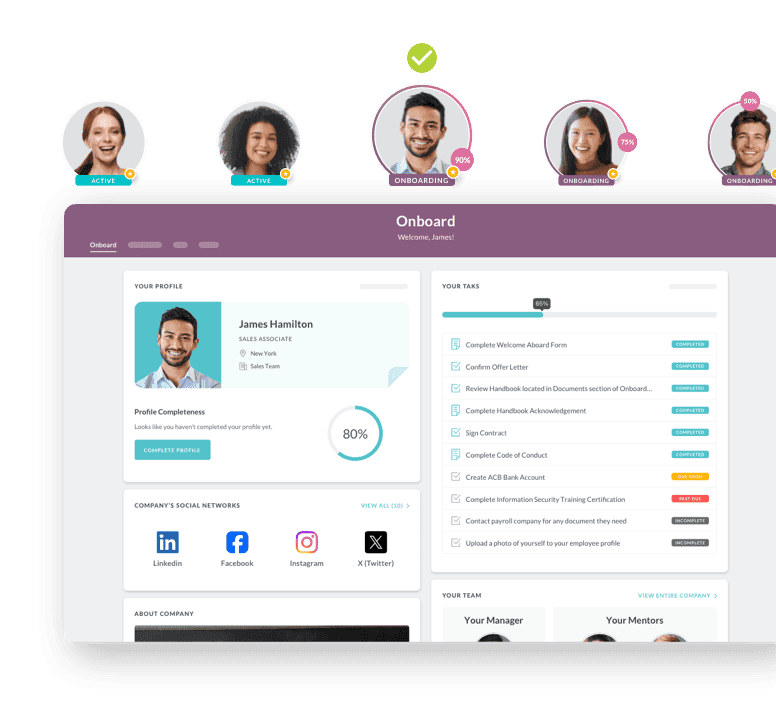
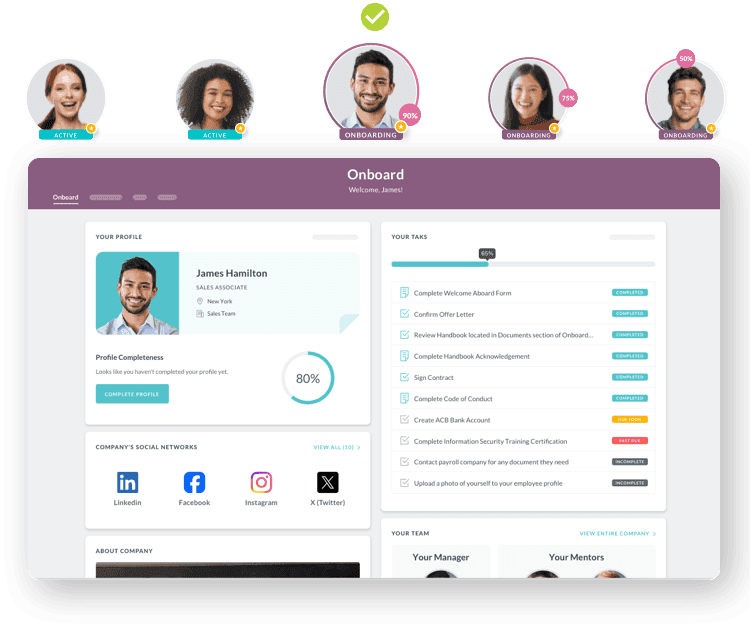
HR Cloud centralizes employee records, onboarding, workflow automation, and compliance tracking in one system, and it's built specifically for organizations with a frontline or deskless workforce spread across multiple states and locations. A company with a single office job across three states has different compliance needs than a company with hourly workers in twelve states, each with different meal-break, overtime, and new-hire-reporting rules, a distinction most HRIS reviews skip entirely.
HR Cloud's I-9 and E-Verify platform has processed more than five million I-9 forms with zero audit fines, and resolves 95% of E-Verify cases instantly inside the platform rather than routing HR through a separate government portal. That matters directly for multi-state employers: I-9 paperwork violations currently run $252 to $2,789 per form, and a company hiring across a dozen states generates a lot of forms. The mechanics, per HR Cloud's own support documentation, work like this: new hires complete Section 1 of the I-9 from any device, HR completes Section 2 in person or via compliant remote verification, and once the required documents are uploaded, HR clicks Submit New Case directly from the Onboard app to start E-Verify without leaving the platform or logging into a separate government portal. Every case, current and historical, stays visible in the E-Verify tab for audit purposes, and the system flags expiring documents automatically instead of relying on a spreadsheet someone forgot to update.
Data security is part of multi-state compliance too, since a breach or an inconsistent access-control policy creates its own regulatory exposure across jurisdictions. HR Cloud's own security documentation states all data is encrypted at rest using AES256 encryption and in transit using TLS 1.2, with data stored across LA, DC, and AWS S3 US-East-1, and the platform has undergone third-party penetration testing through Praetorian. That's a concrete, checkable answer to the kind of security question a multi-state compliance evaluation should include, not a vague assurance.
For construction and utilities employers specifically, multi-state compliance often means keeping state-specific safety training records and equipment or vehicle assignment documentation attached to a field worker as they move across job sites in different states, a tracking and documentation problem more than a legal one. For healthcare employers, it means being able to configure and track license and credential expiration by state rather than in a shared spreadsheet, since a nursing license valid in one state doesn't automatically clear an employee to work in another; HR Cloud tracks and flags those dates, it doesn't determine reciprocity or legal eligibility on its own. HR Cloud's SmartFlow workflow engine runs these tasks, reminders, and approvals by role, location, and hire date, so a documentation requirement tied to a specific state or facility doesn't depend on someone remembering to check a list.
As an ADP Platinum Marketplace Partner, HR Cloud integrates natively with ADP Workforce Now, syncing new-hire data automatically instead of requiring dual entry, and the ADP Marketplace implementation fee is a flat $500 regardless of company size, compared to the $5,000 to $50,000 typical for comparable HRIS configuration work elsewhere. The standard Workforce Now connector specifically supports export of state tax forms and W4s from HR Cloud to ADP, which is the exact data multi-state compliance depends on getting right at the point of hire, rather than a general employee-data sync that leaves state tax setup as a separate manual step; confirm this with HR Cloud directly if the ADP environment in question is Workforce Now Next Gen rather than the standard connector, since integration scope can vary by ADP environment. The platform also connects to UKG, Workday, Paylocity, Dayforce, SAP, and Okta, though the depth of each connector (native sync, file-based, or marketplace app) is worth confirming for the specific workflow a buyer needs, rather than assumed from the fact that a logo appears on an integrations page.
Where HR Cloud fits: companies in the 50 to 2,500 employee range, especially in healthcare, construction, retail, and hospitality, where the workforce is spread across multiple locations and states and a meaningful share of employees don't sit at a desk. HR Cloud runs on fixed annual licensing by company size rather than pure per-seat pricing, so costs don't spike when headcount grows mid-year, and plans start at $295 per month. Where it's a weaker fit: companies that need a single platform to run payroll itself across all 50 states with no separate payroll provider. HR Cloud handles the HR and compliance layer and integrates with the payroll systems that handle tax filing, rather than running that filing natively.
Is ADP Workforce Now the Best Choice for Payroll-Heavy Multi-State Compliance?
ADP Workforce Now is the platform most HR teams default to when payroll accuracy across states is the top priority, and for good reason. ADP is the largest payroll processor in the United States, and that scale shows up directly in multi-state compliance: automated tax filing across all 50 states, garnishment processing that follows state-specific rules, and a dedicated compliance team that tracks regulatory changes and pushes updates into the system rather than requiring the customer to catch them manually.
ADP's compliance team monitors regulatory changes across all 50 states and pushes updates into the system automatically rather than requiring the employer's HR team to track legislative changes state by state. That matters most for employers operating in states that update wage and hour law frequently, since a missed update can mean weeks of incorrect withholding before anyone notices. ADP also handles garnishment processing, which follows different priority and calculation rules depending on the state and the type of debt, a detail that trips up smaller payroll systems that treat garnishments as a single national process rather than 50 different ones.
ADP Workforce Now is built primarily as a payroll and compliance engine, with HR functionality designed to support that core rather than to be the deepest onboarding or engagement tool on the market. Organizations that already run ADP for payroll may still choose a specialized onboarding or employee-workflow layer when they need different workflows around documents, frontline communication, or employee readiness than a payroll-first platform is built to prioritize. HR Cloud's ADP integration exists for exactly this reason: keep ADP for payroll and tax compliance, add HR Cloud for onboarding, engagement, and the parts of compliance (I-9, credential tracking, state-specific documentation) that sit closer to the HR team than the payroll team. HR Cloud is an ADP Platinum Marketplace Partner, and roughly 500 ADP Workforce Now customers already run HR Cloud as their onboarding and engagement layer on top of ADP's payroll core, which is the intended relationship between the two platforms rather than a competitive one.
ADP Workforce Now makes the most sense for mid-size to large companies where payroll accuracy and tax compliance across many states is the primary requirement, and where the buyer is comfortable running a separate or complementary system for onboarding and engagement.
Is Workday Right for Large Enterprise Multi-State Compliance?
Workday runs on a single unified database that combines HR, payroll planning, and financial management, which is what lets it manage complex organizational structures, multi-country compliance, and workforce planning at a scale most mid-market tools can't match. For a company with 1,000 or more employees spread across multiple states and countries, Workday's ability to consolidate legal entities into one employee record while avoiding the data-reconciliation problems that come with bolting separate systems together is a real advantage.
That capability comes with real costs. Independent implementation analysts put the typical Workday rollout at 6 to 12 months, with large, multi-entity, or highly customized deployments running longer, and total year-one cost including services can reach into the high six or low seven figures for mid-market and enterprise buyers. The interface is dense and the multi-step approval chains that make sense for a Fortune 500 finance team often frustrate managers at a 300-person company who just want to approve a time-off request.
Workday's single-database architecture pays off most in scenarios where a company operates multiple legal entities across states or countries and needs a consolidated view of headcount, budget, and compliance status without reconciling data pulled from separate systems. Leaders use the platform's reporting to watch hiring funnels against approved budget in real time, which is valuable at enterprise scale but is significant overhead for a company that just needs accurate multi-state payroll and basic HR compliance. Companies evaluating whether that overhead is worth it, particularly mid-market employers who find Workday's complexity exceeds what they actually need, can compare HR Cloud's Workday alternative positioning directly.
Where Workday fits: large enterprises, typically 1,000+ employees, with complex multi-entity or multi-country structures and the budget and technical staff to support a long implementation. Where it's a poor fit: mid-market companies that need to move faster than a six-to-twelve-month rollout allows, or that don't have a dedicated HRIS administrator on staff.
How Does UKG Pro Handle Multi-State Scheduling Compliance?
UKG built its reputation on time and attendance and workforce management, and that heritage shows up in how well UKG Pro handles multi-state scheduling and labor compliance. Independent workforce management analysts confirm the platform manages California's meal and rest break rules and FLSA overtime calculations through configurable rules, with detailed audit trails built for regulatory scrutiny, including the predictive scheduling ordinances covered below.
That distinction matters most in the growing list of jurisdictions that mandate predictive scheduling, sometimes called fair workweek laws, which require employers to post schedules a set number of days in advance and pay a penalty for last-minute changes; the specific cities and rules are covered in detail later in this guide. A platform that doesn't build these rules into the scheduling engine itself leaves managers to track them manually location by location, which is exactly the kind of gap that turns into a wage-and-hour claim.
UKG's compliance strength is deepest on the labor and scheduling side rather than the broader HR administrative side. Companies evaluating UKG for multi-state compliance should weigh it specifically against how much of their compliance risk sits in scheduling and time tracking versus onboarding documentation, benefits administration, or general HR recordkeeping, since UKG's core strength is the former. HR Cloud integrates directly with UKG for teams that want UKG's scheduling and time strength combined with stronger onboarding and engagement tooling.
UKG Pro is the strongest match for mid-market to enterprise companies with large hourly or shift-based workforces across multiple states, particularly in retail, hospitality, healthcare, and manufacturing, where scheduling compliance is the dominant risk.
Is Paycor a Good Fit for SMB and Mid-Market Multi-State Payroll?
Paycor, now part of Paychex as of April 14, 2025, combines core HR, full-service U.S. payroll and tax, time and scheduling, benefits, and talent management in one platform aimed squarely at the SMB and mid-market segment. Its multi-state compliance automation covers automated tax deposits and filings for federal forms 940 and 941 plus state and local equivalents, and a Client Action Center that flags rate changes, filing discrepancies, and agency notices before they become penalties, per the same independent review.
Paycor's pricing is quote-based rather than published, and implementation fees can apply depending on module selection, which makes upfront cost comparison harder than with platforms that publish tier pricing. Since Paychex's acquisition of Paycor, the combined company has broader payroll tax infrastructure behind it, though customers evaluating the platform should confirm current product roadmap and support structure directly, since integrations in progress after an acquisition can shift. For companies that want dependable multi-state payroll without enterprise-level complexity or cost, Paycor sits in a reasonable middle ground between lighter tools like Gusto and heavier enterprise platforms like Workday. Companies with a frontline or deskless workforce who need onboarding and engagement built specifically for that population, rather than a general HCM layered on top, can see how HR Cloud approaches multi-state HRIS for that use case.
SMB and mid-market employers, typically under 1,000 employees, that need dependable multi-state payroll and compliance automation without a lengthy implementation are the clearest fit for Paycor.
Why Does Paycom's Single-Database Model Matter for Multi-State Tax Automation?
Paycom's core architectural advantage, described directly on the company's own resource site, is that it runs on a single database rather than integrated modules, which means adding a new state is a configuration change rather than a system integration project. Tax tables apply automatically, withholding rules propagate across the platform, and the next payroll run reflects the new state without a sync delay or manual reconciliation step. For companies that expand into new states frequently, that architecture removes a real point of failure that module-based systems introduce.
Paycom covers the full U.S. compliance overlay directly: ACA reporting, FMLA leave tracking, wage garnishment limits under the Consumer Credit Protection Act, and state-specific rules like California meal and rest premiums or Colorado daily overtime. The tradeoff is that Paycom's employee self-service model pushes a lot of data entry and correction responsibility onto employees themselves, which works well for organizations with a tech-comfortable workforce and can create friction in industries with less desk-based or less tech-fluent employee populations, a real consideration for the same frontline and hourly workforces HR Cloud is built around.
A useful diagnostic question for any vendor claiming strong multi-state support, Paycom included: ask for the last 12 months of regulatory updates and whether they arrived as automatic system updates, configuration changes the customer had to implement, or manual notices the customer had to act on. Paycom's single-database model is designed to keep that answer close to "automatic," which is the architecture doing the compliance work rather than the HR team.
Where Paycom fits: mid-market to enterprise companies expanding into new states regularly, where single-database tax automation outweighs the tradeoff of a more employee-driven data entry model.
Does Rippling Handle Multi-State Compliance as Well as Its Unified Platform Suggests?
Rippling's pitch is that payroll, HR, IT, and finance workflows run on one unified system, and Rippling's own multi-state payroll comparison describes automated state tax registration, automated filings, and support for multiple pay schedules across states without separate integrations for each function. Take the self-description at face value on mechanics, but weigh it as a vendor's own framing rather than a neutral review. Companies with distributed teams that also need device management, software provisioning, and finance workflows tied to the same employee record get real efficiency from Rippling's unified approach that HR-only platforms don't offer.
Rippling's state tax registration automation is particularly useful for remote-first companies making their first hire in a new state, since the platform can register the company with the relevant state agency and connect hardware and software provisioning to the same onboarding workflow, cutting the lag between offer acceptance and a fully compliant, fully equipped new hire.
Rippling's multi-state strength is real but narrower than its marketing suggests: the tax registration and filing automation is solid, but the platform's compliance depth on the HR side (leave tracking, documentation, credential management) is less mature than HR-first platforms built specifically around those workflows. Companies evaluating Rippling for multi-state compliance should test the specific leave, documentation, and credential-tracking workflows they need rather than assuming the platform's broader "everything in one place" positioning covers HR compliance as deeply as it covers IT and payroll.
Rippling fits best for companies, often tech and professional services, that want HR, IT, and finance workflows on one system and whose primary multi-state compliance need is payroll tax and filing rather than deep HR documentation and leave compliance.
Is Gusto Enough for Small Business Multi-State Compliance?
Gusto targets small businesses that need multi-state payroll without enterprise complexity, and Gusto's own product documentation confirms automated state tax registration, withholding calculation, and filing built into the core product, plus new-hire reporting handled in all 50 states through its partner CorpNet. For a company making its first hires outside its home state, that registration and filing automation removes a real administrative burden that would otherwise fall on a small or nonexistent HR team.
The catch, confirmed by an independent third-party review, is that multi-state payroll is only available on Gusto's Plus and Premium plans, not its entry-level Simple plan, so a small business needs to confirm it's on the right tier before assuming multi-state coverage is included. Gusto's compliance depth also thins out as company size and state count grow: the platform is genuinely strong for a company hiring across a handful of states with a straightforward org structure, and noticeably less equipped for companies managing dozens of states, complex reciprocity scenarios, or heavy documentation and credential-tracking requirements. Gusto also doesn't offer the frontline-specific onboarding and engagement tooling that companies with hourly, deskless workforces typically need, which is where a platform like HR Cloud is built differently.
Where Gusto fits: small businesses, typically under 200 employees, hiring across a handful of states with straightforward compliance needs and a limited or nonexistent dedicated HR team.
Is TriNet (Formerly Zenefits) Worth It for PEO-Style Compliance Support?
TriNet's platform, built on what was formerly Zenefits after TriNet completed its acquisition of Zenefits in February 2022, pairs HRIS software with PEO-style compliance support, meaning companies get access to HR compliance expertise and shared liability protections alongside the software itself. TriNet operates as a Professional Employer Organization, co-employing client staff, which is the structural difference from a standard software-only HRIS. For a small or mid-size company without an in-house compliance specialist, that combination of software plus expert backup can meaningfully lower multi-state compliance risk compared to a software-only platform.
The PEO structure also affects benefits: because TriNet aggregates employees across its client base for benefits purposes, small companies often get access to health plan rates and options that wouldn't be available to them negotiating alone in a single state, let alone across several. That's a real advantage for a 40-person company operating in three states without the buying power to negotiate its own multi-state benefits package.
The tradeoff with a PEO-style model is a loss of some control and customization compared to standalone HRIS platforms, and companies that outgrow the PEO relationship or want more control over their own compliance processes as they scale often find themselves migrating to a different system later. TriNet works best for companies that want compliance handled largely on their behalf rather than companies that want a compliance tool they configure and run themselves, which is the opposite design philosophy from a platform like HR Cloud, where the company runs its own compliance workflows rather than co-employing through a third party.
TriNet works best for small to mid-size companies, typically under 500 employees, that want PEO-backed compliance support rather than a self-managed compliance tool, and are comfortable with the tradeoffs that come with a PEO relationship.
Is BambooHR Strong Enough for Multi-State Compliance at Small Scale?
BambooHR delivers a clean, straightforward HRIS aimed at small to mid-size businesses, and its multi-state compliance capability is deeper than its simple interface suggests: BambooHR's compliance product, powered by a partnership with VirgilHR, provides federal and state-specific compliance guidance, including county and city requirements, for all 50 states and the District of Columbia, with real-time alerts when labor laws change and a built-in Multi-State Comparison tool. That's a genuinely useful capability for a small company without dedicated compliance counsel, and it's included at no extra cost with every BambooHR package.
Where BambooHR's multi-state coverage is intentionally lighter is on the payroll and HR-documentation side rather than the legal-guidance side: BambooHR Payroll is an add-on rather than a core-plan feature, and it doesn't offer the deep credential tracking or frontline-specific compliance workflows that companies with hourly workforces spread across many states typically need. Companies that grow past roughly 200 to 500 employees or expand into a large number of states often find themselves evaluating a switch to a more compliance-focused platform, and can compare that decision directly against HR Cloud's positioning as a BambooHR alternative.
Where BambooHR fits: small businesses with straightforward multi-state operations that want built-in legal guidance without a dedicated compliance hire. Where it's a weaker fit: companies with complex reciprocity situations, large hourly workforces, or heavy documentation and credential-tracking needs beyond what the VirgilHR partnership covers.
HRIS Platforms for Multi-State Compliance: At a Glance
| Platform | Best For | Multi-State Strength | Company Size | Notable Limitation |
|---|---|---|---|---|
| HR Cloud | Frontline/mid-market compliance | I-9/E-Verify automation, ADP/UKG/Workday integration | 50–2,500 | Not a native full-payroll processor |
| ADP Workforce Now | Payroll-heavy compliance | Automated tax filing, all 50 states | Mid to large | Lighter HR/onboarding layer |
| Workday | Large global enterprise | Multi-entity, multi-country consolidation | 1,000+ | 6–12 month implementation |
| UKG Pro | Workforce management compliance | Scheduling and overtime rule automation | Mid-market to enterprise | Strongest on scheduling, not broader HR compliance |
| Paycor | SMB/mid-market payroll | Automated tax deposits, compliance alerts | Under 1,000 | Quote-based pricing |
| Paycom | Single-database tax automation | New-state config vs. integration | Mid-market to enterprise | Employee-driven data entry model |
| Rippling | Unified HR/IT/finance | Automated state tax registration | Tech/professional services | HR compliance depth narrower than IT/payroll |
| Gusto | Small business simplicity | Multi-state registration and filing | Under 200 | Multi-state gated to Plus/Premium plans |
| TriNet (Zenefits) | PEO-backed compliance | Software plus compliance expertise | Under 500 | Less control/customization |
| BambooHR | Legal-guidance-backed small HR | VirgilHR compliance guidance, all 50 states | Under 200–500 | Payroll is an add-on, lighter credential handling |
What State-Specific Rules Catch Multi-State Employers Off Guard?
A handful of state rules account for most of the compliance failures HR teams run into, and a strong HRIS should handle each one without manual tracking.
California meal and rest break premiums. California requires a 30-minute unpaid meal break for shifts over five hours and paid rest breaks for every four hours worked, and a missed or late break triggers a premium payment owed to the employee, calculated and tracked per shift. Most states have no equivalent requirement at all, which means a scheduling system built for a single-state company often has no mechanism to catch this.
Colorado daily and consecutive-hours overtime. Under the Colorado Overtime and Minimum Pay Standards (COMPS) Order, overtime applies after 12 hours worked in a single workday or after 12 consecutive hours of work, even when those hours span two calendar days, in addition to the federal 40-hour weekly threshold, and the employer owes whichever calculation results in more overtime pay. An employee who works three 13-hour days and stays under 40 hours for the week can still be owed daily overtime that a weekly-only calculation would miss entirely.
Massachusetts blue laws (a live example of how fast these rules change). Massachusetts once required retailers to pay premium rates for work on Sundays and certain holidays, but the Commonwealth phased that requirement out entirely, effective January 1, 2023. A multi-state retail or hospitality policy still built around that old premium-pay rule is now simply wrong, not just outdated, which is exactly the kind of change a compliance system needs to catch automatically rather than years after the fact.
Predictive scheduling and fair workweek laws. Oregon is the only state with a statewide predictive scheduling law, but SHRM confirms a growing list of cities, including San Francisco, Seattle, New York City, Chicago, Philadelphia, and Emeryville, California, enforce their own local ordinances requiring advance schedule posting and predictability pay for last-minute changes. New York City's rules aren't uniform across industries either: covered retail employers face a 72-hour advance-notice requirement, while the city's fast-food provisions run on a separate 14-day notice window. A national employer with locations in even two or three of these cities is mapping compliance city by city and industry by industry, not state by state, and the rules don't harmonize just because they share a general theme.
A platform that builds these rules into scheduling, payroll calculation, and job posting workflows directly removes them as a manual tracking burden. A platform that doesn't leaves HR checking each rule by hand for every new location, which is where compliance gaps start. HR Cloud's I-9 and E-Verify platform applies the same logic to hiring documentation specifically, automating the state and jurisdiction lookups rather than leaving them to a spreadsheet.
How Should You Choose the Right HRIS for Multi-State Compliance?
Start with where your compliance risk actually sits. A company with a desk-based workforce across five states has different needs than a company with hourly frontline workers across fifteen states. The former needs solid tax and reciprocity handling. The latter needs that plus scheduling compliance, credential tracking, and I-9/E-Verify workflows that hold up under an audit.
Ask every vendor the same four questions in the demo: Can I see the audit trail a Department of Labor investigator would actually see? How does new-hire data reach payroll, through a native sync or a manual export? What is the average time-to-go-live for a company our size, and can we talk to a recent reference? What compliance updates has the vendor shipped in the last 12 months, and how were customers notified? Vendors with strong multi-state compliance answer all four specifically. Vendors that answer vaguely are telling you something too.
Weigh implementation timeline against your actual urgency. A platform that takes six to twelve months to implement isn't a bad platform, but it's the wrong choice for a company that needs multi-state compliance working next quarter. HR Cloud's ADP Marketplace customers typically go live in 2 to 3 weeks, which matters when a compliance gap is active today, not a future risk.
Check whether pricing changes with headcount and state count separately. Some platforms price per employee and leave state expansion effectively free once a plan is purchased. Others, like Gusto, gate multi-state functionality to a specific plan tier, and others charge separately for each new state's tax setup, which can turn a five-state expansion into a meaningfully larger invoice than the sales conversation implied. Ask for that breakdown in writing before signing, not after the first multi-state invoice arrives.
Finally, separate what the platform automates from what it merely tracks. Automated tax filing means the system files on your behalf. A compliance dashboard that flags an upcoming deadline still requires someone to act on it manually. Both are useful, but they carry very different levels of risk reduction, and vendors don't always draw that line clearly in a sales demo. Ask directly: does the system file this automatically, or does it tell me to file it?
The Bottom Line on Multi-State HRIS Platforms
There is no single best HRIS for every multi-state employer. The right platform depends on where your compliance risk concentrates, how many states you operate in, and whether your workforce is desk-based or frontline. Enterprise companies with 1,000 or more employees and complex multi-entity structures should look hardest at Workday. Companies whose top priority is payroll accuracy across states should weigh ADP Workforce Now or Paycom, both strong, well-established options for that specific job. Small businesses in a handful of states can move faster and cheaper with Gusto or BambooHR, the latter now backed by real state-by-state legal guidance through its VirgilHR partnership.
For mid-market and frontline-heavy employers, the calculation is different. Multi-state compliance risk shows up most in onboarding documentation, I-9 and E-Verify accuracy, and scheduling across locations, not just in tax withholding. HR Cloud is built around exactly that risk profile, with automated I-9 processing, ADP and UKG integration, and a 2 to 3 week implementation that gets compliance working before the next audit cycle, not after it.
Whichever platform ends up fitting, treat the evaluation itself as part of the compliance process, not a separate step before it. The four questions in the "How Should You Choose" section above, asked directly of every vendor on this list, will surface more about actual multi-state readiness than any feature checklist a sales team hands over. A platform that answers specifically, with real timelines and real audit-trail examples, is telling you it has done this before. A platform that answers in generalities is asking you to find out the hard way.
See how HR Cloud handles multi-state I-9 and E-Verify compliance or talk to HR Cloud about your company's compliance needs.

Discover how our HR solutions streamline onboarding, boost employee engagement, and simplify HR management
Book a DemoFrequently Asked Questions About HRIS Platforms for Multi-State Compliance
What makes an HRIS good for multi-state compliance?
A multi-state-ready HRIS automatically applies state-specific tax withholding, handles reciprocity agreements between states, tracks jurisdiction-specific leave and overtime rules, and keeps I-9 and new-hire documentation audit-ready without manual tracking in spreadsheets.
Do I need a separate payroll provider if my HRIS handles compliance?
It depends on the platform. Some HRIS platforms, like ADP Workforce Now and Paycom, run payroll and tax filing natively. Others, like HR Cloud, handle the HR and documentation side of compliance and integrate with a payroll provider that handles tax filing itself.
How does an HRIS handle state tax reciprocity agreements?
Platforms with strong multi-state compliance calculate withholding based on both the employee's home state and work state, applying reciprocity agreements automatically when they exist so employees aren't double-taxed and the employer isn't left correcting errors after the fact.
What happens if my HRIS doesn't support a state I'm hiring in?
Registration delays are the biggest risk. Some platforms require manual state tax registration that can take days or weeks before the first payroll run in a new state, which can delay start dates. Platforms with automated registration remove that bottleneck.
How long does it typically take to implement a multi-state HRIS?
Implementation ranges widely by platform complexity. Lightweight platforms aimed at small businesses can go live in days to a few weeks. HR Cloud's ADP Marketplace implementation runs a flat $500 fee with 2 to 3 week go-live for most customers. Enterprise platforms like Workday typically take 6 to 12 months.
What is the average cost penalty for I-9 compliance errors?
Paperwork violations currently range from $252 to $2,789 per form, and knowingly employing an unauthorized worker can cost significantly more per violation. Companies hiring across many states generate more I-9 forms and therefore more exposure if the process isn't automated.
Can a small business handle multi-state compliance without a dedicated HRIS?
It's possible with a very small number of states and a simple org structure, but risk rises quickly with each additional state. Automated tax registration, reciprocity handling, and documentation tracking are difficult to maintain manually once a company operates in more than two or three states.
Do multi-state compliance requirements differ for hourly versus salaried employees?
Yes. Hourly and frontline employees are typically subject to more state-specific rules, including meal and rest break premiums, predictive scheduling laws, and daily overtime rules that don't apply the same way to exempt salaried employees, which is why frontline-heavy employers need scheduling compliance in addition to payroll tax compliance.
Does HR Cloud process payroll directly, or does it integrate with a payroll provider?
HR Cloud integrates with payroll providers including ADP, UKG, Workday, Paylocity, and Dayforce rather than running payroll natively, syncing new-hire and employee data automatically so HR and payroll teams aren't duplicating data entry across systems.
Is HR Cloud a good fit for companies without a dedicated compliance specialist on staff?
Yes. HR Cloud's automated I-9 and E-Verify workflows, expiration tracking, and audit-ready documentation are built to reduce the manual tracking burden that would otherwise require a dedicated compliance hire, which is part of why it fits mid-market and frontline-heavy employers without large compliance teams.
What is the "convenience of the employer" rule and why does it matter for multi-state compliance?
It's a tax rule, applied most notably by New York, under which a normal workday an employee spends working remotely still counts as a New York workday, and therefore New York income, when the employee's assigned or primary office is in New York, unless the employee's home office meets New York's specific "bona fide employer office" test. HRIS platforms that don't model this correctly can under-withhold for remote employees whose office of record is in a convenience-rule state.
How does HR Cloud's data security posture factor into a multi-state compliance evaluation?
Data security is a real part of compliance risk, since a breach or inconsistent access control creates exposure across every jurisdiction an employer operates in, not just one. HR Cloud encrypts data at rest with AES256 and in transit with TLS 1.2, stores data across LA, DC, and AWS S3 US-East-1, and has undergone third-party penetration testing through Praetorian, details worth confirming directly with any vendor rather than accepting a general security assurance.
About the author

Keep Reading


Like What You Hear?
We’d love to chat with you more about how HR Cloud® can support your business’s HR needs.
Book Your Free Demo