How to Reduce HR Admin Time with Cloud Automation

You reduce HR admin time by auditing where the hours actually go, automating the tasks with the clearest rules first, and measuring the result against a baseline you wrote down before you started. The five categories that return the most time are onboarding paperwork, time-off requests, employee data updates, compliance document tracking, and routine employee questions. But most HR admin advice quietly assumes something that is false in a lot of workplaces: that employees sit at desks, read corporate email, and log into systems on their own. Where that assumption breaks, the admin work does not disappear. It turns into chasing. The employee who never saw the email, the manager HR has to call twice, the credential nobody noticed was expiring, the new-hire form sitting in somebody's inbox. Reducing HR admin time means closing those gaps, which is a workflow problem before it is a software purchase.
How Much Time Does HR Admin Actually Consume?
Most HR leaders know admin work is eating their week. Very few can say how much, which is why the problem persists. You cannot build a case for automation, or measure whether it worked, without a number.
Published research puts the range high. SHRM Labs reported that automating administrative tasks resulted in HR staff saving over seven hours per week, and noted that 56% of HR leaders admitted their technology solutions did not align with current and future needs. That second figure is the quiet reason so many teams own HR software and still work manually.
Per-task costing makes it concrete. EY's Estimating Labor and Non-Labor Costs Associated With Common Human Resources Functions and Tasks: Cost Update 2025, published September 2025, priced a single manual HR data entry at an average of $4.86 when no self-service technology is involved. The same study priced recording a Form W-4 at $12.85, looking up employee information at $11.75, approving a shift swap at $15.06, and verifying a timecard at $17.54. These are not exotic tasks. They are the normal Tuesday of an HR generalist.
For labor cost, the U.S. Bureau of Labor Statistics reports the median annual wage for human resources specialists was $72,910 in May 2024, or $35.05 per hour. That is base wage only, so the $35 per hour HR Cloud customers typically model is best read as a floor rather than a true loaded rate. Run the numbers at your own loaded figure and the case only gets stronger.
Here is what a few recurring tasks cost a 500-person company over a year at that rate.
| Recurring admin task | Typical manual time | Annual hours (500 employees) | Annual cost at $35/hour |
|---|---|---|---|
| Onboarding paperwork | 8 to 11 hours per new hire | 720 hours at 80 hires/year | $25,200 |
| PTO tracking and reconciliation | 4 to 6 hours per week | 260 hours | $9,100 |
| Employee data updates and lookups | 30 to 60 minutes per day | 195 hours | $6,825 |
| Compliance document chasing | 3 to 5 hours per week | 208 hours | $7,280 |
| Routine employee questions | 5 to 8 hours per week | 338 hours | $11,830 |
The first two rows come from HR Cloud customer data: 8 to 11 hours of HR time per new hire before automation, and 4 to 6 hours of manual PTO work per week without automated leave tracking. The remaining three rows are modeled ranges, not measured benchmarks, which is why Step 1 exists. Your numbers will differ, and yours are the only ones your CFO cares about.
Does Your Process Assume Everyone Has a Desk?
Before the nine steps, one question determines how much of the rest will work: how many of your people complete HR tasks from a corporate laptop and inbox, and how many do not?
In healthcare, construction, retail, education, manufacturing, and field services, the answer is usually that a majority do not. A nurse finishing a twelve-hour shift, a crew supervisor on a job site, a store associate between shifts. None are logging into a portal to acknowledge a policy. When the system assumes they will, HR absorbs the difference as follow-up, the least visible and least measurable form of admin work there is.
Ask three things before you automate anything:
- What share of your workforce has a company email address they actually read?
- Can every task be completed on a personal phone, without a VPN or an app download?
- When a task stalls, who chases it? If the answer is HR, that is your automation project.
Carry those questions into every step below. A workflow that fires perfectly and then waits on someone who never got the message has not saved anyone an hour.
Step 1: Run a Two-Week HR Time Audit
Teams that automate without a baseline cannot prove savings later, and they automate the wrong things first because loud tasks feel bigger than frequent ones.
For ten business days, every member of your HR team logs work in 15-minute blocks against a fixed category list: recruiting, onboarding paperwork, data entry and lookups, time off, payroll preparation, compliance and documents, employee questions, performance administration, offboarding, and strategic work.
That last category is the one that matters. It is the number you are trying to grow. Everything above it is raw material.
Make the logging survivable. Use a shared spreadsheet, not a tool nobody will open. Log at three fixed points a day. Tell the team this is not a performance measurement and individual numbers will not be shared, since inaccurate logs are worse than no logs.
Pull system counts alongside it. Self-reported time is directional. Pair it with numbers you can query: new hires, PTO requests processed, questions received, documents collected, payroll corrections filed. Counts turn "onboarding feels heavy" into "we onboarded 14 people and spent 121 hours doing it."
Add one frontline column. For each category, record hours spent chasing rather than doing. That column often explains more of your total than any other line, and it is invisible in a standard time study.
What good output looks like. One table: category, total hours, percentage of capacity, transaction volume, hours per transaction. That last column identifies your automation candidates, because it is the number automation actually changes.
Time required. Two weeks of logging plus a day to design categories and analyze. Two weeks is usually long enough to expose recurring patterns without the audit becoming an administrative project of its own. Extend it only if your hiring or leave volume is seasonal enough that two weeks would not be representative.
Step 2: Score Your Tasks and Pick the First Three
You now have a list of everything HR spends time on. Automating all of it at once is how projects die. Rate every task on four dimensions, one to five each, then pick three.
Frequency. A five-minute task that runs 200 times a year outranks a three-hour task that runs twice.
Rule clarity. Can you write the decision logic as if/then statements? "If the request is under three days and the balance covers it, route to the direct manager" is automatable today. "It depends on the situation and who is asking" is not, and forcing it into a workflow produces a system people route around.
Error cost. A mistyped address is an annoyance. Missing an I-9 deadline or letting a required credential lapse can create compliance or workforce-readiness exposure, depending on the role, jurisdiction, and credential. High error cost raises priority even when the hours are modest.
Employee visibility. Tasks people feel, like waiting four days for a PTO answer, deliver adoption benefits alongside time savings, which matters for the second and third project you want funded.
| Task | Frequency | Rule clarity | Error cost | Visibility | Total |
|---|---|---|---|---|---|
| New hire document collection | 4 | 5 | 5 | 5 | 19 |
| PTO requests and approvals | 5 | 5 | 3 | 5 | 18 |
| Employee data change requests | 5 | 4 | 3 | 4 | 16 |
| Credential and license expiry tracking | 3 | 5 | 5 | 2 | 15 |
| Policy acknowledgment collection | 3 | 5 | 4 | 3 | 15 |
| Offboarding and asset recovery | 3 | 4 | 4 | 3 | 14 |
| Performance review cycle logistics | 2 | 4 | 2 | 4 | 12 |
| Employee relations investigations | 2 | 1 | 5 | 2 | 10 |
A total of 14 or above is a practical starting threshold, not a rule. Move it if your organization weights compliance risk differently than these four dimensions assume.
The bottom two rows make the point. Investigations carry the highest error cost on the list and should not be your first project, because rule clarity is one. Automate the documentation and routing around investigations later, never the judgment inside them.
Sequence by dependency, not by score. Document collection and data change requests both depend on having a single employee record, which is Step 3. Do that first even though it produces no headline number by itself.


Step 3: Consolidate Employee Data Into One System of Record
Every hour spent reconciling two versions of the same employee record is an hour automation cannot give back, because it will faithfully propagate whichever version is wrong.
Name the system of record for each data domain. Not "we use HR Cloud and ADP." Specifically: which system owns home address, job title, pay rate, emergency contact, certifications. Write it as a one-page table and circulate it. Teams often discover that three systems each believe they own job title, which explains months of confusing reports.
Audit the data before you migrate it. Run four checks: duplicate records, missing required fields, terminated employees still marked active, and job titles that do not map to your approved list. Clean these in the source system. Migrating dirty data means paying for the cleanup twice.
Migrate in a defined order. Active employees first, then recent terminations for retention purposes, then historical records if you need them at all. Many teams find they need three years of history, not fifteen.
Set permissions before go-live, not after. Decide who can see and edit compensation, performance notes, and sensitive documents. HR Cloud's People HRIS handles employee records, digital signatures, and policy acknowledgments with configurable access. Confirm the exact granularity you need during evaluation rather than assuming it. Discovering a gap after 400 people have logged in is the worst version of this project.
Define sync direction for every connected system. Decide which system writes and which reads. Two systems both writing the same field will eventually overwrite each other, and the resulting mystery consumes more HR hours than the manual process ever did. Then re-run the four data checks monthly, because quality decays whether or not anyone is watching.
Time required. Four to eight weeks for a mid-sized organization, most of it cleanup and permissions rather than technical migration. This is the least glamorous step in the guide and the one that determines whether the other eight work.
Step 4: Replace Paper Forms With Digital Forms and E-Signatures
Paper is where HR hours go to disappear. A form that takes an employee four minutes can take HR forty to print, distribute, chase, verify, scan, file, and retrieve. Multiply by every form you use.
Inventory every form first. Include the ones nobody has looked at in years. Expect to find them scattered across onboarding, benefits, policy acknowledgments, equipment issuance, training sign-offs, and status changes. Sort them into three piles: retire, merge, or digitize. Do the retire pile first. Every genuinely unnecessary form you delete is permanent time saved at zero implementation cost.
Digitize with conditional logic, not as a PDF replica. Uploading a scanned PDF to a portal moves the paper without removing the work. The gain comes from forms that adapt: a field that only appears for California employees, a section only for employees with company vehicles, a signature block that routes by department.
Prefill everything you already know. An employee should never type their own name, ID, department, or manager. If your system of record holds it, the form should carry it. That removes the typing time and a major source of downstream errors.
Use e-signatures with a real audit trail. Record who signed, when, and against which document version. HR Cloud logs approvals and acknowledgments with timestamp and user attribution, which converts a compliance scramble into a report you run in a minute.
Handle I-9 as its own workflow. I-9 has deadlines other forms do not. Per USCIS, employees must complete and sign Section 1 no later than their first day of employment, though they may complete it any time after accepting the offer. The employer must complete Section 2 within three business days of the hire. Build reminders keyed to the start date rather than trusting anyone to remember, and front-load Section 1 into preboarding, which USCIS explicitly permits once an offer is accepted. HR Cloud's I-9 and E-Verify tooling exists for this, and it belongs in your first wave regardless of what your scoring table says.
Test every form on a phone before launch. If a field is unusable with a thumb, the form gets completed late or not at all by exactly the population you most need to reach.
Step 5: Automate Onboarding From Offer to Day 30
Onboarding is the largest recoverable block of HR admin time in most organizations. HR Cloud's customer baseline is 8 to 11 hours of HR time per new hire manually, falling to roughly 2 to 3 hours after automation. At 80 hires a year that recovers 400 to 720 hours, roughly one-fifth to one-third of a full-time role.
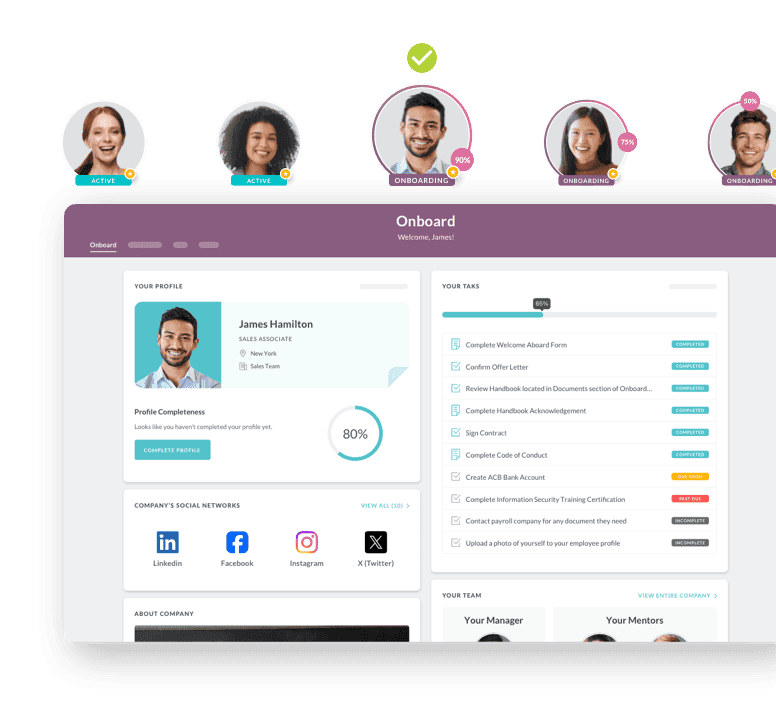
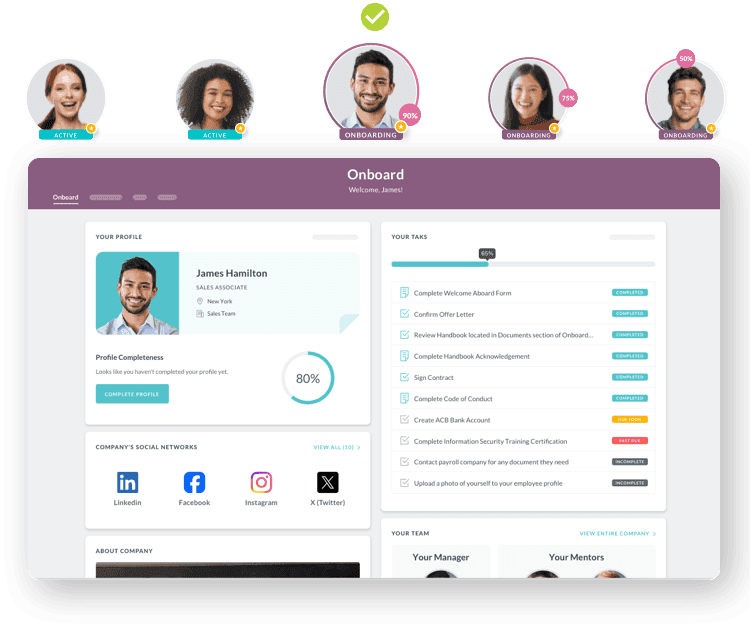
Trigger everything from a single event. The moment a candidate accepts, one status change fires the whole sequence: welcome message, document package, task assignments to IT and the hiring manager, calendar holds for day one. If a human has to remember to start onboarding, onboarding will start late.
Sequence across the timeline rather than dumping it on day one. Four phases work well. Preboarding covers personal details, tax forms, direct deposit, I-9 Section 1, and equipment sizing. Day one covers I-9 Section 2, policy acknowledgments, systems access, and introductions. Week one covers role-specific training and the first manager check-in. Days 14 and 30 cover structured check-ins and remaining certifications.
Front-loading paperwork into preboarding makes day one about the job instead of a clipboard. HR Cloud customers report onboarding completed roughly three times faster. A behavioral health provider reported saving eight hours of HR time each week on onboarding plus a 66% improvement in HR efficiency, documented here.
Assign tasks to everyone involved, not just HR. The hidden cost in manual onboarding is HR chasing other departments. When IT gets an automatic task with a due date and an escalation, HR stops being the routing layer. Osmose Utilities, running distributed field crews, reported seven hours of HR time saved each week and a 65% improvement in HR efficiency after moving to this model, on HR Cloud Onboard.
Escalate to a human only on exception. Reminders go to the person who owes the task, not to HR. HR is notified only when something is overdue past the escalation threshold. That inverts the default, in which HR is notified about everything and must triage everything.
Make it work on a phone. For any workforce not sitting at a desk, mobile completion is the whole ballgame. Veolia reported more than 75% mobile onboarding completion across 10,000 or more employees onboarded through HR Cloud, and MedLinks reported over 70% mobile completion with 70 or more workflows managed by HR rather than IT.
Measure completion, not submission. Track the percentage of new hires with complete documentation at day one, and average HR hours per hire. Both should move within one hiring cycle. The ceiling is higher than most teams assume: MCO onboarded 2,000 employees in five days against an aggressive deadline.
Step 6: Move Routine Requests to Employee Self-Service
Employee questions are easy to underestimate, because each is small and none are scheduled. They arrive as interruptions, and interruptions cost more than the clock time they consume.
Start with the top ten questions. Pull your last quarter of HR email or tickets and count. The list is usually short and repetitive: PTO balance, address change, pay stub location, leave policy, direct deposit, holiday schedule, employment verification, benefits summaries, and how to raise a workplace concern. Most are lookups or routine transactions and require no judgment at all. Where the underlying issue does require judgment, as raising a concern does, automate the intake and routing and leave the handling to a person.
Make self-service actually self-sufficient. A portal that shows information but requires an HR ticket to change it has moved the work, not removed it. The employee needs to complete the transaction: see the balance and request the time, view the address and update it.
Automate time off as your flagship workflow. It is high frequency, high visibility, and rule-clear, which is why it scored 18 in Step 2, and it is what HR Cloud's time off tracking is built around. Employees submit from web or mobile, the system checks balances and policy, managers approve in one click from a push notification, and the team calendar updates in real time. Every approval and denial is logged with a timestamp and the approving manager's name, which removes the documentation work rather than shifting it.
HR Cloud reports an 80% reduction in HR admin time and 95% payroll data accuracy after implementation, with clients saving 10 or more hours per week versus their previous manual process and an average of $50,000 in annual savings per organization.
Publish policy where people already are. A policy library nobody can find generates the same questions as no policy library. Put answers in the app people already use to request time off, and push announcements rather than waiting for people to check. Self-service handles the routine and hands the rest to a named person with context attached. The goal is not zero HR contact, it is HR contact only when judgment is genuinely required.
Watch adoption, not deployment. Track requests arriving through self-service versus email. When adoption is low, check discoverability and the mobile path before concluding employees are resistant.
Step 7: Automate Compliance and Credential Tracking
Compliance tracking is where manual HR quietly accumulates the most risk per hour spent. A spreadsheet of expiry dates works right up until it does not, and the failure mode is not an inconvenience.
Build a single register of everything that expires. Professional licenses, clinical credentials, safety certifications, background check refreshes, driver medical cards, food handler permits, annual training, and version-tied policy acknowledgments. Each entry needs an owner, an expiry date, a renewal lead time, and an escalation path.
Set reminders on a schedule that reflects renewal reality. A single alert on the expiry date is useless, because most renewals take weeks. A 90 / 60 / 30 / 7-day ladder with a daily escalation to the manager is a reasonable default. Set the outer marker to match your longest actual renewal cycle rather than copying a number. For reference, USCIS suggests reminding employees at least 90 days before employment authorization expires, a useful benchmark for similar documents and not a standard that transfers to every credential. HR Cloud's workflow automation monitors expiration dates with reminders to both HR and the employee, which matters because the employee is usually the only person who can complete the renewal.
Notify the employee first and the manager second. Sending everything to HR recreates the manual process with extra steps. HR sees the dashboard; the employee gets the reminder.
Keep the audit trail as a byproduct. The point of automated compliance is not the reminders. It is that the record of which documents and credentials were logged as current, when, and against which configured requirement exists without anyone assembling it. That is evidence for an audit, not a determination that you are compliant, which remains a judgment for your own team and counsel. When an auditor asks, the answer is a report rather than a week of document archaeology.
Treat multi-jurisdiction rules as configuration, not memory. If you operate across states, the required document set differs by work location. Encode that so the correct forms appear automatically, rather than relying on whoever is onboarding that day to remember California's extra requirements.
The financial case here is the easiest in the guide to make. Renaissance Outpatient Rehabilitation Center reported $75,000 in annual cost savings alongside compliance peace of mind after moving credential and document tracking off manual processes.
Know the limits. Automation tracks status, sends reminders, collects documents, and produces evidence. It does not interpret regulations or make judgment calls about accommodation, classification, or investigation. Keep those with a qualified human and, where stakes warrant, with counsel.
Step 8: Connect HR to Payroll So Data Stops Getting Re-Keyed
Double entry between HR and payroll is one of the most expensive remaining manual processes, and the most avoidable. Every field typed twice can differ, and differences surface as pay errors, which cost far more to fix than to prevent.
Map the fields before you connect anything. For every field in both systems, decide the owner. New hire demographics, job title, department, work location, pay rate, effective dates, approved time off, and termination dates each need a single writing system and a defined sync direction.
Understand what your payroll provider does well. Payroll systems are built for tax calculation, filings, and pay accuracy, and they are very good at it. The gap is usually not payroll itself. It is the workflow layer around it: collecting documents, routing approvals, chasing acknowledgments, and getting frontline employees into the system at all. The right architecture keeps payroll doing payroll and puts an automation layer on top rather than replacing anything.
This is why HR Cloud connects to ADP Workforce Now, ADP TotalSource, and ADP RUN, along with Paylocity, UKG, and Paycor, rather than competing with them. As an ADP Platinum Marketplace Partner, HR Cloud supports ADP SSO login, two-way data sync, and automatic new hire data flow into ADP Workforce Now, typically live in two to three weeks. Implementation through the ADP Marketplace is a flat $500 fee regardless of company size. Integrations set up outside the Marketplace path can carry a higher one-time setup fee, so confirm which applies to your account.
Sync approved time off directly into payroll. This closes the most common source of payroll errors, the gap between what HR approved and what payroll processed. When an approval automatically flags the relevant pay period, reconciliation disappears rather than moving to someone else's desk.
Test with a parallel run. Run both for one or two full pay cycles and compare field by field before switching the manual process off. Any discrepancy is a mapping error you want to find in a test, not in a paycheck.
Give payroll a dashboard, not a to-do list. Once the sync is stable, the administrator's job becomes exception review: which records changed, which failed validation, which need a decision. Much shorter than re-entering data.
Step 9: Measure the Hours You Actually Recovered
The project is finished when you can show a number to someone who controls budget. Skipping this is why many HR teams automate successfully and still cannot fund the next phase.
Re-run the Step 1 audit at 90 days. Same categories, same window, same discipline. The comparison is the deliverable. You want strategic work growing as a share of capacity and the chasing column shrinking.
Track four metrics continuously: HR hours per new hire, new hires with complete documentation at day one, payroll corrections per cycle, and routine requests resolved through self-service.
Build the financial case in three lines. Hours recovered per year, times loaded hourly cost, minus annual software and implementation cost. Here is a 500-employee organization hiring 80 people a year.
| Line item | Calculation | Annual value |
|---|---|---|
| Onboarding hours recovered | 80 hires x 7 hours saved | 560 hours |
| Time off admin hours recovered | 4 hours/week x 52 | 208 hours |
| Self-service deflection | 4 hours/week x 52 | 208 hours |
| Compliance chasing recovered | 3 hours/week x 52 | 156 hours |
| Total hours recovered | 1,132 hours | |
| Value of recovered time | 1,132 x $35 | $39,620 |
| Payroll correction reduction | modeled, varies by baseline | not included |
That is roughly 0.54 of a full-time equivalent, recovered without changing headcount. Note that the time-off line recovers 208 of the 260 baseline hours rather than all of them, because automation reduces admin work rather than eliminating it. Any model that zeroes out a category is overstating itself, and a CFO will find that faster than you will.
The hours-saved assumptions come from HR Cloud's published customer results, but they remain assumptions until your own 90-day audit replaces them. Present them that way. A CFO trusts a number you have hedged honestly more than one you have not.
For a faster version with your own inputs, HR Cloud's onboarding ROI calculator walks through the same math interactively. If you want the cost side rather than the hours side, The Real Cost of Manual HR Processes prices the same tasks in dollars.
Report the capacity story, not just the dollars. The dollar figure justifies the spend. The capacity figure justifies the next project. Then keep measuring quarterly, because automation degrades when nobody watches it.
What Causes HR Automation Projects to Stall?
HR automation projects usually stall for reasons that have nothing to do with the software.
Automating a broken process. If your approval chain has four unnecessary steps, automating it produces a fast broken process. Map the current state, remove steps that exist only because they always have, then automate the rest.
Starting with the hardest use case. Teams frequently pick performance reviews or employee relations first, because those feel most painful. Both score low on rule clarity. Start where the rules are clean.
Treating go-live as the finish line. Adoption is the deliverable. Budget for training, a visible launch, and support in the first 30 days. A workflow with 40% adoption creates two processes to maintain instead of one.
Leaving managers out of the design. If approving is slower than replying to an email, managers will keep replying to emails. The same logic applies to employees without a desk: a workflow requiring a corporate laptop excludes much of the workforce in healthcare, retail, construction, education, and manufacturing.
No named owner, and no measurement. Automation needs one person accountable for the workflows, the exceptions, and the metrics. Without the Step 1 baseline you cannot prove value or fund the next phase.
What Changes When Your Workforce Is Deskless?
If you run a healthcare system, a retail chain, a construction firm, a school district, or a manufacturing operation, much of your workforce works a shift, not a schedule, and has no corporate desk. The admin burden is not smaller. It is larger, because every process depending on email becomes a process depending on someone physically finding the employee.
Mobile is the delivery mechanism, not a feature. Forms, approvals, policy acknowledgments, and credential reminders have to complete on a personal phone, in a few minutes, without a VPN. This is why mobile completion rates are the metric that matters for these teams, and why Veolia's 75%-plus and MedLinks' 70%-plus rates are meaningful rather than vanity numbers.
SMS reaches people email does not. Text-first outreach closes the gap between offer acceptance and day one, which is exactly where high-volume onboarding leaks. Maya, HR Cloud's AI onboarding agent for frontline and high-volume teams, delivers pre-boarding tasks by SMS with no portal login and no app download, and runs an 89% SMS task completion rate against 52% for portal-based workflows. Maya availability and plan eligibility vary, so confirm both with your HR Cloud representative.
Location-specific requirements multiply. A construction crew moving between states, a health system with credentialing that differs by facility, a restaurant group with municipal food handler rules. These turn Step 7 from a nice idea into the reason the project exists.
Manager approval has to work from the field. A supervisor on a job site or a nursing floor will not open a desktop dashboard. Push notification with one-tap approval is the difference between a functioning workflow and a bottleneck with a nicer interface. In multilingual operations, onboarding content that exists only in English generates a support burden that lands straight back on HR.
Published customer results come from Osmose Utilities in field services, Veolia and Comfort Systems USA Southwest in utilities and construction, and MedLinks and Interim HealthCare in healthcare. The admin time reduction available in a frontline-heavy operation is typically larger than in an office environment, because the manual baseline is worse.
“ Our hiring managers now have a reliable system that is easy to navigate. Our HR team can actively monitor the process, and assist if needed, but Onboard has helped them save so much valuable time and effort while increasing data accuracy.”

— Kaylee Collins, HR Analyst, Osmose

The Bottom Line
Reducing HR admin time is a sequencing problem before it is a software problem. Audit where the hours go for two weeks, including the hours spent chasing people. Score your tasks on frequency, rule clarity, error cost, and employee visibility, then automate the top three in dependency order. Get employee data into one system of record first, because every workflow downstream inherits its quality. Automate onboarding, usually the largest single recoverable block. Push routine requests to self-service that completes transactions. Connect HR to payroll with defined field ownership and a parallel test run. Then measure at 90 days against the baseline you wrote down in week one.
The published results are real but not automatic. HR Cloud customers report an 80% reduction in HR admin time, 95% payroll data accuracy, and average annual savings of $50,000 per organization. Those come from teams that did the sequencing, not teams that bought a platform and hoped.
If your Step 1 audit shows onboarding, document collection, or new-hire follow-up eating a disproportionate share of HR time, that is where to start, and it is what HR Cloud Onboard is built to turn into trackable workflows. Bring your audit numbers to the call.

Discover how our HR solutions streamline onboarding, boost employee engagement, and simplify HR management
Book Your Free DemoFrequently Asked Questions
How much HR admin time can automation realistically save?
Organizations using HR Cloud report an 80% reduction in HR admin time, with clients saving 10 or more hours per week versus their previous manual process. Results vary with your starting baseline. Teams already using digital forms and a modern HRIS will see smaller gains than teams running onboarding and PTO on spreadsheets.
Which HR task should I automate first?
Onboarding document collection is the most common starting point because it is high frequency, rule-clear, and carries real compliance stakes. HR Cloud's customer baseline is 8 to 11 hours of HR time per new hire manually, falling to roughly 2 to 3 hours after automation. If your hiring volume is low, automate time-off requests first instead.
How long does HR automation take to implement?
Plan four to eight weeks for data consolidation, two to four weeks for forms, and two to four weeks for payroll integration including a parallel run. HR Cloud lists a 30-day go-live, and Interim HealthCare reported six weeks from kickoff to rollout. Data cleanup, not configuration, is usually the longest phase.
Does HR automation mean cutting HR headcount?
The business case does not have to depend on it. Many teams instead evaluate the capacity they can redirect toward work previously getting skipped: manager coaching, retention analysis, and workforce planning. Framing it as capacity gained tends to hold up better with finance, and a smaller HR team carrying the same admin load has not solved anything.
Do I have to replace my payroll system to automate HR admin work?
No. HR Cloud operates independently of payroll and connects to ADP Workforce Now, ADP TotalSource, ADP RUN, Paylocity, UKG, and Paycor. The automation layer sits above payroll and handles document collection, approvals, and workflow routing. Payroll continues doing tax calculation and pay accuracy, which is what it is built for.
How do I calculate the ROI of HR automation?
Multiply hours recovered per year by your loaded HR hourly cost, then subtract annual software and implementation cost. Most HR Cloud customers model admin time at roughly $35 per hour, close to the BLS base wage for HR specialists and therefore a conservative floor. For a 500-employee company hiring 80 people annually, recovering around 1,132 hours values at approximately $39,620.
What is the difference between an HRIS and HR workflow automation?
An HRIS is the system of record storing employee data, documents, and history. Workflow automation is the logic layer that moves work between people based on triggers and rules, such as routing a form or sending a credential reminder. Most platforms including HR Cloud combine both, but they solve different problems.
Can HR automation work for employees without a desk or company email?
Yes, and this is where the largest gains usually are. The requirements are mobile completion on a personal phone, SMS rather than email for time-sensitive steps, and one-tap manager approval from the field. Veolia reported more than 75% mobile onboarding completion across 10,000 or more employees onboarded through HR Cloud.
How do I get employees to use self-service instead of emailing HR?
Make the transaction complete inside the tool rather than requiring an HR ticket, put it on mobile, and answer the ten most common questions where people already are. Then track requests arriving through self-service versus email. When adoption is low, check discoverability and the mobile path first.
What compliance risks does HR automation reduce?
Automation reduces risk from missed I-9 deadlines, expired credentials, unsigned acknowledgments, and incomplete documentation, mainly by generating an audit trail as a byproduct rather than a separate task. It does not interpret regulations or make judgment calls about classification, accommodation, or investigations.
About the author

Keep Reading


Like What You Hear?
We’d love to chat with you more about how HR Cloud® can support your business’s HR needs.
Book Your Free Demo