The Real Cost of Manual HR Processes: What Your Team Is Losing Every Week

What does it actually cost your organization when HR runs on manual processes?
The cost of manual HR processes is almost never visible as a single line item — it shows up quietly in payroll correction hours, compliance penalties, frustrated new hires waiting for system access, and strategic programs that never launch because the week ran out of capacity.
Why do so many organizations accept this drain even when they know automation exists?
HR inefficiency costs are easy to absorb one task at a time. A contact information update takes 13 minutes. A timesheet correction takes 20. A benefits enrollment takes an hour. None of them feel catastrophic in isolation — but multiplied across a full team, across every transaction, across 52 weeks, they become a serious and measurable financial problem.
Is the time wasted in HR processes only a concern for large organizations?
Not at all. For companies with 200 to 2,000 employees, the burden often hits harder because there are fewer HR staff members to absorb the load. One HR manager handling 60 manual transactions a day without automation is not an edge case — it is the norm. This post maps exactly where those losses occur, what they cost in dollar terms, and what HR process automation benefits look like on a real balance sheet.
Your HR team didn't sign up to process paperwork. But right now, manual administrative tasks are consuming a measurable and recoverable share of every HR team member's week — time lost to data entry, chasing forms, and repetitive processes that modern platforms handle automatically.
For organizations with 500 to 2,000 employees, that time drain becomes a serious financial problem fast. Using EY's 2025 per-task cost data, a single HR manager processing manual onboarding, time management, data updates, and compliance documentation across a typical week accumulates over $500 in direct administrative labor costs — before a single compliance penalty or payroll error is counted. Multiply that across your HR team and across 52 weeks, and the annual figure consistently surprises leadership when it is finally calculated.
This post maps the real cost of manual HR processes across four dimensions: where the time goes, what errors cost when they escape, how the burden differs by industry, and what the path to recovery actually looks like with real numbers.
Key Takeaways
- EY's 2025 Cost Update study found a single manual HR data entry costs $4.86 on average. More complex tasks like benefits enrollment cost $89.00 per employee and time management costs $113.40 per employee annually — figures that compound fast across a full team.
- According to the SHRM 2023–2024 State of the Workplace Report, 57% of HR professionals are already working beyond capacity and only 19% of HR leaders expect headcount increases. Manual processes don't just cost money — they push already-stretched teams past their limit.
- The hidden costs of manual HR fall into four categories: direct labor waste, error correction, compliance exposure, and opportunity cost. Most organizations only measure the first one.
- Healthcare, manufacturing, and retail each face industry-specific manual HR burdens that generic cost estimates don't capture — this post covers all three.
- Use HR Cloud's free Onboarding ROI Calculator to calculate onboarding-specific cost savings for your hire volume and team size.
- Use HR Cloud's Cost of Employee Turnover Calculator to quantify what manual onboarding delays and low new-hire engagement are costing you in attrition.
The Hidden Time Drains in Your HR Department
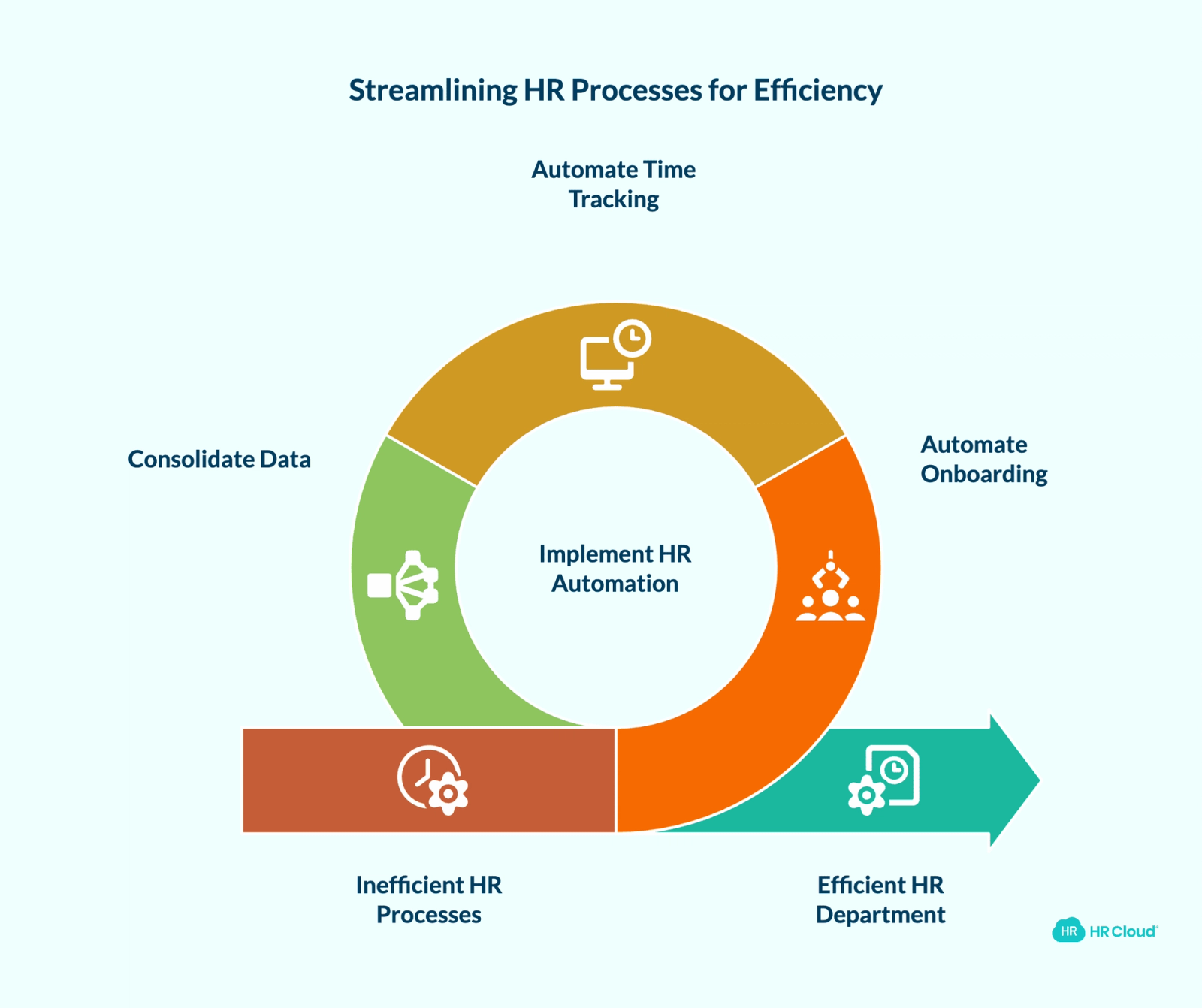
The time wasted in HR processes rarely shows up in a single dramatic moment. It accumulates in dozens of small transactions every day — each one reasonable in isolation, collectively unsustainable at scale.
Onboarding: The Weekly Sink No One Budgets For
New employee onboarding consumes more manual effort than any other HR process. Between preparing paperwork packets, chasing incomplete forms, manually entering data into multiple systems, and coordinating with IT for access provisioning, each new hire requires 3 to 4 hours of administrative work from your HR team.
For organizations hiring 20 people monthly, that's 60 to 80 hours of manual onboarding work per month. Your team spends more time on paperwork than actually connecting with new employees during their most critical first weeks — which is exactly when the foundation for retention is being built or broken. For a detailed look at where these workflows crack under pressure, see HR Cloud's guide to 12 common onboarding problems and how to fix them.
The ripple effects compound quickly. Delayed onboarding creates frustrated new hires who can't access systems or complete required training. Managers follow up repeatedly about missing documentation. IT tickets pile up for access requests that should have been triggered automatically on day one.
Research from Brandon Hall Group found that strong onboarding programs improve new hire retention by 82%. Every hour your team spends processing paper instead of connecting with new hires is an hour spent building the conditions for early attrition.
The onboarding cost reality: EY's 2025 Cost Update study puts the combined per-hire cost of manual onboarding tasks — I-9 processing ($11.97), contact information entry ($12.86), employee agreement processing ($12.90), and benefits enrollment ($89.00) — at over $126 per new hire in direct administrative labor alone. For 20 hires monthly, that's more than $30,000 annually from onboarding paperwork alone.
Time Tracking and Compliance: The Daily Grind
Manual time tracking creates a daily administrative burden that most HR teams significantly underestimate. Collecting paper timesheets, entering data into payroll systems, chasing missing entries, and handling corrections consumes 45 to 60 minutes daily for organizations with hourly workers.
This becomes particularly expensive in healthcare and manufacturing, where shift workers represent the majority of the workforce. A 1,000-employee hospital system with 750 hourly workers can easily spend 15 or more hours weekly just processing timesheets and handling attendance-related questions — time that should be redirected toward workforce planning and engagement.
Compliance documentation adds another layer. I-9 verification, training records, certification tracking, and audit preparation require meticulous record-keeping across multiple systems. EY's 2025 data puts the annual per-employee cost of manual time management alone at $113.40 — encompassing everything from timecard collection to PTO balance calculations. For 500 hourly employees, that's $56,700 annually in a category that automated systems handle without human intervention.
HR teams often maintain parallel spreadsheets because their existing systems don't communicate. That fragmentation is itself a cost — every reconciliation cycle is HR inefficiency in visible form.
The compliance compounding effect: HR inefficiency costs are highest in organizations where manual time tracking feeds manual payroll, which feeds manual compliance reporting. Each handoff is a new opportunity for error, and each error carries a correction cost — or a penalty.

Employee Data Management: The Scattered Information Problem
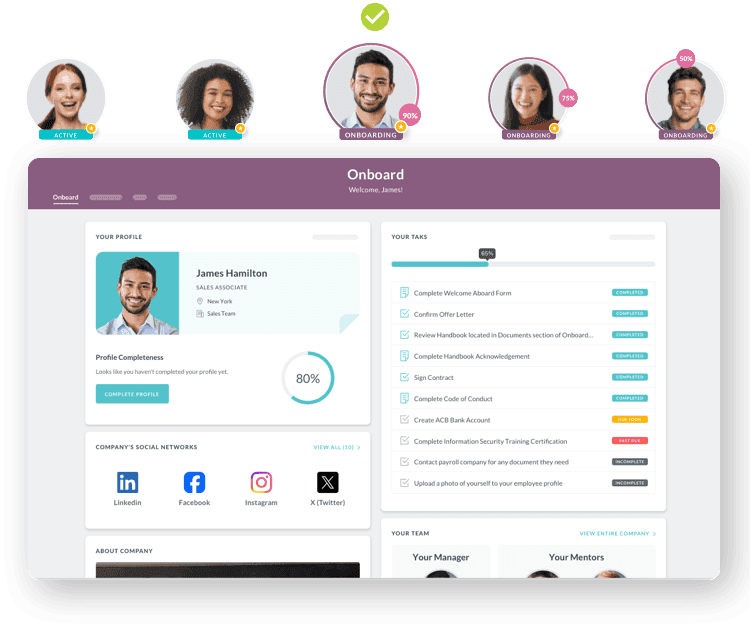
Most growing organizations manage employee information across four to six different systems: HRIS for basic data, payroll for compensation, separate platforms for benefits enrollment, performance management, and learning management. Each system requires manual data entry and updates whenever something changes.
When an employee gets promoted, changes their address, or updates their emergency contact, your team manually enters that information multiple times. EY's research found that a simple contact information update costs $12.86 per instance in administrative labor. A single address change requiring updates in five places takes 10 to 15 minutes of careful data entry per system — and the error risk multiplies with every repetition.
This fragmentation creates compounding problems during reporting periods. Preparing headcount reports, analyzing turnover data, or responding to audit requests requires pulling information from multiple sources and reconciling discrepancies by hand. The HR Cloud People HRIS consolidates all of this into one system, so a single update propagates automatically — eliminating the multi-system entry cycle entirely.
The data fragmentation tax: Organizations running four or more separate HR systems are paying a hidden coordination tax on every employee lifecycle event. Promotion, termination, address change, benefits update — each one multiplied by the number of systems requiring manual entry. This is one of the least visible HR inefficiency costs and one of the easiest to eliminate.
The Real Financial Impact
Direct Labor Costs: The Calculation Your Budget Is Missing
Most HR leaders can feel the cost of manual processes. Fewer have mapped it to a dollar figure. Here is the framework from your original outline, updated with EY 2025 task-cost data:
| Manual HR Process | Time Estimate | Loaded HR Cost | Annual Cost |
|---|---|---|---|
| Onboarding administration | 3.5 hrs × monthly hires | $35/hr | Varies by hire volume |
| Time tracking and payroll prep | 8 hrs weekly | $35/hr | $14,560 |
| Employee data updates | 2 hrs weekly | $35/hr | $3,640 |
| Compliance documentation | 4 hrs weekly | $35/hr | $7,280 |
For a 1,000-employee organization hiring 25 people monthly, these four categories alone account for approximately $85,000 annually in direct labor — and that's before error correction, compliance penalties, or the strategic work that never gets done.
The budget reality for HR directors: Direct labor is the only manual process cost most organizations actually measure. The three categories below — errors, compliance, and opportunity cost — are almost never in the spreadsheet, which is why the true cost of manual HR processes consistently surprises leadership when it's finally calculated.
Hidden Costs of Manual HR: Errors, Penalties, and What Never Gets Built
The hidden costs of manual HR fall into three categories that rarely appear in HR budget conversations.
Payroll errors occur in 20% of manually processed payrolls, according to research cited by Eddy and Paychex. Each error costs an average of $291 to correct. For a 1,000-employee organization, that's a potential correction cost exposure exceeding $768,000 annually — before accounting for the employee trust damage that follows an incorrect paycheck.
I-9 compliance penalties compound manual errors into legal exposure. Manual I-9 processing produces errors in approximately 12% of cases at a correction cost of $8.32 per form. Uncorrected, federal penalties range from $220 to $2,191 per defective form. For an organization processing 300 new hires annually with a 12% error rate, that's a penalty exposure of $7,920 to $78,876 depending on violation severity. HR Cloud's I-9 and E-Verify module automates the entire verification workflow and creates audit-ready documentation automatically — eliminating this exposure at the source.
Opportunity cost is the hardest hidden cost to quantify and the most financially significant over time. When 57% of your HR team's capacity goes to administrative tasks — as Deloitte research documents — the strategic work that doesn't happen includes retention analysis, engagement program design, leadership development, and workforce planning. These are the programs that determine whether your organization keeps its top performers or replaces them at a cost of 50% to 200% of annual salary per departure. Use HR Cloud's Cost of Employee Turnover Calculator to put a real number on that exposure at your headcount and salary levels.
The hidden cost summary: According to the SHRM 2023–2024 State of the Workplace Report, only 19% of HR leaders expect to be able to add headcount. That means the same constrained team absorbing 57% administrative load will also be expected to deliver the strategic work. Something always gives — and it's always the strategic work.
Industry-Specific Manual HR Process Costs
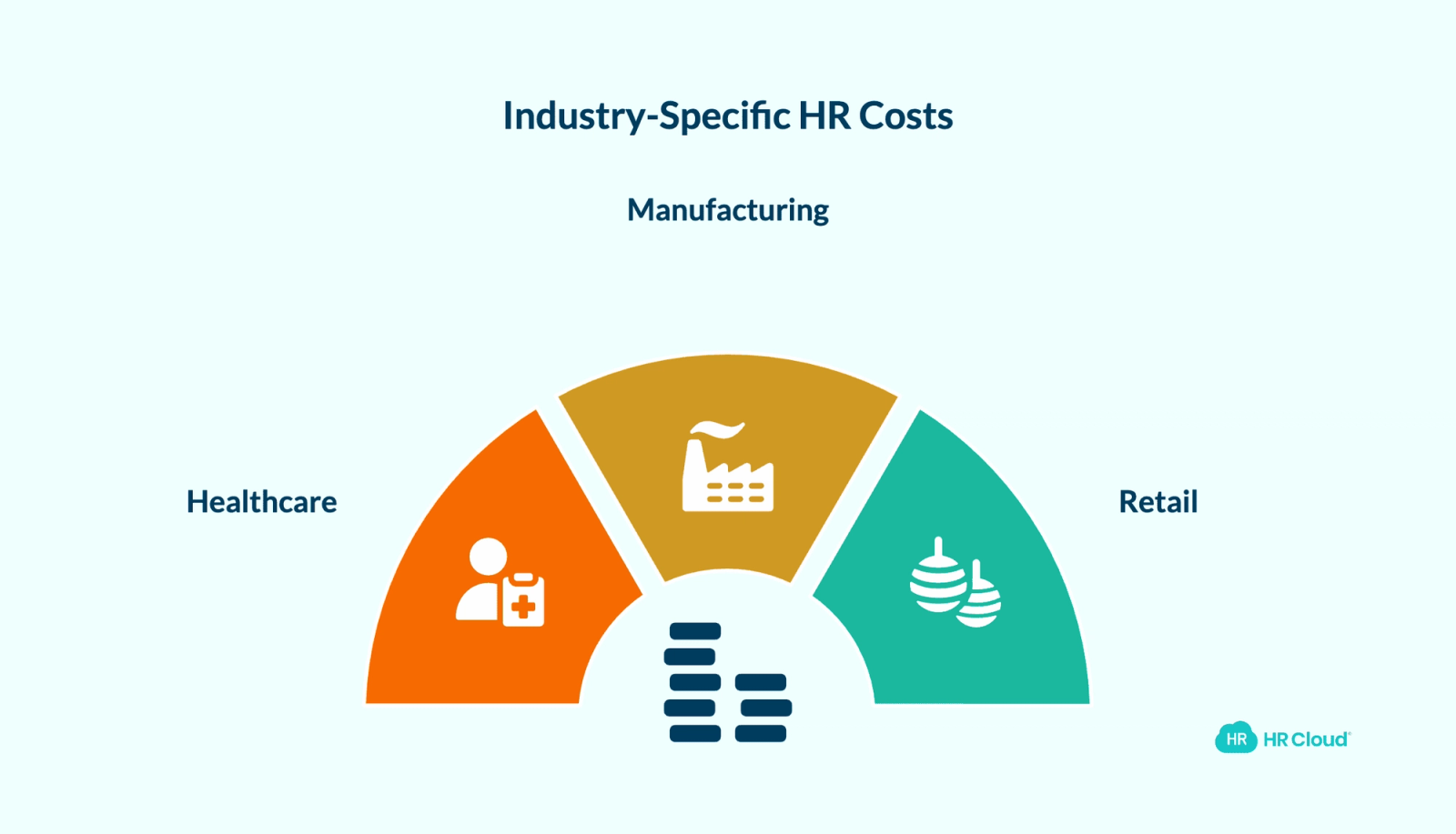
Generic cost estimates understate the real burden for industries where compliance complexity, workforce composition, and operational tempo create uniquely expensive manual HR environments. Here is how the cost of manual HR processes plays out differently across three of HR Cloud's core verticals.
Healthcare: Credential Tracking and Shift Planning
Healthcare organizations face a manual HR burden that goes well beyond standard onboarding and payroll. Credential management alone creates a continuous administrative cycle: tracking continuing education requirements, managing multiple certifications per clinician, verifying licensure ahead of shifts, and maintaining documentation for Joint Commission audits.
A 2024 payer-credentialing report found that 52% of healthcare providers still depend on manual credential tracking processes — a figure that creates direct operational risk, not just administrative inefficiency. When expiry dates live in email threads and spreadsheets, a clinician can be scheduled with an expired license. Payer enrollment can stall when documents are missing. And when auditors request primary-source verification on short notice, manual systems cannot respond in real time.
Shift scheduling compounds the problem. Manually coordinating coverage, ensuring credentialed staff are assigned to appropriate roles, and managing last-minute callouts creates significant administrative overhead. A 500-bed hospital system can easily spend 20 or more hours weekly on manual scheduling coordination and credential tracking — a burden that intensifies during staffing shortages when the administrative scramble and the operational pressure peak simultaneously.
Here's what this looks like in practice: Interim HealthCare SLC was managing recruiting, onboarding, and engagement through paper-based processes. Every new hire created multiple manual touchpoints across systems that didn't communicate. After moving to HR Cloud's Onboard module, their owner reported that the team could place new hires in the field immediately without worrying about compliance documentation gaps — the system handled verification automatically. For more on HR Cloud's approach to healthcare-specific HR challenges, see HR Cloud's healthcare HR challenges guide.
The healthcare cost reality: Manual credential tracking and shift scheduling in healthcare aren't just administrative burdens — they are patient safety risks and billing risks. The cost of a manual error in this environment is not a data entry correction. It is a compliance citation, a billing delay, or a care continuity failure.
Manufacturing: Safety Training and Compliance Documentation
Manufacturing environments require extensive safety training documentation that most HR systems were not designed to manage at the required depth. OSHA's General Industry standards (29 CFR 1910) mandate role-specific training for hazard communication, lockout/tagout, respiratory protection, and more — with documentation requirements that must survive audits and incident investigations.
OSHA penalties in 2025 can exceed $16,131 per serious violation, with repeat or willful violations topping $161,323 each. Organizations with 1,000 or more manufacturing employees that still track training completion manually often dedicate a full-time position to training administration and compliance documentation — and that doesn't include the time line managers spend verifying their teams' certification status before each shift.
The cost of non-compliance in this environment has been measured at nearly three times the cost of maintaining a compliance program, according to industry analysis. Companies that invest in automating compliance tracking spend an average of $5.5 million on compliance programs; those that don't face an average non-compliance cost of $14.8 million when fines, business disruption, and remediation are totaled.
91% of manufacturers report taking on more responsibility for workforce training due to skills scarcity, according to a 2024 Barclays/The Manufacturer survey. That growing training burden, managed manually, is a direct driver of HR inefficiency costs in manufacturing — one that compounds with every new regulation update, every equipment change, and every new hire requiring role-specific certification.
The manufacturing cost reality: Manual training tracking in manufacturing isn't just an HR problem — it's an operational liability. A missed certification renewal is a scheduling constraint. An undocumented training gap is an audit finding. HR Cloud's automation platform handles training record management and certification tracking in the same system as onboarding and time management, so nothing falls through the gap between HR and operations.
Retail: High-Volume Seasonal Onboarding
Retail organizations face a manual HR burden that is cyclical and compressing — seasonal hiring surges arrive on a fixed schedule, and the administrative infrastructure either handles them or breaks under them.
During peak seasons, retail HR teams may onboard 50 to 100 employees monthly, creating paperwork backlogs that overwhelm manual processes. The consequence isn't just administrative stress — it's a direct operational impact. Manual onboarding delays mean new seasonal workers cannot start when needed, affecting customer service coverage during the highest-revenue weeks of the year. The administrative scramble often continues weeks after the hiring surge ends, with HR still processing forms for employees who have already completed their first month.
For retail organizations where HR process automation benefits are most visible, the math is straightforward: Gartner's 2025 research found a 50% improvement in new hire time-to-productivity for companies using AI in onboarding. Applied to a seasonal surge of 80 hires, faster onboarding translates directly into workers who are operational on day one rather than day ten, and customer service coverage that doesn't slip during peak weeks.
The retail cost reality: High-volume, time-sensitive onboarding is exactly the scenario where manual processes fail most visibly. The cost isn't abstract — it shows up in understaffed shifts, customer complaints, and seasonal workers who disengage before their first week ends because their paperwork wasn't ready.
The HR Process Automation Benefits: What the Numbers Actually Show
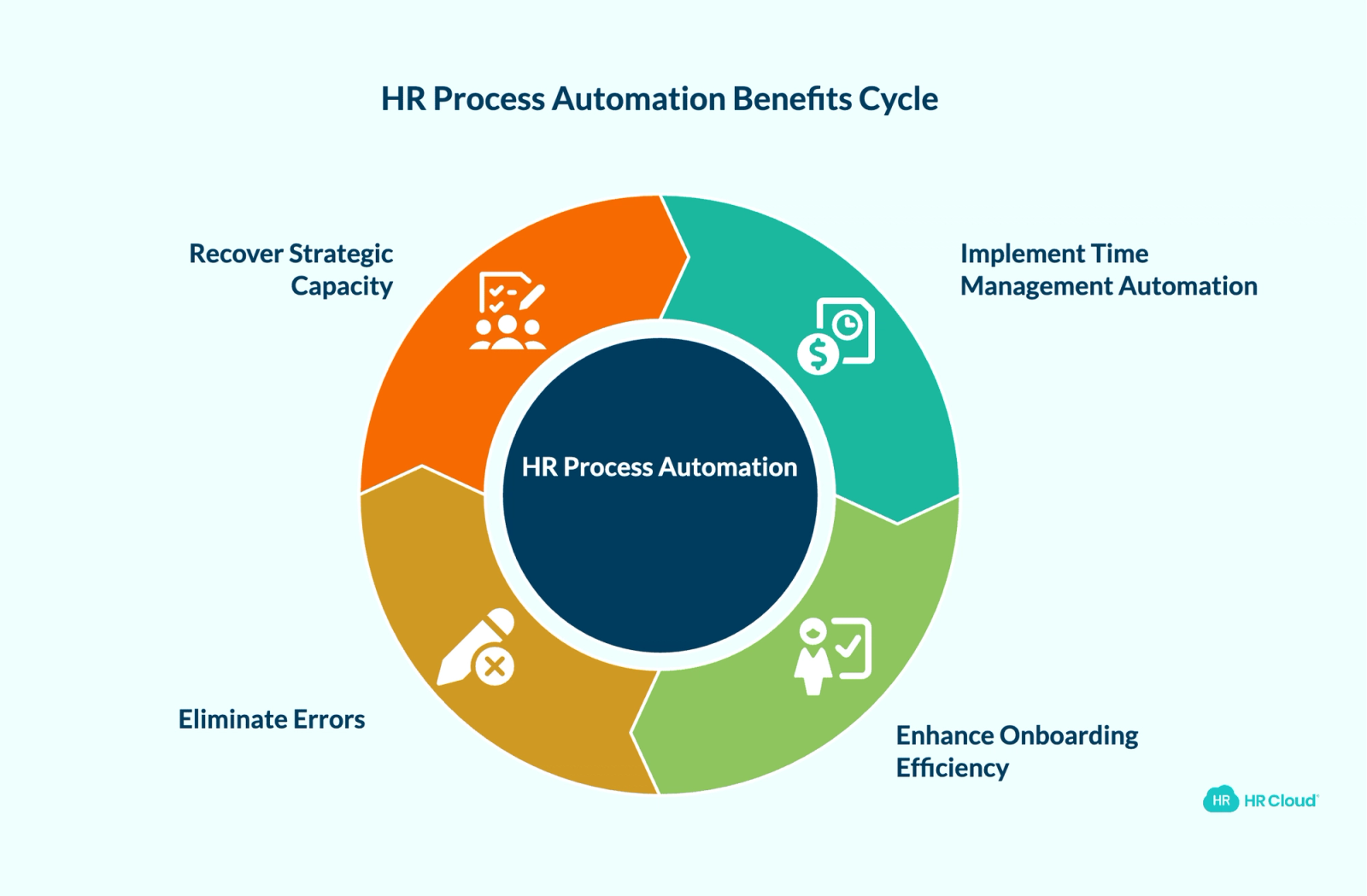
The financial case for automation is strongest when built from cost data, not from vendor claims. Here is what the research shows across the four categories where HR process automation benefits are most measurable.
Time recovery: Organizations implementing time management automation alone save an average of $54,709 annually, according to research aggregated from EY task-cost benchmarks and HR automation outcome studies. Automating timecard entry alone nets $14,000 annually per organization.
Onboarding efficiency: According to Gartner's 2025 research, companies using AI for onboarding saw a 50% improvement in new hire time-to-productivity. Organizations implementing structured automated onboarding consistently report significant reductions in administrative hours per hire — gains that compound quickly at high hiring volumes.
Error elimination: Automated payroll validation and self-service data entry eliminate the error classes that produce the $291-per-correction payroll error cost. Automated I-9 processing removes the 12% error rate that creates federal penalty exposure.
Strategic capacity recovery: When HR teams spend less time on administrative processing, they spend more time on the work that actually moves the business. Gartner's 2024 HR Investment research found that 76% of HR leaders believe they will fall behind competitors without AI and automation implementation within 12 to 24 months. The strategic risk of staying manual is now as measurable as the administrative cost.
HR Cloud's HR automation platform addresses all four categories — connecting onboarding, employee data management, time tracking, and compliance documentation in a single system. For organizations already running ADP Workforce Now, HR Cloud's ADP integration extends automation into the workflows that currently require manual transfers between platforms, without disrupting the payroll infrastructure your team already depends on. For a step-by-step look at what automated onboarding looks like in practice, see HR Cloud's guide to automating employee onboarding.
The automation ROI window: Most organizations in the 200 to 2,000 employee range find that comprehensive HR automation pays for itself within 6 to 8 months through time savings alone — before error correction avoidance and compliance penalty reduction are factored in. Run HR Cloud's free Onboarding ROI Calculator to get a specific number for your hire volume and team size before your next budget cycle.
Download your free employee onboarding checklist
Using this checklist ensures that you are not scrambling to make the new employees feel welcomed, prepared, and set up for long-term success.
Download Now
How to Turn This Into Action This Week
- Step 1: Map one HR team member's actual workday. Pick last Tuesday. List every task completed. Assign an EY 2025 per-task cost to each manual transaction — $4.86 for basic data entry, $12.86 for data updates, $15.06 for shift swap approvals, and so on. Total it. Multiply by five working days and by the number of people on your HR team. That figure is your current weekly manual process cost. It is almost always larger than what leadership assumes.
- Step 2: Identify your highest-cost process category. Using the four categories in this post — onboarding, time tracking and compliance, employee data management, and error correction — determine which one is producing the most cost in your organization right now. High hiring volume organizations should start with onboarding. Hourly workforce organizations should start with time tracking. Organizations that have received compliance findings should start with I-9 and payroll error correction.
- Step 3: Build the business case before the next budget cycle. Take your weekly cost from Step 1, multiply by 52 weeks, and compare it against the automation investment required to eliminate it. Include the error correction avoidance and compliance penalty reduction figures from the relevant section of this post. For most organizations, the data supports payback well within 12 months — and often within 6. That is a CFO-level threshold that most HR automation investments clear without difficulty.
The cost of manual HR processes is not a soft problem. It is a measurable, documented financial drain — in direct labor, in error correction, in compliance exposure, and in strategic work that never gets done. HR Cloud helps organizations in healthcare, manufacturing, construction, education, and retail replace manual workflows with automated onboarding, time management, employee data management, and compliance documentation — so HR teams can spend their week on the work that actually moves the business forward.
Data source: EY, "Estimating Labor and Non-Labor Costs Associated With Common Human Resources (HR) Functions/Tasks: Cost Update 2025," conducted by EY's People Advisory Services practice, September 2025. Available through EY's client research portal at eyquest.com. The study surveyed HR professionals at U.S.-headquartered companies with 250–4,999 employees.

Discover how our HR solutions streamline onboarding, boost employee engagement, and simplify HR management
Book Your Free DemoFrequently Asked Questions
What is the cost of manual HR processes per employee?
According to EY's 2025 Cost Update study, the cost varies significantly by task type. A basic manual data entry costs $4.86 per instance. Benefits enrollment costs $89.00 per employee when processed manually. Time management tasks — from timecard collection through PTO calculations — cost $113.40 per employee annually. For a 500-employee organization managing all three categories manually, the combined annual cost commonly exceeds $100,000 in direct administrative labor.
What are the hidden costs of manual HR processes?
The hidden costs of manual HR fall into three categories beyond direct labor. First, error correction: 20% of manually processed payrolls contain errors costing $291 each to fix. Second, compliance exposure: manual I-9 processing produces errors in 12% of cases, with federal penalties ranging from $220 to $2,191 per defective form. Third, opportunity cost: when HR spends 57% of its time on administrative tasks, the retention programs, engagement initiatives, and workforce planning that would reduce turnover never get built. The SHRM 2023–2024 State of the Workplace Report documents this capacity crisis in detail.
How much time is wasted in HR processes that could be automated?
According to Deloitte research, HR professionals spend up to 57% of their working hours on administrative tasks. The Paychex Pulse of HR Survey found that HR leaders spend four full weeks per year on manual tasks.EY's 2025 data quantifies the cost at the task level: manual time management — from timecard collection through PTO balance calculations — costs $113.40 per employee annually. For a 500-person hourly workforce, that single category alone accounts for $56,700 in annual administrative labor that automated systems eliminate entirely.
What are the HR process automation benefits in terms of ROI?
Organizations automating time management processes alone save an average of $54,709 annually. According to Gartner's 2025 research, companies using AI for onboarding saw a 50% improvement in new hire time-to-productivity. Strong onboarding programs improve new hire retention by 82% (Brandon Hall Group). . Error-free payroll processing eliminates the $291-per-error correction cycle. Most mid-market organizations (200 to 2,000 employees) see full automation ROI within 6 to 8 months through direct labor savings before compliance penalty avoidance is factored in. Use HR Cloud's Onboarding ROI Calculator to model the numbers for your organization.
How do manual HR processes affect employee retention?
The connection runs in two directions. First, poor onboarding from manual processes directly increases early attrition — research shows that organizations with weak onboarding see 50% higher turnover in the first 18 months. Second, when HR teams spend 57% of their time on administrative tasks, the retention programs and engagement initiatives that would keep employees longer never get prioritized. See HR Cloud's guide to employee retention strategies for the playbook on what those programs look like when HR has the capacity to run them.
Which industries are most affected by manual HR inefficiency costs?
Healthcare, manufacturing, and retail face the highest HR inefficiency costs relative to their workforce size. Healthcare carries the added burden of credential tracking, shift-specific compliance, and Joint Commission documentation requirements. Manufacturing organizations face OSHA training documentation requirements where a single missed certification can result in penalties exceeding $16,000 per violation. Retail organizations face compressed seasonal onboarding cycles where manual process failures translate directly into understaffed shifts during peak revenue periods.
About the author

Keep Reading


Like What You Hear?
We’d love to chat with you more about how HR Cloud® can support your business’s HR needs.
Book Your Free Demo